THE 39 STEPS

By Marc S. Sanders

I propose you try an experiment.  Watch one of Alfred Hitchcock’s earliest, British produced films, The 39 Steps, and then have a look at Andrew Davis’ The Fugitive with Harrison Ford and Tommy Lee Jones.  You’re likely to recognize how inspiring Hitchcock’s film is towards modern thrillers almost sixty years later.  In particular, Hitch explored the thrill of the chase.  All he needed was the simplest of reasons for the pursuit to begin.  Then, he had the framework for his entire motion picture.

The 39 Steps is a loose adaptation of John Buchan’s novel.  Hitchcock’s film invented so much more than the book offered.  When the film was previewed for Buchan, midway through, the author reportedly told the filmmaker how he was wondering how it was going to end.  I took a film studies course in college and one of my assignments was to read the book and then document how it compares with the movie.  The nationality of the hero is different, a potential love interest appears in the film that is nonexistent in the novel, and even the actual 39 steps is entirely something else in the film.  Some books are challenging to deliver on a visual medium.  Alfred Hitchcock knew what needed to be altered to make for an adventuresome thriller.

The film opens in a European theater where one of the most astonishing people has taken the stage.  He is Mr. Memory (Wylie Watson) and he claims that his mind contains an infinite number of facts.  So much so, that any reasonable question pertaining to math, science, geography, sports or history can be answered by him instantly.  He won’t be able to tell a lady where her husband is spending his nights, and while he knows how old Mae West is, because he’s a gentleman, he will never reveal a woman’s age.

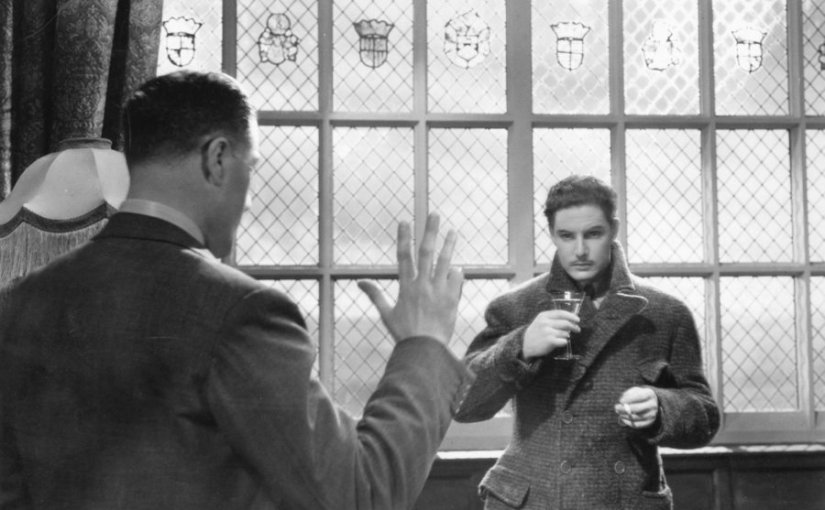
A Canadian gentleman named Hannay (Robert Donat) is in the audience and after a riot breaks out within the crowd and some gunshots go off, he’s escorting a mysterious woman back to his flat.  She hides from the windows, away from the light and is fearing for her life because of what she knows about The 39 Steps.  She also accurately points out two men down below on the street who have been following them. When she awakens Hannay in the middle of the night with a knife in her back, he is suddenly on the run, trying to make it to Scotland with what few clues she has shared with him.  However, he’s also become a prime suspect in her murder.  The police are after him. These two men are following him and who knows who else is on his tail relation to the 39 steps. This foreigner is now up against an entire country that offers no friends and only suspicions. Alfred Hitchcock relishes in drowning his characters within whatever can be sinister.

Though I have not seen the picture in decades, I’ve never forgotten the secret of The 39 Steps. This recent viewing (on a superb Criterion print) offers moments that are near copies of films that had yet to come.  

Ian Fleming declared that without the invention of the suave, well dressed and sarcastic Mr. Hannay there would be no James Bond.  A woman’s scream upon discovering a murder victim is reminiscent of a scene transition from Spielberg’s The Lost World: Jurassic Park.  Black Widow and Captain America evade secret agents the same way Hannay does with a woman named Pamela (Madeleine Carroll) who he inadvertently encounters on a train.  How many times have you seen two characters handcuffed together while on the run? Plenty, right?  (The Defiant Ones and I’m sure there’s an episode or two from Moonlighting or Starsky & Hutch). Here’s where the idea of such an inconvenience first took place.  Of course, there’s Davis’ thriller with so many near identical scenarios like a foot chase through a chilly countryside to blending within the crowd of a town’s marching parade.  The one-armed man from The Fugitive franchise of TV and film is seen here as a character with a deformity on one of his fingers. Both films even boast nail biting train scenarios, and pursuits that take to the air while the escapee flees down below on the ground.

Alfred Hitchcock tricks his viewer time and again.  He will make you believe that the focus of his pictures carries an overwhelming weight.  Often, they do.  However, it’s of no consequence to reveal what must remain secret or concealed.  Instead, his themes are to make sure his protagonists survive and evade.  The 39 Steps is one of his first efforts he thematically became known for about an ordinary man getting entangled in undeserving threats of danger.  

I directed a stage adaptation of The 39 Steps and the script, published in 2005, pays deliberate tributes to some of the most famous films from Hitchcock such as North By Northwest, Rear Window and The Man Who Knew Too Much.  (Liberally, I incorporated my crew into the play and called them The Backstage Psychos.) The play is notable for its broad spoof treatments and the fact that only four actors are intended to play every character, and some props and pieces, within the story.  It may teeter on satire, but it’s also a salute to Hitchcock’s career.  Before any of his most famous films were conceived, The 39 Steps created some of the director’s most well-known set ups.  While Hitch is a direct, or indirect, inspiration to modern filmmakers, he was also laying groundwork for what audiences would accept as shocking and eye-opening beginning with something as simple as a knife in someone’s back.  

I was also impressed with the director’s use of the camera.  The audience’s questions for Mr. Memory come at him fast, and Hitchcock moves his camera from row to row in a zig zag trajectory with a new extra ready with a demanding query as soon as the camera arrives on every face.  You’d think this was Steadicam work, but this is nearly fifty years before that option was available.  Alfred Hitchcock was daring enough to work beyond simplicity.  

Wide shots of a small Hannay silhouette stumbling across the mountainous Scottish terrain allow for the pursuit to appear overbearing.   The police close in, while a flying machine above is ready to bear down on the hero.  Close ups during a dinner sequence at a farmer’s home are provided with alarming looks and eyes widening to spell doom and fear. Hannay’s need for caution while containing his paranoia uphold the suspence. 

The 39 Steps is a picture that any film enthusiast should watch.  When you see a Marvel movie or an Indiana Jones adventure or even an episode of Murder, She Wrote, you are apt to uncover staples and tropes you have become all too familiar with.  Yet, what about when these ideas were fresh and new? 

The 39 Steps is nail biting entertainment from the early twentieth century, ninety years ago.  Despite its grainy black and white footage, its pursuit moves at a brisk pace with new encounters to overcome while a man tries to hide in plain sight. Again, it seems of utmost importance to discover the answers to a conspiracy wrapped in murder and secrecy.  Actually, it’s the struggle to stay ahead and alive that hold you until the end.

You have watched movies like this before, but have you watched one of the first of this kind?

NOTORIOUS

By Marc S. Sanders

In 1946, Alicia Huberman (Ingrid Bergman) is numbing the shame of her father being convicted for treason by drinking herself silly at a party she’s hosting.  We see the back of the head of a nameless guest, eventually revealed to be a man named Devlin (Cary Grant).  Once Alicia is sobered up, she awakens to the handsome image of this man entering her room with her point of view turning like a clock in a hundred- and eighty-degree direction.  This mysterious fellow is about to escort her into a dizzying labyrinth that will test the limits of her loyalty to him and the patriotism she has for her country.

Devlin is an American agent who has been assigned to recruit Alicia as an insider to an associate of her father’s.  His name is Alexander Sebastian (Claude Rains) and he’s likely a Nazi stooge with a deadly plot ready to set in motion.  Alicia is tasked with reacquainting herself with Alex and uncovering who he is working with and what they all have in mind.  Devlin will check in with her on occasion.

Complications ensue however because just before Alicia begins her mission in Rio De Janerio, she has fallen in love with Mr. Devlin.  Normally, I would not be able to buy into the quick whirlwind romance of Alicia and Devlin.  I never liked it when Sydney Pollack would wedge a love story into his thrillers (Absence Of Malice, Three Days Of The Condor).  However, this is Ingrid Bergman and Cary Grant we are talking about here, and they are being directed by Alfred Hitchcock in the classic film, Notorious.  The famous three-minute kiss in the picture seals the argument.  

Standard film practice of the time would not permit a kiss lasting longer than three seconds.  The actors though expand on this romantic moment with inserted dialogue, none of which is altogether memorable, and focus on a prepared chicken dinner to have on the balcony overlooking the coastline.  This scene occurs early in the film just after the exposition of Alicia and Devlin’s assignment is established.  I still don’t know either of character very well.  So why do I care about them?  Well, it’s how Hitchcock films the script by Ben Hecht.  There’s disturbing shadows and ominous mystery to the world that Alicia is seduced into entering after her drunken binge has ended.  As well, Devlin is warned that he will have to keep his distance from her so as not to alarm Alex or any of his Nazi associates.  Now, I’m genuinely nervous for Alicia’s safety.

Once Alicia is ingrained in Alex’ world, a new romance arrives, and she willingly marries the German aristocrat to uphold her ruse while making efforts to uncover the Nazis’ plot.  Devlin enters and exits her life to collect whatever information and access Alicia can supply.

As Notorious played out for me, sadly the first thing that came to mind was that Tom Cruise’s second Mission: Impossible film is nearly a scene for scene remake of Hitchcock’s classic, minus the over-the-top stunts and rock climbing.  Yet even before that thought popped into my head, I thought this is a film that could be remade into a wonderful modern update, but only in the hands of select filmmakers like Martin Scorsese or Christopher Nolan.  Keep the guns and blood and car chases out of it though.  Notorious succeeds without a single punch, gunshot, curse word, or ball of fire.  It’s the characters and Hitchcock’s use of brooding light, mood and shadows that maintain the suspense.  Select props and costume wear are scarier than Godzilla or The Birds.

Nearly twenty years before he made Psycho, the director was terrifying audiences with a maternal element already.  Madam Sebastian (Leopoldine Konstantin) is such an intimidating force within the castle like estate she shares with her son Alex, who easily falls in love with the beautiful Alicia.  The Madam is upholds a watchful eye on all activity. Bergman’s fear of this foreboding mother is just one of the dynamics she brings to her portrayal.  

Suspense is what Hitch relies on.  Sometimes I felt like I could not trust Mr. Devlin.  The name Devlin bears a sinister reminder of a beast within its spelling. Cary Grant is at first aloof with how Devlin regards Alicia’s potential for self-harm.  Hitchcock eerily introduces Cary Grant in the picture.  First, by only shooting him behind his head, not revealing his face. A little later, I felt reluctant to trust his upside-down appearance as Alicia awakens from her drunken stupor.  Thereafter, he will take a measured risk with Alicia riding horseback and never attempt to rescue her.  He leaves it to someone else to save her. He’s a tricky sort of fellow.

Conversely, Claude Rains as Alex, the supposed Nazi, is utterly charming and attentive towards Alicia.  Despite what he might be involved with, he’s ready to begin a newly loving and glamorous life with her.  I trust Alex.  He maintains a genuine affection for Alicia and it’s hard to presume he is anything else, especially of the sinister sort.

Ingrid Bergman is captivating as soon as she appears on screen, exiting her father’s courtroom sentence.  In fact, she resembles her most famous portrayal as Elsa from Casablanca that easily can be part of this cinematic universe.  With Claude Rains on screen with her again, could this have been a sequel of sorts?  I have much more experience with Meryl Streep’s career and therefore Bergman gives me a lot to reminisce about Streep both when she’s a strong and confident person or a fearful subject.  Either way, the bravery of the character upholds.

There are eye opening camera tactics of Hitchcock working here.  I’m amazed at a zoom in that lowers its focus from a great height at Alex’ mansion down to the grand foyer below where Alicia stands with a vital prop key hidden in her fist.  Amidst all of the traffic of an evening party, this tiny key is what’s most important.  A teacup is given greater scale to enhance a monstrous threat of what’s inside the drink.  A wine bottle suddenly becomes a mystery.  Some elderly, petite men dressed in perfectly tailored tuxedos spell a likely outcome of doom.  The darkness of rooms shot in black and white feels inescapable.  The absolute final shot of the picture is unforgettable.

For years, the adventurers of North By Northwest with Cary Grant in his beautifully fitted blue suit held the crown as my favorite Alfred Hitchcock picture.  That title has now been surrendered to Notorious.  It is signature Hitchcock with twists in character, reasons for mistrust, a MacGuffin (that item that drives the story, yet bears hardly any importance), motherly instincts of fear, obscure camera angles, shadows and dim light which is particularly chilling when shot in black and white.  All of these elements add up to the director’s expert craft at suspense.  

Notorious is a hundred percent perfect example of why Alfred Hitchcock remains celebrated as one of the best directors to ever film a motion picture.  

NOTE:  I am surprised that neither IMDb trivia, nor Roger Ebert in his Great Movie review, ever acknowledged that the story of Notorious begins on April 20, also known as Adolf Hitler’s birthday. A curious date for a spy thriller centered around Nazi espionage.

NOTE: I want to also draw attention to a move that Cary Grant does in the film.  Following Alicia’s drunken party, several guests are passed out on the sofa.  Devlin finishes a drink and rests the glass on the upper torso of a passed-out woman where it balances perfectly.  We may be going after dangerous Nazis, but Grant and Hitchcock still found opportunities to make audiences smirk at their mischief.

TO CATCH A THIEF (1955)

by Miguel E. Rodriguez

DIRECTOR: Alfred Hitchcock
CAST: Cary Grant, Grace Kelly, Jessie Royce Landis, John Williams [no, not THAT John Williams]
MY RATING: 7/10
ROTTEN TOMATOMETER: 93% Certified Fresh

PLOT: A retired jewel thief in the French Riviera sets out to prove his innocence after being suspected of returning to his former occupation.


Alfred Hitchcock’s To Catch a Thief is somewhat of a paradox.  It contains all the hallmarks of the master’s touch during what was arguably his most fruitful decade of work: exotic location shoots, a breathless romance, sly comedy, daring innuendo, and, of course, a vivacious blonde.  But there is little to no suspense.  There’s an intriguing mystery that admittedly left me guessing until almost the very end, but I never felt invested in the hero’s predicament.  I cared way more about L.B. Jefferies [Rear Window] or Roger O. Thornhill [North by Northwest] or even “Scottie” Ferguson [Vertigo] than I did for John Robie.

The story opens right away with a typical Hitchcock wink-and-nod.  The camera pushes in to an inviting travel brochure for the south of France, then there’s an immediate smash cut to a woman screaming.  Is she being murdered?!  This is a Hitchcock movie, after all!  No, she’s distraught because someone has stolen her precious jewelry.  There has been a rash of burglaries, in fact, perpetrated by a shadowy, unseen figure whom French authorities believe is none other than the infamous John Robie (Cary Grant), aka “The Cat.”  But Robie has retired comfortably to a stunning villa and claims he’s innocent of this new string of daring crimes.  To clear his name, he must do what the police can’t: identify and capture the burglar himself.

There’s a subplot about how Robie was involved in the French Resistance during the war, but his former comrades, who now all work at the same restaurant (!), are distrustful of him.  I was never quite clear on why.  Something about how the law could catch up to them if Robie was ever arrested?  But if they were Resistance, why would they be considered criminals?  Did they help him with his previous string of burglaries?  The screenplay is not 100% clear on this, unless my attention wandered at some point.

Anyway, in the course of Robie’s investigation, he meets (by chance?) the stunning Frances Stevens, played by the inimitable Grace Kelly in one of her three films for Hitchcock.  At first, she is aloof towards Robie, but when he escorts her to her hotel room after rebuffing him all night, she boldly plants a firm kiss on his lips before closing the door on him.  Not only that, she reveals the next day she knows exactly who Robie is and practically dares him to steal the fabulous diamond necklace she’s wearing.

While Frances is certainly no shrinking violet, her attitude and character felt…forced.  The screenplay explains (in a roundabout way) that she is a bit of a thrill-seeker, so she’s getting her kicks by tweaking a known criminal.  Okay, fair enough, I guess, but later in the film, she abruptly declares she’s in love with Robie, almost out of the blue.  This and other incidents, too numerous to mention, had me thinking that the new burglar was actually…Frances herself?  Watch the movie and tell me I’m wrong for thinking that way.  She throws herself at him in a male-fantasy kind of way because, duh, it’s a Hitchcock movie, but this aspect kept me locked in to my theory of her as the burglar, because what other motive could she possibly have?

Without giving TOO much away, let it be said that the mystery of the new burglar’s identity is cleverly hidden until the final scenes which demonstrate Roger Ebert’s Law of Economy of Characters.  This law posits that a character introduced with no clear role will turn out to be important to the plot.  In hindsight, it’s an obvious choice, but I must admit, it did keep me guessing.

But, again, while there was mystery, there was no genuine suspense.  The whole film is so light-hearted and airy that to introduce real danger might have ruined the atmosphere.  It’s not just comic, it’s downright slapstick, exemplified in a scene where Robie runs from the police only to fall into a bunch of flowers at a market and the elderly flower-seller starts beating him with a bunch of lilies.  In an earlier scene set in a hotel casino, Robie drops a 10,000-franc chip down the cleavage of a female guest as part of a ruse.  These and other instances almost make me want to classify this film as a romantic comedy rather than a suspense thriller.

Which brings up another point.  To Catch a Thief might be the most unwittingly prophetic film in Hitchcock’s filmography.  Consider:

  1. There is an early scene when Robie gets on a bus and sits next to a woman who is holding small birdcage.  Shades of The Birds, released eight years after To Catch a Thief.
  2. One scene features Robie in a motorboat, running from the police who are chasing him in…an airplane.  Four years later, Cary Grant would be running from another airplane in North by Northwest.
  3. A late scene features a key character dangling from a rooftop, which immediately reminded me of Vertigo, released five years later.
  4. The scene at the flower market takes place at an outdoor market that looks uncannily like the same one Cary Grant visits while looking for some rare stamps in Stanley Donen’s Charade, released TEN years later.  (Not a Hitchcock movie, but one featuring a very similar romantic relationship, this time with Audrey Hepburn.)

Having said all of that, I still must confess that this movie did not exactly stir up my emotions the way many other Hitchcock films do, even after repeated viewings.  To Catch a Thief is beautiful to look at, not least because of its sensational location photography and, of course, Grace Kelly.  The mystery at the center of the plot is sound, and I appreciate Hitchcock’s sense of humor, which occupies front and center as opposed to his other films where it lurks at the edges of the danger.  But I was never on the edge of my seat.  I know, I know, this isn’t Psycho or The Birds, but…there you have it.

REBECCA

By Marc S. Sanders

“The suspense is killing me!  I hope it’ll last!”

                                      – Willy Wonka

Even if the outcome does not amount to much, the journey into mystery is often all that is needed for an effective film.  Mood and eeriness, plus unsettling foreboding are reliable tools for engaging storytelling.

The one film in Alfred Hitchcock’s career to win Best Picture is 1940’s Rebecca, and if you’re a fan of the director, you’ll quickly fall in love with his deliberate shots of shadow and the panning explorations his camera gravitates towards.  Close ups of his actors have an unsettling haunt, and large hand-crafted doors are intimidating to an aristocrat’s new wife who carefully enters one room after another.  Other than a few pertinent differences, Hitchcock, with David O Selznick as producer, remain faithful to the eerie themes of Daphne de Maurier’s novel.  

Joan Fontaine works as an attentive helper to a wealthy and brutish snob (Florence Bates) who is on holiday in Monte Carlo.  There, she encounters a dashing aristocrat by the name of Maxim de Winter (Laurence Olivier).  The helper is shy and reserved but somehow Maxim allows her into his world even though she first encounters him as he seems to be stepping off into the rocky ocean depths below, looking like he’s about to end his own life.  Every day she sneaks away to be with Maxim and all too quickly, just as she is about to head off back to the States, he proposes allowing her to be relieved of her obligation to the haughty dowager she’s been serving.

Once married, Maxim brings the new Mrs. de Winter to his regal European estate famously known as Manderley.  It is here that Fontaine’s character will learn details about the mansion and Maxim’s enigmatic and deceased first wife, Rebecca, who drowned during a sailing accident a year earlier.  

Rebecca’s monogrammed R is embroidered in handkerchiefs and bed sheets throughout the house.  Her address book in her drawing room remains at the desk where she ritually wrote her letters. The cornered off west wing of the house is supposedly preserved with Rebecca’s furnishings.  Most disturbing is Manderley’s housekeeper, Mrs. Danvers (Judith Anderson), who is far from comforting or welcome to the new Mrs. de Winter.

Rebecca is quickly engaging because of Hitchcock’s haunting exposition that persists until the final act of the film.  Following the opening credits, he shoots his camera through a distant wooded drive that eventually arrives at the decrepit ruins of Manderley, with Fontaine’s voiceover guiding the viewers towards flashback.  Then we see Olivier, performing rather cold and isolated, apart from his sudden interest in Fontaine’s shyness. After the nuptials, the bulk of the film turns Manderley into a off putting locale, not ready for Maxim to have a new wife living within its confines.

Most effective is Mrs. Danvers.  Judith Anderson lends a spectral presence to a creepy individual dressed in black with a most evident paler complexion, even under the black and white photography.  Reading about the making of the film, Hitchcock wanted to make sure Mrs. Danvers hardly ever entered a scene walking into a room.  He’d cut away to a close up of Anderson simply being there, as if Mrs. di Winter or the viewer never knew she existed in the frame.  It lends to that haunted house kind of tension.  

Mrs. di Winter never feels like she belongs.  That signature letter R is a constant reminder of Rebecca occupying this home’s past.  Her wardrobe, personal bedroom and belongings remain behind too.  Maxim travels out of town often leaving his new wife alone with no family or companionship of her own.  A charming but odd cousin of Rebecca’s named Favel (George Sanders) appears outside the window of the reading room to remind the new Mrs. di Winter that Maxim is not especially fond of him.  Hitchcock left me wondering why Mr. Favel didn’t arrive by the front door.  It’s deliberately odd; certainly strange.  There’s a miser who roams around a small cottage near a beach path that Maxim insists his new wife stay away from.  These are elements to uphold Hitchcock’s penchant for unnerving his protagonist’s senses.  Delirium works to the director’s advantage time and again.

In addition to full sets tall staircases and vast, castle size rooms, a miniature model of Manderley was constructed for the film.  The background of this setting is so dense that every piece of artwork or window curtain or book seems to have a history for Mrs. di Winter to uncover in this cold and unwelcome house.  The gigantic doors to new rooms against Fontaine’s petite figure are disconcerting.  Maxim’s staff of servants may cater to his new wife’s needs, but it is Mrs. Danvers who appears to desaturate any joy or ease from this home’s new guest, and it is reasonable to consider that the housekeeper seeks to disrupt the wife’s adjustment at Manderley.

Joan Fontaine’s mousy, insecure performance works especially well next to the confident and cool tempered strength expected from Laurence Olivier.  Fontaine is also an exact opposite to Judith Anderson’s eerie persona.  How can she ask for anything of this housekeeper who maintains a fierce loyalty for Rebecca, the first Mrs. di Winter?  George Sanders also has a sense of self confidence but with his wide smile and that distinct English dialect, how can anyone feel like they can trust him? I guess it doesn’t help that he’s a car salesman, no less.

I actually thought back to Ari Aster’s Midsommer. In that film, Florence Pugh’s character no longer has a family and the only companionship she is left with is a boyfriend and two friends who she travels with to a mysterious, but intriguing destination.  Like Fontaine’s character, Pugh’s character is alone feeling helpless to turn to anyone for aid.  How can someone in a scenario like this ever feel secure or eventually rescued?  The loneliness for these women in these two broadly different films is what gives me shivers.  It leaves me shaken and terrified.  Is there anyone who would even notice they are missing or unaccounted for?  Just give them someone to trust and talk to!!!! PLEASE??????  ANYBODY????

Answers behind the puzzles found in Rebecca eventually arrive, and while the explanations add up, I did not believe they were especially sensational.  There are some twists.  The story veers off in different directions and Olivier and Fontaine drive the script quite well to a conclusion.  Though the ending is not the greatest strength of Rebecca, it is the journey that’s appealing, especially when you are seeing the film for the first time and have no knowledge of where the story is going.  Hitchcock’s trajectory is the real thrill.  

I pointed out to Thomas and Anthony, two of my Cinemaniac comrades, that in this whole expansive house we never once see a photograph of Rebecca, the first Mrs. di Winter, and then with their input I realize that’s the intended point.  Each viewer has their own design of what the mysterious Rebecca must have looked like based on what’s left behind with her husband, her devoted housekeeper, her cousin, her wardrobes and belongings, and her enormous, hidden dwelling known as Manderley.  Like Steven Spielberg committed to with concealing the driver of his terror truck in Duel or his great white shark in Jaws, Hitchcock applied to a phantom of a past, and her name was Rebecca.  

With a film like Rebecca, Alfred Hitchcock didn’t really need a knife or a gun to rattle your senses.  It’s his approach with mood that will keep you alert and unsettled.  You want to know more and see more and uncover more and more and more.  

Yet, that housekeeper suddenly appears, and those giant double doors are most unwelcoming.

THE BIRDS

By Marc S. Sanders

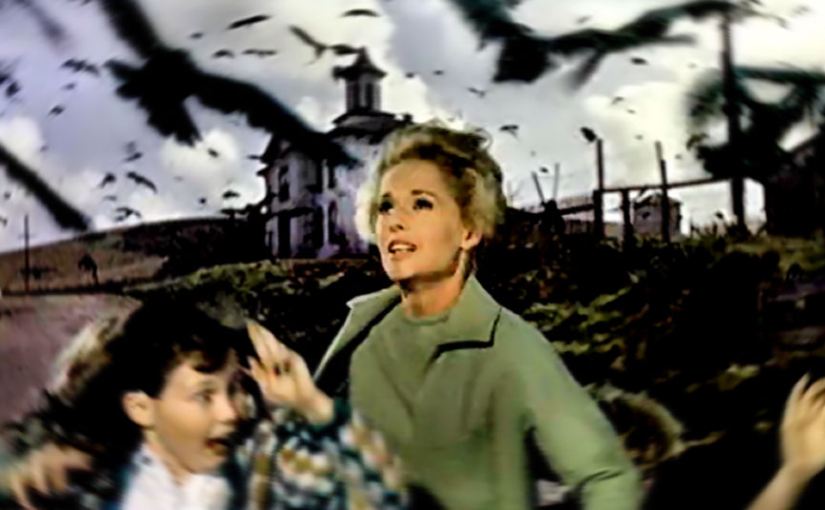
Alfred Hitchcock’s monster movie is The Birds from 1963.  There’s really not much to the piece as far as a story goes.  Characters are just given a purpose to be with one another so that they can be tormented together.  In this case, the film offers up a near hour introduction of newspaper heiress Tippi Hedren playing meet-cute with attorney Rod Taylor.  How ironic that they begin a flirtation in a bird shop of all places only to reconnect at Taylor’s harbor island home in Bodega Bay, located on the outskirts of San Francisco.  Still, as only Hitchcock can demonstrate there’s an ominous feeling sprinkled throughout before the real terror takes flight in the movie’s second half.

While I don’t rush for repeat viewings of The Birds, there’s no doubt as to its influence.  Each time there’s a shot of a bird soaring in the sky, your eyes open wider.  Something will eventually take effect.  At the beginning of the film, Hedren looks out into the San Francisco sky to see large flocks of birds soaring overhead.  Later, while taking a boat in Bodega Bay towards Taylor’s home that he shares with his mother and sister (Jessica Tandy, Veronica Cartwright), she’s attacked by a random gull.  It’ll raise the hair on your arms for sure. 

I’ve noted before how Alfred Hitchcock builds suspense.  The audience knows there’s a bomb under the table.  The characters in the film don’t. So, the audience is nervous as to when the bomb is going to go off or if the characters are even going to discover the explosive.  An outstanding sequence in The Birds includes Tippi Hedren sitting on a park bench near the jungle gym, outside of a school house.  The children are singing along inside.  One crow lands upon the jungle gym.  Then Hitch returns to a shot of Hedren calmly lighting a cigarette.  Then back to the jungle gym and there are four more birds perched just behind her.  Then back to Hedren, unaware.  Then back to the jungle gym for Hedren to turn around and there are suddenly hundreds of crows congregated together.  Effectively, other than the innocent harmonies of the children nearby, Hitchcock opts not to use any music to shock his audience as the scene develops.  The visuals lend to the fear.  The danger that threatens Hedren and the children heard off screen is at the forefront of the viewer’s mind.  No more is needed.  It’s scary, and you want to be as quiet and unalarming as Hedren so as not to instigate the monsters right next to you.

A later scene has Hedren ascend a dark staircase to open a bedroom door.  The roof has been torn open and suddenly the blackness comes alive with flapping wings from every direction.  That’ll make you shift in your seat.

Hitchcock offers plenty of set pieces for bird attacks, but another effective device is to show dissention among the ranks.  From a character perspective, the picture takes a sideways route to imply an oedipal complex between Rod Taylor and Jessica Tandy, who plays his mother.    Therefore, the script suggests Hedren as a threat to their relationship.  Before the film is over, they are likely going to have to develop a united front or it could be their undoing.  (Maybe it’s a nod to Hitchcock’s popularity with Psycho. A cute wink and nod.)

There’s also Suzanne Pleshette as the school teacher that we learn had a tryst with Rod Taylor’s character at one point.  That doesn’t spell out too well for Hedren, either.  As this bizarre epidemic becomes clearer, a scene in the town diner goes so far as to suggest that these random bird attacks didn’t start until Hedren arrived the day before.  Yes!!!!  It’s all her fault!!!! 

None of this will eventually matter though.

Other disaster films and monster movies later relied on exchanges like these, from Jaws to The Towering Inferno.  Hitchcock was wise enough to build tension.  Not a single bird in the scene, but still the fear and doubt among each other bares the strain.  There’s even an advocate for the birds with a strange elderly woman proudly debating her ornithological expertise, while a drunkard at the end of the bar declares the world is coming to an end.  All of these characters could have come from different movies, only to be pasted on to this canvas thereby lending to the frenzy.  Chaos must ensue among the masses.

Often, I get frustrated when there’s no explanation for a film’s central story.  I gave up on the TV show The Walking Dead many years ago because there never was a cause revealed for the zombie epidemic.  It became a smut of soap opera cliché accompanied with ridiculous gore.   Forgive the SPOILER ALERT, but I commend Hitchcock’s film for not providing a wrap up to The Birds.  The film ends with an uneasy final caption.  Nearly every inch of space on the screen is occupied with birds as the cast makes their way to the car to slowly drive out of town, careful not to disrupt the now dominant species of this universe.  Hitchcock provides a picture where the laws of nature declared a winner.  As intelligent as humans are considered to be, they have not won out.  They have had to surrender.  Why the birds attacked, we’ll never know.  Odd phenomena can happen.

There’s nothing thought provoking about The Birds.  It’s simply a film based on heightening your discomfort.  Often, I find the material and dialogue laughable.  The townsfolk notice a man lighting a cigarette right over a stream of gasoline and urge him to put out the flame.  Wouldn’t the dumb guy smell the diesel?????  However, then we wouldn’t get a fantastic fire ball to observe up close as well as from Hitchcock’s “God shot” in the sky with the birds looming into frame over the town below. 

The visual effects look outdated of course, but they still hold because of how Hitchcock demands they are used.  I noticed that his reliable composer Bernard Hermann is credited, but as a “sound consultant” this time.  The shrieking of the birds is what sends the chills down your spine.  Also, there’s the fact that Hitchcock offers up birds flying right at the screen or the windows.  A great sequence includes the front door of a house being gradually shredded apart by the bird masses.  The wood proceeds to splinter.  You don’t see the monsters but you know they’re right there on the other side.  Once that door breaks open or those windows shatter, then it’s likely all over for our heroes.  George A Romero exercised bits like this in Night Of The Living Dead.  Very, very effective.

The Birds is just okay for me, honestly.  The fright material is what keeps its legacy.  Yet, there’s a lot of soapy material among the cast of characters that’s not all that interesting.  Again, a purpose has to be served for these people to occupy the story.  Just offering a movie where birds hover and peck at people wouldn’t be enough.  So, we have to follow Rod Taylor and Tippi Hedren’s trajectory.  It’s fun to see screaming kids run from these animals turned menace, though.  I found it hilarious to watch a birthday party run amok.  I also yelp when I see a flock storm into Jessica Tandy’s house from the chimney turning the living room into a contained disaster area.  An especially gruesome discovery by Tandy later in the film is absolutely eye opening (pardon the pun, if you know what I mean), and clearly an inspiration to a well-remembered scream out loud moment in Jaws.

The Birds is fun, but it’s not the artistic merit you’ll find in other Hitchcock classics like Rear Window, Vertigo, Suspicion, or even Psycho. What I can promise is that once you get through the plodding character connection build up, you’re allowed to forget about any of their value to the picture and simply relish in the mayhem. 

PSYCHO

By Marc S. Sanders

To watch Alfred Hitchcock’s Psycho today is a blessing and a curse.  You can’t take your eyes off the craftsmanship of the film.  Yet, you know all the surprises and plot twists.  There’s only so much blood you can draw from the stone. 

Recently, I told my fourteen-year-old daughter, who doesn’t like scary movies, that she needs to watch the film.  If only because she knows absolutely nothing about Psycho.  She has no idea what’s to come of Marion Crane (Janet Leigh). She’s never heard of the shower scene.  She doesn’t know about the true relationship between Norman Bates (Anthony Perkins) and his chastising mother.  Imagine, assuming you have seen the movie and/or know all its secrets already, watching the movie with someone who is seeing it for the first time with a completely blank canvas to go on.  Oh, the reactions you’ll get to see!!!

Hitchcock’s film, with a screenplay from Joseph Stefano, works under a lot of different dimensions.  It’s classified as the first “slasher movie.”  That may be true.  However, it’s much more intelligent than a typical Jason or Freddy Krueger fright fest.  Psycho begins as one story with a central character, seemingly innocent, carrying out a crime.  Later, it turns on itself and becomes something else altogether.

Marion Crane makes off with $40,000 in cash from a chauvinistic, obnoxious client of her real estate boss.  She hits the road, heading towards her lover’s home in nearby California.  Her impending doom is never implied.  Stefano and Hitchcock focus only on Marion’s scruples with the crime she’s committed.  She gets haunted by a curious police officer.  She certainly wonders what her boss must think when he’ll discover that she never deposited the money in the bank.  Is the used car salesman going to follow up on her after she urgently trades in her car for a new one with new plates?

Soon though, none of that will matter when she has no choice but to pull off the road for the evening to stay at the Bates Motel, currently with twelve cabins and twelve vacancies.

For the one or two readers who have never heard of Psycho, I’ll stop there with the narrative.  However, what I appreciate about the second half of the film is that the new central character, now young, quirky, altogether strange Norman Bates, seems to respond with avoidance when a private investigator named Arbogast (Martin Balsam), and then later Marion’s lover Sam (John Gavin) and her sister Lila (Vera Miles) start questioning him about Marion’s whereabouts.  Arbogast is on the trail of a thief who went off with $40,000.  Sam and Lila are also curious about the theft that seems unheard for Marion to commit.  Yet, there’s something else leaving them curious.  Norman, on the other hand, knows nothing as to what Marion was up to.  In his eyes, the only odd thing about her is that she checks into the motel under a different name.  All of these characters are coming in conflict with one another, but not for the reasons they think they are.  The fun part is that we are the only ones who know the hands that each player is holding.  Even more fun is when we uncover a secret that Norman has been hiding from the audience all along.

Hitchcock tricks his audiences with Psycho.  With its first story, we are in suspense of one criminal.  Will she get away with the theft? Rather, how and when will she get caught?  With its second story, we are unnerved by someone far worse and frighteningly mysterious.  Following the infamous shower scene, it’s a little nerve wracking to watch as Norman tries to hide the evidence in the trunk of a car that he pushes into the nearby swamp.  Any storyteller would just have the car simply sink.  Hitchcock brings in shadowed close ups (with his wise idea of black and white photography) of Norman chewing gum, and then becoming completely still when the car actually stops sinking midway through its descent.  As a viewer, your jaw drops.  What is Norman going to do if the car doesn’t fully submerge?

Later, it’s a wonder how Norman is going to circumvent around the unexpected visits form Arbogast, Sam and Lila.  Then, we are in suspense of their safety.  They’re just looking for the missing money while tracking where Marion went off to.  Unbeknownst to them, they have can’t even fathom her demise.

I was talking with one of my Cinephile brothers about Psycho, explaining how it follows a similar dynamic that the second half of Vertigo moves upon.  In Vertigo, the main characters, Scottie and Madeliene, are both in love with one another.  Yet, it’s for different reasons that they can’t explain to each other.  In Psycho, the characters are all under suspicion and even paranoid of each other, yet for all different reasons.  Norman never knew of Marion’s crime.  Though the other characters suspect that he does.  In both pictures, only we, the audience, know almost everything at play.  According to various documentaries I’ve watched, Hitchcock wholeheartedly trusted his screen writers to flesh out the stories.  He concerned himself more with constructing the film with a faithfulness to the script.  What’s commendable about the films Alfred Hitchcock chose to make is that he sought out these conundrums where his chess pieces are left bewildered or unaware of why they are sharing the stage with the other players.  The director had a way of channeling into deceiving his characters against one another, allowing the viewers to relish in their trickery.  Going a step further though, Hitchcock reveals other twists never suggested in the film to turn the audience on their ear in shock.

You can’t take your eyes off Psycho, even with knowing all the goodies that Hitchcock provides. 

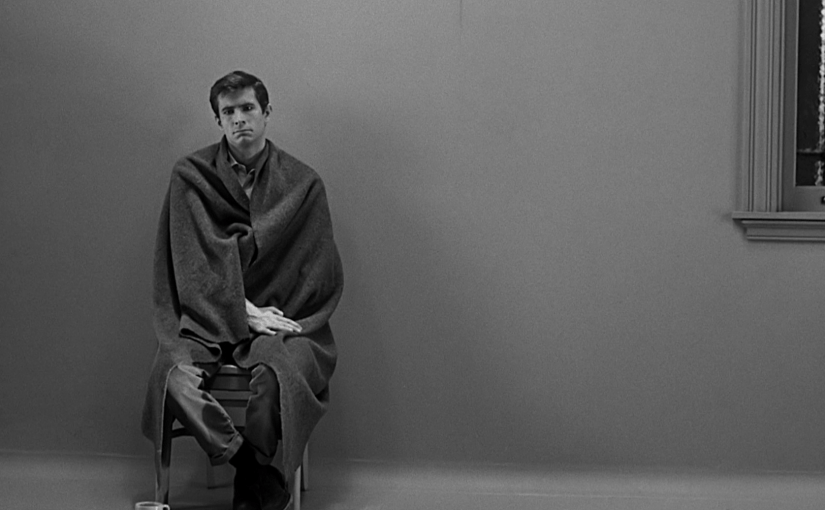
Anthony Perkins especially is a tense and unnerving menace.  He has a boyhood innocence to him that should not appear threatening to Janet Leigh’s Marion Crane.  It’s in his relaxation with the role that it feels all the more terrifying to the viewer.  Simply look at the way Arbogast pulls up to the motel and Perkins is sitting calmly on the porch eating his bag of candy.  Watch how he casually shares with Marion how he relishes in stuffing the birds he has mounted on the parlor walls, or even how he casually offers cabin number one for Marion to occupy so that she can be close to everything.  Norman Bates hides himself very well in his virtue.  A wolf in sheep’s clothing.

The Bates Motel and the large house poised behind it on the hill were set up on a Universal back lot.  It remains one of the most famous settings in film history.  When you see the silhouette of Norman’s mother in the window from afar or young, slender Norman standing in front of the house, the images of the chilling locale stay with you whether it is on a dark and stormy night or even during a sunny afternoon.  Hitchcock opted to shoot the film in black and white to taper the goriness of the piece.  Outside of the gore elements though, the black and white lends a foreboding feeling to this destination.  Even before we realize that Marion is in danger, we feel uneasy with just arriving at this place.

The shower scene of course is one for the ages.  I’m not here to discuss all of the mechanics of film’s centerpiece.  The assembly of the scene’s elements are masterful though.  Can you imagine the scene without Bernard Hermann’s shrieking score?  Hermann was to Hitchcock like John Williams is to Steven Spielberg.  The aftermath is brutally shocking as well.  The camera does a zoom out on Janet Leigh’s eye as the soaking head of her corpse lays down on the bathroom floor.  I notice the eye does just the slightest twitch.  For me, that’s all the more disturbing than just a very still open eye.  It implies the last bits of life leaving her body and consciousness.  Later, when Norman cleans up the bathroom, Hitchcock shows his process with a mop and neatly wrapping Marion in the torn shower curtain and disposing of anything belonging to her, including a newspaper that isn’t just a newspaper.  Norman is methodical.  Perhaps this strange man has done something like this before.

I do have one grievance with Psycho.  The air is kind of sucked out of the film in its last few minutes before that delicious last close up on Norman.  Stefano’s script offers up a psychological explanation for what Norman Bates seems to suffer from.  It’s as if we are given a scientific description for what ails him. This is all painfully boring.  I dunno.  Maybe in 1960, when Psycho was a pioneering kind of horror film, and moviegoers were not as familiar with the genre that seemed far scarier than Boris Karloff, and vampires and mummies, they needed a summation like this.  Sixty years later, naturally this is not necessary.  We know all to well that there are disturbed people who live among us.  We know, sometimes, to be cautious of folks like these.  For someone as reputed as Hitchcock was, being identified as the “Master of Suspense,” this long monologue, spoon fed diagnosis from the psychiatrist kills all of the horror we’ve bared witness to over the last two hours. 

Psycho was the first slasher movie.  It was the first movie to feature a toilet and have it flush on film. It has one of the most famous characters in all of film history.  It has one of the most famous scenes of all time.  It was directed by one of the greatest directors of all time.  Yet, it also has one of the worst conclusions of all time.  If ever a scene should have been cut from a finished product, it is the second to last scene of Psycho.

Now, go find someone who has never heard of Psycho, knows nothing at all about Psycho, and watch them watch Psycho.  Of course, as the famous marketing campaign for the film insisted, by all means do not start the movie or walk in the middle, and never reveal any of its secrets.

VERTIGO

By Marc S. Sanders

Never would I think Alfred Hitchcock would enter the world of the supernatural.  At least of all that I’ve read about him and the films I’ve seen to date, I do not recall tales of ghosts and ghouls from the master of suspense.  Yet, as I’m watching his classic, psychological film, Vertigo, I’m questioning the territory that Hitch has entered.

James Stewart returned to work with Hitchcock in 1958.  He plays Police Detective John “Scotty” Ferguson who opts to retire following a frightening encounter involving a foot chase over the rooftops of San Francisco.  When he succumbs to his debilitating fear of heights, a police man loses his life in the process.  Scotty just can’t go on.

He is recruited by his wealthy industrialist friend Gavin Elster (Tom Helmore) to shadow his wife, Madeleine (Kim Novack).  Gavin is concerned that Madeleine may be suicidal, because it is becoming not too unreasonable to consider that perhaps a woman from the past has taken possession of her.  Scotty is reluctant of course, and it all sounds like a bunch of nonsense.  Yet, he accepts the assignment.

Vertigo may be a classic film, known by millions worldwide, but I won’t dare utter any hint of what’s to come.  Scotty’s pursuit of Madeleine continues to spiral into new inventive twists like Alfred Hitchcock always took advantage of.  The film could have ended on several different notes, and its running time could have been shorter.  However, Hitch lay insistent on peeling back more of the onion.

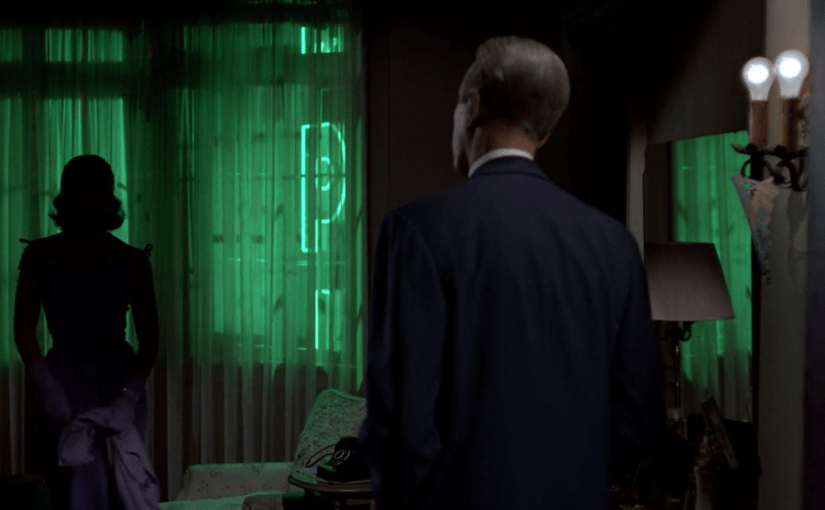
I was fortunate to see the movie following a painstaking restoration after the film was uncovered to be in terrible shape.  Now, it is preserved on 4K disc, and Vertigo is tantamount to the necessity of 4K.  Firstly, as Scotty continues to oversee where Madeline goes and what she does, Hitchcock keeps much of her activity bathed in a rich emerald green.  Green almost works like breadcrumbs for Scotty.  She drives a green car.  Many of her elegant dresses have green in them.  Hitchcock lights many of her scenes in green.  Oddly enough though, while green is so apparent from Scotty’s perspective, Madeleine’s overall purpose and intent is such an enigma.  So, film historians proudly recall how the most popular outfit for the bleach blond Novack to wear in the film is a plain, simple grey suit which tells us nothing.  Grey is melancholy, seeming to express no kind of emotion.  Not fear, or anger or love, or happiness or sadness.  The suit even becomes a significant plot point later in the picture.  The woman is there plain as day, at times shining in the emerald car, or beneath a green light, but why is she there? 

As well, Scotty’s continued pursuit and eventual love affair with Madeleine overcomes him and he spirals into a madness highlighted in reds and blues and oranges with spiral lines turning into bottomless pits.  Hitchcock even imposes haunting animation to show how Scotty’s mind is splintering and falling away from any depth of reality.

I have seen clips of the original film and the colors are so faded out.  It takes you out of the picture.  The color is so pertinent to the narrative of Vertigo that there was no question.  The movie had to be restored.  Watch this movie on 4K.  You won’t regret it.

Have you looked at the well-known marquee poster for Vertigo lately?  It is definitely one that’s consistent to dizzying turns and descents to overtake the movie.

Furthermore, the opening credits of the film zoom into the pupil of a woman’s eye and then spiral sketches start to turn and spin.  It’s easy to connect this to the side effects of Scotty’s acrophobia.  He gets dizzy.  His visual perspective draws him out of measured reality.  As the film progresses, though, it goes further than that.  Hitchcock turns Scotty into a man crippled with obsession. 

I heard my Cinephile colleagues discuss this film recently, implying that Vertigo is not their favorite.  They didn’t like James Stewart’s character.  For one thing he falls in love with Madeleine, his friend’s wife. The Cad!!!  Later, he invokes unequivocal dominance over a new woman he meets in the second half of the picture.  (I won’t say much more, here.)  He insists the woman dress like Madeleine and do her hair and makeup like Madeleine.  She also needs to walk like her too.  Stewart and Hitchcock really put this protagonist through the ringer.  He’s first crippled with a fear of heights.  However, dominant obsession interferes with him as well.  Is it the acrophobia that is so debilitating, or is it a sick obsession that comes into play?

San Francisco is an ironic setting for a film where the main character has a fear of heights.  It’s made up of steep hills that descend from high tops, or ascend into the sky.  Try climbing the staircases that stand upon these hills and now you are even closer to the heavens and further away from the ground.  How could a guy like Scotty Ferguson live in such a city?  Yet, here it is.  Maybe it was a sick, subtle joke of Hitchcock.  I think it’s a nice touch to amplify the suspense.

James Stewart is just as good here as he was in Rear Window.  The likable fellow who serves as a sponge to what’s laid out before him.  If he absorbs too much though it could defeat him altogether.  Much of the suspense Hitchcock is known for, stems from this thread line.  Stewart’s Hitchcockian characters get drunk on needing to know more, and delve even further.  The audience can’t help but get intoxicated with him.

Kim Novack is radiant.  She gives an especially incredible acting performance.  Through the first half of the picture, she’s quiet and reserved laying credence to what Gavin suggests to Scotty.  Is she being possessed by a young woman with odd resemblances too her, who killed herself back in the 1800s?  Is it something else?  Her turn in the second half of the picture leaves you questioning if you are even watching the Kim Novack.  An amazing double performance from her that lends to one of the twists that Vertigo offers.

Pictures like Vertigo and Rear Window are so important for people to see.  These films laid the groundwork for much of the horror, macabre and disturbingly mysterious stories shown today.  They are pioneering films that only invent what needs to be shown.  In other words, they don’t get diverted in overcompensating with action and gore.  Many films that derived from Vertigo desperately turn to blood and over the top stunts and visual effects.  Alfred Hitchcock thought about how the actors, the settings and wardrobe, along with his cameras, would capture the terror and embrace the unknown.  Filmmakers need to continue learning from a craftsman like him.

REAR WINDOW

By Marc S. Sanders

Alfred Hitchcock’s beloved classic Rear Window remains absolutely relatable today.  Before the age of the internet and reality TV, people already had a voyeuristic instinct about them.  Heck, movies are voyeuristic!  The audience watches the behaviors and actions of people on a large screen.  Snooping into the activities within your neighbor’s private apartments is not much different.  Though likely less ethical.

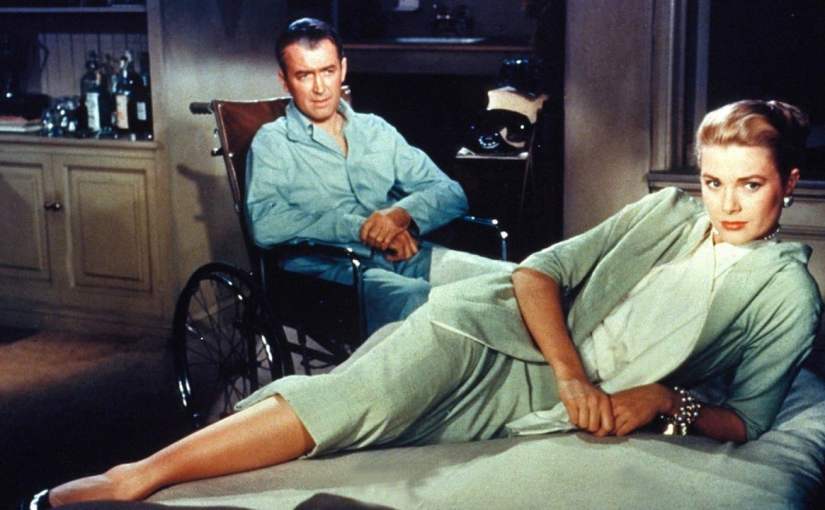
When photographer L.B. Jeffries, aka “Jeff,” (James Stewart, in one of his most famous roles) is bound up in a wheelchair with his broken leg wrapped in a waist high cast, there’s not much adventure like his traveling career demands.  So, he gets caught up in looking at the goings on of his Greenwich Village apartment neighbors like a beautiful hourglass figure dancer he dubs “Miss Torso,” or the newlywed couple and their never-ending sexual escapades.  There’s also an elderly couple who find comfort in sleeping at night on their outdoor balcony next to one another.  He can also take pleasure in a struggling musician trying to write his next piano tune while also entertaining a collection black tie guests.  Another woman he dubs “Miss Lonely Hearts,” for her desperate attempts at entertaining herself with imaginary escorts she’s “invited” for dinner, also leaves him curious to keep up with.

The most inquisitive occupants in this building are a husband (Raymond Burr) and his seemingly ill and often irritating and nagging wife.  Over one rainy night, Jeff takes notice of the husband leaving his apartment with a suitcase at three different times and the wife is nowhere in sight ever again thereafter.  Later glimpses of the husband handling a carving knife, a saw and some rope tied around a storage trunk are also eye opening.  Jeff recounts this sequence of events to his desperate love interest, Lisa (Grace Kelly, with a gorgeous on-screen entrance in one of costumer Edith Head’s legendary dresses) and his nurse caretaker Stella (a smart allecky and perfectly cast Thelma Ritter).  When the likelihood of murder has probably occurred, Jeff also lets his detective friend Tom Doyle in on what’s seen.  All seem skeptical at first. 

Now the action of murder is never seen by Jeff, nor by the audience, mind you.  For the most part, Hitchcock limits the viewer only to what Jeff sees with his own eyes or with the help of his binoculars and his long lens camera.  Midway through the film, the director allows Jeff to doze and gives us a glimpse of something the husband does.  Now, we the audience, have a slight edge of knowledge that our hero doesn’t.  This plays with Hitchcock’s approach to suspense.  We know there’s a “bomb” under the table.  The people sitting there don’t however.  It pains us to wonder if our protagonists will discover the bomb before it goes off.

I’m a big fan of Alfred Hitchcock movies because they never get too complex.  The stories he chose to direct normally place an everyman in a scenario he/she never expected to find themselves in, much less be invited to.  With a screenplay from John Michael Hayes, Hitchcock puts out only a few pieces of a puzzle.  Then, it’s up to his handicapped hero and the audience to solve it.

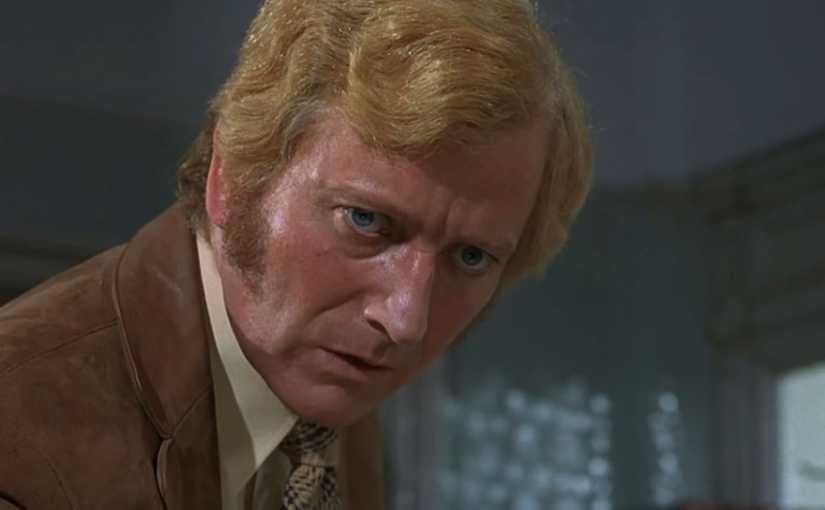
The voyeurism for Jeff seems like a harmless vice while his time at home slowly passes painstakingly by.  Hitchcock and Stewart do very well in assembling this film.  A close up of Stewart will have him turn his eyes to his right and then we will see what the newlywed couple are doing.  Then we will cut back to Stewart and see his reaction with a smirk.  A look down will cut to the dog, curiously digging away in a flower bed.  Then once again back to Stewart for a close up that maybe has him wondering if the dog is getting at something pertaining to this husband and his now missing wife.  The smirk leaves Stewart’s face.  Now, it’s an expression of puzzlement.

I noted earlier that Rear Window can easily be related to what drives people’s obsessions today.  We are people driven by internet surfing and television streaming and social media.  The known statistic that half of marriages end in divorce is still prominent.  (Maybe that percentage is even higher by now.) Stewart’s character of Jeff becomes so obsessed with keeping up with these people’s stories, that he hardly finds time or enthusiasm to accept the romantic gestures of Lisa.  It’d be fair to argue that technological devices of today serve as an equal distraction in relationships.

Grace Kelly is well cast here.  Arguably one of the most beautiful women to ever appear on screen, dressed in some of the most artistic and fascinating costumes provided by Edith Head, and even she can not divert Stewart’s attention away from the activities of others that Jeff doesn’t even have an intimate knowledge of.  Kelly begins her performance in the film with an approaching close up followed by a sensual kiss upon a sleeping Jeff.  She arranges a catered dinner, delivered by the renowned New York restaurant, Twenty-One.  It just doesn’t completely sway Jeff away from what he becomes obsessed with.  Much like people are with social media, Jeff has been addicted to his vice.  When Lisa tries to implore with Jeff to take their relationship further, James Stewart raises his voice to tell her to shut up and insists that her beautiful hairstyles, wardrobes and high heel shoes could never keep up with him on his travels to far off deserts, jungles and war-torn areas that he photographs.  Yes, Jimmy Stewart tells Grace Kelly to shut up.  It’s shocking.  However, maybe the film will eventually demonstrate that Jeff really doesn’t know anything about Lisa.  The everyman of cinema at that time has been corrupted by what he’s focused on, and in an Alfred Hitchcock film, it is bound to get him into more trouble than he ever expected.  More importantly, the one who cares for him may open his eyes to what he really can’t see as this mystery proceeds.  Broken leg or not, Jeff has never truly seen the real Lisa.

I recall visiting Universal Studios in Orlando, Florida when there was an Alfred Hitchcock attraction there.  I miss it.  It was taken over by a Shrek ride and soon it will be another Minions adventure.  Before ever having seen Rear Window, the attraction featured a look at the Greenwich Village courtyard setting of the film.  It was fascinating.  It was four floors of apartments directly across a courtyard that had a flower bed, folding chairs and the like.  There was also an alley that presumably led to a bustling New York City street.  Naturally, you couldn’t see much of the street.  Just a sliver.  Hitchcock arranged with Paramount Pictures to build the set this way.  Audiences would have wide open views of activities within the window frames of these apartments, the hallways beyond the front door of each dwelling and that one slim alleyway.  The viewer is as limited in what can be seen as Jeff.  This mysterious husband may be going somewhere at odd hours of the night, but once he passes that alleyway, there’s no way of knowing where he went.  Today, we might call something like this one of those “Escape Rooms.”  Solve the mystery, but only with what you can see and only from your one stationary position.  If something takes an unexpected direction, you could find yourself in danger without any means of escape.  That’s how Hitchcock sets up the limitations for Jeff.

As the film progresses, Lisa proves that she can be adventurous like Jeff claims that she isn’t.  In her beautiful gown, heeled shoes and coifed hairdo, she climbs into the apartment of the likely murder suspect looking for clues.  Jeff, however, can’t do anything but watch.  There’s not much he can do either even when the suspect returns while Lisa is still there.  He’s helpless to help her or even himself.  This assembly of direction again falls in line with the “bomb under the table” idea.  It’s one of many devices Hitchcock uses to keep Rear Window as suspensefully entertaining as it was for audiences in the 1950s.

Few directors still can’t keep audiences on the edge of their seat like Alfred Hitchcock.  He had such an intuition for knowing what would keep viewers engaged and wanting to know more.  Unlike other films from him, there’s not much of a twist to Rear Window.  The resolution falls in lifting the veils.  Jeff must reveal himself to this mysterious husband.  (When they come face to face finally, Hitch is smart to position Jeff as a silhouette in darkness.)  Lisa must show Jeff a side to her that he refuses to acknowledge in order to save their relationship. Most importantly, a mystery has to be confirmed.  You find yourself more and more breathless as the film moves on, and then more facts are revealed implying that Jeff is truly on to something.  When the picture finally ends, if you got caught in Hitchcock’s web of suspense, you’ll likely let out a satisfying sigh of relief.

FRENZY

By Marc S. Sanders

London is being terrorized by the necktie strangler.

In 1972’s Frenzy, Alfred Hitchcock hearkened back to his killer classic themes remembered from Psycho. Only this time he is much more macabre with his material. Frenzy is Hitchcock’s only R rated film and his first movie to show outright nudity. Naturally, it’s all pretty eye opening, and considering that the film’s killer is regarded as a “sex maniac,” necessary as well.

Richard Blaney (John Finch) is not doing so well. He’s broke and he’s just lost his barkeep job. Subsequent from that he turns to his ex wife Brenda (Barbara Leigh-Hunt), a successful marriage and friendship counselor for comfort. It does not help that Brenda’s secretary overhears Richard violently losing his temper. Nor does it do any good when he has an outburst while dining with Brenda in a crowded restaurant. Why, this could only make him look suspicious of a crime, and the infamous, serial necktie strangler has yet to be caught.

When Brenda turns up dead by means of a necktie around her throat, all accounts point to Richard. Once again, Hitchcock’s protagonist is the Everyman caught up in an unwelcome conspiracy.

Frenzy is thankfully like many of Hitchcock’s best films. It gets straight to the point. Just as the film begins, the naked body of a dead girl floats up from The River Thames. Then it follows through with Richard and introduces likely suspects and or villains including Richard’s friend Robert Rusk (Barry Foster) and his bar waitress co-worker Baba Milligan (Anna Massey)

Hitch goes more horrifying than he might have had the liberty to do so a decade prior to this release. The necktie strangler’s rape and murder of the first victim is quite graphic and disturbing. This is a deranged individual and his victim is rendered helpless.

What keeps viewers interested in a good Hitchcock yarn is the suspense he manufactures for the one who is blamed, as well as for the killer. Hitchcock doesn’t dwell on mystery. Rather, he focuses on what his principal characters are going to do next, now that they are swept up in intrigue. The strangler continues his killing spree but overlooks one thing that could implicate him. The man who is blamed seems to get little help from anyone. Richard is in quite a pickle after all. As well, how will these two people encounter one another to wrap up the storyline?

Humor also comes through quite nicely with Chief Inspector Timothy Oxford (Alec McCowen) who is blessed with a loving wife who relishes analyzing the gruesome details of his investigation while preparing dinner time meals that look awfully worse than the corpses the Inspector encounters; quail with raisins for example. To look at her concoctions will certainly make you wince. It’s great side humor for the suspense at play.

A film like Frenzy hardly explores dimension in its characters. Many of Hitchcock’s films never get weighed down with too much material. The stories he directs are lean, only focusing on the central plot at play. The fun is in the disturbing angles he uses like a woman’s outstretched hand or frozen expression after succumbing to strangulation. Overhead shots of a man imprisoned in a small room can also be jarring. He keeps you engaged as tightly as the fingers of a dead body gripping a significant piece of evidence.

Films like Frenzy or Psycho cannot be made today. There are too many advances in technology and science to undo the developments of simple, yet grossly disturbing stories like this. DNA evidence and cell phones would wrap up any of these plot lines in five minutes. It’s fortunate that we can still transport ourselves to the period when these tales of suspense were originally developed. It doesn’t make it easy for the innocent man, the victims or the killer. I wonder how Hitch would approach today’s conveniences of modern science. If anything, he’d likely make his signature cameo on the wallpaper of someone’s iPhone. Nevertheless, I’m sure he’d find a way to continue to build his suspense. He had such an eye for his camera, his captions and his edits.

Frenzy is a demonstration of classic Hitchcockian thrills.

NORTH BY NORTHWEST

By Marc S. Sanders

A story of mistaken identity becomes one of the grandest adventures on film with Alfred Hitchcock’s North By Northwest. The movie plays at such a fast pace, moving from one locale to the next and it all feels convincingly possible.

Before James Bond, there was the dashing Cary Grant in his sharp, fitted light grey suit (the best suit to ever be shown on film) portraying advertising executive Roger Thornhill who simply raises his hand in the air while meeting some colleagues at The Plaza Hotel in New York and is suddenly mistaken for a man named George Kaplan. Soon he’s forced into a car by two men and driven to an estate property belonging to someone named Townsend (James Mason) who implores “Mr. Kaplan” to cooperate or else. Suddenly, Thornhill who continues to insist he’s not Kaplan is on a cross country journey while escaping the authorities who want him for murder while he tries to prove his true identity and exonerate himself.

Cary Grant is dashingly fun with Hitchcock’s camera. It’s refreshing for a change to watch an innocent protagonist not lay on the heavy drama and panic so much. Hitchcock with Grant were going for a sweeping story of cat and mouse play.

What Alfred Hitchcock does best is put the viewer right in position of Thornhill. For the most part (definitely through the first forty minutes) the viewer only knows what Thornhill knows. We know he’s been mistaken for someone else and we are only given the opportunity to put a few names with faces and get a hold of a crumpled photograph. That’s all we and Thornhill have to go on.

Later on, it’s only fortunate that Thornhill comes upon one of Hitchcock’s celebrated blond actresses he was always reputed to cast. This time it is the incredibly striking Eva Marie Saint as Eve Kendall who becomes a willingly helpful train companion for Thornhill. Cary Grant and Eva Marie Saint make for a spectacular on screen couple. Their chemistry is so natural together.

Not much else should be said about the story of North By Northwest. The entertainment comes from what each new scene reveals. Hitchcock incorporates all the expected twists and makes sure to use a MacGuffin, of course. This time it involves a statue and microfilm. What’s on it? That does not so much matter really. It’s the need to pursue it that’s important. The pursuit is what drives the picture from New York City to the United Nations, all the way to a curious auction house for fine art and then on to the four famous faces of Mount Rushmore in South Dakota.

Naturally, Hitchcock is the master once again as he points his camera up close on Grant, Mason and Saint and then quickly will cut to one of their points of view to lengthen the suspense. Running after or away from something in the moment is where Hitchcock is very strong as a storyteller. It keeps you alert as a viewer. Very alert!!!

James Mason makes for a terrific villain as Townsend, or could he be someone else? He’s got that sneaky inflection in his voice and short build that makes for a great antagonist against Cary Grant’s tall stature. Mason’s sidekick, Leonard (a mysterious looking Martin Landau) is also a spooky guy to keep your distance from.

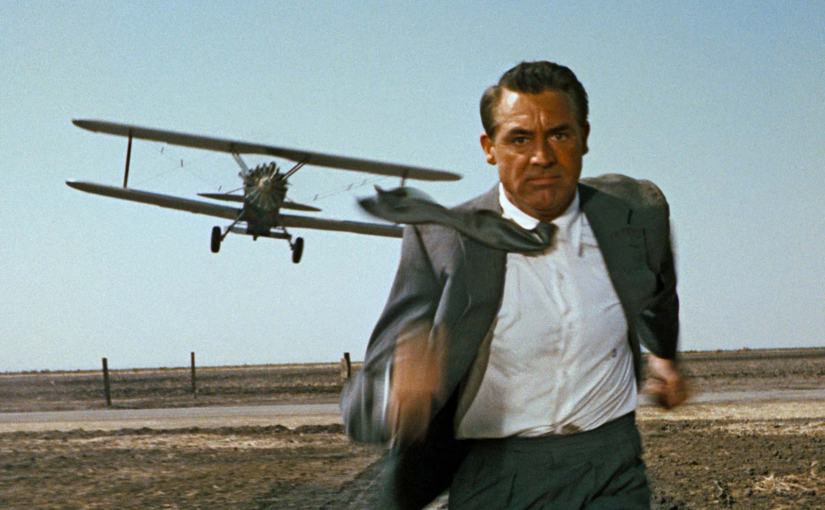
The most celebrated scene probably also contains one of the best captions caught in film. I speak of the very surprising crop duster chase. As Roger Thornhill finds himself in a quiet, Midwestern dirt road intersection, an airplane crop duster turns into a frightening menace. The best shot occurs as Grant runs quickly towards Hitchcock’s camera and the plane flies overhead rapidly getting closer in the upper left side of the screen. As Grant runs and runs, he fills more of the screen, but so does the crop duster. The editing alone is spectacular, as an oil rig eventually comes into play with Grant about to get run over. Story wise, I adore this scene as somehow the life of a man who routinely gets in taxicabs and hob nobs through New York City on a daily basis suddenly has found himself in a dusty field running for his life. What was never expected is suddenly all that matters to this ordinary man.

Hitchcock plays with what’s around to play with. Other than a quick gag in Superman II, l don’t recall many films incorporating Mount Rushmore as such an important element to its picture. Every crevice or ledge or finger hold is important to the edits of the climax in North By Northwest. When Eva Marie Saint is holding on for life, I truly believed she could actually fall. [SPOILER ALERT] Actually, Hitchcock wanted you to believe that as the very last scene doesn’t even truly reveal the solution to her predicament. I like his method of editing this way. Hitchcock seemingly offers no option for survival as Grant and Saint’s hands barely hold on to one another. The editing is just so damn good here.

I’d be remiss if I also didn’t recognize one of the greatest orchestral scores in film. Bernard Hermann’s stirring, fast paced rhythms keep the running man theme in play. The movie seems to play by the beats of Hermann’s conduction. Action films of the future seemed to adopt some measures from he did with this film.

North By Northwest will always remain as one Alfred Hitchcock’s best films. There is not one error in the picture. Every shot is done with deliberate intent to sustain the mystery of suspense. Humor is included even at times on a risqué and subtle measure. Alfred Hitchcock again invites the simplicity of storytelling to introduce the complexity of fear and mystery and outstanding suspense. Not many films compare to North By Northwest.