
by Miguel E. Rodriguez
DIRECTOR: Otto Preminger
CAST: Harry Belafonte, Dorothy Dandridge, Pearl Bailey, Brock Peters, Diahann Carroll
MY RATING: 8/10
ROTTEN TOMATOMETER: 75% Fresh
PLOT: The Bizet opera Carmen is translated into a modern-day story (with an all-black cast) of a sultry parachute factory worker and a GI who is about to go to flying school during World War II.
Otto Preminger’s Carmen Jones will be (or OUGHT to be) remembered for many things, but the thing I will remember it for the most is the dynamic presence of the sexy, sultry Dorothy Dandridge in the titular role. She may not have done her own singing – nearly all the major characters’ singing voices were dubbed by opera singers – but, by God, she knew how to own a role. In the first five minutes, she steals the movie lock, stock, and barrel when she performs that first aria in the mess hall. It’s like watching a Marilyn Monroe film: everything around her pales in comparison to her sheer magnetism, although with Dandridge (at least with the character of Carmen), you can see an intelligence behind the sexiness. Dandridge thoroughly deserved her Oscar nomination. A quick Google check shows she had some stiff competition that year: Grace Kelly, Judy Garland, Audrey Hepburn, and Jane Wyman…although how Kelly pulled out a win over Dandridge AND Garland will forever remain a mystery to me.
ANYWAY.
In this modern retelling, Carmen Jones is a factory worker during World War II, making parachutes for the war effort. During the opening aria, she sets her sights on Joe (Harry Belafonte), a naïve GI in love with a country girl, Cindy Lou, from his hometown. If I’m being completely honest, nothing in the film matches the simmering sexual energy of this opening number. Carmen slinks from table to table in the mess hall, modestly dressed, but with complete knowledge of exactly how to work with what’s available. She flirts shamelessly with Joe, right in front of Cindy Lou.
Later, Carmen gets in a knock-down, drag-out catfight with Frankie (Pearl Bailey, the only principal actor whose singing voice WASN’T overdubbed) and is arrested by the MPs. Joe, who was just about to elope with Cindy Lou, is ordered to drive Carmen to a town some 50 miles away, since the Army can’t put civilians in jail. This sets up another opportunity for Carmen to flirt with Joe, as she does everything but unbutton his pants during their drive. The more he resists, the more she wants him.
…but I don’t want to simply summarize the plot, which was a mystery to me since I have never seen a production of Carmen. (The ending is mildly pre-ordained, because, hello, it’s an opera.) I want to express my admiration of this film, particularly for its ambition. I’m no film scholar, but I’m prepared to bet that in 1954, there weren’t an awful lot of big studio films being directed by A-list directors featuring an all-black cast. The fact this film exists at all is, I think, a minor miracle. I won’t attempt to put words in the mouth of anyone in the black community, but at that time in cinematic and American history, I have to believe this was seen as a giant leap forward, AND a giant risk. (There is probably MUCH more to this story, but I do not want to turn this article into a research paper.)
Otto Preminger’s directing style in Carmen Jones also deserves recognition. A factoid on IMDb trivia states: “This film contains just 169 shots in 103 minutes of action. This equates to an average shot length of about 36 seconds, which is very high, given the 8-10 seconds standard of most Hollywood films made during the 1950s.” This is important because those longer shots create, in many places, an illusion of watching a stage performance. For instance, if I remember correctly, that opening aria that I keep going on about – Dandridge is SMOKING – runs for about 4-5 minutes and has only three total shots. Towards the middle of the film, there’s an astonishingly long take that travels from a bar across the room to a table, following a group of five people, all singing simultaneously at multiple points. The shot lasts just under five minutes, but it feels much longer. It’s a brilliant piece of work.
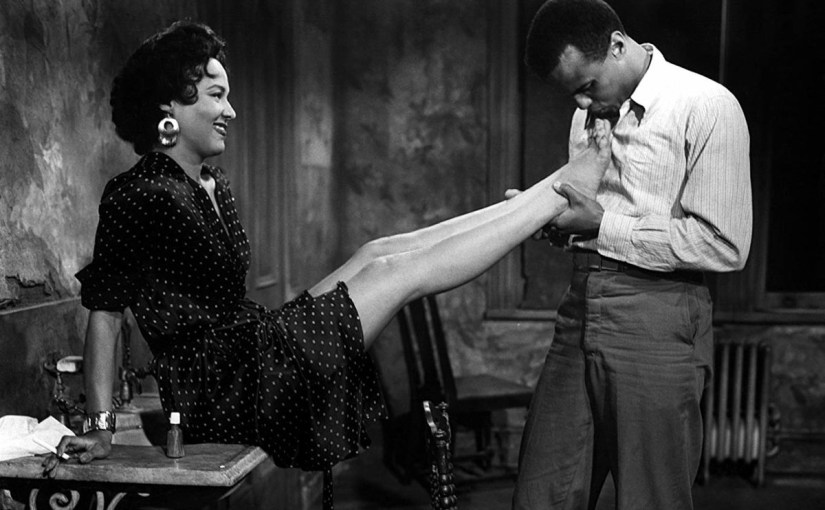
The tragic arc of Carmen Jones may seem inevitable, as I said before, but it remains an entertaining watch. You can see the dominos falling, and you bemoan the choices Joe makes as he falls under Carmen’s spell, but I mean, LOOK at her. There’s a scene that I’m sure would bear the Tarantino stamp of approval as Carmen paints her toenails and coyly asks Joe to blow on them for her so they can dry faster. Dayum. Show me a straight man who wouldn’t fall for that kind of treatment from a woman who looks like Dorothy Dandridge and I’ll show you a dead man.
If I wanted, I could get nitpicky about Carmen Jones. Has it aged well? Not exactly. Does it feature great acting aside from Dandridge? Not exactly. Does it look natural to hear an operatic tenor burst forth from Harry Belafonte’s mouth? Not exactly. But Carmen Jones is a landmark of black cinema in an era when schools and government buildings still had segregated water fountains and restrooms. Based on that fact alone, I consider Carmen Jones to be a vital step in Hollywood’s painfully slow racial evolution. (It is also a painful reminder of a career that might have been; Dandridge died 11 years later at only 42.)
 2 UNPAID MOVIE CRITICS!!!!