SILKWOOD

By Marc S. Sanders

As the 1980s were setting its stride, Silkwood might have been one of the earliest in a line of films to focus on the union worker who fights back at the billion-dollar corporation.  Some might unfairly regard the movie as The China Syndrome, Part II. Other well-known pictures of this mold are even more familiar to me like Michael Mann’s The Insider.  However, director Mike Nichols, working with a first screenwriting effort from Nora Ephron who partnered with Alice Arlen, showcases the aggravation on not just Karen Silkwood, the real life potential whistleblower, but also her friends and co-workers in a one factory town just outside of Oklahoma City.

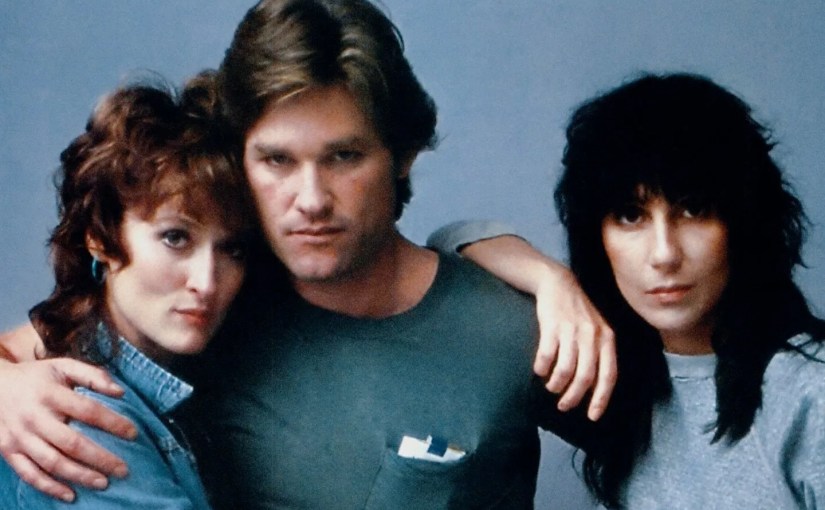
Karen (Meryl Streep) lives with her boyfriend Drew (Kurt Russell) and her best friend Dolly (Cher) in a run-down house in the middle of nowhere.  They ride to work together at the local plutonium manufacturing plant where they dress in scrubs and gloves. Punch in, punch out kind of days, and often they are expected to work double shifts and weekends.  Karen works an assembly line where she places her hands in rubber gloves and assembles dangerous combinations of chemicals in an enclosed box.  It’s also routine that before you leave your station you wave your hands over a sensor to ensure you have not been exposed to radiation.  There’s even sensors you walk through as you enter and leave the plant.  When those sensors go off, a calm kind of film seemingly turns into a horror movie.  The last thing anyone could ever want is to get “cooked.”

Karen does not live a perfect life.  Her three kids reside with their uncompromising father in Texas.  Money is not ideal.  Dolly is a slob and has also invited her girlfriend to live with them.  Karen can manage with all of this, but when she observes some unconventional activities around the factory she gets up the nerve to head the union for better protection and working conditions.  However, the further she goes looking at files and photos, jotting down notes of what people say and do, plus taking trips to Washington DC, and getting phone calls from attorneys at night, she becomes more and more isolated from Dolly and Drew, along with the rest of her close-knit workers.  Karen is not just risking her job, but everyone else’s jobs and worse her own life.

The attorneys lay it out to the townsfolk and the union of the horrifying statistics that go along with radiation exposure.  The tiniest fraction of a miniscule of exposure to the smallest crumb of chemicals could increase a human’s bearable limit towards radiation and cancer.  The sad irony is that the more that is learned, the more the people of this area smoke and smoke some more.  Granted, this story takes place in the early 1970s, though.    

The company is primarily represented by an intimidating Bruce McGill.  He’s great in everything he does and is worthy of an Oscar nomination somewhere.  M Emmet Walsh has no lines but his presence is enough to shake you; the slimy guy you easily recognize from every other movie you have seen.  While the company’s overbearing intrusion is shown plenty, the script for Silkwood focuses more on how these working people get by.  They are treated unfairly and in dangerous working conditions, but they also know this is the only place that offers steady income in the area.  Without this factory, the whole town would be left in dire straits.  Karen is repeatedly told or implied to leave well enough alone.

Meryl Streep notches another harrowing performance on her resume and bears such a departure from more sophisticated characters found in Sophie’s Choice and Kramer Vs Kramer.  Karen Silkwood is not educated and she bears an unmistakable white trash dialect but she’s also not stupid and the more progress she makes at exposing the plant’s shortcomings the more unfairly she is treated with department transfers and workplace shake ups that she is indirectly blamed for.  Potential threats on her life begin to build, but she only upholds a bravery.  You really observe the strength of Meryl Streep.  She’s at the top of an elite class of actresses at this time that also included Sally Field, Jessica Lange and Glenn Close.

Cher plays Dolly in her first on screen role.  The variety act performer probably subjected herself to a bigger departure than Streep.  She was not a professionally trained actress at the time.  Mike Nichols insisted on no makeup along with her hair unkept and flat, while dressed in green chino pants and baggy sweatshirts.  The new actress carries herself so well without the usual glitz that accompanies her.  Her scenes with Streep are workshops in acting technique. 

Kurt Russell delivers another understated performance.  One of the best actors out there who has never been enough of a critical darling.  Drew is likable and Kurt Russell plays him as a settled in match for Streep’s portrayal of Karen.  Watch how they tangle up in each other’s arms in bed or when he snaps at her as she carries on her crusade while he’d rather things be left alone.  His timing is perfect for the script.

Mike Nichols keeps his film calm, except when the go by the numbers narrative must be disturbed.  A radiation cleanse with high pressure hoses will make you wince.  The factory alarms will terrify you.  Meryl Streep accepts the physical taxations necessary for this setting.  Nichols gets in close with his camera to show how cleansers dressed in scrubs and masks rub Streep down until her skin is a burning red.  I distinctly remember how her right ear appears in this scene, getting flushed by something just short of a fire hose, and the aftermath of her sitting in a chair is so discomforting while a company doctor assures her that there’s not much to worry about as long she brings in her urine samples daily.  In fact, soon all of the employees are tasked with delivering their urine samples.  What kind of place is this?

While Silkwood is based on a true story with a burning question left behind, I do not want to reveal too much.  Many have seen Silkwood since it was released over forty years ago, but as the third act begins, the fallout only becomes more disturbing and Mike Nichols directs a horrifying sequence built primarily on the pealing of old wallpaper.  That’s all I want to suggest. 

Karen Silkwood was a very unlikely crusader.  She probably never envisioned what she would become and what she would fight for.  Yet, she uncovered horrible truths that should not have been occurring under the eye of billion-dollar corporate America.  After watching Silkwood, I can only imagine what else was there to turn over.

NOTE: Another good reason to watch Silkwood is to discover early performances from some amazing character actors who were either just starting their careers or continuing to hide in the crowd. 

Scavenger hunt for Anthony Heald, James Rebhorn, David Strathairn, Ron Silver, Fred Ward, Diana Scarwid, Bill Cobbs, M Emmet Walsh, Craig T Nelson, Tess Harper, Will Patton, Richard Hamilton and Josef Sommer.
SILKWOOD (1983)

by Miguel E. Rodriguez

DIRECTOR: Mike Nichols
CAST: Meryl Streep, Kurt Russell, Cher, Craig T. Nelson, Fred Ward, Ron Silver, Bruce McGill, David Strathairn, M. Emmet Walsh, James Rebhorn
MY RATING: 8/10
ROTTEN TOMATOMETER: 77% Fresh

PLOT: On November 13, 1974, Karen Silkwood, an employee of a nuclear facility, left to meet with a reporter from the New York Times. She never got there.


The tagline for Silkwood (quoted above) almost feels like it gives the game away, but it doesn’t really.  Even if Karen Silkwood’s name isn’t exactly part of the cultural zeitgeist anymore, I am willing to bet that a lot of people know what her name signifies in one way or another.  So, it’s not like the movie’s poster or trailers are spoiling what happens at the end of the film because most of us know.

In any event, Mike Nichols’ film isn’t a nuclear-based thriller, like The Day After (1983) or WarGames (1984), that depends on an unexpected resolution.  Silkwood isn’t about theatrical heroics or bombastic personalities.  It’s a quietly intense character study of an everywoman with an untidy personal life who experiences a seismic shift in her perception and decides she simply can’t stand by and do nothing.  This isn’t a crowd-pleaser like Erin Brockovich (2000), but this film’s story and central character are no less important.

The film goes to great pains to show us how ordinary and messy Karen Silkwood is.  The incidents at the Oklahoma nuclear facility where she works (along with her live-in boyfriend, Drew, and her roommate, Dolly) are almost secondary to the plot, at least for the first half of the film.  Karen has kids that live with her ex-husband and his girlfriend in Texas.  Her relationship with Drew isn’t stormy, but it’s not perfect.  Dolly seems tolerable as a roommate, but is not shy about speaking her mind.  Dolly brings a girlfriend home one night, and there is a slyly amusing conversation between Karen and Drew about Dolly’s sexual preferences.  (“I can handle it.”  “Me, too.”  “…so why are we talking about it?”)

I don’t want to go into too many details about the true-life incidents that occurred at the facility where Karen worked because, if you’re not intimately familiar with the facts of the story, they should be as surprising to you as they were to me.  Plutonium is involved, but probably not in the way you’re thinking.  Karen learns enough to know she should be more involved in the factory’s union…a LOT more.  One plot thread almost feels like it’s ripped off from The China Syndrome (1979), until you realize Syndrome was released four years after the events of Silkwood, so if anything, Syndrome was probably inspired by Karen’s discoveries.

I also have to mention Cher as the roommate, Dolly.  Of course, Meryl Streep is amazing and convincing as an everyday, average divorced mom, but Cher more than holds her own in every scene.  There is absolutely no hint of the pop music megastar of the ‘70s in this film.  Director Mike Nichols insisted she wear little or no makeup in her scenes, which went against every fiber of her instinct as a performer.  She understood the assignment: she never upstages anyone.  This is not a grandstanding kind of supporting role, like Tommy Lee Jones in The Fugitive (1993) or Cate Blanchett in The Aviator (2004).  It required subtlety and understatement, and Cher delivered.  I tried to spot her “acting,” and I never could.  She was unbelievably natural and, at times, heartbreaking.  The movie is almost worth searching out just to see her performance.  It’s a clinic in how to own a small role and make it stand out by doing less than you might expect.

Silkwood may not feel as thrilling as some of the other thrillers I’ve already mentioned, but it is just as compelling, specifically because we’re watching an ordinary person under extraordinary circumstances.  We’re not watching a hero triumphantly rise to the occasion.  We’re watching a struggling divorcee who’s trying to do the right thing after years of inaction, even if it means losing the trust of her co-workers or sacrificing her other personal relationships.  I identified more with Karen Silkwood and her situation than I did with Jane Fonda in The China Syndrome or Julia Roberts in Erin Brockovich

The ambiguous nature of the film’s ending mirrors what happened in real life, and when the credits rolled, I felt a surge of empathy for the people left behind and the unanswered questions they live with to this day.  That doesn’t happen to me very often.

THE DEER HUNTER

By Marc S. Sanders

After watching the 1978 Best Picture winner, The Deer Hunter, I followed up by reading some of the trivia about the film on IMDb.  Please do not think I’m a terrible person, but the racial overtones within the portrayals of the Viet Cong never occurred to me.  I guess I can only surmise that war is hell, and I suppose that when any one of us are being held in captivity our prejudices go out the window, and the hatred we feel towards another human is directed at the ones who are exercising their sadistic torment upon us.  It does not matter where they come from or what they look like or even if they are related to me.  Being held prisoner and forced to participate in games of Russian Roulette must allow my seething abhorrence. 

Another important factor that was questioned in Michael Cimino’s film is whether games of Russian Roulette were in fact forced upon POWs during the Vietnam War.  Many veterans insist it wasn’t, therefore holding a strong grudge against the filmmaker.  Cimino argued that he had testimony and photographic evidence to its validity.  I will not even give you an opinion.  I do not know enough about that terrible conflict, and I will not disrespect the service that so many men and women devoted during its time.  I can only focus on the context of the three-hour film. 

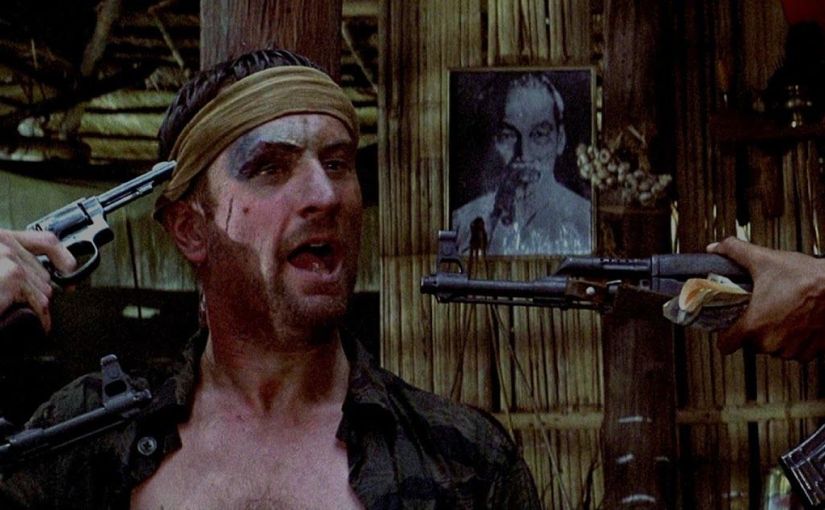
In this movie, I see a perspective of three buddies from a small Pennsylvania steel mill town who voluntarily enlist in the army in the late sixties to serve in the Vietnam War.  Thereafter, they are held as prisoners of war, confined in submerged bamboo cages infested with rats and mosquitoes.  They are only let out to compete against one another in face to face Russian Roulette by a forceful unforgiving Viet Cong.  Upon escape, the three men are separated with different measures of terrible destinies to live with afterwards.

Mike, played by Robert DeNiro, is the Green Beret Army Ranger who returns home to a lifestyle he can no longer lead.  Steve (John Savage) has been permanently traumatized both mentally and physically as he has lost both legs.  Nicky’s (Christopher Walken) whereabouts are unknown.

Before any of this occurs, there is a lengthy first act to The Deer Hunter.  The three men are celebrating their send off to serve, but more specifically Steve is getting married.  Michael Cimino takes much of his time focusing on the ceremony, which contains orthodox Russian traditions, and the party with an enormous amount of wedding guest extras (probably the whole town) to carry out endless, drunken celebrations. 

The first time I saw this film I grew bored with the wedding footage.  It seemed to be overly long and tiring.  Pointless, even.  On this most recent view, however, I found it completely absorbing.  There’s an unbeknownst future to all of these people, not just the three eventual servicemen.  None of the people in this Pennsylvania town live extravagantly.  It’s special for the ladies to wear their formal pink bridesmaid dresses but they run through the wet streets of the town on their way to church.  The men throw on their tuxedos that they likely wore only one time before during their prom.  Once the reception begins for Steve and his wife, Angela, everyone is sweaty and out of breath, happily drunk and wobbly.  They lean on one another in a sloppy way for a group photo. They never stop drinking.  More importantly, they never think about how scary or horrifying the Vietnam War could be for them.  They are celebrating a happily wedded future for their buddy Steve and their soon to come legacies as American war heroes.  Nicky even takes a boozy moment to propose to Linda (Meryl Streep).  Already an abused woman, she immediately accepts.  Mike can only gaze with inebriated amazement at a uniformed serviceman who is disturbingly quiet as he sidles up to the bar.  Mike insists on buying him a drink. 

Late into the night and onto the next morning, the guys are doing their traditional favorite activity with a ride into the mountains for some deer hunting.  They change out of their tuxes and into their hunting gear as they tease one another and gorge themselves on Twinkies with mustard.  None of these boys have a care or worry in the world, except for nerdy Stan (John Cazale) who has once again left his hunting boots behind.

There’s a relaxation and calmness to these people; to the men who are staying behind, to the ones getting ready to leave and to the women who share in their lives.

Regardless of the questions of racism or authenticity, Michael Cimino, with a joint screenplay written with Deric Washburn and Louis Garfinkle, show how the war not only directly changes those that served but also the ones who welcome them home.  Steve’s wife is not only separated from him but also appears mute and inactive.  Linda attempts to move on with her life but is absent of comfort from Nicky, the man who proposed to her on a whim.  Mike is not capable of being the drunken party leader or precise deer hunter he used to be.  The deep scars of the three also draw scars for everyone else back home.

The Deer Hunter is a very difficult film to watch.  The picture ends leaving you feeling traumatized because it stretches from innocent celebration and debauchery over to some of the worst images that could ever be fathomed.   Wars end in a truce, a victory or a defeat, but the conflict does not cease for many of those who participated as pawns for a governing power. 

Nicky never comes back to Pennsylvania.  He tries calling home, but he can never follow through.  He has been changed permanently by his time as a killing soldier and captive who was being forced to use his life for stakes.  Mike returns dressed in his uniform with his medals signifying his achievements but as soon as he sees the “Welcome Home Mike” banners he insists the cabbie drives on by and he does not enter Linda’s trailer home until he sees all the guests leave the next morning. 

There’s a haunt that Cimino’s film ends with as the remaining members of the group assemble following a funeral and segue into singing “God Bless America” together.  I don’t ask this question as a means to minimize anyone who has served or lives as an honored citizen of our country; should these folks who must endure loss from now on be chanting about blessing America, or should they be pleading for a blessing upon themselves? The characters of The Deer Hunter struggle internally and are desperate for a salvation and peace. 

War may be a chaotic, unforgiving hell, but living thereafter is another kind of hell that you cannot escape from.

AUGUST: OSAGE COUNTY

By Marc S. Sanders

Once the dead are buried, the secrets come out.  Some mourn the loss.  Others mourn the reality of what existed.  Tracy Letts’ Pulitzer Prize winning play August: Osage County was adapted into a very well-cast film in 2013.  Letts’ screenplay is just as biting as his original source. Perhaps that is because of the performances of not just Meryl Streep and Julia Roberts, but also the entire collection of actors.

Dysfunctional is not a strong enough word for the Weston family of the sleepy, lifeless area of Osage County, Oklahoma.  The patriarch, Beverly (Sam Shepard) hires Johnna (Misty Upham) a Native American housekeeper/helper, for his pill popping, cigarette smoking wife Violet (Streep) who is also stricken with cancer of the mouth.  Shortly after, Beverly disappears.  The family comes home to the dusty shelves of books and old black and white family photographs and learns that Beverly has committed suicide.  The opportunities flood in for Violet (or Vi) to unleash every ugly, harsh truth that her three daughters Barbara, Ivy and Karen (Roberts, Julianne Nicholson and Juliette Lewis) have encountered along with their partners.  There’s also Vi’s sister Fannie Mae (Margo Martindale), her husband Charlie (Chris Cooper) and their son Little Charlie (Benedict Cumberbatch) to revisit the revelations of the Weston family.  Barbara’s estranged husband Bill (Ewan MacGregor) and her daughter Jean (Abigail Breslin) have their own drama to contend with as well.

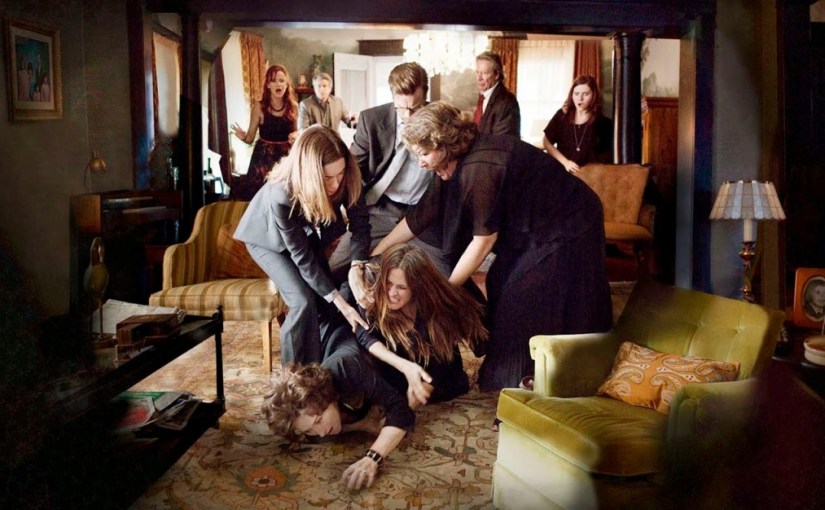
It’s best not to spoil too much of what is revealed in the movie directed by John Wells.  The centerpiece of the picture is the afternoon family meal following the funeral service.  This must be one of the most intense and captivating dinner scenes caught on film in recent years.  Wells positions his cameras perfectly, so you know where every family member is seated at the table and the trading of barbs that go back and forth between the different combinations of arguments.  I would say the scene lasts at least twenty minutes and Wells manages to seat the viewer next to or right in front of every person at the table.  At one end of the table is Charlie.  Chris Cooper is a reluctant fill in to the void left by Beverly, the original patriarch.  The instigator is Vi. Meryl Streep is placed at the other head of the table where her drug addled eye contact can be had with anyone seated in her presence.  I’d love to have seen Meryl Streep while shooting this scene because even when the camera is not on her for a close up, I can still see that she is there in the dining room.  I’d argue she never turned off this persona during the making of this film. 

The most agonizing relationship is clearly between Vi and oldest daughter Barbara.  The first pairing on screen for Meryl Streep and Julia Roberts.  Why didn’t it happen sooner?  Moreover, why hasn’t it happened again since this film?  Perhaps because it is rare to find material of this dramatic weight to justify what can come from these two incredible actors.

The dinner scene is left discomforting to say the least, but the timing and delivery of Tracy Letts’ dialogue is functioning with high energy.  At age fourteen, Jean is the youngest member at the table, and she is questioned as to why she doesn’t eat meat.  According to her, you are consuming an “animal’s fear.”  The Westons are only adoring when they are cruel to one another.  One of the rare times that the rest of the family will unite with the antagonizing Vi is when they can mock and chortle at young Jean’s philosophy for “claiming” to be vegan, which is also undone by her parents when they reveal what she eats back home in Colorado. 

A hip middle aged Florida man named Steve (Dermot Mulroney) in a Ferrari has accompanied Karen to Osage.  Karen is the flighty one with her head in the clouds.  Steve has been married three times and takes a liking to teenage Jean’s curiosity to try pot.  Vi expresses disdain for the jerk with another welcome facial expression from Streep, but Tracy Letts does not have his character lash out or protest Karen’s choice to marry the guy.  For Violet Weston, it is better that Karen does marry this letch.  It gives Vi more purpose to criticize and belabor upon one more poor decision made by another daughter.  Violet thrives on bellowing out the shortcomings of her children, her dead poet/author husband, her sister, and anyone else within her presence.  It’s how she lives and overcomes her cancer while an unkempt wig conceals her chemo remaining grey hairs.

On the side, a relationship is brewing between first cousins Little Charlie and Vi’s middle daughter Ivy.  They know it’s wrong, but they can’t help hiding their affections much longer.  Cumberbatch goes against type here as a nervous, insecure young man who has not matured from his boyhood nature.  Julianne Nicholson appears to be the most held together of the three daughters as she has never ventured out of Osage while living with her parents.  She is now ready to give up that lifestyle, and she’s leaving it in Barbara’s lap to figure what’s to come of Vi. 

Barbara is the most unhinged.  She is married to sweet natured but boring Bill and it’s likely that the past demons she clung to from her upbringing left Osage with her when she relocated to Colorado with her husband and daughter.  Bill might be having a tryst with one of his college students but is he the worst one in the marriage?  Barbara Weston might be Julia Roberts’ best role since her early career film introduction in Steel Magnolias and her Oscar winning turn in Erin Brockovich.  In films like these, Julia Roberts doesn’t look like the starlet she once was in the 1990s.  In August: Osage County she has downed her appearance with no makeup, unwashed hair, and wrinkled clothes while carrying an emotionally exhausted physique.  However, she’s perfect to play the eldest daughter who somehow must be the one responsible for picking up the shattered pieces of dishware that hit the floor on numerous occasions and fractured connections left behind in the family dynamic.  This is a commanding performance by Julia Roberts; one that needs to be seen.  Incidentally, she never does clean up the broken plates.  I only assume it would be her who must do so.  However, the quiet Johnna is around somewhere. She will make everything disappear.

Memorably, a physical altercation ends the dinner.  The day passes into the next mid afternoon and more secrets are uncovered.  Some are quite horrifying, considering the circumstances that some members of the family have themselves in.  Just when you think that this script is ending with a debate of which daughter will look after mother now that daddy is gone, there’s more troubling truth to grapple with as well.

August: Osage County is a movie hinged on the acting chops of its cast with a smart, unforgiving script for the damaged characters depicted.  It falls in the same category as David Mamet’s Glengarry Glen Ross or Sam Shepard’s True West.  We may be witnessing the abnormalities and sins of these people, but it would be more unusual had these folks possessed genuine happiness and solid affection for one another.  The quietly muted Native American Johnna enters the household of people who replaced her own people, who occupied this land long before the early generations of Westons ever arrived.  It’s telling that Tracy Letts demonstrates the original occupants still survive in peace while the ones that took over can’t find a way to live happily among themselves.  Watch the film or see the play.  Then come back and tell me if the white folks of the Weston family truly belong in the once occupied Native American Osage County, Oklahoma.

SOPHIE’S CHOICE (1982)

by Miguel E. Rodriguez

DIRECTOR: Alan J. Pakula
CAST: Meryl Streep, Kevin Kline, Peter MacNicol
MY RATING: 10/10
ROTTEN TOMATOMETER: 78% Certified Fresh

PLOT: Sophie, a survivor of Nazi concentration camps, has found a reason to live with Nathan, a sparkling if unsteady American Jew obsessed with the Holocaust.


I have not seen a movie as stirring, as affecting, or as emotionally shattering as Sophie’s Choice in a very long time.  For years, I was aware of the film’s cachet and of Meryl Streep’s Oscar-winning performance, but the opportunity to watch the movie never presented itself until very recently.  I was intellectually aware of the slang usage of having to make a “Sophie’s choice”, meaning that one had to choose between two equally undesirable options.  I knew it had to do with the movie of the same name, but I had no other context.  And for decades, the real context of Sophie’s choice had remained unknown to me until now.

That fact is one of the reasons Sophie’s Choice had such a devastating impact on me.  The screenplay is another, and naturally, there’s Streep’s landmark performance.

The story opens with an older man’s narration while we watch his younger self onscreen.  This is Stingo, played as a young man by Peter MacNicol.  He’s an aspiring author, and he’s just moved into a large pink boarding house in a Brooklyn suburb shortly after the end of World War II.  On his first day there, he encounters the two people who will irrevocably change his life, Sophie (Streep) and Nathan (Kevin Kline in his film debut).  They appear to be a couple, but they are in the middle of a brutal verbal argument on the stairs, with Nathan yelling awful things to Sophie, calling her a Polack, saying how much he doesn’t need her.  He leaves in a huff, Sophie is in tears, Stingo instinctively goes to comfort her, they get to talking, and the next morning Nathan returns, utterly contrite, at first suspicious of Stingo, but when Sophie assures him Stingo is just a friend, Nathan is all charm and goodwill and has nothing but good things to say about Sophie.

At this point, in my head, I had the movie all planned out.  Okay, so we’ve got a love triangle with a writer/narrator coming between an unattainable beauty and the capricious brute who loves her.  And this, I imagined, is what Sophie’s choice would eventually come down to: the penniless aspiring writer who is “safe” or the roguish charmer with the turn-on-a-dime temper.  Ho hum, been there, done that, I thought, but wow, is Meryl Streep’s Polish accent spot-on or WHAT?  Guess I’ll keep watching just so I can say I watched it.

That’s the ingenuity of the screenplay I mentioned earlier.  It strings you along for close to an hour, making you believe it’s about the romantic relationship among the three leads.  And then the movie springs one of the greatest head-fakes in film history.  What started as a soapy melodrama becomes a character study of the limits of human endurance, with scenes as fraught with tension as anything written by Hitchcock or Tarantino.

(I am going to have to write very carefully from here on out because I want to convey how effective the movie is while preserving its revelations.  It worked so well for me precisely because I knew very little about the plot, and I want to make sure you have the same experience, dear reader.)

Any appreciation of Sophie’s Choice must include a discussion of Meryl Streep’s performance as the title character.  She reportedly begged director Alan J. Pakula for this role, even after he had lined up a Polish actress for the part.  We can all thank the cinema gods Pakula went with Streep instead.  This is, without a doubt, one of the top three or four performances I’ve ever seen by any actor, living or dead.  Even leaving aside her mastery of the Polish accent…well, actually, let’s talk about that for a second.  She learned to speak with a flawless Polish accent.  Then there are scenes where she had to speak fluent Polish, so she learned Polish.  Then there are scenes where Sophie also speaks German, so she learned how to speak fluent German with a Polish accent.  I mean…it took me two weeks to learn two sentences in French and say them fluently.  If there were a fan-fiction theory that Streep is really a magical drama teacher at Hogwarts, I’d believe it.

At times during Sophie’s Choice, Pakula’s camera simply stops and stares at Streep while she delivers a monologue about her days before the war, or about how she survived as a personal secretary to the chief commandant of Auschwitz.  Her delivery during these scenes feels about as naturalistic as you can get.  You don’t feel like you’re watching an actress give a performance anymore.  It’s more like you’re watching a documentary about a Holocaust survivor.  It’s a performance that simply must be seen to be believed.

Next to Streep, Kevin Kline as her beau, Nathan, is almost overdone, stagey, far too full of ebullience and rage and earnestness.  Nathan is Jewish, and he is obsessed with the idea of tracking down the Nazis who escaped justice after the war.  However, his antics are balanced by Sophie’s serenity and unconditional forgiveness.  I look at it as a yin/yang kind of thing.  It works.

There are questions, though, about their relationship, especially as the movie wraps up.  Why does Sophie put up with this lout who whispers sweet nothings to her and impulsively proposes marriage in one moment, and in another moment is given to vicious accusations of infidelity and collaboration with the Nazis, then swings back again in a fit of contrition?  Perhaps she was wracked with survivor’s guilt.  Her parents, husband, and children never emerged from the concentration camps.  Perhaps she felt it was her duty somehow to prop someone up and latch on to a soul like Nathan, someone whose outward cheerfulness masked internal demons.  Perhaps being a helpmate for such a person keeps her own demons at bay.  Just a thought.

When I’m watching a movie on my own, I can measure how effective it is by how many times I talk to myself or yell at the screen while it’s playing.  With Sophie’s Choice, I didn’t do a lot of yelling until it performed its head-fake and veered into territories not even hinted at previously.  After that, there was a lot of my Gods and holy craps and oh Jesus-es.  The end of the movie is a roller-coaster that may not end in the happiest place ever, but it’s the kind of earned emotional catharsis that doesn’t happen very often at the movies.  A movie like this is a treasure.  I hope, if you’ve never seen it, you’ll make it a point to hunt down a copy and see for yourself what all the fuss is about.

And don’t let anyone spoil it for you.

THE DEER HUNTER (1978)

by Miguel E. Rodriguez

THE DEER HUNTER (1978)
Director: Michael Cimino
Cast: Robert De Niro, John Cazale, John Savage, Christopher Walken, Meryl Streep
My Rating: 10/10
Rotten Tomatometer: 86% Certified Fresh

PLOT: An in-depth examination of the ways in which the Vietnam War impacts and disrupts the lives of several friends in a small steel mill town in Pennsylvania

[Author’s note: This will be the first in an ongoing series of reviews inspired by a book given to me as a birthday present by my long-suffering girlfriend.  Entitled Everyone’s a Critic, it challenges readers to watch a movie a week within a given category, then answer questions like, “Why did you choose this particular film” or “Do you feel this film deserved the award? Why or why not?”  Clearly designed to inspire discussion.  This category was “A Film That Has Won Best Picture.” This format is a work in progress, so I hope you’ll bear with me on future installments.

I am going to assume, for the most part, that most readers will have seen the movies being reviewed in this series.  Therefore, some spoilers may or will follow.  You have been warned.]


Once about every couple of years, I like to pick up and read Stephen King’s The Stand in its original uncut version.  My paperback copy runs to 1,141 pages, not including King’s foreword and a brief prologue.  Even Tolstoy would look at that thing and go, “Dude…edit yourself.”  But having read it numerous times now, I cannot imagine what could possibly have been excised from the edited version of King’s novel.  Every detail of that apocalyptic saga feels necessary.  Reading it is like falling into a fully realized alternate universe.

That’s what watching The Deer Hunter is like.  I can still remember the first time I watched it.  I knew its reputation as one of the greatest Vietnam War movies ever made, had heard of its harrowing Russian Roulette scene, and was intensely curious.  I popped it into the VCR, hit play…and for the first 70 minutes I got a slice-of-life drama about steel workers in a tiny Pittsburgh town (Clairton, for the detail-oriented) where, mere days before three friends ship off to Vietnam, one of them is getting married.  And the centerpiece is the wedding reception.  Ever watch a video of a wedding reception?  How high do you think a young teenager would rate its entertainment value on a scale of 1 to 10? 

I could not appreciate, as I do now, how vital this scene is.  Relationships are stated, expanded upon, and brought to a kind of cliffhanger.  Take the mostly non-verbal interplay between Linda (a luminous young Meryl Streep) and Michael (Robert De Niro).  Linda is clearly in a relationship with Nick (Christopher Walken), but it is painfully obvious that Michael and Linda have eyes for each other.  Mike watches intently from the bar as Linda dances at the reception, and whenever their eyes meet you can almost hear their hearts stop beating.  The oblivious Nick even pairs them on the dance floor while he visits the bar himself.  The awkwardness as Michael forces small talk and Linda shyly reciprocates is palpable.  And…is that Nick giving the two of them the eye at one point…?

As a kid, I wondered why this soap opera nonsense was necessary in a Vietnam film.  Of course, I didn’t know what was coming.  That’s the beauty and wonder of The Deer Hunter.  It challenges you to follow along with this miniature melodrama to give meaning to what comes next.

There is a key moment during the reception when an Army soldier wearing a green beret stops by the reception.  Mike, Nick, and Steven (John Savage), who are gung-ho about serving their country, yell their support and let him know how much they’re looking forward to killing the enemy.  The steely-eyed soldier raises his glass, looks away, and says, “Fuck it.”  It’s not terribly subtle, but the ominous nature of this moment always fills me with a sense of foreboding, even having seen the film many times by now.

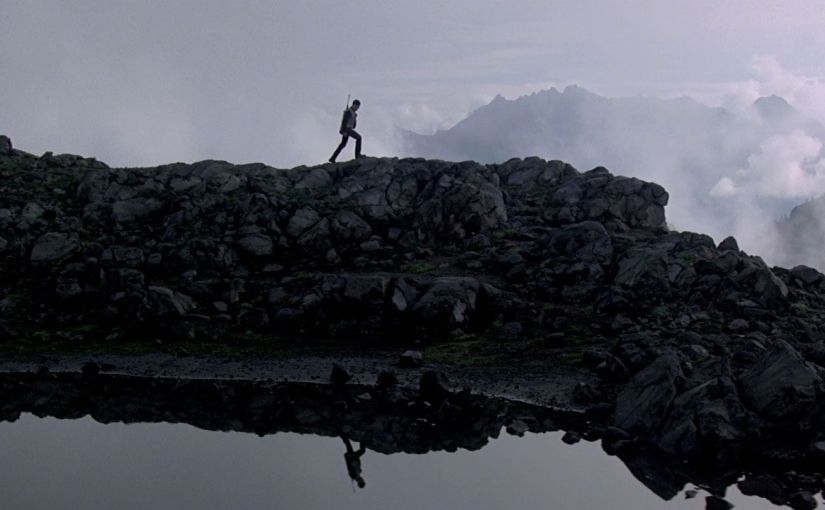
But even after the reception is over, there is one more small-town pit stop to make before the movie gets to Vietnam.  (In fact, The Deer Hunter spends surprisingly little time in Vietnam.)  Michael and a group of friends including Nicky and Stan (John Cazale) go hunting for deer in the mountains as a kind of ritual before Nick, Mike, and Steven are deployed.  It is in this sequence that Oscar-winning cinematographer Vilmos Zsigmond’s talents are put to stunning use.  We are shown vistas of the Allegheny Mountains that are simply breathtaking, with Mike and his friends seen as mere dots in the mountainsides.  Choral music with a men’s choir singing in Russian is heard on the soundtrack, giving the sequence a majestic aura that must be seen and heard to be believed.

Then the hunt is over, and the boys all have one last drunken night at the bar owned by another friend, John (George Dzundza in an under-appreciated, realistic performance).  Here they all sing along to Frankie Valli and listen somberly as John plays a sad classical tune on his piano.  And then, in one of the film’s masterstrokes of editing, we slam-cut immediately to the jungles of Vietnam – no boot camp, no footage of them being trained or flown over there, just suddenly they’re there and the contrast between the carnage we experience in the first few minutes of Vietnam versus the rhythms of their lives in Clairton could not be more extreme.

In a horrific but mercifully brief sequence, we watch as a Viet Cong soldier calmly walks into a burned-out village, discovers a hidden pit holding terrified villagers, and remorselessly tosses a grenade inside.  We then watch as Mike, now a battle-hardened soldier, emerges from a hiding place with a flamethrower and burns the VC soldier alive.

The effect of this scene cannot be understated.  To witness Michael torching a soldier, even after that soldier committed a brutal act himself, is jarring.  And why is it so jarring?  Because we have seen Mike as a civilian, as a friend, as a would-be lover, during that lengthy sequence at the wedding reception and while hunting with his friends.  Admittedly, you got the sense that he could or would get violent if necessary.  (He’s clearly the alpha male of his “clique.”)  But this…I mean, damn.

Then, in one of those Hollywood conveniences that never get old, Mike is unexpectedly reunited with Nick and Steve who just happened to arrive at that very same village with another platoon of US soldiers.  And then, immediately after being reunited, they are captured by enemy forces, imprisoned with several enemy combatants in a riverside compound, and forced by their sadistic keepers to play Russian roulette with each other as the guards bet on the outcome.  Michael comes up with a horrifyingly logical escape plan: convince the guards to put THREE bullets in the chamber instead of one.

Much has been made regarding the historical inaccuracy of this scene.  To those arguments, I say: who cares?  As someone once said, riffing from Mark Twain, “Never let facts get in the way of truth.”  The truth of the matter is, the Vietnam experience was a modern-day horror show, leaving physical and psychic scars on its participants and on our country.  In my opinion, the Russian roulette scene can be interpreted as a symbol of how those soldiers, or ANY soldiers, must have felt every single day.  Going on a routine patrol in the jungle could have potentially lethal circumstances.  They rolled the dice every time they called in an airstrike, betting they didn’t get firebombed themselves.  Booby traps were everywhere.  How is life in a war zone that much different from being given a one-in-six chance at living or dying?

I’ve already gone into far more spoilers than I am accustomed to, so let’s just say this happens and that happens, Michael winds up making it back home, Steven is grievously wounded in the escape attempt, and Nick goes AWOL when, after making it back to a military hospital in Saigon, he wanders the streets at night and discovers an underground ring of lunatics who run a high-stakes game of Russian roulette.  And we’re still just at the mid-point of the film.

When we see Michael back home, the earlier sequences establishing the rhythms of small-town life and his feelings towards Linda, for example, all come into focus.  We need that reception and the hunting scenes so we can see how much Michael has changed.  For example, when Michael is arriving back home by taxi, still in full military dress, he spots a huge banner: “WELCOME HOME MICHAEL”.  He tells the driver to keep going.  In a hotel room later that night, he sits on the edge of his bed and rocks back and forth, winding up crouching against the wall.  He is completely unable to process how to deal with people anymore.  Or, at least, he doesn’t trust what he will or won’t say.  I watch that scene, and I feel such intense sympathy and empathy.  What he’s feeling, what he’s been through, what he’s seen, is so huge that he knows he’ll never be able to explain it to anyone who hasn’t been there.  He knows he’ll get questions like, “What was it like?  Did you kill anyone?  How are you feeling?  Where’s Nicky?”  I’ll never know what it’s like to fight in a war, but if I had gone through what he’d gone through, I wouldn’t have stopped either.

There is a heartbreaking scene where Linda, who is more than a little distraught that Nicky is AWOL, hesitantly suggests to Michael that they go to bed.  “Can’t we just comfort each other?”  Mike rebuffs her, but in a way that makes it clear he’d like to, regardless.  De Niro’s performance here is staggering.  As he walks out, he makes a statement, showcasing how much he is feeling but also how unable he is to articulate it: “I feel a lot of distance, and I feel far away.”  I knew exactly what he was talking about.

The very end of The Deer Hunter is one of the most emotionally shattering finales of any movie I’ve ever seen.  It ends with a simple song, first sung as a solo, then joined by everyone else at the table.  I will not reveal what happens to get us there.  Is it shameless manipulation?  Yes.  Does it work?  Yes, so I can forgive the “shameless” part.

One of the criticisms I’ve read more than once about The Deer Hunter is how “one-sided” it is.  To which I say, “Well, duh.”  The Deer Hunter is not presented as a history lesson or a lecture on the internal politics in the country of Vietnam during the war.  The Deer Hunter is intended to make us feel something.  It wants to show us what happens to a person who is exposed to the very worst side of human behavior and lives to talk about it.  It wants to remind us that a country can wave a flag and stand for what’s right and be willing to sacrifice its best and brightest souls for a righteous cause…but it must also be prepared for the aftermath.  The Deer Hunter is a somber prayer that our country remembers the cost it demands, and that it will take care of its own when the dust settles.

THE RIVER WILD

By Marc S. Sanders

Meryl Streep can do anything. Comedy, drama, accents, age defiance, make unbearable choices, even play opposite Roseanne; anything! She can even go white water rafting. She’s a real life James Bond.

In The River Wild, Streep takes a while to outsmart bad guys Kevin Bacon and John C Reilly, but she always maintains the raft through dangerous rapids while protecting her husband and son (David Strathairn and Joseph Mazzello).

See, according to Curtis Hanson’s adventure film, the best way to outrun the law following committing a robbery is to go white water rafting, even if you have no experience with the sport. That becomes a downer for Meryl Streep’s family getaway where tensions are high in her marriage to her workaholic husband. Fortunately, this setback might get them on the right track and Strathairn will find an appreciation for the dog that has come along. Reader, I won’t give it away but like I said, Meryl Streep can do anything. So, the odds on the family pet making it out of this alive are pretty favorable. Too bad Mazzello and the dog won’t listen to dad when it’s necessary.

The plot of The River Wild is very simplistic. Hanson quickly gets to the river following some exposition of familial discourse at home. However, just because he gets to the river so soon, doesn’t mean that the thrills begin right away. There’s a lot of beautiful nature footage here and everyone is happily getting along. Bacon connects with Mazzello much to Strathairn’s chagrin, and he flirts charmingly with Streep. Then lo and behold, oh my stars, Kevin Bacon is a bad guy??? What? The Footloose guy?????? Why he’s six degrees of any one of us!!!!!

Hanson gets some good action moments on the rapids. There close up shots against the rocks, and right into the water and down the impossible falls. The suspense is lacking though. Strathairn makes an escape in the woods. He’s got a good head start, and the best option he can come up is to climb a steep rock wall in plain sight with no coverage whatsoever. Kevin Bacon, what are you doing? Shoot the guy!!!! Mr. Hanson, you just brought your stride to a screeching halt.

That’s the problem with The River Wild. There’s a lack of thrill to it all. This is not a film brave enough to really endanger the dog, nor the kid, nor Streep. The worst that’s really done is a couple of punches to Strathairn and a cut above his eye.

Mazzello made it as the screamer kid star in his adolescent years in film (see Jurassic Park). Bacon seems like he wanted to get a little crazier in the villain role, but he held back. I wanted him to cross the line a little more, a lot more actually. He wasn’t dangerous enough for me. Reilly was just a bumbling, worried accomplice in tow.

Hanson has done way better than this with his supreme effort like L.A. Confidential and even Eminem’s 8 Mile. Thank goodness I can still respect the man’s career beyond this doused misfire.

LIONS FOR LAMBS

By Marc S. Sanders

Robert Redford directed a huge, glossy looking misfire of a political thriller in 2007 with a film called Lions For Lambs, written by Matthew Michael Carnagan.

Preachiness is never fun when it labors on for an hour and a half. I don’t care if it’s Tom Cruise or Meryl Streep or even Robert Redford doing the preaching. If these powerhouse celebrities called me up and asked if they could come to my house for coffee and talk, and when they got there, all they did was spew in circles a political platform of “right and wrong” and “why” and “don’t” and “can’t” and “yes and no,” I’d call the police and have them arrested. Time for you to leave, Meryl! Tom, it’s been real.

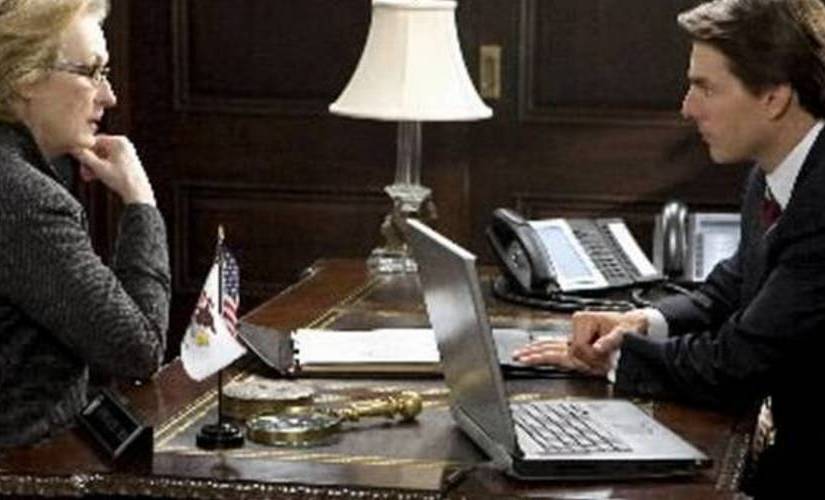
In 2007, during the late half of Bush 43’s second term, questions of war with the Middle East was at the forefront during a post 9/11 age. Redford, with Cruise producing, thought it’d be interesting to show three different stories (actually two long winded conversations set around desks, and two stranded soldiers) occurring. A political professor (Redford) tries to open the eyes of a student (Andrew Garfield) with great potential but no drive to make a difference. A Republican Senator (Cruise) sets up his own interview with a liberal leaning reporter (Streep) to boast of a new secret mission he’s championing, and two special forces ops are left stranded (Michael Pena & Derek Luke) in the cold of Iraq, the most interesting of three narratives.

Carnagan’s script goes in circles and it’s likely the politics he questions all lean left. Yet the conversations (Redford & Garfield; Cruise & Streep) become just a lot of back talk. A character makes a point, and the other character makes a counter point. I was hoping for a line like “Meryl, you ignorant slut!” Where are we going with all of this?

The soldiers are the mission planned by the Senator that has now gone awry and follows their outcome as they are left wounded and surrounded by Iraqi forces in the snowy darkness. We learn they were students of the professor who wanted to make a difference by enlisting in the Army. See the connection now; the very thin uninspired connection?

Here’s something for ya. In case, you can’t recognize easily enough, Redford dresses his characters in either shades of Red or Blue. Nice touch with Garfield’s frat boy wearing a RED Hawaiian shirt while Redford has the BLUE denim button down. Cruise gets the shiny RED coffee mug for a prop. Does the film have to be THIS transparent? If so, couldn’t the dialogue have been as well?

Lions For Lambs talks A LOT and tells me nothing. Streep’s reporter is a disappointment. Yet Redford portrays her as noble. She loathes the platform of the Senator she just interviewed and is adamant about not writing the quite revealing story he just laid out for her. How can she be that way? She’s a reporter!!!! Tell the truth. Inform the public, even if it’s not pretty, and yet Redford will have a viewer believe it is righteous of Streep to figuratively break her pencil and unplug her computer while she gripes to her editor in chief. No! This is an absolute betrayal of journalistic integrity. What is Robert Redford, the once producer and star of All The President’s Men, thinking here???

You wanna talk about betrayal? The final moments with Streep really had me puzzled. She takes a thought-provoking cab ride that drives past the Capital, Arlington National Cemetery, the Supreme Court, and The White House (right, dab, in front of it no less). Reader, I’ve been to Washington DC a number of times as recent as this past summer. Where the hell is this cabbie driving to, and what route was he taking????

OUT OF AFRICA

By Marc S. Sanders

Sydney Pollack’s Out Of Africa might seem like a whirlwind romance if you’re only looking at the top billed names of the cast, Robert Redford and Meryl Streep, but it’s much more than that. It’s an education of the African continent beginning in 1913 when World War I was on the brink, and the British monarchy appeared to become territorial of its lands.

Karen Blixen (Streep) is a Danish Baroness who marries a Swedish nobleman, Baron Bror Blixen (Klaus Maria Brandauer) out of simple convenience. She plans to begin a cattle farm outside of Kenya to manage with Bror. To her unfortunate surprise, Bror has invested her monies in harvesting coffee on the land, which is much more difficult to produce at the altitude where they settle. Bror is also not so concerned with growing to love Karen and would much rather hunt on safari and be a womanizer, while welching off of Karen’s enterprise.

Karen grows to love Africa with its wildlife, as well as the local people whom she does not object to them squatting on her property. She provides medical aid and schooling for the children, too.

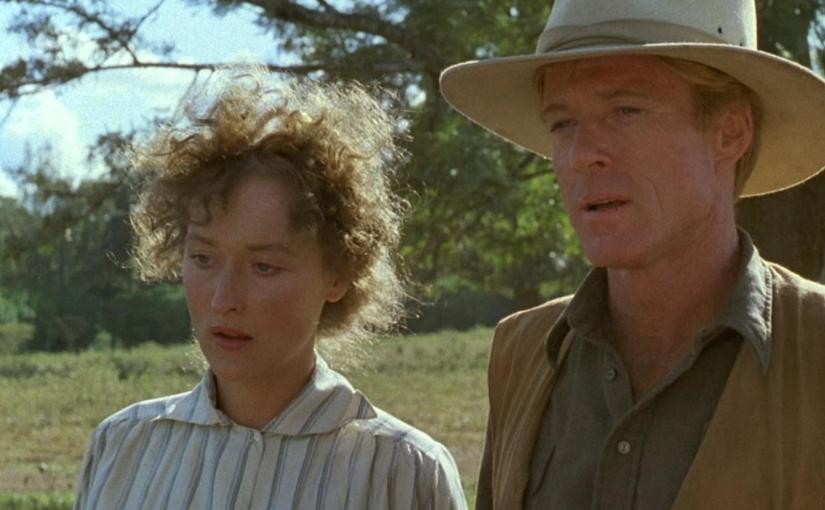
Karen also encounters the dashing adventurer, Denys Finch Hatton (Redford). Denys comes in and out of her life where he welcomes her on expeditions that are up close with lions and rhinos. He also takes her in his biplane to get God’s perspective of the lush scenery, a major centerpiece of the film. Denys, however, is not concerned with offering the full commitment Karen seeks. He’s happy to carry on with his safari treks only to return on occasion.

Clocking in at nearly three hours, Pollack’s film gives plenty of time and footage to absorb gorgeous landscape views of Africa from above and across the plains. The cinematography is on par with some of the best I’ve ever seen in a motion picture, compliments of David Watkin. The colors of sky with green, brown and yellow landscapes are breathtaking. Sunsets are spectacular with Redford’s silhouette in the foreground. Herds of cattle consisting of oxen, gazelles and lion feel so up close and personal. The production design of Karen’s home and coffee farm are also noticeably authentic. The home feels comfortable.

Out Of Africa is based on the stories told from Isek Denisen, Karen’s pseudonym. Like many of these sweeping epics, I find that I need to get accustomed to the nature of the film first. Dialects, when done authentically like Streep always strives for, are challenging for me to understand initially. The African people are hard to understand at times. As well, this is a period picture in a territory that I’m mostly unfamiliar with. So, I find that I have to adjust to the habitat and culture of the characters. Frankly, the first half hour or so was a little tough for me to stay with the picture. Once I got my footing with the film, though, I could not get enough. I felt terrible for Karen when she contracts syphilis. I was truly annoyed with how the Baron treats Karen with such disdain. It’s also heartbreaking when Karen and Denys are in disagreement with one another, simply because I loved the chemistry between Redford and Streep. Later setbacks feel tragic, especially as you feel like you’ve traveled through the progress and impactful differences that Karen affectionately made for Africa and its people.

Out Of Africa is an outstanding piece of filmmaking. It’s another example of a film where the setting is as much a character as the leads who carry the story. Sydney Pollack and his crew, which includes grand horn and string chords from Oscar winning composer John Barry present a captivating story that also feels rich in a documentarian point of view. A restored copy of the film on a large flat screen TV is a must see.

THE LAUNDROMAT

By Marc S. Sanders

Steven Soderbergh gets a little too inventive in his delivery of revealing “The Panama Papers,” in his new film The Laundromat now showing on Netflix.

His film is too convoluted deliberately to drive home the point of shell company, laundered fraud within the world. As such, it makes it very challenging to comprehend every point crammed into his short 90 minute film.

The two Panamanian attorneys behind the scheme, Mossack & Fonseca (played with great duet chemistry from Gary Oldman and Antonio Banderas) narrate the film by introducing different ways in which a shell company valued at everything on paper but tangibly nothing from an actual monetary standpoint.

Primarily, it focuses on Ellen Martin (Meryl Streep) a driven senior citizen who learns the truth of the plot when insurance does not compensate following the tragic accidental drowning of her husband on a boat tour.

Streep is brilliant as always. Such a natural with her monologues and her seemingly useless efforts to gain restitution for her loss.

The whole cast is excellent but the intentional confusion behind the story falls short of satisfying entertainment or enlightenment. I needed some moments where Soderbergh would give it to me straight. A diagram or a graph might have helped.

With The Laundromat Steven Soderbergh fails at becoming the next Jay Roach (The Big Short and Vice). Imagine if Roach actually got his hands on this script. Then there’d be a lot more buzz about this film. Oh well.