STILL ALICE

By Marc S. Sanders

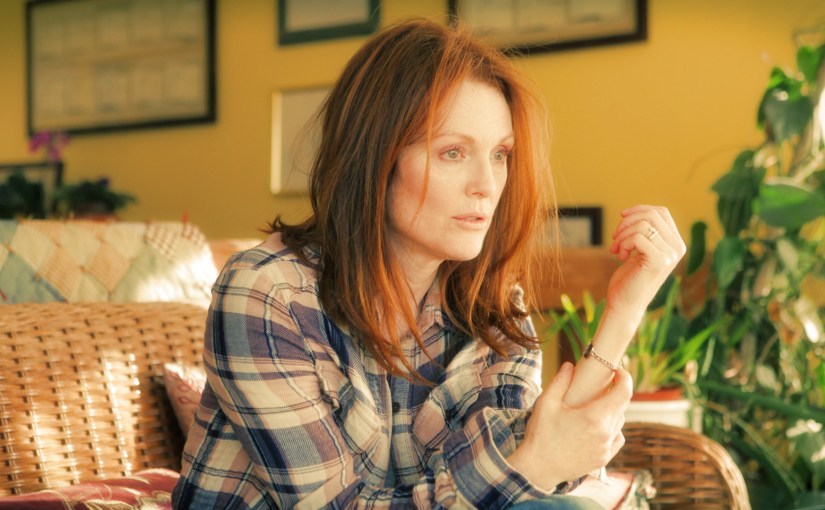
Still Alice is the observation of a woman whose mind gradually deteriorates from the symptoms of early onset Alzheimer’s disease.  Julianne Moore won an overdue slew of awards, particularly the Oscar, for the portrayal of the title character.  It’s a magnificently sensitive performance that will have you in tears following the first twenty minutes of the film.

Alice Howland is a revered Columbia professor of linguistics.  She has three grown children (Kristen Stewart, Kate Bosworth, Hunter Parrish) and John, her loving husband (Alec Baldwin).  The sad irony of Still Alice, adapted from Lisa Genova’s novel, is the fact that Alice specializes in teaching word origins and their formations, but she is stricken by the disease that will wipe her memory of the simplest vocabulary.  A highlighter becomes a “yellow thing.” 

The beginning of the film shows Alice functioning at her highest capacity following her fiftieth birthday.  She teaches her classes, does her daily jogs across campus, plays word games on her phone, travels across country delivering seminars and also tries to convince her youngest daughter, Lydia (Stewart) to abandon her dreams of becoming an actor and acquire a college degree.  Mixed in, however, are losses of train of thought, forgetting recipes, misplacing basic objects, forgetting appointments and getting lost during her jogs.  A quick glance over some visits with a neurologist (Stephen Kunken) set the wheels in motion of what we will witness Alice struggle with over the course of the film.  These doctor visits also teach the audience how one is examined for symptoms with simple memory tests and spelling questions. 

The film was directed by Richard Glatzer and Wash Westmoreland.  After I watched the movie, I learned that Glatzer could not speak while he was directing.  Due to his gradual deterioration from ALS, he had to resort to a computer monitor that would express his instructions to the cast and crew.  So now I’m that much more impressed.  To home in on the sensitivity of Still Alice, it only seems fitting that someone with Glatzer’s condition could co-direct this story. 

This is not a glamourous film.  Sometimes we may laugh at ourselves because we cannot think of a word or we forget a year or a name or we put our car keys in the refrigerator as soon as we come home and reach for a cold beverage.  However, when we see Alice discover that she puts a bottle of liquid soap in the fridge it says so much more.  Illnesses like Alzheimer’s and ALS strip people of the basics in living.  Having recently witnessed a friend slowly suffer and perish from ALS, I know that one disease brings you to this point with complete mental capacity while the other seems to tease you with how your mind gradually deteriorates.  Yet, like Richard Glatzer, my friend Joe did not stop functioning and co-wrote a play with me in his final year of life.  He couldn’t speak.  He couldn’t walk, but the man could write.

I have to credit the supporting cast behind Moore’s performance.  The film begins with the ease of conversations between the family members.  Before you know it, the exchange of dialogue shifts and becomes more one sided.  Julianne Moore most often shares scenes with Alec Baldwin and Kristen Stewart respectively.  She hides so well in her character’s mental incapacity that eventually, it looks like Alice Howland is not even applying the intelligence she’s collected and earned over her lifetime.  A scene in a yogurt shop towards the end of the film seems like Baldwin is the only one working.  He’s consuming his yogurt and reminding his wife of where she used to work while she sits beside him in an absolute haze of emptiness.  He simply says she is the smartest woman he’s ever known and by this point, I know exactly what he is talking about.  Moore is so heartbreaking in moments like this that I have to give credit to Alec Baldwin for maintaining his own performance against a scene partner who cannot offer much in return.

Alzheimer’s first affects the victim but also the family.  Still Alice allows time to explore the inconvenience of the illness.  There is the expected residual squabbling among the siblings.  Alice needs to be overlooked more and more as she gets sicker.  Who can be with her?  John still has to earn a living and has an opportunity for career advancement that he cannot afford to pass up.  A relocation is questioned because will it be okay for his wife.  Lydia is on the other side of the country trying to build her acting career.  Anna (Bosworth) is a pregnant, busy attorney, while Tom (Parrish) is in medical school. 

It’s also much more serious when the family learns that the gene Alice possesses has a one hundred percent chance of being passed down to the children.  This angle is touched upon for a brief moment, but then is hardly reflected as the film moves along.

Still Alice is a difficult film to stay with because it feels genuine in its account of living with Alzheimer’s.  Simple mistakes are just as heartbreaking as the big developments.  Leaving a potato in a purse is as hard to watch as seeing a mother speak to her daughter backstage, following a live acting performance. The daughter is now a stranger to the mother. 

Yes.  At times, the film feels like schmaltz you may find on the Lifetime channel, but then again you are seeing authentic, relatable performances from a cast who make up this family, especially the Oscar winner, Julianne Moore.  Alzheimer’s is an unfair and cruel disease that strips away everything a person builds for themselves in a lifetime.  Pardon the pun, but Still Alice makes sure you never forget that.

MAY DECEMBER

By Marc S. Sanders

A blaring piece of pounding piano music from Marcelo Zarvos hearkens awake the silent opening few seconds of Todd Haynes’ May December against that of a caterpillar/butterfly terrarium.  I don’t like the music and I’m immediately reaching for the volume control on my remote.  It’s only as the film progresses, however, that I develop a grateful appreciation for the often-disruptive soundtrack.

Julianne Moore and Charles Melton are Gracie and Joe Yoo, the relationship referenced in the film’s title.  Twenty years prior, Gracie, at age 36 who already had children and a husband of her own, had an affair with Joseph, a 13-year-old seventh grader at the time, in the storage area of a Savannah GA pet shop where they worked together.  Gracie went to prison for the crime of statutory rape and delivered their baby while serving her sentence.  Once her term was finished, the two continued their relationship and got married, bearing a set of twins, a boy and girl.

As the twins are approaching graduation, a television actress named Elizabeth (Natalie Portman) has arrived in town to do observational research and interviews to prepare for her portrayal of Gracie in a made for TV account of what occurred.  On the surface, all seems calm with the past put behind everyone.  Townsfolk will say that Gracie and Joe are so appreciated and loved in the community, and they love each other.  However, the script from Samy Burch will reveal otherwise as Elizabeth develops different kinds of connections with Gracie and Joe, respectively, as well as others she speaks with in town, including Gracie’s attorney, her ex-husband, the pet shop owner, and Gracie’s now adult son from her first marriage.  His name is Georgie (Cory Michael Smith) who was close friends with Joe until the affair was revealed, and now let’s everything hang out avoiding any kind of subtlety.  He’s even candid about what he believes occurred in Gracie’s childhood that could have dictated why she committed her act.

Todd Haynes’ picture is a complete character study of a story that many would regard as sordid or seedy trash material to talk about over dinner with friends.  People like Gracie and Joe may seem real to any of us who live in another part of the country.  We will never have any kind of relationship with them.  They are meant for cover stories in People magazine and The Inquirer.  It’s soap opera junk or trashy romance novels brought to reality.  It’s easy to judge the kind of person Gracie in particular is because what she has done is wrong and disturbing.  All these years later and they are still receiving packages on their doorstep that contain feces.  Gracie committed a terrible crime, but what does an act like this say about someone who would go to that length, so many years later? 

The performances in this film are astounding.  Charles Melton especially.  Samy Burch writes a disturbing and well-drawn character with Joe.  He’s thirty-six years old now, in 2015 when this story takes place, and as his children are graduating and are about to make their home an empty nest, he seems so much more immature than them.  A telling scene occurs when his son takes out a joint and practically instructs Joe on how to use it.  Joe coughs uncontrollably.  He gets ill, and it is his son who is calming him down.  Gracie also appears to treat Joe like the child she bedded all those years ago, instructing him to straighten up the house and put away his butterfly garden, or not to get into bed because he reeks of the BBQ he used earlier in the day.  Joe lives in an adult body, but he skipped his progressive years to go straight into marriage and fatherhood, and therefore he has not had an opportunity to grow up.

Julianne Moore plays delusional all too convincingly.  She might have confessed guilt to her crime.  She served her time, but as her attorney and Georgie will imply, none of that means anything if she still believes she did nothing so terrible.  She’s now married to Joe, who is now well past legal age and has had a twenty-year relationship with him, as well as the children they share.  Gracie happily accepts her new role as a baker in the community.  Yet, it doesn’t even occur to her that some acquaintances merely place orders just to keep her occupied.  Either Gracie chooses to wear blinders or she’s truly unaware of how she’s considered; still remaining a pariah within her social circle.  It’s devastating when someone cancels a cake order, tells her to keep the money that was paid for the work, but is also told that the cake no longer needs to be baked.  Especially now, as her children from her second marriage are leaving the home for college, she is realizing that she has no worth or value to anyone anymore.  No one even wants to sample her cake any longer.  Part of me wants to say it serves her right, but with Julianne Moore’s performance, it’s also terribly heartbreaking.  There are acts we commit in our lives that we will never, ever recover from.

Natalie Portman adds another accomplished performance to an outstanding resume.  Todd Haynes assists with demonstrating how manipulative and subtle Elizabeth, the starlet actress, is supposed to be.  When she first arrives at the couple’s home for a summer barbecue, Haynes captures Elizabeth with no jewelry on and wearing a hat and sunglasses that she never takes off.  Gracie, Joe and the others come to greet her and offer her a hot dog, but Elizabeth doesn’t reveal herself.  She keeps herself hidden.  She’s begun a camouflage as she initiates her observations.  As the story moves on, we get to see how perhaps a Julliard trained method actor prepares.  She begins to apply her makeup just like Gracie would.  Elizabeth dresses like Gracie.  She wears her hair like Gracie.  Elizabeth duplicates Gracie’s hand gestures captured in news articles.  Most significantly, she develops a bond with Joe, just like Gracie did.  A crumpled-up letter from Gracie that Joe has held on to since they began their affair twenty years ago, is reintroduced later in the film that Elizabeth pounces on.  Todd Haynes captures an unbroken take of Portman reciting the letter in a mirror and it’s an eye-opening moment for the character.  Suddenly, I don’t see Elizabeth anymore.  I see Gracie, and Natalie Portman is playing the predatory sex deviant.

By 2015, this story is a been there/done that.  The general public has stopped caring.  Only a few still carry an anger with those packages that are left on the doorstep.  Otherwise, there’s nothing left to share or care about.  Yet, May December does a fine job of showing the residual detritus of what’s come from such an illicit affair.  Gracie’s husband before the affair will say he’s over the betrayal and humiliation, but clearly he’s not.  Gracie now has two families.  The first family from a standard marriage with adult and teen children she greets as if they are neighborhood kids.  She’s on the outside of what she used to have as a mother. Then there is the second family consisting of the college age daughter she delivered while in prison and the twins that came thereafter.  An awkward moment occurs in a restaurant when the two families run into one another.  No one is well recovered from Gracie’s transgressions, even if she served her time.

Reflecting back on the music, I wondered why it made such a presence in this intimate, quiet drama.  It literally pounds at you every time it is reintroduced.  I believe it first serves as an abundance of the cheesy melodrama that naturally spawns from an unwell story like this.  Elizabeth is set to appear in a television movie adaptation of this ripped from the headlines account, much like a Lifetime movie of the week which shamelessly thrives on this kind of gossip trash.  The music seems to tell me to “LOOK AT WHAT SHE DID!!!!!!”  Later though, Marcelo Zarvos’ composition seems to remind me that this is not just “another story” as Elizabeth freely dismisses it when talking to Joe during a personal crisis of insecurity.  Joe immediately snaps back at her that this is not just some story.  “This is (his) life!!!!!” 

Before Todd Haynes’ film begins, terrible acts have occurred.  During the course of the movie, we see that terrible results remain.  The narrative of May December is kept interesting because we don’t learn everything at once.  There is exposition to uncover as soon as the film begins all the way to the very end where Gracie undoes all of Elizabeth’s prep work with a curveball truth.  Then, we witness Elizabeth do one take after another on a soundstage with a pet shop prop snake twisting around her arms as the seduction of a young, teenage boy is reenacted.  I don’t think Elizabeth got a convincing grasp on what makes Gracie and Joe tick, and now she questions what she invested in and what she sacrificed of herself in order to learn about the character she committed to portraying.

It’s disturbing what Gracie did.  Perhaps it’s at least as ominous that it is now being duplicated for the sake of entertainment in front of a worldwide audience.

SAFE (1995)

by Miguel E. Rodriguez

DIRECTOR: Todd Haynes
CAST: Julianne Moore, Xander Berkeley, Peter Friedman
MY RATING: 4/10
ROTTEN TOMATOMETER: 87% Certified Fresh

PLOT: An affluent but unexceptional homemaker in the suburbs develops multiple chemical sensitivity.


From Wikipedia:  “Multiple chemical sensitivity (MCS)…is an unrecognized and controversial diagnosis characterized by chronic symptoms attributed to exposure to low levels of commonly used chemicals…Blinded clinical trials show that people with MCS react as often and as strongly to placebos as they do to chemical stimuli; the existence and severity of symptoms is seemingly related to perception that a chemical stimulus is present.”

I lead off with that because the disease showcased in Safe is utterly unknown to me.  To me, it sounds like a fancy term for bad allergic reactions, but I’m not a pharmacologist, so there you go.  I don’t mean to suggest it isn’t real, despite the blinded trials.  For the people afflicted by it, their symptoms are real enough for them, so it’s good enough for me.

And yet, despite the fact that Carol (Julianne Moore), the protagonist of Safe, is clearly suffering from something – clinically, mentally, or otherwise – affecting her health in unusual ways…I simply didn’t care.  Safe is one of those movies probably best discussed with a group so I can get opposing viewpoints, because mine is fairly negative.  Apart from Julianne Moore’s effective performance, the movie is a well-photographed but ultimately confusing slog.

Carol is an affluent housewife – sorry, homemaker, she makes that correction herself in the film – whose days are filled with making sure the 2-piece sofa she and her husband ordered is the right color, tending to her rose garden, lunching with friends, baby showers, and Jazzercise (the film takes place in 1987).  Her speaking voice sounds as if she’s internally apologizing for filling the gaps in conversations.  Her relationship with her stepson isn’t the greatest, and the role of her husband (Xander Berkeley) seems to be little more than that of a breadwinner and baby-maker.  Moore is a great actress, and in Safe she succeeds in making Carol a void, which is not an easy task.  (I was sometimes reminded of Anthony Hopkins in The Remains of the Day where his one goal as a butler was to make sure everyone forgot he was there.)

One day, Carol suffers a coughing fit after driving behind a dump truck that spews vast amounts of smoke.  Later, she zones out at a dinner engagement with her husband’s clients.  She has trouble breathing after drinking a glass of milk.  She gets a spontaneous nosebleed after getting a salon perm.  The way the movie and Carol’s character are constructed, I got the idea that her illness was directly related to her nearly crippling ennui.  Actually, Carol reminded me of the main character in Jeanne Dielman 23, Quai du Commerce 1080 Bruxelles, that semi-obscure Belgian film that was recently named the best film of all time by Sight & Sound magazine.  In both cases, a woman goes through the routine of everyday life while something percolates beneath the surface.  Safe attacks the story directly while Jeanne Dielman takes the long, long, LONG way around the barn, but the principle is the same.

Carol sees her family doctor who pronounces her perfectly healthy, aside from her apparent reactions to chemicals.  She starts wearing a mask when going outdoors.  One day, she walks into her local dry cleaner’s wearing her mask before realizing the place is being fumigated for pests.  She immediately falls to the floor with convulsions; blood suddenly appears in her mask.

So far, it’s looking like a “Disease-of-the-Week” Lifetime movie.  Ah, but here’s where it gets sort of interesting.  In a nearly throwaway line, it is revealed that the blood in Carol’s mask didn’t come from her lungs or her nose.  Apparently, she bit her lip.  No one can fathom why she bit her lip, least of all Carol herself.  So, I’m thinking, “Okay, she’s really suffering, but it’s not from anything real.  She bit her lip because she saw the exterminators and their masks and their sprayers and she needed to be sick.”

Mind you, despite the sensational nature of that plot description, the movie up to this point is slow as molasses.  It seems to want to create a sense of creepiness or dread, but because I was pretty sure she wasn’t truly sick, based on the information provided in the story, it didn’t really grab me.

Eventually, Carol winds up at Wrenwood, a kind of “rehabilitation clinic” she saw in a commercial on TV.  If the movie was weird and confusing before, it gets more so from here on out.  Wrenwood is not so much a clinic as a metaphysical/holistic retreat.  Its leader, Peter Dunning (Peter Friedman), speaks to his patients/slash congregation with a curious message that can be distilled down to this: if you’re sick, it’s because your negative emotions – anger, fear, envy, etc. – have gotten the best of you and are affecting your immune system.  In other words, it’s your fault.  And to get better, you just have to be more positive.

This philosophy is insidious to the extreme.  I have a friend right now who was just recently diagnosed with ALS, a disease for which there is no known cure, and which is invariably fatal.  I wonder how he would respond if someone told him that, not only is this disease his fault, but he would get better if he would only be more positive.  Pardon my French, but that’s a load of horseshit.  ALS and cancer kill many thousands of people a day, no matter how positive their attitudes are.  Are you telling me they died because they didn’t smile enough?  Give me a break.

So, here Carol is, with this guy, and she listens to his orientation speech (which is followed by a musical duet right out of a stereotypical hippy commune from the late ‘60s), and she goes back to her cabin and cries her heart out.  And I’m thinking, “Finally, she’s come to her senses.  She realizes, like we the audience do, that this guy isn’t going to help her illness, imagined or not, because he’s a charlatan.”

But no!  She buys into it.  The movie keeps throwing these plot-related curveballs that made it difficult for me to understand what the filmmakers are getting at.  I’ve read that Carol’s illness is a metaphor for AIDS.  Okay, if that’s the case, what is Safe trying to say?  That there’s no cure?  What else is new?  This movie was made in 1995, long after AIDS first invaded the cultural zeitgeist, and two years after the movie Philadelphia brought it into the cinematic mainstream.

But let’s say that is the message.  Okay, let’s talk about how Safe delivers the message.  Short answer: it doesn’t.  At first, the movie would have you believe Carol’s illness is motivated by hysteria and not pharmacological.  Then it isn’t.  Then it is again.  Then she finds a haven that might provide a cure.  Then the haven turns out to be a fraud.  But she goes along with it anyway.  But then her condition seems to get even worse…

Safe wants to have it both ways.  Maybe it’s a Rorschach test.  Or maybe it’s more accurate to call it Schrodinger’s movie, where both solutions are equally possible, depending on who’s watching.  Are there movies that can pull this off?  Maybe you can list other examples besides 2001: A Space Odyssey, because I can’t.  By the time the cryptic ending rolled around, my chains had been yanked so many times that I just didn’t care anymore.  Carol is suffering from her illness, imagined or not, so it’s real to her.  But if the movie isn’t going to come down either way, what is it actually saying?  Having no perspective is worse than having one I disagree with.

Like I said, I need to watch this movie with other people, and we need to discuss it afterwards.  Maybe other viewpoints will broaden my mind a little bit to grasp Safe’s message, whatever the heck it is.  Viewed by itself in a vacuum, much like Carol herself, I was bored sick.

[P.S. The trailer for Safe is one of the most misleading trailers in film history, yet another in a long line of scenarios where a studio cuts the trailer for the movie they thought they’d get as opposed to the one they have. Watching it, you’d think you were in for another Outbreak. But, alas, no.]

THE LOST WORLD: JURASSIC PARK

By Marc S. Sanders

The Lost World: Jurassic Park contains a batch of characters making a lot of stupid decisions all in the name of being stupid for stupidity’s stake.  That doesn’t make it a bad movie though.  Just somewhat…unsophisticated…and stupid.

In the sequel to the monster smash adaptation from Michael Crichton, Steven Spielberg reunites with Jeff Goldblum, now at the top of the credits list, as smarmy mathematician Dr. Ian Malcolm.  It really doesn’t matter if the guy is a doctor of any kind of specialty though.  Malcolm doesn’t utter one scientific fact or theory or observation this time around.  Whatever shred of debate regarding the resurrection of dinosaurs that existed in the first film is completely abandoned this time around.  Carnage, mayhem and outrageous ridiculousness take center stage, stage left, stage right, downstage, upstage, off stage, and over a high cliff.

In an early scene, Malcolm is summoned by wealthy entrepreneur John Hammond (Richard Attenborough, in a welcome cameo).  Hammond tells Malcolm that his paleontologist girlfriend (isn’t that a coinkidink), Sarah (Julianne Moore) is on a nearby island to the original one from the first film, and studying the behaviors of the dinosaurs that were developed there.  She will soon be meeting up with a photographer (Vince Vaughn) and another associate (Richard Schiff; I don’t recall the script explaining his specialty).  So, Malcolm sees no choice but to go after Sarah and rescue her from the island.  This is one Daring Mathematician.

One point of order, because this is a Spielberg adventure, a kid has to be involved.  Malcolm’s pre-teen daughter and gymnast extraordinaire Kelly (Vanessa Chester) stows herself away on the excursion. Thank god she’s gymnast.  That may come in handy.

At the same time, Hammond’s greedy nephew, Peter Ludlow (Arliss Howard) is leading a large expedition crew on the island to recover representatives of each breed of animal to bring back to the mainland in San Diego for show and tell.  The leader of this pack is also the best character in the whole film.  He’s a game hunter named Roland Tembo (Pete Postlethwaite).  Tembo’s price is to hunt down one Tyrannosaurus-Rex for his own game pleasure.  Aaaaand that’s where the story stops. 

I just ticked off a lot of actor names, didn’t I?  Well, this is a sequel and in a monster movie sequel there’s a demand for more casualties of course.  If that’s what you are looking for, you won’t be disappointed. 

You also won’t be disappointed in the assortment of dinosaurs on hand.  This time there are two T-Rex’s and they are used beautifully in a very daring, albeit long for the sake of maximum suspense, scene that involves our heroes dangling within a double RV trailer that has been pushed off a cliff.  When Sarah lands face first on the back windowpane of glass, try your best not to bite your nails.

Another exceptional scene is when the expedition runs into a tall grass raptor nest.  This is like Jaws on land.  With the help of much CGI, but also puppetry from Stan Winston’s imagination factory, Spielberg gets great overhead shots of fast forming black lines that quickly cut through the meadow taking out one poor soul after another where beast overcomes man. These moments occur in the large second act of the film where it’s nothing but action done with Spielberg’s skill to oversee. 

The third act is questionable, but I found a nostalgic admiration for it.  Spielberg goes for the salute to King Kong, the grand daddy of all monster movies.  Ludlow’s hubris and what remains of his expedition team trap and bring back the male T-Rex to San Diego aboard a large freighter.  In the dead of night, garbed in his finest suit, he’s ready to give a speech to a press junket that must work a graveyard shift introducing the marvelous attraction.  Naturally, we know things will not go as planned.  Now, we know this is not New York City and the Empire State Building is not nearby, but this T-Rex will naturally run amok anyway and settle for destroying a suburban dog house, about a dozen cars and a 76-gas station.  No, it is not King Kong, but the salute is appreciated nonetheless.  There’s even a wink and nod to Godzilla.  I laughed.

Pretty stupid of Ludlow to do this, right?  Well, he’s the villain.  So, let’s give him a pass.  On the other hand, the heroes are dumb as rocks.  Sarah takes a baby T-Rex away from its quarters. Ian gets up into a high area platform with his daughter as an escape to safety…but then he comes down again!!!!!  The hunters simply think they are hunting kittens no matter the stature of any of the game they are pursuing.  The telephone doesn’t get answered when it really, really should.  You’ll find yourself shaking your head and outstretching your arms at the screen (palms up) as if to say “WHY????????”. 

It really doesn’t matter.  The first Jurassic Park film never had a fully developed brain.  This installment, unabashedly, never even stops to think.  It’s as if a collection of characters in a shoebox raised their hand for volunteer slaughter. 

My wife watched this with me recently, and at times she would ask “Why are you doing this or why not just call such and such?”  I’d have to remind her it’s not that simple.  Cuz if it were that simple, then they would have picked up the phone.  We all have a destiny in life.  I truly believe that.  The destiny of the cast of The Lost World: Jurassic Park was to run and maybe or maybe not get chomped on and eaten.  This is what they were groomed for their whole lives. So, let’s not interfere with the laws of nature.

BOOGIE NIGHTS

By Marc S. Sanders

Boogie Nights was director Paul Thomas Anderson’s second feature following a very different and very quiet film debut with the gambling addiction piece Hard Eight.

Heck, it’s fair to say all of Paul’s films are very different; here is the seediness of porn while later in his career he will focus on the ruthlessness of a wealthy and angry oil man and then an obsessed dressmaker devoid of care for the models who parade his accomplishments. (See There Will Be Blood and Phantom Thread.). Paul was definitely striving for recognition with his familial depiction of life in the California pornographic film industry.

What I’ve always liked about Boogie Nights was Anderson’s intent to show the naive innocence of this large cast of characters. Filming blatantly oblivious awful porn scenarios can still be regarded as very proud efforts by its talent.

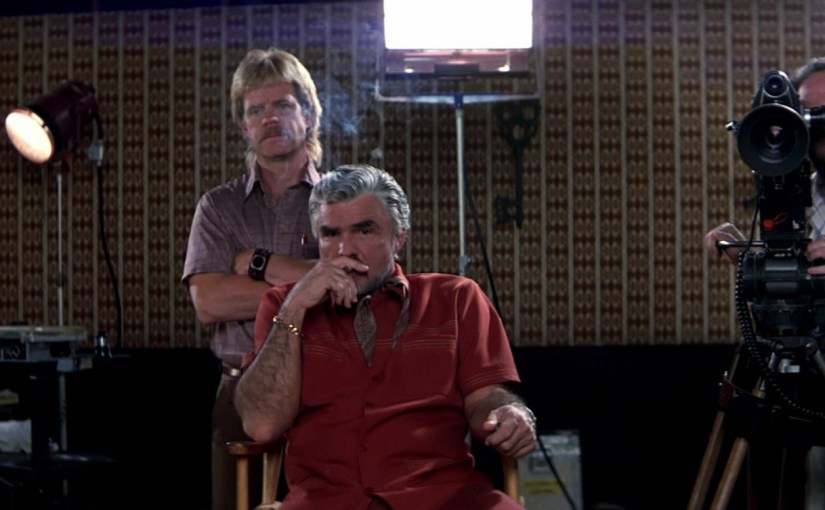
The main character is Eddie Adams (aka the amazing Dirk Diggler) played with macho pathos by Mark Wahlberg. It’ll likely be the best role of Wahlberg’s entire career. Dirk is proud of his natural talent in front of the camera. He’s even more proud of what God has gifted him. Don Cheadle is another porn star named Buck. He’s also proud of his accomplishments and simply a kind fellow looking to make country cowboy a trendy look for a black man while selling the “Hi-est Fidelity” in stereo equipment on the side. Julianne Moore is Amber Waves, the maternal porn mom of the bunch; very affectionate, very comforting and very reassuring when Dirk shoots his first porn scene. The one individual who really holds all of these misfits together is Burt Reynolds as Jack Horner, the porn film director. He’s the paternal one who believes in his artistic merits of shooting porn but with a story, and only with the integrity of film, and never the cheapness of videotape. So, Jack is like any artist who insists on a certain type of canvas. It might be smut, but he has principles, and he has pride.

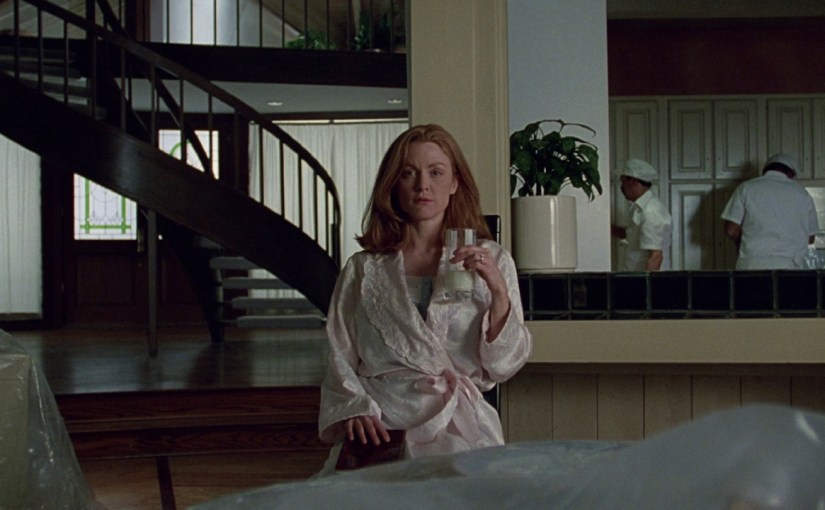
Anderson is wise in how he divides up the developments. The film begins in the late 1970s during evening night life and decadence and everything seems fine and innocent and right despite the endless debauchery of reckless sex and drug use on a Disco backdrop. Wahlberg’s character is welcomed lovingly into this world, and nothing appears wrong. It all seems to stay that way for Dirk until New Year’s Eve, 1979. The 80s begin with a gunshot and then Anderson’s cast must pay for the revelry of their sins. A great moment presented on this night is where Amber Waves introduces Dirk to cocaine. Dirk has been thriving, making money, developing a following and now it is jeopardized in one moment thanks to his naivety. Julianne Moore is superb in this particular scene against Wahlberg. She’s the mentor with the peer pressure to pass on her high and keep it running.

Drug addiction, violence, sexual abuse and even changes in pop culture lead to hard times for these likable people.

It’s a hard life. It’s a complicated life. Yet it’s not all necessarily illegal. Morally, it might appear wrong, but it’s a life nonetheless.

Anderson was wise to use (at the time, relatively new) filming techniques of Martin Scorsese with rocking period music and fast edits along with savored moments of great steady cam work. One long cut especially works when the film first begins on the streets of Reseda and on into a crowded night club. This industry doesn’t sleep. So, neither will the camera that follows it. The music must also be celebrated. I do not listen to Night Ranger’s Sister Christian without thinking of firecrackers and a dangerously drug addled Alfred Molina playing Russian roulette. Though I know which came first, I also wonder if Three Dog Night’s Momma Told Me Not To Come and Spill The Wine by Eric Burton & War was written to enhance the celebratory introduction for Dirk when he attends his first party at Jack’s house. It’s another great steady cam moment from a driveway, followed by steps in and out of Jack’s house to simply a bikinied girl’s dive in the swimming pool. As a viewer I was absorbed in the California haze. Superior camera work here.

The cast of unknowns at the time were a blessing to this film. Anderson writes each person with care and attention and dimension. They have lives outside of this world like Amber’s child that we never get to meet, thanks in part to her lifestyle. She might be maternal but that doesn’t make her a good mother. Julianne Moore should have won the Oscar she was nominated for. Burt Reynolds’ own legacy seems to carry his role. His distinguished silver hair and well trimmed beard earn him the respect of every cast member and he performs with a quiet grace of knowledge, and insight, even if he will inevitably be wrong with how things turn out. Phillip Seymour Hoffman plays the dumb kid Scotty insecure and unsure of his homosexual attraction to Dirk. It’s not easy to play a dumb character when you are not doing it for laughs. Hoffman makes a huge impact with little dialogue but Anderson is wise enough to capitalize on him.

Boogie Nights offers one of the best cast of characters and assembled talents in any film ever made. An individual movie could be made about each of these people, and it’d be interesting and entertaining.

Try to avoid a blush and mock at the industry depicted because then you’ll see how another walk of life truly lives day to day. It might be porn. It might be smut. Yet, it’s still a thriving industry.

MAGNOLIA

By Marc S. Sanders

Ernie Anderson was the cool voiceover for the ABC television network that would introduce upcoming programs for years. He was a staple of the television industry from the 1970s through the ‘90s. I promise that you or your parents know his sharp, recognizable tempo. So, it makes sense that his son Paul Thomas Anderson would center his multiple story crossover film Magnolia around the television industry, within a 10-block radius in the Hollywood Area. Magnolia presents the off-chance coincidences that somehow happen and the unusual phenomena that can occur when never expected.

Anderson’s three hour epic offers storylines centered around former and present day game show quiz kids (Jeremy Blackmon, William H Macy), the game show host stricken with cancer (Phillip Baker Hall), the drug addicted daughter he’s estranged from (Melora Walters), the dying game show producer (Jason Robards), the producer’s son who is a motivational speaker for men to sexually conquer women (Tom Cruise), and the producer’s gold digging wife (Julianne Moore).

Because the narrative of the film has a biblical theme specifically referencing Exodus 8:2, there are also two good natured guardian angels involved. John C Reilly as a sweet but clumsy police officer proud of his work, and a sentimental hospice nurse played beautifully with bedside sympathy by Phillip Seymour Hoffman.

Anderson’s film opens with three stories of random coincidence that resulted in the deaths of three different men. More than likely most people would say these tall tales of legend could only occur in a movie. Yet, the voiceover narrator , Ricky Jay, says they did not, and thus begins one specific day with torrential downpours of rain, where all of these random characters will come in contact with a personal experience of monumental impact that will change their individual lives forever. Oddly enough, all these people are somehow connected to one another and are within blocks of each other located near Magnolia Blvd in the Hollywood Hills.

Like Boogie Nights, Paul Thomas Anderson directs a film of very weighty emotions that thematically focuses on the sins of fathers that carried over to the futures of their children. The game show is titled “What Do Kids Know?” which likely symbolizes what they didn’t know while at the behest of their parents during their youth. What they know now about their fathers is a burden to bear in insecurities, drug abuse and outright cruelty for the opposite sex. Every character represents some aspect of this ongoing theme during Magnolia. It’s a lot, a whole of information, but fortunately it moves at a very swift pace with an energetic steady cam and dramatic notes of instrumental soundtracks.

Anderson consistently shows different references to Exodus 8:2 by either using the numbers in clocks or decks of cards or temperature readings of the weather or on marquee signs. It’s almost like a scavenger hunt when seeing the film on a multiple viewings.

MAYBE A SPOILER ALERT:

“But if you refuse to let them go, behold, I will plague all your country with frogs.”

Sure. Most recognize the Bible verse as Moses’ decree to Pharaoh to release the Jews from Egypt. I like to think Anderson used Magnolia to release his beloved, but damaged, characters from their own sins or the sins of their fathers. Set them free even if it could be by means of confession, judgment, offering and begging for forgiveness, or journeying towards a personal salvation.

The smart device that Anderson uses is the angelic music of Aimee Mann. Often I talk about how I love when film characters would spontaneously dance. In Magnolia, the cast surprisingly breaks into song with Mann’s confessional number entitled “Wise Up.” It more or less summarizes each individual plight that all the various characters must endure. Magnolia is only an even better film because of Mann’s music.

Magnolia is a beautiful film that I draw many personal parallels from, especially having now lost both of my parents and being by my father’s bedside during his difficult final days of illness.

It is very touching, sometimes funny, and sometimes a difficult film to watch with a belief in random coincidence that is only stronger after watching it.

Like the film insists “we may be through with the past, but the past ain’t through with us.” After Magnolia finishes, you won’t be through with Paul Thomas Anderson’s film. It’s a film that will stay with you.

THE FUGITIVE

By Marc S. Sanders

In 1993, Andrew Davis directed the best Alfred Hitchcock film that was not directed by Alfred Hitchcock. The Fugitive with Harrison Ford being pursued by Tommy Lee Jones was a runaway smash. As we now live in an age of cell phones and the World Wide Web, you’d think this film might be somewhat dated but it is the last thing on your mind while watching. This is a tense, taut thriller that never, ever lets up. Another favorite picture of mine.

The opening credits serve as a prologue, showing Dr. Richard Kimble struggle with a one armed man in his home after his wife (Sela Ward) has been assaulted and killed. Kimble becomes the accused and eventual guilty party who is sentenced to death.

Davis is now ready to show his first of many wonderful set pieces. As Kimble’s prison bus careens off the road landing on railroad tracks, an oncoming train collides with the bus. Kimble and another prison inmate now have the opportunity to escape and go on the run. Enter Tommy Lee Jones as Deputy Sam Gerard and his team of smart, intuitive misfits to catch up to Kimble who has made a mad dash into the dense Illinois woods. Because Kimble and Gerard are depicted to be incredibly smart, Kimble only remains a few steps ahead throughout the picture. Later in the film, Kimble makes his way back to Chicago to search for the one armed man and uncover exactly why his wife was murdered.

Location shots are masterfully done in The Fugitive. From the woods to a sewer system (a manufactured set I believe), to the streets of Chicago and Cook County Hospital.

The train crash is one of the all time best moments in film. No miniatures. No CGI. This is a fully loaded train crashing into a bus, and this is where you can not deny the craftsmanship of great filmmaking. Cameras were positioned at multiple angles to capture the mayhem in one take.

The other great set piece occurs during the actual St Patrick’s Day parade in Chicago. Gerard once again gets Kimble in his sights and Kimble manages to blend in with the parade marchers. The quick editing of improvisational camera work is spectacular here. Kimble and Gerard are literally in the same frame and yet Gerard can’t see what’s under his nose. Moments like these can’t be storyboarded. Andrew Davis’ production could not stop the actual parade for another take. It all had to be done on a now or never basis.

I watch The Fugitive and I always think back to Alfred Hitchcock’s best work like The Man Who Knew Too Much and North By Northwest. An innocent man is unexpectedly swept up in a conspiracy where he becomes the target and his adrenaline and instincts must kick in to save himself. The only thing he’s armed with is his mind. There’s also an unusually creepy antagonist, The One-Armed Man. This makes the film incredibly foreboding. I know the film stems from the legendary television series, but Davis treats this villain as if he’s among the ranks of Hitchcock’s use of Martin Landau or James Mason.

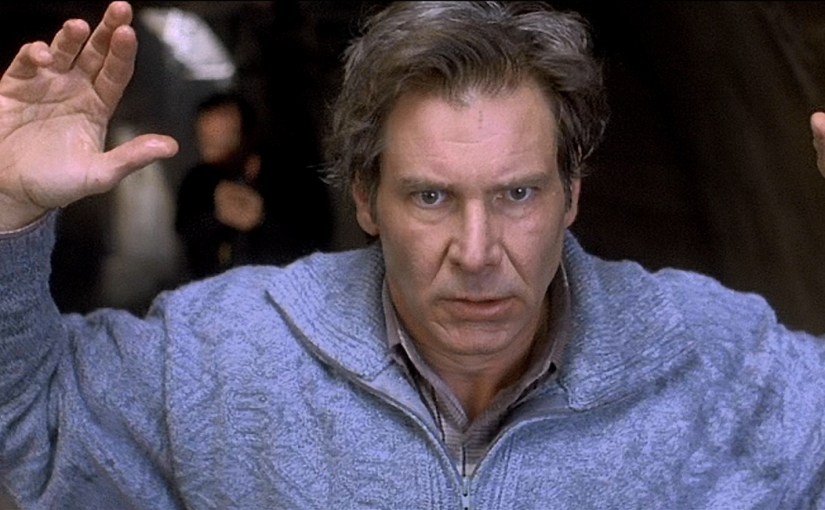
Harrison Ford is great at never glamorizing his role. He doesn’t suddenly become Rambo. He becomes a man of convincing desperation. Ford shines in roles like these such as his other films like Witness, Air Force One, and Frantic.

Tommy Lee Jones gives one of my most favorite performances on film. He plays Gerard with non stop adrenaline. He has exquisite chemistry with his team, including Joe Pantoliano. As well, Gerard is only interested in fetching what has escaped. He has no interest in guilt or innocence, until he realizes that Kimble has no interest in the consequences of escape. Kimble is interested in his innocence. Even Gerard becomes attuned to Kimble’s drive. Here is where the script is wise. There is no dialogue to imply what Gerard is thinking. Tommy Lee Jones has a way of giving a great close up to show what he’s thinking. He trusts the audience will presume what’s driving his intuition.

Davis pulls out all the stops with this film. There’s magnificent action shots of Gerard’s helicopter quickly flying over the ambulance that Kimble is racing away in. A great cat and mouse maze sequence happens within a sewer system. Lighting is perfect, there. Nothing is overly dark. There’s also incredible overhead shots of the dam and ravine that Kimble makes for a getaway with an absolutely surprising dive from an enormous height.

The Fugitive is smart and action packed to the teeth. You are in full focus while watching the ongoing pursuit. This film was nominated for Best Picture. Rare for an action film, but also a testament to its greatness. Tommy Lee Jones deservedly won the Oscar for Supporting Actor.

No doubt for me that The Fugitive is a must-see film for any kind of moviegoer. There are moments to feel scared, to laugh, and to cheer. When it is finally over and the story arrives at its satisfying conclusion, you cannot help but let out a deep breath. You feel like you’ve run a hundred miles, or at least as long as Richard Kimble ran towards his innocence. Your time will be well spent investing in the The Fugitive. An absolutely fascinating picture of great, mounting suspense.