THE WILD ROBOT (2024)

by Miguel E. Rodriguez

DIRECTOR: Chris Sanders
CAST: Lupita Nyong’o, Pedro Pascal, Bill Nighy, Stephanie Hsu, Ving Rhames, Mark Hamill, Catherine O’Hara
MY RATING: 10/10
ROTTEN TOMATOMETER: 97% Certified Fresh

PLOT: An intelligent helper robot winds up stranded on an island populated only by wild animals.  To survive its new environment, it adjusts its programming, with unexpected results.


Just days after watching Flow [2024], a dialogue- and human-free animated film about animals struggling to survive after a cataclysmic flood, I watched The Wild Robot, also human-free, also starring mostly animals, and also about the struggle for survival, but it adds conventional dialogue and an intelligent robot in search of its purpose.  In broad, REALLY broad strokes, they are similar, but don’t bother asking me which one is better.  I give them both a ten-out-of-ten, each for different reasons from the other.  Flow may be literally unique, at least in my experience, but The Wild Robot tames its genre and bends it to its will, creating one of the most heart-tugging movie experiences since Wall*E [2008].  If you’re prone to crying during a movie, this is a three-hanky film, at least.  (Penni went through five, herself.)

On a dark and stormy night, a mysterious container washes up on the shores of an uninhabited island.  Inside is Rozzum 7134, an intelligent helper robot with exceptional physical capabilities and the speaking voice of Lupita Nyong’o.  Hope she gets her royalty checks.  Upon escaping her would-be watery coffin, Rozzum searches the island for the one thing that will give her existence meaning: a task to complete.  The opening scenes get us off to a hilarious start as she tries to complete tasks for various animals, to no avail.  In an intelligent bit of screenwriting, she powers down for a couple of days and, through passive listening, effectively learns the language of the animals around her.  In a lesser movie, this feat might have been handled with the push of a button.  I liked the fact the writers went for something a little easier to swallow, science-fiction-wise.

Through circumstances which I will not reveal, Rozzum winds up as the guardian for a newly-hatched gosling, and as the unlikely friend of a fox named Fink (Pedro Pascal, whose voice was utterly unrecognizable; I thought it was Matthew Broderick).  The gosling imprints on Rozzum, which she finds bothersome.  A helpful mom opossum, Pinktail (Catherine O’Hara), warns Rozzum that the gosling must learn to feed itself, swim, and fly by the next fall so he can migrate with the other goose; otherwise, it will starve during the harsh winter.  Presto…a task!

Eventually, Rozzum is shortened to Roz and she names the gosling Brightbill (Kit Connor).  As she undertakes her task of raising the gosling, Roz’s programming…evolves.  She starts to actually care for the little guy.  She starts asking questions that robots aren’t supposed to ask.  She exhibits all the early warning signs of helicopter-momism.  And all the while, she debates whether to activate the internal beacon that will let her makers know where she is…

Because the plot is so dependent on tugging those heartstrings, that’s all I’ll say about it.  Let me talk instead about Wild Robot’s visual style.  The backgrounds and characters are gorgeous, sumptuous, evocative of oil or acrylic paintings.  I could mention two or three specific shots right now that contain some of the most beautiful animated imagery I’ve seen since Pinocchio [1940], but I don’t want to give anything away.  (Hint: butterflies and geese.)  In this way, among others, it shares a lot of DNA with Flow, whose backgrounds and characters also resembled hand-painted objects.  I don’t even want to think about how long it took to create such a painterly style and make it look so effortless and organic.

I also liked the way Wild Robot used its story to make a pointed commentary, but not in the direction I thought it would go.  From the trailers, I assumed it would be yet another paint-by-numbers story about preserving nature or life, which was already covered as well as it possibly could be covered by Brad Bird’s The Iron Giant [1999].  Instead, Wild Robot makes some eloquent statements about the terrifying task of parenthood.  At one point, Roz, who is programmed to solve problems, discovers the task she’s undertaken – raising a gosling, i.e., being a parent – is a task that could potentially never end.  She experiences the fear of almost losing a child.  The joy of watching Brightbill learn to fly, while at the same time realizing that means he will one day migrate.  As I list the plot points here, it sounds like the movie is composed of cliches, but I can assure you, it’s not.  All of these nuances, and many more, are allowed to occur organically without the slightest hint of being nudged along by the screenplay.

DreamWorks has created possibly their best animated film since…gosh, I’ll go all the way back to The Prince of Egypt [1998].  It’s a crowd-pleasing adventure with a point, which is a hallmark of only the best science-fiction movies/stories.  There are real stakes on the line.  There are some actual deaths in the story, which surprised me for some reason, but there you are.  It looks sensational.  It’s smart.  I can’t say enough about it.  The Wild Robot was one of my most favorite films of 2024.

BEETLEJUICE

By Marc S. Sanders

On Friday night, we watched Beetlejuice the movie.  On Saturday afternoon, we watched Beetlejuice the musical, and as soon as the curtain was pulled on the stage and the performance began, I knew exactly what the movie did wrong and what the play did so right.

I saw Tim Burton’s much beloved spooky comedy for the first time just last year with my Cinemaniac pals, which includes the other Unpaid Movie Critic.  The guys were laughing and laughing until it hurt.  I was off to the side thinking how I remember seeing that scene while flipping channels on occasion.  Cute, but ultimately boring.  That’s how I feel about Burton’s second film, following a hilarious debut with Pee Wee’s Big Adventure and just ahead of his blockbuster accomplishments with the first two Batman films.  Beetlejuice is full of big ideas but devoid of content, and I mean that literally, because the title character brilliantly played by Michael Keaton is scarcely in the film.  When he is not on screen, the remaining cast are quite bland or unwelcomingly weird.

Adam and Barbara (Alec Baldwin, Geena Davis) happily reside in a three-story Connecticut home.  Adam indulges in making a scaled model of their picturesque hometown and Barbara…well I can’t recall what she does.  On an errand trip, they haphazardly die and suddenly return to the house.  Yet, they realize quickly that they have expired and what is even less convenient is that they cannot leave the house lest they end up in a kind of limbo threatened by a monstrous sand worm and other unusual experiences. 

Shortly after, Charles and Delia (Jeffrey Jones, Catherine O’Hara), appearing with the typical Tim Burton flavor, move into the house along with his suicidal daughter Lydia (Winona Ryder) and their quirky interior decorator Otho (Glenn Shadix).  They plan to refurbish the house in their own way with Delia’s ugly art sculptures and Charles looking for a reading room.  Adam and Barbara want them out so they can roam free and avoid being contained within the attic. 

Upon discovering that Lydia can speak with them and following an entrance to the Netherworld, they get an idea to scare the new owners away.  Only whatever efforts they set out to make fails miserably and they consider reciting the name of the “ghost with the most” three times to carry him over to their side to do their bidding.

Great storyline.  Sounds great on paper.  So why didn’t it work for me?  Well, Lydia is resigned to her mostly miserable suicidal self and that is neither funny nor empathetic to me.  More importantly, conflict works best when different worlds clash and what I find lacking in several Tim Burton films is that the characters on both sides of the coin are not different enough from one another.  The ghosts or souls or comforts of the Netherworld do not look far enough apart from how Charles, Delia, Lydia and especially Otho behave.  Everyone is weird.  Where is the normalcy to ruin or undo or disagree with? 

Beetlejuice himself is a character to behold though.  Keaton is doing Jim Carrey better than Jim Carrey does and long before that guy was ever discovered.  The actor is working in the area of Robin Williams material, particularly as the Genie from Alaadin.  The issue I have is that Michael Keaton is seldom in the film.  It is a long first act with Baldwin and Davis not doing much of anything before they finally encounter Beetlejuice to have a couple of funny exchanges.  Then they leave him to have mundane conversations with everyone else in the film, particularly Winona Ryder who has nothing to do except dress in her signature, depressing black.  When Keaton finally is summoned, he takes possession of a dinner party with the beloved Calypso tune “Dayo.”  However, we don’t see Keaton in this popular sequence.  Instead, we get Jones and O’Hara with David Niven doing odd contortions to the music with some butt shaking and grotesque facial and body expressions.  I would rather have seen Keaton doing his funny best in a lip sync routine.  What’s in the final cut is just not funny enough for me. Kooky, yes.  Funny, no.

Eventually, the black and white striped suited ghost with green hair is called back for the final act and we get to see him pull all the tricks out of his hat.  However, it’s not enough.  Just as the routine is getting started, it’s over, and then the movie is over. 

There are some inventive sight gags.  Not enough though.  I particularly loved the shrunken headed ghoul with the googly eyes and the pink skinned prostitute whose legs are separated from her torso.  I love when Beetlejuice’s head gets shrunk, and I like when Adam and Barbara’s faces are contorted into odd shapes of gigantic beaks or zany skulls beneath their facial skin.  These are the highlights of this film’s Netherworld and the distance I travel to see it all is smaller than Rhode Island.  In the original Star Wars, I experienced what felt like thousands of alien races.  In Ghostbusters, New York is haunted by one different kind of afterlife from another and another.  In any episode of The Muppet Show, I get to see one breed of silliness before another ridiculous set up is put into play.  The Netherworld setting of Beetlejuice is simply not vast enough.

The stage musical makes up for the shortcomings I have with the film.  The spine of the story is what the two pieces have in common.  After that, the stage play takes more risks.  The musical numbers are absolutely winning.  More significantly though, all the characters are granted more depth and dimension.  The root cause of Lydia’s anguish is explored.  We see the snobbery of Charles just like in the film, but he is also a loving father who recognizes Lydia’s suffering following the loss of his wife/her mother.  Delia also has a desire to connect with her stepdaughter Lydia.  All the elements are given enough attention amidst the craziness offered by Beetlejuice himself who occupies the story from beginning to end.  The character works like a great two-hour stand-up routine with his unlimited imagination of ghoulish trickery and fun.

Burton’s film was released in the late-1980s when updated stop motion effects of the puppet kind were new to the medium of film.  The imagination was there, though it does not hold up as it is very outdated.  Still, Tim Burton was showing his gift for macabre creativity that he has become known for ever since.  Nevertheless, he did not go far enough with the vision of his film, and he did not award any of his characters enough ingredients to let them be unique.  It is not enough that they all speak weird and look strange.  It is better if we can know why they are so uncompromisingly odd.  Beetlejuice the film lacks its variety. More specifically, it lacks its Beetlejuice.

ELEMENTAL

By Marc S. Sanders

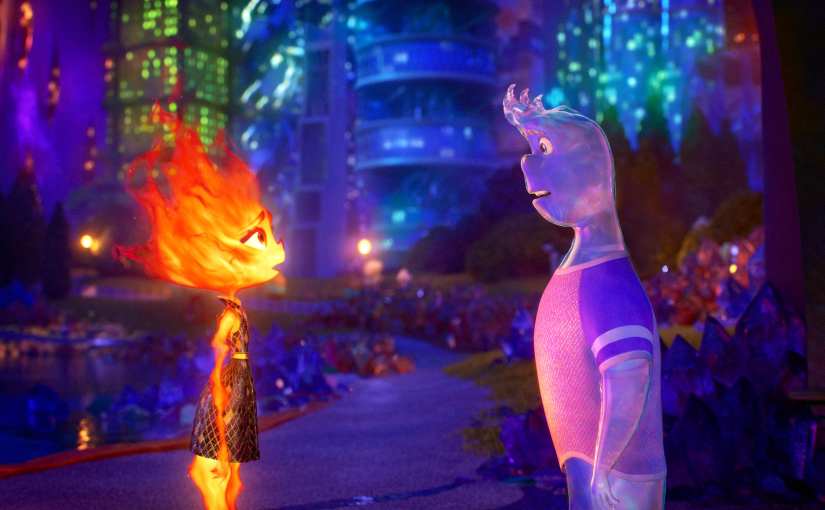
Ember and Wade are perfect for one another.  They truly belong together.  Yet, science dictates that they have zero chemistry.

Ember is a figure of fire.  Wade is a bubbling, joyful standing puddle of water.  They reside in Element City along with people of earth and air, respectively.  Pixar with Disney Studios, has transitioned from emoting human feelings in lovably figurative toys, monsters, cars and colorful emotions to the primary elements of our planet.  Hence the title Elemental.  It’s a blessing that the storylines and messages of this digitally animated feature are a winning combination.

Ember (Leah Lewis) is the daughter of her fire immigrant parents, Bernie and Cinder (Ronnie Del Carmen, Shila Omni).  She loves to work with her dad in his mercantile shop that he built from nothing, known as The Fireplace.  She’s hardworking and dedicated, but she can suffer from a short temper that turns her firebrand orange disposition into a raging purple. Suddenly, she’s charred the shop interior and maybe some of the customers.  

Wade (Mamoudo Athie) is a water made building inspector who by unexpected circumstance comes upon the aftermath of a temper tantrum from Ember.  He works as a building inspector for the city and simply by doing his job he cites enough offenses with The Fireplace that could shut down the shop for good.  Now Ember must work with Wade to avoid that from happening, including haphazard water leaks that are stemming from a mysterious source within the city.

Elemental works because while it bursts with magnificent color, it has a story to tell in a brilliantly inventive and functional environment, much like the Monster World in Monsters, Inc. Pixar does not just stop at the marvelous animation. Their products continue working even beyond their well planned stories and conflicted characters.

With this film, the immigrant crisis that is a prevalent problem in the real world is addressed, but simplified for all ages to comprehend.  Fire based citizens, inspired by Asian/Eastern cultures, are typically restricted to only fraternizing within their area of the city, among only their demographic.  They are regarded as harmful and unsafe from the other three elements.

On the other hand, people of water, air and earth live in harmony.  Director Peter Sohn, with a highly informative script from John Hoberg, Kat Likkel and Brenda Hsueh, is consistent with this reflection.  Water, air and earth make up the first three iterations of Element City.  Fire gets no recognition.  Fire was not invented by a higher power.  It had to be discovered.  Therefore, they are sadly treated as a minority.  The film doesn’t go so extreme as segregating the fire community to literal internment camps, but the feeling of isolation seems quite authentic.  

Yet, fire serves an important purpose. Bernie might envision his daughter taking over the business as he is getting older and slower.  Still, with Wade’s help Ember is realizing that she has talents that will make her happier and more fulfilled.  She’s a natural at honing glass sculptures with merits in practicality and art.

At the same time Wade and Ember are becoming friends and maybe there is something more going on in their newfound relationship.  Problem is they dare not make contact with one another.  What would actually happen if fire and water mixed?  Bernie and Cinder would never approve of this relationship either.  As well, poor Wade and Ember may be frowned upon with prejudice if seen in public together.  

My colleague Miguel reminded me that Elemental gets 98% of its science accurate.   I definitely appreciate that.  However, I’m also grateful for the remaining 2% left for my suspension of disbelief that is quelled by insightful imagination.  Ember and Wade are such wonderful characters that they deserve the happiness they long for.  As I watched, I longed for their destinies to outlast the seemingly impossible.

This is a special film from the Pixar factory.  Elemental demonstrates that nothing should limit what any us of yearn for.  No shortsighted policy of any kind should bar us from our pleasures.  There’s a way for anything to work together.  It only takes some thought.  So you know what I say as I root for Ember and Wade?  SCIENCE/SCHMIENCE!!!!

AFTER HOURS

By Marc S. Sanders

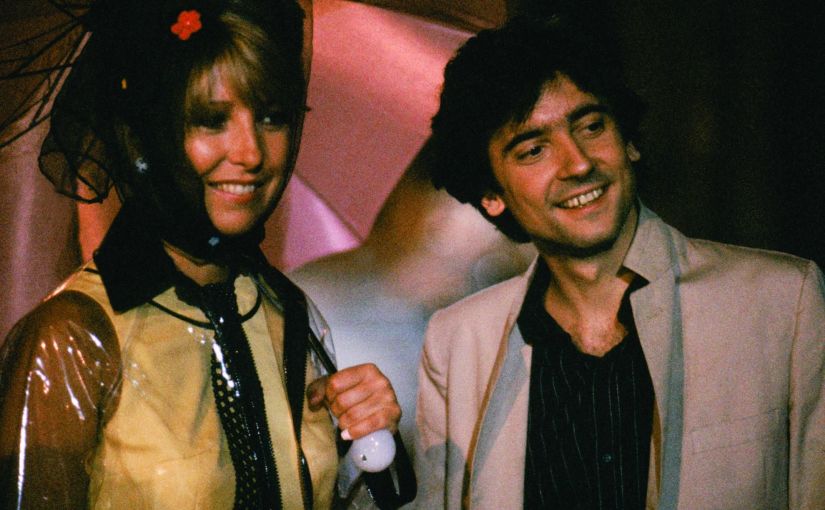
If L. Frank Baum’s classic fantasy The Wizard Of Oz were adapted in a setting of say 1985 New York City in the So Ho section, beginning sometime after 11:30 at night, then it would be a fair argument to change the name of his story to After Hours.  The story would no longer be whimsical. Instead, it would be screwball, with a disturbingly demented narrative from the brilliant but unsettling camera work of Martin Scorsese.  The protagonist would be a lonely yuppie named Paul (Griffin Dunne) who encounters one odd woman after another when all he intended to do was meet up with a kind and attractive young lady named Marcy (Rosanna Arquette) who offered the opportunity of obtaining one of her roommate’s specialty crafts of Parisian bagel & lox paperweights.  (Yes.  You read that description correctly.  Don’t overthink it.)  Unlike Dorothy from Kansas though, the oddballs that Paul meets up with become challenging to him even if they insist on welcoming him into their arms.  These women are not the comfort conveniences of a scarecrow, tin man or lovable lion.

How odd that this film from Scorsese would follow his masterpieces, Raging Bull and Taxi Driver; a major departure from themes of mental disturbance exhibited by characters like Jake LaMotta and Travis Bickle.  Here, the disturbance hinges on paranoia that eventually develops; not seeded in place at the start.  The film relies on absurd situations where Paul inadvertently gets in over his head when all he wants to do is return home and sleep. It quickly dawns upon Paul that it is likely not a good idea to go out after hours when a whole other kind of community is awake, that is uncustomary to his lifestyle.  I was waiting for the film, written by Joseph Minion, to tell me it’s all a dream.  My foolhardy mistake though.  Scorsese would never resort to such a tired, cliché.  If he is going to direct a film of the utmost ridiculous, then he’ll make certain Paul’s unfortunate outcomes are believable…even if they are hard to be believed.

If you’ve seen at least three of Scorsese’s films prior to After Hours, you’ll likely just fall in love with this picture based on his craft with the camera partnered with his always trusty editor, Thelma Schoonmaker.  Cinematographer Michael Ballhaus has his first collaboration here with Scorsese (before Goodfellas and Casino).  Conversations in offices or diners or apartments or bars occur, only they are more exciting than countless other exchanges of dialogue. You will be watching a film that does not sit still and always strives for your attention.  So, while Arquette’s character describes an ex-boyfriend’s obsession with the film adaptation of Oz, your director at play startlingly zooms in on her performance monologue and then circles back to Dunne, her listener on the other side of the table.  No standard quick cuts.  The camera circles and surrounds the players.  A set of keys dropped from a balcony straight down directly towards Dunne’s waiting face below gives an eye opening zoom thanks to Ballhaus’ techniques.

The developments that quickly fall upon Paul are not fair for him.  He loses his only twenty bill that he can rely on, gets caught in torrential downpours of rain, uncovers a suicide, becomes trapped in a punk rock club that wants to give him a tortuous mohawk, and a modern-day pitchfork mob equipped with flashlights and an ice cream truck are hungry for his head because they believe he’s a serial neighborhood burglar.  The poor guy can’t even make a phone call because a ditzy Catherine O’Hara revels in breaking his concentration to remember a phone number.  Teri Garr also appears with a bee hive hairdo as a waitress at an all-night gay diner vying for attention that Paul just can’t afford to give at three o’clock in the morning.  Paul just wants some basic help from anyone who can offer a simple gesture. None of it is that simple however, and the problems build upon one another until they are compounded upon his shoulders so much so that at one point, he literally cannot move out of the physical circumstance he ends up in.  Forgive my vagueness, but I wouldn’t dare spoil what that literally means.  You owe it to yourself to watch the film and find out for yourself.  My first instinct was to go “Come on!!!  Really!!!” Yet, then I remembered this is a film of daring escapes.  Still, Minion’s script and Scorsese’s film turn those breathless escapes into deeper depths of a So Ho hell, as the film proceeds to its inevitable sunrise.

After Hours might have been a subpar John Hughes comedy, only vaguely remembered from the decade of excess, the 1980s.  In Martin Scorsese’s hands though, it’s comedy pathos and yet frightening at times.  Only Scorsese can show us funny, yet bleak.  That’s okay.  It’s different.  I’ve seen the standard slapstick unfortunate circumstances of School Principal Ed Rooney in Ferris Bueller’s Day Off, and countless copycats thereafter.  Scorsese offers up a different, inventive, and very twisted approach for a typical victim of circumstances beyond his control.  

My recommendation for a double feature:  watch Neil Simon’s The Out Of Towners with Jack Lemmon and Sandy Dennis.  Then watch After Hours.  You may begin to understand how New York City can be a vicious and unforgiving beast with enough chutzpah to attack you, even if you never deserved any kind of punishment.  If you’ve ever found yourself in any kind of metropolitan city throughout North America, you’ll likely nod your head at what this poor guy encounters, and you might not feel so singled out.