GHOSTBUSTERS: FROZEN EMPIRE

By Marc S. Sanders

When you make a new installment in a long-celebrated franchise, going on forty years, you have to reinvent the base material to keep it fresh and new.  I think the Jurassic Park/World movies are fun, but don’t they also feel like carbon copies of each other by this point?  I mean how much can you broaden the adventures that come with dinosaurs? The roar, they run, they eat.  

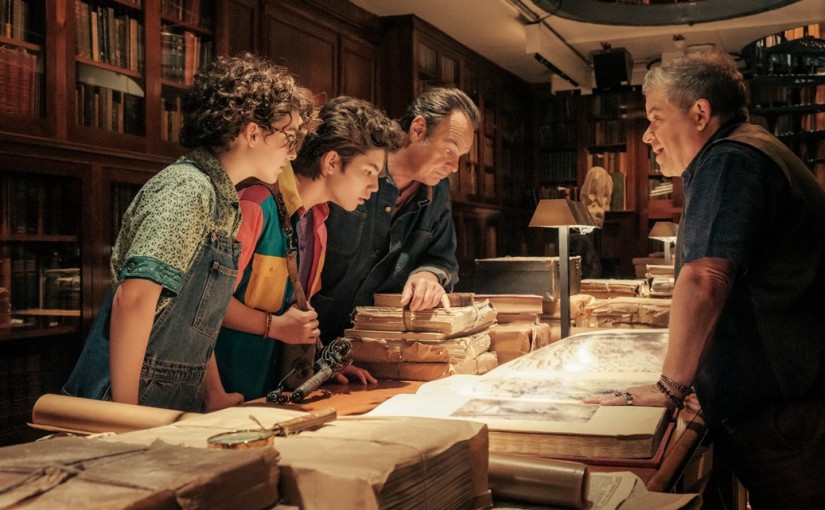
With the Ghostbusters films, there’s more flexibility in what you can do.  You can replace Saturday Night Live players with a fun, lovable leading man like Paul Rudd and he can team up with some brainy kids to fend off ghosts in the best movie jungle there is, New York City.  However, why drain all of the comedy out of the burger?  

The ongoing teenage troubles of the latest reinvention of the Reitman/Ramis/Aykroyd property hinges on so much teen angst that ghosts and ghouls only appear after we’ve endured one Breakfast Club moment after another.  Sadly, there aren’t many spooky critters roaming around the metro area anymore.  Who you gonna call? Doesn’t feel like we need to call anybody, really.

Here’s the pyramid food chain of Frozen Empire.  1) Sad, frustrated teens 2) Inevitable cameos of the celebrated heroes of the first two movies 3) Ghosts.  This movie needs to reexamine its priorities.  

The main storyline is carried by McKenna Grace as Egon’s granddaughter Phoebe who is grounded by Walter Peck aka Mr. Pecker aka Dickless (William Atherton).  I’m referencing what this guy is remembered as because the movie fails to do so. Phoebe is a minor.  Therefore, she can’t hunt after ghosts and thus builds a relationship with a sixteen-year-old friend named Melody (Emily Alyn Lind) who appears in the form of blue supernatural lighter fluid.  Melody died in a fire.  Sooooooo…much of these two young ladies’ sad sleepover conversations populate the film.

Then there is Dan Aykroyd returning as Ray to enlighten some back story on the main monster we can expect to appear in the third act.  He’s performing like an R.L. Stine adult in a second-rate Nickelodeon kid’s picture though.  Ray Stanz was always the guy who had loony science on his mind, but the comedy of the character shown through with Aykroyd’s boyish naïveté.  Remember how excited Ray was to go down the fire pole or when he thought up the giant marshmallow man?  What about when he talked back to the pink slime in the first sequel? It was downright ridiculous and now Ray is a midlife crisis depressant.  

Bill Murray is collecting a paycheck again.  The character is the same with the comedian’s special sarcasm, but if he’s in this film longer that ten minutes it’s a lot and he utters no more than five lines.  He serves one purpose to Frozen Empire – to be in the advertisements and draw a crowd.  Paul Rudd and Bill Murray have done two Ghostbusters and an Ant-Man movie together and somehow, they still have yet to share a great exchange of dialogue.  For the third time in four years, Rudd and Murray seem to be unaware that they are both members of SAG working on the same project.  If I ever need to deliver the argument that there is a lack of good writers working today, I’ll use these missed opportunities as an example of what I mean. 

Annie Potts wears the nerdy glasses, but I don’t remember a thing she says.  Ernie Hudson as Winston plays the financier of the modern Ghostbusters, but there’s nothing special going on with him.  Even the librarian from that fantastic opening of the 1984 film appears.  He talks to Ray for a moment and that’s it.

Why are these people here?  Just so we can say “Uh!  Look who it is!!!”  C’mon!  Surely, there’s something better to be spun here.

Part of the plot involves the threat that the storage container of all the ghosts ever captured over the years will be breaking down soon and set all of the paranormal prisoners free.  That’s brilliant!!!  Yet, why doesn’t the movie capitalize on that????? We are threatened by this terrible scenario over and over with music of impending doom and glances at a digital monitor.  Can the thing just break already?  

We see the slimer green ghost blob under a pile of candy wrappers in the attic.  Not bad.  Where are the other ghosts we had become familiar with?  Remember the cab driver, or the angelic apparition that seduced Ray in his sleep?  Where are they?  I’d rather see these guys than a boring Dan Aykroyd in a jean jacket.

The best parts of Frozen Empire occur in a turn of the century prologue with frozen characters in a formal dining room.  There’s also a fantastic pursuit following that scene showing all the cool tricks of the updated ECTO mobile as it races through the streets chasing after an eel like monster.  During the sequence a drone trap launches off the roof of the hearse!  That’s awesome.  The last good scene occurs midway when one of the stone lions outside the NYC public library comes alive. Everything else in this sleepy picture is very bland, however.

The original, and even Ghostbusters II and the Paul Feig lady comedienne reinvention worked as comedies like the franchise became known for.  I wasn’t crazy about those two sequels but at least the ghosts were the punchlines.  Now the main ghost needs therapy and so does the lead character.  It’s so dreary.  

Where’s the funny?  There is no longer a silliness or loony tune appeal to these monsters.  As well, there are no more jokes to tell about The Big Apple.  Don’t forget that Ghostbusters showed us that ghouls can pop out of drainpipes, drive cabs, gorge themselves on room service meals and hot dog stands and even cause the ghost hunters to wreck a posh banquet hall all in the service of the greater good.  The well of laughs that stem from New York cannot be all dried up just yet.  There are subways and buses to haunt. Broadway theatres. Cell phones. Parades. Ferrys. Morning News Shows.

I left Ghostbusters: Frozen Empire feeling morose and melancholy.  When I got home, I knew for the first time that Zuul could never be living in my refrigerator and suddenly I was as sad as Melody and Phoebe.  If this movie is depressing, then is it me or is it the Ghostbusters of today?

AVENGERS: INFINITY WAR

By Marc S. Sanders

Avengers: Infinity War is a really FAT movie. Like ORCA FAT (thank you Keyser Soze), because it is chock full of so much to see. If this equated to gorging on junk food, after two hours and forty minutes, I would have a diabetic cardiac arrest immediately following the credits. Is this a film that is worth that handicap, however? You bet it is.

There is an ensemble of top Hollywood talent portraying a huge cast of characters, once again, and thus another installment has surfaced in the franchise that allows them to have various moments to shine. Producer Kevin Feige with all of Disney’s support, has mastered the formula to ensemble casting and production, as good as when George Clooney and company performed under Steven Soderbergh’s direction in the Ocean’s 11 remake. Thousands of special effects shots do not overpower the stage presence of the actors. The Marvel movies succeed because a story is always written first. Then witty dialogue comes thereafter, and then valid, convincing shock value. The special effects are the final ingredient. This is what the Transformers franchise and (yes, I’ll even own up to it) the Star Wars prequel trilogy (about ¾ of it) failed to achieve. This successful formula gives merit to the (at the time) biggest opening weekend ever, worldwide, and Avengers: Infinity War deserves the accolades.

How good is it? Well, reflecting back to May 1980, when sitting in a crowded theatre watching the ending to The Empire Strikes Back, by comparison I think audiences have finally been served up a cliffhanger (10 years in the making) that is just as effective. How is this all going to wrap up from here? How is this all going to be resolved? Reader, I don’t know if the next chapter will be satisfying. I don’t know if we will feel cheated like Annie Wilkes from Stephen King’s Misery. Presently, however, I’m turning an ending like this over in my mind; the same way I did with my pals in 1980 debating the survival ratio of Han Solo and if Darth Vader has told the truth, and if that was Vader’s brain or head that I saw, and who is this “another” that Yoda referred to….and that, my friends, is what makes a spectacular film. I don’t care if it gets watered down in the hype and McDonald’s promotions and toys. If you can mull over a movie long after it has ended, for days, even months and years, then a film like The Empire Strikes Back and Avengers: Infinity War has more than served its purpose.

Josh Brolin provides a villain with a justification to his madness. He’s not just twirling his mustache to be mischievous and sinister. He has a destiny to fulfill, and his portrayal of the mad titan Thanos does not compromise. This is a beast of a purple villain with size 52 boots and gold-plated armor with a chin that looks like it was clawed by Wolverine. Thanos cries, actually cries, while committing his crimes. He’s not just cackling. He flat out says that he executes his actions all so that he can relax and retire. Isn’t that what we are all trying to do, anyway? Nothing wrong with that. Guy sounds like a CEO to a large corporation. Maybe Thanos is updated to resemble an Elon Musk. 

All of the other actors from main staple Robert Downey Jr to Chris Pratt to Chadwick Boseman to Zoe Saldana and Chris Hemsworth, and so on, remain consistent to what we’ve seen of various prior installments. Their gimmicks continue to avoid becoming stale. Audience applause is cued by their appearances. These are well loved characters.

As an avid comic book reader of the silver age (1980s), Avengers: Infinity War presents itself as of one those annual limited series runs that were special because they were MAIN EVENTS!!!! My favorite back then was Marvel’s Secret Wars. Typically, a comic book from the 1980s would average about 18-22 pages with advertisements sprinkled in. Nearly every scene in this film equates to one issue of a limited run of a main event. That is a why a fat movie like this succeeds. The cast of characters are separated in various story lines. The scenes are given their time to flesh out and develop to move the subplots and overall story along. Each scene is like reading a new 18 page issue comic book. If I’m watching a comic book film, by golly, I want to see how a comic book is brought to life in a cinematic medium. Marvel’s films succeed greatly over DC’s films (produced by Warner Bros) because they rely on the source material. They know they got the goods. Cast it right, adapt it properly and go with that. If it ain’t broke, don’t fix it. A wealth of material (nearly 70 years) and Marvel/Disney uses it all. (How does DC/Warner Bros miss the mark so often?)

Of all of the Avengers films, Infinity War is definitely the best one. Ironically, I wasn’t expecting it to be. I was waiting for this stuff to get old and tiring. It just hasn’t faltered yet. It hasn’t gotten lazy yet. It all seems so fresh still. It’s a fantastic cinematic accomplishment. Sure, its main story is a guy chasing down six different colorful MacGuffins. So what! It’s simple. It allows the characters to stand out from there. An organized plotline like this doesn’t take much effort or time to explain its purpose. It states its conflict early on, and then the show stopping moments present themselves. One after the other after the other until a monster of an ending that is so jaw dropping, head shaking, thrilling and gasping, satisfyingly arrives. 

More importantly, the MacGuffin search drives the motivations and fleshes out the film’s main character, Thanos. This Marvel installment belongs to Josh Brolin as Thanos. Everyone else serves as his antagonists. What matters is that the bad guy wins this time, just like demonstrating that an Empire will strike back. Ironic that Spider-Man makes a humorous correlation to that celebrated franchise from almost forty years ago.

Avengers: Infinity War ended up in my top 10 list of 2018, and still holds as the best film in the Marvel Cinematic Universe.

GONE GIRL

By Marc S. Sanders

David Fincher is best when he builds tension in dark cinematography. It’s eerie and moody, but it all seems to make appropriate sense.

A skilled director like him proves that even with Lifetime television soap opera material, if delivered with care for detail and with genuine acting he can hold on to the attention of a scrupulous movie going audience. Haunting filmmaking, like Fincher is known for with movies like Seven or Panic Room, can also work in sensational material that at first might draw the attention of lonely housewives pigging out on Rocky Road ice cream while watching hours upon hours of scorned victim gossip material on the WE Channel. Gone Girl adapted from the best-selling novel by Gillian Flynn, who also wrote the screenplay, is a thrilling cinematic piece even if the story’s ending is a little disappointing.

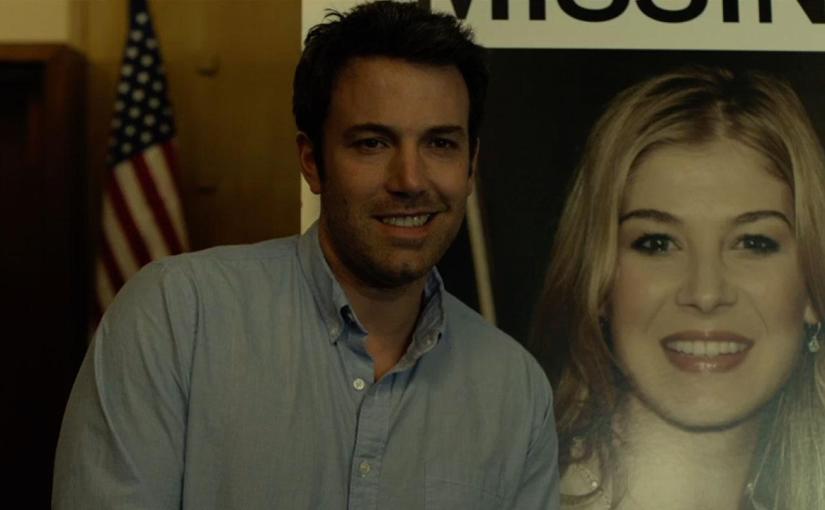
Ben Affleck plays Nick Lowe who discovers a broken glass coffee table in his home and realizes his wife of 5 years is missing. Rosumund Pike is Amy, who seemingly vanished without a trace.

Fincher closely shoots Flynn’s story with developments you might expect or have experienced with various news stories and documented investigations by sensational legal journalists like Nancy Grace. Nick, with Amy’s parents (Lisa Banes, David Clennon), initially form a united front for the press but that falls apart when it’s uncovered that Nick has had an affair. Amy had a close neighbor who expresses tearful concern that cameras latch on to for ratings. The cops (Kim Dickens, Patrick Fugit) grow more and more suspicious of Nick. Nick eventually hires a high-priced lawyer (Tyler Perry). Nick is eventually considered to be an abusive husband as well. It all adds up.

These are the steps you’d expect from a missing persons case. You might also suspect murder, but no one can claim that out loud if there’s no body to be found. So, toe the line carefully detectives, journalists, & gossip mongers!

What is not expected in Gone Girl are the surprises that open up midway through the picture, and the book. Flynn is a really inventive storyteller, and Fincher as director gives ample opportunity to answer for every surprise up the writer’s sleeve. Gone Girl plays with a lot of internal character thought to process its details.

I had read the novel long before the movie was even cast, and I couldn’t put it down. That being said, I was frustrated when the conclusion arrived. I can say the same for the faithful film adaptation. It’s an ending that could happen but, wow, is it a long shot.

Rosamund Pike was Oscar nominated as Amy, the complicated wife in this marriage. She’s good at occupying the complexity of her past shown in flashback. She’s likable in many moments, but then Amy is also a character that we are reluctant to trust based on her relationship to Nick, as well as her own parents.

Affleck remains a good actor with this picture. I think it takes an honest actor, writer and director to accurately show a man who might not be responding to this crisis like a general public expects. I think much of Affleck’s personal issues of infidelity and alcoholism in the public eye lend credence to how genuine he makes Nick out to be. Could this guy be handsome enough to think he could harm or actually murder a woman as beautiful as Amy; the “Amazing Amy” as she’s widely known in her mother’s series of best-selling children’s books? Is Nick that good at hiding his evil side? On the other hand, is Nick simply innocent, despite all the skeletons that are gradually uncovered? That’s a fair question as well.

Again, Gone Girl is superb in its delivery. It’s ending, though, is the setback. At least I felt that way. For every reader, like me who considers it dubious, I’m sure there are readers who applaud the inventiveness of Gillian Flynn’s gripping and modern mystery.

I guess if a good story prompts a group discussion on a Saturday night, then a really good novel or a great movie has achieved its purpose. At the very least, I consider that a great compliment for an outstanding cast, director and writer.