NIGHTBITCH (2024)

by Miguel E. Rodriguez

DIRECTOR: Marielle Heller
CAST: Amy Adams, Scoot McNairy, Jessica Harper
MY RATING: 7/10
ROTTEN TOMATOMETER: 59%

PLOT: A woman pauses her career as an artist to be a stay-at-home mom, but her domesticity takes a surreal turn.


[SPOILER ALERT…if you plan on seeing Nightbitch, avoid this review.  This movie, like most movies, works best on the viewer if they have no idea what’s happening or what’s about to happen.  Consider yourself Spoiler-warned.]

Nightbitch shoots out of the starting gate like a thoroughbred – or a greyhound, if you will – but about halfway through, it runs out of narrative steam.  I felt like a gambler watching a horse race, watching my horse lead the pack around the first turn, already spending the winnings in my head, and then my horse fades a bit, then a bit more, and by the time we get to the finish line, I’m tearing up my ticket in frustration.  I needed a WIN, not a PLACE.  There goes my trifecta.

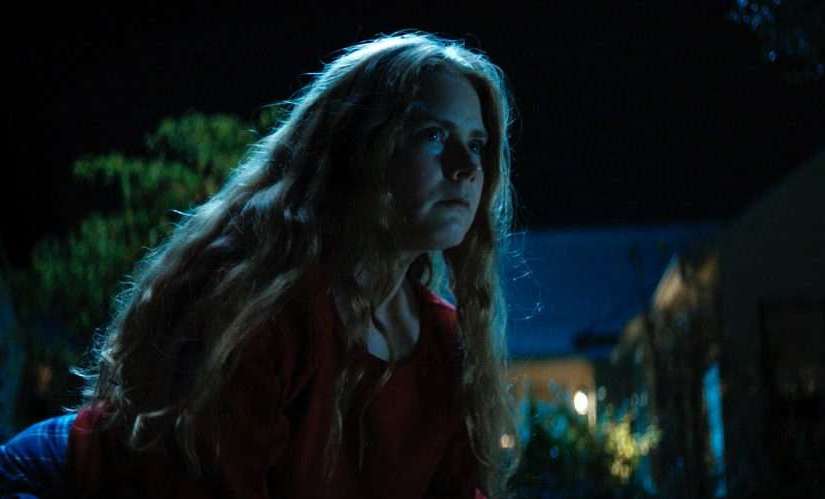
Amy Adams plays an unnamed Mother who has put her promising career as an artist on pause to be a stay-at-home mom while her also-unnamed Husband (Scoot McNairy) pursues his career as a…um…well, whatever it is, he has to travel a lot, leaving Mother at home with, you guessed it, Son (played by adorable twins Arleigh and Emmett Snowden).  Referred to throughout the movie as “my guy” and “sport” and “little buddy,” Son is a typical toddler in the throes of the terrible twos: cute for long stretches, maddeningly frustrating for longer stretches.  [Ed. Note: the author is not a father, has no plans on becoming a father, and will never possess the immense dedication it takes to rear a child, so don’t expect him to embrace the chaos of toddler-hood because it ain’t gonna happen.]

Mother is going through an identity crisis, set up in a brilliant opening scene where Sally, the woman who assumed Mother’s job at an art gallery, asks her, “Do you just love getting to be home with him [Son] all the time?”  Mother answers the question with a little more honesty than Sally or anyone had a right to expect, including this tidbit: “I am deeply afraid that I am never going to be smart, or happy, or thin ever again.”  I am a straight Hispanic cisgender male, so I’m here to tell you, I will never understand that mindset, but I am reasonably certain there are untold millions of moms out there who, if they listened to Mother’s opening statement, would say, “AMEN, sister.”

A little later, Mother delivers an internal monologue where she reflects that, as a mother, you can squeeze someone into the world “who will one day pee in your face without blinking.”  Again, I’m not a parent, but I know that’s truth in cinema right there.

After a few more establishing scenes of Mother interacting with Son, who absolutely REFUSES to go to sleep at night or eat anything for breakfast except, apparently, hash brown patties fried in butter, some odd things start to happen.  At the playground, some stray (?) dogs approach her as if she’s their best friend.  Mother notices her sense of smell has become much more acute.  Son helpfully points out that her back is hairy.  And, in a creepy Cronenberg-y moment, she notices a lump growing at the base of her spine just above her rump.  Curiosity gets the best of her.  She heats a needle, lances the lump, and…well, if you remember the title of the film, you have an idea of what pops out of that lump.

This was all wonderfully thrilling stuff as a movie lover.  I’m thinking, “My god, this is a Spike Jonze movie told from a woman’s perspective!  I’ve never seen anything like this!  This is gonna be GREAT!”  Mother starts to enjoy eating a lot of meat.  She starts to play “doggie” with Son, growling and barking at each other like two puppies.  The two of them eat their lunch at a deli with no silverware…or hands, to the consternation of other diners.  Son doesn’t sleep at night, so Mother, in a genius parenting move, buys a dog bed and gets Son to play “doggie” and sleep in the dog bed at night.  Presto, problem solved!

And more and more dogs start showing up at her door, at night, sometimes bringing gifts: small dead animals.  One night she walks outside, starts digging around, and an astonishing transformation takes place…

I know, I know, SPOILERS, I get it.  But it’s important to get across just how brilliantly original the first act of the film is, because the second act is, alas, all downhill.  I am not saying that the film’s message is unimportant, not at all.  I admire the film because of its message, and because it was being delivered in such an original way.  But then we get into conflict with Husband, who is desperately trying to understand why their 2-year-old is now sleeping in a dog bed on the floor, or why their cat suddenly turned up dead on the front porch, or why his wife suddenly wants a separation.  It must be said, Nightbitch is remarkably even-handed with the Husband’s dialogue.  He is not reduced to a 2-dimensional sitcom husband.  When she lays into him for not supporting her career, he fires back with a well-reasoned argument.  Their dialogue could be turned into a first-rate play.

But instead of exploring the surreal nature of Mother’s new condition, the movie settles into soap-opera territory, with only the occasional nod to the mystical incidents in the first act.  I distinctly remember, in the middle of the second act, feeling as if a balloon had deflated in the plot.  I imagine defenders of the film might say, “Well, the second act is where the weird stuff has to take a back seat to deal with the real issues at hand.”  Okay, maybe that’s true from a real-world perspective, but to me, it felt as if the filmmakers were on the verge of showing us something mindboggling, then backed away from the precipice at the last minute.

Does that make me guilty of critiquing a movie for what I wanted as opposed to what I got?  I guess it does, as much as I dislike that tendency in myself.  I feel there are so many different ways the movie could have gone in act two, could have leapt gleefully over the edge of convention and truly broken the mold with this movie.  When it became clear what they were doing instead, my elation evaporated.

I give Nightbitch a generally favorable score, though, based on the mad inventiveness of the first act and the plot in broad strokes, and also on the incredibly brave performance from Amy Adams, who maybe has two scenes in the entire film where she seems to be wearing any makeup.  She also appears to have to put on some weight for the role, which is not something I can ever recall seeing a female actor do.  Male actors have turned that kind of thing into a cottage industry, but when was the last time you saw a woman do it?  That took guts.  Watch Nightbitch for Amy Adams’ performance and for the story, even if the movie doesn’t follow its own plot to a satisfying conclusion.
MAN OF STEEL (2013)

by Miguel E. Rodriguez

Director: Zack Snyder
Cast: Henry Cavill, Amy Adams, Michael Shannon, Diane Lane, Russell Crowe, Kevin Costner, Laurence Fishburne
My Rating: 9/10
Rotten Tomatometer: 56% (damn…haters gonna hate)

PLOT: The last son of a dead planet finds a home on Earth and, thanks to enhanced senses and powers, becomes its mightiest defender when an ancient enemy attacks.


I never tire of repeating this: the majority of my enjoyment of a movie is derived from how it affects me on an emotional level.  And, brother, in my case, Man of Steel knows exactly which buttons to push to make the hairs on my arm stand on end.

I can still remember the first time I saw the very first teaser trailer, back in 2012.  It fired my imagination almost as much as the first trailers for The Phantom Menace did.  “At last,” I thought, “someone is going to make a SERIOUS Superman movie!  It worked for The Dark Knight, why not Superman?”

And in my humble opinion, it did work.  But before I get into the debate between different Superman versions, let me talk about this movie first.

Man of Steel is ambitious, audacious, and visually spectacular.  Its one major fault lies in the finale, in which a human family is threatened by a heat ray, and it seems all they have to do is just…run the other way.  But a point is being made (a good one, I might add), so I can forgive it after the fact.  On first viewing, though, I will admit the mildly absurd situation took me a little bit out of the moment.

But I’m picking nits.  The rest of Man of Steel is just a great experience at the movies.

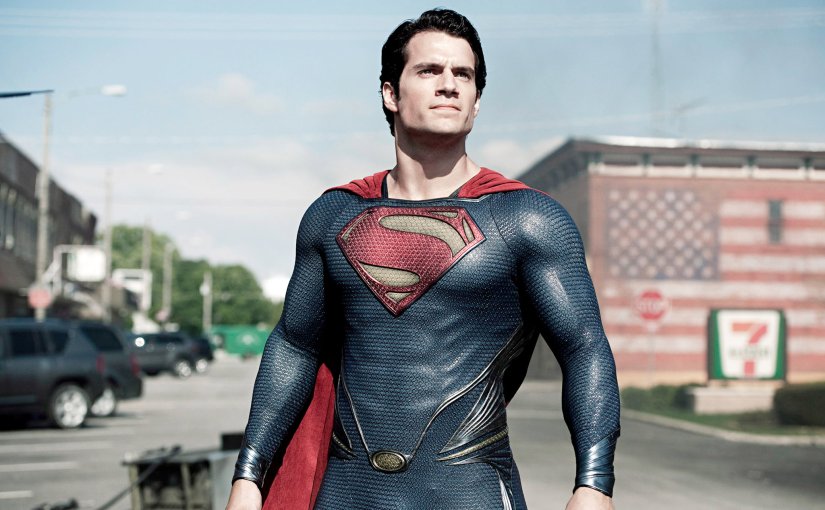
Right from the get-go, we know we’re in for something different when, for the first time since Superman II [1980], we get a glimpse of Kal-El’s homeworld, Krypton.  But this is not your father’s Krypton.  This is a lush, red-sky world, with stunning vistas, flying creatures, and hyper-advanced technology.

The familiar story is all there: a dying race and a loving mother and father who send their infant son to the stars for one last chance of survival, for him and for their race.  In flashback, we see Kal-El’s childhood in Kansas, as he struggles to adapt to his enhanced senses.  This is one of the great concepts I’m glad the movie took the time to show.  We see him trying to cope with seeing and hearing EVERYTHING, all at once, and learning to focus his powers so he can function in this new world.  That was a nice touch.  The school bus scene was handled especially well.

We see him as a grown man (played by Henry Cavill) before he dons the familiar suit, a drifter, only reluctantly playing the hero from time to time.  I liked the beats in this section because they echoed some of the good deeds we saw in “Superman” [1978], but everything was done from a standpoint of genuine awe and astonishment.

Then an alien ship is discovered buried under the ice in northern Canada, Clark investigates, and so does ace reporter Lois Lane (Amy Adams), and things start to snowball from there.  But in “Man of Steel”, everything is handled in a way that makes the far-fetched story seem more real and relatable, more so than its predecessors.  And that appeals to some part of me that is hard to quantify or put into words.

Ever since I was a kid, I was drawn to the darker, grittier aspects of comic books.  My favorite Batman comic?  “The Dark Knight Returns,” Frank Miller’s magnum opus in which Bruce Wayne is an old man, the Joker winds up getting killed, and Batman and Superman fight to the death.  My favorite Marvel comic?  “Identity Crisis,” in which a superhero’s wife is murdered and the Justice League bands together to find her killer.  My other favorite comics?  “Preacher”, “Y: The Last Man”, “Saga”, “Watchmen”, “V for Vendetta”, and “Ronin.”  I was always, and still am, a fan of how the medium of comics can be used for telling mature stories that don’t always depend on happy endings, or heroes swooping from the skies to catch falling helicopters.

So when a movie DOES come along that, by default, has swooping heroes and a happy ending, but can ALSO make things a little darker or grittier than usual, I am thrilled, because it means the filmmakers are not confining themselves to ancient stereotypes.  They’re trying to surprise me.  They’re making a movie for ME.  …at least, that’s how I feel, because it’s right up my alley.  For example, one of the heaviest criticisms involves the overblown battle scenes.  But, man, I was TOTALLY okay with it.  No flying sheets of cellophane or creepy identical twins here.  These guys are playing for KEEPS.

Does this mean I am somehow in favor of comic book movies removing all traces of fun?  Of course not.  One of my favorite DC movies is “Shazam!” which was WAY more fun than I anticipated.  It’s pretty much a straight up comedy.  Would I prefer a grittier “Shazam” movie drained of fun, with dark skies and a darker ending?  No.  For “Shazam”, the fun approach worked.

When it comes to Superman, I think it’s a mark of the character’s versatility and endurance that it’s even possible for the “fun” Superman (yes, including “Superman Returns [2006]) to exist alongside the darker Superman.  It’s not like “Man of Steel” or its sequels somehow erased or replaced previously existing versions.  They’re still there.  If the comic book industry has taught us anything, it’s that the market for reboots and “remixes” is almost inexhaustible, as long as you stay true to the core principles of the character you’re working with.  In my opinion, “Man of Steel” does exactly that.  It keeps Clark Kent’s innate principles and values in place while dressing up the story to give us one of the best reboots of a character since “The Dark Knight” [2005].

There is, perhaps, one glaring exception, and it comes at the finale of “Man of Steel”, so SPOILER, SPOILER, SPOILER.

SPOILER ALERT.  You have been warned.

If you’ve seen the movie, you know what I’m talking about: Superman is forced to kill General Zod (Michael Shannon) when it becomes clear that Zod will never stop his war on humanity, when he vows to kill everyone on Earth to avenge his lost civilization.  In the comic book, it’s a given that Superman himself does not kill anyone.  (There may be exceptions, but give me a break, I don’t read comic books religiously.)  So why this egregious contradiction?

Since “Man of Steel” is a reboot, I choose to think of it this way:

This is Kal-El’s first test as a hero, his first battle with an enemy as strong as he is in every physical way possible.  He is faced with an impossible choice: kill Zod, or allow countless more humans to die in who-knows-how-many-more battles.  He may be more powerful than a locomotive, but he is just plain inexperienced when it comes to this kind of decision.  So he does what he feels is necessary to preserve life.  He is definitely NOT okay with it.  Watch the movie, and you’ll see his howl of anguish and regret after the deed is done.

But he makes his choice.  He is the son of two worlds, but he chooses Earth.  “Krypton had its chance,” he yells at one point.  It’s time for him to move on.

I know, movies are subjective, and there are no doubt many excellent arguments against my interpretation.  Maybe that’s what makes “Man of Steel” and the Superman character so durable: the fact that there are so many vastly differing interpretations, and that they all apply equally.  Superman can be many things to many people, but no matter how many years go by, he’ll still be what he’s always been: a symbol of hope.

(Got a little mushy there at the end, hope you don’t mind.)

TROUBLE WITH THE CURVE

By Marc S. Sanders

Roles for the “aging has been” who is either about to retire or refuses to retire seem reserved these days to Robert Redford or Clint Eastwood.

Back in 2012, Eastwood gave up his director’s chair to star in a little known film about an aging baseball scout in Trouble With The Curve. I’ve seen him play this kind of role many times before like In The Line Of Fire, or Grand Torino.

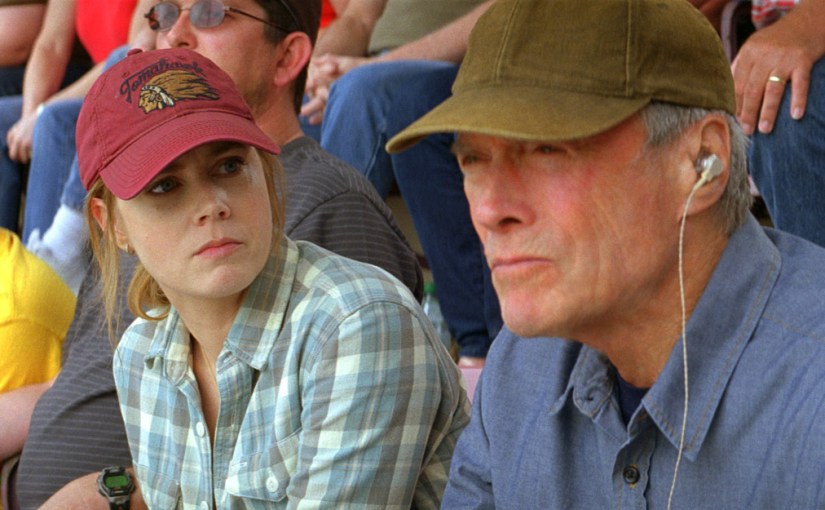
There’s nothing memorable about Trouble With The Curve, but it does feature some good scenes between Eastwood and Amy Adams as his tough as nails attorney/estranged daughter who forces herself upon his scouting trip to look after him when it seems his health, particularly his vision, is deteriorating. Adams is good as the underestimated baseball expert. She can recognize a 95 mph pitch and she can triumph over you in reciting RBI stats, batting averages, etc. Give her a bat and she can also cream a ball outta the park.

Justin Timberlake is the necessary pretty boy romantic interest for Adams, but he doesn’t offer much to the film in the way of humor or even sex appeal. This guy is a great actor beyond his music. (See The Social Network)

The movie belongs to Eastwood alone.

First time director and regular Eastwood crewman, Robert Lorenz does well with the baseball footage of young prospects and the end is satisfying as the argument weighs whether experience and instinct can still trump the power of technology.

Has baseball truly come to rely on what a computer says is the best first round draft pick? Wow…how sad.

ARRIVAL (2016)

by Miguel E. Rodriguez

Director: Denis Villeneuve
Cast: Amy Adams, Jeremy Renner, Forest Whitaker, Michael Stuhlbarg
My Rating: 9/10
Rotten Tomatometer: 94% Certified Fresh

PLOT: When 12 alien spacecraft descend to Earth at seemingly random points around the globe, a linguistics expert (Adams) is recruited to interpret the aliens’ speech in order to find out why they are here, among other things.


“If you could see your whole life from start to finish, would you change things?” – Louise Banks (Amy Adams), Arrival

That seemingly simple question lies at the heart of Denis Villeneuve’s sci-fi brainteaser, Arrival.  Surrounding it is a film of uncommon grace, beauty, and intellectual stimulation that deserves comparison to Kubrick’s 2001 or Tarkovsky’s Solaris.  When I first saw it in 2016, I’ll admit to some slight confusion at the end, but after many repeat viewings, I believe I understand it fully enough to call it a masterpiece.

After a prologue where we witness a montage of her losing a daughter to an unnamed but ravaging disease, we see Dr. Louise Banks (Amy Adams) teaching linguistics at a university.  Classes are interrupted when news breaks of not one, but TWELVE alien spacecraft suddenly appearing at random points around the globe.  Eventually, the military contacts her and reveals that contact has been made between us and the aliens, but to say we can’t comprehend their language is an understatement.  She and a top-notch mathematician, Ian Donnelly (Jeremy Renner) are flown to the US sites in Montana and are given an impossible task: decipher the alien language and ask them why they’re here.

The design of the aliens and their ship are visual masterstrokes.  The ship, in fact, bears a striking resemblance to the famous Cloud Gate sculpture, aka “The Bean”, in downtown Chicago.  (Google it if you’re unfamiliar with it.)  But imagine it standing vertical on end, matte gray-black instead of chrome, and hundreds of feet tall.  Ominous and delicate at the same time.  The aliens themselves…well, I won’t spoil it for anyone who hasn’t seen it, but I will say they are called “heptapods” by the scientists.  Seven legs.  Cool.

The US researchers and military are connected via satellite to every other landing site around the globe, each attempting to make a communications breakthrough, but it’s Dr. Banks who realizes the aliens may have a form of written communication.  Using a whiteboard and simple words at first, she can have very limited conversations with the heptapods.  But when Banks is finally able to ask the all-important question, “Why are you here”, the answer she gets throws the military and government representatives into a tizzy and they cut off all communications to the other landing sites.

Meanwhile, Dr. Banks has periodically been having extremely vivid visions or memories of her daughter at random moments.  At one point, she is struggling to remember the scientific term for a “win-win” situation, and the memory comes back to her in a flash from a previous conversation with her daughter.  Although it is odd that we hear the term first in the present, and then she remembers it in the past…but enough about that.

Arrival may strike some as slow and plodding.  I suppose they’re right, in a sense.  It lacks any of the deliberately manipulative editing of, say, a Spielberg or a Scorsese film, where the cuts are specifically designed to grab the audience member by the collar and propel them to the film’s high and low points.  By contrast, Arrival takes its time.  It stands back and presents us with all the information we need to really, actively watch the film and work those brain cells.

[The score of Arrival deserves special mention.  In a film whose story arc involves linguistics and translations, it’s appropriate that, at key moments, the score includes multiple human voices harmonizing in ethereal chords or pulsing in a rhythm that sounds utterly alien, not just foreign.  A brilliant touch.]

What gives Arrival that extra push is that question Dr. Banks asks at one point in the film.  “If you could see your whole life from start to finish, would you change things?”  This question, when it comes, has poignant undertones that were not even hinted at in previous scenes.  And I find it to be incredibly moving, every time.  In fact, I wonder if I’m not really the prime target audience for this movie.  I wonder if it’s most effective for people who have lost loved ones to disease or accidents – untimely, unbearable deaths.  For those people, I cannot even begin to imagine how they would answer, or if they agree with Dr. Banks’s answer to her own question.

For myself, I have been blessed in this life, knock wood.  I have lost family members, but mostly to old age, although two uncles were taken by cancer in their fifties and sixties.  But I found myself thinking about this question today more than any other time, for some reason.  If I could magically go back in time, while retaining all my current knowledge, would I change things?

It’s deceptively easy to say “yes”, especially when it concerns the big things.  Sure, I would probably not stay as silent as I did when I learned a dear friend was being molested in high school and college.  No, I would probably not have gotten romantically involved that one time with the absolute wrong person.  No, I would most certainly not have skipped work that one day to see Spider-Man 3.  I would have remembered my driver’s license that one time I was pulled over.  I would have rearranged my schedule to go with my father and sister to Spain that one time.  And on and on.

But…if I hadn’t done some of those things…I may not be where I am now.  In a wonderful relationship with my best friend.  Working at a job that has its challenges but is rewarding and accommodating enough for me to do theater.  Surrounded by a support structure of friends that is second to none.  Able to leap tall buildings in a single bound.  Just kidding.

Your answer may differ from mine, or from Dr. Banks’s answer in the film.  That’s fine.  We all have our own reasons for our own answers to that question.  What’s wonderful about Arrival is its ability to couch that existential question in a top-notch sci-fi drama that, in its own unflashy way, is every bit as exciting and though-provoking as ten Independence Days.  It looks great, sounds great, acted great…what more could I ask for?

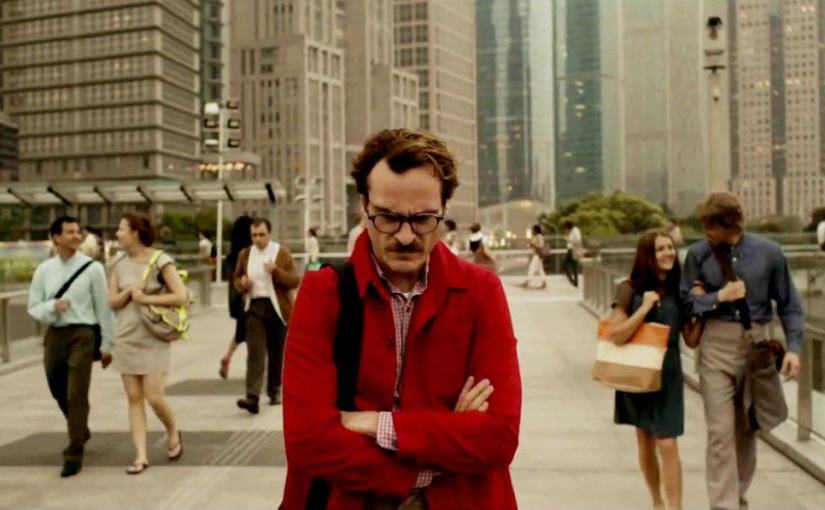
her

By Marc S. Sanders

Director/Screenwriter Spike Jones is a master at adding multiple dimensions to what we always know exists. It’s been evident in his prior films, Adaptation, Where The Wild Things Are, (which I did not care for personally), and most especially in Being John Malkovich. He plants the seeds of fantasy in what we can normally touch, hear and see. Then his elements of fantasy receive a supportive crutch from what his viewers have always been familiar with.

her is another masterwork; a film that takes place in the not too distant future that expounds on our current digital age. If we can already talk to “Siri” or “Alexa” and trick–umm, excuse me, “her” (I mean “Siri”) into making sophomoric dirty jokes, then of course we are bound to approach the stage where we can literally, truly fall in love with her and then she can reciprocate.

With her raspy yet silky vocals, Scarlett Johansson is inspired casting as the voice of “Samantha.” Had she actually had a physical presence in the film I would have totally fallen for her affections. The film hinges on the performance of Joaquin Phoenix as Theodore. If we can’t believe that he loves “Samantha” more than he loves himself (a surefire test of true love as far I’m concerned) then “her” falls apart. Phoenix passes abundantly. He deserved his Oscar nomination.

From the start, you become very accustomed to the banter between Theodore and his electronic device voiced by “Samantha.” Both have personal feelings. Both have personal longings (more especially “Samantha” the computer, of all things!!!).

Spike Jonze explores all the diameters and dimensions of a loving relationship. The ups, downs, and in betweens. What’s different is how all of these layers of a relationship are received in this currently fictional (bound to come true, one day) dynamic of a relationship. Theodore and “Samantha” are affectionate. They argue, they laugh, they even make love. Watch the movie to understand that last point. It happens, and it is perfectly executed with the residual effects of their lovemaking bringing the film into its next act brilliantly.

Jones won the Oscar for original screenplay simply for how innovative this picture is. I’m not sure it’s the most exciting two hours of film, however. Personally, I think other films in this category back in 2013 had sharper and more interesting scripts. her is practically all talk and when it ended, I was ready for it to be over, and it concluded as I expected.

Still, Jones is fortunate that his cast (Johannsson, Phoenix, Amy Adams and Rooney Mara and Chris Pratt) trusts him. If they hadn’t, this movie would have lost its magic by probably how absurd this script must have originally been perceived on paper. Well done work by all involved but credit has to begin with Jones, the screenwriter.

VICE

By Marc S. Sanders

Christian Bale is one of the greatest method actors working today. He’ll put on muscle mass for Batman. He’ll shrink himself down to a skeletal 100 pounds for roles in The Mechanic and his Oscar winning turn in The Fighter. In Adam McKay’s new film, Vice, Bale puts the weight to present an uncanny resemblance to former Vice President Dick Cheney. Without Bale and co-star Amy Adams as wife Lynne Cheney, Vice would not succeed. Both will be nominated for Oscars this year. McKay can expect nominations for himself and Best Picture.

McKay approaches Vice similarly to his winning film The Big Short, where a historical debacle of great proportions is told from a comedic approach. However, the gags of Vice don’t necessarily measure up to the absurdity of the real estate investment collapse of The Big Short. Cheney’s accomplishments were just too sad, too tragic, too shocking to laugh at entirely.

Dick Cheney was a drunk who suffered multiple heart attacks. He got kicked out of Yale University. His daughter, Mary, is gay. His other daughter, Liz, went into politics herself and dismissed her sister’s sexual orientation. Dick has remained married to his very wise and very aggressive wife Lynne who more or less rescued him from a wasted life. Dick Cheney shot his close friend accidentally while hunting, and never apologized for it. He was fortunate to receive a heart transplant that continues to prolong his life, and Dick Cheney became Vice President of the United States for two terms. You don’t have to like the guy but you have to admit he’s got a colorful past.

It’s all in the movie. Immediately, McKay puts in a few words of a byline that this film is based on fact to best of their knowledge but they more or less tried their fucking best.

My impression of what could be considered a very divisive film was actually not divisive to me at all actually. Bale along with McKay’s screenplay show a Dick Cheney who truly sees no other way to carry on a political career than with a silent yet ruthless touch. Later, it required more aggressive tactics not labeled as torture and not appearing beyond his authority even if he is only the Vice President. Bale has the voice down, the walk and as noted before the appearance. This film will likely win Best Makeup.

Having recently seen three potential nominees for Best Actress in The Favorite, I have to say Amy Adams as Lynne Cheney beats them all. This is not an Amy Adams we’ve seen before. Lynne is depicted as smart, aware in a mindset of no nonsense bullshit. She gets the job done, and if she had her way she’d take the job herself but she’s aware of her limits as a woman. Adams easily shows her Lady Macbeth in a scene where daughter Mary reveals herself as gay. Dick promises to love Mary no matter what. Adams as Lynne does not. Adams offers an expression that kills. Right there in this scene is her Oscar moment. This is one of the best performances I’ve seen all year.

Back to Macbeth for a moment, McKay has a great imagination for gags including elevating the fantasy of Dick and Lynne reciting MacBeth to each other in bed while mulling the possibility of becoming George W Bush’s running mate. It’s more than that for Dick. Both know this is absolute power…finally. I’d accept if their decision to run came down to something like this. It takes an ego trip to obtain power after all. If you’ve already been denied power before, the power trip only becomes more powerful on another occasion.

The Shakespeare gag works. Some others fall a little flat. Some really win. Out of the blue, prior to running on Bush’s ticket, McKay wraps up the first portion of Cheney’s life and literally rolls end credits. Then a phone rings and Cheney’s biggest story begins. The end credits moment is a great psyche out.

Vice is not a perfect movie. A huge misfire occurs midway through the end credits that derails McKay’s best effort at a neutral point of view for the Republican. It’s a moment that screams of present day chaos of opinion. McKay said screw it and folded his hand to take advantage of showing how he really feels. Before this scene, McKay and his cast embraced the Cheneys despite their hard to swallow viewpoints and actions. If you are going to make a movie about Dick Cheney or Barack Obama or Mickey Mouse you, as the storyteller, have to develop an appreciation for the centerpiece. If all you are going to do is bash and mudsling, then perhaps you are not qualified to tell the tale. McKay failed at the finish line.

Still, the journey is always interesting. There are things to learn here, things to recollect and things to question how it all came to be a reality.

A good cast is offered including a surprising appearance by Tyler Perry as Colin Powell; make a movie about this guy and get Perry back. Steve Carrell plays a buffoonish Don Rumsfeld. Was Rumsfeld this stupid and this haphazard? I don’t know. McKay uses him to play the fool and the jester. I doubt Rumsfeld has a loyal fan base ready to wave pitch forks. So who cares, really? It’s in the past.

A casting misfire is Sam Rockwell. Moviegoers are too familiar with the real George W. Bush especially in 2018 following the loss of his parents and his deeply appreciated eulogies. Rockwell teeters on 12:45 am Saturday Night Live material, as he chomps down on chicken wings, with a good ol’ boy Texas dialect. I know people want to believe Bush 43 was this stupid. I’m just not ready to accept that. Ironically, a producer on this project is Will Farrell, widely known for his George W Bush on SNL. Farrell would have been a better George here.

Compliments also go to Jesse Plemons as a narrator with an unknown connection to Cheney. Plemons’ delivery plays well on an even keel.

Vice is a complicated film about a hard man to like with little to know redeeming qualities. Adam McKay is cornering the market on films about American absurdities of the past. He’s good at this kind of filmmaking. This isn’t his best film but it still works. Just get ready to leave the theatre as the real end credits roll. Again, it’s a moment that serves the film’s worst flaw as McKay leaves his imagination at the door. Everything before that was right on track. Adam McKay…next time, don’t think too hard.

MAN OF STEEL

By Marc S. Sanders

The first time I saw Zack Snyder’s Man Of Steel, I was disappointed.  Very disappointed.  It was only after a second viewing about a year later that I realized I was simply biased and unfair with my perception of the film.  I grew up with the Richards’, Donner and Lester, films that featured Christopher Reeve in the role of Superman/Clark Kent.  Nothing could violate what was done in those films from the ’70s and ’80s. 

My impression of Man Of Steel now is that it is a marvelous film.  It’s an exploration of a stranger in a strange land questioning how to adapt to a living environment that he is not from, nor where anyone around him is genetically built like him either.  Henry Cavill fills the role of the title character.  What’s especially important is that he is not attempting to do what Reeve memorably did before him.  Actually, David S Goyer’s script really doesn’t allow for the hijinks of the prior films.  Clark Kent is not portrayed as a goofy and lovable klutz this time around.  Instead, the boy from Smallville, Kansas is challenged to limit his abilities at the behest of his Earthling father, Jonathan (Kevin Costner).  It’s dangerous for Clark to show all that he is capable of from his super strength to his heat vision.  Clark’s Earth mother, Martha (Diane Lane), is more protective of her son.  A really powerful scene occurs when young Clark is in the classroom and he has a bout with sensory overload of super hearing and super x-ray vision.  He can’t get the encompassing sounds and sights out of his head.  One of many CGI effects in the film come with Snyder showing the skeletal insides of Clark’s classmates and teachers.  It’s frightening; even to an innocent alien boy from another world.  This is good conflict.  Does the world need Clark Kent?  Would Clark Kent be better off someplace else?  Can he manage to live with daily life drowning out his sensibilities?

Another dilemma opens the film on Clark’s home planet of Krypton where he was born with the name Kal-el.  His father, Jor-el (Russell Crowe) has insisted to the governing body that the planet is expected to self destruct soon, and civilization needs to be relocated to another planet.  The politicians refuse to accept his theory.  Jor-el’s friend, the military leader General Zod (Michael Shannon) sides with his opinion.  Though his approach is violent insurrection of the Kryptonians.  Zod is punished for his crimes and sentenced to an eternal prison known as The Phantom Zone before baby Kal-el is shipped away, and the planet implodes with all its inhabitants.

Following this opening, Snyder cuts his film with flashbacks and forwards showing Clark in various different roles as either a fishing boat crewman or a bartender trying his best to remain undercover even when the temptation for use of his powers repeatedly shows itself.  Clark reflects on moments from his childhood when he and his Earth parents questioned how to present himself.  

Superman’s known love interest eventually shows herself, Pulitzer Prize winning reporter for the Daily Planet, Lois Lane (Amy Adams).  She’s following up on an alien ship that has been discovered in the arctic after 20,000 years.  Clark and Lois connect at this moment.  Of all the Superman angles that are familiar to so many of us, this is where Goyer and Snyder perhaps do not focus enough.  Man Of Steel is a satisfyingly long film, but there’s a lot of material and drawn out action to cover as well.  So the Lois and Clark relationship is somewhat sacrificed and not as nuanced as we have experienced in other iterations.

Zod arrives on Earth requesting that Kal-el reveal himself along with the intent to destructively turn Earth into a new Krypton at the sacrifice of the planet’s human population.  Naturally, a city wide battle will ensue. and lemme tell you reader you wanna talk about destroying the village just to save it….well…that’s what happens here.  When New York got destroyed in Marvel’s The Avengers or Ghostbusters, those pictures looked like spilled milk compared to what Superman and Zod do here.

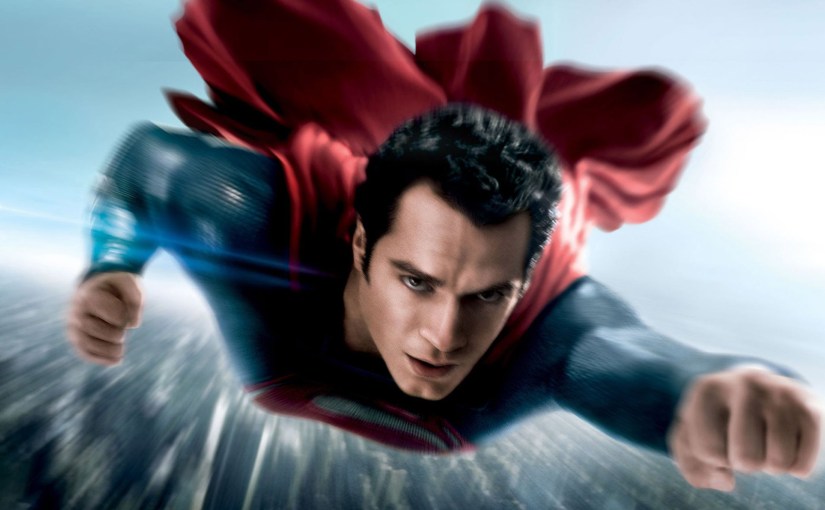
Man Of Steel is the best film of the new Warner Bros/DC universe.  It might be Zack Snyder’s best film as well.  The assembly of the picture is masterful.  Hans Zimmer’s score has these great build ups as Clark discovers more of his capabilities.  It especially lends to when the character dons the cape and costume for the first time ready to leap in the sky and fly.  Snyder shows the efforts needed for Superman to carry out this talent.  The flying doesn’t come easy.  It looks like work on the super hero.  Zimmer’s score starts out quiet and then advances to these powerful notes as Superman soars higher and higher.  The boy from Kansas is making himself into something greater that he has no familiarity with.

Michael Shannon plays another of many kinds of villains and antagonists on his resume.  I’m not sick of this guy’s antics yet.  It’s time he become a James Bond villain.  He plays Zod with an uncompromising determination and disregard for anything else but to rule.  It’s all very sci fi like but I love how unforgiving he is with the role.  Much less Shakespearean than when Terrance Stamp played the part so well with Reeve as the hero.  Shannon is more direct and bloodthirsty.  Michael Shannon just knows how to be scary on film. This kind of personality would work great in a silly comedy from the Farrelly brothers as well.

Amy Adams is fine as Lois, but there’s not much here to work with honestly.  More details of her relationship with Superman come through in later films.  However, this story development soured me on my initial viewing.  The iconic irony of Superman pathos is that as sharp a reporter as Lois Lane is, she can not realize that the guy wearing the glasses who is working right next to her is actually Clark Kent?!?!?! Readers and viewers were always thankfully in on the joke.  On follow up viewings of Man Of Steel, I understand that Goyer and Snyder were never aiming for irony.  Lois knows who Clark really is from the get go. What was once an unforgivable departure for me, no longer is a concern.  There are deeper angles to question in Man Of Steel, like a purpose to others and the freedom to force a change because it can be done.

Snyder and Goyer broach on the well known Christ allegory with Superman.  The film takes place in Clark’s thirty third Earth year.  Jor-el is slain with with a stabbing to his rib.  There’s also the crucifixion  pose on a number of occasions.  I must admit, as a Jew raised conservatively with just the Old Testament, I am not very educated on the texts of Jesus Christ.  However, the basics are explored in Man Of Steel.  Is Superman a savior?  Snyder wisely even has Clark visit with his Smallville priest to question his obligations to Earth and to Zod’s calling, with window artwork of Christ in the background.  

One vice I have with Snyder’s picture is the shameless plugging.  How overt must signage from Sears, U-Haul, 7-Eleven and IHop be?  Granted, all of these summer blockbuster films have the inserts of brand labels going all the way back to the original Superman films.  Here though, the corporate advertising is a true eyesore.  Superman being thrown into the dining area of an IHop is not as memorably funny as when Zod’s underling, Non, crashed into New York’s famed Coca-Cola sign back in 1981.

The seemingly endless battle consuming about forty five minutes of the third act of the film are over the top outrageous.  I might normally be saying I’ve seen enough while casualties are never considered as buildings literally topple over into mushroom clouds of concrete dust.  Still, the cast keeps these moments alive.  Shannon and Cavill, along with Laurence Fishburne as Perry White, the Daily Planet editor, and Amy Adams, actually show risk and fear amid all of this bombastic action.  Still, Snyder is insistent on his freedom to go crazy with CGI effects.  It’s more than a bit much, but the characters up to this point keep me engaged with the film all the way through.  Later DC films in this franchise don’t do it so much for me, but that’s another column altogether.  

Again, what I especially like about Man Of Steel is how Snyder cuts back and forth with the film.  Heroic moments occur and then are reflected back to times in Clark’s childhood with Jonathan and Martha.  With Zimmer’s score, it seems to allow Clark to consider conversations and moments from his past as meaningful to what he is experiencing in the present.  When Zack Snyder stays on this trajectory it makes Man Of Steel more than just another comic book movie for summer box office.  There’s depth from Goyer’s script that Snyder wisely does not disregard.  

Man Of Steel is a new and unfamiliar kind of Superman, but its a very welcome Superman too.

BATMAN V. SUPERMAN: DAWN OF JUSTICE

By Marc S. Sanders

Zack Snyder may have been indulging in too many cookies from the jar when he made Batman v Superman: Dawn Of Justice.  I can not deny how ambitious this film is, but did it ever need to be this ambitious?  There are too many storylines, too many characters, and not enough thought provoking dialogue to really make any sense of the gobblety gook that’s splattered all over the screen.

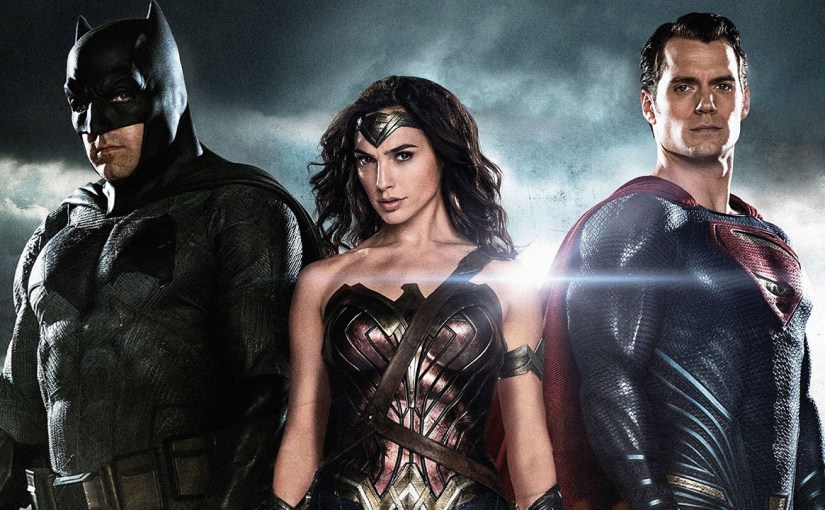
Reader, my favorite super hero of all time is Batman.  Nearly any variation of Batman (including moments from the dreadful Joel Schumacher films) contains an element that I just love about the character.  Ben Affleck is cast as The Dark Knight here.  He’s fine in the role.  I knew since he had done Daredevil, that he could pull off this part.  He might be too long in the tooth, and too busy an actor/director, for a new series of super hero films, but I digress.  That being said, the movies have gone into overkill on the Batman character.  It’s time the Gotham crusader hide in his cave for a little while and let some of the other super heroes out to play.  Snyder’s film proves my theory.  After all, the true highlight is neither title character in this movie.  

Actually Wonder Woman (Gal Godot) making her big screen debut is the draw above anything else here.  Even that is problematic, though.  I’ve seen this film twice now.  Can anyone tell me why Wonder Woman aka Diana Prince even makes an appearance in this film?  From a story perspective, what justifies Diana creeping into this film, other than to plaster her picture on DVD covers and merchandise a new action figure?

Events begin right after Snyder’s stellar Superman film, Man Of Steel.  An older and experienced Bruce Wayne is dubious of the benefits that Superman (Henry Cavill) can serve on Earth.  After all, his bout with the Krypton villain, General Zod, practically leveled Metropolis.  Heaven forbid if one day this powerful alien with the red cape goes out of control.  Bruce, as well as politicians led by Holly Hunter, ask a wise question.  Who on earth could ever stop him?  So Bruce, with assistance from Alfred (Jeremy Irons playing the well known sidekick more as a strategist, than a polite butler) begin preparing for a seemingly inevitable battle to eliminate the Kryptonian. 

Meanwhile, a young, brainy Lex Luthor (Jesse Eisenberg) is planning for his own undoing of both of these super heroes by living up to the film’s title; pitting the Bat of Gotham against the God of Metropolis; mano y mano.  Like most iterations, Luthor plays with defying the odds of nature.  In this case, he is experimenting with a green element sourced from Krypton which we all know is Kryptonite, as well as extracting blood from the corpse of Zod to create his own monster movie.  That last part feels like a side gig for the supposedly genius villain.

In addition, a mysteriously exotic and beautiful woman is turning up on various occasions.  Somehow, only Bruce seems to take notice of her.  Why?  I don’t know.  There’s really no purpose for him to scope out this person amid a sea of other extras attending a Luthor gala. 

There’s also Lois Lane (Amy Adams) and Martha Kent (Diane Lane).  There’s a retread of Bruce Wayne’s origin story that we’ve seen countless times before.  There’s a bitter and disabled former employee of Wayne Enterprises.  There’s a dream sequence showing vague plague like foreshadowing to come.  There’s an arms dealer/terrorist sequence in the desert for Lois to investigate, and another figure for Bruce to track.  There’s the eventual gladiator battle between the two heroes, and then there’s another battle thereafter for the two guys to team up with the the woman who carries a magic lasso to defeat a Doomsday monster; likely rejected sketches from the Harry Potter and Star Wars franchises.  Oh yeah.  There’s also some teaser material for what’s yet to come in the DC cinematic universe.

Do you see where I am going with all of this?  There’s just too much stuff here.  Eventually it all gets tedious.  A laundry list of storylines with little to no connection with one another feels burdensome.  I wish the screenwriters, Chris Terrio and David S Goyer, finished writing a script before starting another script.  As lengthy as all of these stories feel, they also seem unfinished, and, I can’t understand why.  

Forgive me.  It’s easy to compare the DC Comics film adaptations to the Marvel Comics films that Disney now owns.  The latter franchise seems well structured and outlined.  The former franchise helmed by Snyder seems rushed to catch up to everything that Marvel has already accomplished.  If the intent was to have a huge franchise of films, then why smash all of your material together in one sitting?

That gets back to my viewpoint on Batman.  Why Batman, all over again?  Snyder and the producers really aced it with the casting of Gal Godot.  She is Wonder Woman.  Snyder also struck gold on Man Of Steel with Cavill as Superman.  I wanted more exploration of that guy.  So why make this a Superman and Batman film?  We’ve seen enough Batman through the last thirty years.  Let’s give someone else a chance.  Much could have been accomplished had this installment been a Superman and Wonder Woman team up with maybe a teaser ending of a new Batman yet to come.  This Batman shows me nothing I hadn’t already seen.  There’s a new car and gadgets and cables to swing from.  It’s all been done before.  Lemme see some of what this Wonder Woman can do.  As well, if Wonder Woman is here, then tell me why she is here.  Again, she just comes out of nowhere and never explains why she’s there.  My wife and daughter tried to explain it to me.  Apparently, she wants to acquire a photograph of her with her war comrades from the first World War, and Lex Luthor is in possession of it.  Really?  That’s it?  She just needs to get a sentimental photograph back?  By the way, why does Lex have this photo, and how did she know he has it anyway?

Good stories always answer questions with more questions until it’s eventually tied off at the end.  Moments in Batman v Superman: Dawn Of Justice seem to begin in the middle of their stories with questions that did not answer questions that likely came before, and by the end of the picture, there’s no ending or answers in sight.

I had already reviewed Wonder Woman, and in that column I specifically noted that DC films with Warner Bros always seems to come close, but never gets it completely right.  This film boasts an impressive cast, and all are good in their respective roles.  My approach to this Lex Luthor from Eisenberg might have been different if I were in charge; make him more like a Steve Jobs kinda guy rather than a slight variation of the actor’s other famous role as Mark Zuckerberg.  Still, it’s not good enough and it’s hardly forgivable for what the filmmakers churned out with this picture.  The writers have an infinite wealth of source material to select from.  Pick up a comic book, guys!!!!  They have the funds and opportunity to divide up the best moments of these outstanding characters for the next ten years of film installments.  Nevertheless, they don’t take the time to think strategically, and flesh out the environments and the characters that inhabit these settings.  

Batman v Superman: Dawn Of Justice is just a sloppy mountain of peas, carrots, corn and green beans, with lumpy mashed potatoes and covered in lots of over seasoned gravy.