MISSION: IMPOSSIBLE THE FINAL RECKONING

By Marc S. Sanders

The blessing behind Mission: Impossible The Final Reckoning is that it opts not to follow the uninspired routine that was settled for with the previous entry, Dead Reckoning Part I.  With myself included, that film was poorly received overall (look for my review on this page). It performed way below box office expectations as well.  After its release, writer/director Chrisopher McQuarrie and producer/star Tom Cruise were in a quandary.  The hanging thread of a magical key/MacGuffin and the answer to destroying the omnipotent Entity were left unresolved.  A new film had to be made, despite an empty storyline.  Money had to be spent.  So, the guys needed to invest it wisely.  For the most part, the finances were used quite well as the pair learned what worked. More importantly they steered away from what didn’t.

What this movie improves upon is a hearkening back to some of the favorite elements of almost all of the prior films in the series, now on its eighth chapter.  Naturally, some citations cover what occurred in the last film to drive the continuous thin story of Final Reckoning. There are references made to the mysterious Rabbit’s Foot from the third picture, a favorite of mine.  Most notably, is the return of a long-lost character that no one would ever expect to turn up again. The best thing is that he truly serves the mission.  He’s not just a cameo blink and miss it.  Ghostbusters: Frozen Empire repeated that terrible grievance over and over.  The return of this particular guy actually makes you smile, laugh and cheer.  Yes, believe me when I tell you that marketing for Final Reckoning thankfully do not share every detail.  There’s more here than Tom Cruise running and running some more. 

Miguel and I took advantage of an IMAX presentation, and for two guys who normally favor Dolby, this action/adventure should only be seen on IMAX.  Probably the best film I’ve ever seen in this medium and I saw Dead Reckoning Part I this way, but that did not measure up to what’s offered this time.

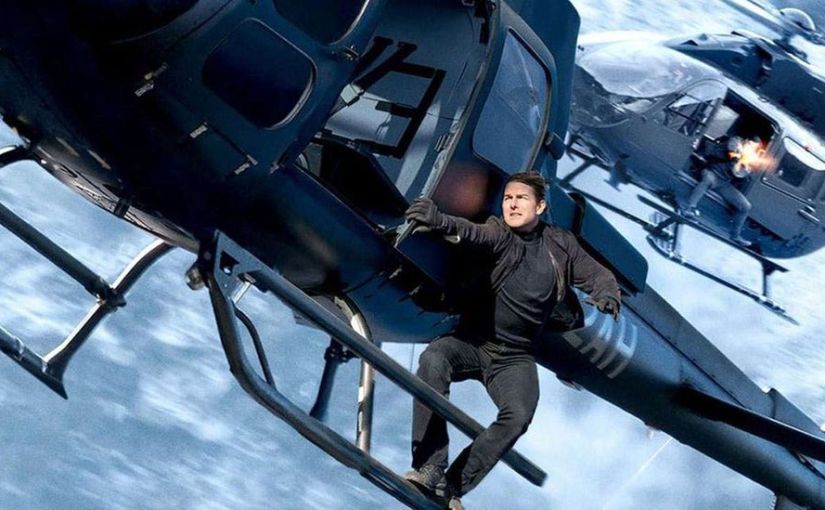
Tom Cruise is absolutely nuts.  He’s over sixty and he’s doing some of the most daring stunts he’s ever accomplished.  The insurance bill to cover his safety must be at least half the budget to make the movie.  The famed biplane scenes that you likely caught in trailers, even on the marquee poster, is so much more impressive on IMAX.  You are seeing every limb of the actor’s body stretch to their breaking points to hang on to first a red plane and later a yellow plane.  Cruise’s facial muscles stretch against the G-force that is giving him resistance at ten thousand feet in the air.  McQuarrie makes sure to cover every inch of these flying machines from the cockpit to the wings and the tail rutters and the landing wheels underneath.  Cruise’s superspy, Ethan Hunt, has to climb all over these things as they go up and down and upside down and right side up on top of bursting into flames.  This scene is not even over in ten minutes.  It feels like a good twenty-five minutes and it looks like it’s no easy feat for Mr. Hunt.

Midway through the film finds Ethan Hunt deep sea diving to a shipwrecked submarine.  This sequence might rely more on set design, but I was convinced the entire time that Cruise was actually that deep below the surface of the water.  Memories of James Cameron’s The Abyss come to mind, but McQuarrie’s craft of this middle sequence within his three-hour film is so well edited and designed.  On IMAX you feel yourself submerged with the weight of the ocean above you.  The film will cut to the outside of the sub to show it drifting as Ethan Hunt shifts from one side of the interior to the other.  Whatever action the guy takes, the sub works against him leaving you wondering if the vessel is going to topple over an ocean floor cliff to even greater and unescapable depths. 

I will never like this movie as much as when I saw it in the IMAX screening.  It’s impossible to feel the same way on a large in-home flat screen.  This is a giant movie.

Grand set pieces with the sub or the planes had me thinking that Christopher McQuarrie should get a Best Director nomination.  I know it won’t happen but not everyone can accomplish what’s offered in Final Reckoning.  Could Martin Scorsese or Francis Ford Coppola?  I question that, because this is an altogether different kind of beast.

McQuarrie must have done a polish on the violations he committed with the last film.  The story remains to be nothing but a chase with countdown digital clocks and the urgency for all of these tasks to be accomplished by Ethan and his team at the exact same second (a repeat M:I staple), but the dialogue does not drive in literal circles of similar vocabulary this time.  Terms like “the key” and “the entity” are not so exhaustingly uttered over and over in this film.  Esai Morales, as the conniving Gabriel, is much more interesting.  In the last movie he was terribly boring.  No charm.  No anger.  No brattiness.  Here, he at least gleefully laughs at Ethan’s demise.  He’s still far from a great villain and totally forgettable, but at least he’s given something more to do than just stand menacingly behind Tom Cruise. Morales is not just donning a dark tan and a salt and pepper goatee. 

Most of Ethan Hunt’s team is given something to do, particularly Ving Rhames as Luther and Simon Pegg as Benji, always reliable.  Hayley Atwell was the best feature of the last movie and she’s great here too as the pickpocket, and now supposedly a quick learning kick ass superspy.  Kind of—No-VERY ridiculous but I stopped asking questions.  Atwell deserves a franchise series of her own.  She’s charming and lights up the screen.  Great actor too.

Pom Klementieff as the dangerous assassin Paris is now a good guy and other than speaking eloquent French she’s regrettably become a ho hum element.  There are other unnecessary characters including Kittridge (Henry Czerny) and those two guys who were chasing Ethan in the last movie.  One carries a stupid secret that’s more like an unwelcome surprise.  The other joins Ethan’s team to shoot a gun and look panicked. 

It will only frustrate you to follow when Ethan or Gabriel has the upper hand.  Christopher McQuarrie fleshes out his overly long three-hour picture playing games like that, and I stopped trying to pass his impossible SAT exam.  The attractions are a few of the characters who work with Ethan and the great feats of strength that the hero attempts to overcome. 

It is not the best in the series.  It is a huge improvement over the last picture, though.  What’s most significant is that Mission: Impossible The Final Reckoning is a gorgeous, mind blowing and breathless visual opus.

SEE IT ON THE IMAX before it self-destructs on your flat screen in five seconds.

THE WILD ROBOT (2024)

by Miguel E. Rodriguez

DIRECTOR: Chris Sanders
CAST: Lupita Nyong’o, Pedro Pascal, Bill Nighy, Stephanie Hsu, Ving Rhames, Mark Hamill, Catherine O’Hara
MY RATING: 10/10
ROTTEN TOMATOMETER: 97% Certified Fresh

PLOT: An intelligent helper robot winds up stranded on an island populated only by wild animals.  To survive its new environment, it adjusts its programming, with unexpected results.


Just days after watching Flow [2024], a dialogue- and human-free animated film about animals struggling to survive after a cataclysmic flood, I watched The Wild Robot, also human-free, also starring mostly animals, and also about the struggle for survival, but it adds conventional dialogue and an intelligent robot in search of its purpose.  In broad, REALLY broad strokes, they are similar, but don’t bother asking me which one is better.  I give them both a ten-out-of-ten, each for different reasons from the other.  Flow may be literally unique, at least in my experience, but The Wild Robot tames its genre and bends it to its will, creating one of the most heart-tugging movie experiences since Wall*E [2008].  If you’re prone to crying during a movie, this is a three-hanky film, at least.  (Penni went through five, herself.)

On a dark and stormy night, a mysterious container washes up on the shores of an uninhabited island.  Inside is Rozzum 7134, an intelligent helper robot with exceptional physical capabilities and the speaking voice of Lupita Nyong’o.  Hope she gets her royalty checks.  Upon escaping her would-be watery coffin, Rozzum searches the island for the one thing that will give her existence meaning: a task to complete.  The opening scenes get us off to a hilarious start as she tries to complete tasks for various animals, to no avail.  In an intelligent bit of screenwriting, she powers down for a couple of days and, through passive listening, effectively learns the language of the animals around her.  In a lesser movie, this feat might have been handled with the push of a button.  I liked the fact the writers went for something a little easier to swallow, science-fiction-wise.

Through circumstances which I will not reveal, Rozzum winds up as the guardian for a newly-hatched gosling, and as the unlikely friend of a fox named Fink (Pedro Pascal, whose voice was utterly unrecognizable; I thought it was Matthew Broderick).  The gosling imprints on Rozzum, which she finds bothersome.  A helpful mom opossum, Pinktail (Catherine O’Hara), warns Rozzum that the gosling must learn to feed itself, swim, and fly by the next fall so he can migrate with the other goose; otherwise, it will starve during the harsh winter.  Presto…a task!

Eventually, Rozzum is shortened to Roz and she names the gosling Brightbill (Kit Connor).  As she undertakes her task of raising the gosling, Roz’s programming…evolves.  She starts to actually care for the little guy.  She starts asking questions that robots aren’t supposed to ask.  She exhibits all the early warning signs of helicopter-momism.  And all the while, she debates whether to activate the internal beacon that will let her makers know where she is…

Because the plot is so dependent on tugging those heartstrings, that’s all I’ll say about it.  Let me talk instead about Wild Robot’s visual style.  The backgrounds and characters are gorgeous, sumptuous, evocative of oil or acrylic paintings.  I could mention two or three specific shots right now that contain some of the most beautiful animated imagery I’ve seen since Pinocchio [1940], but I don’t want to give anything away.  (Hint: butterflies and geese.)  In this way, among others, it shares a lot of DNA with Flow, whose backgrounds and characters also resembled hand-painted objects.  I don’t even want to think about how long it took to create such a painterly style and make it look so effortless and organic.

I also liked the way Wild Robot used its story to make a pointed commentary, but not in the direction I thought it would go.  From the trailers, I assumed it would be yet another paint-by-numbers story about preserving nature or life, which was already covered as well as it possibly could be covered by Brad Bird’s The Iron Giant [1999].  Instead, Wild Robot makes some eloquent statements about the terrifying task of parenthood.  At one point, Roz, who is programmed to solve problems, discovers the task she’s undertaken – raising a gosling, i.e., being a parent – is a task that could potentially never end.  She experiences the fear of almost losing a child.  The joy of watching Brightbill learn to fly, while at the same time realizing that means he will one day migrate.  As I list the plot points here, it sounds like the movie is composed of cliches, but I can assure you, it’s not.  All of these nuances, and many more, are allowed to occur organically without the slightest hint of being nudged along by the screenplay.

DreamWorks has created possibly their best animated film since…gosh, I’ll go all the way back to The Prince of Egypt [1998].  It’s a crowd-pleasing adventure with a point, which is a hallmark of only the best science-fiction movies/stories.  There are real stakes on the line.  There are some actual deaths in the story, which surprised me for some reason, but there you are.  It looks sensational.  It’s smart.  I can’t say enough about it.  The Wild Robot was one of my most favorite films of 2024.

JACOB’S LADDER

By Marc S. Sanders

When a movie works beyond formulaic conventions, it takes risks.  A storyteller will either really impress their audience, or they will leave them feeling shortchanged.  You’ll either get a “Whoa!  Now that’s cool.” (The Usual Suspects, The Sixth Sense, but I did call that ending when I saw it in theatres.  Ask my wife if you don’t believe me.) On the contrary, you’ll arrive at “That’s it?” (The Happening, Signs or any other M Night Shyamalan reach for the rafters but come up foul kind of flick.)

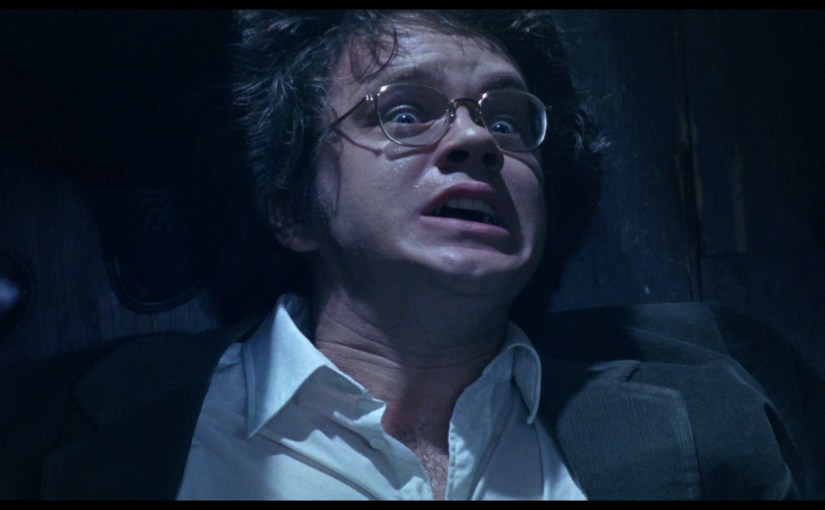
A movie like Adrian Lyne’s Jacob’s Ladder is anything but standard and it asks you to trust in its ambiguity in order to arrive at its big payoff.  For most of the picture it is unclear what you’re watching.  What keeps you engaged is Lyne’s approach to atmospheric indicators, like dark tunnels, dim bulbs, distant echoes and a disturbingly scared and depressed Tim Robbins.  The creepier the film looks and the more ominous it feels, then perhaps it will lead to a conclusion that will leave you satisfied.  Jacob’s Ladder functions like an M Night Shyamalan film where you just want to arrive at the twist.  When it finally reached its destination though, I was ready to turn the car around and go home.

Tim Robbins is Jacob Singer, a Vietnam veteran.  The picture opens up with Jacob returning from the dense jungles to reunite with his squad after what was his like hundredth bowel movement, it seems.  The squad jokes about with men’s locker room talk and then a disturbing occurrence takes place.  The next scene, thereafter, has Jacob dressed in a mailman uniform awakening from a nightmare aboard a New York subway train.  He gets off at his stop, but then he cannot find his way out of the subway station and then he encounters unsettling images like perhaps a demon or two on board a train that just misses running him down.

Much of Adrian Lyne’s film sets up sequences like this where the unexplainable cannot be explained.  Jacob now lives with a girlfriend, Jezzie (Elizabeth Peña), who is growing frustrated with Jacob’s unusual behavior.  It seems he suffers from PTSD following his time in the war, but also he mourns the death of one of his three sons (Macaulay Culkin) from his first marriage.

Robbins is especially good at not going for big moments in his role.  He’s a quiet, cheerless individual working with very little dialogue.  That’s impressive but it’s also a little boring, especially considering that for most of the film it’s near impossible to decipher what is going on, nor what is the exact story to uncover in Jacob’s Ladder.  My patience was trying, up until a stand at attention moment that came from nowhere.  Still, not much arrives thereafter. 

Jacob receives a call out the blue from one of his old army buddies.  When they meet up, it dawns on Jacob that his friend is encountering similar kinds of feelings.  When he reunites with the rest of the squad it occurs to them to sue the United States government for experimental drug treatments that were administered to them while serving in the war.  They turn to an attorney played by Jason Alexander in a role far off from his Seinfeld sitcom days to later come in his career.  This lawsuit may uncover a link for Jacob.  Unfortunately, I think it diverts away from Adrian Lyne’s intended lack of clarity for another kind of movie altogether.  The movie goes in this detour with Alexander’s attorney role and then finds its way back on the main road for the third act.  Hardly any new mileage was to be gained from this rerouting though.

This new development may give a more literal understanding into Jacob’s psyche and condition. However, I think the film fails to pounce on a new opportunity to attack a topical storyline that had become suspect during the actual timeline of the war.  As the film arrives at its conclusion, the script seems to rush to the surprise ending it wanted to garner.

Frankly, an early conversation with a Jacob’s chiropractor (Danny Aiello) easily spelled out the twist for me.  Alas, perhaps that took me out of the film early on. 

There are good ideas and good performances to be had in Jacob’s Ladder.  Yet, I don’t think the film entirely works because of Adrian Lyne’s attempt to push it’s vagueness.  Demons that come out of nowhere during Jacob’s hallucinations should be scary and have a fright shock to them, but instead these moments come off like abstract art that only frustrated me. 

I always thought I knew the ending, and I was right for the most part, but why does a runaway car have to chase Jacob down an alleyway to deliver the point?  Arguably, a boogeyman like Freddy Krueger might have done a better job at disturbing a threat of death than what was ever going on in Jacob’s Ladder.

HOMICIDE (1991)

by Miguel E. Rodriguez

DIRECTOR: David Mamet
CAST: Joe Mantegna, William H. Macy, Ving Rhames, Rebecca Pidgeon
MY RATING: 8/10
ROTTEN TOMATOMETER: 88% Fresh

PLOT: A Jewish homicide detective investigates a seemingly minor murder and falls in with a Zionist group as a result.


Homicide is one of those movies where the lead character experiences just one damn thing after another until he winds up in a situation that is not even barely hinted at in the film’s first half hour.  If I didn’t think it was being a little pretentious – and maybe if I understood the term just a little more – I’d call it Kafkaesque.  It reminds me a bit of Martin Scorsese’s After Hours, where that lead character is drawn unwittingly into the unexplored jungles of New York City at night.  Likewise, Detective Bobby Gold (Joe Mantegna) starts the film on a manhunt, searching for a wanted killer, and thirty-six hours later winds up begging Zionist activists to let him be involved in blowing up a storefront suspected of printing Nazi pamphlets.

In other hands, the events of the film leading up to Gold’s digression into racial/social activism could come off as comic.  First, he’s put on the manhunt case, searching for a man named Randolph.  Then a weirdo booked for killing his family wigs out at the station and attacks Gold, ripping the strap off his holster, and giving him a bump on the head that’s visible for the rest of the movie.  (I was unavoidably reminded of Jake Gittes’s nose in Chinatown.  Both wounds serve as constant reminders of either the odds the characters face or of the unpredictability of the world they inhabit.)  On their way to interrogate Randolph’s mother for his whereabouts, Gold and his partner, Sullivan (William H. Macy), randomly run into what looks like a hostage situation which turns out to be a cop cornered by a vicious dog in a candy store.  In the store is a dead woman.  The commanding sergeant arrives at the scene and gives Gold the dead woman case.  Turns out the dead woman is Jewish.  Her family shows up at the scene, learns Gold is Jewish, and insist he be their personal liaison for the case.  Meanwhile, Sullivan has to carry on with the Randolph case on his own.  A recurring theme will be how Gold keeps missing out on important events with the Randolph case while babysitting the family of the dead woman, a case he considers unimportant.

What happens next unfolds so naturally and surprisingly that I will not spoil it for you.  What I will say is that Mamet turns a standard police procedural into a searing character study of a man who has never really considered who he is in terms of his heritage.  At one point, he speaks with a Jewish scholar who shows him a page of Hebrew text.  Gold says, “I can’t read it.”  The scholar tells him, “You say you’re a Jew and you can’t read Hebrew.  What are you then?”  This is a question that Gold will try to answer for the rest of the film.

On a personal note, that bit of dialogue resonated quite a bit with me.  I’m full-blooded Puerto Rican on both sides of my family.  Yet my knowledge of Spanish is barely passable.  When faced with reading Spanish text, I can sound out the words, but my comprehension level is probably only 60 to 70%.  My conversation with fluent Spanish speakers is halting, at best.  I just never took the time to learn it as thoroughly as my parents or my sister did.  Does that make me any less Puerto Rican?  I don’t think so, and I might feel resentment towards a stranger telling me that I’m not Puerto Rican just because I don’t speak Spanish.  I know who and what I am, and my identity is not tied to what language I speak.

But things are different for Detective Gold.  Earlier in the film, he talks to his partner, Sullivan, on the phone and talks about how the Jewish family he’s now working for, or with, are high-strung, crying wolf (they claim someone is shooting at them from the building next door, but there are no bullet holes to prove it), how they saved ten bucks a week by letting the old lady work at the store herself, how they’re “not MY people, baby.”  Only after he realizes he’s been overheard does he feel immense guilt and obligation to help the family.  Not to just solve the case, but to “find the killer.”  So, he’s experiencing all sorts of new emotions that may or may not be interfering with his ability to do his job impassively.

The people in Homicide sound as if they are speaking in subtext only, using Mamet’s unique writing style to bypass what we think of as “normal” speech and deliver lines that are almost poetic, even when laced with racial epithets and curse words.  This makes the overall tone of any Mamet-scripted film seem hyper-stylized, as if the characters are one level removed from reality, but not in a bad way.  It elevates the film somehow.  I’m at a loss to describe it more accurately.

One bit of dialogue exemplifies what I’m talking about.  Gold is being thrown out of a building.  The gentleman at the door tells him, “Don’t bother to return.  The next time you come, there’ll be nobody here.”  Don’t bother to return?  That’s unnecessarily decorous.  “Normal” conversation would be something like, “Don’t bother coming back.  If you do, we won’t be here.”  However, Mamet’s signature word choices here suggest an almost Shakesperean construction, as if the words are being shoehorned into a buried structure or pattern that operates subconsciously.  Based on what happens with Gold throughout the film, I could theorize that Mamet is trying to create a mood reminiscent of Greek tragedy, and the actors are reciting dialogue that has been translated from Greek or some other language.

But that’s just me.

The experience of watching Homicide will never be quite as exciting or kinetic as other superlative crime dramas like, say, Heat or The Departed, movies that also examine their characters in detail, sending them on similar journeys of self-discovery.  Those other movies are defined as much by their action as by their intelligence.  In Homicide, any “standard” action scenes are purely incidental, or sometimes accidental, intended not to thrill but to move the plot forward with a minimum of fuss.

In any event, the action is not the linchpin of this film.  We watch Homicide, not to see who Gold kills or who tries to kill Gold, but to see if he is capable of resurrecting the person within himself that he thought he had killed long ago, a sacrifice he made on the altar of being a good cop.  He has a painful conversation where he realizes that everything he’s done to suppress his own self has been, “Not for me.  All for someone else.”  He must decide whether to act in service of his conscience or his sworn duty as a cop.  The choices he makes have consequences he never anticipated, as with all good tragedies.  Homicide reminds us of that inescapable fact, not with a bang or a whimper, but with the calm, flat gaze of an impassive Greek god who lets us draw our own conclusions.

MISSION: IMPOSSIBLE FALLOUT

By Marc S. Sanders

Mission: Impossible Fallout is the best of the so far seven films in the series.  It is carried not only by the stunts that Tom Cruise insists on risking his middle-aged self to perform, for the sake of his fans. As well, the film’s casting and the puzzle twisting script from Christopher McQuarrie, writing with inspiration from his famed Oscar winning screenplay for The Usual Suspects is a treat for the eyes and mind.  If this were a novel, I’d quickly be turning each page to see what comes next.  Like McQuarrie’s well-known invention of Keyser Soze, this movie questions Who is John Lark?  Is Ethan Hunt (Cruise) John Lark? 

Hunt chooses to accept the mission of locating this unidentified Lark who is interested in purchasing enough plutonium to wipe one third of the world population, likely in and around Pakistan and China.  However, the CIA doesn’t trust Hunt’s cavalier instincts and insists he partners up with a hulking Henry Cavill playing an agent named Walker.  Benji and Luther (Simon Pegg, Ving Rhames) are back for hacking, field work and some clever mask trickery.  Ilsa Faust (Rebecca Ferguson), the dubious British MI6 agent from the prior film (Rogue Nation) is a welcome surprise and just as perplexing with her actions.  The big bad, Solomon Lane (a snake like Sean Harris), also returns.

Like all the M:I films, Fallout operates with the same kind of formula.  We have to accept the promise that there’s a world ending MacGuffin.  Ethan and the team are assigned to find who has it and who wants to buy it and can use it.  All of this is written outside of the lines of planning out the action scenes these pictures are recognized for.  It’s as if Cruise, with his producer hat on, sketches stunts with skydives, cars, motorcycles, trucks and helicopters and then assigns his writer/director to apply words for the donut filling within the movie.  Mustn’t forget a reason to include a running sequence for Ethan to perform on rooftops.  Fortunately, all of it works best here, more than in any of the other films.

What sells these pictures, and again Fallout is the best example, is the photography and editing applied to these scenes.  Two sequential car/motorcycle chases occur throughout the streets of Paris.  (Look!  I see our honeymoon hotel, The Hotel Regina located across from the Louvre, as Ethan races by in a BMW!!!!!)  A smashing three-person fist fight in an impeccably white men’s room is a brawl for the ages. 

The highlight of this installment is a helicopter chase above and within a mountain valley that first focuses on Tom Cruise himself climbing a rope up, up, up to a chopper and swinging his legs onto the railing to get a foothold.  There’s time dedicated to him falling and inching his way back into the vehicle.  Then it becomes a chopper chase followed by a collision that ends with the remains wedged within a narrow mountain crevice.  What a set piece this is!  Absolutely outstanding camera work.  The wide and close editing, sound and visuals work so perfectly in sync with one another.  I don’t want to watch the making of documentary for this picture.  The trickery of McQuarrie’s camera crew is such a treat.  I’d rather savor the finished product on repeat viewings.

Juxtaposing against this chopper fight are two other scenarios involving Ethan’s teammates.  This is where I’m especially grateful for Christopher McQuarrie’s writing.  Two bombs are rigged in line with each other, and a detonator also must be retrieved by Ethan.  The whole team has to work cohesively, otherwise it is sayonara to much of the Asian continent if both devices explode.  McQuarrie’s “impossible mission” is orchestrated beautifully with suspense cranked way up.  His imagination for adventure allows a magnificently edited third act.  To date, I consider the stakes here to be the highest in the entire series.

The presence of this collection of actors is marvelous with recognition deserving of Henry Cavill donning an untrusting mustache and looking like a brutal, blunt instrument against the superspy Ethan Hunt.  Cavill also plays CIA agent wisely.  He’s got a stoic expression for most of the film but that is because he trusts the audience will assume what a dangerous threat he can be.  Cavill occupies one of the best characters in the seven films.

Mission: Impossible Fallout is truly one of the most thrilling pictures you’ll find.  What’s most important is the action serves the story.  Action just for the sake of action is tiring like in the Fast/Furious films.  There has to be a cost and a tangible feeling to the speed, obstacles and pain that good action scenes serve their characters and the story as a whole.  When Ethan falls from a helicopter or has to jump out a window, I grip both arm rests and let out a collective bellow with the audience.  Films with the grandest of adventure must draw out responses like that.  Otherwise, it’s all just a ho hum journey to the end credits.  Fallout is anything but a stroll.  It’s an absolute balls to the wall, explosive crowd pleaser.

MISSION: IMPOSSIBLE DEAD RECKONING PART 1

By Marc S. Sanders

The object of the Mission: Impossible films is not to wow its audience with thought provoking questions of politics or Cold War intrigue or even daring and uncompromisingly evil villains (apart from Phillip Seymour Hoffman).  The elements of espionage coursing through the TV series are non-existent in the film adaptations.  I’m not watching a film based on a John LeCarre spy novel.  By the time the seventh installment has arrived, titled Dead Reckoning Part 1, the goal of the film series is to sketch out the set ups for one action piece after another.  Only they must be bigger, bolder, and seemingly that much more impossible to overcome for their hero, Tom Cruise (playing a guy named Ethan Hunt).  The action is once again top notch.  The glues that bind these displays of bravado together, you know where the characters have to talk and give us a semblance of a plot, is as nil as the scotch tape that assembles a stretch of film reel into a running time length of nearly two hours and forty-five minutes.

The locales are as grand as any travel getaway. We go through a labyrinthine airport.  A techno night club works as a meeting place for a bunch of characters. There are journeys to the Arabian Desert, Rome, Venice, and a beautiful ride along the famed Orient Express.  Shot on digital, this movie is a gorgeous travelogue.

Let’s get the problems out of the way, though.  The MacGuffin that Ethan Hunt and his trusty pals Benjy and Luther (Simon Pegg, Ving Rhames) have been assigned to recover is two parts of a specially designed key.  One part is supposedly with the disavowed MI6 agent Ilsa Faust (Rebecca Ferguson).  The other half is questionable as to who possesses it, but a thief known only as Grace (Hayley Atwell) may be significant in finding it.  Put the two halves of the key together and it will unlock something that no one seems to know of, or where it is located.  Here’s my first issue.  The audience does know what the key unlocks because it is shown in the first three minutes of the film.  So, while the cast of characters act dumbfounded, we know all along.  So, there goes any curious interest I may have for wanting to follow through with this. 

The other problem is that the same conversation happens over and over and over again.  Lines like (and I’m paraphrasing here, or maybe I’m not) “If this key gets into the wrong hands…” and “Whatever this does unlock, Ethan, could spell the end of the world…” or “It’s important that both halves of the key are not put together…”  or “Whatever this does unlock…”  (See?  Even I just repeated myself in this write up.) Except, we know what it unlocks!!!!!  The same exchange of dialogue occurs over and over.  The redundancy exhausts itself.  It occurs so much in fact that it’s writer/director, Christopher McQuarrie, relied upon the repetitive dialogue to stretch this next M:I chapter into two films instead of one (Part 2 is scheduled to be released in 2024).  I don’t recall the context of any of Ving Rhames’ lines going further than what I have presented here, for example.

The film is also a little too character heavy.  I never understood why two agents (Shea Wigham, Greg Tarzan Davis) are constantly pursuing Ethan.  Just was not clear for me. Heightened suspense?  That’s the best excuse I can think of.  The White Widow from the prior film (Vanessa Kirby) also appears.  Not much purpose to her.  Cary Elwes is the deputy director, there at the beginning and later towards the end, but again I was not entirely certain of his contribution to the story.  Even Ilsa Faust does not seem to have much value, except to work as a step in Ethan’s ongoing trajectory for the key.  I think Rebecca Ferguson had no more than five lines in the whole picture.

Finally, Ethan Hunt seems to be up against an omnipotent enemy, an AI program known as The Entity.  The humans doing the bidding of this phantom program consist of a goatee wearing Esai Morales and his henchwoman, played by Pom Klementieff.  She looks straight out of a James Bond picture and makes for a good car chase through the stone cobbled streets of Rome in a tank like Hummer.  Morales is as boring as most of the other the M:I villains.

What works for the film is what Tom Cruise really wants to impress you with though.  Riding a speeding motorcycle off a mountain and parachuting his way down.  That’s actually a near sixty-year-old Tom Cruise performing that feat.  Very impressive.  The car chase with a handcuffed Cruise and Atwell in a puny yellow Fiat versus an unbeatable Hummer and an army of Italian police vehicles is fun on the level of Roger Moore’s Bond films.  Most impressive for me is the final act where the famed Orient Express train tumbles off a bridge with a gap in the middle, car by car with all the furnishings, piano included, pouring out while Ethan and Grace hold on for dear life. 

It’s the high stakes stunts that work.  Whatever smidge of a story there is fails though.  The script by McQuarrie and Erik Jendresen lacks so much that the cliffhanger the film ends on doesn’t leave me yearning for more because it only hearkens back to the beginning.  The characters catch up to what the audience has known for the last three hours.  So, I’m not losing sleep wondering with what happens next.

Of course, I’ll go see the Part 2 installment.  Tom Cruise won’t let me down in whatever daredevil achievements he’s dreaming of doing next.  However, am I going to these movies to watch Mission: Impossible, or to watch an aggressively updated version of Circus Of The Stars?

MISSION: IMPOSSIBLE ROGUE NATION

By Marc S. Sanders

Mission: Impossible Rogue Nation is as stunt filled as its predecessor. Perhaps even more.  The difference for me though, is that it is better than Ghost Protocol.  The stunts and action are at least equal in both films, but Rogue Nation also plays with its characters while not stopping at certain points to explain what must happen next.  Sure, the movie talks, but it speaks with developments and surprise, rather than starting the story all over again from square one (a shortcoming for me with the prior film).  Much of that is thanks to a new character, a disavowed British Intelligence Agent named Ilsa Faust played with perfect unsurety and mistrust by Rebecca Ferguson.  She’s the actress keeping me interested beyond the magnificent action scenes because I want to uncover what her game really is all about. 

Rogue Nation opens soon after Ghost Protocol ended.  A hearkening back to the original TV series has finally introduced the nefarious and clandestine organization known only as The Syndicate.  No one has been identified as heading this mysterious group.  A face or name has yet to be linked.  None of the major governments, including America, even believe they exist.  Tom Cruise as Super Spy Ethan Hunt is the only one certain that this Syndicate is responsible for a series of terrorists’ attacks and government overthrows occurring throughout the world.  By the way, I always call him Super Spy, because nothing gets past Ethan Hunt.  Not only can he run fast enough to hop onto a cargo plane taking off a runway, but he even has a talent for drawing as well as reading lips in various languages. Amazing!!!!  Incredible!!! Astounding!!!! ETHAN HUNT – SUPER SPY!!!!!

Don’t ask how we get there, but Ethan recruits his trusty pal and computer hacker Benjy (Simon Pegg) to attend an opera in Vienna where the leader of this shadowy Syndicate may be.  Complications and fistfights, along with sniper rifle assassination attempts ensue backstage during a performance, and now Ethan has convinced Benjy that his hunches must be true.  Ilsa is also there, but is she trying to kill Ethan or just fend him off, or is she working alongside of him?  Ferguson plays the role with a perfect poker face, and it helps keep the movie running along while wanting to find out more information.

Every Mission: Impossible film has that one especially heightened action set piece.  This time, Ethan has three minutes of inhaled oxygen while he enters an underwater vault to hack into a “safe deposit box.”  Benjy gleefully sees the simplicity in this.  “Well you can do that!”  As an extra bonus, we are treated to a kinetic motorcycle chase through Morocco.  The sound editing alone with revving engines and cars screeching, machine gun fire, and horns blasting is impressive enough.  Accompany it with well placed camerawork (nothing is blurry or shaky like in many other action films) and you have a set piece that’ll keep you alert.  Who needs dumb Fast/Furious junk when this stuff tops it?  Kudos to writer/director Christopher McQuarrie.

There are some standard motifs to Rogue Nation.  Once again, there’s a government official or two who does not trust Ethan Hunt’s intentions and thus he’s number one on the Most Wanted list.  How many times has this guy saved the world, already?  Give him a break! Also like before, most recently in the last installment, the IMF team has been shut down.  That does nothing for me anymore.  I wouldn’t expect anything less.  No IMF team, but Ethan and Benjy still get a hold of the most inventive gadgets and tricked out cars they can find.  So what’s the big deal if the IMF is on the chopping block?  Still, I like how this picture wraps its storyline up and defeats the villain.  It’s different and a welcome surprise.  Ilsa Faust’s character arc tidies itself up nicely as well.

Amazing stuff happening in this fifth chapter of the film franchise.  As long as Tom Cruise and company get more daring and aggressive with the impossible missions that need to be overcome, the staying power of these films holds.  Mission: Impossible Rogue Nation is a fantastic piece of filmmaking.

MISSION: IMPOSSIBLE GHOST PROTOCOL

By Marc S. Sanders

When JJ Abrams took the reins of IMF adventures with Mission: Impossible III, he brought his penchant for meet cute romance between Tom Cruise’s super spy and his love interest Michelle Monaghan. It worked well as a new dynamic in the high-octane series. In the follow up film, noted Pixar director Brad Bird takes over with his own touch of tongue in cheek wry humor courtesy of Simon Pegg, as well as a little bit from Cruise and some side characters.

This is a great installment opening with a fun prison break moment accompanied by some Frank Sinatra in the background to earn your appreciative grin. An energetic credit theme sequence featuring Lalo Schifrin’s adventurous theme song follows with a spark on a fuse. I get so wired when I hear the Mission: Impossible Theme.  From there, Bird offers up challenges like putting a spin on the now familiar ID retina scan by any typical spy computer.  There are shootouts, of course. More running – lots of running courtesy of Tom Cruise – a sandstorm, a Kremlin covert operation and a climactic chase for a briefcase within a weird multilevel movable parking garage filled with cars to crash, bash, and drive off high level platforms.

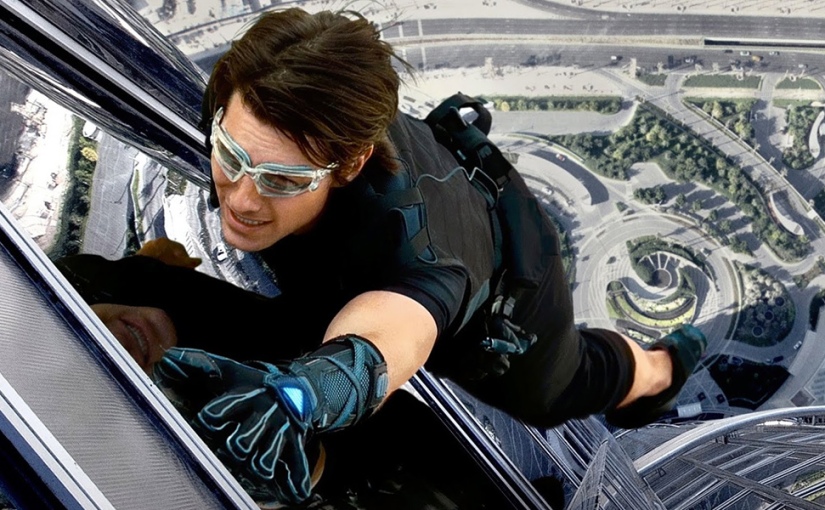
The main centerpiece reaches for the sky however with the world’s tallest (I think) building, the Burj Khalifa in Dubai. I love this scene. Not just because Cruise is doing the stunt of climbing the glass tower himself, but it screams of hilarious moments that belong in Bird’s other great accomplishment, his Incredibles films.  The photography is unbelievable in this sequence even when watching it on a 4K flat screen at home.  This one scene can be taken out of the context of the film and treated like a short story adventure.  The goal that Ethan Hunt is trying to accomplish is to quickly hack into the building computer.  Seems so trivial for the enormous lengths he goes through, but then we wouldn’t get the scene!!!!  So, scale that glass Ethan and let’s see how you get yourself out of this one.  A highlight of not only the film series, but Tom Cruise’s amazing career.

Simon Pegg is hilarious against the reluctance of Cruise’s straight man along with an out of touch Jeremy Renner. There’s a sticky glove that won’t work for Cruise as he scales the outside of the building, but Bird milks the joke while also using Renner, who is of no help but invites nervous glee and desperation.

Especially with Ghost Protocol, the film seems to begin, conclude, and then begin again.  Over and over, the players are explaining what must happen or needs to be done, or what the next step in the mission is.  So, there’s a lot of stops and starts with exposition through the course of the film.  What does it all spell out?  I hardly care.  All I know is the heights of danger are that much bigger, because all IMF agents, including Ethan Hunt and team, are now disavowed following an attack on the Kremlin in Russia. 

I don’t try too hard to piece everything together in the M:I films. Other than Phillip Seymour Hoffman in Abrams’ film, the villains have not been altogether memorable. The breathtaking action is much more fun than the stories. Though this film talks a little too much, something is always happening. This occurs in nearly every installment of the franchise, save for John Woo’s short-changed Mission: Impossible II.

This is a franchise that hasn’t self-destructed.  Cruise and company choose to up the ante with each new installment.  I hope the films continue on that course.

MISSION: IMPOSSIBLE II

By Marc S. Sanders

Mission: Impossible II is undoubtedly the weakest installment of Tom Cruise’s series, adapted from the classic tv show. Action Director John Woo is normally regarded as “ACTION DIRECTOR JOHN WOO” because he can only direct action. He hardly ever directs story. There’s no dimension to his characters and nothing intriguing. It’s all just glitz and neon colors in his cinematography. No weight at stake in Action Director John Woo’s action.

A third act fist fight between Cruise’s Ethan Hunt and a very, very uninteresting villain played by Dougray Scott gets very tiresome, very, very quickly. Punch, kick, tackle, twirl, take off your jacket, get up in very slowwwwww motion, throw off your sunglasses, and do it again and again and one more time.

The MacGuffin of the picture is a virus and the anti-virus. Hunt recruits a sexy thief played by Thandie Newton to infiltrate Dougray Scott, her ex-boyfriend seeking to cash in on the prize at hand. Somewhere, lost in Robert Towne’s script, Scott’s character gets wise to the fact that of all the “M:I” agents out there, Ethan Hunt is the one onto him even though they never come in contact with one another until the middle section of the film is complete. So, the bad guy, at times, disguises himself as Hunt. Screenwriter Robert Towne thought he’d get one over on the audience with the disguise twists that the M:I franchise is known for. Sadly, it’s not subtle enough in this picture. All twists can be foreshadowed as early as the opening credits actually.

Action Director John Woo really fails with this effort. He makes a terrible habit of amping up the gloss of his film with an abundance of slowwwwww motion actions and reactions to accompany a mostly mandolin soundtrack from Hans Zimmer. Beautiful set pieces of music. Though none of it belongs in this film. Zimmer’s work here is better suited for something more genuinely romantic and exotic, without the revving motorcycle rides and bare-knuckle brawls in the final act of the film.

In addition, Action Director John Woo is not given much action to “action direct.” There’s a lot of bland talking in Towne’s script. So much so that we finally arrive at what the film promises, only it’s very late in Act 2, and then drags on very slowwwwwwwly in Act 3.

For a brief stint early on, you get the impression that Cruise is adopting a flirtatious James Bond approach with Newton’s character. They hide away cuddled in an empty bathtub and quickly bed one another, but Towne writes no sexual innuendo to go with Cruise & Newton’s grins, or their shiny, moisturized complexions.

There’s no humor either. There’s really no reason to like Ethan Hunt here. He has nothing to say. All he does is walk in slowwwww motion in response to Action Director John Woo.

Cruise, again as producer, makes the mistake of only allowing his hand in the cookie jar. No one gets to do anything of great importance except him. A team is assembled to just watch Tom Cruise play and walk slowwwwwly. Cruise hired his own fan club for this film, including Anthony Hopkins. Now here’s a charming chap playing Hunt’s supervisor. You see him appear for the first time early on. He returns in the epilogue, and when the film has concluded you realize that Oscar winner Anthony Hopkins next to nothing to do, really. He doesn’t debate or joke with Cruise. He, like most of the cast of the first two M:I films, just tells Hunt who to meet next. What potential for a great character played by a marvelous character actor and it’s regrettably squandered away.

Fortunately, the approach of the subsequent M:I films went in different direction following Action Director John Woo’s contribution. All elements of this short-changed story were abandoned for better material from better directors to later come.

MISSION: IMPOSSIBLE III

By Marc S. Sanders

Remember that CW TV show called Felicity?  I’ve never seen an episode, but I remember the advertisements.  Beautiful, former child actor, Keri Russell with the golden, curly locks of love, was on her way to college.  Every commercial had that crisp, home like comfort feel voiceover.  It left me with an impression that this was a corny, yet sweeping exploration of coming of age while at college, and gaining independence.  The show came from JJ Abrams.  Abrams is a good director and writer.  He’s now one of the biggest producers in Hollywood.  Back in the early 2000s however, he wanted to nurture his characters.  Protect them.  Make them feel warm and content.  After Felicity, he went on to develop a spy thriller series called Alias with Jennifer Garner.  She was a college student with a lovable roommate by day and was super spy by night, or whenever the moment called for it.  Abrams went on to blending his coziness with that of stunts and explosions that modernized a series like, say…Mission: Impossible.  Naturally, when Tom Cruise recruited him for the third film of the high-octane franchise, we got the “Felicity Finish” applied.  Ethan Hunt is sweet and kind, and he’s ready for married life.  How precious!

Don’t get me wrong.  Mission: Impossible III is likely what kept the still running blockbuster movie series going.  Following a style over substance lackluster entry before, from action director John Woo, this third entry went in a completely different direction.  Ethan Hunt hugs a soon to be sister-in-law. Ethan Hunt cries.  Ethan Hunt has feelings.  Ethan Hunt has to rescue who he regards as his “kid sister,” Felicity…I mean adorable Keri Russell from being held hostage.  Ethan Hunt belongs on the cover of a Hallmark card with actress Michelle Monaghan.

I imagine JJ Abrams is not fond of the early James Bond movies.  I’d make a case that he watches them and wishes that someone, anyone would just give 007 a warm and sincere hug after he saves the world, and hold him close.  Superspies have emotions too, ya know?

The story of this third M:I chapter focuses on the pursuit of a MacGuffin known as the rabbit’s foot.  A powerful weapons dealer named Owen Davian (a brutally frightening Phillip Seymour Hoffman) is working to get a hold of it.  Following a first act rescue mission that Ethan and his IMF team (Ving Rhames, Maggie Q, Jonathan Rhys Meyers) engage in, the main hero finds reason to capture Davian and intercept the mysterious rabbit’s foot.  Complications get in the way because Ethan has fallen in love with an adorably beautiful doctor named Julia (Monaghan), who is unaware of her fiancé’s exploits.   

The action is superb in Abrams cinematic directorial debut.  Once it gets started after a sweet engagement party scene, it does not let up.  Everything is well edited and choreographed. An essential part of a Mission: Impossible movie.  An unexpected attack on a bridge crossing is spectacular.  The covert tactics are fun to watch as well.  When Ethan and team secretly invade The Vatican, the step-by-step maneuvers are carried out with gleeful ease.

There are twists and double crosses at play as well that you are not even thinking about looking for.  Frankly, they work more effectively here than they did in the original M:I film directed by Brian DePalma.  When the traitor is revealed to deliver a line like “It’s complicated,” it is not unreasonable to gasp.

Hoffman still remains the best of the villains in Cruise’s action franchise.  Maybe that’s by Abrams’ design because this is probably the most personal of all the films to date.  Phillip Seymour Hoffman is the guy who will be apprehended and braced to a railing on an airplane by the IMF team, and yet will still hold the upper hand.  A question like “Do you have a wife or a girlfriend?” has a much more sinister context when uttered by Phillip Seymour Hoffman.

I do recall when I first saw the film that the ending is not original.  It’s an opportunity for Tom Cruise to do another running scene, but it was first used in an episode of Alias where an operative is remotely giving directions to the hero while talking on a cell phone.  Clever the first time.  The second time seeing it, I was just calling it out.  So, Abrams needs to stretch his imagination a little.  No matter.  The pulse of the adventure races at high speed.

Mission: Impossible III might be unabashedly hokey and corny.  Everyone looks like they belong in a JC Penney commercial at Christmas time, or on a CW TV show like Felicity. However, it won’t deny you of what you are looking for which are big stunts in the sky and on the ground, along with the cool gadgets and those signature pull away masks that made the original series so memorable. 

I still realize that by the time film series reached this chapter, the franchise still belonged exclusively to Tom Cruise occupying every frame.  Once again, his team of IMF agents really don’t matter or carry any substance except to wear clothes.  At least this time, Tom Cruise cries over someone else.  So, he’s not as self-involved as the last couple of times, or even the last couple of dozen movies.  That’s a nice change of pace.