
By Marc S. Sanders
Within one of the most crime ridden and destitute neighborhoods of Miami, Florida a black youth named Chiron does his best to survive bullies while evading the drug fueled temper of his mother, Paula. Barry Jenkins shot his Best Picture Oscar winner in twenty-five days. The film’s pace is sluggish, but the sum of its three acts is very effective.
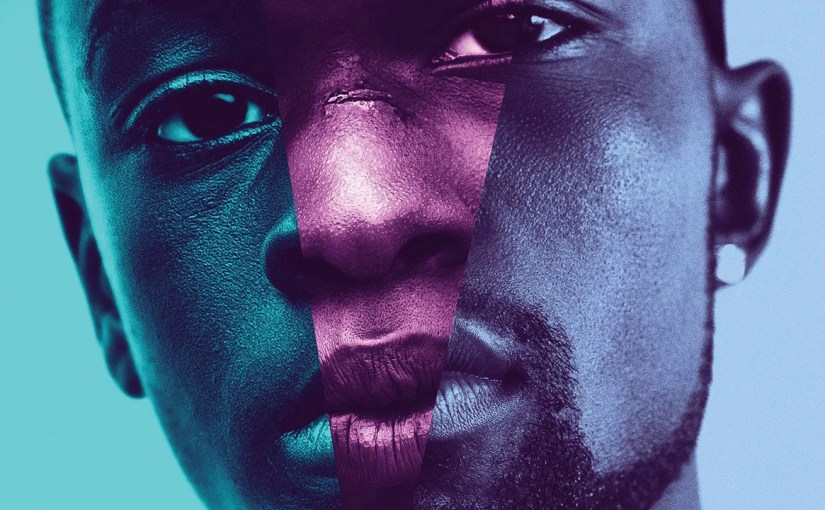
Chiron is portrayed by three actors, each depicted on the marquee poster for the film as a combined amalgamation of one face – truly one of the best ever designed still photo ads for a film in recent memory. You have to take a beat to study the crafted image before you realize it is three different generations staring back at you.
As a pre-teen, the character is identified as “Little” played with calm astuteness by Alex R. Hibbert. This boy is defined more by his blue backpack, neat haircut and conservative clothes than any of the few words he has to say. The environment he roams on an everyday basis identifies him more accurately. Little is always running and hiding from bullies while also being teased. He doesn’t seek support, but a drug dealer named Juan (Mahershala Ali, in his first of two Oscar winning performances) welcomes Little into the home he shares with Teresa (Janelle Monáe, truly the most underrated member of this cast).
There’s only a minimal amount of information to learn about the central character and what’s most important is during one of few moments he speaks. Shortly after Little participates in a silly group comparison of young boys who reveal their privates, he asks Juan and Teresa what does the word faggot mean? I won’t share the response, but I certainly approve of Juan’s simplistic description. There little dimension to such an ugly word.
Sadly, life is rightfully confusing for Little. Paula worries about her son only when she returns from an overnight stupor when he hasn’t come home because Teresa prepared a supper and bed for him to stay overnight.
A terrible irony is that there is a small degree of common separation between Juan and Paula. I’d argue Little never experiences disappointment with his mother because how she carries herself is never unchanged. Rather, it is regretful to learn what is realized about Juan – his mentor, who has fed him, taught him to swim and assured him that any confusion he might have with personal identity is nothing to be ashamed about. It’s hard to trust someone who seemingly offers affection when an ugly accuracy accompanies the image.
In his teens, Little goes by Chiron (Ashton Sanders, who delivers the most heartbreaking performance of the three actors in the role). The backpack is now grey, not blue, and school and life at home are twice as harsh. Paula is completely undone with addiction that torments her son for whatever scrapes of money he has in his pockets. From the beginning Naomie Harris plays Paula, which is an entirely unidentifiable character from her Moneypenny iteration in the James Bond films. She’s erratic and physically bathed in sweat as she yearns for a fix. Apparently, Harris shot all of her scenes in just three days during a tight promotion schedule for SPECTRE. Her work is astonishing.
One less positive influence is absent from his teenage life which is never explained. Likely, Jenkins wants to demonstrate how quickly people are expelled from a survival of the fittest contest located in the run-down projects of broken homes and crime. What Chiron experiences in just the two short days of this middle section is tender and trusting one moment, but unforgiving following the next sunrise.
Chiron’s sexuality becomes more tangible with Kevin, his childhood best friend (Jharell Jerome). Loyalty is tested later on followed by Chiron’s level of tolerance to be a victim. I’d argue that violence usually stems from purpose. It’s fortunate that Barry Jenkins offers enough of a back story before we see a brutal attack occur to close out this chapter. Jhraell Jerome demonstrates a breaking point for a boy who’s not yet a man. His silence is consistent with that of Alex Hibbert’s portrayal. However, tears, hand holding, a quiet, homeless night on the beach, and eventually rage say more than enough.
The final act is when Chiron goes by the name of Black in his early twenties. He’s portrayed by Trevante Rhodes. His behavior is mostly consistent with the other two interpretations. Still, by no fault of the actors, I find this portion to be significantly weaker than the other two. Black reunites with Kevin, following both men serving time. Kevin is now played by André Holland. He manages a diner near Atlanta.
I do not believe Black (or Chiron) makes peace with his past demons. I do not believe Barry Jenkins ever aimed for a resolve. He’s staying physically fit while being independent and adopting a similar appearance to Juan. I was not clear on it, but I believe he follows Juan’s unfortunate career path as well. Is that good, or worse than ever? As well, an encounter with Kevin before the film comes to a close could leave you feeling unsure about Chiron’s future. Yet, there is no promise of a future in this world.
Rhodes and Holland are fine actors. I simply found their conversations to be stale and uninteresting. Holland owns the most dialogue and unfortunately Trevante Rhodes upholds Chiron’s minimal expression. That grows tired by this point. He’s a damaged individual, but to offer this small slice of his early adulthood should have had more to say than just a slow-moving conversation in a diner booth. Still, one of Chiron’s last lines of dialogue says so much. It just takes a little too long to get there.
Moonlight is a complex watch, broken up into three short one act plays focusing on one person’s torrent youth. The world he’s beholden to is always challenging and devoid of relief. It’s not easy to watch a child endure these conditions where your positive influence is a criminal and your best friend must use you as an expense for his own survival, regardless of any affection he can offer.
The cast is exceptional. However, as impactful as Marhersha Ali is during his twenty minutes of screen time, I never felt like he provided enough for the widespread acclaim that followed this film’s release. I think the script shortchanges his character. His role is quite significant to the central character, but his presence feels insufficient.
The supporting work of Janelle Monáe and Naomie Harris are the standouts. I actually wish their maternal roles were further explored. Both women are short on tolerance for pity. Neither will weep for Chiron’s anguish. One operates with an affectionate purpose and the other is wired for impatience and abuse.
Moonlight certainly belongs to the three men who play Little, Chiron and Black. Barry Jenkins would not allow the actors to meet in person on set. He wanted the performance of the respective episodes of this boy’s life to play without any outer influence beyond the script and his personal direction. Wise move. Nothing is mimicked. Yet, the responses and behaviors of Chiron add up sensibly as the young man experiences a rough adolescence. Chiron gets chased, pushed, punched and verbally abused. However, when he finally fights back, it’s not in a similar kind of method with fists and name calling. Chiron goes a step further.
Moonlight is a very special film that explores how a boy can ever be expected to survive when the nature to be a criminal appears to be his only destiny and his sexual orientation is unaccepted. The odds of just feeling content are not favorable for some that reside under a moonlight amidst isolation or with limited companionship. By the time the film concludes perhaps it’s at least positive that a quiet, young man from the projects can offer up a sad truth about himself beyond what shows on the surface.

