
By Marc S. Sanders
My favorite kind of crime dramas are the ones that tackle the grit. The screenwriters and directors go for where the itty-bitty stuff scrounges up into something bigger for either the career criminal or the low-level cop. These guys start out as butterflies flapping their wings and before you know it their legacies and pursuits are as big as hurricanes. Movies like The French Connection or Heat operate on these trajectories. How did we get from there to HERE?
Ridley Scott went in an unconventional direction away from his science fiction eye and ancient history recollections when he directed American Gangster with a screenplay by Steve Zallian based on the true stories of Harlem drug kingpin Frank Lucas (Denzel Washington) and narcotics detective Richie Roberts (Russell Crowe).
These two sensational actors don’t share one scene together until the epilogue of this always interesting three-hour opus. Yet, in their second film together their pairing is as classic as DeNiro and Pacino or Newman and Redford. I hope before they retire, these men pair up for at least one more film.
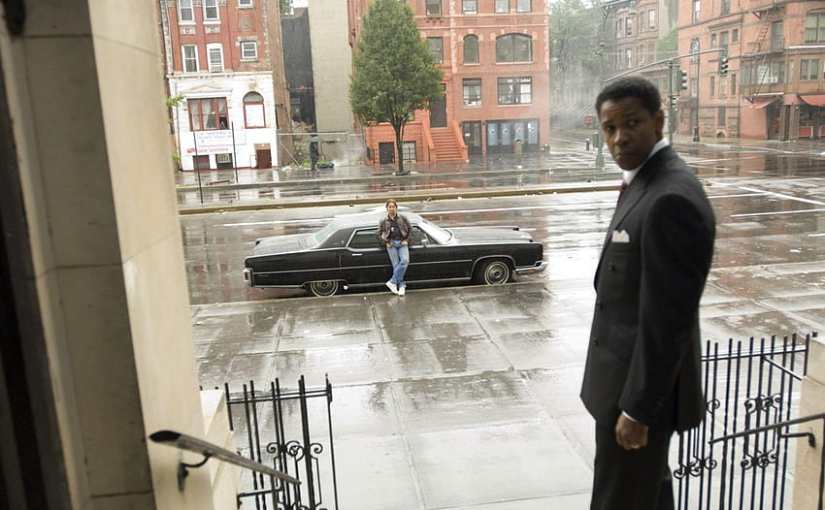
Ridley Scott and his nominated art directors, Arthur Max and Beth A Rubino, capture a gritty urban, crime ridden Harlem of the 1960s/70s. The streets are filthily here, as well as in the five New York boroughs and all the way across the bridge into New Jersey. Frank’s markets carry a very wide berth. The buildings are distressed and cracked. The clothes are of the hippie era with polyester suits. This is where Frank Lucas moves his imported contraband, white powder heroin, labeled exclusively as “Blue Magic.” The film provides a convincing source locale deep within the jungles of Vietnam where thousands of kilos are shipped to Frank for sale on the street. The purity of the drug is beyond compare. Scott and his art designers place you directly in this time period of dingy grime and among the sweaty Viet Cong and rivers to finally arrive at the crop Frank purchases his products from.
Once he finds his footing by eliminating the competition and recruiting his brothers and cousins to run his business, Frank invests in creature comforts with a furnished penthouse apartment for himself and a beautiful mansion for his mother (Ruby Dee in an Oscar nominated performance that comes off so naturally; you’d think she’s sitting at the Thanksgiving table with you). He marries a beautiful Puerto Rican wife that he treats like a princess. Frank is smart. He stays under the radar by wearing conservative suits and not making many waves like going out at nights and showing himself around the social scene. He knows famous athletes like boxer Joe Lewis or the staff on the New York Yankees that could give his nephew a shot at being a pitcher. Still, his profile manages to stay low. Like his mentor, he just operates a business with a viable commodity. He tells his younger brother (Chiwetel Ejiofor) that the loudest one in the room is the dumbest and the most likely to get caught. So, mind how you carry yourself, how you dress yourself and how you flaunt yourself.
A separate story has no business intersecting with Frank’s plight until something gives. Richie Roberts is a good, honest cop. Though he’s also a lousy husband and father. He has been assigned to head up a task force that will bust the top of the assorted drug empires. He needs those rare breed cops who are not on the take and follow a strict policy of law enforcement ethics. His team will not bust a common street hustler. They will be looking for the kingpins with unquestionable evidence to put them away for good.
American Gangster follows two separate stories for most of its running time. At least during the first two acts of the film, Frank and Richie are unaware of one another. It’s only through some gradual surveillance that the cop finally gets a whiff of an idea and starts to move methodically towards a conclusion. The methods are the fascinating parts the movie.
When Denzel Washington plays a villain it’s always memorable and contrary to popular opinion, Frank Lucas is my favorite of his antagonists, especially compared to his Oscar winning work in Training Day. Watch how he walks or sits on a sofa and broods over how his family and his business are functioning. He’s the only African American actor I can see playing this guy because I’m always convinced that whoever Denzel Washington portrays, it’s a character who will never be intimidated. This guy faced down Gene Hackman during a threat of nuclear holocaust. Not many other actors can do that so authentically.
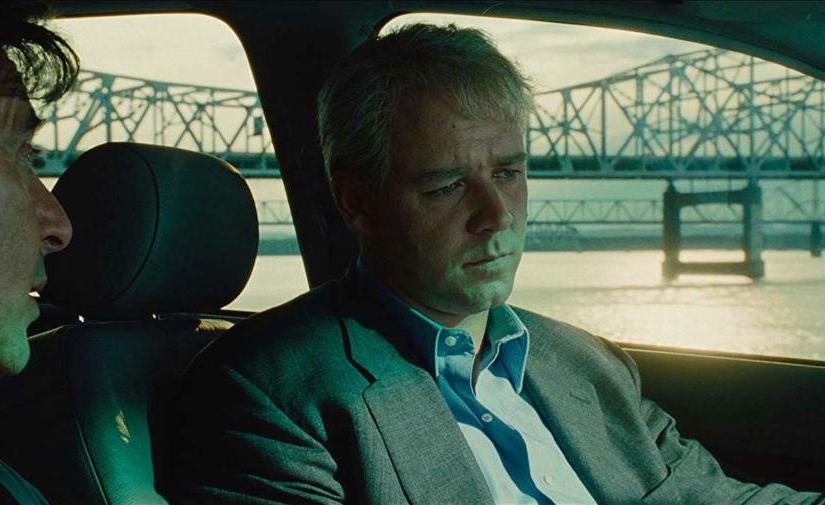
Russell Crowe works like that hero who doesn’t want to wear the cape. Richie Roberts succeeds on so many levels where his peers surrender to their inhibitions. This cop passes the bar exam while fighting for custody of his kid on top of going after the empirical criminals who litter the streets in drugs and murder. I’m reminded of his role in The Insider, where he used a similar American accent. Richie is not as temperamental or hard wired as that guy, but he is at least as focused on doing what’s right regardless of threat or distraction. Russell Crowe has a way of getting audiences to admire the concentration needed for many of his complicated characters. You have as much tunnel vision as he wants the men he’s portraying to have. You are zoned in with what his characters live by. You only trust their standards.
There are signature staples within the construct of this true story adaptation. There are gunfights. Punches are thrown. The guy at the top beats up one of his cronies when he gets out order. Yet, what stands this material apart from others is that now I’m watching how Denzel Washington and Russell Crowe handle everything.
The truth behind the story of a black gangster defying the dirty cops and the Italian mobsters who were thought to run the metropolitan undergrounds is amazing. It’s so interesting to see how novel Frank is with smuggling the product from one side of the world to the other. Then, you see how he uses his family members to distribute to the consumers and collect the monies. Ridley Scott provides all the breadcrumbs in an easy-to-understand fashion.
Painted against the landscape of an unwinnable Vietnam War that just won’t end, power is acquired and thus the best police officers are forced to change their approach. So again, you see two different stories that start out small and undetected. Frank and Richie are the most careful and meticulous of guys in their respective fields. Therefore, it only makes sense that their paths don’t cross until their missions are nearly over.
There’s much to learn from American Gangster.
You get an idea of how the harm of the war was not exclusive to just what was happening over in Vietnam. There were more indirect effects to that crisis impacting the streets of New York and New Jersey.
You see what subtleties an investigation will collect upon before pouncing on to a bigger stake. You also learn how to handle a criminal empire with trust and dignity rather than announcing your immorality. You witness the sheer defiance of a righteous guy in what is supposed to be a law-abiding field. Steve Zaillian’s script is not just good guy vs bad guy. It’s each of these guys holding on to the top while trying to catch up with or stay away from each other.
American Gangster is a very thorough and well-planned biographical thriller.
 2 UNPAID MOVIE CRITICS!!!!