
FAREWELL, MY LOVELY (1975)

DIRECTOR: Dick Richards
CAST: Robert Mitchum, Charlotte Rampling, John Ireland, Sylvia Miles, Anthony Zerbe, Harry Dean Stanton, Jack O’Halloran, Joe Spinell, Sylvester Stallone
MY RATING: 9/10
ROTTEN TOMATOMETER: 71% Fresh

PLOT: When a giant ex-con fresh from prison asks Philip Marlowe to find his missing sweetheart, Marlowe winds up entangled in multiple murders, prostitutes, and a sultry trophy wife.


Because it was released only a year after Chinatown (1974), it is tempting to compare Farewell, My Lovely to that landmark film noir, but although they are in the same genre, the two films are apples and oranges…or at least apples and pears.  Both feature hard-nosed private eyes accepting cases that turn out to be more complicated and far-reaching than they appear, both feature multiple unexpected deaths, and both feature curvy, smoky-eyed dames with dangerous secrets and aging husbands.  All true to the genre.  But Chinatown breaks (successfully) with film noir in several key areas, while Farewell, My Lovely achieves its lofty heights while still remaining faithful to the bedrock tropes of vintage film noir, right down to the tired voice-over narration from the hero.  I have no idea how faithful it is to the Raymond Chandler novel by the same name, but if the book is half as entertaining as the movie, I may have to track it down and give it a read.

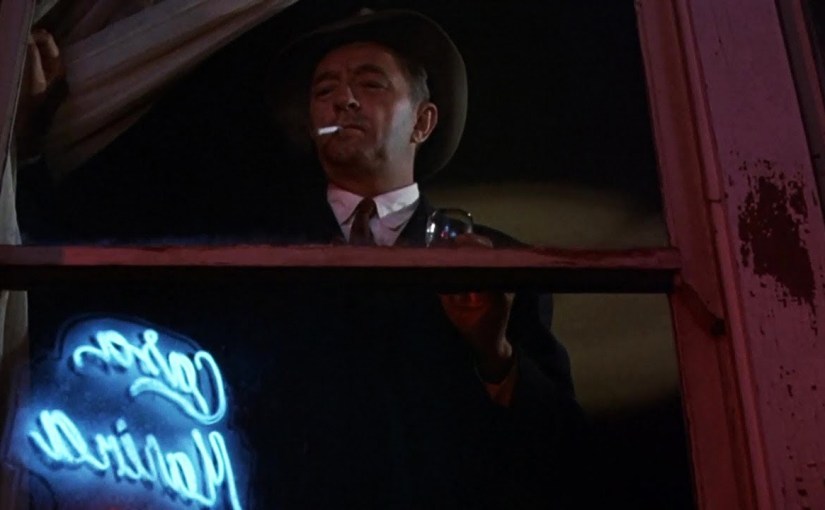
Robert Mitchum plays legendary gumshoe Philip Marlowe, the third version of the character I’ve ever seen after Humphrey Bogart (The Big Sleep, 1946) and Elliott Gould (The Long Goodbye, 1973).  Compared to the other two, Mitchum is by far the most shambling version, but I mean that in a good way.  We first see him staring out of a rundown hotel room in downtown Los Angeles, some time in 1941.  We know the timeframe because of a calendar here and there, and because Marlowe is obsessively following Joe DiMaggio’s progress, as he is on the verge of breaking the record for hits in consecutive games.  That’s a nice touch.  Marlowe’s world-weary narration plays over Mitchum’s sagging face and drooping cigarette, and the spell is complete: we are in the hands of one of the great genre pictures, from a story by one of the greatest mystery writers of his generation.

Marlowe’s story starts as a flashback, a story he’s relating to similarly-weary Lieutenant Nulty (John Ireland).  See, it all began when Marlowe was tracking down a rich family’s runaway daughter.  Soon thereafter, “this guy the size of the Statue of Liberty walks up to me.”  This is Moose Malloy, an ex-con fresh out of the slammer after serving seven years for armed robbery and making off with $80,000, which was never recovered.  Moose is played by Jack O’Halloran, whom cinephiles will recognize immediately as the overly large/tall man who played Non, the mute superpowered henchman in 1980’s Superman II.  To see this man actually string words together into sentences was a strange experience, but I eventually got used to it.

Moose wants Marlowe to find his sweetheart, Velma, who hasn’t written to him the last six years of his stretch.  Next thing you know, someone takes a potshot at Moose on the street, Moose winds up killing a guy in a bar, and Marlowe follows Velma’s trail to an insane asylum, and that’s still just the tip of the damn iceberg, because now there’s this guy who wants Marlowe to help deliver $15,000 in ransom to some other guys who stole a jade necklace…and we STILL haven’t seen the rich trophy wife yet.

And round and round it goes.  I have seen other films that attempted to combine this many plot threads and they wound up a jumbled mess.  Not this movie.  Farewell, My Lovely skillfully walked that tightrope and held my interest all the way through.  I was never lost, never confused…except for a couple of places where the soundtrack obscured a word or two, but I don’t know if that’s the soundtrack’s fault or the actors for mumbling too much.  Plus, this movie contains one of the single greatest interrogation sequences I’ve ever seen, starring Marlowe, two thugs, and the madame of a whorehouse.  It starts semi-normal, escalates with a shocker, then tops the first shocker with something I didn’t think even a hardcase like Philip Marlowe would do.  But the more I watched this movie, the more I got the sense (whether it’s true or not, I don’t know) that this Mitchum version of Marlowe is truer to the literary Marlowe than we ever got previously, in terms of Marlowe’s principles.

I should also mention the dialogue, which contains some of the best one-liners and comebacks I’ve ever had the pleasure of listening to.  For example:

  • Marlowe describing a large house he’s driving up to: “The house wasn’t much.  It was smaller than Buckingham Palace and probably had fewer windows than the Chrysler Building.”
  • Marlowe on his billing practices: “I don’t accept tips for finding kids.  Pets, yes…five dollars for dogs, ten dollars for elephants.”
  • Marlowe describing the obligatory femme fatale (Charlotte Rampling): “She had a full set of curves which nobody had been able to improve on.  She was giving me the kinda look I could feel in my hip pocket.”
  • Marlowe when the femme fatale asks him to sit next to her: “I’ve been thinking about that for some time.  Ever since you first crossed your legs, to be exact.”

Dialogue and lines like this are dangerous because they have been the targets of so many parodies for so long that modern audiences may have forgotten how to take them at face value.  But in Farewell, My Lovely, it comes off perfectly as a tribute to the classic noirs of the 1940s and ‘50s, a tip of the hat to the giants of the past.

Conversely, this movie also reminded me of many of the best eighties thrillers I remember watching, which is ironic considering it was released in 1975.  Movies like Body Heat and Jagged Edge and Silverado, whose purpose for existing seemed to be just to tell a freaking awesome story, unburdened with subtextual layering but laden with style and wit and intelligence, paying homage to their cinematic ancestors by emulating them without plagiarizing them.  There are no doubt film historians who could analyze this film scene by scene and explain exactly what the filmmakers were really trying to tell us underneath the ingenious dialogue and intricate plotting.  But even if I knew or understood all of that, I maintain the best reason for seeking out and watching Farewell, My Lovely will always because it’s just a damn good movie.

(…if for no other reason because of that interrogation scene…I had to rewind it a couple of times just to get my shocked laughter out of my system…)
SCROOGED

By Marc S. Sanders

Bill Murray with director Richard Donner delivered their contribution to the Charles Dickens assortment of A Christmas Carol iterations with a modern update called Scrooged.  Until now, this movie eluded me.  Yet I can’t deny it has all the ingredients for a sure-fire green light to make the movie.  Bill Murray? Doing Ebenezer Scrooge?  Stop everything people!  Get this ready for December.  STAT!

Unfortunately, it misses the mark.  

Now, I’m supposed to like this miser by the end of the story, right?  So then why is Murray’s personification so annoying and unappealing by the end? If I was his nephew, I’d rescind my invitation to come over for Christmas dinner.

The best and most hilarious part of Scrooged occurs in the beginning following the easily recognizable Danny Elfman instrumentals.  Santa and his elves are happily making toys when suddenly terrorists attack the North Pole and Lee Majors jumps out of nowhere ready to bear arms with ol’ St. Nick and his crew.  I was sad to realize this was only a TV commercial for the station programming that Murray’s character oversees.  If there is a God, he’ll reveal the location of the lost film for The Night The Reindeer Died.  Earlier this year I saw Lee Majors needlessly squandered away in the terrible Fall Guy adaptation.  It crushes me that he got this same kind of treatment over thirty years prior.

Bill Murray is the uncaring and thoughtless Frank Cross.  When we meet him on Christmas Eve day, he’s firing an executive (Bobcat Goldthwaite) for simply disagreeing with him.  Also, in typical overplayed Bill Murray fashion, Frank insists that his assistant Grace (Alfre Woodard) ignore the needs of her family during the holiday and get work done with him.  Grace of course filling in for the Bob Cratchit role.  

Following a few other gags to parade the comedian’s antics around, Frank is encountered with the Jacob Marley stand in, played by John Forsythe.  At this point I’m still with the picture even if the breadcrumbs are easy to follow.  Forsythe, in his grotesque makeup, works well against the clown who leads this movie.  (Not a bad scene together between Charlie and Bosley. “Hello Angels!”).

It’s when the follow up ghosts make appearances that my mind ponders what I’ll be writing about in this review.  Ghosts of Christmas Past (David Johansen) and Present (Carol Kane) enter on cue and right away I grew bored and uninterested.  

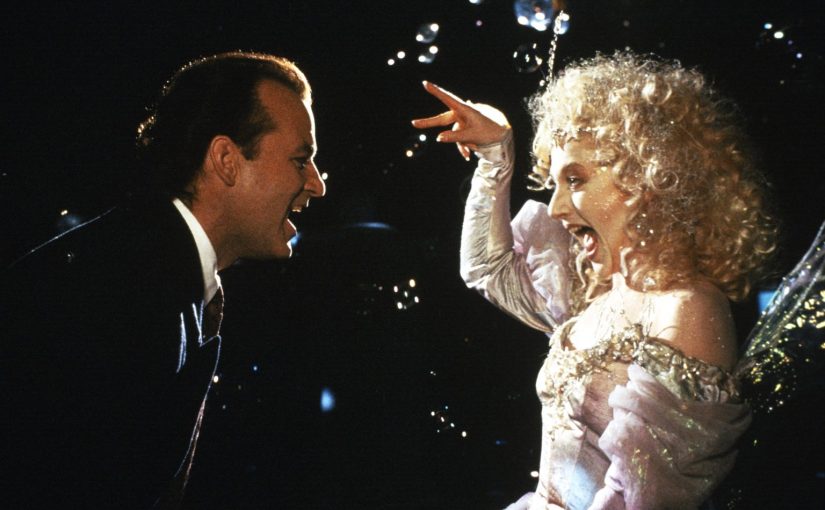
Johansen is a cabbie, or just another screeching screamer like Murray.  He’s laughing at Frank’s demise and past missed opportunities, but I’m not seeing what’s funny or even heartbreaking.  Neither theatrical mask of comedy or tragedy is functioning.  Carol Kane does her typical schtick with the high-pitched baby talk voice, dressed in a fairy get up.  Beyond that familiar routine, she commits every kind of Three Stooges smack and painful tug on Frank’s face that you can imagine.  Why of all things does she rely on a toaster to upper cut the jerk in his face?  I mean why a toaster???? If the comedy works, then I should not be wondering why a toaster or a pie or two by four or an anvil.

There’s nothing wisely written here.  The screaming and the smacking get old very fast and it gets in the way of a potential love story passed by that the script was promising for the Frank Cross character and his crush Claire (Karen Allen, whose smile always lights up a room).  I never felt like Bill Murray was ever listening to Karen Allen in the scenes they share.  Did they even rehearse this stuff?  Too often, Bill Murray seems to just be winging it, and it wouldn’t make a difference if Karen Allen even memorized her lines.

Scrooged starts out with fresh, quality made National Lampoon material but then waddles into the same typical chapters of Dickens’ holiday story.  However, while it hammers the familiar story beat by beat and you tell yourself there’s the Fred character and there’s the mute kid covering for a crippled Tiny Tim and there’s Yet To Come, you got Bill Murray who was granted too much artistic license to improvise, and has thus squeezed out all of the sensitivity and spirit that we expect from A Christmas Carol.

I’m sorry but I think I liked this Frank Cross a whole lot more before he was visited by the ghosts.  This is one Scrooge who should’ve been allowed to sleep through Christmas.

PS: If anyone can find a DVD print of The Night The Reindeer Died, I’m ready to review it.

THE FRIENDS OF EDDIE COYLE (1973)

by Miguel E. Rodriguez

DIRECTOR: Peter Yates
CAST: Robert Mitchum, Peter Boyle, Richard Jordan, Steven Keats, Alex Rocco
MY RATING: 9/10
ROTTEN TOMATOMETER: 98% Certified Fresh

PLOT: After his most recent arrest has him looking at a long prison sentence for repeat offenses, an aging Boston gangster must decide whether or not to snitch on his friends to avoid jail time.


When scrolling through movie titles online or on your favorite streaming service, you might be forgiven for thinking that a 1973 movie with a title like The Friends of Eddie Coyle is a dialogue-driven character study by John Sayles or John Schlesinger, about a group of friends gathered at a hunting cottage or a class reunion or something.  Imagine my surprise when I watched it, and it turned out to be a nearly-forgotten gem of early ‘70s crime films.  (I’d call it a neo-noir, but it was released over fifty years ago now, so I’m not sure the term “neo” applies anymore.)  Featuring spare, economical storytelling reminiscent of other crime classics like Rififi [1955] or The Killing [1956], The Friends of Eddie Coyle is indeed a character study, but one that manages to downplay even Robert Mitchum’s heroic persona.

Eddie Coyle is getting old, and he knows it.  He’s currently facing up to 5 years in jail when he goes in front of a judge in a few days, but his old associates still rely on him to obtain “clean” firearms to use in pulling bank robberies.  The first time we see him doing this thankless job, he tells his cocky young supplier a story about why he has extra knuckles on his left hand, a speech that might have been written by a multiverse version of Quentin Tarantino.  (In fact, the bank robberies are accomplished when Eddie’s friends hold the bank manager’s family members hostage, so he’ll open the vault without question, a method paraphrased by “Pumpkin” in the opening scene of Pulp Fiction.)  Mitchum delivers this mini-logue with his trademark brand of world-weariness and menace, leading us to believe at the outset that he’s a man not to be trifled with, when in fact he’s little more than a glorified gofer for his bosses.

The film oozes a 1970’s atmosphere in every frame, but somehow it doesn’t feel all that dated.  There are no long zooms or extended chase sequences.  The most suspenseful scenes are the two bank robberies and one aborted car chase that is over as soon as it starts.  (I actually thought that was pretty clever, subverting our expectations by ending the chase after about fifteen seconds; this method was also put to good use in 2003’s not-as-bad-as-you-think S.W.A.T.)  The dialogue feels more modern, laced with f-words and racial epithets that, again, feel more at home in a Q.T. film than in a Robert Mitchum movie.  For my money, there may be a few movie-watching experiences that can top hearing Robert Mitchum telling someone to go f— himself, but I can’t think of what they are right now.

Director Peter Yates (Bullitt, Breaking Away) never once strains for effect, never showboats.  Like John Huston’s The Asphalt Jungle, it is content to merely set the stage and observe what happens, letting the events and the characters drive the plot instead of contrived action scenes or fancy camera movements.  Instead of becoming bored, I was drawn into Eddie’s dilemma, his conflict between loyalty to his so-called friends and his desire to stay out of prison.  Complicating matters is the fact he has a wife and three school-age kids; they all live in a tiny townhouse where you can touch both walls of the kitchen with your arms outstretched.  This is a wrinkle uncommon in most gangster films, where the heavies lead unattached lives.

When Eddie approaches a federal agent (Richard Jordan) and asks if the New Hampshire judge will look favorably on Eddie’s sentencing if he agrees to squeal on his gunrunner friend, I felt a little sorry for him, and that’s a neat trick.  Because of Mitchum’s presence, you almost automatically want to root for him to do the right thing, but because of the character he’s playing so well, I just got the feeling that things were not going to end well for him, and I was right.  After getting a taste of what Eddie has to offer in terms of high-profile arrests, the federal agent leaves him dangling, telling him the judge will keep him out of jail if he keeps ratting on his buddies.  Poor Eddie is in an impossible situation, and the irony is, when he finally makes his decision, it’s already too late…but I don’t want to spoil anything.  It’s a brilliant catch-22 that left me feeling even sorrier for Eddie than I did before.

The whole movie is like that.  We’re shown right up front that Eddie is a criminal.  But the hands-off filmmaking approach allows the viewer to make up his own mind.  You could, I suppose, watch this movie in one of two mindsets: either you empathize right away with Eddie and his predicament, or you can take him at face value and watch the movie waiting to see if he gets what’s coming to him, both for being a crook AND for squealing on his friends.  Either way, I think the movie’s resolution satisfies both interpretations, which is not an easy task.

If you sit down to watch The Friends of Eddie Coyle, just remember that it’s not The French Connection or Heat or anything splashy or flashy.  It’s a grim, gritty crime drama with a bona fide legend playing a petty thug instead of a crime lord.  Mitchum fits the bill, and the movie fits Mitchum.  The Boston environments – all shot 100% on location – mirror the way Eddie walks and talks: gray, blank, tired.  Beneath that grimy coating, though, is a rather brilliant character study of a man whose life has brought him to a crossroads where he must decide what’s more important to him, his friends or his life.  (His decision kinda surprised me, I’ll be honest.)

CAPE FEAR (1991)

By Marc S. Sanders

Would you ever think that Martin Scorsese could be a master of horror? I do. I thought so ever since I saw his remake of Cape Fear, back in 1991, featuring Robert DeNiro, Nick Nolte, Jessica Lange and Juliette Lewis. This cast of four is an astonishing assemblage of talent, complimented with players from the original film, Robert Mitchum and Gregory Peck, as well as Joe Don Baker, Fred Thompson and Illeana Douglas.

Wesley Strick is credited with this updated screenplay that questions the measure of sin; pot vs heroine, battery vs rape, flirting vs infidelity, as well as the ethics and justifications that we reason with every day.

DeNiro provides one of his greatest roles. He lost the Oscar in 1991 to Anthony Hopkins. Reader, DeNiro should have won for a much more complex, fleshed out part. He plays Max Cady, a man released from prison after a fourteen year stretch. His focus during his time was to learn how to read, build up his body, tattoo his flesh with the principals he inherited from the Almighty Bible and other literary sources, and most importantly reconnect with his defense attorney Sam Bowden (Nick Nolte in one of his best roles, as well). Cady needs to remind Bowden of how he was misrepresented during his trial.

Strick’s screenplay is so smart. Smart because the antagonist never, ever makes an error, not until the end of the story. Cady’s intelligence is always one step above anyone else’s intuition and with the literal mechanics of the law beside him, Cady’s tactics come off very believably. Cady might come off as hokey, hillbilly white trash with ugly polyester clothing, a slicked back mullet and a fat, offensive cigar but he is a smart hunter who will weaken his victims before initiating his attack.

Bowden is a smart lawyer but he’s at a loss, and he does not have the support he needs from his family to protect himself and them, Jessica Lange as his wife and Oscar nominee Juliette Lewis as his daughter. Lange is very good as a wife who has survived marital turmoil of infidelity from her husband. She’s a marketing career woman who does not succumb to Sam as being head of the household. Sam asks that the dog not be put on the table and Lange as Leigh Bowden scoffs at his concern.

Fifteen years old at the time, Lewis is astonishing as a young girl discovering her sexuality but unsure of what is appropriate; almost like a kid finding a loaded weapon in a closet. One of the greatest acting sequences in the last thirty years, occurs between DeNiro and Lewis alone on a stage set against a sinister lighted Hansel & Gretel set. Lewis twitches and stutters like any girl would, as DeNiro assuredly comforts her and seduces her into a touch that leads to a kiss. Scorsese uses this midpoint scene to quiet down an aggressively frighteningly film, meticulously edited by the legendary Thelma Schoonmaker. Before this moment, telephone rings, shutters, racket balls, car engines, aggressive close-up zooms, and Elmer Bernstein’s horn and string sections of his orchestra startle you and scare you when almost nothing terribly vicious has really happened. When we arrive at Lewis and DeNiro’s scene, Scorsese quiets it all down. He needs no devices for this exchange of disturbing, yet researched dialogue by Strick, blended with the performance talents he has at his disposal.

Another stand out performance belongs to Illeana Douglas in a small, early role. She plays a court clerk to Bowden’s lawyer and they are flirtatious. Cady uses this as an opportunity to remind Bowden that he must take his sins seriously. Douglas is supreme in an inebriated scene with DeNiro as she flirts with him and then goes to bed with him. We can sense the danger she’s in. Douglas’ drunken portrayal cannot. Never does she look like she’s foreseeing her immediate future.

It’s ironic, really. I can’t help but compare Cape Fear to any one of the various slasher films featuring Jason, Freddy, Michael, etc. Those guys stalk the house or are seen from the distance at the end of the street. Those are horror films as well where an entity stalks a prey. Scorsese really has that here with Strick’s screenplay. However, Scorsese finds other ways than to just have the menace be…well the menace. He offers up an overabundance of fireworks behind Cady as he sits in Bowden’s backyard. He’s got Bernstein’s blaring horns and squealing strings for soundtrack, of course. He colors the palette of the sky above Bowden’s doomed house in bruised purples and blood reds. He even changes the perception of the Bowden family by showing what they are looking at in a sort of X-ray/black light like state. Are they seeing what they think they are seeing? Sure, Cady is stalking them, but in a given moment, are they just being paranoid by the disturbances Cady has cemented in their consciousness?

I’d imagine these are filmmaking inventions of Scorsese not specifically featured in Strick’s script. That’s what makes Martin Scorsese a director above so many others. He doesn’t just settle for the page. He won’t necessarily manipulate the script, but he won’t settle to just leave it at only what he reads. Cape Fear is a demonstration in unsettling, visual terror, and it’s worth revisiting for a look.