WHIPLASH

By Marc S. Sanders

It’s impossible to find absolute perfection.  I don’t care if it’s in the field of medicine, law, mathematics, art or even music.  No one is THE ONE.  Yet, if you are determined to partake in that hunt, it’s likely you’ll scream with frustration.  You might think you’re on to something but still it’s not quite the one.  Maybe, however, you will force your search for the one if you throw a chair at your gifted student, scream some of the ugliest obscenities, impose threats, slap him, allow the tears to run, force a literal blood draw, or sweat them into numbing exhaustion.

Whiplash is the name of a piece of jazz music originally composed by Hank Levy.  It is also the title of Damien Chazelle’s brilliant first film, and the best to come out of 2014. Allegorically speaking, the term takes on a harsher connotation.   The word whiplash gives me an image of torn skin and hot, dripping blood.

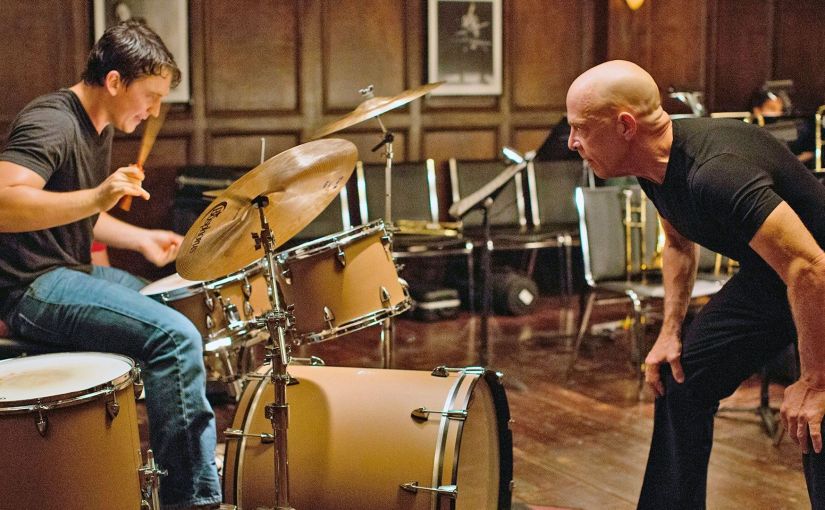
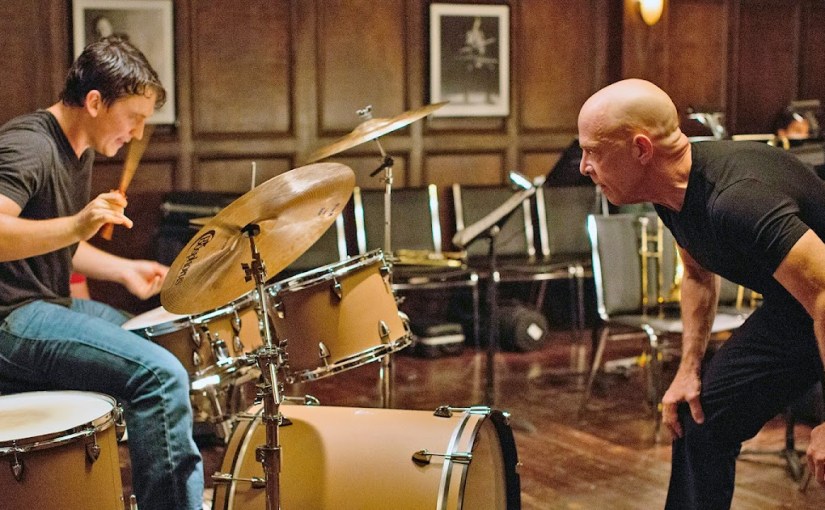
Andrew (Miles Teller) attends the Shafer Conservatory in New York.  He’s a jazz drummer who gets hand picked by the esteemed conductor Terence Fletcher (J.K. Simmons, in a well deserved Oscar winning role) to join his elite class.  Mr. Fletcher is cordial at first and a little instinctive as he’ll stop his musicians short of getting past one note before asking them to start again.  A hand gesture with a headshake and a wince.  Now go again.  Another gesture.  Go again.  One more gesture.  Again. Now an outburst of violent rage.

Individually, Andrew and Terence are determined with unhealthy mindsets to obtain levels of achievement that appear impossible to grasp.  The boy wants to get to where his drummer idol Buddy Rich plateaued.  The teacher wants to find the next Charlie “Bird” Parker.  These men of different generations are terribly talented.  Terribly I say because their passion for music is their self-imposed and cruel undoing.

Chazelle has much respect for the field of contemporary jazz.  I like jazz but I know nothing about how a piece is assembled so rhythmically among an assortment of instruments from the drums to the harp to the cello to the 88 keys and the various horns.  Put them all together, and there’s an atmospheric magic to what’s churned out.  It’s beautiful and bewildering.  Complicated, yet mesmerizing.  In Whiplash though, the music may be the worst antagonist because the frustrations that arrive with trying to become a master are unforgiving.

A late scene in the film shows Terence Fletcher, an altogether tyrant of a teacher, playing melodic nightclub piano in a bar.  He’s applauded and appreciatied as he presses down on the final key.  He thanks his audience with a nod.  Nevertheless, J.K. Simmons shows a different level of frustration.  Up to this point, the actor’s character has been a series of screaming eruptions.  In this moment, the man looks like he wants to cry.  No matter what he plays or how well loved he is, Terence Fletcher knows it could have been better.  So, if he lives with his suffering, then he will teach his best students to suffer through music as well.

Andrew is on the cusp of living his own life.  With a mother no longer in the picture, he still shares movie times with his father (Paul Reiser) perhaps so his father can still be a father, or maybe it is to remain a child to someone.  He’s starting a what could be a promising relationship with a girl named Nicole (Melissa Benoist), but his need to be a better drummer interfere and the only way he’ll know he’s at least as good as Buddy Rich is if he satisfies his teacher.  That’s the only sure sign.  

Does Terence turn Andrew into a monster, or is it the music?

This will always be one of Miles Teller’s best roles.  He’s got that innocent, quiet way about him, but as he gets “mentored” by this new composer, he changes.  He becomes devoid of care for Nicole and rebellious towards the lack of respect he receives from family and fellow students.  Like a chess champion, the art of drumming turns the drummer into an unloving creature soaked in blood and sweat.  This ongoing trajectory might make him a better musician but it will also bring him to an end result that matches his teacher.  

Beyond the energy of the music, Damien Chazelle steers a thrilling duo.  Simmons is an outstanding villain as a guy you can only hate until you see the motivations he’s only trapped himself into.  Only then you might just sympathize. Teller is circling the waters of a dangerous relationship with music.  Chazelle allows his picture to swim towards defiance with bloody and painful persistence. The epilogue of the film demonstrates precisely what these two men are searching for.  It’s only when you arrive at the end of Whiplash do you realize and empathize with the internal and physical pains these people choose to weigh on themselves.

To my ears, music is a beautiful, universal language.  

For the scribes, it’s an agony they choose to bear.

BEVERLY HILLS COP: AXEL F

By Marc S. Sanders

It took thirty years for Eddie Murphy’s best on screen character, Detroit Detective Axel Foley, to make a return.  He should have waited another thirty years. 

Reader, I got what I expected from Beverly Hills Cop: Axel F.  Yes, it was better than the third film in the franchise, but then again so was Morgan Stewart Is Coming Home (a Jon Cryer flick, directed by Alan Smithee).  There are moments in this latest flick, offered up by Netflix, that work, but it’s not enough to save the picture.

With Murphy producing, the smartest tactic the film takes is to gather up most of the surviving members of the other films, Judge Reinhold, John Ashton, Paul Reiser and Bronson Pinchot.  The problem is they are hardly used.  Axel F opts to go in the direction of feelings for the wisecracking cop from Detroit who always wreaks havoc in 90210.  Axel has a daughter named Jane Saunders (Taylour Paige).  I certainly know her last name because in the few moments that Murphy is shooting off his mouth, he takes time to repeat her last name and actually spell it out.  S-A-U-N-D-E-R-S.  Yes.  That’s a whole scene.  This is supposed to be comedy?  Saunders is not ranked up there with Focker.  That’s for sure.

Axel’s buddy Billy (Reinhold) is a private detective now and he’s come upon some kind of conspiracy.  He recruits Jane (a Beverly Hills criminal attorney) to represent a kid who is being framed.  When Axel gets word that Jane is being threatened, out to California he goes, but then Billy turns up missing and I mean missing throughout the whole movie.  Now Axel has to uncover the bad guys while trying to reconnect with Jane.  Of course they are estranged.  Axel also partners up with Jane’s ex, a cop named Bobby, an unfunny Joseph Gordon-Levitt.  Every so often Axel also marches into Taggert’s office (John Ashton) to just remind us that Taggert is back. 

Beverly Hills Cop never functioned on complex mysteries or storylines.  The films hinged on Eddie Murphy’s schtick, which used to be very, very funny and addicting.  As well, the smart route was always taken when the comedy of the first two pictures didn’t just rely on Murphy.  There was also material for Ashton and Reinhold, and on the side was Reiser and Pinchot as well. 

The glaring error in Axel F is that Murphy hardly does anything with these guys.  Instead, there are repetitive conversations with Paige’s character and how Axel put his career ahead of being a father.  Twice within the script, they remind one another that he’s been a father as long as she’s been a daughter.  How much thought was put into this dialogue?

The Cinemaniacs gathered together to watch Axel F, and we all agreed the film would be a half hour shorter had the storyline with Jane been completely stricken from the script.  Who says Axel Foley had to have a daughter?  The guy already has enough members within his world to work with.  Ashton, Reinhold and Murphy do not share a single moment together until an epilogue scene before the closing credits.  This is as egregious as when the new Star Wars pictures opted never to have Han, Luke and Leia reunite.  You got everyone back for Axel F and you opt not to use them or use them together.  Why?  This kind of success couldn’t have been served up better and yet it’s squandered.

Part of the fun in Axel Foley is his ability to con his way into a place.  At one point he returns to the Beverly Hills hotel from the first picture.  He approaches the counter and as he’s about to start a routine, but then he says fuck it, never mind and just chooses to pay for a room.  The script and Murphy could not have made their laziness in making this movie more apparent. 

Another staple was always the outrageous chases that would happen with unconventional vehicles.  The best moment in Axel F is when Murphy and Levitt pilot a police helicopter.  Levitt gets terrified and I think a little sick.  Murphy shoots his mouth off and here is a reason to watch Axel’s return.  Other moments do not work as well including a snowplow truck careening through Detroit and a big rig crashing through the glass front doors of a mansion.  There’s also a three-wheel motor scooter that does some tricks.  I recognize the attempts at recapturing the big moments from the first two films, but the editing does not work as well with a beginner director named Mark Molloy.  Martin Brest and Tony Scott were the MVPs who cemented the success of those other pictures.

I could not help but also take issue with some minor details.  Harold Faltermeyer was the symphonic composer of the other films.  You’ll certainly recognize his tunes this time around but they are annoyingly mixed with unnecessary overlays.  At times, the needle drop of music is so distracting to what you are watching that you might think there is something wrong with your sound system. 

In addition, and I can’t believe I’m saying this about a Beverly Hills Cop film, but the costumer had to be someone who was just fired from Old Navy.  Murphy dons a Detroit Lions jacket and a pair of jeans that look two sizes too big on him.  His clothes look so baggy on his frame.  As well, for some reason, he’s given a bright orange t-shirt to wear against the black and blue Lions coat and it could not be a worse eyesore.  Any color you want and you choose orange?

Miguel’s input was that it was better than three, but what kind of endorsement is that really?  Over the last decade, the franchises that were so beloved in the 1980s are making returns with the near geriatric stars of those films.  Some work (Top Gun: Maverick, and yes Indiana Jones).  Some definitely do not (that last Die Hard movie, Rambo and Terminator).  Axel F slides into the latter category.  It has some moments to laugh at along with send ups of some of the franchises best songs.  Yet, while I’m happy to hear the picture open to Glenn Frey’s “The Heat Is On,” it’s also indicative of little thought applied to making this movie. 

Ultimately, though, why did this picture have to get so watered down with an uninteresting father/daughter soap opera while neglecting the other favorites of this franchise?  What will these filmmakers do next?  Reinvent the Three Stooges, only the trio will be split up, and you’ll only follow Larry around for two hours?

ALIENS: THE DIRECTOR’S CUT

By Marc S. Sanders

James Cameron’s Aliens is deliberately morose in its storytelling and cinematic look.  It’s ugly and nightmarish.  It’s nerve-wracking at times.  It’s dark and somber too.  It’s also one of the best action films ever made.  For me, this is Cameron’s best film and it’s not only because I’m a sci-fi blockbuster nerd of sorts. 

Serving as a sequel to Ridley Scott’s monster movie, Alien from 1979, Aliens works on its own independence while still adhering to the storyline qualities of the original.  Sigourney Weaver returns as Ripley.  The story begins 57 years later where Ripley’s lifeboat ship from the end of the first film is found in deep space.  She reports back to the conglomerate company of the terrifying happenings she experienced with her crew mates who didn’t survive when an unrecognizable creature terrorized them aboard their vessel.  The company is less than apt to believe her account though. 

One of the company men, Burke (Paul Reiser), requests that Ripley accompany him and a squad of tough Marines on a mission to the planet, LV-426, where her crew discovered an immense crop of eggs and took back an alien aboard their ship.  In Ripley’s absence, a colony of over a hundred families was set up on the planet to establish habitable real estate.  However, the colony has lost contact, and the company is sending in the military to assess the situation to see what’s going on. Ripley is supposed to only serve as an advisor.

James Cameron’s script and direction takes its time to build up suspense and explore what’s unknown to these soldiers.  Upon arrival on the planet, much of what they find is left in wreckage and no one is to be found anywhere.  At best, Ripley can only see what was likely the remains of alien attacks with acid burns within the steel structures.  Yet to Ripley and viewers familiar with the first film, it is still a mystery as to what truly occurred.  Naturally, more will eventually be uncovered and then this arriving crew will have their hands full.

James Cameron has an imagination that bursts with colorful and amazing ideas.  The Terminator films were astonishing in its own apocalyptic future that haunts a present time period.  Titanic was a film mired in much expense and technical setbacks. Though, no one ever expected just how accomplished the award-winning blockbuster turned out to be.  Avatar is wonderous on a planetary level.  However, James Cameron is not necessarily a celebrated script writer.  Often his dialogue is very cheesy and unnatural.  Aliens is the exception though.

The script acknowledges that these gung-ho marines are “grunts.”  Thankfully, they talk like grunts.  I know that many fans adore Bill Paxton as the cut-up member of the troupe known as Hudson, who has brilliant one liners.  It’s actually a well fleshed out character.  Before Hudson knows what he’s up against, this new mission is just a lame “bug hunt” and he happily screams out as their spacecraft makes the quick drop into the planet’s atmosphere.  When he eventually comes to face to face with the monsters, terrifying, cry baby like fear overtakes him.  He’s giving his one liners like “Game over, Man,” and “We’re  fucked!”  Yet, the dread and anxiety are completely relatable.  There’s something out there waiting to tear me apart and eat me, and there’s hardly anyone left to help and rescue me.  I’m in the middle of nowhere.  Cameron wrote a good under the radar kind of character, and we feel for this guy’s dilemma as if it’s our own.  Paxton’s performance made it better and awarded it with adrenalized highs…and these aliens, with teeth and tails and acid for blood, are most definitely scary as hell.

I no longer watch the original theatrical cut of Aliens.  I turn to the Director’s Cut that Cameron always envisioned.  Particularly, it triumphs because the Ripley character is much more fleshed out with necessary dimension for the film.  Early on, a cut scene, now restored, tells us that Ripley’s daughter died from cancer while she was lost in deep space.  The daughter lived to the age of 66, even though Ripley didn’t age a bit.  Awakening from her cryo sleep, only introduces heartache for Ripley.  What I like about this information is that it serves a relationship later found in Aliens.  A little girl named Newt (Carrie Henn) is found by the marines and appears to be the sole survivor of the alien attacks.  Ripley steps in as a surrogate mother towards Newt as all of the characters work tirelessly to survive and somehow get off the planet.  The Director’s Cut gives some value to Ripley and purpose beyond just violently slaughtering aliens as a means of revenge or fulfillment.  It allows Aliens to work on an effective emotional level and Sigourney Weaver earned her Oscar nomination because of it.

Cameron introduces traitors as well into the story, which are likely not so surprising but make the film all the more challenging for the heroes of the picture.  Michael Biehn is the sex symbol, a cool and quiet tough guy.  Jenette Goldstein is a Hispanic marine who gives off good imagery as one of the few female squad members who enters the areas first with the largest gun in the troupe.  Lance Henrikson is memorable as an android that Ripley is apprehensive to trust – perhaps he’s the “Mr. Spock” of this sci-fi entry.

Technically speaking, Aliens is so unbelievably atmospheric in its bleak, futuristic setting.  Barring a few moments where the spaceships clearly look like miniatures, the interiors look organically formed.  I can’t compliment the set pieces enough in that respect.  When the Marines enter a large cavern, it is enormously shell like that it looks like an animal’s nest.  Cameron hides his various monsters perfectly.  So that when they slowly unravel their tales and skeletal forms, it looks as if the darkness within the frames begin to move.  The stillness of what surrounds our main characters awaken with life that maybe we don’t want to see. 

Aliens works independent of Ridley Scott’s prior picture because it’s a war movie; one that is set on an outer space planet.  We witness how the surviving squad troops strategize with what little they have left.  Thereafter, we see how they face enemies who may have the upper hand in battles to come.  I love how Cameron builds suspense with a sensor device the troops use.  It begins to ring as a life form closes in on their proximity.  The monitor fills with glowing blurs as more life forms nearby build up.  A nervous and great moment occurs when they can not understand how the aliens could be so close and yet none of them can see what is so nearby.  The surprise is unexpected and worthy of a scream. 

Cameron’s script doesn’t give his heroes a break.  Aliens thrives on the characters simply playing keep away, while one member of the party is working against what little they have left.  I like that.  While Aliens may be intentionally dreary the fact that there’s no easy out for these folks is what keeps the pulse of the film racing with nonstop suspense and action.

Aliens is an absolutely solid picture promising a future for this franchise. Sadly, it really never excelled above what was accomplished in these first two films from Ridley Scott, and now James Cameron.  Years later, Scott returned to the franchise with some interesting prequel films that colored in some of the elements that were only talked about before, like the company that puts all these people within the peril of the aliens.  Yet to date, that all still remains unfinished.  James Cameron just set the bar so high with his movie that the few that followed never amounted to what he created.

You may not feel all warm and fuzzy after watching Aliens, but at least you’ll feel incredibly excited with its construction from a director in the early years of his profession.  James Cameron brought about a solid script and unbelievable effects that say so much on a visual level.  If Aliens makes you nervous, fearful and especially terrified, then James Cameron has done his job.

WHIPLASH (2014)

by Miguel E. Rodriguez

Director: Damien Chazelle
Cast: Miles Teller, J.K. Simmons, Paul Reiser, Melissa Benoist
My Rating: 10/10
Rotten Tomatometer: 94% Certified Fresh

PLOT: A promising young drummer at a prestigious music conservatory is mentored by an instructor who will stop at nothing to realize a student’s potential.


That’s right, I finally jumped on the bandwagon and watched Whiplash after no fewer than eight years of prodding by my fellow cinephiles.  Not only can they finally get off my back about it, but they all now owe me one.  Hope you all enjoy Wild Tales when next we meet.

I was hesitant to watch Whiplash because it was released and gained notoriety at a time in my life when I was yearning for some positivity after getting psychically beaten down by some really depressing foreign films.  Why, I asked myself, would I want to subject myself to ninety minutes of watching J.K. Simmons verbally abuse some poor kid just so he could play the drums a little better?  I’ve seen this movie before.  The abusive mentor sees the light, the victimized student either turns his back or excels like never before, etcetera, etcetera, blah blah blah.  I had the whole plot written out in my head from start to finish.  (I used to do that a lot, I’m realizing…kinda stupid, in most cases.)

Having just finished watching it, I can say, without reservation, that Whiplash belongs on the short list of the best films ever made about the drive for artistic perfection along with The Red Shoes, Black Swan, and Amadeus.  And it manages to have its cake and eat it, too, when it comes to the ending.  Tragedy and triumph walk hand in hand, though not necessarily in the way I would have ever imagined it.

Andrew (Miles Teller) is a talented young jazz drummer who has just started his first year at the fictional Shaffer Conservatory of Music.  He is anxious to gain the attention of Terence Fletcher (J.K. Simmons), the leader of the school’s prestigious jazz ensemble, The Studio Band.  Fletcher is a piece of work.  To say he engages in mind games is like saying Bill Gates dabbles in computers.  He recruits Andrew for his own band in the middle of someone else’s music class.  On his first day with the Studio Band, Fletcher berates another musician for playing off key.

Did I say “berates?”  Fletcher belittles, humiliates, and degrades the poor guy with a stream of profanity that would have made the drill sergeant in Full Metal Jacket envious.  He fires the guy on the spot.  When the guy leaves, Fletcher looks around and confesses that he wasn’t really out of tune, but he didn’t know he wasn’t, which is just as bad.  Accurate?  Technically yes.  Does that kind of teaching method belong anywhere outside of a military unit?  I’m going with “no.”

Andrew is willing to go along with this because he doesn’t just want to be good, he wants to be GREAT.  He wants to be remembered in the same breath with Charlie Parker and Buddy Rich, and he believes, like Fletcher, that greatness is not achieved without struggle and sacrifice.  Again, technically true.  Would Rembrandt have painted half as well with both ears?  Would Beethoven’s Ninth be remembered today if Beethoven hadn’t been totally deaf by the time it was finished?  The rolls of the Screen Actors Guild are littered with actors from broken or abusive homes.

There’s a revealing scene when Andrew eats a meal at home with his father and uncle and his two cousins.  The table conversation rings with praise for the two cousins who play football at their school and scored a long touchdown, etcetera.  When Andrew talks about being a “core” member of the best conservatory jazz ensemble in the country, he’s met with polite congratulations and that’s about it.  No one seems to think he’s going to make it as a musician, not even his own father.  “I’d rather die drunk, broke at 34 and have people at a dinner table talk about me than live to be rich and sober at 90 and nobody remembered who I was.”  Like Charlie Parker.  Like Amadeus.  Andrew’s only goal is to be great.  If he has to give up friends, romance, even family to achieve it, so be it.

But at what cost?  Fletcher pushes Andrew so hard that his hands bleed during rehearsals.  He demotes Andrew, then puts him back in the core, demotes him again, then basically makes him re-audition for the core spot against two other alternates until 2 am.  In one excruciating scene, Andrew actually tries to play in a competition after being in a freaking car accident.  It’s a truly desperate act from someone who is so afraid of being anonymous that only a body cast will stop him from taking his shot.

Make no mistake, the rehearsal scenes and the verbal and mental abuse from Fletcher are not pleasant.  They’re emotionally engaging, but they were also off-putting.  In a strange way, I was reminded of Requiem for a Dream and its disturbing subject matter that was nevertheless compelling to watch.  When we get to what happens to Andrew after the car accident, I was getting thoroughly depressed, despite the powerful emotional beats of what came before.

But then the movie enters its final act, and that’s where Whiplash finds another gear story-wise.  Andrew and Fletcher meet in an out-of-school setting, and Fletcher has an interesting speech where he says, among other things, “There are no two words in the English language more harmful than ‘good job.’”  He admits his tactics were brutal, but he devoutly believes in the necessity of pushing people beyond what is expected of them.  “Otherwise, we’re depriving the world of the next Louis Armstrong.”

Fletcher convinces Andrew to play for a new jazz ensemble one last time.  What happens at that concert is so horrifying that I watched most of it through my fingers.  I kid you not.  But then the screenplay transforms that situation into something magical, almost religious.  You get the sense that all of the horrible and despicable things Fletcher did and said during the whole film, all misery we had to endure with Andrew, during which time I wondered, “Why am I watching this??” – all of that unpleasantness was just the setup for the finale.  And that finale only means something because of everything that came before it.

In other words, just like Andrew, I was only able to experience that tremendous cathartic moment at the end because of the suffering I had experienced in the movie’s first 90 minutes.

…which leaves me feeling torn because that’s exactly the kind of thing that Fletcher believes in, but which I feel is unnecessary outside of a boot camp.  Ideally, yeah, I think that you catch more flies with honey than with vinegar.  I’ve directed my fair share of community theatre productions, and I’ve never had to resort to yelling or humiliation as a method to get what I’m looking for.  But then, I’m directing community theatre, not a multi-million-dollar film that may live or die on the performances I’m getting or not getting from my star.  Nor am I a drill sergeant training men to become soldiers.  It seems there is a line, but apparently to get certain kinds of results, it must be crossed.

It’s this dichotomy that will likely keep me awake the next couple of notes.  That and the senses-shattering finale.  I mean…I did not see that coming.  (And man, I am a jazz fan, so to me it was like eating a perfectly-cooked steak.)  It was not a pleasant road to get there, but it had to be unpleasant.  Otherwise, it wouldn’t have been great.

BEVERLY HILLS COP II

By Marc S. Sanders

I know. I know. I SHOULDN’T like this movie, but I do.

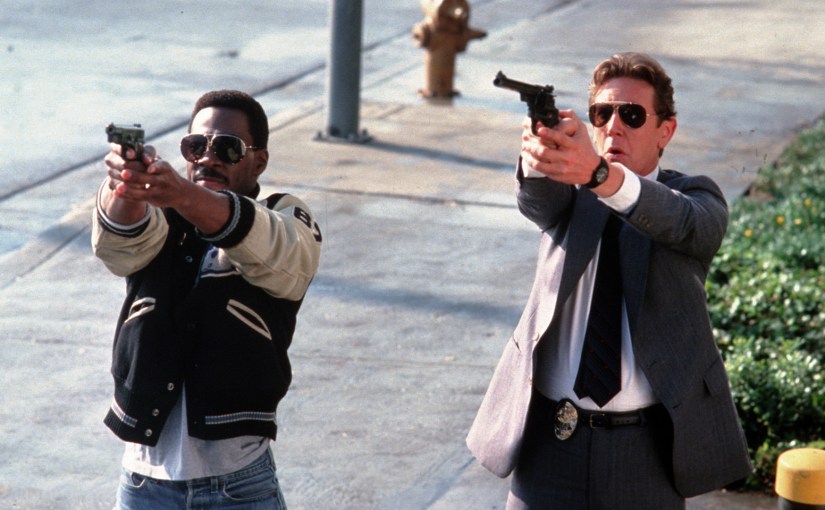
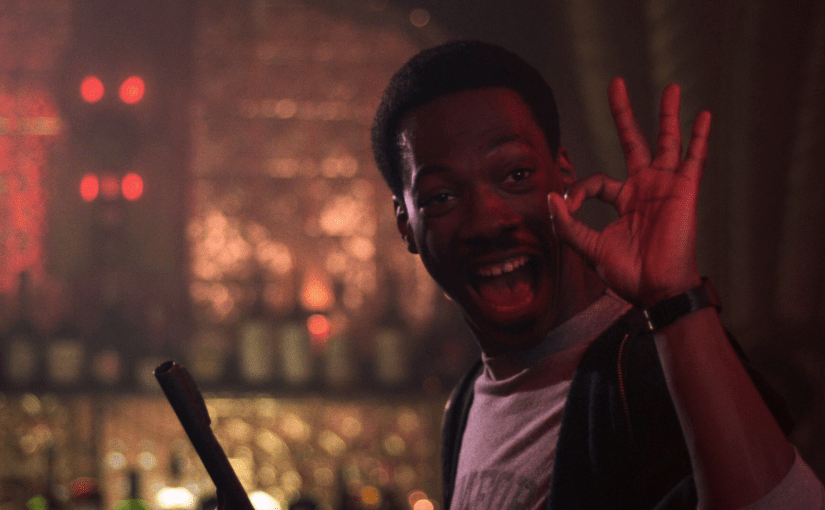
Beverly Hills Cop II is a sequel that is really an opportunity to see a wide variety of close ups of an Eddie Murphy who was well in his ‘80s prime, releasing one #1 movie after another. Here the viewer is treated to Murphy’s Axel Foley blowing a kiss to himself in the mirror, laughing to himself, tucking his crotch in his tailor made suit, flipping sunglasses on and off, driving a Ferrari, and shamelessly plugging the Detroit Lions all while trying to stop an “Alphabet Bandit” criminal in Beverly Hills, CA.

So there’s really not much here when all the vanity is on Murphy. Well, then what’s to like?

Considering I’m a fan of director Tony Scott, who uses great cinematography in all of his films with quick, tension filled editing, it’s hard to resist.  Most especially here Scott’s film is accompanied with an exceedingly cool and dangerous soundtrack from Harold Faltermeyer. Just the opening scene alone (without Murphy in it) belongs in a better movie. A robbery at a City Deposit bank and then later at a horse track are so well edited that you might tuck your knees into your chest and chew on your thumbnail. Great stuff from Tony Scott that would eventually carry over in films like Crimson Tide, Enemy Of The State, and one of my very favorites True Romance.

There are other good moments in Beverly Hills Cop II, especially a great scene with Gilbert Gottfried, and a few with Paul Reiser as well as a smirk inducing scene with Hugh Hefner.

I shouldn’t like this movie but sue me. It’s a guilty pleasure for me. However, watch the far superior first installment over this one any day of the week.

BEVERLY HILLS COP

By Marc S. Sanders

Who actually wrote the Oscar nominated script to Beverly Hills Cop? Daniel Petrie Jr and Danio Bach, or Eddie Murphy?

Murphy’s lines are delivered so fast and so naturally that it seems impossible they could ever rest on a page. Eddie Murphy is an enormous talent of word play and delivery. I miss this Eddie Murphy. I’m reluctant to welcome the Eddie Murphy of PG related fare of recent years. He just doesn’t look comfortable in that garb.

One of the first R rated films I ever saw in theatres (not THE first, as that honor belongs to the Clint Eastwood classic, Sudden Impact) still holds with its hilarity, and the credit does not belong to just Murphy but the whole cast including John Ashton, Judge Reinhold, Ronnie Cox and even early in career appearances from Jonathan Banks, Bronson Pinchot, and Damon Wayans.

I still haven’t forgotten this theatre experience when I joined my older brother, Brian and his friend Nick at the movie theatre in Ridgewood NJ. Never had I heard an entire packed room of people in the dark on a Saturday night laugh so hard together. It’s likely a moment that impressed my love for movies going forward. Movies could bring all sorts of joy and happiness and escape. Beverly Hills Cop was altogether another thing entirely.

Yes!!!! A foul mouthed cop from Detroit who becomes a stranger in a strange land while visiting Beverly Hills to solve his friend’s murder. That’s a film that’s had a great impact on me. As a writer, director Martin Brest’s film (later to do Midnight Run and Scent Of A Woman) offers a very simple blue print to allow Murphy to run wild. It cuts out a lot of complicated red herrings to just stay on a straight resolution. As Murphy’s Detective Axel Foley (great character name) comes across another development, in walks another great set up.

I compare the frame of Beverly Hills Cop and Eddie Murphy to the first Mission: Impossible film with Tom Cruise. The Cruise film makes a huge oversight. Early on it introduces a huge array of characters for an M:I team and then eliminates them all to hardly be used. It was wall to wall Tom Cruise. He was a producer on that film with much creative control and it felt to me as if he insisted on owning every scene, every line, every moment. It turned me off a little.

Murphy on the other hand plays along with his ensemble. Ashton and Reinhold have great moments all to themselves. I still die laughing out loud as Reinhold tries to subdue a situation by ordering an army of machine gun toting bad guys to lay down their weapons only to be silenced with another round of gunfire. The banana in the tailpipe! Ashton working with Murphy to stop a random robbery at strip joint, and then helping to save him later on from arrest. What about Ashton trying to climb a wall during a shootout?

Then there’s Murphy and Pinchot discussing a weird art piece (“Get the fuck outta here!”). Couldn’t you envision Pinchot and Murphy in another film together?  A shame it hasn’t happened.  (No, I won’t count the dreadful reunion in Beverly Hills Cop III.)

Brest provides great showpieces accompanied by one of the best film soundtracks ever. I will never not listen to “Neutron Dance” by the Pointer Sisters on Sirius XM’s 80s on 8 while recalling this film’s opening scene double rig truck chase. Brest directs a symphonic high energy blend of sight and sound. Plays like an awesome music video. Same goes for Glenn Frey’s “The Heat Is On.” If I ever get an opportunity to visit Detroit, that’s what will be playing in my head.

Orchestrator Harold Faltermeyer’s electronic keyboard deserves much credit as well. His covert, sneaky 5 note tune shaped the Axel Foley character. Faltermeyer only made Murphy even cooler during the heyday of “Miami Vice MTV Cops.”

Beverly Hills Cop remains one of the best films with the longest staying power of the 1980s. It’s a comedy. It’s an action picture. It’s music filled fun with great characters. It’ll always be Eddie Murphy’s best film. I can watch it again and again. I’ll never tire of it.