A BEAUTIFUL MIND

By Marc S. Sanders

The genius was always easier than living with the monsters in his mind.  So was the dilemma that consistently plagued Nobel Prize winning Professor John Nash.

Ahead of seeing A Beautiful Mind for the first time, what you don’t know about Professor Nash is what will dazzle you the most when Ron Howard uncovers the mysteries he lived with during graduate school and on through his fellowship at MIT and with his enduring and loving marriage to his wife Alicia (Jennifer Connelly in an Oscar winning role).  John Nash is masterfully portrayed by Russell Crowe in a celebrated, nominated performance.

Dr. Nash comes off like a genius savant when Howard’s film introduces him in 1947 at Princeton University.  The director adopts a technique of presenting much of Nash’s depths and highlighting patterns and numbers in magazines or on chalk boards or even within the reflections that appear before his eyes in bright sunlight.  On a clear night, see if you can find an umbrella within a starry sky. 

For many of us, I presume it’s hard to decipher what it means to live the life of a mathematical genius. Ron Howard with Akiva Goldsmith’s hailed adapted screenplay does not expect anyone to comprehend formulas or equations.  The filmmakers simply ask you to witness how discovery is processed.  Nash writes endlessly on his dorm room windows.  He fills up every inch of the chalk boards at his disposal.  He tears apart articles in magazines and wallpapers his room and office with them.  Even when he is not writing, he is computing how situations will end up best towards his and his peers’ advantage. There’s one curvaceous, blond woman standing in the center of a bar for one of the men to hopefully have a tryst with, but then who will be left to pair with the dark-haired ladies that surround her?  Nash finds the logic in all of the men abandoning the blond.  The genius realizes what none of us can see.  Go for what no one would ever expect to have occurred.

Despite the professor’s odd ticks, unwelcome vernacular and his lack of social skills, a well-established livelihood works out for him.  He falls in love with a former student that he marries, Alicia, and he obtains a fellowship for himself and two Princeton comrades to practice out their theories at MIT.  Personal companionship arrives with his former roommate, Charles (an energetic Paul Bettany), and his niece.  On the other hand, John has also been recruited to become a code decipherer for the government and he must answer to a mysterious gentleman named Parcher (Ed Harris) who is using John to stay a step ahead of the Soviets.   John’s work must remain top secret and as his clandestine activities become more threatening and intense, so does the paranoia get increasingly overwhelming.

I’ve only covered the first act of A Beautiful Mind because when the truth of John Nash’s purpose and how he is regarded is revealed, this biography becomes something much further from how it began.  Akiva Goldsmith’s trickery in his script is capable of surprising an audience when some veils are lifted for both the primary subject of this piece and those who come in and out of John Nash’s life.  This is a true story but it’s incredibly surprising that a mathematical wizard like John Nash could be living a whole other life that makes little sense at first.

Ron Howard is doing some fine work here reaching for material that might feel familiar with other cinematic geniuses in film ranging from the fictional Will Hunting to more recently real-life figures like Mark Zuckerberg. Characters like these stand out for their quirkiness and oddities.  With Russell Crowe’s brilliant characterization of awkwardness in his uneven walk and how he carries his papers and briefcase, it is not hard to adapt to the man on film.  What he says and how he speaks would leave any one of us to roll our eyes at his behavior.  You’d likely chortle at John just as his Princeton classmates do.  Later though, you understand how valuable his accomplishments are to a greater good, and at the same time you become alarmed at how Dr. Nash is being used both from his own perspective as well as by those figures who unexpectedly enter his life and will not just leave.

Jennifer Connelly’s role does not amount to much at first.  With her alluring looks that have graced other films in her earlier career, she initially comes off as a token spouse to the main character and you remind the person sitting next to you that is actress Jennifer Connelly who got her start in Labyrinth with David Bowie, and Once Upon A Time In America with Robert DeNiro.  Yet, as more dynamics are revealed about her husband does the character Alicia show through, and she has no choice but to survive with her spouse’s torment.  Connelly has a scene that will crush you when she must unleash her frustrations in the middle of the night as well as sporadically throughout the film. She has to be carefully observant of her husband’s behavior for the safety of their child and herself.  Ron Howard sets up scenes that haunt Alicia only, and his wide camera work is absolutely eye opening as it lends to her personal performance.

It’s fascinating to observe John Nash’s willpower as he persists to live with personal demons while upholding the demands of his genius.  This film works on so many levels of enhanced editing and perspective, but without unforgettable work from Russell Crowe, Jennifer Connelly, and a supporting cast of character actors like Christopher Plummer, Josh Charles, Judd Hirsh, Ed Harris and Paul Bettany it could not sustain its staying power. 

A Beautiful Mind is a thoroughly effective biography.
HERE

By Marc S. Sanders

I get a thrill out of being in a location occupied by someone from the past.  Last week, I toured Paramount Studios and sat on the bench that Tom Hanks did when he shot Forrest Gump.  There’s something exciting about it.  Time capsules or a recovery of an ancient burial are fascinating to me.  Just once I’d love to hold in my possession Action Comics #1, Superman’s very first appearance.  Often, items like this are preserved behind glass in museums to witness and study.

Robert Zemekis is a “What if?” director.  What if a man was marooned on a deserted island or what if you could communicate with extra-terrestrials from another galaxy?  What if live humans could interact with cartoon characters? He reunites with Hanks as well as Robin Wright for his newest film called Here.  The picture attempts to answer what precisely happened in one specific, exact location since the dawn of Earth.  

The film opens with the violent creation of the planet, complete with molten rock and falling meteors stirring about, along with an ice age, and a prehistoric period.  Then it is on to further points in history that the script from Eric Roth will occasionally return to, such as the plight of a Native American tribe and then later close to a post-Revolutionary War era where a house with a large bay window in the living room is erected and a famed historical figurehead is referred to.  We witness the activities on both sides of this living room’s bay window, and what was there before it.

There are brief views of folks living in the early twentieth century when new technology like airplanes are fresh, and eventually a Lazy Boy becomes essential to any home.  

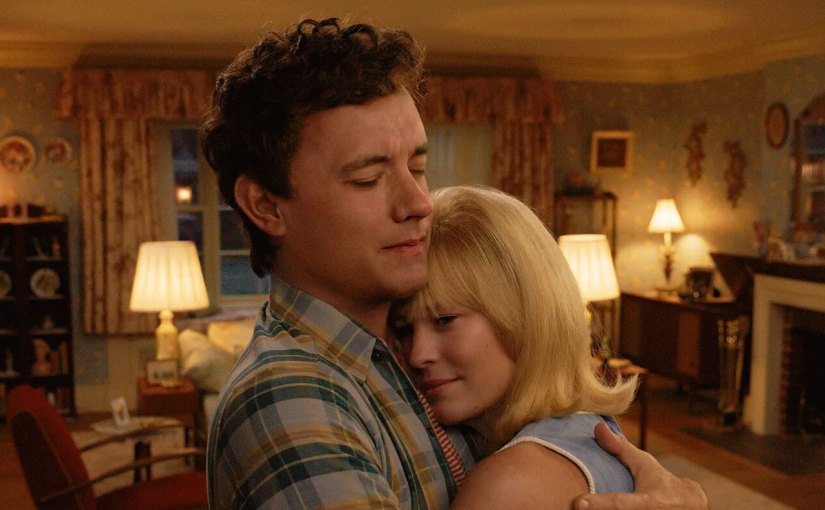
Primarily though, there are three generations of a twentieth century family lineage that starts with Paul Bettany as a PTSD alcoholic World War II veteran, and his housewife Rose (Kelly Reilly).  Tom Hanks portrays Richard, their eldest child who aspires to become a career painter before his plans are interrupted by marrying his pregnant girlfriend, Margaret (Robin Wright).  Life, however, gets in the way of his dreams.

Finally, we are brought to a more current point with an African American family living through challenging times of police brutality and Covid.

Over the course of the whole movie, Zemeckis has you believe that his camera never moves once from this specific place.  He narrates the activities that occur in this broad scope of time with pictures within pictures.  Rectangles or squares will appear to show what happened later in life or back in the past on this specific spot and then transition the scene to that new period episode he wants us to witness.  Where the fireplace is located, a squirrel climbed the bark of a tree that was once there.  Where the sofa is now, there worked a slave laborer from the 1700s, or its where a Native American smoked a pipe before then.

If Here was any longer the novelty might have worn off.  Fortunately, the characters with the most interesting storylines are given to Bettany, Reilly, Hanks and Wright.  The challenges of living long lives raising children, dealing with job security, health, love, loss and stress are carried by them.  We grow accustomed to how the family lineage evolves, particularly with Thanksgiving dinners, Christmas photos, marriage, graduations, and children growing up.  

It helps that the latest trend of visual effects, de-aging and aging the players, works convincingly in this picture.  I attended a live conversation at the 2024 AFI Film Festival between Tom Hanks and Robert Zemeckis, and the actor revealed that to get himself back to the age of seventeen and then a thirtysomething all the way to a man in his eighties required Zemeckis’ team to collect thousands of images and footage from the actors’ extensive careers.  Everything was then seamlessly assembled for effective performances.  I think the trickery works.  If it didn’t, then it’s likely Here would not succeed.

My one issue with the film is the glaring omission of substantial storytelling for the African American family compared to the amount of time devoted to the family who lived in this home before them.  The African American characters do not appear fleshed out enough.  They only serve to remind us of current, complicated times that we recently endured or are still living through.  Roth and Zemeckis did not go deep enough with this group, only to bookend it with an unimpactful death.

Here works like a warm blanket to snuggle up with.  I believe it is worth a second and maybe a third watch in order to catch all the little changes in details that vary as time travels through this piece of land that eventually became a living room.  The TVs and what’s on changes from the Beatles first appearance on The Ed Sullivan Show to The Three Stooges to CHiPs (neat wink and nod moment here; tell me if you know what I am thinking of) and Katie Couric and so on.  The furniture gets updated.  So do the phones. What occurs across the street in front of the two-story colonial house changes.  Though we are only seeing one room during the entire running time, it’s near impossible to pinpoint what was there before from left to right and top to bottom. What’s there now and what will be there later is part of embracing the experience of Here.  However, what kept my attention is how Eric Roth and Robert Zemeckis invent ways to keep different time periods connected.  It’s relative to how Zemeckis did numerous minute and detailed face lifts to Hill Valley in his Back To The Future trilogy.

By the end of Here, there’s opportunities to relate to how many of these people end up with their long lives.  They experience all the ingredients of life through love, frustration, happiness, illness, loss, anger, sadness and eventually death.

Here is a deliberate experimental film, and for most of the picture, its attempts at modifying the stage of performance truly work.  Where it falls short is not allowing equal attention to all of the stories that enter this locale.  Then again, if the movie were to go any longer, time might have come to a mundane standstill.  It’s simply a blessing that I had just enough time being Here.

AVENGERS: INFINITY WAR

By Marc S. Sanders

Avengers: Infinity War is a really FAT movie. Like ORCA FAT (thank you Keyser Soze), because it is chock full of so much to see. If this equated to gorging on junk food, after two hours and forty minutes, I would have a diabetic cardiac arrest immediately following the credits. Is this a film that is worth that handicap, however? You bet it is.

There is an ensemble of top Hollywood talent portraying a huge cast of characters, once again, and thus another installment has surfaced in the franchise that allows them to have various moments to shine. Producer Kevin Feige with all of Disney’s support, has mastered the formula to ensemble casting and production, as good as when George Clooney and company performed under Steven Soderbergh’s direction in the Ocean’s 11 remake. Thousands of special effects shots do not overpower the stage presence of the actors. The Marvel movies succeed because a story is always written first. Then witty dialogue comes thereafter, and then valid, convincing shock value. The special effects are the final ingredient. This is what the Transformers franchise and (yes, I’ll even own up to it) the Star Wars prequel trilogy (about ¾ of it) failed to achieve. This successful formula gives merit to the (at the time) biggest opening weekend ever, worldwide, and Avengers: Infinity War deserves the accolades.

How good is it? Well, reflecting back to May 1980, when sitting in a crowded theatre watching the ending to The Empire Strikes Back, by comparison I think audiences have finally been served up a cliffhanger (10 years in the making) that is just as effective. How is this all going to wrap up from here? How is this all going to be resolved? Reader, I don’t know if the next chapter will be satisfying. I don’t know if we will feel cheated like Annie Wilkes from Stephen King’s Misery. Presently, however, I’m turning an ending like this over in my mind; the same way I did with my pals in 1980 debating the survival ratio of Han Solo and if Darth Vader has told the truth, and if that was Vader’s brain or head that I saw, and who is this “another” that Yoda referred to….and that, my friends, is what makes a spectacular film. I don’t care if it gets watered down in the hype and McDonald’s promotions and toys. If you can mull over a movie long after it has ended, for days, even months and years, then a film like The Empire Strikes Back and Avengers: Infinity War has more than served its purpose.

Josh Brolin provides a villain with a justification to his madness. He’s not just twirling his mustache to be mischievous and sinister. He has a destiny to fulfill, and his portrayal of the mad titan Thanos does not compromise. This is a beast of a purple villain with size 52 boots and gold-plated armor with a chin that looks like it was clawed by Wolverine. Thanos cries, actually cries, while committing his crimes. He’s not just cackling. He flat out says that he executes his actions all so that he can relax and retire. Isn’t that what we are all trying to do, anyway? Nothing wrong with that. Guy sounds like a CEO to a large corporation. Maybe Thanos is updated to resemble an Elon Musk. 

All of the other actors from main staple Robert Downey Jr to Chris Pratt to Chadwick Boseman to Zoe Saldana and Chris Hemsworth, and so on, remain consistent to what we’ve seen of various prior installments. Their gimmicks continue to avoid becoming stale. Audience applause is cued by their appearances. These are well loved characters.

As an avid comic book reader of the silver age (1980s), Avengers: Infinity War presents itself as of one those annual limited series runs that were special because they were MAIN EVENTS!!!! My favorite back then was Marvel’s Secret Wars. Typically, a comic book from the 1980s would average about 18-22 pages with advertisements sprinkled in. Nearly every scene in this film equates to one issue of a limited run of a main event. That is a why a fat movie like this succeeds. The cast of characters are separated in various story lines. The scenes are given their time to flesh out and develop to move the subplots and overall story along. Each scene is like reading a new 18 page issue comic book. If I’m watching a comic book film, by golly, I want to see how a comic book is brought to life in a cinematic medium. Marvel’s films succeed greatly over DC’s films (produced by Warner Bros) because they rely on the source material. They know they got the goods. Cast it right, adapt it properly and go with that. If it ain’t broke, don’t fix it. A wealth of material (nearly 70 years) and Marvel/Disney uses it all. (How does DC/Warner Bros miss the mark so often?)

Of all of the Avengers films, Infinity War is definitely the best one. Ironically, I wasn’t expecting it to be. I was waiting for this stuff to get old and tiring. It just hasn’t faltered yet. It hasn’t gotten lazy yet. It all seems so fresh still. It’s a fantastic cinematic accomplishment. Sure, its main story is a guy chasing down six different colorful MacGuffins. So what! It’s simple. It allows the characters to stand out from there. An organized plotline like this doesn’t take much effort or time to explain its purpose. It states its conflict early on, and then the show stopping moments present themselves. One after the other after the other until a monster of an ending that is so jaw dropping, head shaking, thrilling and gasping, satisfyingly arrives. 

More importantly, the MacGuffin search drives the motivations and fleshes out the film’s main character, Thanos. This Marvel installment belongs to Josh Brolin as Thanos. Everyone else serves as his antagonists. What matters is that the bad guy wins this time, just like demonstrating that an Empire will strike back. Ironic that Spider-Man makes a humorous correlation to that celebrated franchise from almost forty years ago.

Avengers: Infinity War ended up in my top 10 list of 2018, and still holds as the best film in the Marvel Cinematic Universe.

SOLO: A STAR WARS STORY

By Marc S. Sanders

To those who naysayed this standalone installment in the galaxy far, far away, all I say is you are trying too hard to be pleased.  Shut up and have some fun, will ya?

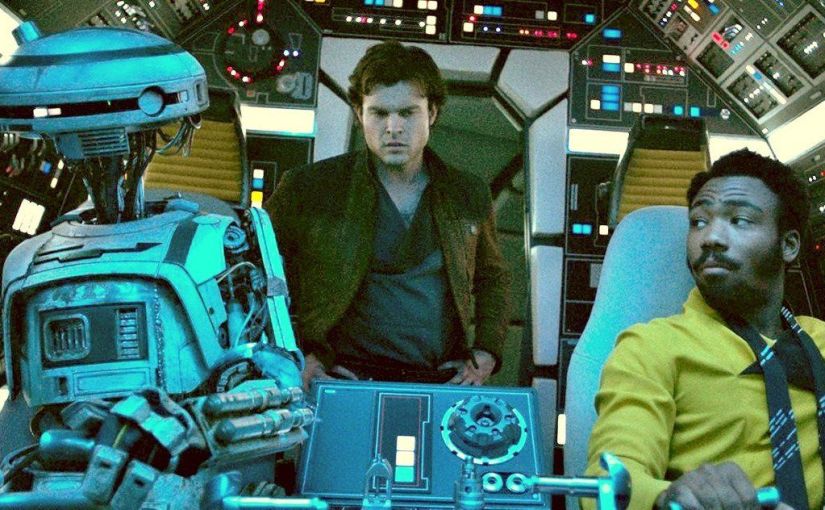
Solo: A Star Wars Story presents a film that stands on its own, relying on mysterious legendary side stories only talked briefly about for the last fortysomething years like the Kessel Run, Sabaac card games, dice and the origin of how Chewbacca met everyone’s favorite space smuggler, Han Solo, plus the Millennium Falcon and the scoundrel Lando Calrissian.  

My brother and even a few friends of mine (Joe Pauly) grew up loving John Wayne’s films. No one else epitomized a Hollywood western better than The Duke.  He was their childhood hero.  For me, it is the generation after that which introduced the space cowboy Han Solo played by Harrison Ford.  He is not anywhere near a multi-dimensional character; pretty one note if you ask me (which ironically is opposite of what I demand in any kind of storytelling these days).  

Captain Solo was the guy who would make it up as he goes; never planning ahead or considering others beyond his trusted furry partner and his beloved spaceship.  He’d poorly talk his way out of trapped situations and when that didn’t work, he was a fast draw with his blaster.  

The screenwriters for Solo, legendary Lawrence Kasdan with his son Jonathan, were all aware of Han’s placement in this space opera, while constructing this film.  Only this time they intended on showing how that devil may care came about. It reminded me of a similar approach writer Paul Haggis took with the reinvention of James Bond in Casino Royale.    A lone hero trusts very little beyond his own arrogance and self-assurance.  The Kasdsans used that technique as the spine for this story and it works.

Director Ron Howard is the right guy to fill in following a notorious director incident beforehand.  Howard keeps the film moving fast with casualties you might not expect to perish, revealing masks (an under looked theme of the original films), traitors, fast ships, fast cars, and their pursuits and chases.  A favorite scene, saluting the Western, is a thrilling train robbery across a snowy mountain that seamlessly changes its angle and vector at times.  It’s as awesome a scene as it promised in the trailers.  

Howard is best at keeping the film grounded in actors rather than tired CGI cartoons.  He definitely makes Han, Lando and the rest look convincing trying to steer a ship or carry a blaster and play cards.

The cast is great.  Alden Ehrenreich is fine in the role; young, cocky, brash, handsome.  I wasn’t looking for him to do a Harrison Ford impersonation.  That would only look like a 12:45 am Saturday Night Live skit. The guy had to do his own thing, not someone else’s much like the Batman and Bond films have done before.  Donald Glover is perfect as Lando, even adopting Billy Dee Williams own way of pronunciation (“Han” vs Ha-an”).  Still, he makes the part his own.  He’s fun to watch.  Beyond some mild makeup scarring, Paul Bettany makes for a really uncomfortable crime lord, like a suave Miami Vice drug kingpin, and Woody Harrelson is just right in the inspirational pirate role; gruff and tough and educating.  Emilia Clarke is finally directed properly in a film.  (I still haven’t forgotten her awful Terminator: Genisys Sarah Conner portrayal.). She is dangerously sexy, but smarmy and cocky like Carrie Fisher was.  She’s a great femme fatale of the 1940s beautifully incorporated into some very thick sci fi.  

This was such a fun time at the movies.  Go ahead.  Accuse me of my bias, but as well shouldn’t I be expected to be a tough demanding critic of all new Star Wars material?  I’d probably be wanting it to match the magic of the original trilogy.  Well no.  I don’t want it that way.  I want new and fresh ideas, while still recognizing George Lucas’ used universe settings.  Disney and Lucasfilm continue to move along, stretching their imagination in monies well spent while also following the rules of smart aleck characters, film western motifs, Eastern cultures and death-defying cliffhangers.  Had the Star Wars franchise remained with Fox, audiences would not be getting the treats we’ve been blessed with for these last 10 years.

Solo really only has two minor misfires.  The droid L3, Lando’s Co-pilot, does not live up to Anthony Daniels nor Alan Tudyk and their high brow robot attitudes.  Why? Because it’s hard to understand what L3 is truly saying.  The lines are garbled at times; drowned out by the robot dialect I guess, and maybe also by a mostly origninal score.

As well, there is one ending moment that’s eye opening, but puzzling with little demand for it.  It was one surprise that did not seem to be well thought out and considering this is a stand alone film, it left me unsure of what Lucasfilm hoped to gain from it.  The moment was too distracting for me.  Yet it’s in there and it’s not the worst offense.  Just very very unnecessary and perplexing.

Solo: A Star Wars Story is none other than great fun with something to think about.   I was laughing out loud.  The audience we were with was clapping and cheering.  That’s why Star Wars films continue to thrive.  Their audiences get caught up in the ride, especially when the films are relatable while not taking themselves too seriously.

THE DA VINCI CODE

By Marc S. Sanders

Akiva Goldsman’s screenplay adaptation of the bestselling novel The Da Vinci Code by Dan Brown suffers from an overabundance of information; like A LOT of information, a TON OF INFORMATION actually. The book is an incredibly fast read with brief chapters and plenty of diagrams and images to study. It surprises me, though, how in depth director Ron Howard’s approach is with the film. Howard must have literally shot every page Brown documented including his edits. Amazingly there is a Blu Ray EXTENDED CUT. It seems Goldsman and Howard at one point couldn’t help themselves. Restraint had to step in for the controversial story’s cinematic debut.

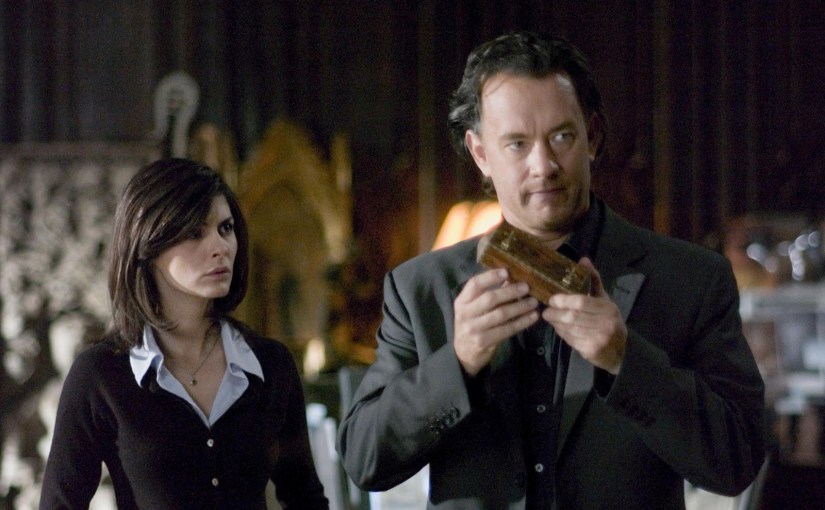
Tom Hanks plays the great modern literary character, Robert Langdon. He is very good in the role of a research expert on historical symbols and cryptology. Hanks even masters Langdon’s self-debilitating weakness of claustrophobia very well, which proves to be a hinderance. It’s maybe an under celebrated part in Hanks’ career because the film is so heavy. Little is talked about this film any longer. (The second sequel, Inferno, flopped at the box office. I’ve yet to see that one.)

Langdon is recruited to go the Louvre in Paris one evening to look over a recently murdered victim left with a pentagram carved in his chest and a gunshot wound in his belly. The victim’s name is Sauniere (Jean-Pierre Marielle). Soon Langdon is teaming up with Sophie (Audrey Tatou), Sauniere’s granddaughter, to uncover one puzzle or clue after another left behind most prominently within the artwork of Leonardo DaVinci, including the “Mona Lisa.” Gradually, a conspiracy is uncovered revealing a strong possibility of how Mary Magdalene and Jesus Christ are actually connected. Amidst all of this, Langdon and Sophie become fugitives under the suspicion of murder. Now the cops (headed by Jean Reno) as well as a secret society within the Catholic Church are hot on their trail to stop them from revealing the truth. A dangerous, self torturing Albino monk (Paul Bettany) also comes into play.

That’s a long ass paragraph I just wrote and it hardly scratches the surface of how in depth The DaVinci Code really is. Because it is so nuanced, I had some major problems with the film. For one thing the cinematography from Salvatore Totino is very dark. I know. Most of the film takes place in the middle of the night within the hallowed halls of the Louvre and the streets of Paris. However, I think certain liberties should have been taken here. The details thrown at the audience never stop. Long summaries of dialogue come into play and at times Totino and Howard will highlight a code or a portion of a piece of art or a passage in a book. Because the story is so deliberately murky, I wish at times what I was looking at could have been presented all the more clearer.

Another issue is with Audrey Tatou who is of French descent and whose character is that way too. Her French accent is too thick to clearly understand every word she is saying. A lot of details become lost because her dialect swallows her words. Natural dialects can be a slippery slope in film. You want the characters to be as genuine as possible but none of that means much if you can’t follow along.

The best surprise of the film reveals itself when Ian McKellen appears, portraying Sir Leigh Teabing, a mentor and friend to Langdon. Yes. He offers up a ton of information too. Too much for any one film really. However, McKellan is so giddy in the role. Leigh relishes the fact that Langdon and Sophie appear at his home. He’s elderly and crippled and excited with glee to come across them so he can share his own theory of Mary, Jesus and what is possibly the real interpretation of the Holy Grail. At ninety minutes into the film, McKellan’s introduction is quite a welcome, relief from the heaviness of everything before.

The DaVinci Code clocks in at over two and a half hours. It feels longer actually. There are multiple endings as surprise traitors need to be revealed, more history and theories need to be uncovered and more European locales need to be visited complete with secret passages and hidden staircases. It took a lot of mental effort to remain patient with the film, and I had already read the book!!!

Ron Howard’s film merits the discussion of whether Brown’s bestseller should have ever been filmed. As good as Hanks and McKellan are, I say no. This is not Indiana Jones with bullwhips and truck chases. This is a treasure hunt that sticks to what is on a page and within an exhibit. To mask what is discovered by dictating endless dialogue from the cast becomes incredibly tedious.

Dan Brown’s story is wildly out there in theory and supposition. It’s what makes it fun, really. So, do I recommend The DaVinci Code? You bet I do. I definitely recommend you read the book.

CAPTAIN AMERICA: CIVIL WAR

By Marc S. Sanders

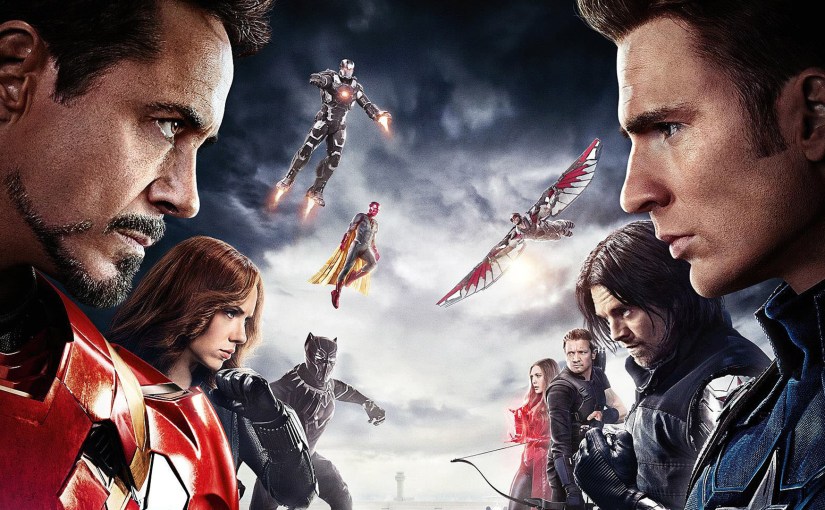
I think the Civil War chapter must be one of the best installments in the Marvel Cinematic Universe. The action ranging from fight scenes to car chases to shootouts and explosions are so well executed and edited.

This film lives up to what makes each Marvel character special in their own way, and while most of the attention is naturally focused on Chris Evans’ Captain America and Sebastian Stan’s Winter Soldier (aka Bucky), the large cast is respectively given numerous moments to shine individually with well-conceived backgrounds and traits beyond just their superpowers.

Interestingly, until the late scene where all the characters collide against one another, the film was very shy of any intentional humor and focused more on what is morally correct in this fantasy world. There was a debate to grapple with, and a threat to both sides of the moral compass. All good layered dimensions, my favorite vice of effective storytelling.

Anyone who says popcorn movies like Avengers are nothing more and simply brainless would fail at recognizing good analysis and dimension. More often than not the MCU succeeds at setting up a dilemma to keep a viewer hooked. Once they are taken…then the storytellers will do something bold like destroy the headquarters, or an airport, or a whole city or Iron Man’s armor, and on and on. Too many other franchises (Transformers, Fast/Furious or DC) bring the buildings down before the cement is dry and the windows are Windexed. That’s when story is neglected for showmanship. There’s no weight to the loss. What do I care who died? You just destroyed the village in order to save it. Disney and Marvel know this and steer clear of those habits.

The cast is so perfectly assembled in Civil War. They interact very well with line exchanges, debates and fisticuffs.

Much of this film was a blur during my first viewing. These are Marvel movies. There are so many now, the scenes all seem to blend together. Yet now I see this particular film is special. Good set pieces, costumes, makeup, visual effects and great performances lead to a great, fun presentation. I’m sold.

AVENGERS: AGE OF ULTRON

By Marc S. Sanders

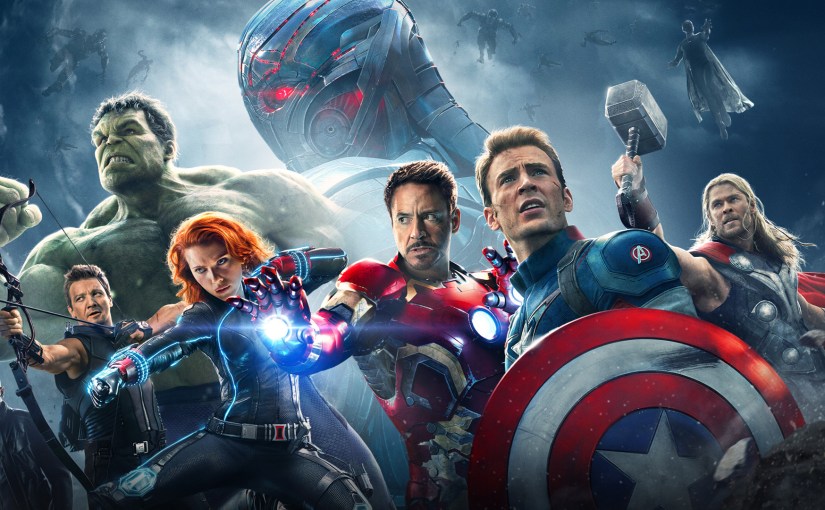
The character of Ultron, a terrorizing cyborg, has been a favorite Marvel Comics villain of mine ever since I discovered him in 1984 during the Secret Wars 12 issue limited run. He looked sinister with a devilish face in the shape of a metallic claw. His sonic blasts appeared more destructive than anything else ever drawn on the page. Ultron was a badass!!! (“Language!”). That being said, the cinematic interpretation is quite different, yet he’s modeled on a much more grown up sculpt.

Ultron is still a terrorist bent on utter destruction, but now he has a disregard for man. He’s written quite inventively as a direct contradiction to arguably the favorite of all the Marvel cinematic characters, Iron Man aka Tony Stark. How fitting that James Spader is cast opposite his former brat pack cast mate (Less Than Zero), Robert Downey, Jr. It is really uncanny how the dialect of Spader’s limitless Ultron can sound just like Downey’s genius Stark but with a means of annihilation; “All of you against all of me.” Ultron is smart first, powerful second. He’s not just a monochromatic android. There’s a means to his end and an inventive science to his purpose; uproot a country high in the sky and then DROP IT BACK DOWN INTO THE PLANET, like an anvil flattening Wile E. Coyote. It’s actually more novel than I’m giving it credit for.

Most Marvel afficianados from the blogs, and fellow colleagues as well, do not care much for this chapter in the MCU. I have yet to understand why. Again, each character is really drawn out beautifully by Joss Whedon with a respective storyline. Finally, Jeremy Renner’s Hawkeye is given some oomph to his back story. So is Paul Bettany as the other cyborg, Vision, formerly J.A.R.V.I.S, the artificial intelligence.

Vision/J.A.R.V.I.S. outshines Data (“Star Trek: TNG,” apologies to my friend, Jim Johnson), but will never top C-3PO. I like how he’s introduced as an amalgamation of all of the film’s main characters’ abilities. Bruce Banner and Tony Stark, Thor, Ultron, Scarlet Witch, some brilliant doctor friend, and even the nation of Wakanda. They all have a piece of themselves in Vision. It’s a better story than the comics ever suggested. Maybe I’m biased having grown up on these stories, but the Vision element makes me want to clap every time I see it. So inventive and economically told for a two-hour film with a ginormous cast. Vision’s introduction is one of the best scenes in all of the Marvel Cinematic Universe.

A great device to unhinge most of the Avengers comes through by means of Elizabeth Olsen’s Scarlet Witch (identified as Wanda Maximoff) who cripples them with mind control. How else should a sorceress take out a whole lotta muscle? It works and it gives Olsen conflict to play with. The visual effects surrounding her are also pretty cool. Sure, it might be just some neon red mist, but the cinematography and CGI surrounding her look gorgeous.

This installment also serves as neat set up for what’s to come. Quick Easter Egg in Age Of Ultron: Tony Stark Name drops the term “Endgame.” Oooooooo!!!!!!

It is really admirable what Marvel and Disney have done with the MCU, and especially watching this film. It’s ironic how filmmaker James Cameron made a statement hoping for “Avengers fatigue” so the phenomenon can die down in movie houses, etc. Funny! For me, seeing all of Ultron’s toys and wit seemed to outshine quite a bit of the residuals spawned from Cameron’s Terminator franchise.

Whedon wrote and directed a film with much more intelligence, wit, at least as much action, and threat than I ever got from Cameron’s reputation of clunky dialogue and plot hole time travel storytelling. It would do Mr. Cameron well to maybe not throw stones at the glass Avengers towers. I’m skeptical that his upcoming FOUR Avatar films will carry the smirk inducing cues the MCU has used to its advantage.

MARGIN CALL

By Marc S. Sanders

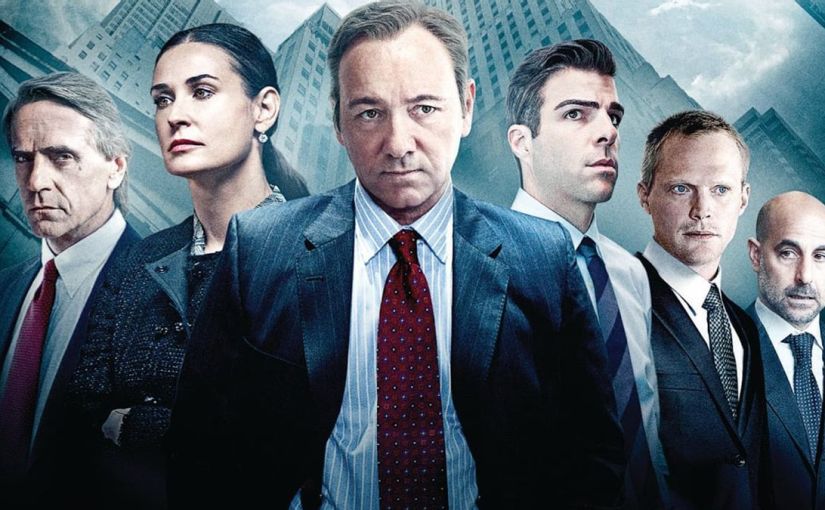
Could it have been possible that a rocket scientist and a bridge engineer uncovered one of the biggest market crashes in American history?  Writer/Director J.C. Chandor’s first film, Margin Call, will have you believe that.  It makes sense when you think about it.  Numbers and bar graphs and pie charts and zig zagging lines become so complex with themselves that you have to wonder how people wearing $1500 designer suits and selling products over the phone could decipher such nonsense.  So, it would take a rocket scientist to unravel such an exceedingly large ball of rubber bands in only one night.  Yet, how does a rocket scientist and a bridge engineer come to encounter this predicament.  Easy.  It’s all about money.  You might be the greatest scientist in the world, but if the pay isn’t right, is the science really worth it? 

Zachary Quinto plays Peter Sullivan, the rocket scientist from MIT.  Stanley Tucci plays Eric Dale, the bridge engineer.  They abandoned their college majors and specialties to go where the earnings are much more lucrative.  They both work in the risk management department for a large, unnamed New York investment bank.  On a Thursday afternoon, along with a whole slew of other people, Eric is fired.  His company cell phone is immediately shut off and he’s escorted quickly out of the building along with his personal belongings.  Before he leaves, he’s able to pass off a computer file for Peter to have a look at.  Eric was close to completing something deeply impactful, but didn’t get a chance to finish.  When Peter stays late after work to download the file, a stunned look eventually appears across his face, and he’s quickly calling back his workmates at 10 o’clock at night.  Those guys were getting hammered at the nightclub downtown, celebrating that they were not on the chopping block earlier in the day.

The cataclysmic results of Peter’s discovery is first passed on to his buddy Seth (Penn Badgely), then to the next level up which is Will Emerson, supervisor of trading (Paul Bettany).  Will then tosses it over to the higher risk supervisor, Sam Rogers (Kevin Spacey), who then passes it on to the Jared Cohen (Simon Baker), maybe the company’s second in command.  Jared assembles the men to meet with Sarah Robinson and Ramesh Shah (Demi Moore and Aasif Mandvi), who compute risk at even high level. 

Chandor is so genuine with his script and characters that as the earth-shattering news gets shared and then shared again and again, each higher up the food chain demands that it be explained to them in simple English.  By the time, Jared passes on this news to the head, HEAD Honcho, John Fuld (Jeremy Irons in a thankfully scene stealing performance), it is being requested of Peter to speak to John as if he were a golden retriever.  I guess in the corporate world, the sharper your clothes and hairstyle are, as well as the more formal your position title is called, the simpler the explanations need to become.  The ones who earn the big bucks don’t sit on the top floor to be belabored with charts and graphs that lack prestige and personality.

I want to point out a symbolic sequence here as well.  Each higher up seems to work on a higher floor than the other.  So, Seth and Peter accompany Will and Sam up an elevator to where Sarah, Ramesh and Jared are located.  After this meeting, Seth, Peter and Will go up on the rooftop of the building to smoke and commiserate.  Will even considers jumping.  They are then interrupted from an even higher level beyond the pinnacle of the building.  A helicopter arrives with John in tow.  God has descended at this inconvenient hour to tend to his prophets and their disciples.

Margin Call might sound like a complex assembly of numbers and math.  It really isn’t though, because Chandor approaches his film without ever really giving away how complex the issue is.  Instead, he demonstrates how deep it is.  Sam focuses on a computer screen and asks “Wait, is that number right?”  Peter’s nervousness is enhanced with his hands laced behind his head as he paces back and forth.  Will has been chewing on Nicorette gum up to this point.  Midway through the film, he’s back to smoking.  Seth understands that the mass firing he just survived hours earlier will inevitably catch up to him and all he can do is cry on the toilet.  Sarah comforts herself by asking Peter if the report he’s laid out is his work.  She wants to be excluded from being a cause of the crisis.  The best indicator of how serious and intense this has become is when an ice cool looking and handsome Simon Baker (even the blue tie he wears says icy cool) as Jared asks for the time.  It’s 2:15am.  He mutters to himself “Fuck me,” and then asks again for the time.  It’s 2:16. “Fuck me,” with a leap off the chair and a distant stare out the window.

The nature of the problem isn’t so important to grasp.  What’s necessary to take away from Margin Call, is that the gods of currency have irresponsibly and deliberately neglected the warning signs.  The returns have just been too damn good.  Now the boat has taken on too much water to stay afloat, though.  Chandor opts to focus on the response and behavior to the dilemma at hand.  There’s whispered blame to be exchanged.  There’s the need to stay silent.  When Jeremy Irons eventually comes into the fold, he holds a board meeting and calmly asks for someone to explain the situation.  Chandor points his camera on concerned close ups of middle age men not willing to speak up; messengers who truly believe they’ll be killed for delivering the dire news.  Even Jared can’t speak.

The sad outcome of the film is actually how the crash of 2008 with Collateralized Debt Obligations and Sub Prime Mortgage Defaults (see Adam McKay’s The Big Short) played out on the eve of its first day.  The investment bank in the film opts to sell off its worthless assets that enormously exceed the entire net worth of the billion-dollar company.  Chandor’s film reminds us that it’s legal to do so, and the buyers of this “odorous bag of excrement,” are John and Jane Q. Public.  At 9:30am, these brokers will put on the charm and sell at a price of $100/share knowing that by 2:00pm, it’ll be worth .65 cents/share, if they’re lucky.  Their customers paid for porterhouse, but went home with a cold burger in a doggy bag.  It’s the only way to survive. 

There are no heroes in Margin Call.  There are only profit makers.  Profits that are earned at the expense of everyone else on the planet.