
TEACHERS

By Marc S. Sanders

I grew up watching the television show M*A*S*H with my mother and brother.  Don’t hate me but I have yet to see the Robert Altman film.  Perhaps that is because I was afraid of major disappointment.  The formula for many of the episodes and seasons of the TV show work so well at blending tidbits of comedy within a setting that is nothing else but bloody turmoil.   For those characters to survive required all of them to laugh and lampoon into the face of an uncontrollable situation where their lives could end at any time while they live in misery.

These thoughts came back to me as I watched an unsung and forgotten film from 1984, Teachers directed by Arthur Hiller.  John F Kennedy High School is only going in one direction which is very far south beyond the gates of hell.  A gym teacher is getting students pregnant, a kid shows up at the principal’s office with a stab wound in the arm, and the school psychologist has just lost her marbles because the old fart tenured teacher hogs the ditto copy machine (Remember those?  You could get high off the ink on the paper.).  A mental patient has managed to worm his way into a comfortably welcome substitute teacher position.  The driver’s ed car has been stolen and one student terrorizes another teacher in an assortment of ways beginning with biting and then moving on to theft.

Alex Jurel (Nick Nolte) is the admired social studies teacher who has lost his passion for the profession.  It’s not so much that the student body or the teaching staff is out of control.  The whole administration has taken to a new mentality of profit over proficiency.  The merits that come with an education are all but dismissed.  The assistant principal (Judd Hirsch) used to care as well.  Now, his job is to maintain a façade for the school and churn out one student body after another year after year.  The principal only knows to answer any questions with a genuine “I don’t know.” reply.  Bottom line is no student should ever be flunked from John F Kennedy High School.  If they can read enough, then it’s enough to get the diploma.

A former student of the school is Lisa Hammond (JoBeth Williams), now an attorney and representing a graduated student who is suing the school claiming he is an illiterate who cannot find a job or begin a future due to the negligence of the school. Lisa is a crusader.  She’s not here for the money to be earned from the case.  She’s here to make a change and her lynchpin deposition will come from Alex who will testify about the truth that’s occurring. Hopefully, he will also recruit other teachers in tow to back up the claim.  Naturally, as his former student with the nice ass, Lisa becomes involved with Alex on the side.  Like most movies, this one also does not question the conflict-of-interest circumstance.  We just have to roll with it.

I really take to the dilemma of the school and I understand both sides of the argument.  Now, more than ever, over forty years after the release of this film, I think our educational system is in dire straights with minimal funding, lack of support and respect for a teaching staff, parents who exonerate themselves of being responsible for their children’s lack of progress and behavior, and then of course there is the very real epidemic of school shootings and on campus violence. 

However, school is a necessary element to our society and its where all of us begin.  To uphold a reputation will involve both losses and wins.  Not every student will make it.  Not every student will miss out either.  As Judd Hirsch’s character insists, half of these students will not graduate with a proper education but half of them will.

Okay.  Enough arguing!  How about Arthur Hiller’s movie? Teachers has much to stand on and I wish it had garnered more attention.  It’s undoubtedly worthy of it. 

Like M*A*S*H, there’s organic comedy that comes from the film and a variety of teachers and students appear like they have been cut from familiar cloths.  Most of the comedy works especially well.  I love the ongoing joke of the one teacher who sits at the back reading his paper and dozing off, with the students facing away from him while they complete an assignment during the period.  The punchline to this joke may be predictable, but I’m still allowed to laugh as I watch it play out.  It’s funny. 

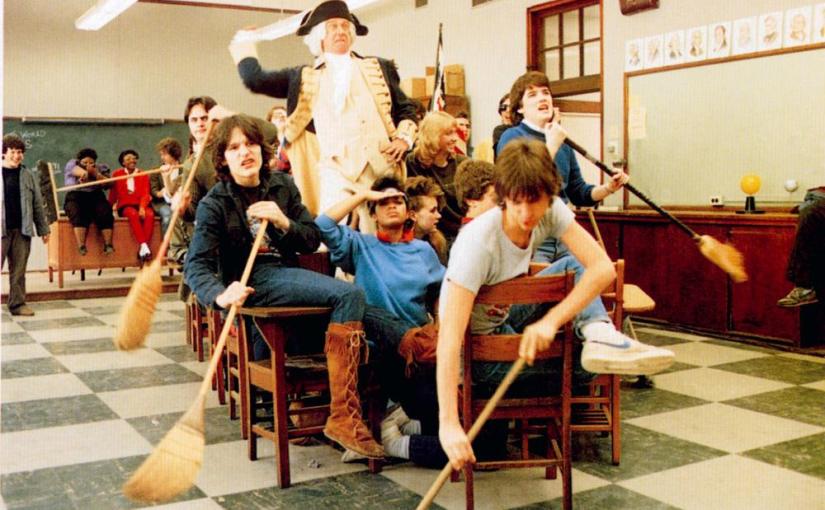
Richard Mulligan (Empty Nest) plays a mental patient that ironically engages his students when he conducts his classes dressed as famous historical figures like Lincoln and Custer.  Watch him reenact George Washington’s crossing of the Delaware with his students “rowing” the boat.  It’s an image I will not forget.  Nor will I forget his final scene in the picture as he encounters Nolte’s character in the hallway.

Where the film falls short is in the one student that is primarily focused on, played by Ralph Macchio, shortly after coming off his first Karate Kid movie.  Just like in The Outsiders, which I recently wrote about, Macchio relies on his dark complexion, stylish black hair, blue jeans and that popped up jacket collar again.  There’s also that strut he always has.  Forgive me for beating up on the kid, but too often I see Macchio donning the same image – that cool kid pose needed for the cover of Teen Beat Magazine.  Nick Nolte shares a lot of scenes with the actor playing the troubled kid with a sixth grade reading level.  However, Nolte is the only one working most of the time.  Another actor in this role would have served better.  It’s a necessary role as it attempts to awaken Nolte’s teacher character to try saving another kid before he gets lost.  Back then, maybe Emilio Estevez or Lou Diamond Phillips would have been more suitable.  Instead, we get Ralph Macchio being Ralph Macchio all over again.

Teachers is a comedy drama that mostly works.  It’s easy to get caught up in the comedy and, sadly, the absurd truth of what goes on in a metropolitan public school system back in the 1980s.  There’s also very dramatic and heavy elements to the film that stay with you.  Before school shootings no longer became shocking (a sad and current truth), Teachers explored the trauma of school bullying and the response the comes with that issue.

Arthur Hiller’s film did not invent the wheel on troubled times within school.  Heck, even The Sweat Hogs from Welcome Back, Kotter were troublemakers too.  Not to mention there are other school dramas to come before, like Blackboard Jungle.  However, Teachers is an very engaging film. I was completely absorbed as soon as the movie began, first in its comedy, and then later in its drama.  A near final scene of the film is eye opening and much like Steel Magnolias will leave you laughing and crying all at the same time.  That happens because you quickly begin to care for most of these characters and the turbulent times they live through as a teacher making next to no money while working under unfair and unreasonable scrutiny.

I think Nick Nolte is delivering one of the best performances of his career.  He has great chemistry with JoBeth Williams, who is good in her role.  The romantic storyline does not go overboard.  It does not get schmaltzy.  It is just enough, and it’s wise to include dialogue where they debate one another from two different sides of a coin.

Teachers also works as a great look back piece.  A lot of well-known, eventual recognizable actors round out this cast including Morgan Freeman, Crispin Glover, Laura Dern, Allen Garfield, and Lee Grant. Anytime Nolte is on screen, he only enhances the scenes he shares one on one respectively with most of these actors.  The moments between him and Macchio only work because of Nick Nolte.  Call Nolte the Alan Alda/Hawkeye Pierce of this picture. 

Teachers might look tame by the turmoil we see today in schools across the country but none of what is seen is untrue or exaggerated either.  Well, maybe except for the mental patient who arguably turns out to be the most engaging and influential instructor of them all.  That’s funny stuff, but you gotta be a little bit crazy to become a teacher nowadays.

Q & A

By Marc S. Sanders

Sidney Lumet is a favorite director of mine.  Maybe it’s because I simply get caught up in good crime dramas and legal thrillers, like Dog Day Afternoon, 12 Angry Men, and The Verdict.  Maybe it’s because I appreciate the genuineness of Lumet’s technique.  The man’s career seems to follow a documentarian theme throughout New York City’s boroughs, politics, courtrooms and especially the various precincts of its police force.  Corruption is the angle that Lumet looks for, and Q & A from 1990 is another such example.

The title refers to the routine transcript that a district attorney will ask a witness following an incident.  So, after the first two minutes of the picture have concluded with New York cop Mike Brennan (Nick Nolte) shooting a Hispanic at point blank range, execution style, outside a seedy nightclub, a fresh-faced D.A. named Al Reilly (Timothy Hutton) is recruited in the middle of the night to collect Mike’s statement on the incident and wrap it up quickly, as his supervisor Kevin Quinn (Patrick O’Neal) strongly urges.

Mike is a celebrated cop with tall tales to share of how he strong arms suspects.  Everyone seems to like his relaxed way of tossing around racist vulgarities in his anecdotes.  No demographic is left out with how he speaks.  In fact, the name calling is shared among the whole precinct in a very casual way.  The two detectives assigned to the shooting that Mike was involved in, Sam “Chappie” Chapman and Luis Valentin (Charles S Dutton, Luis Guzman), seem to take it in stride as well.  They guffaw with the rest of the crowd when Mike describes how he roughs up street hoods who don’t cooperate. 

Al was once a cop as well, and his father before him was a “hero cop” to the boys in blue too.  He’s more than willing to let this incident go the quick routine, but then he soon realizes how corrupt Mike is and how much of a stronghold he has on the precinct and the various walks of life within the city from the Italian mob, to the Hispanic drug runners, to the transvestite hookers and the Jewish lawyers.  They all fall under his thumb.  Nolte’s stature and bombastic voice tell you that Mike carries a large thumb no matter how blatant his crookedness may appear. 

“Chappie” may be regarded by Mike as the “whitest n—er” he knows, but he’d never even think of turning his colleague in.  That’ll be the day he quits.  He proudly announces he’s blue first and black second. Luis, the Hispanic partner regarded as a “n—er with straight hair, is scared to move forward.  He’s got kids.  Kevin Quinn needs this to just move on.  The shooting of a lowlife Hispanic is not worth risking his advancement in politics.  Al is challenged and turns to his Jewish mentor, Lee Richardson (Leo Bloomfield) for guidance, who can help him get this pushed up the ranks and nab Mike for his atrocities, while circumventing the racist and antisemitic nature of Deputy District Attorney Quinn. 

It gets more complicated for Al, as his ex-girlfriend, Nancy (Jenny Lumet, Sidney’s daughter) is now attached to an important witness to the crime.  Bobby Texador (Armand Assante) is a Hispanic drug dealer who can not only pin Mike for the crime but also incriminate others within the system.  He’s just not so willing to sing.  Al is in a difficult quagmire that circles back to pension left for his mother per his father’s prior service.  He’s also wracked with how to handle Nancy.  They broke up simply because his reaction upon learning that her father was a black man did not go so well.  Even Al, born of virtue, is corrupt of prejudice.  Perhaps Lumet’s screenplay suggests the message that intrinsically we are all at least a little too stereotypical or partial for our own good.  It comes with our sensibilities and maybe it’s a mindset we best unlearn.  The most obvious challenge for Al is that he is subjected to intimidation from his boss Quinn, and especially Mike.  You don’t want Nick Nolte in your face.  That’s for sure.

I can’t lie.  Having watched the film for the first time, I was only looking at the plot and story development of Q & A.  I wasn’t seeing the bigoted culture sewn in among the masses.  Afterwards, I watched Siskel & Ebert on You Tube and they focused on the racist themes and casual name calling among the characters.  It never occurred to me while I was in the moment of watching the movie.  I don’t know what that says about me.  Maybe I’ve grown as comfortable with racist name calling as these characters have.  I don’t talk this way.  I may laugh at Cards Against Humanity or Family Guy.  For these cops to talk among themselves, casually using prejudiced connotations for African Americans, Hispanic Americans, Homosexuals, Transvestites, Jews and Italians within the melting pot of New York City with such nonchalance is more telling of Q & A, than the corruption that unfolds over the course of the picture.  Understanding what Siskel and Ebert found within the script granted me much more appreciation for Lumet’s film, because the twists of the plot and the overpopulation of characters was becoming too convoluted for me.

The strengths of the movie come from the cast performances, especially Nolte and Assante.  Nolte has played many roles where he’s the brute.  Here though, he’s downright despicable with his slicked back hair, tall stature, his thick “I’m your buddy” mustache, and his Irish Catholic character background that announces his superiority to all others.  Armand Assante is an unusual kind of drug kingpin.  He plays Bobby Texador with much self-awareness knowing he can be killed not only for what he knows about this particular shooting but other inside information he can share as well.  He’s a guy who will rise above any threat though.  This guy might be a criminal, but he hardly needs an attorney to negotiate on his behalf.

The trio of Nolte, Assante and Hutton works because each of the men are so different from one another.  These guys wouldn’t work well on a baseball team together.  They wouldn’t even socialize at parties.  Lumet writes these characters so far apart from each other, that loyalty can’t exist between any of them.

A lot of the characteristics of the film are consistent with many other achievements within Lumet’s repertoire like Night Falls On Manhattan and Serpico.  Those are better films.  When plot details reveal themselves in Q & A, I found myself rewinding to the beginning of a few scenes to fully comprehend what was just said. After a while, I gave up interest in the twists.

There was a choice of musical style that left me unsure as well.   Ruben Blades conducted the score for the film and a pop/rock song follows the prologue over the opening credits.  It later resurfaces as things are coming to a head near the end of the film.  Especially for the seedy and unglamourous approach that I love in Sidney Lumet’s films, I wasn’t enthusiastic on this style to heighten the dramatic crescendos.   It felt a little too Miami Vice, when I believe Lumet was aiming for his audience to get mad at the corruption that overtakes a system grounded in law and order. 

Q & A is a must see for fans of Sidney Lumet.  I’m glad I finally saw it.  It’s been on my bucket list for quite a while and I could not find it anywhere on any platform or medium.  (At the time of this writing, it’s available for free on Hulu.)  It’s definitely raw in its character creatures of a New York City from the 1990s, and it’s honest how the rite of passage to be a cop is to roll with the punches of racially lampooning your ethnicity.  It’s the only way to survive among the masses.  Fortunately, the cast plows through with that ugly nature to deliver something authentic.  When the film dives into its conspiracies for the sake of the plot, however, it’s a little too muddied for me to appreciate.  Watch the film for the characterizations.  Heck, watch it for the plot developments because if you can make out everything that’s happening and why, I’d love for you to explain it to me.

CAPE FEAR (1991)

By Marc S. Sanders

Would you ever think that Martin Scorsese could be a master of horror? I do. I thought so ever since I saw his remake of Cape Fear, back in 1991, featuring Robert DeNiro, Nick Nolte, Jessica Lange and Juliette Lewis. This cast of four is an astonishing assemblage of talent, complimented with players from the original film, Robert Mitchum and Gregory Peck, as well as Joe Don Baker, Fred Thompson and Illeana Douglas.

Wesley Strick is credited with this updated screenplay that questions the measure of sin; pot vs heroine, battery vs rape, flirting vs infidelity, as well as the ethics and justifications that we reason with every day.

DeNiro provides one of his greatest roles. He lost the Oscar in 1991 to Anthony Hopkins. Reader, DeNiro should have won for a much more complex, fleshed out part. He plays Max Cady, a man released from prison after a fourteen year stretch. His focus during his time was to learn how to read, build up his body, tattoo his flesh with the principals he inherited from the Almighty Bible and other literary sources, and most importantly reconnect with his defense attorney Sam Bowden (Nick Nolte in one of his best roles, as well). Cady needs to remind Bowden of how he was misrepresented during his trial.

Strick’s screenplay is so smart. Smart because the antagonist never, ever makes an error, not until the end of the story. Cady’s intelligence is always one step above anyone else’s intuition and with the literal mechanics of the law beside him, Cady’s tactics come off very believably. Cady might come off as hokey, hillbilly white trash with ugly polyester clothing, a slicked back mullet and a fat, offensive cigar but he is a smart hunter who will weaken his victims before initiating his attack.

Bowden is a smart lawyer but he’s at a loss, and he does not have the support he needs from his family to protect himself and them, Jessica Lange as his wife and Oscar nominee Juliette Lewis as his daughter. Lange is very good as a wife who has survived marital turmoil of infidelity from her husband. She’s a marketing career woman who does not succumb to Sam as being head of the household. Sam asks that the dog not be put on the table and Lange as Leigh Bowden scoffs at his concern.

Fifteen years old at the time, Lewis is astonishing as a young girl discovering her sexuality but unsure of what is appropriate; almost like a kid finding a loaded weapon in a closet. One of the greatest acting sequences in the last thirty years, occurs between DeNiro and Lewis alone on a stage set against a sinister lighted Hansel & Gretel set. Lewis twitches and stutters like any girl would, as DeNiro assuredly comforts her and seduces her into a touch that leads to a kiss. Scorsese uses this midpoint scene to quiet down an aggressively frighteningly film, meticulously edited by the legendary Thelma Schoonmaker. Before this moment, telephone rings, shutters, racket balls, car engines, aggressive close-up zooms, and Elmer Bernstein’s horn and string sections of his orchestra startle you and scare you when almost nothing terribly vicious has really happened. When we arrive at Lewis and DeNiro’s scene, Scorsese quiets it all down. He needs no devices for this exchange of disturbing, yet researched dialogue by Strick, blended with the performance talents he has at his disposal.

Another stand out performance belongs to Illeana Douglas in a small, early role. She plays a court clerk to Bowden’s lawyer and they are flirtatious. Cady uses this as an opportunity to remind Bowden that he must take his sins seriously. Douglas is supreme in an inebriated scene with DeNiro as she flirts with him and then goes to bed with him. We can sense the danger she’s in. Douglas’ drunken portrayal cannot. Never does she look like she’s foreseeing her immediate future.

It’s ironic, really. I can’t help but compare Cape Fear to any one of the various slasher films featuring Jason, Freddy, Michael, etc. Those guys stalk the house or are seen from the distance at the end of the street. Those are horror films as well where an entity stalks a prey. Scorsese really has that here with Strick’s screenplay. However, Scorsese finds other ways than to just have the menace be…well the menace. He offers up an overabundance of fireworks behind Cady as he sits in Bowden’s backyard. He’s got Bernstein’s blaring horns and squealing strings for soundtrack, of course. He colors the palette of the sky above Bowden’s doomed house in bruised purples and blood reds. He even changes the perception of the Bowden family by showing what they are looking at in a sort of X-ray/black light like state. Are they seeing what they think they are seeing? Sure, Cady is stalking them, but in a given moment, are they just being paranoid by the disturbances Cady has cemented in their consciousness?

I’d imagine these are filmmaking inventions of Scorsese not specifically featured in Strick’s script. That’s what makes Martin Scorsese a director above so many others. He doesn’t just settle for the page. He won’t necessarily manipulate the script, but he won’t settle to just leave it at only what he reads. Cape Fear is a demonstration in unsettling, visual terror, and it’s worth revisiting for a look.