SINNERS

By Marc S. Sanders

Ryan Coogler is one of the most inventive writer/directors working today.  This is a filmmaker who will assemble a hundred different ideas into one body of work. All of it makes sense when blended together.  A movie musical sourced in blues and grassroots instruments like banjo, piano, harmonica, foot stomping and guitar stitched together on to a horror film?  Once the wheels get turning, Coogler can’t see it any other way and so he lands upon October 15, 1932, one day and one very long night in Clarksdale, Mississippi where Sinners takes place. 

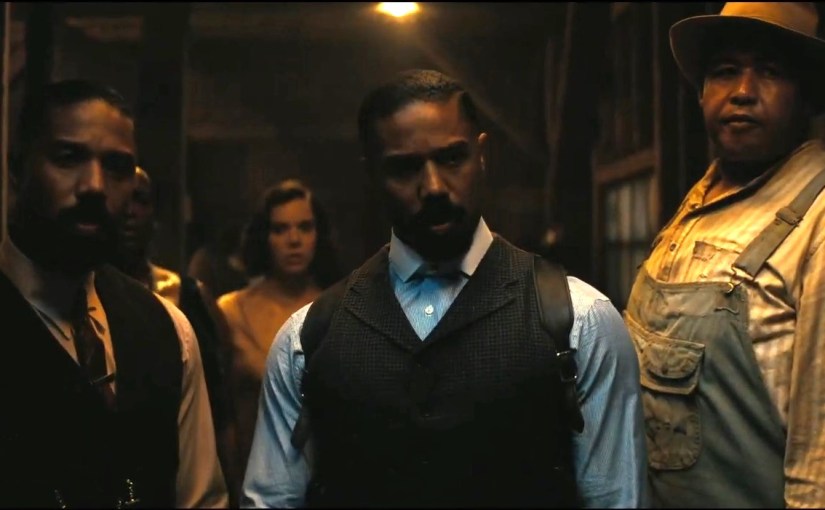
The smokestack twins – Smoke and his brother Stack – return from working with Al Capone in Chicago.  They’ve got lots of money and big plans to open up the Juke Joint when the sun sets.  Michael B Jordan plays the charming gentlemen. Smoke is donned in blue accents, while his brother Stack is identified primarily in red.  Jordan is such a skilled and aggressive actor in everything he does. I truly did not realize he was playing both roles until about a third of the way through the picture.  His performances are so tantalizingly unique and memorable that Jordan has to be a contender for an Oscar nomination.

The boys circumvent the Clarksdale area. First they purchase a barn and the land it dwells upon.  With their pistols at the ready, their purchasing agreement is that the seller’s Klan associates do not come around here.  They go to the train station to recruit Delta Slim (Delroy Lindo) for the piano and harmonica.  Smoke visits Ruthie (Andrene Ward-Hammond) to prepare the most delicious crawfish and shrimp.  Ruthie is also the mother of Smoke’s deceased infant child and they need to catch up on some history that was not tied off.  Stack needs to contend with Mary (Hailee Steinfeld), his sultry lover from the past who was also left behind unexpectedly. 

Most impressive is a debut performance from Miles Caton as Sammie Moore, the local preacher’s son, and the kid who can strum a mean guitar in the back seat of a car or down at the joint.  Sammie looks up to the twins. They will show him how to carry himself.  There’s a history to everyone the men encounter.  Sometimes they are welcome.  Sometimes they’re not, like the Klan, and sometimes they’d rather avoid who they come across as they continue to spread the word about the Juke Joint celebration that’s too come with all the liquor, food, and music they can imagine. 

Michael B Jordan and Miles Caton are definitely Oscar worthy; two very hot properties.  Caton can do it all.  He can sing and act.  He’s as big a surprise as Mikey Madison was with Anora.  You can’t take your eyes off of him and if the guy goes on tour, I’m buying a ticket to see him. 

A prologue narration followed by a disturbing, eye-opening epilogue scene within a town church opens Sinners.  Something unfathomable must have happened at the Juke Joint on this particular night. 

I went into this film having not seen a trailer, a commercial or even reading an article about it.  I was not aware of the blazing bluegrass root music that populates this film, nor of the surprise monster fest that eventually takes overtakes the story.  It was a better viewing experience for me than I imagine had I known some of the details of Coogler’s film.  This gorgeous film accompanied by magnificent sound and visual details with award caliber editing and direction steers into so many different curveball surprises and genres.  Sinners is a film that you go see in the movie theater.  The Juke Joint alone is worth the price of admission.  As memorable a setting as Rick’s Place in Casablanca, the Cantina in Star Wars or Jack Rabbit Slim’s in Pulp Fiction

You read it here first!  The Juke Joint is sure to be a haunted house at Universal’s Halloween Horror Nights.  I promise you.

That being said, my love for the two-and-a-half-hour film dwindled during its last third when the monsters are revealed and the picture spirals into a blood fest battle between heroes and villains with spurting blood, fiery Molotov cocktails, guns and screaming and wrestling and chases upstairs and out the doors and off the balconies.  I’ve seen all of this a hundred times before and as well constructed as a film this is, nothing was surprising me anymore.  Nothing was giving me jump scares. 

For such an imaginative picture, the inventions went into neutral.  The dialogue starts to drain in lieu of schlock gore and the intelligence of this abundance of characters checks out at the door.  Some of what you see looks like material that could have been in Friday The 13th Part 14.  And, well, a lot of the material is a rehash of Robert Rodriguez and Quentin Tarantino’s very proud B movie From Dusk Til Dawn.

Until the final act of Sinners, Ryan Coogler incorporates so much researched and genuine attention into this Jim Crow era film.  I read that while he was making the Creed and Black Panther films, he was feeling withdrawn after a favorite uncle passed away.  This uncle told stories of this Mississippi area, complete with a small immigration of Chinese populace.  Coogler capitalized on that idea and a well-drawn couple named Bo and Lisa Chow (Yao, Helena Hu) are weaved into this story to supply food and drink for the party that’s to come.  No one would ever question if these two were not part of this cast.  They could have been two black actors or even a pair of whites, but Coogler ensures additional flavors are worked into the film with the authenticity to back it.  These are not even walk on roles.  They own two different mercantile stores within the heart of town. 

The best idea to Sinners is when the music is most entertaining at the Juke.  Ryan Coogler has fun with the clay he infinitely molds.  A long Steadicam shot is the centerpiece of the film as it travels through the whole barn that has been transformed into the Joint.  Coogler seamlessly goes for an ethereal or maybe spiritual feel as the sweaty, sexy and rhythmic performers and their music blends into all kinds of jazz, rap and soul found within the future generations of this community.  A turntable scratcher is positioned next to an acoustic guitar player or a banjo, and as deliberately anachronistic as this seems for 1932, it all belongs together within this seasoned stew.

Outside the Juke Joint are the monsters priming for their own celebration to come with Celtic harmonies, clogging and river dancing to get their appetites drooling, literally drooling.  Two communities will clash and it will be for more than just than standard prejudices found along the cotton fields of Jim Crow Mississippi.

This was not an easy review to write.  I do not want to disclose the surprises and turns that Sinners takes.  As well, my experience with the film is a mixed bag.  There is so much new and fresh material found in Ryan Coogler’s picture, but there’s also a lot of staple work that’s all too familiar as well.  What I recognize is not the least bit surprising and it is frankly uninteresting to me.  Sinners needed the creation of a new kind of cinematic monster to uphold its inventions. 

Especially considering that the body horror film The Substance and Jordan Peele’s terrifyingly smart Get Out earned tons of accolades recently, it will not be a surprise if Sinners earns a lot of end-of-the-year nominations as well.  The direction, editing, art design and costume design are equally worthy of large appreciation.  Sinners has likely clinched a spot for Best Picture nomination.  Only the wrap up will deny itself of the trophy though. 

I must end with a long overdue BRAVO to horror.  Often the genre does not get deserved recognition, because so much of it runs on cheap gross out junk or jump scares with no sensible reasoning behind any of it.  Guys like Coogler and Peele are finally working on the braininess which can be found in this area of storytelling and craftmanship.  They know there are scarier things to imagine than a foreboding hockey mask. 
SINNERS (2025)

by Miguel E. Rodriguez

DIRECTOR: Ryan Coogler
CAST: Michael B. Jordan, Miles Caton, Delroy Lindo, Hailee Steinfeld, Wunmi Mosaku, Jack O’Connell
MY RATING: 9/10
ROTTEN TOMATOMETER: 98% Certified Fresh

PLOT: Trying to leave their troubled lives behind, twin brothers return to their hometown to start again, only to discover that even greater troubles are waiting to welcome them back home.


“You keep dancin’ with the devil…one day he’s gonna follow you home.” – Jedidiah in Sinners

Ryan Coogler’s Sinners pulls one of the best head-fakes I’ve seen in a long time.  The initial trailers would have had you believe the film was basically a character study (albeit an intense one) of identical twin brothers trying to run an illegal business in 1932 Mississippi.  Since both brothers are being played by the excellent Michael B. Jordan, aided by a stellar supporting cast, I got the impression it would be a hybrid of Heat, The Cotton Club, and Michael Mann’s Public Enemies.

Sinners does cover much of that fertile ground…for its first half.  Read no further if you’ve been lucky enough not to have seen what the main attraction is, plot-wise, for the film.

We first get a prologue depicting a bloodied young black man bursting into a Sunday church service while holding the top half of a broken guitar neck.  This is Sammie Moore, played by Miles Caton in his film debut.  The rest of the film is a flashback to the previous day.

The Smokestack brothers have returned home.  Smoke and Stack are identical twins, although one of them (Smoke, I think?) has some visible gold in his smile, so that helps distinguish them from each other.  They are both sharply dressed, having returned from Chicago after working for Al Capone for a spell.  They plan to open a juke joint in a building they purchased from a smarmy character named Hogwood, a white man who grins and assures them they won’t have any trouble from the Klan ‘round here.

This whole first half of the movie is masterfully told.  We are presented with fully drawn characters, not generic placeholders to be shuffled randomly later on.  We find out that Sammie is cousin to Smoke and Stack.  We meet Mary (Hailee Steinfeld), a mixed-race woman who was left high and dry romantically when Smoke left for Chicago.  There’s Delta Slim (Delroy Lindo), a nearly-ancient man who plays a mean blues harmonica, whom the brothers want to hire to play in their new joint.  There are the Asian owners of a grocery store, hired to cater their grand opening.

And then there’s actress Wunmi Mosaku, who gives a luminous, heartbreaking performance as Annie, a woman who bore Smoke a child that died as an infant.  One of the highlights of the film shows Smoke reconnecting with Annie in a scene that at first invites some crude jokes, but which later provides a deep emotional resonance in the movie’s closing passages.  I only remember Mosaku as a sizable presence in the one-and-done HBO series Lovecraft Country (2020), but she was also apparently in Deadpool and Wolverine (2024), so now I gotta go back and watch THAT again.  Twist my arm.

The movie plays more like a really good Stephen King novel than any other movie I can think of since Pan’s Labyrinth (2006).  The film’s canvas is painted beautifully and crisply, moving smartly without rushing.  I would hope Sinners gets nominated for its film editing (provided by Michael P. Shawver), not because of the thrilling later sections, but because of how economically the first half of the film provides us with the perfect amount of information to understand everyone’s motivations when the second half arrives, when all hell breaks loose.

I must also mention the film’s, I guess, “mystical” content when it comes to African American history.  Early on, Annie, who is a “hoodoo” practitioner (I don’t think “witch” is the right word here), tells a lovely story about how, every once in a while, a musician comes along who can play so beautifully that their music “pierces the veil” between past, present, and future, inviting the spirits of all three to come together and enjoy the music as one.  There is a magnificent sequence where we get a visual representation of exactly that when Sammie starts to play the blues in the juke joint.  Trying to describe it in print is a fool’s errand, but it is one of the film’s many visual highlights.  Trust me.  You’ll know it when you see it.  It’s as elegant a representation of Black history as I’ve ever seen, and I don’t know how anyone will be able to top it in the future.

All of that, though, is just prologue for the main event: the vampires.  If you’ve read this long and didn’t know that was coming, I’m sorry I spoiled that for you, but you were warned.

The whole second half of Sinners flirts with becoming a straight-up genre picture, which is not a bad thing in itself, but which would have been almost disappointing when stacked against what came before.  However, because we have been given such a thorough grounding in all the characters beforehand, there are real stakes involved in trying to predict who will live and who will die.  Some deaths are almost foregone conclusions, but even those are more affecting than they would have been in other similar films.

Traditional vampire lore is very much at play, especially the bit about having to be invited into a house.  But the filmmakers did add one new bit, which I thought was EXTREMELY effective.  As a vampire is about to feed (or thinks it’s about to), it begins to drool…a thick, gooey saliva that drips from its mouth like ectoplasm.  This is a cool touch, and it makes perfect sense, a Pavlovian response to an imminent meal.  Don’t be surprised if another vampire film in the future steals that from Sinners.  I’d steal it.  Wouldn’t think twice about it.

Sinners undoubtedly has some deeper meanings that I am not qualified to unpack, and I leave it to you to find them.  This is one of the best films I’ve seen this year, and it is deservedly making bank at the box office.  (Over $200 million globally as of May 3rd, 2025.)  It is surprising, it is dramatic, it is thrilling, and it is worth seeing on the big screen.  Trust me.

BLACK PANTHER: WAKANDA FOREVER

By Marc S. Sanders

Marvel does it right.  DC doesn’t.  Black Panther: Wakanda Forever  is not a perfect film, but it’s not Black Adam.  The latest Marvel production offers sharp visual effects and action scenes, along with thought provoking moments that reflect on loss.  Black Adam offers a crusty, yellow lightning bolt on the chest of The Rock.

Director Ryan Coogler was faced with a terrible challenge to make the follow up to his smash hit, Black Panther.  The star at the center of the film, Chadwick Boseman, unexpectedly passed away from colon cancer.  A screenplay for the film’s sequel had to suddenly be rehashed.  A unified cast had to work with a hole in its structure.  Coogler opted not to recast the role of T’Challa, the King of the fictional African nation, Wakanda.  That was a smart choice.  Boseman’s portrayal was so embraced in that film, as well as three other Marvel chapters, that he was seemingly irreplaceable.  T’Challa was not just another James Bond or Batman.

I liked most of Wakanda Forever.  First and foremost, the primary cast is mostly female and Marvel’s early reputation with female characters left a lot to be desired when all they would do is flirt with the action star and scream for help.  As well, none of the women characters were very diverse.  The African influence of the Black Panther characters demonstrate that the Marvel universe is unlimited in appearance and style.  (Star Wars productions of late prove that as well.) 

The design of the picture is also gorgeous.  I still yearn for Wakanda to be a real locale that can be toured.  I’m sure Disney is already giving this some thought.  At times, it was hard to know what overhead locations were mere CGI and what was real.  The backdrops are seamless.  The whole movie is gorgeous. 

The sensitivity to the loss of Boseman is especially handled beautifully.  The opening sequence is a ceremony we have all been waiting for since the actor’s death two years prior to the release of the film.  Some of the customs and practices might be fictional, albeit inspired by what has been researched in other factual nations and observances, but it is also endearing.  The silence of the Marvel logo montage will especially grab you.

Wakanda Forever is carried primarily by Letitia Wright as Shuri, T’Challa’s sister.  The film takes place one year after T’Challa has passed away from a disease and she is not ready to burn the funeral garb she wore when his soul was sent off to the ancestors.  However, while Wakanda was once thought to be the sole resource of Vibranium, the most powerful element in the world, a new character is introduced from under the ocean.  Namor (Tenoch Huerta) is the mutant who leads a nation of underwater dwellers with their own source of Vibranium.  He proposes that his nation works in conjunction with Wakanda to protect what they possess from other nations (like the United States and France; though why must Marvel show these countries in a bad light?) who could potentially use this commodity for nefarious purposes. 

From this seed in the storyline, subplots are branched out.  They just don’t work, though.  Wakanda’s American ally, Agent Everett Ross (Martin Freeman), is brought back into the fold.  He only adds unnecessary running time to a very long film.  First, he provides a lead on to a new character, that’s expected to fill the hole left by Robert Downey Jr’s Iron Man.  A character named Riri Williams (Dominique Thorne) who I have learned becomes the super hero Iron Heart with a new Iron suit.  After that Ross is left to watch Anderson Cooper on CNN as we have already seen the plot unfolding for ourselves, and have conversations with a character named Valentina Allegra de Fontaine (Julia Louis Dreyfus, looking at her most uninteresting and boring).  I know. This character serves as teaser fodder for what the MCU promises in future installments, but why is it necessary?  I believe this is her third appearance between the films and Disney + shows.  All she does is drag the stories down.  Wakanda Forever is a 2 hour and 40-minute film, that could have saved thirty minutes without the characters from Freeman and Dreyfus, and likely Thorne as well.  Let’s just stick with the Wakandans and forget about advertising what’s coming next from the Marvel factory, please.

Another issue with the film is the delay of showing the new Black Panther.  That’s what we ultimately paid for.  The middle section of this long running time had me yearning for when I could see the new suit in action, and who was going to wear it.  When it finally arrives in the third act, I gotta say I was let down.  While there’s a newly inventive design, like each time there was with Iron Man, we don’t see much of what’s new in action and there’s hardly anything that’s novel about it.  Does this Black Panther suit offer any new tricks? 

What’s fortunate for the film is the cast.  Letitia Wright has a good balance of youth segueing into maturity as she toils with loss.  I love this angle in the same way I appreciated the cancer storyline written for Natalie Portman in Thor: Love And Thunder.  Superpowers do not shield us from what slowly dwindles our lives away.  Angela Basset remains a very strong actor after an over forty-year career as the surviving Queen of Wakanda.  She commands a powerful presence of authority.  Danai Gurira as the spear wielding acrobatic Wakandan warrior Okoye is absolutely cool in action scenes.  She also has well written scenes to perform with the other two leads, as her character’s commitment to country is tested. 

Ironically, the Namor character is one of the oldest Marvel characters in print, introduced long before Spider-Man or the Hulk came on the page.  I was never a fan of the character though.  He just didn’t have a cool enough costume for me as it was only a bathing suit and he had wings on his ankles.  Meh.  I feel the same way here.  The back story of the character is altered to fit the mold of the script, and that’s okay, but I didn’t feel for this antagonist’s plight.  In the prior film, I was more on the side Eric Killmonger’s (Michael B. Jordan) cause than I was on T’Challa’s.  In this film, Namor is just a guy to do battle with while he flies and swims.

Ryan Coogler is a detailed director.  When I’m in Wakanda, I want to explore every building and hop aboard each vehicle that hovers overhead.  He leaves no stone unturned.  I would have chosen for some of the action scenes to be shot in the daytime so I could get a better look at what goes on.  I feel that way about all action and adventure films.  However, a darkened action scene in nearly any Marvel film is much more articulated than any scene, daylight or otherwise, in Black Adam from DC.

Black Panther: Wakanda Forever is a good film, but not great, mostly due to its overstayed running time.  What should have been cut from the final reel is obvious.  Yet, good writing and acting allows for the film that many Marvel fans needed after one of their heroes left us.  Losing Chadwick Boseman likely equates to how we lost our Superman, Christopher Reeve.  It seemed so unfair that someone who offered such heroic optimism and joy could be taken from our reach so early in life.  At least, the loss of Boseman was thankfully not washed over with a replacement that could never fill his void.

BLACK PANTHER

By Marc S. Sanders

Ryan Coogler’s Black Panther is a stand out film among what has become an overpopulated Marvel Cinematic Universe.

It is a super hero film for sure, complete with the standard gadgets, super strength and abilities, action and over the top science fiction. Yet, this film did not have to be a superhero narrative to drive home the message of its story. This could have been an Oliver Stone film rooted in political quagmire. It could have been a John Hughes teen rip off film that takes place in a typical Wasp suburban school.

A question embraces this film. Simply, when is it appropriate to share?

Chadwick Boseman plays the title character also known as T’Challa, and following the recent death of his father he becomes the next king of the fictional African based country of Wakanda, a location hidden from the rest of the world so that no one else can take advantage of its most precious resource, Vibranium, which has allowed for the most sophisticated technology, weaponry and even medical advancements ever known. How it’s all lumped together, who knows? Pick up a Marvel Comics Encyclopedia for that answer. T’Challa is tasked with whether it is a moral obligation to share the resource with the rest of the world. However, if it is provided, will the Vibranium be taken advantage of for nefarious purposes?

(SIDE NOTE: Reviewing all of these Marvel films is getting to be trying, as I feel resorted to using the same terminology some times; words and phrases like “hero,” “villain,” “nefarious purposes” and “also known as.”)

His nemesis is Eric Killmonger played by Michael B. Jordan; this guy is going to get an Oscar one day. Killmonger is an educated, skilled soldier and cousin to T’Challa who was abandoned by Wakanda following his own father’s betrayal of the country. He grew up in the projects of Oakland, California. Killmonger returns to Wakanda with the purpose of becoming king and allowing the tech and resources Wakanda possesses to be used by the outside world, particularly by populations of African descent and people of color who have endured a history of suffering. Once again, Marvel Studios scores with a villain you want to root for and endorse. Just like Jeff Bridges’ Obidiah Stane in the first Iron Man film, you have to recognize the stance that Killmonger holds on his side of argument. That’s great writing. It’s not so much that Killmonger is a slaughterer. He really isn’t at all. Once he overthrows the hero, the mission is only just beginning as he wishes to right the wrongs of Wakanda for never providing in the first place. It’s ironic really. This guy sides on the fact that he doesn’t want a wall, while the protagonist is doing all he can to maintain a divider to the outside world. In 2018, was there another film that really reflected the sign of the times so succinctly?

Coogler makes a beautiful sweeping film of country and special effects. The Wakandan ships are very cool. Overhead shots of Africa and the camp bases of various tribes are astonishing. One particular tribe resides on a winter like mountainside and the leaders room is spectaculary decorated in horizontal lumber hangings. T’Challa’s staff of mostly female combat warriors and scientists led by Lupita Nyong’o are really exciting. At times the film takes inspiration from some of the best standards of the James Bond films, as his sister introduces her latest inventions for the Black Panther suit. Naturally, the Black Panther costumes are stand outs in the film, black with glowing power enhancements of purples and yellows.

Is Black Panther worthy of a Best Picture nomination and an abundance of awards attention? I’m still not sure. It’s a very strong piece that is light years ahead of any DC Universe film, but it has great characters and messages like most of the Marvel films and even some of the more recent Bond films featuring Daniel Craig. Maybe it is one of the best films of they year, and maybe it should be a Best Picture nominee, but perhaps only because 2018 did not offer a wealth of extraordinary film achievements to begin with. I found merits in all of the 8 Best Picture nominees in this particular year, but I also found problems with many of them too (don’t get me started on A Star Is Born); shortcomings that in another year with better films would keep many of these nominees from ever being considered for the grand prize.

Yet, as I document these thoughts, I think about Black Panther again. Truly, it does not have anything negative in its feature. Ryan Coogler directed and wrote a very focused and thought provoking film. Yup! It was truly one of the year’s best films.

CREED II

By Marc S. Sanders

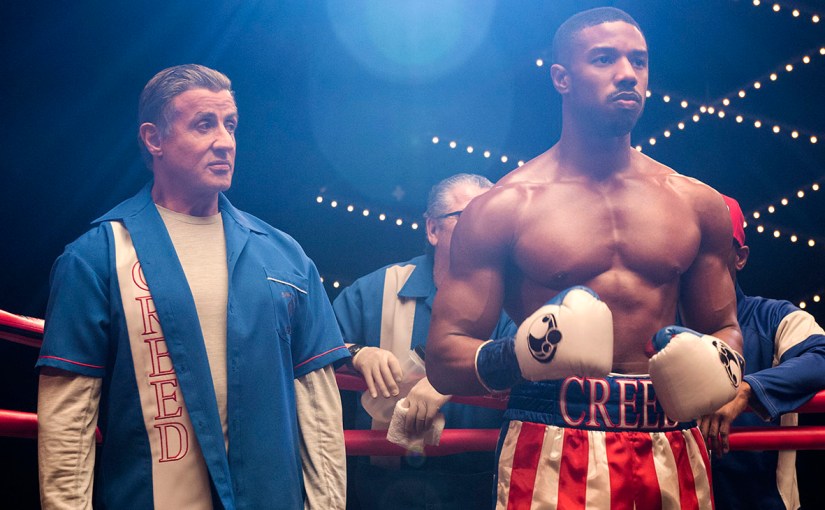
Creed II is fortunate to have a stellar cast that includes an exceptional Michael B Jordan as the title character, Sylvester Stallone (again as Rocky Balboa), Tessa Thompson, Phylicia Rashad and even Dolph Lundgren back as Russian boxer Ivan Drago. It’s a cast with great chemistry, especially between Jordan and Thompson, rekindling what made their relationship so authentic in the first “Creed” film. I appreciate how all the characters genuinely care for one another without getting too schmaltzy. Nevertheless, that’s about all that works for this installment.

The problem with Creed II is that it is blatantly formulaic, almost to the point that I was getting drowsy. If not for the gentleman sitting next to me who could not get into a comfortable position, I might have slept through the whole film. The first hour is really a slog. Maybe this next door viewer was getting bored like me, and couldn’t fight his restlessness.

In the 2nd hour, after Creed gets beaten to a pulp mentally and physically by Drago’s gigantor of a son (am I really spoiling anything here?) does it pick up, because we are about to enter BEAST MODE where the staple training montages (this time in a desert where i guess sunburn and dehydration lead to exceptional athleticism) are about to begin, and Creed is gonna kick the Russian guy’s ass once and for all.

Hey! I didn’t give away the ending here. You’ve seen this movie before in Rocky III, Rocky IV and Rocky 99 1/2. So quit your cryin’.

That’s the thing with Creed II. It’s an exact replica blueprint of the Rocky franchise films before it. Stallone pulled up his saved script on Word, and simply changed a couple of names and pop culture references. Example: scratch out music by Survivor and insert modern age hip hop.

There’s nothing new here, except for maybe giving a little dimension to Ivan Drago as a one time heroic celebrity of a country that no longer exists and a people who no longer celebrate him. Now, he lives through the stamina and strength of his son, Viktor. Not bad writing for Drago. Just not enough material for him. Otherwise, again there’s nothing special here that you haven’t seen before.

Wait…scratch that…I gotta say I couldn’t keep my eyes off Michael B Jordan. This guy is a good actor, but man is he ripped. I mean not an ounce of fat on this guy. He’s practically an eighth wonder of the world. It’s great to see, but even that is not enough to see Creed II in theatres. Wait for Netflix and save 12 bucks.

JUST MERCY

By Marc S. Sanders

I’ve learned so much from movies. I really have, and I’m continuing to learn. An important lesson that I absorbed from Destin Daniel Cretton’s film Just Mercy is that we have a long way to go in this country. A racial divide is sadly still in existence. As I watched this film while the nationwide protest response to the killing of George Floyd is still prominent, it’s glaringly obvious that this story, taking place from 1987 to 1993, has likely only made a tiny dent in the reach for equal and fair justice between black and white Americans.

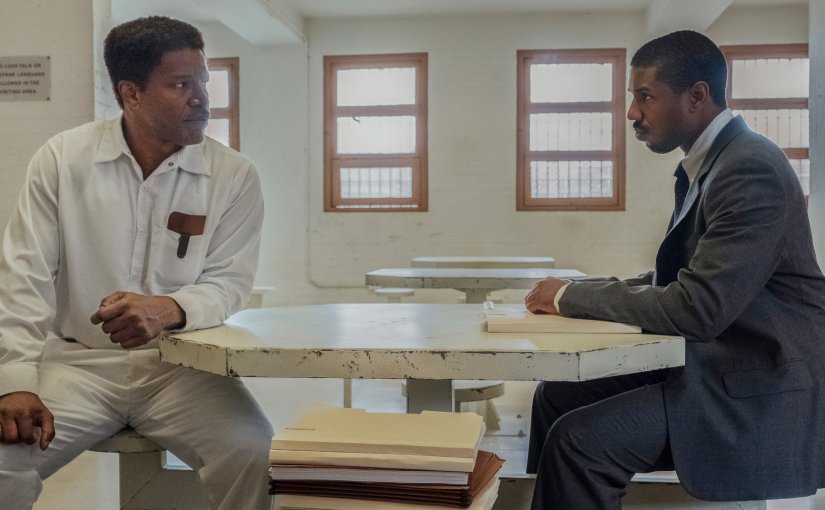
Just Mercy follows newly appointed Alabama civil rights attorney Bryan Stephenson’s (Michael B Jordan, who I still insist will win an Oscar one day) pursuit to overturn a murder conviction for Walter “Johnny D” McMillan (another magnificent performance from Jamie Foxx). Johnny D was easily ruled to have murdered an eighteen year old white woman. The trial hinged on the testimony of another convict (Tim Blake Nelson) pressured into making up an outrageous story that put Johnny D at the scene of a crime he had nothing to do with. All that mattered was that the all white jury believed this ridiculous testimony.

Bryan is newly graduated from Harvard University with nothing but righteousness and the intent of making a difference in this world. Against his family’s urging for fear of his life, he deliberately moves to Alabama with Federal Grant money to start the Equal Justice Initiative (EJI) with Eva Ansley (Brie Larson), a passionate white southern mother who is prepared to face the danger of a prejudiced community that’s hypocritically proud to boast that it is the hometown of writer Harper Lee (To Kill A Mockingbird). Bryan is informed that he can actually visit the Mockingbird museum and see where Atticus Finch actually stood. I question if the majority of Monroe, Alabama have even read Lee’s book.

Bryan’s intent is to research and represent those prisoners that likely never received a fair trial. One man is a Vietnam veteran who did in fact kill a woman with a home made bomb. Sadly though, his PTSD likely motivated this regrettable action. This man is more mentally ill than guilty and his country could care less.

Most of the film’s focus goes to the egregious acts that convicted Johnny D. While it’s plain to see how innocent he is, Bryan is faced with bigoted pushback from the local police force as well as the District Attorney (a very good and effective Rafe Spall). Bryan obtains a material witness but then that is compromised. Now he must rely on if the convict who originally testified against Johnny D will come clean with telling the truth.

There’s a lot you can become more aware of while watching Just Mercy. First, our legal system can be very tainted with extreme prejudice. Second, slavery may have been long abolished by the end of the twentieth century, but it’s racial underpinnings and need to dominate a black community still appears justified in many southern eyes. There’s a sad food chain that exists in the state of Alabama. It therefore becomes an impossible obstacle for Bryan and Johnny D when they take their case to the state Supreme Court. This doesn’t take a law degree to recognize such an apparent wrong. Yet, that means nothing if the judicial system won’t even read a simple and otherwise obvious explanation.

A third aspect that Just Mercy presents is police brutality against black men. It exists. A black man, such as a hard working tree cutter like Johnny D or a Harvard graduate in a suit, can get pulled over. The man can cooperate completely with hands shown and calm politeness when faced with an authority. Yet, with next to no action that black man will suddenly have a gun drawn on him and get slammed against a truck and put in handcuffs.

Moments like this continue to occur simply because of the color of their skin. It matters not where they were going or where they were coming from. If they just look guilty, then they must be guilty.

Just Mercy is a demonstration of a large menu of wrongs being committed against black America. Cretton’s script with Andrew Lanham, is a well edited and focused film that doesn’t drift into any side stories. Bryan Stephenson seemingly takes in a lot of cases all at once but for a two hour and twenty minute film, only so much can be presented.

Yes, Johnny D’s case is most prominent but time is also devoted to what could be his overall fate, a trip to the electric chair. Bryan Stephenson sees this first hand with another case. It is often a wrong and terrible outcome but it at least amplifies his motivation to represent these wrongly convicted men.

Bryan Stephenson is a tremendous hero portrayed by a humble yet passionate performance from Michael B Jordan. How many Harvard graduates would truly take their expensive Ivy League degree and put their lives on the line in an unwelcome community with no pay to save the lives of convicts who no one else has ever regarded?

Most especially during the current climate of our country, Just Mercy is an absolute must see film.