BATMAN BEGINS

By Marc S. Sanders

The merits of a lot of action/adventure films is predicated on how strong the villain is to the story.  Often the hero is the straight character in the heroic garb ready to enter the scene just as the bad guy is on the brink of maniacally destroying the world.  In the early 2000s however, the focus diverted to the hero when big franchises opted to reinvent themselves.  James Bond’s origin was finally offered up in the best film of the series, Casino Royale.  Christopher and Jonathan Nolan served up one of the best cinematic Batman stories on screen.  The title said it all.

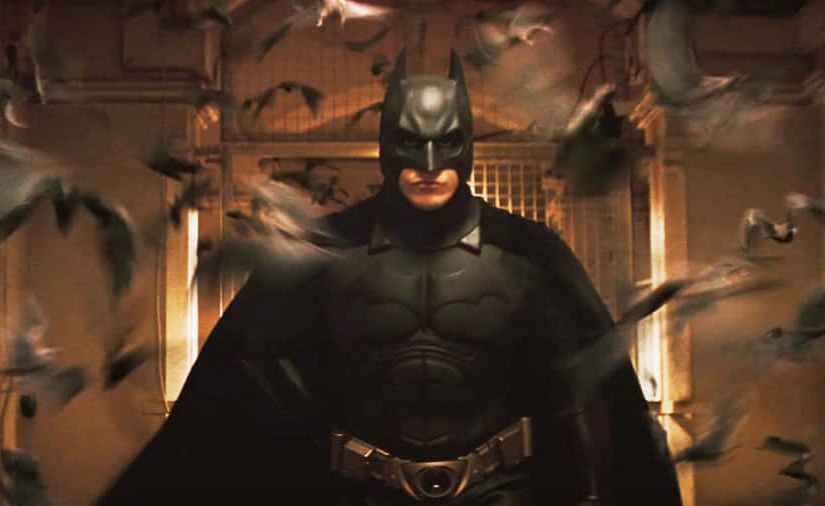
Batman Begins gets every note right with the all too familiar back story of Bruce Wayne’s drive to become Gotham City’s Dark Knight vigilante.  The film has its collection of villains but the center of the picture is always circumventing around Bruce Wayne, perfectly played by Christian Bale, with somber truth hidden by handsome playboy disguise.  As a child, he discovers his fear of bats and then attends the theater with his billionaire parents.  Upon their exit through a back alley, he witnesses their death and is left to be raised by his trusty butler, Alfred Pennyworth (Michael Caine, my favorite actor in the role to date).

This film achieves my undivided attention because it paints a full canvas of this character before he ever adopts an alter ego in a black costume.  We explore how he becomes motivated followed by his intense training in the zenith alps, on the Asian continent.  Then we see how he supplies himself with all of the familiar gadgets and costumes when he befriends an ally within his father’s company, Lucius Fox (Morgan Freeman). 

Jonathan Nolan’s script diverts away on occasion to embrace the capable villains of this story with the Scarecrow (Cillian Murphy), Rha’s Al Ghul (Ken Watanabe) and mob boss Carmine Falcone (Tom Wilkinson).  Bruce’s mentor, Ducard (Liam Neeson), is a big factor in the hero’s development as well.  Lastly, there’s Bruce’s childhood friend and legal connection, Assistant D.A. Rachel Dawes (Katie Holmes).  Lt. James Gordon is the uncompromised police detective that Bruce singles out to trust within this dense world of corruption.

Just to read this cast list is impressive as they fall beautifully within the matrix of Nolan’s blueprint.  Everyone is given enough time to make more than one impression as their storylines twist and alter.

Christopher Nolan’s films are always moving like a smooth ride on a never-ending stretch of road with no traffic in the way.  Nothing bears repeating from what was already shown in an earlier scene.  There’s something new to learn as the pace continues.  Nolan is one of the few filmmakers where you do not mind the time jumps he incorporates into his stories.  Bruce will first be seen as a ten-year-old boy, then in his muscular fit thirties in a Chinese prison completely departed from the wealth of Wayne Manor.  A step back before that shows him as a Princeton drop out with a mop top haircut.  Every different appearance of Bruce is interesting and you become intrigued with how he ends up in one place after another. 

Like the first appearance of Daniel Craig in the Bond series, this Batman/Bruce Wayne is repeatedly imperfect.  He’s flawed because he still needs to learn and the characters that enter and exit and reenter his life must teach him.  Alfred will lecture a short-triggered Bruce when he’s on the cusp of risking the reputation of his father’s legacy.  Rachel will slap him when he’s prepared to kill in cold vengeance.  Ducard will teach him the ways of physical survival and will test Bruce’s loyalty and the measures of crime with punishment.  Even the Scarecrow is smarter than Batman when he springs an unexpected trap.

The ongoing education of Bruce Wayne is the theme of Batman Begins, all the way to the end, when he finally learns to mind his surroundings.

Christopher Nolan made Batman exciting in a new unfamiliar way.  The Batmobile is a not a sporty kind of vehicle.  It’s a tank called The Tumbler and it bears a thunderous series of sound edits as it barrels through Gotham City.  After some slip and falls off rooftops, Batman becomes much more covert than in other interpretations.  You don’t have to physically see Batman to observe him operate.  If a thug gets swallowed into a void of darkness, you know what has ensnared him.  The crusader’s devices which stem from his gold utility belt are demonstrated with explained reason for why he selected them for his fighting advantage.  The Nolans proudly recognize the theatricality of this guy.

Cillian Murphy is unforgettable as he lives up to the name of Scarecrow, also known as Dr. Jonathan Crane, a criminal psychologist.  His choice to put his victims into a hypnotizing sense of fear lend to the back story of Bruce Wayne’s intent to become a frightening figure himself, where his enemies will recognize his dread.  Tom Wilkinson claws his gangster persona straight from a Godfather kind of picture, but he represents an old guard of Gotham City before costumed and makeup identities take over.  Gotham will transition from the sharp dressed mobsters over to the crazed clowns yet to come. 

Gary Oldman invents another unique personality – a strait-laced city guy who might have come from a 1970s ABC cops and robber show like Dragnet.  No two characters of Oldman’s are ever the same.  So much so, you almost wish they would all assemble in a movie for the various personalities to interact.  Morgan Freeman and Michael Caine are like comfort food who are so subtle and relaxed in front of a camera.  Neither one makes big waves with their characters.  Jonathan Nolan wrote their respective purposes for this Bruce Wayne and they execute their techniques of less is more beautifully.

Liam Neeson delivers the second-best performance of his career thus far, after Oskar Schindler.  He adopts the same kind of method that Freeman and Caine work with, but then he sways from that behavior when Ducard has to surprise Bruce as a means for his pupil’s development. Some of what he does comes from nowhere.  Early in the film, his first two scenes could not be more different.  Neeson works like an unpredictable entity.

The next film in this trilogy replaced Katie Holmes with Maggie Gyllenhaal.  I was disappointed because Holmes was maturing as a very formative actor by this time.  She was blessed with a well written character in Rachel Dawes.  When I watch the next film, The Dark Knight, I cannot help but wonder how she would have performed the role for a second and much more developed opportunity. 

There is not one flaw in Batman Begins.  This is the movie that placed Christopher Nolan in the echelon of top blockbuster directors like Spielberg and Hitchcock, along with Lumet and Mann.  Hans Zimmer’s soundtrack is thrilling as it speaks for The Dark Knight who is of few words.  Zimmer’s scores announce the introduction of Bruce Wayne first, and then later Batman. 

Gotham City makes for a sensational character with various rooftops, fire escapes, tunnels, bridges and a gorgeous, elevated train at its center.  The entire city breathes steam amid the distressed decay, wet streets and rusted architecture. 

Wayne Manor has a ghostly effect as Alfred and Bruce climb the large staircases and floors.  Further down under its platforms rests the cave that’ll serve Batman well.  The waterfalls and rocky caverns are immense. 

Batman Begins is not one of the best films of a genre like any other superhero movie.  I refuse to recognize it that way.  Instead, I see a character study where a man accepts a responsibility to fix what scarred him at a young age.  He wants to right a world that once had promise.  I don’t see the costumed protagonist announce himself as a superhero.  I don’t see the costume.  With the cape and the horns on the head and the car and the tools, I see an image, never a superhero.  With Christopher Nolan’s first film in what will become a well-received trilogy, I always see the man underneath the mask. 
LEAP OF FAITH

By Marc S. Sanders

You never know when God may come knocking.  You never know when Jonas Nightengale may come knocking either.  If you’re fortunate enough to reside in small town Rustwater, Kansas, you sir, or you ma’am, or you dear child may be blessed by the healing powers of Reverend Nightengale. 

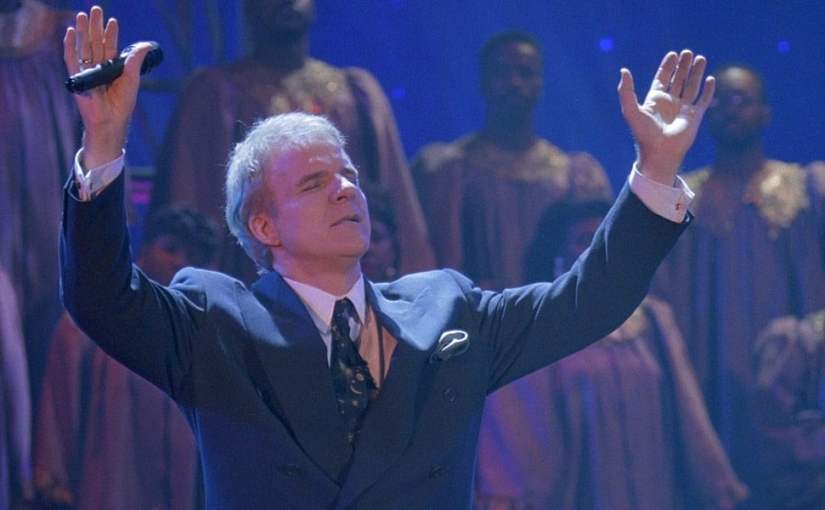
On the surface, Jonas appears like a comedic role for Steve Martin, but in actuality it is not aiming for laughs at all.  When it comes to the confidence scheme that Reverend Jonas offers the townsfolk of Rustwater, Steve Martin plays the phony preacher with nothing but a serious operandi. 

Jonas and his crew travel the states from one big city to the next where he preaches his gospel of deceitful hope in exchange for donations to his traveling church that supposedly serve the almighty lord.  When one of their trucks breaks down in Rustwater, Jonas and his top aide, Jane (Debra Winger) use it as an opportunity for easy cash.  This Kansas town relies on harvests and the infrequent rain that feeds the crops.  Otherwise, this sleepy town has one diner, a movie theater, and a sheriff named Will (Liam Neeson) who is out to reveal the false Oz behind the curtain.  At the same time, Will is romancing Jane who has been eagerly seeking out a flame that never had a chance to flourish because she is on the road so often.

Jonas is wooing Marva (Lolita Davidovich), a waitress at the diner who is also skeptical of the whole act and is protective of her younger handicapped brother, Boyd (Lukas Haas) who suffered a permanent leg injury in a car accident that killed their parents.  Boyd was once told by a preacher that there is not enough faith in his heart for him to be the receiver of healing powers.  Lukas Haas was not just cast because he’s a talented actor.  He also has that angelic face that suggests he’s never committed a sin.

The tricks of Jane and Jonas’ trade are all revealed here.  Jane hides in the back feeding information about certain audience members and their ailments into Jonas’ earpiece.  Eavesdropping by the crew (including an early appearance by Phillip Seymour Hoffman) ahead of the show provides Jane with all the data.  It’s neat to see and it is likely how these outrageous televangelists pull off their miraculous “gifts.”

There’s an interesting argument to Leap Of Faith.  Jane defends Jonas’ façade to Will by him just selling fairy tales that make people feel good and fulfilled.  Will sees the obvious moral dilemma.  Jonas offers another defense.  Is this any different than a circus act that presents the fantastic for an audience to witness. Personally, I think Jonas and Jane’s defense is a bunch of hooey.  Yet, the residents of Rustwater buy into the act and soon people from all over the Midwest are lining up to listen to the gospel and witness the miracles of Reverend Nightengale. 

Jonas has a dilemma himself though.  He has a fondness for Marva, and he likes Boyd.  Boyd is not a plant in the audience to go along with the healing power showmanship.  So, how is Jonas going to explain his position?  He’s quick on his feet to fend off public accusations from Will, but how can someone who is not a miracle worker perform a miracle while maintaining his illusion.

I like the set up and questions that Leap Of Faith asks.  It’s the story of the arriving snake oil salesman which I do not see too often in films.  The showy pieces of the movie are wonderful with terrific singing from the choir under the big top circus tent with the enormous crucifix of Jesus in the center.  There’s also an enthusiastic supporting cast from Phillip Seymour Hoffman, as well as Meat Loaf as the church keyboardist.  The crowd extras are wonderful with their vocal responses.  I also especially love how Jonas ups the ante with a terrific sight gag to silence his biggest doubter, namely Will. 

The film is different, especially for Steve Martin.  He’s a ball of energy on the stage. He does his one-foot slide that was often seen on Saturday Night Live and his stand-up acts, but here it is not done for laughs.  Instead, Martin’s recognizable schtick upholds the public persona of Judas, and it works. 

Still, I do not think I got what I would have prayed for from the film.  I could not get past how Liam Neeson does not work as a Midwest sheriff in this Podunk town.  His boyish good looks from the early 1990s are right for the romance, but he makes no effort to hide his native Irish dialect.  He just doesn’t blend into the Americana canvas very well.  Debra Winger is great and it’s a shame I do not see her in enough films.  Almost everything she does I like.  She just has a natural vibe about her.  She has good scenes with Neeson, but just like his character, their storyline belongs in another movie very distant from the prime directive of Leap Of Faith.

The romance between Martin and Davidovich does not amount to much either. Frankly, it feels as if the story editors opted to abandon this angle midway through the making of the film. I do not recall how the relationship resolved itself and the ending certainly does not generate any kind of response for how either character regards one another. 

Towards the end of Leap Of Faith, the unexpected occurs twice, sort of like what happens in the end of Magnolia.  I found it interesting, but then the credits roll and the gospel choir sings on until the screen goes dark.  I’m leaping from my chair asking but wait, what about this and what about that.  Nevertheless, the choir keeps on singing, deafening my concerns.  Janus Cerone’s script seems to paint itself into a corner just when a brilliant irony arrives and hardly an acknowledgement, and certainly no explanation, is offered for the new phenomena that occurs. 

Leap Of Faith begins with a prologue between Jonus and a traffic cop.  It’s a brilliant scene demonstrating right away how smooth this “preacher” is when it is a one on one grift.  (Celebrated trickster and former con man Ricky Jay was a consultant on the film.) Later, we see how mesmerizing Jonus is in front of hundreds of people.  I was very excited during the first hour and a half of the picture, but then the movie gives up on itself.  The best way to describe this viewing experience is to say that Leap Of Faith simply loses faith in itself.

THE COMMUTER

By Marc S. Sanders

Sometimes it gets boring to have your suspension of disbelief tested with a movie.  Especially if it is a movie where there’s that eye in the sky that can see everything the hero does, thereby making his dilemma that much harder.  Downright impossible, actually.

You know what I mean when I say eye in the sky?  That’s where the villain or the antagonist can see everything the hero attempts to do to save the day, and every time he tries something like making a cell phone call or writing a secret message on a piece of paper (hidden next to his thigh under the table) for someone else to see, the bad guy always knows what he’s doing. It’s a wonder if the protagonist can even take a leak in private.

In The Commuter, Liam Neeson plays a former New York cop, now insurance salesman, who takes his morning and afternoon train from upstate into the city and then back after work.  Everyday, it’s the same regulars on the train while Neeson’s character, Michael MacCauley, reads the classic literature books that his son is assigned to cover for school.  I guess it’s the way they bond, and it’s pretty fortunate that this is Mike’s hobby because on the day he gets fired from his job, it might come in handy.  Go figure.  These bad guys messed with the wrong avid reader.  I mean he’s reading The Grapes Of Wrath for heaven’s sake.

Just before Mike enters the train, his wallet and cell phone are pickpocketed.  He defeatedly slumps down in his seat and shortly after an alluring woman named Joanna played by Vera Farmiga sits across from him and proposes a hypothetical.  Find twenty-five thousand in cash hidden somewhere in the bathroom.  Then seek out a passenger who identifies as Prynne and swipe the bag that person is holding.  Once that is done, he’ll collect an additional seventy-five thousand, but it must be done before the train reaches the Cold Spring station.  Joanna leaves the train making the offer sound so simple.

Considering Mike just lost his job and he’s got no cash savings as well as his son’s college tuition to pay for, he retrieves the hidden money and tries to make a clean getaway at the next stop.  However, he’s immediately halted by someone who gives him an envelope with his wife’s wedding ring in it.  Now, he knows this woman and whoever else is setting him up with his wife and son in possible danger.

As he finds a way to communicate with Joanna by phone, Mike tests just how serious she and her cohorts are, and that’s when a couple of people wind up dead.  Ultimately, the only way out of this conundrum is for Mike to find out which passenger is Prynne.

Much of the running time of The Commuter is occupied with red herrings.  Could Prynne be the punk girl with the nose ring (Florence Pugh)?  Is it the asshole Investment Banker with the phone earpiece?  Maybe it’s the guy all dressed in black?  Or the one with the guitar case?  Yeah.  It could be any one of these folks who Mike does not recognize as regular travelers.  I won’t even tell you if any of the people are the real Prynne or not, but I knew what to expect from this kind of storytelling pattern.  Mike finds a way to small talk some of them and seek out clues.  He uses the conductors by explaining that he sees something suspicious and suggests they look in their parcels.  At times, I felt like I was playing the Clue or Guess Who?  or Twenty Questions.  I dunno.  This kind of set up for a movie just seems too silly.

Sixty-year-old Mike also engages in hand-to-hand fist fights with some suspects.  I don’t know how old Liam Neeson is, but Mike says he’s sixty, and sixty-year-old Mike endures getting his head bashed through more than one speeding train window, plus a couple of knife slashes and some ass kickings, in his pursuit for the truth.  I know.  He’s a cop so he’s got fighting skills.  That’s okay.  I buy that, but to have your head bashed through doubled paned windows while this commuter train is going a hundred miles an hour? Well, that’s enough stretching for one day.

So how does Joanna stay one step ahead of Mike to ensure he’s playing by the rules?  Well, apparently there are cameras positioned in the overhead vents of every train car that can follow his every move.  C’mon now!  I’d rather the writers and director simply turn this into a sci fi cheapo and declare the villain omnipotent.  This train is at least six cars long.  Maybe seven, and the length of each one is maybe five yards if I’m being conservative, and I’m supposed to believe that these cameras cover every nook and cranny of every single train car?  Seriously, stop stretching.  You’re bound to pull something.

I stayed with The Commuter until the end because frankly I was curious who Prynne turned out to be and what the significance of this particular passenger was to the interests of Joanna. It actually works.  It’s Mike’s convenience in detective work and the powers operating against him that’s ridiculous. 

Moreover, the visuals are incredibly distracting in this picture.  The CGI could not be more apparent anytime Liam Neeson throws a punch or takes one across the chin or out a broken window.  The animation of the CGI appears terribly false.  It looks unfinished and rushed for editing as Neeson’s facial expressions of pain and struggle contort in odd ways.  The bad guys he gets into fisticuffs with appear to have the same problem.  Truly some of the worst action scenes I can remember watching in quite some time. 

The speed of the train looks false as well.  I read where Liam Neeson said that the settings within the train cars were shot on a soundstage.  Afterwards, director Juame Collet-Serra was challenged with changing the outdoor scenery of the train on a constant basis to simulate ongoing speed and movement.  I imagine this is all incredibly challenging.  I don’t know how to do it.  However, it just does not work.

The visuals for most of The Commuter fail tremendously.  Last year’s most recent installment of Mission: Impossible demonstrated how a speeding train should look in an action picture.  With this movie though, the finalized print was rushed for that all so busy January release in 2018.  Look, if you can’t do it right, then let somebody else handle the job, or better yet, make a better movie.

The Commuter would have been a much better and much shorter film had Mike never let his curiosity overtake him and go to the bathroom for that money.  Mike, why couldn’t you just stay in your seat and finish reading your Steinbeck?

THE DEAD POOL

By Marc S. Sanders

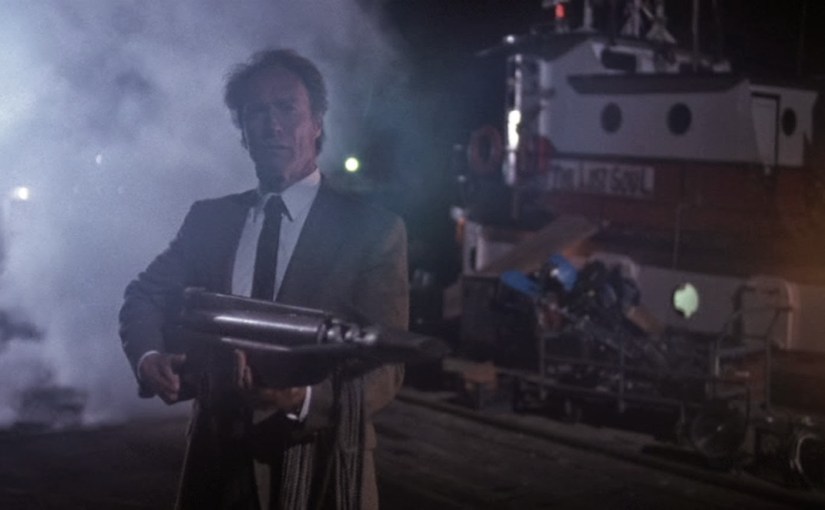
Sometimes five is too much.  It was for Clint Eastwood as Inspector Dirty Harry Callahan.  The Dead Pool was the fifth and final entry in the famed crime drama series.  Eastwood moves slower this time.  He does not come off as much of a rebel any longer.  Most notably, the story doesn’t have the feel of a Dirty Harry film.  The cop who was infamous for questioning the laws set in place seems to be just slotted into this film. 

The Dead Pool is directed by Buddy Van Horn, who had a long career as a stuntman and assistant director for many of Eastwood’s films, and other actors like Charlton Heston and Henry Fonda.  He does a ho hum job with the picture.  I don’t need to be treated to inventive shots or camera angles to enjoy a movie.  I have yet to visit San Francisco, but at least Buddy Van Horn provides enough locales to feel like I’m getting a serviceable tourist view.

A twisted game is being played in the underground scene.  People are making lists and betting on local celebrities they expect to die soon.  One name includes a heavy metal rock star played by James Carey, later to be known as Jim.  There’s also a snobby film critic who is a deliberate inspiration of Pauline Kael.  (Kael’s reviews were not too kind to many of Eastwood’s films over the years, particularly the original Dirty Harry.)  At the bottom of the list is Harry himself, who is surprisingly favored by the police department officials – first time that has happened – for putting away a powerful mob boss.  A side story consists of the boss giving orders out to his crew to take revenge on Harry and provide some escapist shootouts to move the film along. 

The police department want Harry to cooperate as their hero poster boy.  Harry doesn’t care for fame, though.  It’s not his style.  Yet, a persistent television reporter (Patricia Clarkson) wants his story.  A little romance is implied but Harry is not one for gossip fodder.  Unfortunately, Eastwood and Clarkson are really lacking chemistry here.

The rock star and the movie critic are murdered.  Harry must be next, and a horror film director (Liam Neeson) seems like the prime suspect because his dead pool list had included all three names. 

The Dead Pool is not a terrible movie, but it does not live up to other Dirty Harry installments. Primarily because it does not follow the character’s familiar mantra against the bureaucrats and the flawed system of prosecution and law enforcement that he’s always been challenged with.  At times, I’m looking at Eastwood and I’m asking myself who is this guy?  Sure, he’s got a few one liners of dry wit.  The famed eyebrow stare is there too, and the .44 Magnum as well.  However, Harry doesn’t seem to stand apart so much from everyone else as he did in the other films.  Beyond the giant gun, that is what made Harry Callahan so famous on screen. 

The investigation that Harry is assigned to with a Chinese American cop (Evan C Kim) is very bland.  We hardly get to know any of the victims or what they stand for, and when the true killer is revealed, it turns out to be a last-minute introduction of someone we’ve yet to see.  There’s no surprise to the culprit behind all of this. 

The series is also well known for the partners that Harry is forced to work with.  In The Enforcer, Tyne Daly brought out Harry’s regard towards women working in his dangerous field that demonstrated his initial frustration followed by his reluctant acceptance.  In the first movie, Remi Santori came about when it was okay to say that Harry took issue with all kinds of demographics, including Mexicans.  A chumminess nicely developed between those two guys as they tracked down the killer, together.  The second film, Magnum Force, offered a partner to also care about.  These are good side performers that colored in much of the Harry Callahan lore.  In this movie, Evan C Kim has one standout moment in the first ten minutes where he surprises everyone, especially Harry, with how he disarms a robber by use of martial arts.  It’s a great scene.  After that, though, he’s given nothing to do.  This actor had promise for more interactions with Eastwood.  It just never delivered.

The series started in the gritty times of 1971 when political correctness was not ever considered.  By the time the last two films were released in the 1980s of Ronald Reagan, who famously adopted “Go ahead.  Make my day,” for Gorbachev, there was a new wave of sensitivity abound.  I like to believe with the prior installment, Sudden Impact, Harry Callahan learned something new about himself with regards to the rights women had or were denied of while still applying his own code.  With The Dead Pool, the writing seems reluctant to go anywhere near a potential debate, and so it drips itself into a stale slasher movie with the cop ready to fire his six shooter.

The grand highlight of the film is a car chase on the hilly streets of San Francisco, which is the best place for a car chase, always.  What separates this one from the others is a little remote-controlled car that pursues Harry and his partner, ready to activate its equipped detonator at just the right moment.  The editing of this sequence is really fun, and it’s a great salute to Bullitt and other gritty, urban cop films, particularly the Dirty Harry movies.  This toy car flies over fruit stands and careens through sidewalks and over sewer holes.  Meanwhile Harry screeches down one hill after another trying to evade this pesky rapscallion.  It’ll definitely put a smile on your face while the moment lasts.

I recall being eager for another Dirty Harry movie.  I grew up loving many of Clint Eastwood’s films.  Dirty Harry is a favorite character of mine.  Yet, I also remember feeling really let down when my dad and I walked out of the theatre.  The Dead Pool just doesn’t have the same flavor as the other Eastwood products.  Again, it’s not the worst picture.  It’s standard cop fare coming in at a lean ninety minutes.  Eastwood and the rest of the cast are okay with what they’re doing.  I just would’ve changed the name of the main character listed at the top of the cast list.  He could have been Dirty John Doe for all I care.

SUSPECT

By Marc S. Sanders

Okay. Fair Warning. I am going to spoil this movie with my review. Why? Well, if you haven’t seen Suspect, directed by Peter Yates, then I’m telling you that you absolutely do not ever need to see Suspect directed by Peter Yates.

What is Suspect worthy of 33 years later? Nothing beyond my personal allowance to spoil the film for you. I know! It goes against my principals as a film critic, but I choose, for YOU, MY READERS, to fall on my sword.

Scripts of any variation whether they be stage plays, television episodes or feature films should always show the unusual. If it’s mundane, it should never be made. You don’t want to watch two hours of someone brushing their teeth. You want to watch epic films like Malcolm X or witness a man that flies in Superman: The Movie or the murderous ways a person will devote his affection for his mother in Psycho. Unusual and special stories make the best stories. Unusual! Not utterly preposterous!

Now, I’m sure in the annals of trial law there had to have been a handful of cases where a defense attorney got involved socially and/or romantically with a member of the jury. Otherwise, we’d never hear of the term “jury tampering.” So, there’s something unusual to sink our teeth into. Preposterous though (AND I WARNED YOU) is that within this very same trial, you know the one where the defense attorney and jury member are getting some from each other on the side, that one, the presiding judge turns out to be the killer. Okay. Now Mr. and Mr. Filmmaker, you’re no longer using your imagination. You’re just throwing spaghetti at the wall, hoping it’ll all stick.

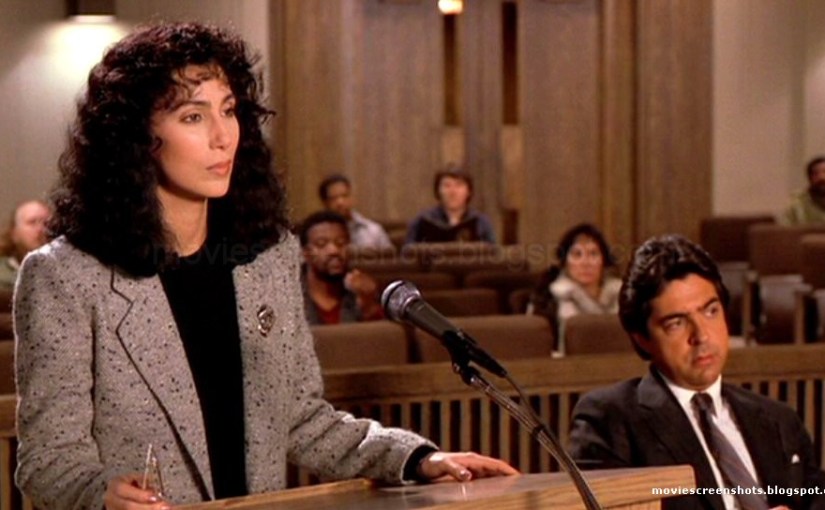
Cher plays a public defense attorney named Kathleen Riley. Dennis Quaid is a handsome DC lobbyist named Eddie Sanger serving on the jury. Liam Neeson is the deaf mute title character who is a vagrant homeless person, and John Mahoney is the presiding judge aka the actual killer revealed at the end. Lawyer and juror meet up outside of court to find clues and eventually make out. The judge is the killer. People please!!!! Washington DC is not this effed up, is it? (Maybe don’t answer that.)

Frankly, Kathleen is not a very good attorney. She’s not aggressive enough with her objections and I don’t think she applies herself well enough to win her case. In fact, without Eddie’s self motivation to dig into the case himself and help her out, then this suspect (Neeson) doesn’t have a chance in hell of being exonerated. The victim, a political staff member, had her throat slashed. Kathleen doesn’t even consider if the killer is right or left handed? Really? Eddie did at least. Still, I’m okay with watching an inept lawyer in a movie. Too often, movies show us lawyers that are too brilliant and quick on their toes. They’re almost too brainy. So, okay yeah, I’ll accept a lawyer whose not the sharpest crayon in the box for a change of pace.

On the other hand, Mahoney, the actual killer, is easy to predict when he voluntarily takes this case and then rules against literally every objection that Kathleen brings up. Every single one! Plus it stands to follow Roger Ebert’s economy of characters. There’s only so many characters in your multiple choice of cast members to consider as the killer. I can’t fathom Quaid, the juror, as the killer, nor Cher the defense attorney. So either Neeson, the suspect on trial, is the killer (not likely because then why have a movie) or it’s the judge. Nah! It couldn’t be the judge. Could it? Hmmmm.

Washington DC makes for a great setting for legal thrillers or courtroom dramas. It’s full of secrets and government and dealings and politics. A million and a half motivations and any one of its residents could find a reason to kill. The script for Suspect, written by Eric Roth, never cares to try that hard though. We are treated to a wasteful side story of Eddie doing some lobbying for milk (I’m sorry. MILK? LIKE DAIRY MILK????) when he’s not in court. He sleeps with a congresswoman to get her vote…and why am I seeing any of this?

There’s no build up in the murder trial either. The few expert witnesses called to the stand are forgettable. Nor do they foreshadow anything. Cher’s character doesn’t seem to work hard enough in questioning a witness. Instead, this dumb lawyer relies on a juror she shouldn’t ever be talking to.

Once again, normally, it’s against my policy to spoil a film. After 40 years, I won’t even spoil The Empire Strikes Back, cuz someone out there still hasn’t seen it. However, this film is ridiculous. This would even be too ridiculous for a Maury Povich episode or a Lifetime TV movie. How absurd must one murder trial be?

Think about it. All in one movie. One murder trial. One case. The defense attorney is involved with a juror AND the judge is the killer????? There are odds….and then there are gazillion to one shots.

SCHINDLER’S LIST

By Marc S. Sanders

Oskar Schindler was a handsome, well dressed man. A man of wealth, power, and influence. A successful businessman. He was a womanizer. And Oskar Schindler was a Nazi who saved 1100 Jews from the atrocities of the Holocaust.

On a filmmaking measure alone, Schindler’s List is one of the best pictures to ever be made. Steven Spielberg’s production value is incomparable. Nothing I can recall appears as grand (not sure that’s the appropriate word here???) and authentic as Schindler’s List. How did Spielberg pull off this feat? How did he direct hundreds, thousands maybe, of extras to reenact the vilest human suffering that a generation of people could ever encounter? I’m astounded. Positively astounded.

This evening was only my second time seeing the film. I always put off watching it over the last 30 years; reluctant maybe to see a horrifying truth. The first time I saw the film was on Christmas Day, 1993 at the Hyde Park cinemas in Tampa, Florida with my father. I didn’t realize it at the time, but I was in the beginning stages of the flu with a high fever. Midway through the film, I had to leave the theatre as my illness caught up with me. I mustered the strength to return to watching the remainder of the movie, as I recall I could not go without finishing this masterpiece. I was horrified and yet amazed; amazed that this moment in world history could have ever occurred.

To see a man like Amon Goth (brutally and uncompromisingly played by Ralph Fiennes), a high ranking Nazi, excuse himself from his nude mistress’ bed and perch himself on his balcony to sniper random Jewish prisoners as a means of sport was sickening and twisted to me. Twenty five years later, it is this moment that has always stayed with me, as much of the story and scenes left my memory from so long ago. This moment as well as Spielberg’s choice to highlight a young girl in a red coat amidst a most somber black and white picture have stayed with me all these years. The glimpse of red serves as a truth to Schindler’s naivety. Spielberg is a thinking director. He never follows the manual. He chooses to think outside the box. A glimpse of a child dressed in red in a sea of black and white where mutilated corpses and possessions are aimlessly strewn about. It’s a marvelously telling moment.

Liam Neeson plays Schindler. It will likely be the greatest role of his career. Schindler is a man who even fools the audience until the very end when he reveals that the war has ended and his salvation has rescued these 1100 souls. Finally, his humanity no longer hides and he weeps to his accountant and accomplice, Itzhak Stern (played subtly and beautifully by Ben Kingsley). Schindler weeps for he could have saved more. Neeson is superb in this moment. His commanding stature crumbles, his materialism and wealth have disappeared. Neeson translates all of that clearly, and finally my tears arrive. Prior to this moment, I was numb to the Nazi tactics of gas chambers, careless bloodshed and apathetic separation of families and friends; perhaps because I’ve extensively studied it during my years in Yeshiva. Before Schindler’s List, much of the history on the Holocaust seemed like textbook fare to me. Spielberg made its terrifying and tragic reality real.

Ben Kingsley’s performance is so important as well. The architect behind the list, his portrayal of Stern is countered with contained fear and leveled sensibilities amid the senseless intentions of a dominant force of evil. His instincts kept him alive so that only he could help keep his comrades alive.

Schindler’s List won the Best Picture Oscar for 1993, only 50-52 years following the events of the Holocaust. Many survivors thankfully remained to see Spielberg’s epic premiere. People who I share this planet with experienced the most insane and heinous evil ever encountered. They were well to do people living normally until they were violently pulled from their homes, stripped of their possessions, separated from their families, suffered at the threat of murder, witnesses to other murders and hate crimes, humiliated, beaten, forced into slave labor in tightly contained ghettos and eventually thrust into concentration camps. Yet, these few survivors lived to carry on with their lives and deliver new generations, beyond this morally ugly and evil historic episode.

I’m being redundant as I’ve said it many times before, but isn’t that the point? The Holocaust and the Nazi regime only occurred around 85 years ago. This happened before. This can happen again.

Thank you, Steven Spielberg for Schindler’s List.

I don’t consider myself to be very religious anymore. Because of moments like the Holocaust, I question how a God could ever be possible. Still, for the survivors and those that perished, I can only say Baruch Hashem, and L’Chaim. 

Peace.  Progress.  Love.

STAR WARS EPISODE I: THE PHANTOM MENACE

By Marc S. Sanders

22 years after the first Star Wars film made a ginormous cultural impact on the world, George Lucas finally returned to the franchise to make the first film of a new prequel trilogy with Star Wars Episode I: The Phantom Menace. It was hyped beyond measure, and it sold gazillions in ticket sales but was nevertheless a letdown for diehard fans and pretty much everyone else. I don’t think it’s a terrible movie. I just don’t understand how necessary the film is.

There’s a lot of irrelevant moments here. Early on two Jedi step off a ship, and a droid introduces herself to them and says “this way please,” and the three figures literally walk out of frame. This takes up time that I don’t understand. Why couldn’t the three just end up in the room they were supposed to be in? There are a lot of “so what?” moments in The Phantom Menace, and it all weighs the film down, hindering a story.

Listening to an audio commentary a number of years ago, one of the visual effects makers pats himself on the back of a shot midway through the film that consists primarily of CGI characters and sets. That was when I realized the conception of The Phantom Menace was completed with a short-sighted intent. Sure the scene might have been a technical breakthrough in 1999, but where’s the story? Fact is, there is no story and little regard for the celebrated franchise in Episode I. Lucas and his team were more concerned with shooting new CGI discoveries blended with human interaction. They offered next to no regard for intelligent plot and storytelling. The film suffers because of Lucasfilm’s hubris.

Consider the pod race. There’s a moment where young Anakin’s (Jake Lloyd) racer falls apart at high speed and he’s gotta get it back together. He uses a magnetic tool to get a cable plugged back in. If this child is “the chosen one” and potentially “dangerous,” why not show the child potentially use the force to bring the cable back in place? Why not show moments where unexplainable power emits from Anakin, to what would imply the inevitablity we are aware will eventually happen?

Lucas is also all over the place in his storytelling and characters. From the Shakespearean manipulator, Senator Palpatine, to the immature cartoon like Jar Jar Binks. I think they all serve a purpose to entertain. Yet while adults and die hard fans will relish the return of Ian McDiarmid (a terrific actor) they’ll be bored to death with actor Ahmed Best in the Jar Jar role. This I expect happens in vice versa with 8 year olds seeing their toy figures come to life. There is a silly charm to Jar Jar, but what 8 year old wants to pay attention or even comprehend debates among galactic senators over taxation and trade? It’s as if Bugs Bunny entered the halls of Congress, or Othello walked in on a pie throwing melee among the Three Stooges. At almost every point in The Phantom Menace something doesn’t belong or seems out of place.

The film moves far away from the tradition of the original trilogy. For the first time the human characters are enormously flat. Liam Neeson, Natalie Portman, Ewan McGregor…all flat, all bland. There’s no snarkiness to them. No sarcasm. Before The Phantom Menace when was it ever said that the Jedi order was so formal in their ways? It doesn’t feel very fun to be a Jedi, like it did for Alec Guinness and Mark Hamill before.

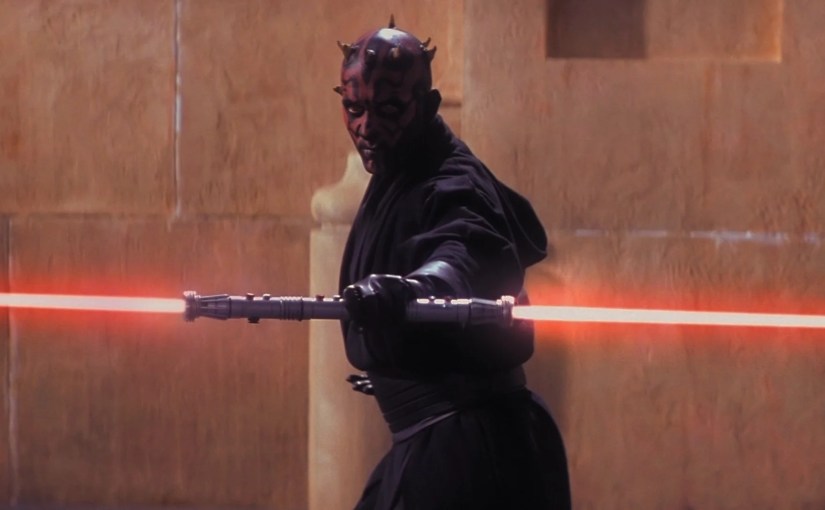
The two redeeming qualities of this film belong to the pod race which is thrillingly edited in sound and visuals. There’s some fun shots of each racer, the pit droids, the crowds in the stands and even Jabba The Hutt. The film really comes alive here much like the memorable cantina scene from the original Star Wars. The other best feature is the villain, the apprentice to the phantom menace, the red and black tattooed Darth Maul played by the agile martial artist Ray Park.

Lucas didn’t use Park enough in the film. With his double bladed lightsaber, the two on one dual Park has with the Jedi characters towards the end is one of the greatest sword fights in film. I would’ve welcomed an additional five minutes of this scene. Shamefully, this would be Ray Park’s only appearance in the film franchise, as well as Darth Maul. This was a great blend of actor and character. Lucas abandoned a good thing too soon.

Yes! I have much to complain about The Phantom Menace. Yet it is not all bad as a whole. I love the political trickery that McDiarmid displays and the senate meeting among the delegates is a nice foreshadowing for what we know will come of it. Visually, it’s a treat as well. (Again, though, what kids are going to be entertained by all of that?) The pod race and lightsaber dueling are masterful as well. There’s some good material here. There just could’ve been a whole lot more….and a whole lot less overall.

ROB ROY

By Marc S. Sanders

In Scotland, in the year 1713, Robert Roy MacGregor, the chief of the Clan MacGregor, protects his people from cattle thieves while trying to endure against starvation and minimal resources. Rob Roy was a leader but never looking to herald a cause. He just wanted to live day by day with his clan, along with his wife Mary and their two children.

Michael Caton-Jones directs Rob Roy with Liam Neeson as the title character and Jessica Lange in a strong performance as Mary. The film doesn’t move with the sense of sweeping adventure that I was expecting. However, that’s the point. Caton-Jones shoots Alan Sharp’s screenplay as a Rob Roy reluctant to rebel or wage war against a selfish monarchy that rules Scotland.

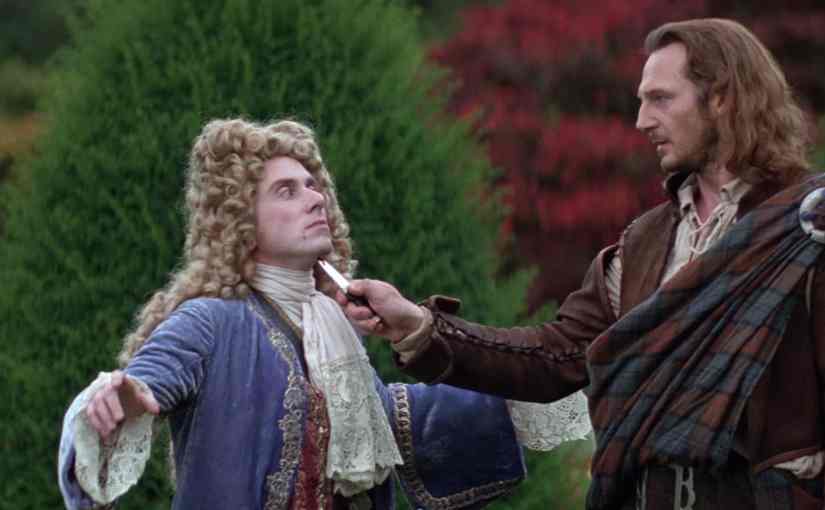
James Graham, Marquess of Montrose (the always effective John Hurt) agrees to lend Robert 1000 pounds to be paid back with interest. Rob is most grateful for the assistance that can help his clan. However, when Rob’s trusted friend Alan (Eric Stoltz) picks up the money, he is brutally murdered on his way back by Archibald Cunningham (Tim Roth, in maybe his best role ever).

Montrose, unaware of what has truly occurred, carries no sympathy for Rob’s predicament and obligates him to the original contract. Eventually, it becomes ugly as Montrose permits Archibald to carry out violent intimidation including slaughtering the clan’s cattle and burning down Rob’s home as well as raping Mary.

Rob Roy moves at a slow pace at times, but that doesn’t take away from brilliant characterizations. Roth as Archibald is a blazing villain. He’s introduced as a snobbish brat dressed to the nines though living off the prosperity of the mother who sent him to Montrose for a better royal upbringing. He carries an effeminate way about him in his long, curled, flowing wigs and garish pink and blue aristocratic wardrobes. He is a bastard though, yet a master swordsman. Like many great scene stealing performances before, Tim Roth has just the right timed expressions for the camera. Caton-Jones captures every best shot of Roth’s presence. Tim Roth, at the very least, deserved his Oscar nomination. I couldn’t get enough of him.

Jessica Lange gives another reason why she is such a celebrated actor for women. She picks smart roles over and over again. I was going into the film thinking she would be playing the dutiful wife and mere damsel. However, as Mary MacGregor she’s incredibly strong before and after she is victimized. She is torn with conflict to share the whole truth with Rob as to what has occurred to her. How will Rob respond? Will it make it worse for him with the monarchy? Will he feel ashamed of Mary? A fascinating character piece.

Brian Cox appears as Killearn, Montrose’s aid and factor. Yet, he is also secretly serving to Archibald’s underhandedness. He’s quite good in his role too.

Liam Neeson is fine as Robert Roy MacGregor; tall, built and athletic. He looks like a real hero. However, I’m not sure if I got a dense enough character from Alan Sharp’s script. Much of the film only comes alive when the other performers are on stage, like Hurt, Cox and especially Lange and Roth.

I was always aware of the famous sword fight in the film and it is quite spectacular. However, maybe hearing the hype over all these years watered down my expectations. The choreography is spectacular and often it really is Neeson and Roth in the moment; not stunt doubles. Yet, I remain more impressed with the work of Errol Flynn and scenes from The Princess Bride and The Empire Strikes Back.

Rob Roy takes some patience to watch. A very good film but not necessarily wall to wall action to consider it a popcorn flick. Watch the film for the performances and take in the gorgeous countryside footage.

I recommend it.

LOVE, ACTUALLY

By Marc S. Sanders

Love, Actually is like a warm favorite blanket to snuggle up in. Richard Curtis writes and directs a collection of the greatest British actors (along with American Laura Linney) in a kaleidoscope of love and relationships against the backdrop of beautiful London, England during the five weeks leading up to Christmas.

I won’t list my favorite characters or actors. In a film this treasured, this loved and this appreciated, that would be like picking your favorite child. It’s impossible when every single storyline is perfectly executed with thought and tenderness.

The stories of love uncovered, love that’s lost, love based in friendship, and love drowning in heartache beautifully jump from one to the next and then back again. Curtis is wise to not show all of the facets of each story early on. Some stories reveal more about themselves later that’ll leave you hurting for those that are not so merry and those that offer plenty of cheer.

I’m especially happy that Curtis did not compromise in the language or subject matter of his tales. Strong language at times makes for some memorable dialogue and nudity presents a normality to how we really are with those we have affections for.

It’s fair to say everyone in life experiences some variation of love. Yes! I mean everyone. Richard Curtis reminds you that love is a natural instinct, and so we can not focus on the easily recognized gloom of our world. To have these stories captured around Christmas time only enhances what we treasure, or what we wish we didn’t have to endure at times. Curtis’ blazing soundtrack helps along the way.

Love is hard. Love is challenging. Love will sweep you off your feet and love will destroy everything you thought you had. However, love will never leave you with complete regret. It’s never the love we have for someone that we regret. It’s only a wish to have it wholesome, healthy, happy and pure.

Love, Actually is all around.

THE CHRONICLES OF NARNIA: PRINCE CASPIAN (2008)

by Miguel E. Rodriguez

Director: Andrew Adamson
Cast: Ben Barnes, Georgie Henley, Skandar Keynes, William Moseley, Anna Popplewell, Peter Dinklage, Warwick Davis, Liam Neeson, Eddie Izzard
My Rating: 9/10
Rotten Tomatometer: 66%

PLOT: The Pevensie siblings return to Narnia, where they are enlisted to once again help ward off a tyrant and restore the rightful heir to the land’s throne, Prince Caspian (Barnes).


If The Chronicles of Narnia: Prince Caspian had been released in a world without the Lord of the Rings trilogy and the Harry Potter franchise, I believe (but cannot prove) it would have been hailed as one of the great works of fantasy cinema, with deeply drawn characters, political intrigues, spectacular battle scenes, and scores of wondrous creatures, some of the best put on film.  Unfortunately, we don’t live in that world, and despite scoring over $400 million at the box office, it fell far shy of its 2005 predecessor, The Lion, the Witch and the Wardrobe, and was declared a failure.

I don’t mean to suggest that previous franchises are to blame for this so-called failure, but in re-watching it, it’s virtually impossible not to compare Prince Caspian to its epic predecessors, especially Lord of the Rings.  Look at the visuals of the final epic battle in front of Aslan’s How.  A massive army slowly advances on a stone-built fortress, while giant catapults hurl boulders from a safe distance.  Narnia?  Or the Battle of Pelennor Fields in The Return of the King?  At one point, a small army of sentient trees intervenes.  Narnia?  Or the Battle of Orthanc at the end of The Two Towers?  Susan Pevensie wards off numerous attackers using only a bow and arrow.  Shades of Legolas, wouldn’t you say?

Whatever.  It takes a conscious effort of will, but I believe it is possible to enjoy Prince Caspian on its own merits rather than judging it by comparison.  Once you can do that, this is a highly enjoyable adventure.  It captures the spirit of the source material, while also combining a childlike enthusiasm for all things fantastic, from centaurs to minotaurs to talking badgers, with a dark, mature storyline involving Game-of-Thrones-level castle politics.

In Prince Caspian, the Pevensie children are living their lives in 1942 London when they are once again magically transported back to Narnia, where they once ruled as beloved kings and queens.  However, time seems to move much faster in Narnia; whereas only a year has passed in the real world since they returned to London, over a thousand years have elapsed in Narnia.  During that time, the castle where they sat in power has been reduced to overgrown ruins that are barely recognizable.  Narnians (magical creatures) are forced to live in hiding.  And Aslan himself is nowhere to be found.

I found this particular story element rather powerful, but it’s hard to pinpoint why.  If I had to guess, it’s because it’s almost like a post-apocalyptic tale.  “We used to live here, when things were good.  Now something terrible has happened, and everything we’ve known is reduced to ruin.  What do we do now?  How do we rebuild?”  That kind of thing.  I guess.

Anyway, I won’t bore you with a full summary, which you can find online.  There’s a prince who’s been exiled by his greedy uncle, a talking mouse voiced by Eddie Izzard – an outspoken atheist appearing in a movie based on a work of Christian fiction, how ‘bout that? – daring rescues, single combat, an ingenious trap, and a provocative ending that suggests at least one Earthly traveler may have visited Narnia even before the Pevensies.

I think this is one of the most underrated and unfairly dismissed fantasy films in recent years.