SILKWOOD

By Marc S. Sanders

As the 1980s were setting its stride, Silkwood might have been one of the earliest in a line of films to focus on the union worker who fights back at the billion-dollar corporation.  Some might unfairly regard the movie as The China Syndrome, Part II. Other well-known pictures of this mold are even more familiar to me like Michael Mann’s The Insider.  However, director Mike Nichols, working with a first screenwriting effort from Nora Ephron who partnered with Alice Arlen, showcases the aggravation on not just Karen Silkwood, the real life potential whistleblower, but also her friends and co-workers in a one factory town just outside of Oklahoma City.

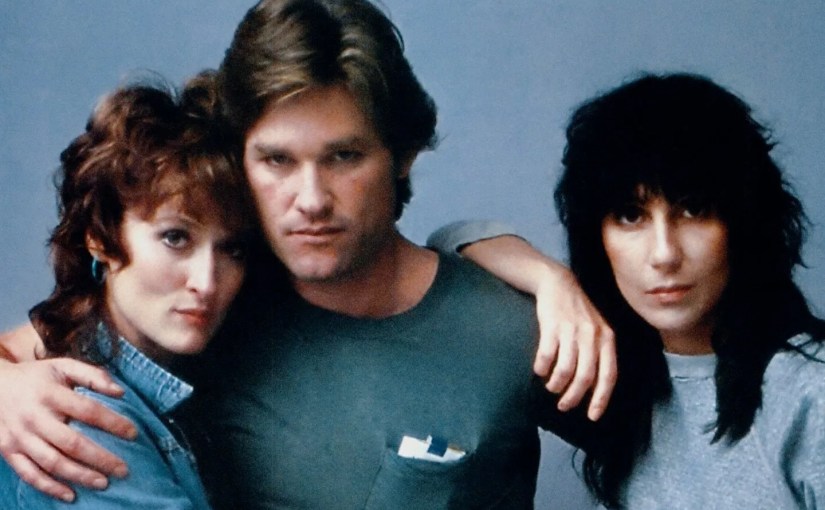
Karen (Meryl Streep) lives with her boyfriend Drew (Kurt Russell) and her best friend Dolly (Cher) in a run-down house in the middle of nowhere.  They ride to work together at the local plutonium manufacturing plant where they dress in scrubs and gloves. Punch in, punch out kind of days, and often they are expected to work double shifts and weekends.  Karen works an assembly line where she places her hands in rubber gloves and assembles dangerous combinations of chemicals in an enclosed box.  It’s also routine that before you leave your station you wave your hands over a sensor to ensure you have not been exposed to radiation.  There’s even sensors you walk through as you enter and leave the plant.  When those sensors go off, a calm kind of film seemingly turns into a horror movie.  The last thing anyone could ever want is to get “cooked.”

Karen does not live a perfect life.  Her three kids reside with their uncompromising father in Texas.  Money is not ideal.  Dolly is a slob and has also invited her girlfriend to live with them.  Karen can manage with all of this, but when she observes some unconventional activities around the factory she gets up the nerve to head the union for better protection and working conditions.  However, the further she goes looking at files and photos, jotting down notes of what people say and do, plus taking trips to Washington DC, and getting phone calls from attorneys at night, she becomes more and more isolated from Dolly and Drew, along with the rest of her close-knit workers.  Karen is not just risking her job, but everyone else’s jobs and worse her own life.

The attorneys lay it out to the townsfolk and the union of the horrifying statistics that go along with radiation exposure.  The tiniest fraction of a miniscule of exposure to the smallest crumb of chemicals could increase a human’s bearable limit towards radiation and cancer.  The sad irony is that the more that is learned, the more the people of this area smoke and smoke some more.  Granted, this story takes place in the early 1970s, though.    

The company is primarily represented by an intimidating Bruce McGill.  He’s great in everything he does and is worthy of an Oscar nomination somewhere.  M Emmet Walsh has no lines but his presence is enough to shake you; the slimy guy you easily recognize from every other movie you have seen.  While the company’s overbearing intrusion is shown plenty, the script for Silkwood focuses more on how these working people get by.  They are treated unfairly and in dangerous working conditions, but they also know this is the only place that offers steady income in the area.  Without this factory, the whole town would be left in dire straits.  Karen is repeatedly told or implied to leave well enough alone.

Meryl Streep notches another harrowing performance on her resume and bears such a departure from more sophisticated characters found in Sophie’s Choice and Kramer Vs Kramer.  Karen Silkwood is not educated and she bears an unmistakable white trash dialect but she’s also not stupid and the more progress she makes at exposing the plant’s shortcomings the more unfairly she is treated with department transfers and workplace shake ups that she is indirectly blamed for.  Potential threats on her life begin to build, but she only upholds a bravery.  You really observe the strength of Meryl Streep.  She’s at the top of an elite class of actresses at this time that also included Sally Field, Jessica Lange and Glenn Close.

Cher plays Dolly in her first on screen role.  The variety act performer probably subjected herself to a bigger departure than Streep.  She was not a professionally trained actress at the time.  Mike Nichols insisted on no makeup along with her hair unkept and flat, while dressed in green chino pants and baggy sweatshirts.  The new actress carries herself so well without the usual glitz that accompanies her.  Her scenes with Streep are workshops in acting technique. 

Kurt Russell delivers another understated performance.  One of the best actors out there who has never been enough of a critical darling.  Drew is likable and Kurt Russell plays him as a settled in match for Streep’s portrayal of Karen.  Watch how they tangle up in each other’s arms in bed or when he snaps at her as she carries on her crusade while he’d rather things be left alone.  His timing is perfect for the script.

Mike Nichols keeps his film calm, except when the go by the numbers narrative must be disturbed.  A radiation cleanse with high pressure hoses will make you wince.  The factory alarms will terrify you.  Meryl Streep accepts the physical taxations necessary for this setting.  Nichols gets in close with his camera to show how cleansers dressed in scrubs and masks rub Streep down until her skin is a burning red.  I distinctly remember how her right ear appears in this scene, getting flushed by something just short of a fire hose, and the aftermath of her sitting in a chair is so discomforting while a company doctor assures her that there’s not much to worry about as long she brings in her urine samples daily.  In fact, soon all of the employees are tasked with delivering their urine samples.  What kind of place is this?

While Silkwood is based on a true story with a burning question left behind, I do not want to reveal too much.  Many have seen Silkwood since it was released over forty years ago, but as the third act begins, the fallout only becomes more disturbing and Mike Nichols directs a horrifying sequence built primarily on the pealing of old wallpaper.  That’s all I want to suggest. 

Karen Silkwood was a very unlikely crusader.  She probably never envisioned what she would become and what she would fight for.  Yet, she uncovered horrible truths that should not have been occurring under the eye of billion-dollar corporate America.  After watching Silkwood, I can only imagine what else was there to turn over.

NOTE: Another good reason to watch Silkwood is to discover early performances from some amazing character actors who were either just starting their careers or continuing to hide in the crowd. 

Scavenger hunt for Anthony Heald, James Rebhorn, David Strathairn, Ron Silver, Fred Ward, Diana Scarwid, Bill Cobbs, M Emmet Walsh, Craig T Nelson, Tess Harper, Will Patton, Richard Hamilton and Josef Sommer.
SILKWOOD (1983)

by Miguel E. Rodriguez

DIRECTOR: Mike Nichols
CAST: Meryl Streep, Kurt Russell, Cher, Craig T. Nelson, Fred Ward, Ron Silver, Bruce McGill, David Strathairn, M. Emmet Walsh, James Rebhorn
MY RATING: 8/10
ROTTEN TOMATOMETER: 77% Fresh

PLOT: On November 13, 1974, Karen Silkwood, an employee of a nuclear facility, left to meet with a reporter from the New York Times. She never got there.


The tagline for Silkwood (quoted above) almost feels like it gives the game away, but it doesn’t really.  Even if Karen Silkwood’s name isn’t exactly part of the cultural zeitgeist anymore, I am willing to bet that a lot of people know what her name signifies in one way or another.  So, it’s not like the movie’s poster or trailers are spoiling what happens at the end of the film because most of us know.

In any event, Mike Nichols’ film isn’t a nuclear-based thriller, like The Day After (1983) or WarGames (1984), that depends on an unexpected resolution.  Silkwood isn’t about theatrical heroics or bombastic personalities.  It’s a quietly intense character study of an everywoman with an untidy personal life who experiences a seismic shift in her perception and decides she simply can’t stand by and do nothing.  This isn’t a crowd-pleaser like Erin Brockovich (2000), but this film’s story and central character are no less important.

The film goes to great pains to show us how ordinary and messy Karen Silkwood is.  The incidents at the Oklahoma nuclear facility where she works (along with her live-in boyfriend, Drew, and her roommate, Dolly) are almost secondary to the plot, at least for the first half of the film.  Karen has kids that live with her ex-husband and his girlfriend in Texas.  Her relationship with Drew isn’t stormy, but it’s not perfect.  Dolly seems tolerable as a roommate, but is not shy about speaking her mind.  Dolly brings a girlfriend home one night, and there is a slyly amusing conversation between Karen and Drew about Dolly’s sexual preferences.  (“I can handle it.”  “Me, too.”  “…so why are we talking about it?”)

I don’t want to go into too many details about the true-life incidents that occurred at the facility where Karen worked because, if you’re not intimately familiar with the facts of the story, they should be as surprising to you as they were to me.  Plutonium is involved, but probably not in the way you’re thinking.  Karen learns enough to know she should be more involved in the factory’s union…a LOT more.  One plot thread almost feels like it’s ripped off from The China Syndrome (1979), until you realize Syndrome was released four years after the events of Silkwood, so if anything, Syndrome was probably inspired by Karen’s discoveries.

I also have to mention Cher as the roommate, Dolly.  Of course, Meryl Streep is amazing and convincing as an everyday, average divorced mom, but Cher more than holds her own in every scene.  There is absolutely no hint of the pop music megastar of the ‘70s in this film.  Director Mike Nichols insisted she wear little or no makeup in her scenes, which went against every fiber of her instinct as a performer.  She understood the assignment: she never upstages anyone.  This is not a grandstanding kind of supporting role, like Tommy Lee Jones in The Fugitive (1993) or Cate Blanchett in The Aviator (2004).  It required subtlety and understatement, and Cher delivered.  I tried to spot her “acting,” and I never could.  She was unbelievably natural and, at times, heartbreaking.  The movie is almost worth searching out just to see her performance.  It’s a clinic in how to own a small role and make it stand out by doing less than you might expect.

Silkwood may not feel as thrilling as some of the other thrillers I’ve already mentioned, but it is just as compelling, specifically because we’re watching an ordinary person under extraordinary circumstances.  We’re not watching a hero triumphantly rise to the occasion.  We’re watching a struggling divorcee who’s trying to do the right thing after years of inaction, even if it means losing the trust of her co-workers or sacrificing her other personal relationships.  I identified more with Karen Silkwood and her situation than I did with Jane Fonda in The China Syndrome or Julia Roberts in Erin Brockovich

The ambiguous nature of the film’s ending mirrors what happened in real life, and when the credits rolled, I felt a surge of empathy for the people left behind and the unanswered questions they live with to this day.  That doesn’t happen to me very often.

THE HATEFUL EIGHT

By Marc S. Sanders

Quentin Tarantino’s eighth film, The Hateful Eight, has the signature director’s fingerprints all over, but it still stands apart from the rest thanks to a lurid, foreboding soundtrack from Ennio Morricone with an Agatha Christie narrative approach.

During a post-Civil War period, near the mountaintops of Wisconsin, an image of a crucifixion post is blanketed in snow as a stagecoach races past.  The cold symbol spells doom.  The coach is stopped by a curious, well-dressed man in the middle of the road.  This is Major Marquis Warren (Samuel L Jackson), a legendary black Union veteran, now bounty hunter.  With a fierce blizzard on its way, the Major convinces another bounty hunter, who has paid for the coach, to hitch a ride.  That man is John Ruth (Kurt Russell) and he’s escorting his ten-thousand-dollar bounty, a black-eyed unsavory Daisy Domergue (Jennifer Jason Leigh), to her hanging in the nearby town of Red Rock.  A would-be sheriff of that town eventually hitches a ride as well, Chris Mannix (Walton Goggins). The coach has to take shelter from an oncoming blizzard at Minnie’s Haberdashery, where four other men are already holed up.  They are Confederate General Sandy Smithers (Bruce Dern), the charming British hangman Oswaldo Mobray (Tim Roth), Cowboy Joe Gage (Michael Madsen) and the giant like Mexican Bob (Demian Bichir).  Tarantino has invented another collection of seedy two-dimensional characters whose unique appearances and vocal inflections set them apart from the rest of the gang respectively. Still, they are interesting enough.

The first celebrated performer of the piece is Morricone’s Oscar winning soundtrack which is totally eerie, sinister and immersive.  I go back to that carved out wooden image of Christ hanging from the cross and covered in snow.  Morricone’s music replays the same notes but with more intensity each time it starts up again.  It’s as if the Devil is luring us into his hellish lair.  If the famed Conductor’s chords could speak it would start with “Once upon a time, on a dark and stormy night…”

Twists of fate await all of these men and the one woman.  Like a mystery from Dame Agatha, the characters are set up for introduction to each other, with a little bit of back story.  The ones that especially stand out belong to Major Warren who possesses a personalized letter from President Abraham Lincoln himself.  The curious question of what could possibly merit a ten-thousand-dollar bounty for a small woman like Daisy is the other mystery I initially take notice of.  Once everyone is gathered at Minnie’s Haberdashery, how will these people intersect with one another?

The Hateful Eight plays like a short story you might find in a Reader’s Digest.  Taratino might correct me and insist that more specifically it would be found in a magazine of lurid subject matter – pulp fiction.  Go figure.  It is a theme he sticks to and continues to reinvent himself with each passing film.  The creativity comes in the new situations he constructs for his players.  He’s placed his figures in another kind of western by this point already.  He’s applied them to an alternate kind of Nazi occupied Europe during the second world war.  He’s updated swordplay in a zippy Dojo.  Now, he inserts his personalities into primarily a single setting, like Christie did time and again. 

Clues are uncovered as the film moves on to indicate that something may have happened here, before the stagecoach arrived.  There’s a broken door that needs to be nailed shut each time it is crashed opened.  A jellybean?  A chess board sits in front of the General and appears to be in the middle of a game.  And where is Minnie and Sweet Dave, the caretakers? The Major positions himself as the detective and within the small confines of this log cabin suspicions will reveal more about how the men and Daisy are connected and why they are here, now, while a harsh, unforgiving blizzard rages on outside.

The dialogue of The Hateful Eight is not as memorable as other Tarantino scripts.  Yet, the characters are just as colorful, and there are a couple of zips in time to keep you alert when a new development surfaces.  Tarantino is not shy about the bloodshed either.  The violence plays like most of his other films with a kind of slapstick twist.  A character gets violently ill and vomits blood all over Daisy.  That’s after a couple of wallops to the nose and jaw, plus a face full of stew that she’s had to endure as John Ruth’s handcuffed prisoner.  Later, someone’s brains splatter all over her. 

None of the guys are standard cowboys of the Old West either.  Goggins plays a good-natured dimwit.  Jackson is impervious to the racial name calling.  Russell is a cranky old grunt.  Your grandfathers did not take your fathers to Saturday matinee “ride ‘em into the sunset” westerns like these.  This is the most garish of material, and as in your face as it is, it’s also quite entertaining.

Tarantino has definitely graduated from the simplicity of his first films, Reservoir Dogs and Pulp Fiction.  The production value of The Hateful Eight is phenomenal.  Originally, I saw this movie in theaters with a couple of my Cinemaniac buddies.  Tarantino was proud to present it on 70mm Panavision film, complete with some intrusive lines and occasional burn spots.  Don’t tell me if this was not shot on location.  I don’t want to know.  I treasure the illusion. The deep snow-covered Wisconsin mountains are glorious to look at.  I feel completely absorbed in the setting with the harsh whispers of chilly winds happening outside as the dark blue of the snowstorm can be seen through the cabin windows.  This may be Quentin Tarantino’s most atmospheric film to date. 

This movie has a running time of three hours, but I strongly recommend to watch it without stopping.  The blu ray was a Hanukkah gift from my wife, and I tried watching the night before, but I kept having to pause it to struggle with a cold I’m currently fighting.  I only made it to “Chapter Four: Domergue’s Got A Secret.”  The next day, I told myself to start it from the beginning while everyone was out of the house and the experience was very fulfilling as Tarantino’s wintery day moves into night and then finally reaches its bloody conclusion. 

The Hateful Eight works like a graphic novel come to life.  It’s a great late-night rainy-day kind of picture.  If you haven’t seen it or it’s been a while since the last time, like it was for me, then I recommend checking it out during this winter season.  Trust me.  It just wouldn’t play as well on a hot summer night in July.  Quentin Tarantino and his cast work better when they are at their most cold blooded.

THE MEAN SEASON

By Marc S. Sanders

I get caught up in movies focused on serial killers.  As an actor, I imagine it must be fun to portray a deranged psychopath like Norman Bates or Hannibal Lector, or maybe even John Doe from Seven.  On the other hand, maybe not because an effective screenplay needs to be nearby.

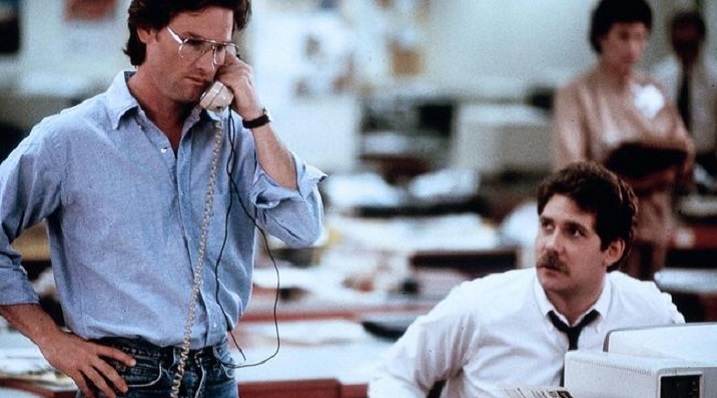
The Mean Season from 1985 has an effective premise but that’s where the positives of the picture stop.  Kurt Russell portrays Malcolm Anderson, a burnt-out reporter for the The Miami Journal.  He is the paper’s most reputable writer but just as he is ready to resign and move to Colorado with his loving girlfriend, Christine (Mariel Hemingway), he’s tasked with writing an article about the murder of a teenage girl on the beach.  Soon after, he’s getting phone calls from the killer himself, played by Richard Jordan whose face is concealed through most of the film by his hand holding a telephone.  The killer insists on only maintaining communication with Malcolm and no one else, especially not the cops.  He relays that the city of Miami can expect four more murders.

The title of the film stems from south Florida’s well known weather variations that occur at the start of hurricane season, primarily in July.  That does nothing for me, but the title alone sounds marketable enough for a thriller.  Almost sounds like a Stephen King novel.  The Mean Season!!!!!  Unfortunately, that’s all that this movie has to rely on, even if Kurt Russell is doing his best like he always does in better suspense movies like Unlawful Entry and Breakdown.

The fault with The Mean Season resides with the director’s amateurish approaches.  Fifteen minutes into the film, with the story hardly in motion, a nude Christine is taking a shower.  The haunting music begins and suddenly the shower curtain is pulled for Malcolm to deliberately startle his girlfriend.  So, we have the Psycho salute.  Check!  Later, following an argument between the two lovers, Malcolm gets in his car and is startled by Christine coming up from behind in the backseat. Ha!!!! Okay and there’s the Halloween nod.  Another check!  I bet these cheap tactics were not even written in the script.  Director Phillip Borsos (never heard of this guy before; doesn’t surprise me) must be so insecure in his skills behind a camera that he just goes for duplicative tripe.

Threats to the couple elevate as the film moves on and when Malcolm gets wind of Christine being in danger, he’s in his Mustang racing to her.  The cops (Andy Garcia, Richard Bradford) are right behind him, and no one thinks of summoning a squad car to where Christine is expected to be?  Of course not.  If they did, then we wouldn’t be treated to a clumsy sequence where an elevated bridge gets in Kurt Russell’s way forcing him to make a leap across the gap and come down on the steep other side and continue his foot race.  Kurt Russell really looks stupid in this moment, and I’m sure he was thinking I can not believe I agreed to this.

As with any of these movies, there is a just when you think the bad guy is dead, there he is again.  No wonder we didn’t get a long enough closeup on the corpse found in the dense Everglades.  However, we get treated to seeing a long, meaningless sequence of Kurt Russell being a passenger on a swamp buggy.  Big deal.  Does this enhance any kind of suspense?  Does it move the story along?  The director got access to a couple of swamp buggies and a day of shooting in the Everglades and said we gotta get this in here.

The final fight is as moronic as the rest of the picture.  Richard Jordan and Kurt Russell are going at it in the living room while a hurricane rages outside.  Mariel Hemingway just sits on the sofa and watches.  She just watches.  She doesn’t reach for a kitchen knife or a vase to smash on the bad guy’s head and help her poor boyfriend.  We just get a sad excuse of a damsel who is not in distress. 

Thankfully, Kurt Russell’s career survived this junk of standard jump scares and shortness on intellect. 

As I’ve said before in other columns, there was a better movie here.  There could have been a movie that explored the endless hours that an investigative reporter must endure.  His editor and photographer (Richard Masur, Joe Pantoliano) could have shared the heightened fear and suspense.  The cops on the case could have applied more pressure and/or assistance to the reporter.  They don’t even tap his phone to trace where the calls are coming from.  In 1985, I think they already had the technology to do that.  A tape recorder was used though, and the audience not only gets to listen to the conversations once as they are happening but then again as the characters listen to the tape.  Why?  Is there something I missed the first time I heard Kurt Russell say hello?  This is filler crap. 

A better movie would have pursued what motivates this killer we hardly get to know.  We should have learned more about this guy because he’s the one making the phone calls.  So, it is obvious he wants to be heard.  However, the guy has nothing to say of any significance.  Even a psychologist who’s recruited for one scene doesn’t make any observation that gives me, or the characters in the film, pause. 

The Mean Season is an “I got it!” film.  It’s where the director gets his big break and declares “I’ve got it!!!!  We’ll do Psycho and then we’ll do Halloween.  Gotta make sure we see Marial Hemingway topless.  That’s definitely at the top of the list. Oh yeah, and then we’ll get swamp buggies and can we get some wind and rain machines for a really, really, really mean—I mean very mean—season!”

EXECUTIVE DECISION

By Marc S. Sanders

A commercial passenger plane carrying a bomb with enough explosives to wipe out the entire eastern seaboard of the United States has been hijacked.  Fortunately, Steven Seagal has come up with an idea to get his squad of commandos on board and contain the threat.  It’s also a blessing that in the first twenty minutes of Executive Decision, Seagal dies during the midair transfer.  There!  I spoiled it for you.  I’m not big on spoilers, but this is worth it because I believe it’ll entice you even more to watch this scrappy, under the radar action picture directed by Stuart Baird.

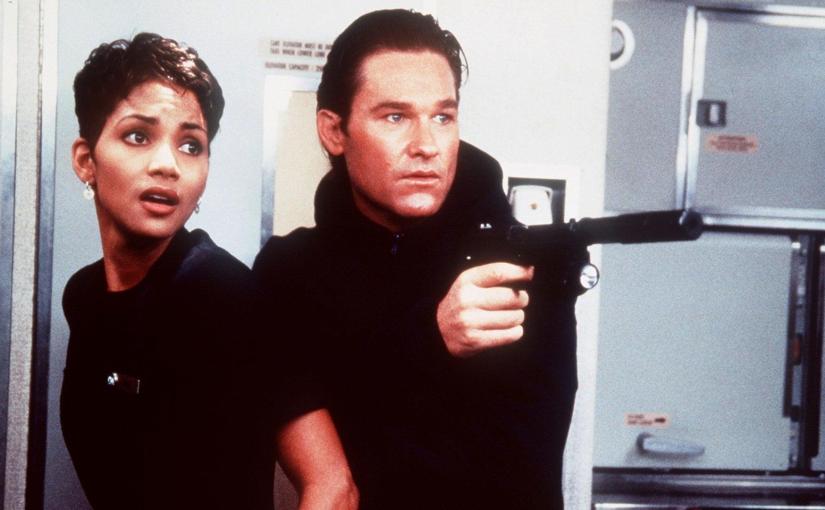
Before all of the action gets started, Kurt Russell makes his introduction attempting to land a small plane during a flying lesson.  I wonder if that’ll play into the story later.  Hmmm!!!! Russell plays David Grant, a consulting analyst for the US Army. Dressed in his tuxedo, he’s swept up from a dinner party and informed of the terrorist hijacking at play.  Grant is familiar with the lead terrorist and his ideals.  For whatever reason he’s instructed to board a specialized jet with Seagal’s crew.  This jet carries a tube that will attach to the hull of the captive plane in midflight. The soldiers will climb aboard and go to work.  Complications ensue though, and after that harrowing scene is over, four members of the elite squad (one becomes paralyzed) have made it on board along with Grant and the design engineer (Oliver Platt) of the jet.  Now the fun begins. 

Baird invests a lot of moments with the commandos (led by John Leguizamo) sneaking around, and drilling small holes in the ceiling and floorboards of the plane to insert tiny cameras and get a look at the activity going on.  Every so often the terrorists threaten or give scary looks and we hope they don’t look down that hallway or in the elevator shaft.  The bomb also has to be deactivated but it’s never as easy as knowing to cut the blue or red wire, and there’s a “sleeper” passenger who can detonate the bomb by remote.  Where on the plane is that guy, though?  As well, the government debates with shooting down the plane of 400 passengers before it reaches America.  So, there’s a lot going on here.  Kurt Russell is especially good as a “work the problem” kind of leader who manages to earn the assistance of a flight attendant (Halle Berry).  We may know how this standard story will end up.  However, that doesn’t mean the journey can’t keep us on pins and needles. 

Executive Decision is never boring.  It’s engaging from beginning to end, even if we’ve seen this very basic formula countless times before.  Credit has to go to Stuart Baird and his lengthy experience as a film editor (the Superman and Lethal Weapon films), as well as the cast.  Kurt Russell is always reliable with upholding the tension of a situation.  Like Harrison Ford, he’s really good at playing the everyman caught up in a jarring, nerve-wracking situation.  Look at his film Breakdown for further evidence. 

Beyond Seagal’s early demise, the most amusing part of Executive Decision is watching Marla Maples Trump as another flight attendant emoting the worst panicked expressions for Halle Berry to act off.  Marla never delivers a single word of dialogue.  Even in 1996, long before the Trump name became regarded for many other reasons I need not discuss here, this likely unintended joke generated so much amusement for me, personally.  It must be seen to be believed.

That being said. Don’t watch Executive Decision just for Marla Maples Trump and Steven Seagal.  Watch it for the taut, suspenseful story it is, with a fantastic lead role performance from Kurt Russell, a solid supporting cast and a gripping assembly of tension from Stuart Baird.

BREAKDOWN

By Marc S. Sanders

The southwest region of the United States can be brutal.  The desert landscape is scorchingly hot and the end of the world seems like an eternity away…no matter how fast you drive or how far you go.  Worse yet could be the truckers and locals who could care less about who you are, where you came from or where you’re going.  So, you better be sure your well equipped Jeep Cherokee has enough gas in the tank and your oil dipstick comes up black.  For Jeff and Amy Taylor, though, nothing they do will matter.  Their car is destined to break down anyway.

Jonathan Mostow wrote and directed a taut thriller called Breakdown that builds on a Hitchcockian formula for a road picture.  When Jeff and Amy’s (Kurt Russell, Kathleen Quinlan) car breaks down on a long, lonesome highway in the middle of the desert, a friendly trucker stops by (JT Walsh) to lend a hand.  He offers to take them to the next stop where they can call a tow truck.  Jeff agrees to stay with the car.  Amy hitches a ride to call for the tow.  Shortly after, Jeff realizes that Amy has mysteriously disappeared.  When Jeff catches up with the trucker, the situation gets even stranger because this guy claims to have never met Jeff before or even know who his wife is.  It gets even weirder and more frightening from there.

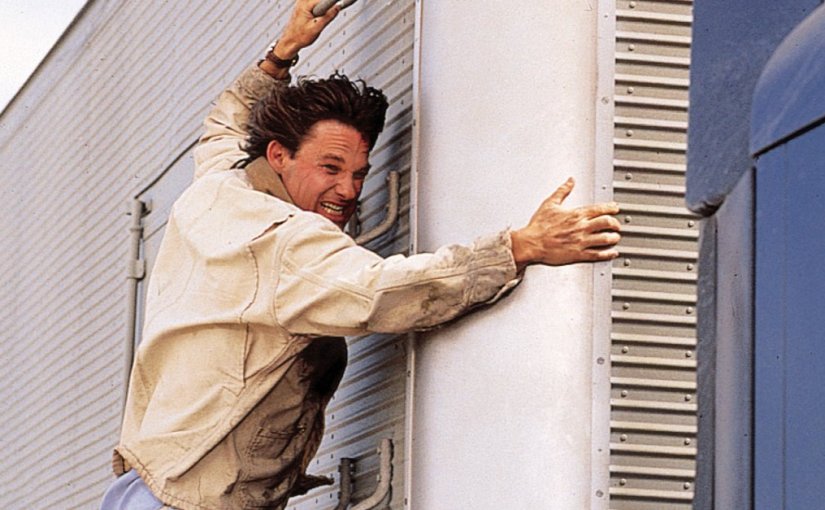
Kurt Russell is very good in a relatively simple, but effective story that only needs its ninety minutes to get your heart racing.  As Jeff learns of the conspiracy playing against him, the panic builds in Russell’s performance.  A really effective moment occurs when Jeff is forced to go to a local bank and withdraw ransom money.  While the banker is executing the money transaction, Jeff enters the restroom.  In this short moment, Mostow keeps a good close up on a very sweaty, beaten and nervous Kurt Russell.  Jeff is looking for something to use as a weapon.  Now, we’ve seen this many times before.  What kept me absorbed in the suspense of the film is how Kurt Russell evokes his thought process without having anyone to talk to.  In this bathroom, he involuntarily walks in circles, seemingly asking himself “what am I going to do?”.  Mostow never breaks the shot, allowing his lead’s performance to send home the paranoia.  I was right there with this poor guy.  What is Jeff going to do?

JT Walsh was an under the radar character actor; one of those guys that you recognize from dozens of films (Good Morning, Vietnam, A Few Good Men), but you just never knew his name.  He passed away too soon.  I’d wager eventually he’d get some kind of awards recognition.  This is a magnificent villain in Breakdown.  A good antagonist is one you can trust at first.  So that when the veil is lifted, your jaw drops a little.  Walsh accomplishes that here.  He turns on the good guy and he betrays the viewer.  He really plays a guy with two masks on.  Friendly and helpful at first.  Later, a toothless scowl is across his face as he terrorizes Jeff.  The big rig truck that Walsh drives becomes reminiscent of what Steven Spielberg accomplished with his first film, Duel.

While a Jeff Taylor character may have appeared in an Alfred Hitchcock film, as the common man caught up in an outrageous plot he was never looking for, Jonathan Mostow has modernized the method with well edited action scenes.  This is a road picture but there really are not car chases to behold.  Instead, there are moments where like any of us, we will increase our speed on long stretches of road.  When we take our eyes off the highway for a split second, we never expect what will pop out and startle us.  As well, when we try to pass ahead by cutting into the opposite lane, a head on collision may come our way.  The film goes for those pressure points first before another overly used car chase.  This is where the environment fights back against the protagonist.  

The location shoots of Breakdown are superb.  An old diner, in the middle of nowhere, has some locals who could care less about a polite out of towner, clearly concerned about his missing wife.  They just look straight ahead while nursing their beers.  The bartender has also had enough of this guy to the point of threatening him with a gun to get out of the joint.  A passing by police officer (Rex Linn of Better Call Saul, another great character actor) devotes no more than five minutes of his time to poor Jeff’s concern, and then he moves on.  The desert and the people who occupy the area serve only apathy to a helpless stranger.  The setting of Breakdown is a villain all its own.

This thriller works simply because a scenario like this could happen to any of us.  It was released in 1997, just ahead of the cell phone age, and there’s acknowledgement of that time.  Jump to today and this situation could still happen.  Technology is not always going to help us, no matter how many bells and whistles we have on a car or how many bars show on our handheld devices.  In the desert, any one of us can be a victim unto ourselves.  In the middle of nowhere, a bad guy can use an opportunity to his advantage at the expense of any persons leaving themselves unguarded.

Breakdown shows that our worst nightmare could be to drive into an endless daylight void, where any one of us can get stuck, only to later get caught.  It’s scary as a desert hell, and it’s a fantastic nail biter right until its bang-up conclusion.

THE THING (1982)

By Marc S. Sanders

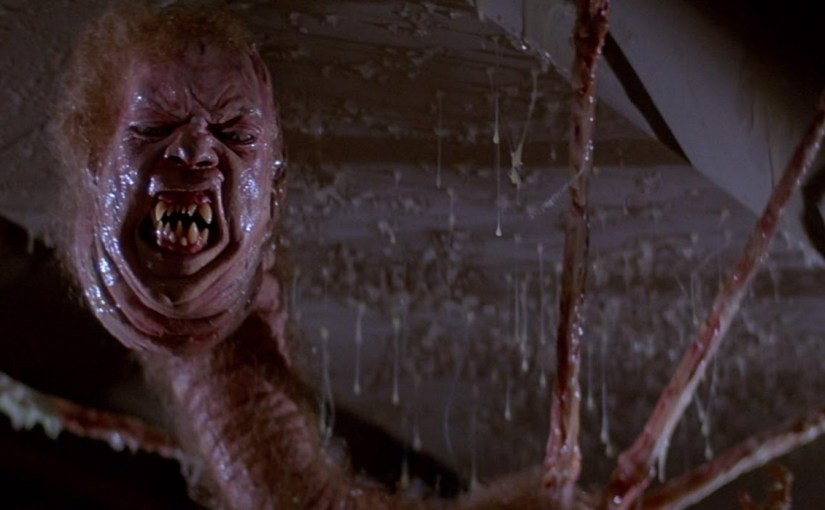
Often, a great beginning to a film offers an intriguing question. So as I finally watched John Carpenter’s 1982 interpretation of The Thing, I was especially curious as to why a sniper aboard a fast moving helicopter was targeting a dog running across the open plains of Antarctica with a pulse pounding beat from legendary film composer Ennio Morricone. The film has me hooked and none of the gory horror to come, compliments of creature effects wizard Rob Bottin, has even presented itself yet.

Gore never did anything for me in horror, and horror has never been my most favorite genre of film. Rather, suspense always held my attention and kept me thinking long after the movie was over. Carpenter’s film is full of Bottin’s imaginative gore but the paranoia and mistrust among a crew of science operatives is the real centerpiece here. Whether it’s the innocence of a dog or the star power of Kurt Russell, I never trusted the narrative of The Thing and that’s the point.

An exceptional scene on the same level as the dinner scene in Ridley Scott’s Alien occurs following a crew man suffering a heart attack. The defibrillator is brought out, “CLEAR” is shouted and the man is zapped. Then something else happens. I won’t spoil the moment. Yet, this is where imagination was put to work; where effects and storytelling work cohesively. Thankfully, moments like these become a running theme throughout The Thing. You never know what to expect from an unmeasurable and incomprehensible enemy. The fact that resources are scarce and escape is impossible traps our characters and the viewer as well.

Convenient, fast learning knowledge only tells you that this entity can duplicate anything it comes in contact with. So, you might just be sidling up to the thing itself and you won’t even know it until it’s too late.

Isolation, lack of trust, fear, paranoia – all of these elements work towards the advantage of superb imagination and storytelling in Carpenter’s piece.

The Thing was always a movie that eluded me. I’m now so grateful to have witnessed it. It makes me yearn for better storytelling in today’s films beyond remakes and superhero exhaustion.

John Carpenter’s The Thing is an absolute must see motion picture. Watch it with friends and watch it with the lights turned off.

GUARDIANS OF THE GALAXY VOL. 2

By Marc S. Sanders

James Gunn continues his Looney Tunes odyssey helming Guardians Of The Galaxy Vol. 2. The silliness is grander, the story is weirder and the characters are now comfortably fleshed out.

Vol 2 is probably not better than the first installment. However, it is more inventive as Gunn takes his film along the hanging thread left over from before. Peter “Star Lord” Quill (Chris Pratt) meets his father at last in the persona of Kurt Russell who goes by the moniker Ego. This is all enthralling to Quill, though his love interest, Gamora (Zoe Saldana) sees beyond the facade.

Ego has invited them to his planet that he created. It pops with colors, serenity and cheer. This plays for a good story; maybe as a better and more developed Star Trek episode.

What differentiates this film from other Marvel films comes out in the third act. This does not consist of just space battles, laser swords and shootouts. The end is something else, something new, entirely. Thus, you are given the film’s greatest strength. I found it to be very imaginative.

Gunn however falls a little bit into his own trap along the way. There are too many relationships and characters that work as filler for side stories. Gamora vs her bitter sister Nebula. Drax (Dave Bautista) with a new, weird antenna on the head character named Mantis and Rocket Racoon and his big mouth with Yondu (Michael Rooker, in a bigger more significant role this time). Oh yeah! There’s also Yondu vs Sylvester Stallone (huh? why? how?) and Yondu vs his mutinous army, The Ravagers. It’s all a little too much for an already busy looking film.

I found it funny that The Ravagers reminded me of the motorcycle gang, The Black Widows, from Clint Eastwood’s Every Which Way… bare knuckle comedies. Those guys were much funnier than these Ravagers. Gunn overstays their welcome as they randomly cackle and heckle poor Baby Groot, the toddler tree thing. That gets old quickly.

Gunn approaches a special kind of humor here. Repeatedly, because these are outer space characters, it’s apparently funny to lend them explaining the punchline of a gag. So if Drax realizes that Peter has the hots for Gamora, he’ll belly laugh and explain literally how Peter feels and do it bigger and louder. Variations of that gag occur quite often among most of the characters. Sometimes it works. Sometimes it gets old.

GOTG Vol 2 is a fun watch. I don’t foresee this installment carrying the legendary status the first one did or even standing out among the best of the Marvel series, but I will give props to the outcome of what Ego truly is and what his intent depends on. (I won’t spoil that here, of course.)

The cast is great. Saldana is one of the stronger female characters in the MCU. She captures a background to Gamora that is blatantly absent from other Marvel ladies. Bautista has become a great character actor as well. He’s a smart guy with good timing. With his extensive child and adult film resume Kurt Russell is perfectly cast as Pratt’s father. Their personalities lend to some good chemistry.

James Gunn owns the Guardians films. No one else can capture his blend of humor and pop culture salutes. Yet, he overreaches a little trying to incorporate so much story and so many gags into one film. His vision is well defined, though.

Plus, Gunn stages another dance scene for Pratt and Saldana, and it’s great. As I noted in my Vol 1 review, that’s how you get to a viewer’s heart. Everyone loves to dance.

As well, Gunn accompanied his sequences with some tunes both fresh and familiar from Fleetwood Mac, Electric Light Orchestra and George Harrison to name a few.

James Gunn was always going to make sure never to take his films seriously. So, when you see a baby tree groove along while trying to detonate a bomb, I defy you to be so serious as well.

UNLAWFUL ENTRY

By Marc S. Sanders

The boogeyman is dressed as a police officer!

In 1992’s Unlawful Entry, Jonathan Kaplan (The Accused) directs a well-played Ray Liotta as a psychotic cop named Pete Davis who is terrorizing a yuppie couple named Michael & Karen Carr (Kurt Russell, Madeleine Stowe). The Carrs experience a home intruder who puts a knife to Karen’s throat. Officer Davis offers comfort to the pair and happily volunteers the arrangements for a high-tech alarm system. The first mistake that Michael makes is sharing the password with trusty Pete. You’ll expect that to come into play later on. Maybe what inspired the password will work itself into the film as well. Hmmmmmm?????

It’s difficult for Pete to resist the obsession he has for Karen and so he begins a campaign to get Michael out of the way. First, he demonstrates his brutality by offering Michael the opportunity to senselessly beat up the home intruder for no other purpose than personal satisfaction. When Mike refuses, Pete finishes the job. Later, Mike makes efforts to keep Pete out of their lives. It’s hard to do that when a highly decorated cop is involved. Karen, his own loving spouse, won’t even truly believe Mike; neither will the police chief.

As Pete continues with his intentions, Mike’s credit cards are maxed out, he loses a high priced client that Pete has been talking to, parking tickets add up, and so on. Pete also appears at the house at inopportune times like when Karen is taking in a swim or creepily stepping into their bedroom while the married couple is having sex. Eventually, Mike is put out of the way when he’s imprisoned after being framed as a drug dealer. Now Karen is all alone for a terrifying third act that you’ve likely seen hundreds of times before.

Unlawful Entry is engaging while you’re watching, but it does not convey much. The happenings all appear probable if a deranged cop wanted to go through all this trouble. Therefore, Ray Liotta owns the picture. Yet, what did I learn here? Don’t call the police?

For Kurt Russell, this is the first of two “husband is being terrorized” roles for him. Later, Russell would headline the cast of a better film to fall in this genre called Breakdown. Still, I like Russell here. He starts out as a guy who is not capable of fighting for the sake of his wife. He regrettably admits that shame to Pete early on. Pete pounces on that advantage to win Karen. Later, the strength of Mike’s short temper followed by his fear push him to do what he must to protect himself and his wife.

Madeleine Stowe is a good actress. There’s just not much for her to do with this part. She’s the spouse who opts not to believe her husband’s concerns. If she did, there wouldn’t be much of a movie. The third act is all action and blood and falling down the stairs and running back up the stairs. It’s no surprise really. Though it is convenient that Michael is finally able to post bail and get home in time for a final confrontation with Pete.

One thing that kept echoing in my head though was that as good as Ray Liotta is (he’s very, very good actually; very primal and deceiving), he is terrorizing a woman named “Karen.” Every time he says the name Karen, all that comes back to me is the film Goodfellas where he more or less tormented and disrespected Lorraine Bracco known as, you guessed it, Karen. A rule should be put in place, Liotta can no longer be cast with other characters named Karen. His Karen quota is maxed out.

ONCE UPON A TIME…IN HOLLYWOOD (2019)

by Miguel E. Rodriguez

Director: Quentin Tarantino
Cast: Leonardo DiCaprio, Brad Pitt, Margot Robbie, Timothy Olyphant, Dakota Fanning, Bruce Dern, Luke Perry, Al Pacino, Kurt Russell
My Rating: 10/10
Rotten Tomatometer: 84% Certified Fresh

PLOT: A fading television actor and his stunt double strive to achieve fame and success in the film industry during the final years of Hollywood’s first Golden Age in 1969 Los Angeles.


Quentin Tarantino’s ninth film is a little bit like Beethoven’s Ninth Symphony.  It’s big, bombastic, and goes the long way around the barn to get to the finale, but in the end it all makes sense and is a transcendent experience.

Let’s see, where do I start?

First of all, the film’s evocation of 1969 Los Angeles is like Mary Poppins: practically perfect in every way.  I’m no fashion scholar or visual historian, but every exterior shot of the city was pretty convincing to my layman’s eyes.  The movie theatres, the movie posters, the restaurants (anyone else remember “Der Weinerschnitzel”?), the cars, those HUGE sedans sharing the road with VW Bugs and M/G’s…it’s clear they did their homework.

There’s the performances by the two leads.  Tarantino once said he considered himself the luckiest director in modern history because he was able to get DiCaprio and Pitt to work on the same film.  Can’t argue with him on that score.  They carry the film in a way that few other tandems could have.  (Newman and Redford come to mind.) Mind you, DiCaprio and Putt don’t look much like each other, considering one has to be the other’s stuntman, but you get the idea.

Above all, there’s the story.  DiCaprio plays Rick Dalton, a former leading man from ‘50s TV westerns who is now playing colorful bad guys in ‘60s TV westerns.  Brad Pitt plays Cliff Booth, the stuntman who’s been taking the dangerous falls for Dalton for years.  Dalton happens to live next door to Roman Polanski and Sharon Tate on Cielo Drive in the Hollywood Hills.

All the trailers, and all the industry buzz, reveal that the Manson family and Sharon Tate play a part in the film.  That’s no spoiler.  Given what we know about those events, the movie plays like Gimme Shelter, the landmark documentary about the ill-fated concert at Altamont that was actually due to take place a few months after the events of this film.  It’s all very suspenseful, in the sense that we know what’s coming, but we’re just not sure how the movie is going to approach it.  So every scene with poor Sharon Tate in it is overshadowed by the fact that we know her ultimate fate in history.

It’s like the famous Hitchcock analogy of suspense.  Two people are eating at a restaurant when a bomb suddenly goes off under their table…that’s surprise.  Put those same two people at the restaurant, where the audience knows there’s a bomb under the table, but it doesn’t go off right away as the two people eat and converse and have dessert, and we’re wondering will they leave BEFORE the bomb goes off or not…?  That’s suspense.

And that’s the genius of this movie, with Tarantino’s sprawling, winding screenplay.  We get to know Rick Dalton and Cliff Booth intimately, we get the rhythms of their relationship, of Dalton’s mood on set, of Booth’s quiet acceptance of his role as Dalton’s sole support system.  We are treated to lengthy scenes showing Dalton at work on the set of a TV western, so we can appreciate the vast differences between an actor and their characters.  There’s a brilliant backstage scene between Dalton and a child actor who is impossibly, hilariously advanced for her age, and who winds up giving Dalton some goodhearted advice.

And interspersed through it all is Sharon Tate.  Sharon Tate bopping to music at home.  Sharon Tate picking up a female hitchhiker on her way into town.  Sharon Tate almost passing, then backing up to admire with youthful excitement, her name on the marquee of a movie theatre, right next to (gasp) Dean Martin’s name!  Sharon Tate dancing, walking, smiling, drinking…living.  She’s the diner at the restaurant, and the Manson family is the bomb we know will eventually go off.  It casts a pall over the proceedings, but not in a bad way.  It’s an interesting way to bring the reality of the situation into focus from time to time.

And now I have to end this review before I inadvertently give away certain, ah, plot elements that elevate Tarantino’s film from a mere character study or period piece into the heady heights of cinematic transcendence.  I have not myself read any reviews of the film, so I can only guess that whatever negative reviews are out there probably center on the film’s finale, or perhaps on its meandering script.  All I can say, or will say, is that I am firmly on Tarantino’s side on this one.  The way the conclusion was written and filmed is the kind of thing that people will still be talking about years from now.

So just take it from me.  If you’re a movie fan, and ESPECIALLY if you’re a Tarantino fan, this is right up your alley.  It’s easily his most slowly paced movie since Jackie Brown, but that just gives you time to e-e-e-ease into the characters, like putting on a tailored suit piece by piece.  This film, like Beethoven’s Ninth, is a masterpiece.