BATMAN BEGINS

By Marc S. Sanders

The merits of a lot of action/adventure films is predicated on how strong the villain is to the story.  Often the hero is the straight character in the heroic garb ready to enter the scene just as the bad guy is on the brink of maniacally destroying the world.  In the early 2000s however, the focus diverted to the hero when big franchises opted to reinvent themselves.  James Bond’s origin was finally offered up in the best film of the series, Casino Royale.  Christopher and Jonathan Nolan served up one of the best cinematic Batman stories on screen.  The title said it all.

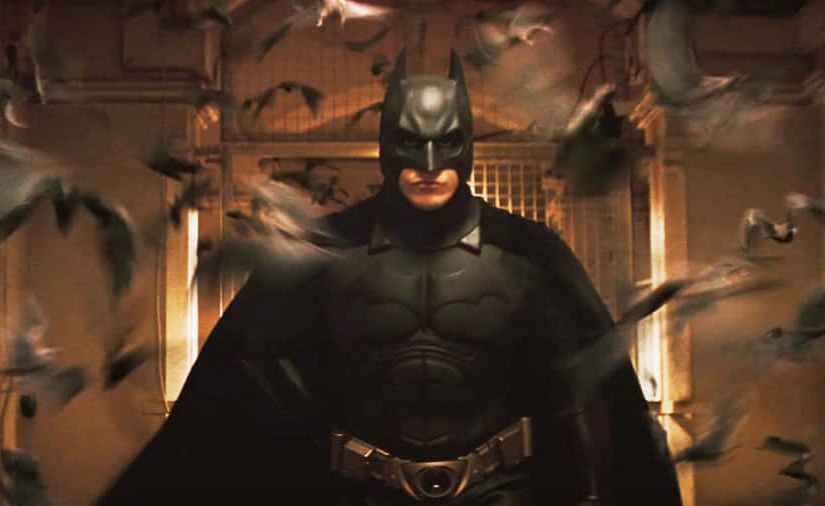
Batman Begins gets every note right with the all too familiar back story of Bruce Wayne’s drive to become Gotham City’s Dark Knight vigilante.  The film has its collection of villains but the center of the picture is always circumventing around Bruce Wayne, perfectly played by Christian Bale, with somber truth hidden by handsome playboy disguise.  As a child, he discovers his fear of bats and then attends the theater with his billionaire parents.  Upon their exit through a back alley, he witnesses their death and is left to be raised by his trusty butler, Alfred Pennyworth (Michael Caine, my favorite actor in the role to date).

This film achieves my undivided attention because it paints a full canvas of this character before he ever adopts an alter ego in a black costume.  We explore how he becomes motivated followed by his intense training in the zenith alps, on the Asian continent.  Then we see how he supplies himself with all of the familiar gadgets and costumes when he befriends an ally within his father’s company, Lucius Fox (Morgan Freeman). 

Jonathan Nolan’s script diverts away on occasion to embrace the capable villains of this story with the Scarecrow (Cillian Murphy), Rha’s Al Ghul (Ken Watanabe) and mob boss Carmine Falcone (Tom Wilkinson).  Bruce’s mentor, Ducard (Liam Neeson), is a big factor in the hero’s development as well.  Lastly, there’s Bruce’s childhood friend and legal connection, Assistant D.A. Rachel Dawes (Katie Holmes).  Lt. James Gordon is the uncompromised police detective that Bruce singles out to trust within this dense world of corruption.

Just to read this cast list is impressive as they fall beautifully within the matrix of Nolan’s blueprint.  Everyone is given enough time to make more than one impression as their storylines twist and alter.

Christopher Nolan’s films are always moving like a smooth ride on a never-ending stretch of road with no traffic in the way.  Nothing bears repeating from what was already shown in an earlier scene.  There’s something new to learn as the pace continues.  Nolan is one of the few filmmakers where you do not mind the time jumps he incorporates into his stories.  Bruce will first be seen as a ten-year-old boy, then in his muscular fit thirties in a Chinese prison completely departed from the wealth of Wayne Manor.  A step back before that shows him as a Princeton drop out with a mop top haircut.  Every different appearance of Bruce is interesting and you become intrigued with how he ends up in one place after another. 

Like the first appearance of Daniel Craig in the Bond series, this Batman/Bruce Wayne is repeatedly imperfect.  He’s flawed because he still needs to learn and the characters that enter and exit and reenter his life must teach him.  Alfred will lecture a short-triggered Bruce when he’s on the cusp of risking the reputation of his father’s legacy.  Rachel will slap him when he’s prepared to kill in cold vengeance.  Ducard will teach him the ways of physical survival and will test Bruce’s loyalty and the measures of crime with punishment.  Even the Scarecrow is smarter than Batman when he springs an unexpected trap.

The ongoing education of Bruce Wayne is the theme of Batman Begins, all the way to the end, when he finally learns to mind his surroundings.

Christopher Nolan made Batman exciting in a new unfamiliar way.  The Batmobile is a not a sporty kind of vehicle.  It’s a tank called The Tumbler and it bears a thunderous series of sound edits as it barrels through Gotham City.  After some slip and falls off rooftops, Batman becomes much more covert than in other interpretations.  You don’t have to physically see Batman to observe him operate.  If a thug gets swallowed into a void of darkness, you know what has ensnared him.  The crusader’s devices which stem from his gold utility belt are demonstrated with explained reason for why he selected them for his fighting advantage.  The Nolans proudly recognize the theatricality of this guy.

Cillian Murphy is unforgettable as he lives up to the name of Scarecrow, also known as Dr. Jonathan Crane, a criminal psychologist.  His choice to put his victims into a hypnotizing sense of fear lend to the back story of Bruce Wayne’s intent to become a frightening figure himself, where his enemies will recognize his dread.  Tom Wilkinson claws his gangster persona straight from a Godfather kind of picture, but he represents an old guard of Gotham City before costumed and makeup identities take over.  Gotham will transition from the sharp dressed mobsters over to the crazed clowns yet to come. 

Gary Oldman invents another unique personality – a strait-laced city guy who might have come from a 1970s ABC cops and robber show like Dragnet.  No two characters of Oldman’s are ever the same.  So much so, you almost wish they would all assemble in a movie for the various personalities to interact.  Morgan Freeman and Michael Caine are like comfort food who are so subtle and relaxed in front of a camera.  Neither one makes big waves with their characters.  Jonathan Nolan wrote their respective purposes for this Bruce Wayne and they execute their techniques of less is more beautifully.

Liam Neeson delivers the second-best performance of his career thus far, after Oskar Schindler.  He adopts the same kind of method that Freeman and Caine work with, but then he sways from that behavior when Ducard has to surprise Bruce as a means for his pupil’s development. Some of what he does comes from nowhere.  Early in the film, his first two scenes could not be more different.  Neeson works like an unpredictable entity.

The next film in this trilogy replaced Katie Holmes with Maggie Gyllenhaal.  I was disappointed because Holmes was maturing as a very formative actor by this time.  She was blessed with a well written character in Rachel Dawes.  When I watch the next film, The Dark Knight, I cannot help but wonder how she would have performed the role for a second and much more developed opportunity. 

There is not one flaw in Batman Begins.  This is the movie that placed Christopher Nolan in the echelon of top blockbuster directors like Spielberg and Hitchcock, along with Lumet and Mann.  Hans Zimmer’s soundtrack is thrilling as it speaks for The Dark Knight who is of few words.  Zimmer’s scores announce the introduction of Bruce Wayne first, and then later Batman. 

Gotham City makes for a sensational character with various rooftops, fire escapes, tunnels, bridges and a gorgeous, elevated train at its center.  The entire city breathes steam amid the distressed decay, wet streets and rusted architecture. 

Wayne Manor has a ghostly effect as Alfred and Bruce climb the large staircases and floors.  Further down under its platforms rests the cave that’ll serve Batman well.  The waterfalls and rocky caverns are immense. 

Batman Begins is not one of the best films of a genre like any other superhero movie.  I refuse to recognize it that way.  Instead, I see a character study where a man accepts a responsibility to fix what scarred him at a young age.  He wants to right a world that once had promise.  I don’t see the costumed protagonist announce himself as a superhero.  I don’t see the costume.  With the cape and the horns on the head and the car and the tools, I see an image, never a superhero.  With Christopher Nolan’s first film in what will become a well-received trilogy, I always see the man underneath the mask. 
LETTERS FROM IWO JIMA

By Marc S. Sanders

The companion piece to Clint Eastwood’s World War II film, Flags Of Our Fathers, and shot back-to-back, is Letters From Iwo Jima.  It’s not so much a war film as it’s a perspective of a losing battle during the height of the war, shown through the eyes of Japanese soldiers bearing little ammunition, food, and supplies while being plagued with dysentery and starvation. 

Right from the start, what I found interesting is how similar the Japanese mentality is to that of American soldier characters I’m all too familiar within other cinematic retellings. Paul Haggis recruited Iris Yamashita to write the screenplay, entirely in English, and then translated into Japanese.  The subtitles seem to read with a familiar English vernacular that my limited knowledge of Japanese culture would never expect.  I also find it interesting that rankings are the same from General to Lieutenant for example, and the salute to officers is precisely identical.  All of these similarities, and still the world powers find reason to fight one another.

The running theme of the picture reminded me of the television show M*A*S*H.  An assortment of characters take the time to write home about their experiences and fears along with the hardships they are enduring with unpure water, sweltering heat, infectious bugs and exhaustion.  One soldier’s letters are told will get censored if they ever reach the mother land.  These men are bakers and scholars, forced to serve a power that controls them.  They are not spies or regular army men.  They had no choice but to be here digging and preparing to kill.

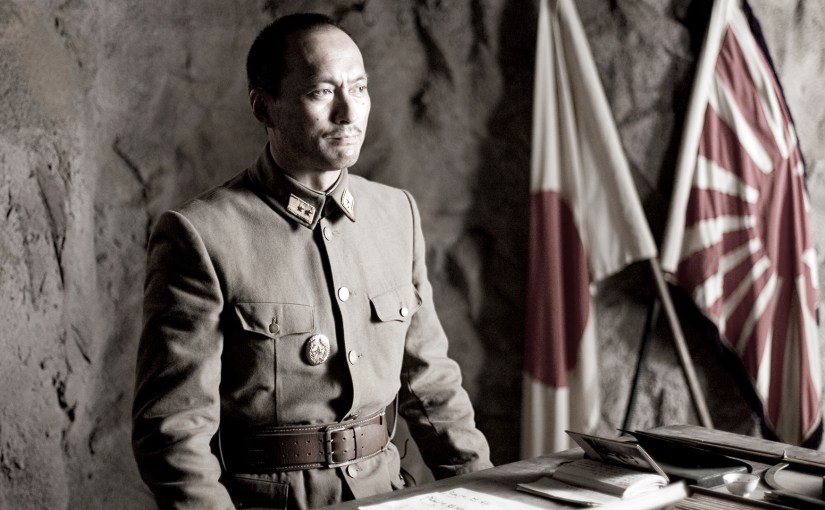
Ken Watanabe portrays General Kuribayashi.  In the beginning of the film, he is writing a letter to his wife as he is landing on the island days ahead of the battle to come.  One of his biggest concerns is that he did not finish installing the kitchen floor in his home before leaving. Kuribayashi is a celebrated strategist and hero, who actually studied and worked abroad in the United States.  He even broke bread with famed American military leaders and carries a valuable gift from them in his holster.  Yet, he is committed to his country’s Imperial Army and he knows he will not return home from this island.  He also knows that he will have to kill the very same men that he shared a meal with just a few years earlier. That kitchen floor is what is on his mind. 

A young infantryman named Saigô (Kazunari Ninomiya) was forced to enlist while his loving wife is carrying their child.  I’ve seen character situations like these before.  It’s much more revealing to see what cinematic history has described as the enemy to my John Wayne and Clint Eastwood heroes, though.  Recently, I listened to The Cine-Philes podcast recap of the film Crimson Tide, and they focus heavily on the midway dinner scene among the officers.  Denzel Washington’s character concludes that “…the true enemy of war is…war itself.”  Letters From Iwo Jima delivers on that argument.

Ahead of the well-known battle, there’s a quiet tranquility among the Japanese troops.  They debate about digging trenches and even fighting on the island which is devoid of any stronghold or power.  It’s also an unwinnable battle as the Japanese have realized that they are getting no air or naval support because much of their military cavalries have already been decimated.  The ultimate purpose for these men is to hold off the Americans, who are ten times more powerful, for as long as possible.  No man serving the Imperials is to surrender.  They will fight until they are as good as dead.  General Kuribayashi’s best idea to hold out is to dig caves within the mountainsides, thus making it challenging for the American soldiers to locate Japanese within the darkness of the caverns.  It worked longer than it should have as the engagement that was expected to only last five days went as long as thirty-six days instead.

Disturbing moments within the film do not compromise.  A small unit’s unified shout of “BANZAI!” will live with you forever when you see what they jointly commit within the cave they occupy.  Eastwood convincingly shows you the carnage.  Another character recollects how he was enlisted for five days in the military before he was forced to serve at this miserable place for disobeying a direct order. His humanity undid him.  Letters From Iwo Jima tells the stories before the occurrences that left gravesites (estimated to be ten thousand Japanese men lost) on its black sand beaches.

In a way it makes me proud that Clint Eastwood chose to direct Letters From Iwo Jima.  While his war pictures (Where Eagles Dare, Kelly’s Heroes), and even his Dirty Harry films which lean on prejudice for the truth found in humor, are endlessly memorable, he opts to take a sensitive position to the other side of the coin.  Eastwood does not lose sight of the fact that his heroes celebrated during the first half of his career were heroically killing and taking out fellow humans.  Letters From Iwo Jima recognizes the loss of humanity amidst the rocket fires and artillery of violence.  Six Japanese men will take to killing a captured American by beating and stabbing him into lifelessness.  Later, faceless Americans concealed by the director’s familiar shadows of photography will point blank kill a pair of unarmed Japanese men. 

Flags Of Our Fathers points a critical eye at the celebrations of victory.  Letters From Iwo Jima acknowledges victory is beyond reach but the enemy of all of us, war, is never done with any of us.

GODZILLA: KING OF THE MONSTERS (2019)

by Miguel E. Rodriguez

Director: Michael Dougherty
Cast: Kyle Chandler, Vera Farmiga, Millie Bobby Brown, Ken Watanabe, Bradley Whitford
My Rating: 6/10
Rotten Tomatometer: 40%

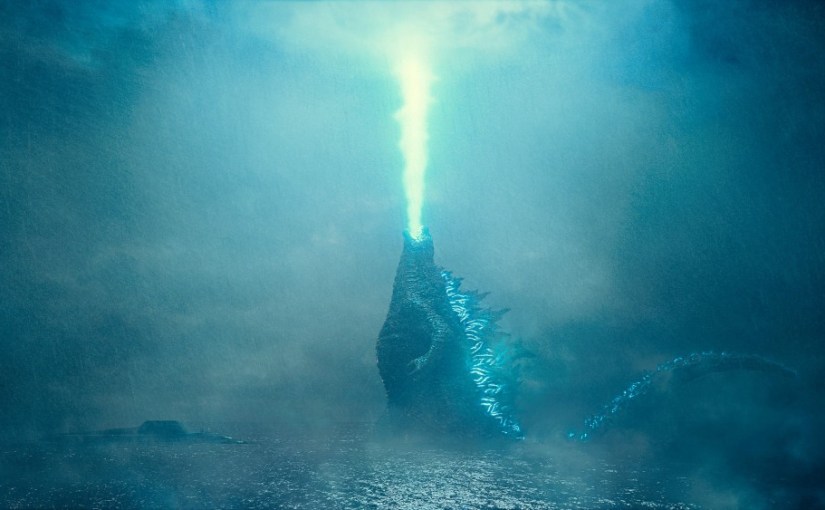
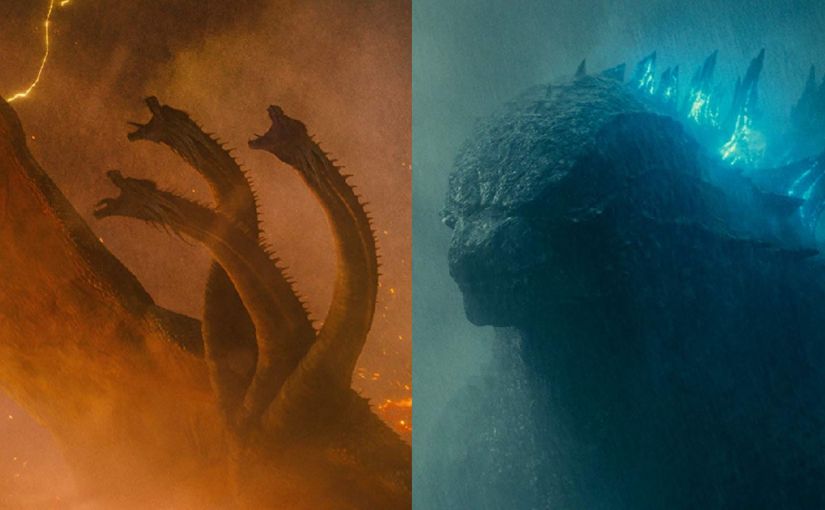
PLOT: Five years after the events of Godzilla (2014), humanity finds itself once again at risk as multiple titanic creatures awake from slumber and wreak devastation on the planet.  Who can stop them?  Indeed, WHO?


In many ways, Godzilla: King of the Monsters reminded me of Guillermo del Toro’s kaiju epic Pacific Rim, although, to be fair, the monster battles were far superior in del Toro’s film.  But that’s the framework in which this movie should be measured: the monster battles.  With a title like King of the Monsters, one shouldn’t walk into a screening of this film expecting a screenplay by Ernest Hemingway.  You won’t find self-reflexive, multi-layered dialogue here.  You want that, wait for Oscar season later in the year.

No, this is a popcorn movie, pure and simple, and on that level, I believe it succeeds.  We got two monster “species” total in 2014’s Godzilla reboot, and in this sequel, we get an additional six at least.  We got two major monster sequences in the first film…this time we get, jeez, four, I think?  I lost count.  In the summer blockbuster vein of “bigger is better”, G:KotM pulled out all the stops.

At least, in terms of the monster battles.  The screenplay is one giant cliché after another.  Think of the screenplay for Independence Day and square the cheesiness factor.  Then think of all the monster movies you remember from your youth, and imagine someone funneled every cliché from those terrible scripts into this one.  Yeah, it’s like that.

  • One character talks about humanity being a scourge to the planet, and how it ought to be eradicated by the titans in order for the planet to survive.  As my friend Marc Sanders pointed out, they should have just called Thanos; he could have fixed the problem in a SNAP, thank you, I’m here all night.
  • At one point, a kidnapped little girl is taken to a military-style bunker and, in a feat that rivals Houdini, manages to steal an EXTREMELY important piece of hardware, climb into an air shaft, and literally stroll out the UNGUARDED front gate, presumably while all the grownups are too busy watching the world end on their computer monitors.
  • At another point, it’s determined that the best way to revive an injured Godzilla is to fire a nuclear weapon into his radioactive underwater lair.  Alas, the launching mechanism has failed, and it’s impossible to detonate it remotely, meaning someone must volunteer to hand-carry a nuclear warhead, place it literally RIGHT NEXT to Godzilla, and blow themselves up.  Because, why not?  Instead of feeling like a heroic moment, it felt really, REALLY contrived.

But, I mean…it’s not like any of that really matters here, does it?  To re-state an important factoid, the title of the movie is Godzilla: King of the Monsters.  KING OF THE MONSTERS.  This is simply a mindless, monstrous summer diversion that oddly appealed to me, but only when we saw the monsters fighting.  It kinda took me back to my childhood, watching one of any number of Godzilla films in syndication.

I’m not saying it’s better than the 2014 film, let me be clear.  I thought that film, helmed by Gareth Edwards (who went on to direct the sensational Rogue One), was a more “awesome” movie in the most literal sense of the word.  There was a sense of grandeur, almost, to Godzilla that bordered on reverence. King of the Monsters is all about the fight.  The rumble.  The battle for dominance.  Only one can be king, and Godzilla will not give up his throne without a fight.  Or three.

Many moons ago, I went with my good friend Marc to see what promised to be a cheesy movie: Freddy vs. Jason (2003). Was it cheesy? Yes. But did it deliver on its title? Brother, we got, not one, but THREE showdowns between the two title characters. I got what I paid for and had no complaints.

Same principle applies here.

GODZILLA: KING OF THE MONTSTERS

By Marc S. Sanders

Godzilla: King Of The Monsters

Imagine our reaction upon learning that the cast of this epic features the following:

Academy Award Nominee: David Strathairn

Academy Award Nominee: Ken Wantanabe

Academy Award Nominee: Vera Farmiga

Academy Award Nominee: Sally Hawkins

The FBI Guy from The Wolf Of Wall Street: Kyle Chandler

Emmy Nominee: Millie Bobbie Brown

Emmy Nominee: Charles Dance

…and the guy from Speed and Terminator 2: Judgement Day and most importantly the 2nd episode of What’s Happenning!!!: Joe Morton

Here is a film where scientist Vera Farmiga justifies waking up 10 million ton monsters on earth because it will “SAVE THE EARTH FROM POLLUTION DUE TO OVER POPULATION.” (Ahem, couldn’t she have just called Thanos?”)

Here is a film where scientists reason that the only way to communicate with Gorjira (a bad ass looking three headed Hydra) is by humpback whale frequency. (Ahem…one more thing…couldn’t Spock simply travel back to the mid 1980s and pick up George & Gracie?)

Here is a film where Boston is brought down to rubble save one street conveniently available for a Hummer to race down so that Kyle Chandler and Vera Farmiga can race back to their house to find daughter Millie Bobbie Brown safely taking refuge.

Despair not though my friends.

Boston survived!!!

There was one sole remaining functioning traffic light still standing following the mass destruction. That’s all I need for self assurance.

Let me tell you something though. You get your money’s worth out of this mashed potatoes of a film. One of the best comedies of the year!!!

It was a lot of fun.