A BEAUTIFUL MIND

By Marc S. Sanders

The genius was always easier than living with the monsters in his mind.  So was the dilemma that consistently plagued Nobel Prize winning Professor John Nash.

Ahead of seeing A Beautiful Mind for the first time, what you don’t know about Professor Nash is what will dazzle you the most when Ron Howard uncovers the mysteries he lived with during graduate school and on through his fellowship at MIT and with his enduring and loving marriage to his wife Alicia (Jennifer Connelly in an Oscar winning role).  John Nash is masterfully portrayed by Russell Crowe in a celebrated, nominated performance.

Dr. Nash comes off like a genius savant when Howard’s film introduces him in 1947 at Princeton University.  The director adopts a technique of presenting much of Nash’s depths and highlighting patterns and numbers in magazines or on chalk boards or even within the reflections that appear before his eyes in bright sunlight.  On a clear night, see if you can find an umbrella within a starry sky. 

For many of us, I presume it’s hard to decipher what it means to live the life of a mathematical genius. Ron Howard with Akiva Goldsmith’s hailed adapted screenplay does not expect anyone to comprehend formulas or equations.  The filmmakers simply ask you to witness how discovery is processed.  Nash writes endlessly on his dorm room windows.  He fills up every inch of the chalk boards at his disposal.  He tears apart articles in magazines and wallpapers his room and office with them.  Even when he is not writing, he is computing how situations will end up best towards his and his peers’ advantage. There’s one curvaceous, blond woman standing in the center of a bar for one of the men to hopefully have a tryst with, but then who will be left to pair with the dark-haired ladies that surround her?  Nash finds the logic in all of the men abandoning the blond.  The genius realizes what none of us can see.  Go for what no one would ever expect to have occurred.

Despite the professor’s odd ticks, unwelcome vernacular and his lack of social skills, a well-established livelihood works out for him.  He falls in love with a former student that he marries, Alicia, and he obtains a fellowship for himself and two Princeton comrades to practice out their theories at MIT.  Personal companionship arrives with his former roommate, Charles (an energetic Paul Bettany), and his niece.  On the other hand, John has also been recruited to become a code decipherer for the government and he must answer to a mysterious gentleman named Parcher (Ed Harris) who is using John to stay a step ahead of the Soviets.   John’s work must remain top secret and as his clandestine activities become more threatening and intense, so does the paranoia get increasingly overwhelming.

I’ve only covered the first act of A Beautiful Mind because when the truth of John Nash’s purpose and how he is regarded is revealed, this biography becomes something much further from how it began.  Akiva Goldsmith’s trickery in his script is capable of surprising an audience when some veils are lifted for both the primary subject of this piece and those who come in and out of John Nash’s life.  This is a true story but it’s incredibly surprising that a mathematical wizard like John Nash could be living a whole other life that makes little sense at first.

Ron Howard is doing some fine work here reaching for material that might feel familiar with other cinematic geniuses in film ranging from the fictional Will Hunting to more recently real-life figures like Mark Zuckerberg. Characters like these stand out for their quirkiness and oddities.  With Russell Crowe’s brilliant characterization of awkwardness in his uneven walk and how he carries his papers and briefcase, it is not hard to adapt to the man on film.  What he says and how he speaks would leave any one of us to roll our eyes at his behavior.  You’d likely chortle at John just as his Princeton classmates do.  Later though, you understand how valuable his accomplishments are to a greater good, and at the same time you become alarmed at how Dr. Nash is being used both from his own perspective as well as by those figures who unexpectedly enter his life and will not just leave.

Jennifer Connelly’s role does not amount to much at first.  With her alluring looks that have graced other films in her earlier career, she initially comes off as a token spouse to the main character and you remind the person sitting next to you that is actress Jennifer Connelly who got her start in Labyrinth with David Bowie, and Once Upon A Time In America with Robert DeNiro.  Yet, as more dynamics are revealed about her husband does the character Alicia show through, and she has no choice but to survive with her spouse’s torment.  Connelly has a scene that will crush you when she must unleash her frustrations in the middle of the night as well as sporadically throughout the film. She has to be carefully observant of her husband’s behavior for the safety of their child and herself.  Ron Howard sets up scenes that haunt Alicia only, and his wide camera work is absolutely eye opening as it lends to her personal performance.

It’s fascinating to observe John Nash’s willpower as he persists to live with personal demons while upholding the demands of his genius.  This film works on so many levels of enhanced editing and perspective, but without unforgettable work from Russell Crowe, Jennifer Connelly, and a supporting cast of character actors like Christopher Plummer, Josh Charles, Judd Hirsh, Ed Harris and Paul Bettany it could not sustain its staying power. 

A Beautiful Mind is a thoroughly effective biography.
TEACHERS

By Marc S. Sanders

I grew up watching the television show M*A*S*H with my mother and brother.  Don’t hate me but I have yet to see the Robert Altman film.  Perhaps that is because I was afraid of major disappointment.  The formula for many of the episodes and seasons of the TV show work so well at blending tidbits of comedy within a setting that is nothing else but bloody turmoil.   For those characters to survive required all of them to laugh and lampoon into the face of an uncontrollable situation where their lives could end at any time while they live in misery.

These thoughts came back to me as I watched an unsung and forgotten film from 1984, Teachers directed by Arthur Hiller.  John F Kennedy High School is only going in one direction which is very far south beyond the gates of hell.  A gym teacher is getting students pregnant, a kid shows up at the principal’s office with a stab wound in the arm, and the school psychologist has just lost her marbles because the old fart tenured teacher hogs the ditto copy machine (Remember those?  You could get high off the ink on the paper.).  A mental patient has managed to worm his way into a comfortably welcome substitute teacher position.  The driver’s ed car has been stolen and one student terrorizes another teacher in an assortment of ways beginning with biting and then moving on to theft.

Alex Jurel (Nick Nolte) is the admired social studies teacher who has lost his passion for the profession.  It’s not so much that the student body or the teaching staff is out of control.  The whole administration has taken to a new mentality of profit over proficiency.  The merits that come with an education are all but dismissed.  The assistant principal (Judd Hirsch) used to care as well.  Now, his job is to maintain a façade for the school and churn out one student body after another year after year.  The principal only knows to answer any questions with a genuine “I don’t know.” reply.  Bottom line is no student should ever be flunked from John F Kennedy High School.  If they can read enough, then it’s enough to get the diploma.

A former student of the school is Lisa Hammond (JoBeth Williams), now an attorney and representing a graduated student who is suing the school claiming he is an illiterate who cannot find a job or begin a future due to the negligence of the school. Lisa is a crusader.  She’s not here for the money to be earned from the case.  She’s here to make a change and her lynchpin deposition will come from Alex who will testify about the truth that’s occurring. Hopefully, he will also recruit other teachers in tow to back up the claim.  Naturally, as his former student with the nice ass, Lisa becomes involved with Alex on the side.  Like most movies, this one also does not question the conflict-of-interest circumstance.  We just have to roll with it.

I really take to the dilemma of the school and I understand both sides of the argument.  Now, more than ever, over forty years after the release of this film, I think our educational system is in dire straights with minimal funding, lack of support and respect for a teaching staff, parents who exonerate themselves of being responsible for their children’s lack of progress and behavior, and then of course there is the very real epidemic of school shootings and on campus violence. 

However, school is a necessary element to our society and its where all of us begin.  To uphold a reputation will involve both losses and wins.  Not every student will make it.  Not every student will miss out either.  As Judd Hirsch’s character insists, half of these students will not graduate with a proper education but half of them will.

Okay.  Enough arguing!  How about Arthur Hiller’s movie? Teachers has much to stand on and I wish it had garnered more attention.  It’s undoubtedly worthy of it. 

Like M*A*S*H, there’s organic comedy that comes from the film and a variety of teachers and students appear like they have been cut from familiar cloths.  Most of the comedy works especially well.  I love the ongoing joke of the one teacher who sits at the back reading his paper and dozing off, with the students facing away from him while they complete an assignment during the period.  The punchline to this joke may be predictable, but I’m still allowed to laugh as I watch it play out.  It’s funny. 

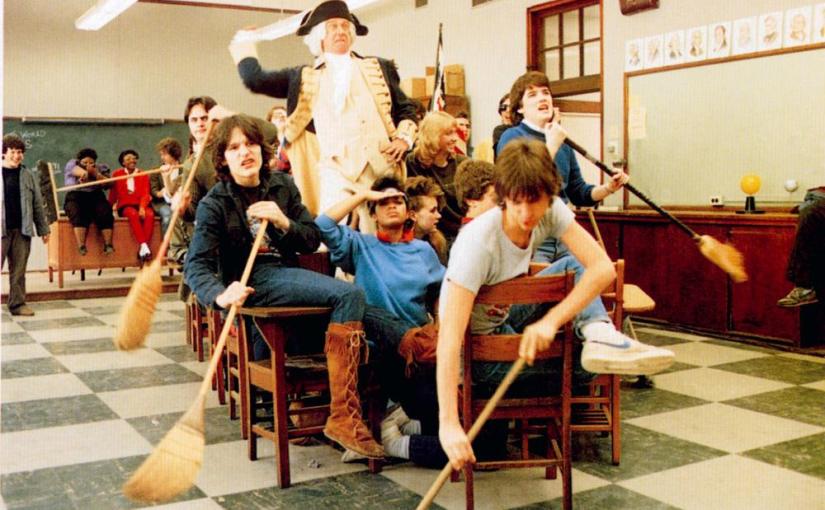
Richard Mulligan (Empty Nest) plays a mental patient that ironically engages his students when he conducts his classes dressed as famous historical figures like Lincoln and Custer.  Watch him reenact George Washington’s crossing of the Delaware with his students “rowing” the boat.  It’s an image I will not forget.  Nor will I forget his final scene in the picture as he encounters Nolte’s character in the hallway.

Where the film falls short is in the one student that is primarily focused on, played by Ralph Macchio, shortly after coming off his first Karate Kid movie.  Just like in The Outsiders, which I recently wrote about, Macchio relies on his dark complexion, stylish black hair, blue jeans and that popped up jacket collar again.  There’s also that strut he always has.  Forgive me for beating up on the kid, but too often I see Macchio donning the same image – that cool kid pose needed for the cover of Teen Beat Magazine.  Nick Nolte shares a lot of scenes with the actor playing the troubled kid with a sixth grade reading level.  However, Nolte is the only one working most of the time.  Another actor in this role would have served better.  It’s a necessary role as it attempts to awaken Nolte’s teacher character to try saving another kid before he gets lost.  Back then, maybe Emilio Estevez or Lou Diamond Phillips would have been more suitable.  Instead, we get Ralph Macchio being Ralph Macchio all over again.

Teachers is a comedy drama that mostly works.  It’s easy to get caught up in the comedy and, sadly, the absurd truth of what goes on in a metropolitan public school system back in the 1980s.  There’s also very dramatic and heavy elements to the film that stay with you.  Before school shootings no longer became shocking (a sad and current truth), Teachers explored the trauma of school bullying and the response the comes with that issue.

Arthur Hiller’s film did not invent the wheel on troubled times within school.  Heck, even The Sweat Hogs from Welcome Back, Kotter were troublemakers too.  Not to mention there are other school dramas to come before, like Blackboard Jungle.  However, Teachers is an very engaging film. I was completely absorbed as soon as the movie began, first in its comedy, and then later in its drama.  A near final scene of the film is eye opening and much like Steel Magnolias will leave you laughing and crying all at the same time.  That happens because you quickly begin to care for most of these characters and the turbulent times they live through as a teacher making next to no money while working under unfair and unreasonable scrutiny.

I think Nick Nolte is delivering one of the best performances of his career.  He has great chemistry with JoBeth Williams, who is good in her role.  The romantic storyline does not go overboard.  It does not get schmaltzy.  It is just enough, and it’s wise to include dialogue where they debate one another from two different sides of a coin.

Teachers also works as a great look back piece.  A lot of well-known, eventual recognizable actors round out this cast including Morgan Freeman, Crispin Glover, Laura Dern, Allen Garfield, and Lee Grant. Anytime Nolte is on screen, he only enhances the scenes he shares one on one respectively with most of these actors.  The moments between him and Macchio only work because of Nick Nolte.  Call Nolte the Alan Alda/Hawkeye Pierce of this picture. 

Teachers might look tame by the turmoil we see today in schools across the country but none of what is seen is untrue or exaggerated either.  Well, maybe except for the mental patient who arguably turns out to be the most engaging and influential instructor of them all.  That’s funny stuff, but you gotta be a little bit crazy to become a teacher nowadays.

THE FABELMANS

By Marc S. Sanders

Often, coming-of-age stories are narrated through the eyes of the child on the cusp of becoming a teenager or a grown up.  It’s important you realize that I say through the eyes, however.  It’s what the protagonist observes that allows him or her to appreciate, and comprehend.  Steven Spielberg will tell you he came of age by learning how to make movies.  It stands to reason however, that he did not come of age by looking with just his eyes, but rather with his 8mm and 16mm cameras.  The Fabelmans is a fictionalized, loose interpretation of how the celebrated filmmaker transitioned from adolescence into young adulthood with dreams of telling stories with movie making inventiveness.

Sammy Fabelman (Gabriel LaBelle, the older version; Mateo Zoryan, the younger version – both performances are magnificent) is escorted for the first time to the movies by his parents Mitzi and Burt (Michelle Williams and Paul Dano) on a wintery New Jersey night in 1952, where he sees The Greatest Show On Earth.  For eight year old Sammy, what starts out as nervous fear of what to expect in a dark theater with a giant screen turns into exhilaration as a car does a head on collision with a locomotive.  Shortly thereafter, a series of eight Channukah gifts assemble a Lionel train set for Sammy.  It’s exciting to see it go around on an oval track.  It’s more electrifying to preserve it on film with a toy car driven by a Mordecai figurine crash right into the steam engine and the boxcars hitched to it.  That was Mitzi’s idea to capture it on film.  That way Sammy can get a thrill out of watching the accident over and over again without causing any further damage.

Sammy only progresses from there.  When Burt gets a job promotion, the family moves to Arizona.  The desert allows a teenage Sammy to continue with his love of filmmaking by shooting his family during the cross country trek and then making westerns and war films with his Scout Troop pals as the actors.  He sets up tracking shots by propping his camera on a baby carriage rolling along cardboard laid out on the ground.  Ketchup becomes blood.  Sammy is even inventive enough to poke holes in the actual film strip at precise moments when his sheriff and outlaws fire their six shooters.  Now it really looks like the cowboys are shooting real rounds of gunfire.  Mom and dad, his sisters, his teachers, and friends are all impressed. 

His Uncle Bennie (Seth Rogen) is also dazzled by Sammy’s natural talent.  Bennie is Burt’s best friend and co-worker, and per Mitzi’s insistence he moves to Arizona with the family.  By use of his camera and editing machine, Sammy will soon learn that Bennie actually means more to Mitzi than he does to Burt. 

With a script that Spielberg constructed with Tony Kushner, the director/writer depicts a kid, much like he was, who expressed his honesty and learned the truth about the people around him when his projector was on.  The camera doesn’t lie, ever.  A motion picture camera will even hold on to the final beats of a person’s pulse before they finally expire.  That one moment in time where there’s life and then suddenly there’s death can be eternalized on film, forever.  It’s through this storytelling device that allows The Fabelmans to stand apart from other coming-of-age films like Rebel Without A Cause or Splendor In The Grass or any of the John Hughes brat pack films.  The childlike quality yearning for adventure and fantasy shines through with Sammy’s westerns or John Wayne inspired war pictures.  Sammy also realizes though that he can pick up on real life and emotion with his 8mm, like on a family camping trip.

Michelle Williams gives an outstanding, sometimes ethereal performance.  It’s real.  She’s not doing fantasy.  Yet, she lives for the fantasy and adventure.  I recall a well known anecdote of Spielberg where he described in his youth, his father woke up the family in the middle of the night to watch the skies for a meteor shower.  (Watch The Skies was the original title for his film Close Encounters Of The Third Kind.)  In The Fabelmans, Mitzi enthusiastically takes her children in the car to pursue a tornado.  Later moments will have her dancing freely in her nighty in front of the car headlights while the family is camping; uncaring over the fact that her dress is see through.  Sammy will notice how awkward his father Burt feels, while at the same time seeing how enamored Bennie is at the sight.  Williams has a beautiful balance though of a woman trying her best to appear happy and collected for the sake of her children and husband, but not living the story she wants.  This will influence Sammy as he maps out his own future.  He’ll live the life he wants.  Learning the merits of algebra will never hinder his destiny to make movies.

Later occurrences will show evidence as to how well Sammy can capture reality with his camera.  Following a series of bullying and antisemitic teasing after the family transitions to northern California, Sammy is welcomed to shoot the senior ditch day at the beach.  A telling moment occurs when the film is shown at the prom.  The taller bully is overwhelmed by how championed he’s depicted in the film.  He’s bordering on furious with Sammy, though.  The mean kid knows he’s cruel to the scrawnier, Jewish Sammy, and it immediately eats away at him with guilt over his past treatment.  Sammy’s film has changed and disrupted this kid.  Another kid bully is shown to look like the jerk he is and nothing else.  He walks alone on the beach.  He’s not an athlete.  He’s nothing but a no talent, unlikable antisemitic jerk.  This kid is also changed because now he can see what he truly is as the viewer looking at his own cruel behavior shown on film for the whole world to see.  Movies will bring out what we harbor deep down, inside. 

Ironically, Sammy is so well versed with camera work and follow up editing that he is practically unaware of how durable his theme of honesty through the lens truly is.  What Sammy captures comes without even trying and it sends a raw emotion to the viewer, whether it’s a mean-spirited bully or even his own mother watching.

Steven Spielberg could never be anything else except a movie maker.  Yet, after over five decades he’s still introducing audiences to new kinds of accomplishments.  He started as a director with adventure and fantasy on his mind with the likes of monster trucks, killer sharks as well as swashbuckling treasure seeking and visitors from outer space.  Later, he had to reinvent his craft and think outside his fanciful dreams to show brutality and hope through horrifying moments in history like the abuses endured by black southern plantation dwellers, slavery, the Holocaust and the unglamorized harshness of war, political unrest, and terrorism.  Further on, he carried out the romance of stage musical performance and even learned to poke fun at his own past accomplishments.

In the short period of time that we get to know Sammy Fabelman, we see transfers of perspective in this young boy’s outlook through a camera.  Sammy goes from making silly mummy monsters of his sisters to intimate hand holding shared by his unhappy mother and the man she truly loves, a man who is not his father. 

Whether he is watching his own films, or it is his friends, or his mother, his father or even his tormentors at school, Sammy realizes that a film will always do one thing and never falter away from that one thing.  His camera will always, always, always tell the truth. 

Thankfully, a truly inspired epilogue moment, which left me with a big, enthusiastic grin, has Sammy still learning that as frank as his filmmaking may be, it’s important that it is also never boring.  I don’t think I have ever been bored with a movie made by Steven Spielberg.

RUNNING ON EMPTY

By Marc S. Sanders

Director Sidney Lumet’s 1988 film, Running On Empty, depicts Judd Hirsch and Christine Lahti as former radicals against the Vietnam War. They have been running from the authorities for 15 years after bombing a Napalm laboratory as part of their cause. They have two sons, one of them played by River Phoenix with a chance to attend Juilliard. His opportunity does not seem likely however as it would mean he could never see his family again, and his family is reluctant to set him free.

In a film about criminals, this is a story lacking in crime or violence. Lumet’s film is a narrative of a family and how they live by constantly changing their identities, backgrounds, and residences. It’s not a life for an innocent child, especially one with a promising future.

Phoenix was nominated for an Oscar for his conflicted role. He’s quiet, but he’s torn and he’s accepting of what fate brings him. Sadly, he prevents himself from making his own destiny. A bright element comes in the form of fellow student Lorna, played beautifully by Martha Plimpton. This is her best role as Phoenix’ girlfriend who falls in love with him and shows him pure happiness. She’s the fulcrum that introduces him to what possibilities are available, but he’ll have to sacrifice his current life for a better one, and his parents will have to accept his decision.

There’s no easy wrap up in screenwriter Naomi Foner’s Oscar nominated script. A painful outcome is inevitable. Yet, that’s what makes this a great drama. The conflict is too great for an easy resolution.

What a terrible shame that 5 years after this film, at age 23, River Phoenix died of a drug overdose. Imagine what he would evolve into as an actor. Here in this role, as well as films like The Mosquito Coast, Stand By Me, and even as a young Indiana Jones, he was more than just a child actor or a teen magazine cover. He performed with a mystery to his characters where he would never reveal every dimension that his parts possessed. In a film like Running On Empty you almost wish his real life fate never came true.

ORDINARY PEOPLE

By Marc S. Sanders

Psychiatry is regarded as a stigma within the world of Ordinary People.

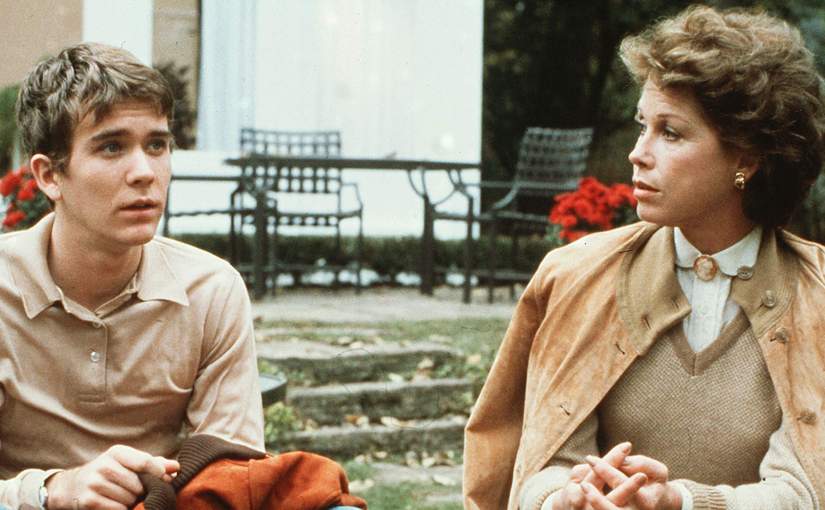
Robert Redford’s Oscar winning directorial debut centers on a troubled high school student named Conrad (Timothy Hutton in an Oscar winning role) who finally gets the gumption to see Dr. Berger (Judd Hirsch) following a suicide attempt brought on by the guilt he carries when he could not rescue his older brother, Buck, in a stormy boating accident. His parents, Beth and Calvin (Mary Tyler Moore and Donald Sutherland), accept this action with differing viewpoints.

For Beth it’s shameful and unnecessary to see a doctor. Her stance is made all the more clear when her own mother frowns upon this, especially with this doctor being a Jew. On the other hand, Calvin looks at it as an opportunity for a breakthrough. This doctor could really be good for Conrad. Beth is embarrassed when Calvin has a few drinks at a neighborhood dinner party and shares these developments with some friends.

For a WASP community, seeing a psychiatrist is not regarded well. It shows that Beth’s image of a perfect lifestyle is tainted. Any problems they have should be resolved in the home. What never occurs to Beth, however, is the resentment she fails to hide for her second son. There’s nothing breaking through Beth’s exterior to allow her true feelings to come out. By contrast, Conrad gradually lets his inner struggle loose and the film shows that it helps, as challenging as it could be.

In 1980, the prior year’s Best Picture winner was Kramer vs Kramer. Three years later it would be Terms Of Endearment. Hollywood was recognizing an audience’s interest in the domestic life. The Vietnam War was now in the past. Reagan economics were taking over and middle-class America seemed to be doing well. Redford’s adaptation of Judith Guest’s novel with a screenplay by Alvin Sargeant showed what was happening behind closed doors. Dramatic moments occur and they can offer a terrible shock in the moment but as days move on, so does everyone around you. You make efforts to do so as well, but you’re still weighed down by that one moment of loss.

Redford directs Hutton with quiet moments of anguish. Quick cut flashbacks offer a glimpse of what’s running through Conrad’s mind. Fortunately, it doesn’t run too long and upstage Hutton’s performance. Timothy Hutton is astonishing with his twitches and stutters and struggle to simply sit still. His blank stare of his blue eyes covey his deep depression. When a girl classmate takes notice of him, you feel the remedy of his sessions starting to make a difference. Where his mother refuses to recognize his need for love, someone else does and you feel better about yourself as well.

There’s always a reason to live. Dr. Berger reminds Conrad of that. Judd Hirsch is right for his role against the waspy wealth of Conrad’s upbringing. He encourages a “not giving a shit” attitude to how people perceive Conrad. We all want a mother’s love, but it doesn’t always work out that way. We want to be accepted at school. That might not work out either. With his sloven stature and chain-smoking manner, Hirsch is very convincing in reminding Conrad to say it’s okay to tell someone to fuck off, and most importantly to stop punishing himself for saying it.

Mary Tyler Moore and Donald Sutherland work incredibly well at conflicting with each other while also convincing us that before this terrible accident they likely complimented one another perfectly. Yet, as the film explains, life gets messy. The question is how best to respond when the mess appears and stays with you. Conrad finds the benefits in seeing a therapist like Dr. Berger. Beth will hear nothing of the idea. A magnificent scene done with one tracking camera comes out of nowhere while Beth and Calvin are playing golf with relatives. A slight mention of their son by Calvin gradually explodes into what really sets Calvin and Beth apart from one another. All of their sub conscious thoughts explode on a crowded golf course in front of the community they’ve absorbed their history and marriage within. Redford gets the best beats out of his actors because the shields that maintain their personas will only hold for so long. It’ll break down at a time when it’s never opportune or convenient. This scene occurs near the end of the film as we see Conrad’s recovery, while Beth and Calvin are still mired in both individual and shared heartache and resentment. It’s a crescendo moment that the film builds to for these characters.

Within film discussions, Ordinary People is often sadly regarded as the film that once again denied Martin Scorsese of a well-deserved Oscar (for arguably his greatest work Raging Bull). I don’t think that’s fair, however. Some might say Ordinary People may be dated. However, now that I’ve finally seen the film, I can’t deny it’s importance. Mental health has become more apparent through all kinds of different social classes. Yet we still hide ourselves, and are encouraged to shelter ourselves under a facade of happiness. That can’t always be true for any of us. We, as humans, all suffer. We all feel pain or embarrassment or sadness. If anything, a piece like Ordinary People reminds us that we are all typical, and must succumb to dealing with issues far beyond our mental capacity at one time or another.