THE COLOR OF MONEY

By Marc S. Sanders

The Color Of Money is the first and only time that director Martin Scorsese tackled a sequel of sorts.  Paul Newman returned to the screen as Fast Eddie Felson, the hustling pool shark from thirty years prior in The Hustler.  That movie established his career on a bigger scale going forward.

Fast Eddie is older now, and wiser.  He’s much more humbled as a bar owner with a conservative amount of cash on the table to stake younger pool players for small time wagers.  A young John Turturro is who he relies on and quickly loses faith in when a brash, cocky kid named Vincent Lauria (a perfectly cast Tom Cruise) easily undoes his opponent. 

Eddie sees the talent in the kid.  He’s got a helluva break and clears a game of nine ball with as much speed as he has conceit.  What he lacks for in brains and instinct is made up in Vincent’s cool and mature girlfriend Carmen (Mary Elizabeth Mastrantonio in an Oscar nominated role).  It does not take long for Eddie to coach her into realizing that together they can make a lot of money off of what Vincent can do in pool halls across the country.  If only he’d listen to them and do what they tell him to do. Vincent can’t comprehend how sometimes you win a whole lot more, when you lose first.

Scorsese works his camera like a swinging Steadicam.  When he gets close ups of this trio of actors, it’s never just a close up.  He’ll position his lens in a northward direction and then swing around east.  Newman, Cruise and Mastrantonio trust the eye of the camera to follow their performances.  There’s an energy to this kind of shooting.  It makes for a great style.  Scorsese was doing this novel kind of filmmaking, going all the way back to 1971 with Alice Doesn’t Live Here Anymore.  The director is so favored because as typical as a script might seem by its title or its prose, he’s going to find an exhilaration to its narrative.

Along with the director’s resident editor Thelma Schoonmaker, there’s a crackle and quickness to the many variations of pool play – much more playing than I believe was featured in The Hustler.  Schoonmaker makes sure to cut in the cracks of the pool balls as they collide with one another.  The blue cue chalk snows off the tip of the cue sticks.  Reflections of the players appear in the shine of the balls.  Close up profiles of Cruise and Newman lower down into frame just before they take their shots.  Before the kinetic energy found in later films like Goodfellas and The Departed, Scorsese and Schoonmaker were already putting their tag team best at play in The Color Of Money.

Yet, all of this is style with not so much substance.  What kind of story does this next installment in the legacy of Fast Eddie Felson have to say?  Not much really.  While the three actors are doing top notch work, the conversations run very repetitive and do not build toward higher stakes or developments.  Time and again they argue over Vincent’s refusal or naivety to understand the hustling strategies that Eddie has in mind.  Carmen gets it but she goes her own way more often than cooperating with Eddie.  Simply, this is a story of the protégé not grasping what the mentor is trying to teach, and it never evolves from that problem.  It gets stagnant.

What changes within the second half of the film is the introduction of a championship pool tournament in Atlantic City.  Therefore, it’s easy to expect a showdown between Vincent and Eddie.  It happens and there is a twist of a dagger included, but then when the real competition is about to begin, Scorsese concludes his film.  Does it matter who is the better player?  I don’t know, but as the film is wrapping itself up, one character gets short changed.  When that’s discovered, the film opts to also shortchange the audience.  I didn’t think that was very fair.

I think about the notorious ending to the HBO series The Sopranos.  Sure, it’s an ending no one will ever forget but for all the wrong reasons, and I defiantly believe it is because the storyteller ran out of imagination or lost his confidence in upholding an ending that he really wanted.  I feel the same way with The Color Of Money.  The film establishes the skills, intelligence and capabilities of these characters.  Yet, when you take the tool kits away from them, the building never gets completed; only left abandoned.

I’m drawn to watch The Color Of Money.  Michael Ballhaus’ photography is smokey and colorful. I can’t get enough of Paul Newman’s gravelly vocal inflections or even how he unfolds hundred dollar bills from the roll in his pocket.  Tom Cruise humbles himself to look like an idiotic jerk and it works well against the maturity of his scene partners.  Mary Elizabeth Mastrantonio oozes sexual appeal with a lot of brains to uphold the cons.  She has sensational scenes with Paul Newman.  There’s a coolness to the picture because of the cast, the settings, the sounds, the visuals, the editing and the direction. 

This film arrived in 1986 with rock music from the likes of Eric Clapton and Phil Collins.  Beyond Miami Vice and an assortment of John Hughes teen flicks, these artists were making for effective needle drops of atmosphere in films from the 1980s.  Scorsese’s use of the camera keeps me engaged, but when I look at what the characters are anchored to only do, and never rise above, the film does not hold the weight of other character studies that several of Newman’s and Scorsese’s pictures were so astute at achieving.

One scene transcends the arc of Newman’s character and it works beautifully within or out of the context of the picture.  A relatively unknown Forest Whittaker portrays an unlikely kid who goes up against Fast Eddie. As the long scene evolves over their pool competition, the writing hearkens back to the weaknesses and torment that defined Eddie Felson’s character in The Hustler.  If you watch the first film and then jump over to this scene, you recognize a connection for the protagonist of both pictures.  Beyond that The Hustler and The Color Of Money stand a long distance apart from each other.  This scene though is always a favorite of mine for the eventual Oscar winner, Forest Whittaker.  Watch how Whitaker holds his cue stick when he exits the scene.  Think about how he picks the cash up from the table after Newman drops it.  Consider, what his character Amos really means when he asks Eddie: “Do you think I need to lose some weight?”

Had The Color Of Money used more of Whitaker’s character in the film along with the other three, there might have been something more solid to say and introduce within the world of pool hustling with a 1980s barroom vibe.  Same could be said if John Turturro’s character was utilized more.

Paul Newman received the Oscar for this picture.  The actor was nominated seven times before, having never won and the irony is by the time this nomination arrived, Newman opted not to attend the ceremony.  Roles in films like The Verdict (for which he should have won the award) and Cool Hand Luke were much more memorable and fleshed out.  I’d argue Newman likely knew this was not his best performance because it was not the best written of his long-established career, and so he genuinely did not expect to win.  Because he won, it became a celebration of his legendary status as an actor who should have been taken much more seriously, much sooner.   (Two more nominations would follow in Newman’s career.)

QUIZ SHOW (1994)

by Miguel E. Rodriguez

DIRECTOR: Robert Redford
CAST: John Turturro, Rob Morrow, Ralph Fiennes, Paul Scofield, David Paymer, Hank Azaria, Christopher McDonald, Mira Sorvino
MY RATING: 7/10
ROTTEN TOMATOMETER: 97% Certified Fresh

PLOT: In the late 1950s, a popular TV quiz show, along with its current champion, falls under federal investigation following allegations of rigging.


I imagine there will be no shortage of people more than willing to tell me how wrong I am, but while Robert Redford’s Quiz Show was well-directed, well-written, and well-acted, I never fell completely under its spell.  For that matter, it never felt like it had the director’s stamp on the material; a lot of it felt like a Ron Howard film.  No doubt the story captured a lot of attention when it happened in the late ‘50s, but it failed to grab mine, at least to that same degree.  It’s too well-made for me to skewer it mercilessly, but neither do I consider it a masterpiece.  It’s…okay.

It’s 1957, and Sputnik captures the world’s attention at (or at least near) the height of the Cold War.  To distract themselves from Sputnik’s implications, Americans tune their TV sets to the most popular game show on the air: Twenty-One, in which competing contestants are asked random trivia questions while isolated from each other.  These questions are something else.  One multi-part question includes: “Who rode with Paul Revere?  Who lent him his horse?  Was it a mare or a stallion?  And what was the horse’s name?”  I mean, really?  The current champion, Herbie Stempel (John Turturro), knows these answers and many others and has become something of a local hero, but he’s not terribly photogenic, with his oversized shoulders, those nerd goggles, and that one rotten bicuspid that you can’t take your eyes off.

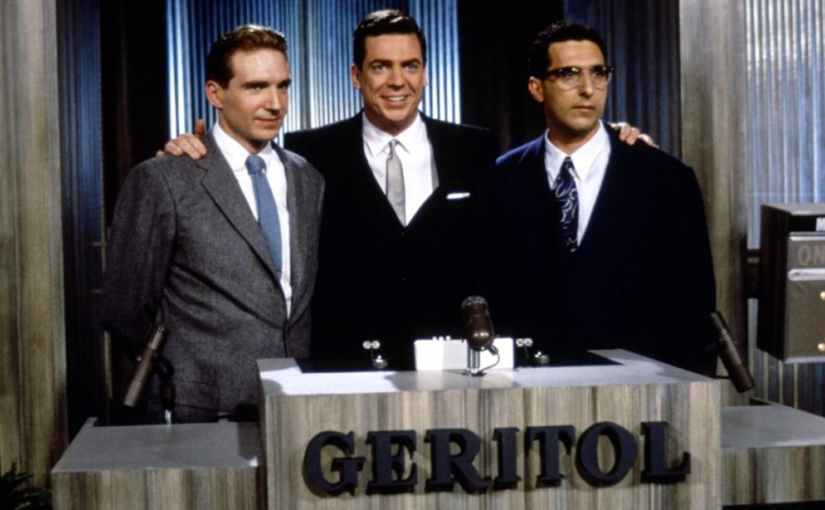
Twenty-One’s showrunners decide Stempel’s run has come to an end and hatch a plan to throw the next episode to handsome young Charles van Doren (Ralph Fiennes), a Harvard professor who in real life did not look quite as handsome as Ralph Fiennes, but whatever, this isn’t a documentary.  Both Van Doren and Stempel comply with this plan, but the scenes in which they make their decisions felt contrived, or false, or something.  I was never convinced of their motivations.  Stempel needed the money but was supposedly swayed by the possibility of being awarded his own “panel show.”  Van Doren clearly didn’t need the money and even turns the offer down at first, but then he changes his mind because…I guess he needed a way to live up to his Pulitzer-Prize-winning father?  All the pieces are there, but it’s never fully explained until his final speech in front of a Congressional committee.

The story engine involves a young DC lawyer named Dick Goodwin (Rob Morrow) who gets a whiff of potential scandal and, eager to make a name for himself – as a possible parallel to Van Doren himself – does some independent investigating.  His digging leads inevitably to Stempel, who is more than happy to name names, but whose irascible personality makes him a less than ideal witness.  Things get interesting when he interviews Van Doren.  He is clearly suspicious, but no hard evidence appears…until he watches an old clip of a previous Twenty-One contestant who appears to give an answer the host was not expecting…

I don’t know how relevant this is, but I feel compelled to observe that director Redford seems to have phoned in a lot of favors when it came to casting Quiz Show.  In addition to the fine performances from the leads (Rob Morrow is outgunned by Turturro and Fiennes, but he holds his own), the supporting cast reads like a Woody Allen picture: David Paymer, Hank Azaria, Christopher McDonald (perfectly cast as the smarmy, superficial host of Twenty-One), Mira Sorvino, Martin freaking Scorsese, and walk-ons by Timothy Busfield, Ernie Sabella, Barry Levinson, Mario Cantone, Illeana Douglas, Calista Flockhart, and a blink-and-you’ll-miss-him Ethan Hawke.  Redford clearly wanted to make sure his canvas was deep and well-drawn, and not just with the impeccable period production design.

But to what end?  I went into Quiz Show thinking it would involve a much deeper conspiracy than just two showrunners who, following orders from corporate, simply bribed several contestants to follow a scripted playbook.  About halfway through the movie, I realized there was not going to be much more to that part of the story, and we were going to follow the lawyer on his quest to uncover the truth, and I was like, “…that’s it?”  Does that make me guilty of criticizing the movie that I wanted it to be, instead of criticizing the movie itself?  I’m not sure.  Rightly or wrongly, I felt the movie wanted me to empathize or sympathize, or one of the -izes, with Van Doren.  But I was not moved to goosebumps by Van Doren’s final speech at the end of the film.  I found myself siding more with the committee member who says, “I don’t think an adult of your intelligence ought to be commended for simply, at long last, telling the truth.”

(I suppose a case could be made that the whole film is a parable for Watergate, still several years in the future; Nixon is name-dropped a few times.  The end credits inform us that NBC and Twenty-One’s sponsor, Geritol, were never indicted because their underlings claimed full responsibility for their actions, much like Haldeman, Ehrlichman, and the rest.  Does the buried subtext of America’s lost innocence make Quiz Show a better film?  Maybe a little, but only when you stand back from it, not while you’re watching it.)

TO LIVE AND DIE IN L.A.

By Marc S. Sanders

William Friedkin is the director of one of the greatest automobile chases ever put on film with the 1971 Best Picture The French Connection. In 1985, he tried to up his game with the counterfeit caper called To Live And Die In L.A. He just about tops himself.

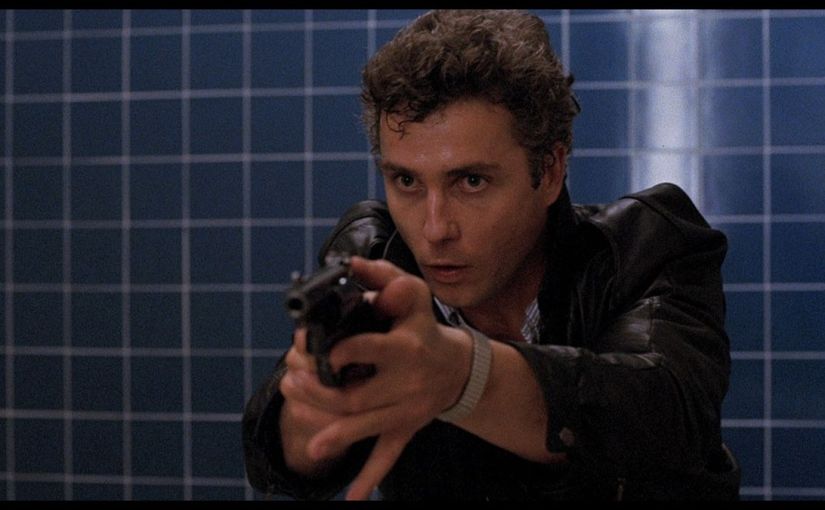
It is a dated flick with a Wang Chung soundtrack, popped up shirt collars, black leather jackets, and skinny ties. Friedkin goes Miami Vice and it more or less works but his lead player, William Peterson, is no Don Johnson. He’s more like a contestant on the dating show Love Connection.

Peterson plays a Secret Service agent with the last name of Chance; Richard Chance to be more precise. Kind of apprapo as he seems to always test his fate like bungee jumping off bridges (long before bungee jumping was ever a thing) and taking his tactics over lines that should not be crossed.

Chance is on the trail of nabbing counterfeiter, Rick Masters (Willem Dafoe), who killed Chance’s partner with only three days left until retirement. The cop who gets killed early on always seems to have three days left until retirement. To get at Masters will require Chance to…well…take some chances. He’ll blackmail a prostitute informant. He’ll also pressure his new partner (John Pankow) into circumventing policy. As well, like any movie cop or agent, he’ll go against the instructions of his supervisor. Chance might even rip off a diamond dealing exchange.

The acting is nothing special here. Peterson looks more athletic than fierce or driven. He’d never be Gene Hackman. Dafoe’s weirdly youthful appearance with his Benneton ‘80s outfits look…just that…well…weird! He’s an artist (like with actual paintings) while also printing fake money.

Friedkin’s film carries on its longevity through the years with an effective car chase; one of the best on film. From what I can tell he mounted a camera on the hood of the car. The camera can pivot 360 degrees. So we can see Peterson driving the car and then the camera can swoosh and turn to give a point of view as to where the car is driving. So now the viewer can see where the cars are careening and turning and speeding towards. It gets especially hairy when the car goes the wrong way up the freeway exit ramp into rush hour traffic. No CGI work here. This is in your face material.

To Live And Die In L.A. is worth the watch. A surprise moment towards the end also gets your attention by going against the typical cops and robbers formula film. The shoestring budget is apparent here with quite dull, very dull, cinematography and no big stars at the time (Peterson, Dafoe, Pankow, John Turturro, Dean Stockwell). However, William Friedkin does his best to make every moment worth it, and I can’t deny it, this 80s raised kid thinks the Wang Chung soundtrack is so friggin’ cool.

DO THE RIGHT THING

By Marc S. Sanders

inally, after 30 years, I’ve caught up to a film that has eluded me, Spike Lee’s masterpiece Do The Right Thing. Here is a film from 1989 that really could have been made in 2019. At the very least, it should be rereleased in the theatres. We desperately need this film right now.

My view of Spike Lee has gradually changed over just the last year. It must be due to the current political and socioeconomic climate. I’ve become terribly sensitive to what I see in the news these days.

Following seeing BlacKkKlansman and now this film, Lee really is aware of how low humanity can go. Do The Right Thing offers just a little push that leads to an endless fall, however.

Lee’s film was shot on location in the Bedford-Stuyvesant neighborhood in Brooklyn. The story takes place on a day where the heat wave has reached a record high, so the predominantly black community has turned on the fire hydrant and Sal’s Pizzeria is open for business. Sal is played by Danny Aiello in an Oscar nominated performance. The main character that everyone knows is Mookie, Sal’s trusted delivery guy, played by Spike Lee. Mookie is well aware of Sal’s mild prejudices towards his customers; mild compared to Pino’s blatant racism (John Turturro), Sal’s older son who works for him along with Vito, the other son.

The film is a day in the life when it appears the same daily routines occur yet again. Mookie delivers pizzas while getting chastised by his son’s mother (Rosie Perez’ debut) for not making more of himself. The middle age men sit on the corner talking about anything random. The kids roam up and down the street goofing off and teasing. Da Mayor (Ossie Davis) seems a little crazy even if we can recognize a life of experience as he’s sipping on a bottle while trying to charm Mother Sister (Davis’ real life wife Ruby Dee) who stays perched on her window sill, and Radio Raheem (Bill Nunn) and Buggin Out (Giancarlo Esposito) are on their own mission to make sure black celebrities appear on Sal’s wall along with the Italian Americans, and “Fight The Power” is rightfully blasting on the boom box.

Each scene in the film plays like a vignette and Lee often times will be as direct as possible with his characters to honestly show what they stand for, whether they are racist or intrusive or even naively annoying. The heat index is nicely displayed through the random commentary from the local DJ portrayed by Samuel L Jackson, and it’s easy to grasp that the temperature serves as a threatening metaphor for what we fear will eventually happen. Our communal mentality is about to boil over.

I easily saw the still controversial ending coming. What’s sad is that it is no longer surprising in today’s era. It’s probably one of the best endings to a film that I’ve ever seen. That’s a bold statement but having watched the film just a week ago, I’ve repeatedly had an internal argument with myself. Who is right? Who is justified? Who is wrong? Why do these activities continue to happen? If I’m still turning this film over in my head after a week, then I can’t deny the impact Spike Lee accomplished. I’m angry. I’m annoyed. I’m sad. Don’t get me wrong. I was also entertained with the film. It’s a great script and a great cast.

Beyond the messages of Do The Right Thing, the film is an assortment of bright colors in costumes and backdrops within the neighborhood. Bedford-Stuyvesant really looks like a beautiful area. It looks clean and the residents really never appear terribly intimidating. Lee finds qualities in all his characters to like, even Pico the most racist of all. Mookie even tries to make a point to Pico about just how racist he seems. It’s a great conversation about the status quo of a black celebrity vs simply another “N-word” who walks into Sal’s for a slice of pizza. I found charm among most of the various conversations in the film. So much so that I said to myself, this is a film that truly could be adapted into a musical or a stage play. There’s so much to tell and so many ways to say it. I wouldn’t be surprised if Lee likely had a hundred more pages of dialogue and a dozen more characters that never made it into the final product.

In 1989, and all the years thereafter, I dismissed this film. I never cared for Lee’s commentary during public interviews. I can’t stand his response to certain issues, and admittedly I just do not like hip hop and rap music. I also may have naively thought that Spike’s viewpoints were a little over the top. I still do, at times. Nevertheless, I was blind, Reader. I truly was.

There’s a terrible truth to Do The Right Thing. A frightening truth. We are very, very far out of reach of racial harmony.

We learn best, only when we fall. Spike Lee’s film shows the shortcomings of the human spirit. Spike Lee’s film makes you think and debate. You have no choice but to question a moral compass.

Whether you have already seen it or not, watch Do The Right Thing today. More importantly, watch it with your children.

THE BATMAN (2022)

By Marc S. Sanders

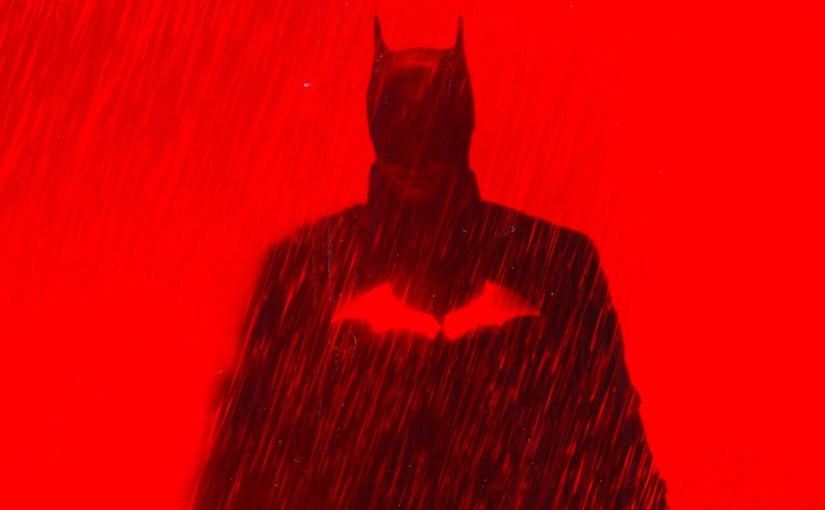
Another year at the movies, means another trip to see Batman on the big screen.  I think we are close to a dozen iterations, no?  Fortunately, the latest reinvention for March 2022, The Batman, is a refreshing interpretation that focuses on the detective skills of the masked vigilante hero who prowls from the rooftops of Gotham City.  Matt Reeves has written and directed a gripping and engaging film that doesn’t rely on simple paint by numbers.  He’s capitalized on using the mysterious Riddler (Paul Dano) as the main villain here, and Batman’s (Robert Pattinson) brains get more exercise than his brawn.   

It is the second year since Batman has introduced himself to the crime ridden city.  The man behind the mask, Bruce Wayne, keeps a journal of his exploits and observations, and through voiceover he questions if his actions have benefitted since it appears that crime has only increased since his first appearance.  A serial killer is taking responsibility for the grisly deaths of important people within the city and he’s leaving greeting cards for “The Batman” with a common scribble of “No More Lies,” along with a “?,” and a riddle for The Batman to solve.  Thanks to a strong partnership with Police Lt. Jim Gordon (Jeffrey Wright), Batman is given easy access to the crime scenes so he can attempt to reveal the mysterious villain and determine exactly what his endgame is. The Riddler doesn’t make it easy, though.

Mobsters like the Penguin (Colin Farrell) and Carmine Falcone (John Turturro) have a grip on the city, as well.  There’s also a possible lead from a woman (Zoe Kravitz) who’s managed to infiltrate the gangsters’ underground headquarters.  She also has the fighting skills and agility that’s comparable to the caped crusader, and maybe she’s a cat burglar as well.  Still, is she pertinent to Batman’s investigation or not?

It’s better not to spoil anything that occurs in Reeves’ film.  The mysteries that are uncovered are part of the fun, and it does take some time and exposition to get there, but I found it worth it.  Barring a few ingredients within the film that I recognized from the Christopher Nolan and Tim Burton films, the picture is worth seeing for a new formula on a character, that although is a favorite of mine, I feel has also been done to death on the big and small screens.  This is a Batman film where I appreciate the thinking approach of its craft, over the action.  When Batman is playing detective with Jim Gordon, it is much more enticing than just another Batmobile chase or another ham-handed fist fight.  This film is a test of Batman’s mental capacity and ability for analysis.

Reeves direction is also appreciated, though I’m expecting the naysayers.  The Batman is a very dark motion picture.  When it’s not dark, the photography is dim and blurred.  There’s lots of rain and dimly lit streets and garages.  There are strobe lit nightclubs.  Windows are blurred, so sometimes you can’t make out the image in front of you.  He makes the viewer work for the focus and that kept me alert.  I believe Matt Reeves was attempting to give the viewer the literal point of view of the characters.  It will not be a surprise, however, to find some movie watchers lose patience with the technique. 

The Riddler especially is most mysterious with a twisted and inspired Zodiac killer approach.  Often, Matt Reeves’ film feels especially reminiscent of David Fincher’s Seven.  I would not be surprised if Reeves wrote his script as a cop/detective story, and then added the Batman flavor to make his final draft.  This is not a picture of grand special effects or superpowers and gadgets. 

It’s definitely not the Batman film that everyone wants.  I foresee the response being very divisive.  Nonetheless, if you’re a Batman devotee like me who grew up on the character in the macabre storied comics (as well as the hammy tongue in cheek material), you’re going to be thankful for this “at last” interpretation.  I’ll definitely be seeing it again.

NOTE: The Batman is not a film for children under age 13. I truly believe that. There are disturbing images and threats within the story, and the violence depicted or left to the imagination is not for celebratory effect and amusement. This is definitely a film for mature audiences. Do not presume it’s meant for all ages based on its misleading marketing approach with companies like Legos and Little Caesars pizza.

QUIZ SHOW

By Marc S. Sanders

Robert Redford’s 1994 masterpiece deserves much more recognition than it ever got.

Here, he produced and directed a stellar cast that showed how America was always in it for the competition and for the glory and for the fame and naturally for the money.

Redford opens his film with a car salesman describing the regal elegance and perfection of a 1957 Chrysler convertible. It’s a gorgeous car. Then the potential buyer turns on the radio. The car isn’t so fascinating anymore as a news announcement reveals that Russia beat the United States into space with its launch of Sputnik. All America has now is just a car.

Opening credits roll and the next American sensation is presented, “21,” the most popular show displayed on the greatest invention, a home television set. However, the show is all a lie, and yet by the end it’ll survive along with its network, NBC, and its wealthy sponsors.

Quiz Show foreshadows the cost of fame and attention. It’s a wonderful sensation until it’s stripped away in personal disgrace. John Turturro (how did he not get an Oscar nomination?) is Herb Stemple, the champion, nerdy schlub who is growing tiresome among producers and audiences. He is forced to take a dive and be replaced by the handsome Charles Van Doren played Ralph Fiennes, a member of one of the country’s most intellectually gifted families. The difference in appearance is obvious. So is the desire for a change in programming. What’s obvious is how the two men are exploited as pawns for gain in corporate America. Cheat, but if you call it television, what harm is there really?

The harm falls in public perception. Disgrace comes to these men, and worse, to their families. It mirrors modern stories like Harvey Weinstein, Joe Paterno, Bill Cosby, Kevin Spacey and Matt Lauer.

It’s a very calm film that debates the ethics of these men and necessities to uncover the truths and reveal the falsehoods.

Redford only gets aggressive in his period settings and I’m thankful for it. Nothing looks out of place, including the large enthusiastic grins of a 1950s American viewing audience dressed elegantly and innocent. Even nuns and pajama clad children are invested in “21.” This clean cut appearance will soon fade , however, after the quiz show scandal dies down.

Ugly lies and denials were committed against Redford’s beautiful backdrops. Therein lies the necessary conflict of another fascinating story.

Was this country ever innocent?

ROUNDERS

By Marc S. Sanders

Recently, I watched The Cincinnati Kid with Steve McQueen and it reminded me how much I enjoy a good poker movie, and I don’t even play cards.  Shortly thereafter, I took it upon myself to watch Rounders directed by John Dahl.  A few things occurred to me.  Poker movies do not acknowledge an organization called Gamblers Anonymous.  I guess to do so would be too much of a downer when the real suspense lies in the close ups of these talented players trying to read and outplay one another across the table.  Addictions become all too real and movies are not about reality but rather enhanced reality.

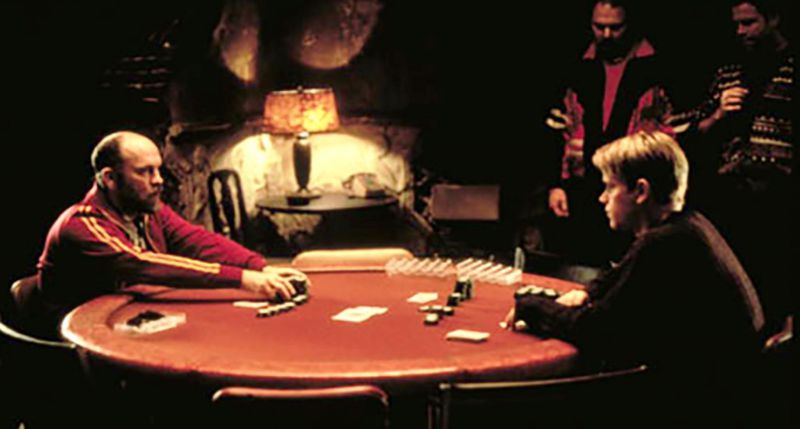
Rounders explores a seedy underground world of poker in modern day New York City.  Its community is made up of guys with names like Teddy KGB (aka The Mad Russian with ties to the mob), Joey “Knish,” and Worm.  There’s also a heavy who conveniently comes in to collect debts, and his affectionate name is Gramma.  These guys are portrayed by an outstanding cast of actors; respectively John Malkovich, John Turturro and Edward Norton.  Gramma is Michael Rispoli looking squat but all muscle under a derby hat while residing in his brothel of hookers who work for him.  All of these characters couldn’t be any more different.  The only thing they have in common is the game.  Gramma is the destiny that follows you after the game.  The other thing they have in common is the storytelling device of mentor, both good and bad. 

Knish maintains a conservative career approach to poker that allows him to pay his bills and alimony, and has groomed a baby faced “rounder” known as Mike McDermott.  He doesn’t look like he belongs with these shadowy figures but maybe that’s why he’s so good at the table.  KGB is the devil that’s not in disguise.  He’s the Oreo chomping Russian psycho with an appropriate, yet overly laid on Bolshevik accent. Worm is Mike’s pal who won’t let up to entice his childhood friend to keep the juice going because poker, honest or more importantly shady, is all that matters. 

Matt Damon is Mike in one of his most underappreciated roles.  Mike looks like a law student with a promising career.  I said he looks like that.  The film however shows that Mike is not a law student at all.  At least he shouldn’t be.  Early on in the film, Mike’s britches get too big for him and he loses everything such as his tuition money and rent and anything else he’d been saving up for.  Knish offers to help him get back in the game, but Mike swears off poker like someone who perhaps would swear off fatty foods.  I guess it’s not an addiction that is taking over his livelihood such as with his devoted law school student  girlfriend Jo, played by Gretchen Mol.  In Rounders, law school and love are the inconvenience.  Not poker.

Nine months go by and Mike picks up his childhood best friend, Worm, played with exceptional sleaze by Edward Norton.  Mike resists Worm’s advances to get back in the neighborhood games where they were masters at the hustle.  Worm is desperate and eager to play because it’s all he wants to do and he has an acknowledged drive to simply self-destruct in endless debt.  Mike’s devotion to Worm is tough for him to compromise and pretty soon his personal vouch for his friend gets them both into trouble where binge gaming is their only option.

The step-by-step play of the story is predictable here.  We know there’ll be one big game at the end with a monster win.  Mike will face set backs along the way.  He’ll have mentor moments and arguments with Jo.  But so what.  Look at the actors this film has to offer, and follow along with a great script of dialogue too. 

Rounders came out in 1998 when Matt Damon was surprising the world with his original script Good Will Hunting.  This movie is one of the first films where he got top billing and his name above the title.  He has so many good scenes because many of them play like duets.  Damon vs Malkovich.  Damon with Turturro.  Damon with, and sometimes against, Norton. 

My favorite pairings are the scenes he shares with Martin Landau who plays Mike’s law professor, Abe Petrovsky.  Landau personally touched me as the son of Jewish immigrants where each generation went on to Rabbinical school.  Petrovsky describes for his law student, Mike, that through his own personal experience that our destiny chooses us.  Often, we don’t choose what we have to become.  The Petrovsky character was raised in the Jewish orthodox community where I also had experience while attending Yeshiva for ten years.  I knew this man that Landau so accurately portrays.   Beyond my review, I have to share that this character spoke to me and reunited me with the Rabbis who taught me in elementary school. Personally, Petrovsky assured me that it was okay that I did not follow in the footsteps of my teachings at Yeshiva.  It wasn’t for me, much like law school is not for Mike.  Mike has a talent for something else.  Still, it’s a very risky talent.  Rounders would like to tell you that everything in life is worth taking risks.

I’m not sure I agree with the philosophy of Rounders.  Gambling can easily turn into a terrible addiction.  My father played all the games at the casinos on occasion, but he never stayed very long and he only went infrequently like when he was on a business trip.  He always told me that he would not be sure he’d be able to stop if he took up the game.  I knew exactly what he was talking about which is why I never even opted to learn.  I know my limitations.  Rounders doesn’t focus on limitations, though.  Limitations are for nerds, I guess.  Rounders is all about searching for strategy to improve your game.  It’s movie money.  So, there’s only pretend risk as Mike aspires to beat the best of the underground, come out alive from the violations of his pal and then move on to Vegas where he’ll give it a shot at the World Series of Poker.

There’s one other aspect I admire about Dahl’s film.  I looked for it on this most recent viewing and I’m telling you I couldn’t see it anywhere.  Dahl never, ever shows you the full hands of the players.  Either you see only a part of the river of a Texas Hold ‘Em game or you see the pair of cards the players hold, but never both in any round of the various card playing.  Dahl’s approach like the Mike’s philosophy is not so much playing the cards as it is to show the players play against each other.  The ticks and expressions they give like how they smoke or drink or even how they eat Oreo cookies out of their poker chip rack.  It’s very effective compared to other poker scenes in films like The Sting or even Casino Royale.  With a fine tuned script by David Levien and Brian Koppelman, it is fair to say that anyone knows what hand beats a flush or two pair or whatever.  More importantly, what matters is what read is ultimately gonna win you the table.  Rounders is all about winning the table, not the hand.