AMERICAN GANGSTER

By Marc S. Sanders

My favorite kind of crime dramas are the ones that tackle the grit.  The screenwriters and directors go for where the itty-bitty stuff scrounges up into something bigger for either the career criminal or the low-level cop.  These guys start out as butterflies flapping their wings and before you know it their legacies and pursuits are as big as hurricanes.  Movies like The French Connection or Heat operate on these trajectories.  How did we get from there to HERE?

Ridley Scott went in an unconventional direction away from his science fiction eye and ancient history recollections when he directed American Gangster with a screenplay by Steve Zallian based on the true stories of Harlem drug kingpin Frank Lucas (Denzel Washington) and narcotics detective Richie Roberts (Russell Crowe).

These two sensational actors don’t share one scene together until the epilogue of this always interesting three-hour opus.  Yet, in their second film together their pairing is as classic as DeNiro and Pacino or Newman and Redford.  I hope before they retire, these men pair up for at least one more film.  

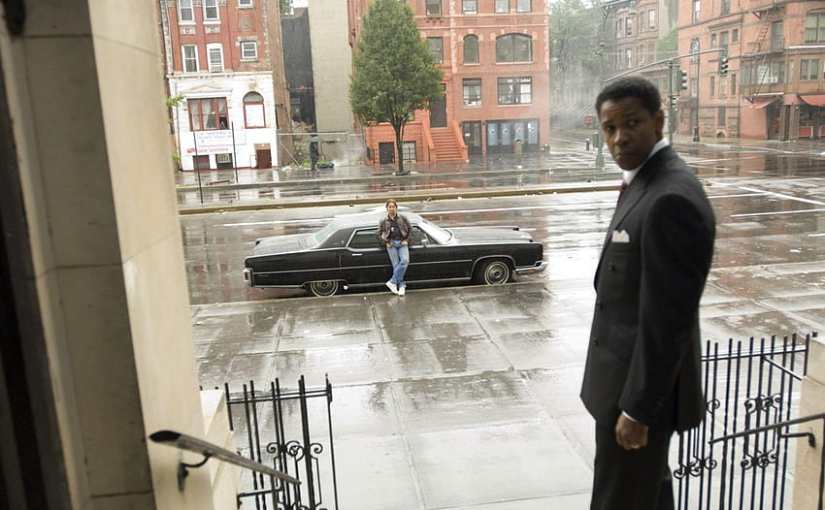
Ridley Scott and his nominated art directors, Arthur Max and Beth A Rubino, capture a gritty urban, crime ridden Harlem of the 1960s/70s.  The streets are filthily here, as well as in the five New York boroughs and all the way across the bridge into New Jersey.  Frank’s markets carry a very wide berth. The buildings are distressed and cracked.  The clothes are of the hippie era with polyester suits.  This is where Frank Lucas moves his imported contraband, white powder heroin, labeled exclusively as “Blue Magic.”  The film provides a convincing source locale deep within the jungles of Vietnam where thousands of kilos are shipped to Frank for sale on the street.  The purity of the drug is beyond compare.  Scott and his art designers place you directly in this time period of dingy grime and among the sweaty Viet Cong and rivers to finally arrive at the crop Frank purchases his products from.

Once he finds his footing by eliminating the competition and recruiting his brothers and cousins to run his business, Frank invests in creature comforts with a furnished penthouse apartment for himself and a beautiful mansion for his mother (Ruby Dee in an Oscar nominated performance that comes off so naturally; you’d think she’s sitting at the Thanksgiving table with you).  He marries a beautiful Puerto Rican wife that he treats like a princess. Frank is smart.  He stays under the radar by wearing conservative suits and not making many waves like going out at nights and showing himself around the social scene.  He knows famous athletes like boxer Joe Lewis or the staff on the New York Yankees that could give his nephew a shot at being a pitcher. Still, his profile manages to stay low. Like his mentor, he just operates a business with a viable commodity.  He tells his younger brother (Chiwetel Ejiofor) that the loudest one in the room is the dumbest and the most likely to get caught.  So, mind how you carry yourself, how you dress yourself and how you flaunt yourself.

A separate story has no business intersecting with Frank’s plight until something gives.  Richie Roberts is a good, honest cop. Though he’s also a lousy husband and father. He has been assigned to head up a task force that will bust the top of the assorted drug empires.  He needs those rare breed cops who are not on the take and follow a strict policy of law enforcement ethics.  His team will not bust a common street hustler.  They will be looking for the kingpins with unquestionable evidence to put them away for good.

American Gangster follows two separate stories for most of its running time.  At least during the first two acts of the film, Frank and Richie are unaware of one another.  It’s only through some gradual surveillance that the cop finally gets a whiff of an idea and starts to move methodically towards a conclusion. The methods are the fascinating parts the movie.

When Denzel Washington plays a villain it’s always memorable and contrary to popular opinion, Frank Lucas is my favorite of his antagonists, especially compared to his Oscar winning work in Training Day.  Watch how he walks or sits on a sofa and broods over how his family and his business are functioning.  He’s the only African American actor I can see playing this guy because I’m always convinced that whoever Denzel Washington portrays, it’s a character who will never be intimidated.  This guy faced down Gene Hackman during a threat of nuclear holocaust. Not many other actors can do that so authentically.

Russell Crowe works like that hero who doesn’t want to wear the cape.  Richie Roberts succeeds on so many levels where his peers surrender to their inhibitions.  This cop passes the bar exam while fighting for custody of his kid on top of going after the empirical criminals who litter the streets in drugs and murder.  I’m reminded of his role in The Insider, where he used a similar American accent.  Richie is not as temperamental or hard wired as that guy, but he is at least as focused on doing what’s right regardless of threat or distraction.  Russell Crowe has a way of getting audiences to admire the concentration needed for many of his complicated characters.  You have as much tunnel vision as he wants the men he’s portraying to have. You are zoned in with what his characters live by.  You only trust their standards.

There are signature staples within the construct of this true story adaptation.  There are gunfights.  Punches are thrown.  The guy at the top beats up one of his cronies when he gets out order.  Yet, what stands this material apart from others is that now I’m watching how Denzel Washington and Russell Crowe handle everything.

The truth behind the story of a black gangster defying the dirty cops and the Italian mobsters who were thought to run the metropolitan undergrounds is amazing.  It’s so interesting to see how novel Frank is with smuggling the product from one side of the world to the other. Then, you see how he uses his family members to distribute to the consumers and collect the monies. Ridley Scott provides all the breadcrumbs in an easy-to-understand fashion.  

Painted against the landscape of an unwinnable Vietnam War that just won’t end, power is acquired and thus the best police officers are forced to change their approach.  So again, you see two different stories that start out small and undetected.  Frank and Richie are the most careful and meticulous of guys in their respective fields.  Therefore, it only makes sense that their paths don’t cross until their missions are nearly over.

There’s much to learn from American Gangster.  

You get an idea of how the harm of the war was not exclusive to just what was happening over in Vietnam.  There were more indirect effects to that crisis impacting the streets of New York and New Jersey.  

You see what subtleties an investigation will collect upon before pouncing on to a bigger stake.  You also learn how to handle a criminal empire with trust and dignity rather than announcing your immorality. You witness the sheer defiance of a righteous guy in what is supposed to be a law-abiding field. Steve Zaillian’s script is not just good guy vs bad guy. It’s each of these guys holding on to the top while trying to catch up with or stay away from each other.

American Gangster is a very thorough and well-planned biographical thriller.  
TERMINATOR 2: JUDGMENT DAY SPECIAL EDITION

By Marc S. Sanders

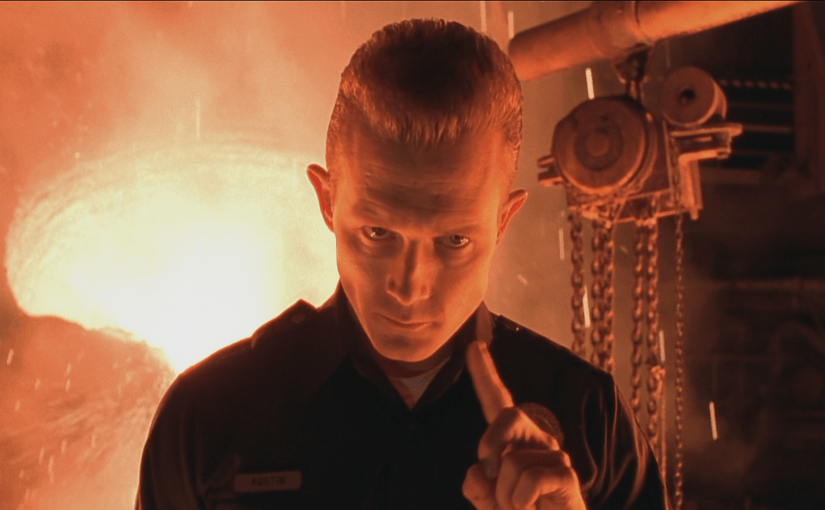
Hailed as one of the greatest sequels ever made, James Cameron’s sci-fi extravaganza Terminator 2: Judgment Day remains revolutionary in its achievements in special effects that still hold up over thirty years later.  This was a major film in Arnold Schwarzenegger’s career, but Robert Patrick became a known character actor for his stoic expressions as a sinister android with the ability to shape shift out of a substance of liquid metal that consumes his entire body.  Neither of these actors have much dialogue and yet the hero versus villain element is so well defined with Cameron’s imagination and drive for effects enhancements. 

It’s ironic.  The first Terminator was a scrapy film with an interesting plotline of time travel to serve outstanding shoot out and car chase mayhem for an hour and forty minutes.  Stan Winston’s make up work was effective. Visual effects of the metal exoskeleton look like the work of Ray Harryhausen from his days working on the Sinbad movies.  Impressive, but they looked outdated.  It’s forgivable though because the storyline and the action were masterfully orchestrated.  Cameron’s sequel makes up for these shortcomings.  It was a box office smash.  The image of Schwarzenegger mounting a Harley Davidson with sunglasses and a black leather motorcycle outfit (shotgun in hand) became as iconic as his standard promise of “I’ll be back,” and just about everything in the film raised the bar that much higher for all vision effects to be produced thereafter.  Some of the imagery in this film remains absolutely astonishing.

In this 1991 installment, two Terminators from the year 2029 are sent back in time to protect a pre-teen John Connor (Edward Furlong in a wonderful and spirited debut performance), the leader of the human resistance in a futuristic war between man and machine.  There is Schwarzenegger as a new T-800 (a steel skeleton with living tissue and skin on top) designed with good intentions to keep John alive.  The T-1000 is the much more advanced liquid metal monster who can form sharp objects like knives and stabbing weapons.  It can also take the shape of any human it encounters.  So, it has the capability of deceit.  This thing is truly unstoppable. 

John’s mother, Sarah (Linda Hamilton), who was being hunted in the first film is now a bulked-up warrior imprisoned in a psychiatric hospital for her violent tendencies, making outrageous stories that predict a doomed future, and for the crime of blowing up a computer factory.  Hamilton makes a major departure from her hokey damsel in distress in the first picture.

James Cameron is a director with high standards.  With each film he has made in his storied career (Titanic, Avatar), he seems to be both the teacher and student of advanced filmmaking.  Every new film shows a new discovery on his part.  The dazzling special effects of Terminator 2 work because they serve the robotic characters.  The effects are the threats and superpowers meshed within the plotline.  The technology used, along with Stan Winston’s artistic make up imagery, serves the story.  The liquid T-1000 will get frozen in liquid nitrogen.  Cameron will show Robert Patrick breaking apart like chipped ice.  Schwarzenegger will shoot the frozen statue, breaking it into a thousand pieces.  Is the monster dead though?  Cameron applies another cool effect for a fast resurrection, and you see how it all functions and morphs into something new.  The T-800 will shoot a grenade into the head of the T-1000, and you’ll see it break apart and what it does next in response.  It’s groundbreaking.  More importantly, it is eye opening.  Absolutely marvelous work.

There’s a handful of cheesy dialogue in Terminator 2: Judgment Day.  That’s to be expected in many of James Cameron’s scripts.  I can’t help but roll my eyes when I hear Michael Biehn or Linda Hamilton deliver a line like “On your feet, soldier!”  I dunno.  It just doesn’t come off authentic to me in the same way a drill sergeant would demand.  Hamilton’s voiceovers never did it for me either and I think it’s a combination of the dialogue and the vocal performance from the actor.  The melodrama is a little too thick in these areas. I’ve often regarded faults like those of Cameron.  That doesn’t make his films any less watchable.  I’m looking at some of the greatest visuals ever to grace a screen.  I do wish that he would take his screenplays to a script doctor, though.

Terminator 2 is never boring.  I opt to watch the Special Edition found in a DVD set.  It’s a recut of the film with lots of extra footage that flesh out the functionality of these sci fi futuristic figures and lend to more character depth.  A dream sequence is included.  Sarah sees the return of Kyle Reece (Michael Biehn), John’s father, to push Sarah on her campaign to change the future and ensure the technology that soon develops in a future 1997 never comes to be, while also continuing to protect their son.  My favorite new addition comes in the final act when we see the T-1000 suffer from the cumulative damage done by the heroes.  That welcomes some new visuals not seen in the original theatrical cut.

No matter which edit you watch though, the set pieces are spectacular with lots of shoot ‘em up mayhem, truck and motorcycle chases, and bullets blazing all over the place, including bouncing off of Arnold Schwarzenegger, while being “absorbed” by Robert Patrick.  A helicopter collides with a SWAT team van.  An entire building explodes into a huge blaze. Cameron offers frequent nightmares for Sarah that depict a truly frightening end to nearly all of humanity with scorching white heat, fire and ash.  A playground never looked so scary.

I digress with a mild spoiler alert.  This most recent watch of the film was fun because I showed it to my fifteen-year-old daughter.  She had a different impression than most movie going audiences who saw the film in 1991.  Promotions at that time clearly demonstrated that Schwarzenegger was a good Terminator this time, while Patrick was the threatening bad guy.  My daughter had no idea.  So, a well edited suspense scene that builds in a shopping mall left her quite surprised when both Terminators meet face to face for the first time, with their guns drawn and John perched right between them.  Who was the protector and who was the killer?  See?  It pays not to watch the commercials and previews.

Terminator 2: Judgment Day is one of many outstanding achievements for James Cameron.  It enhanced a new visual effect introduced in an earlier film of his, the “water worm” in The Abyss, and made it a major story element.  He might not be the best dialogue writer, but Cameron repeatedly showcases the art of writing a solid storyline around the technology he toys with as he brings it all to perfection. 

EXECUTIVE DECISION

By Marc S. Sanders

A commercial passenger plane carrying a bomb with enough explosives to wipe out the entire eastern seaboard of the United States has been hijacked.  Fortunately, Steven Seagal has come up with an idea to get his squad of commandos on board and contain the threat.  It’s also a blessing that in the first twenty minutes of Executive Decision, Seagal dies during the midair transfer.  There!  I spoiled it for you.  I’m not big on spoilers, but this is worth it because I believe it’ll entice you even more to watch this scrappy, under the radar action picture directed by Stuart Baird.

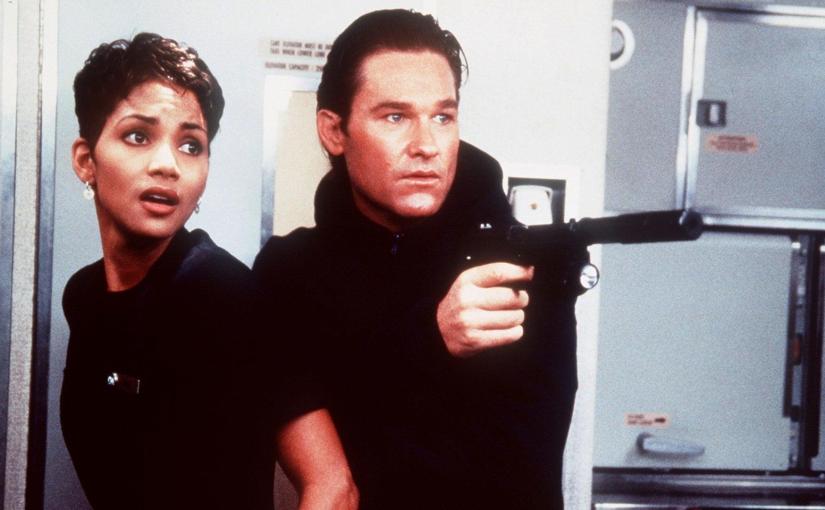
Before all of the action gets started, Kurt Russell makes his introduction attempting to land a small plane during a flying lesson.  I wonder if that’ll play into the story later.  Hmmm!!!! Russell plays David Grant, a consulting analyst for the US Army. Dressed in his tuxedo, he’s swept up from a dinner party and informed of the terrorist hijacking at play.  Grant is familiar with the lead terrorist and his ideals.  For whatever reason he’s instructed to board a specialized jet with Seagal’s crew.  This jet carries a tube that will attach to the hull of the captive plane in midflight. The soldiers will climb aboard and go to work.  Complications ensue though, and after that harrowing scene is over, four members of the elite squad (one becomes paralyzed) have made it on board along with Grant and the design engineer (Oliver Platt) of the jet.  Now the fun begins. 

Baird invests a lot of moments with the commandos (led by John Leguizamo) sneaking around, and drilling small holes in the ceiling and floorboards of the plane to insert tiny cameras and get a look at the activity going on.  Every so often the terrorists threaten or give scary looks and we hope they don’t look down that hallway or in the elevator shaft.  The bomb also has to be deactivated but it’s never as easy as knowing to cut the blue or red wire, and there’s a “sleeper” passenger who can detonate the bomb by remote.  Where on the plane is that guy, though?  As well, the government debates with shooting down the plane of 400 passengers before it reaches America.  So, there’s a lot going on here.  Kurt Russell is especially good as a “work the problem” kind of leader who manages to earn the assistance of a flight attendant (Halle Berry).  We may know how this standard story will end up.  However, that doesn’t mean the journey can’t keep us on pins and needles. 

Executive Decision is never boring.  It’s engaging from beginning to end, even if we’ve seen this very basic formula countless times before.  Credit has to go to Stuart Baird and his lengthy experience as a film editor (the Superman and Lethal Weapon films), as well as the cast.  Kurt Russell is always reliable with upholding the tension of a situation.  Like Harrison Ford, he’s really good at playing the everyman caught up in a jarring, nerve-wracking situation.  Look at his film Breakdown for further evidence. 

Beyond Seagal’s early demise, the most amusing part of Executive Decision is watching Marla Maples Trump as another flight attendant emoting the worst panicked expressions for Halle Berry to act off.  Marla never delivers a single word of dialogue.  Even in 1996, long before the Trump name became regarded for many other reasons I need not discuss here, this likely unintended joke generated so much amusement for me, personally.  It must be seen to be believed.

That being said. Don’t watch Executive Decision just for Marla Maples Trump and Steven Seagal.  Watch it for the taut, suspenseful story it is, with a fantastic lead role performance from Kurt Russell, a solid supporting cast and a gripping assembly of tension from Stuart Baird.

SPEED

By Marc S. Sanders

Jan de Bont’s Speed is one of the best action thrillers ever made. It moves at a breakneck pace with huge suspense, big laughs and never-ending excitement. It’s also really smart with its crazy storyline.

A mad bomber (Dennis Hopper) manages to terrorize the city of Los Angeles by rigging a high-rise elevator with a bomb. Thirteen hostages need to be rescued and for an opening scene of a movie it does not get better than this. The heights and cramped space of the elevator and shaft are tightly claustrophobic, leaving you biting your nails. Small explosions come unexpectedly. This is what Hitchcock is always talking about. Putting a bomb under a table is suspense. The moment you detonate the bomb, the fear is over. De Bont blows up some bombs, but he leaves you hanging for when he’s going to set off the biggest bomb of all – the one that’ll put a hole in the world.

Later, the bomber does the same to a city wide transit bus traveling the freeway routes of rush hour traffic in the city. If the bus’ speed drops below 50 MPH, it’ll explode. Imagine pulling two tricks of Hitchcock all in one film. Imagine trying to never slow down a bus. This bad guy is destroying the city without even setting the big bomb off yet. This is great writing from Graham Yost. The whole scenario is tension at a maximum level.

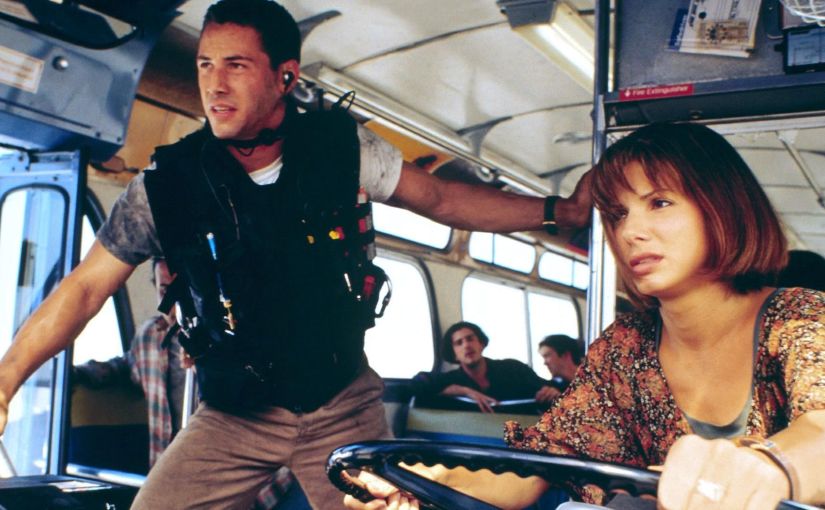
The cop trying to stop the bomber is Jack Traven (at the time of release, an unlikely Keanu Reeves). Reeves is a perfect hero in this film. He allows the film to stand apart from being just another Die Hard rip-off by avoiding the Bruce Willis smart aleck stance. He’s a smart guy who keeps focus on just the situation at hand. He’ll get the bad guy later.

Sandra Bullock plays an adorable character named Annie who consequently has to drive the bus. This was Bullock’s breakthrough performance and I truly think it still holds as one her best. She’s funny, but she has some good dramatic moments as the tensions build up where Hopper’s crazed bomber makes things more difficult for Jack and the passengers. Bullock is good at crying on film, but she also knows how to deliver a line too.

De Bont does a great job at poking fun at the mundane trappings of traffic and intercity daily activity. As the bus careens through the city, pedestrian crossings are at risk, tow truck cars are problematic, cop cars are bashed up, and Annie is mindful enough to turn her blinker on as she careens around the corners. That last gag kills me every time. De Bont does what I always insist works in most films. He makes the setting of his film the character as well. This bomb rigged bus is stressing out the city of Los Angeles, for sure.

Seeing Speed holds a special memory for me. I saw it on its opening Friday night with some college buddies. Two days later, I insisted on taking dad to see it. Dad could not stop laughing through the absurdity of it all as street signs crash down, cars get totaled, and the fast editing blended with Annie’s laughable panic. Most especially, he loved a hapless driver (a scene stealing cameo from Glenn Plummer) in his gorgeous Jaguar convertible known as “Tuneman” by his license plate. Jack desperately hijacks his car as a means to catch up to the bus. As Tuneman’s car gets more and more wrecked, Dad could not get over it. He was in stitches. This is why movies can be so vital in our lives. I’ll never forget Dad’s nonstop laughing. I carry it with me forever, and I heard it again last night as I caught up with Speed. He’s gone now, but these are the moments I miss most about Dad.

A third act of the film is just as thrilling. Let’s see. We’ve done an elevator and a bus. How about a subway train? It’s a briefer sequence for the climax of the film, but it keeps the thrills ongoing.

Speed works on so many levels with a brilliant cast of B actors (at the time of 1994) that also include Joe Morton, Alan Ruck and a great Jeff Daniels as Jack’s partner with bomb experience. The action sequences cannot be complimented enough, and the Oscar nominated editing from John Wright with De Bont’s direction pair perfectly in timing.

Speed is an absolute thrill ride and a rocking great time at the movies.

GODZILLA: KING OF THE MONTSTERS

By Marc S. Sanders

Godzilla: King Of The Monsters

Imagine our reaction upon learning that the cast of this epic features the following:

Academy Award Nominee: David Strathairn

Academy Award Nominee: Ken Wantanabe

Academy Award Nominee: Vera Farmiga

Academy Award Nominee: Sally Hawkins

The FBI Guy from The Wolf Of Wall Street: Kyle Chandler

Emmy Nominee: Millie Bobbie Brown

Emmy Nominee: Charles Dance

…and the guy from Speed and Terminator 2: Judgement Day and most importantly the 2nd episode of What’s Happenning!!!: Joe Morton

Here is a film where scientist Vera Farmiga justifies waking up 10 million ton monsters on earth because it will “SAVE THE EARTH FROM POLLUTION DUE TO OVER POPULATION.” (Ahem, couldn’t she have just called Thanos?”)

Here is a film where scientists reason that the only way to communicate with Gorjira (a bad ass looking three headed Hydra) is by humpback whale frequency. (Ahem…one more thing…couldn’t Spock simply travel back to the mid 1980s and pick up George & Gracie?)

Here is a film where Boston is brought down to rubble save one street conveniently available for a Hummer to race down so that Kyle Chandler and Vera Farmiga can race back to their house to find daughter Millie Bobbie Brown safely taking refuge.

Despair not though my friends.

Boston survived!!!

There was one sole remaining functioning traffic light still standing following the mass destruction. That’s all I need for self assurance.

Let me tell you something though. You get your money’s worth out of this mashed potatoes of a film. One of the best comedies of the year!!!

It was a lot of fun.