RED ONE

By Marc S. Sanders

Santa Claus has been kidnapped.  It’s up to Dwayne Johnson and Chris Evans to rescue him before Lucy Liu has to explain to all the Presidents and Prime Ministers across the world that there might not be a Christmas.  It’s one thing to read this as pertinent information.  It’s another to say it out loud with a straight face.  I’m now convinced that Lucy Liu is the most amazing actress of all time.  Not a curve, not a wrinkle, not a twitch in her stoic expression. Still, I believe Christmas is going to happen.

Yes, ol’ St. Nick (J.K. Simmons) has been captured.  His bodyguard is Cal (Dwayne Johnson), also head of security at the North Pole.  He is determined to get the bearded man in red back before Christmas Eve, and he partners up with a petty computer hacker mastermind, lacking any Christmas spirit, named Jack (Chris Evans).  The guys will argue with each other before they connect as buddies. You know how this works.  They’ll follow the leads to find out who and why “Red One” was taken. 

Red One works as a fun action picture with pretty cool and imaginative visuals like I’d count on from director/writer Jake Kasdan, son of Lawrence.  As a Christmas movie though? It needs a lot more tinsel.  

J.K. Simmons is not a conventional fat man Santa with a jolly “Ho Ho Ho.”  This dude is a weightlifter and, well, he talks like the guy from Whiplash and those Spider-Man movies.  Pair him up with the bruising Dwayne Johnson and this Santa is the morose police captain who would sit behind a desk, handing out the next Lethal Weapon assignment.  

The director of security is played by Lucy Liu, dressed in a black starched pantsuit, stressing the urgency of the problem.  Like the rest of the cast, save Evans, she takes Christmas way serious and that’s where the problem lies with Red One.  It’s not gleeful or celebratory of the holiday.  When she warns us that Christmas may not come, how am I supposed to respond to such a dire consequence?  Should I be scared? Am I supposed to laugh or cry?  When Doc Brown told Marty McFly he may be erased from existence, well you know that was pretty heavy (and not as trivial as something wrong with the gravitational pull of the earth).  When Lucy Liu and The Rock talk about NO CHRISTMAS of all things, I gotta wonder if I’ll get my annual Chinese dinner with my Jewish family.  Red One feels like a cliffhanger episode of NCIS.  Even Die Hard was more in line with the Christmas spirit than this flick.  John McClane declared his “Ho Ho Ho!” when he got a machine gun.  No one in this movie seems to have a sense of humor.  Chris Evans cracks some one-liners as if he’s shying away from the hokey script that everyone else embraces like a Tom Clancy novel.  

What works in Red One is the visual imagery of a wicked Christmas witch and assorted trolls and monster mayhem, particularly from Krampus (Santa’s gholish beast of a brother played by Kristofer Hivju) who gives a hilarious beatdown on The Rock.  There’s also a cute way to disarm some beastly polar bears who can encase our heroes in ice. The designs of the North Pole look cool as an industrial military base specializing in toy manufacturing.  However, we could have seen some cool gadgetry with this factory.  Instead, there’s a lot of underground mazes to circumvent that we barely get a look at amid the fast pace of the action scenes.

Cal is gifted with a power wristlet that packs a punch, shrinks him down for fighting advantages and has the ability to turn Hot Wheels cars into life size Chevrolet products for quick travel.  Naturally, Cal also knows that storage closets found in any toy store will transport you to another part of the world.  Nifty!  Not holiday spirited though.

The chases and fights work.  Johnson and Evans make for an okay buddy cop kind of pair.  The designs of the movie hold.  Yet, what’s missing is a spirit of Christmas magic.  Again, the holiday of Santa with his magical reindeer and cookies and stockings all feel hollow here.  Something is definitely missing because it’s hard for me to pinpoint who this film is catered for.  Families?  Red One comes off too nihilistic for that crowd ready to enjoy everyone’s comfort during winter break.  It’s too hokey just for the adults or the action movie lover.  A threat of Santa Claus missing with Christmas at risk also seems too overwhelming for the under 8 crowd.  

I got a kick at everything I saw on screen but there’s no one to connect with or empathize, and even for this Jewish guy, there’s an absence of Christmas tidings to behold from music to decor to the common recognizable tropes. Even when Santa poses as a shopping mall iteration, Simmons’ tough guy exterior doesn’t lend to any sort of joy or whimsy that comes with the holiday.

The sad irony is that Cal wants to retire because he sees more pessimism and materialistic selfishness in the adults these days.  Santa tries to convince Cal to reconsider as the spirit of the holiday will return.  If that’s true, then St Nick with a J. Jonah Jameson disposition does not offer much promise.  

These guys are rescuing Santa Claus like they are rescuing the President Of The United States, and frankly who the hell has liked any of the Presidents Of The United States of late?

RED ONE (2024)

by Miguel E. Rodriguez

DIRECTOR: Jake Kasdan
CAST: Dwayne Johnson, Chris Evans, Lucy Liu, J.K. Simmons
MY RATING: 8/10
ROTTEN TOMATOMETER: 30%

PLOT: After Santa Claus is kidnapped, the North Pole’s Head of Security must team up with a notorious hacker in a globe-trotting mission to (all together now) save Christmas.


Jake Kasdan’s Red One is by no means perfect, but it is not nearly as bad as the plethora of negative reviews would have you believe.  The Rotten Tomatoes website lists such jabs as:

  • “…forgettable as a first dusting of snow.”
  • “…offers big-budget visuals but lacks soul…”
  • And my favorite: “An ugly, under-lit, joyless slog, devoid of any holiday charm or sense of fun.”

Let me first address that “under-lit” comment.  I first attempted to watch this movie at our local AMC cineplex, and I noticed that the ads and previews were so dim that parts of the screen looked almost black.  I petitioned the manager to adjust the projector settings twice, but to no avail.  (“That projector has been giving us problems for two weeks.”)  When the movie started and it was just as dark as the previews, I gave it up as a lost cause, left and got a refund, and streamed it on Prime instead, and on our big-screen HD TV, presto, no more under-lit areas.  Everything was perfectly visible, clear, and bright.  So, it’s entirely possible that that reviewer’s issue with the screen being “under-lit” could have been a projector issue, and NOT a problem with the film itself.  Just wanted to throw that in there.

As far as those other negative comments go, well, I don’t know what kind of mindset those folks were in as they watched Red One, but it’s difficult for me to comprehend how anyone could call it “joyless.”  I found it charming and funny myself.  But then, when it comes to holiday movies, I have always been partial to the ones that attempt to provide logical solutions to the massive logistical problems involved in getting one man to travel the entire globe in a single night, delivering presents to every household that’s waiting for them.

For example, in The Polar Express, we are treated to a semi-industrial North Pole that runs like clockwork and (thanks to convenient time dilation) can get everything into Santa’s sleigh so he can dash away just before midnight. Red One ups that ante right from the get-go.

After he has taken a brief holiday in the city – masquerading as, of course, a mall Santa – the real Santa Claus, call sign “Red One” (J.K. Simmons), is driven to the nearest military airbase in an armored limo with a motorcade escort.  Accompanying him is his Chief of Security, Callum Drift (Dwayne Johnson)…because of course the real Santa would have a bodyguard.  It just makes sense.  Then, at the airbase, under blacked-out radar coverage, Santa’s state-of-the-art sleigh, powered by eight gigantic reindeer and carefully monitored by NORAD, takes off for the North Pole with a fighter jet escort.

I dunno, man, I just ate this stuff up with a spoon.  The imagination and attention to detail that went into creating this version of the Santa mythology brought a smile to my face for pretty much the entire movie.  Another example: I mentioned to my girlfriend that this version of Santa Claus is not very fat, which is usually a given.  But then there’s a scene where Santa lifts weights in a gym as Drift spots him, and I thought, okay, I can buy that.  Santa needed to drop a few pounds. It sounds absurd writing it out like that, but I’m telling you, for me it all made sense.

So, like I said, right away I was on board with the logistics of the story.  Then the real plot kicks in when Santa is kidnapped under everyone’s noses by a gang of bad guys who manage to infiltrate the North Pole’s highly sophisticated defensive measures.  The only way Drift and his colleagues will have a chance of retrieving Santa before Christmas Eve is with the help of Jack O’Malley (Chris Evans), a talented but amoral tech genius who claims he can track down anyone, anywhere, anytime.

There’s the usual backstory of Jack’s son who lives with his mother and her husband, and Jack was never father material to begin with, but the son is going to play in a concert on Christmas Eve, and so on.  I’m not saying this material is irrelevant, but for me it was secondary to my enjoyment of how the filmmakers were treating all the mythological/fantasy/sci-fi material.  We get talking polar bears [not the Golden Compass kind, the Zootopia kind], murderous snowmen who are seemingly invincible, tech gadgets that turn Matchbox cars into full-size vehicles [I want one!], a whole new use for Rock ‘Em Sock ‘Em Robots, and we even get to meet Santa’s brother.  Yep…his brother.

I mention all these details because they are what I responded to mostly during the film.  The plot?  The plot is, let’s face it, standard thriller fare, with a reasonably interesting big-bad and hidden connections and a few surprises, but because the filmmakers went to such great lengths to provide a fascinating backstory for all the mythological characters and how the North Pole is organized logistically, I didn’t particularly care if the story was perhaps shallow and mildly predictable to anyone who has seen more than 10 movies in their lives.  I’m not ashamed to admit it.

But because of how the filmmakers were telling the story this time around, I just ate it up.  Dwayne Johnson and Chris Evans are a decent screen pairing.  Bonnie Hunt as Mrs. Claus was a treat.  Lucy Liu was perhaps the most wasted of the entire cast, although she does get one very brief kicking-ass scene.  The motive behind Santa’s kidnapping was credible.  There was nothing in the movie that broke its own set of rules, which is more than I can say of quite a few would-be thrillers out there.

Heck, I’m just gonna say it: Red One is the Galaxy Quest of Christmas movies.  You either buy into the preposterous, but logically sound, premise and laugh for a while, or you don’t.  As for me, I’ll be watching this one again next Christmas.  Or maybe sooner.

WHIPLASH

By Marc S. Sanders

It’s impossible to find absolute perfection.  I don’t care if it’s in the field of medicine, law, mathematics, art or even music.  No one is THE ONE.  Yet, if you are determined to partake in that hunt, it’s likely you’ll scream with frustration.  You might think you’re on to something but still it’s not quite the one.  Maybe, however, you will force your search for the one if you throw a chair at your gifted student, scream some of the ugliest obscenities, impose threats, slap him, allow the tears to run, force a literal blood draw, or sweat them into numbing exhaustion.

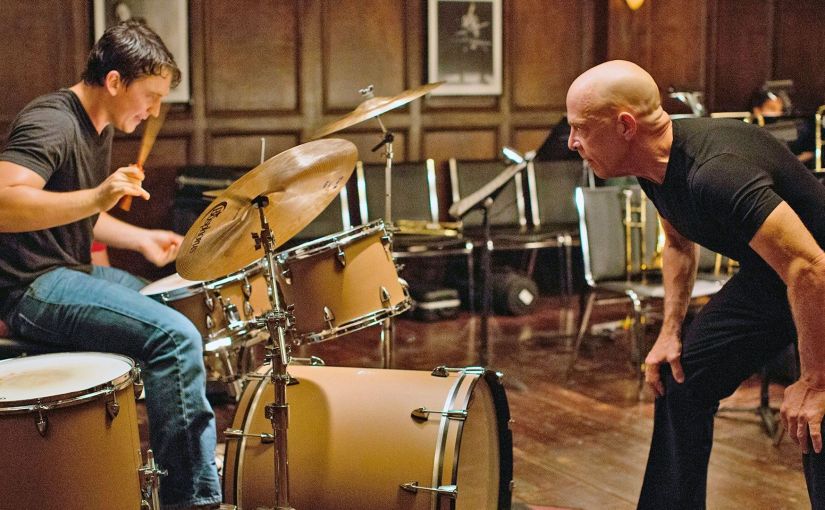
Whiplash is the name of a piece of jazz music originally composed by Hank Levy.  It is also the title of Damien Chazelle’s brilliant first film, and the best to come out of 2014. Allegorically speaking, the term takes on a harsher connotation.   The word whiplash gives me an image of torn skin and hot, dripping blood.

Andrew (Miles Teller) attends the Shafer Conservatory in New York.  He’s a jazz drummer who gets hand picked by the esteemed conductor Terence Fletcher (J.K. Simmons, in a well deserved Oscar winning role) to join his elite class.  Mr. Fletcher is cordial at first and a little instinctive as he’ll stop his musicians short of getting past one note before asking them to start again.  A hand gesture with a headshake and a wince.  Now go again.  Another gesture.  Go again.  One more gesture.  Again. Now an outburst of violent rage.

Individually, Andrew and Terence are determined with unhealthy mindsets to obtain levels of achievement that appear impossible to grasp.  The boy wants to get to where his drummer idol Buddy Rich plateaued.  The teacher wants to find the next Charlie “Bird” Parker.  These men of different generations are terribly talented.  Terribly I say because their passion for music is their self-imposed and cruel undoing.

Chazelle has much respect for the field of contemporary jazz.  I like jazz but I know nothing about how a piece is assembled so rhythmically among an assortment of instruments from the drums to the harp to the cello to the 88 keys and the various horns.  Put them all together, and there’s an atmospheric magic to what’s churned out.  It’s beautiful and bewildering.  Complicated, yet mesmerizing.  In Whiplash though, the music may be the worst antagonist because the frustrations that arrive with trying to become a master are unforgiving.

A late scene in the film shows Terence Fletcher, an altogether tyrant of a teacher, playing melodic nightclub piano in a bar.  He’s applauded and appreciatied as he presses down on the final key.  He thanks his audience with a nod.  Nevertheless, J.K. Simmons shows a different level of frustration.  Up to this point, the actor’s character has been a series of screaming eruptions.  In this moment, the man looks like he wants to cry.  No matter what he plays or how well loved he is, Terence Fletcher knows it could have been better.  So, if he lives with his suffering, then he will teach his best students to suffer through music as well.

Andrew is on the cusp of living his own life.  With a mother no longer in the picture, he still shares movie times with his father (Paul Reiser) perhaps so his father can still be a father, or maybe it is to remain a child to someone.  He’s starting a what could be a promising relationship with a girl named Nicole (Melissa Benoist), but his need to be a better drummer interfere and the only way he’ll know he’s at least as good as Buddy Rich is if he satisfies his teacher.  That’s the only sure sign.  

Does Terence turn Andrew into a monster, or is it the music?

This will always be one of Miles Teller’s best roles.  He’s got that innocent, quiet way about him, but as he gets “mentored” by this new composer, he changes.  He becomes devoid of care for Nicole and rebellious towards the lack of respect he receives from family and fellow students.  Like a chess champion, the art of drumming turns the drummer into an unloving creature soaked in blood and sweat.  This ongoing trajectory might make him a better musician but it will also bring him to an end result that matches his teacher.  

Beyond the energy of the music, Damien Chazelle steers a thrilling duo.  Simmons is an outstanding villain as a guy you can only hate until you see the motivations he’s only trapped himself into.  Only then you might just sympathize. Teller is circling the waters of a dangerous relationship with music.  Chazelle allows his picture to swim towards defiance with bloody and painful persistence. The epilogue of the film demonstrates precisely what these two men are searching for.  It’s only when you arrive at the end of Whiplash do you realize and empathize with the internal and physical pains these people choose to weigh on themselves.

To my ears, music is a beautiful, universal language.  

For the scribes, it’s an agony they choose to bear.

JUROR #2

By Marc S. Sanders

Since Unforgiven, director Clint Eastwood has sought out projects that have an intrinsic message or a question of morality.  That film seemed to channel the second half of his career that has spanned over a half a century.  Before, many of his films sensationalized the quiet killer or the silent tough guy with the six shooter gunplay and cracking fists. After the movie won Best Picture in 1992, movies like A Perfect World, Letters From Iwo Jima and Mystic River were not developed for simply the sake of escapist entertainment.  There was something to ponder after the stories wrapped up. 

Eastwood’s latest film, and supposedly his last, is Juror #2 and to the best of my recollection, I believe it is the first time the actor/director brings his experience to a courtroom.  Some of his more recent efforts have been questionable and not up to his best standards (Cry Macho), but Juror #2 is one of the best films he’s directed, and perhaps the best picture I’ve seen this year so far. 

Nicholas Hoult plays Justin Kemp, an expectant father with his wife Allison (Zoey Deutch).  He has just been selected for jury duty in a Savannah, Georgia courthouse.  Justin is Juror #2.  The case centers on trying a man for the murder of his girlfriend who was found bloodied and bruised in a rocky, wooded canal beneath a bridge.  Earlier that night, the couple were witnessed at a local watering hole having a drunken argument.  She walked off in the dead of night in the pouring rain.  The man was seen going after her.

Coincidentally, Justin was at this same bar.  He drove off in his car around the same time, but he accidentally hit what he thought was a deer.  The incident was hardly considered again until the opening statements were heard in court a year later.  Suddenly, the young man is putting two and two together and questioning if in fact he hit a deer.  Now Juror #2 embarks on a test of morality while sometimes adopting a Twelve Angry Men narrative.  Justin might appear as noble as Henry Fonda, but is he the culpable one?

Juror #2 assembles a good cast of characters.  Toni Collette is the prosecuting attorney, Faith Killebrew, who is also campaigning for an important election.  Collette has that deep southern twang, but the earth tone suits she wears along with her firm body language exude a tough exterior.  You believe Collete’s character is compartmentalizing this trial away from her chances of election.  The opposing attorney, Eric Resnick (Chris Messina, who I’d like to see in more films), is apt to imply the true motive behind Faith’s pursuit of trying his client.  Is it for personal gain, because Eric truly believes his client is innocent.  The evidence and facts add up to reasonable doubt.

Eastwood, with a script by Jonathan A Abrams, places his film in a variety of on set locations around Savannah.  Personally, it was fun recognizing certain areas following a recent weekend getaway my wife and I took to the storied town.  There are flashback pieces to the night in question at the bar and the crime scene.  Beautiful locales within the historic squares of Savannah are also covered in addition to the river boats near the docks.  Much of the picture occurs in the jury room where the group of twelve deliberate.  Leslie Bibb is charming as the Jury Foreperson.  However, Justin tries to find ways to allow his peers to consider other possibilities.  The only one on his side is a well-cast J.K. Simmons.  Simmons has the deep crackling voice that absorbs you into what he’s believes versus everyone else in the room.  Against him are jurors played by Cedric Yarbough and Chikako Fukuyama, also well cast.  What seems like an easy wrap up case of declaring a guilty verdict turns into a dead heat of 10 to 2, and eventually even Faith the prosecutor is personally questioning what occurred.

Juror #2 is very well cast film.  None of the actors are stand out marquee names, which works as an advantage.  They all appear common.  They don’t look like movie stars and thus it is easier to buy them in their roles.  After seeing the film at the 2024 AFI Film Festival, the gentleman sitting next to me had to surrender to a friendly debate we had.  He tried to point out plot holes in the film but I had an answer for each element he questioned.  Juror #2 is solid in its storytelling.  The motives that characters like Justin and Faith and even the respective jurors stand by all have a validity to their lines of thinking.  Therefore, Abrams’ script works well at arguing two sides of the same coin and the picture concludes with an opportunity to think about it long after it’s over.  Hanging threads to solid conundrums are a favorite factor of mine.

A story currently circulating in the trade papers is that Juror #2 is only being released in fifty theatres nationwide.  This is Warner Brothers’ decision and it’s a terrible shame.  When the debate of streaming versus exclusive theatrical releases is continuously being put into question, this is a sure sign of movie theatres eventually becoming obsolete. What a pleasure it was to watch Clint Eastwood’s film among crowd at the famed Grauman’s Chinese Theater (aka TCL Theatre) in Hollywood, California.  The audience was completely engaged, applauding as names appeared in the credits and laughing at the intended cues provided by the director and screenwriter.  To see a film, any film in a theatre, is a unique experience when it can be embraced among a crowd of movie lovers. 

If Robert Zemeckis’ Here can be released nationwide in thousands of venues, there is no reason why a well-made Clint Eastwood picture can not have the same treatment.  Movie houses were never designed to offer only the latest Marvel or Transformers film.

My hope is that the ongoing, widespread positive reception that Eastwood’s final film is receiving is noticed thereby building some traction for Warner Brothers to consider going wider with exposure.  At the very least, the famed studio owes it to arguably its most prized filmmaker and actor.  Time after time, the WB logo appears just ahead of Eastwood’s own Malpaso studio credit.  There is no Warner Brothers without Clint Eastwood and to close out his legendary career commands a bigger recognition. 

At the very least, Warner Brothers needs to recollect what occurred with a film like The Shawshank Redemption.  No one saw it in theatres and it had a terrible initial box office.  Some argue it was the title that turned people off.  Maybe.  Yet, think about the admiration that movie continues to garner thirty years later.  Warner Brothers needs to pay more attention to the quality they possess in their library.

At any rate, my hat off to Mr. Clint Eastwood – a pioneer filmmaker and one of the last survivors of a filmmaking yesteryear.  He began directing in 1971 with the thriller Play Misty For Me, and at age 94, he has only enhanced his meticulous dedication to drawing a crowd in while directing sensational casts.  Along with Harrison Ford and Steven Spielberg, I have followed Clint Eastwood’s career all my life.  Beginning with seeing Dirty Harry at age 8, I grew up on his imposing stature and his reliance on silent performances.  The first R rated film I saw in theatres was Sudden Impact.  Beyond being a Producer, Director and Actor, he is also a film composer.  Clint Eastwood is one of the few multi-talented people within the history of Hollywood, but no one compares to him.  You’re likely never to hear someone say that guy reminds me of Clint Eastwood, because there is only one Clint Eastwood. 

I am only blessed because I still have yet to see every one of his films.  If Juror #2 is his last effort, it’s a noble and solid ending to his run.  Yet, I’m glad I know I still have more to uncover in Clint Eastwood’s celebrated career.

NOTE: The murder victim is portrayed by Francesca Eastwood, Clint’s daughter.  As well, look for a blink and miss it moment where the director makes his way down a staircase while JK Simmons and Toni Collette share a scene together.  Eastwood is full bearded but there is no doubt that’s the guy.

PERSONAL NOTE: On the closing night of the 2024 AFI Film Festival, I had the pleasure to meet actors Cedric Yarbaugh, Amy Aquino and Zele Avradopoulos following the film and it was such a treat to hear how much they appreciated Mr. Eastwood as a director. All three were consistent in their admiration for the filmmaker describing him as patient, quiet, and a master of his craft who continuously worked with the same crew on one film after another. It was a real treat to chat with them. I also saw Nicholas Hoult walk by me three times and because I simply didn’t recognize him, I regret not asking him for a quick chat and photo as well. Yet, he and Toni Collette introduced the film which included a quick impersonation of Clint on the phone offering the role to him. Everyone was positively charming. This was such a memorable moviegoing experience. I’ll treasure the memory always.

WHIPLASH (2014)

by Miguel E. Rodriguez

Director: Damien Chazelle
Cast: Miles Teller, J.K. Simmons, Paul Reiser, Melissa Benoist
My Rating: 10/10
Rotten Tomatometer: 94% Certified Fresh

PLOT: A promising young drummer at a prestigious music conservatory is mentored by an instructor who will stop at nothing to realize a student’s potential.


That’s right, I finally jumped on the bandwagon and watched Whiplash after no fewer than eight years of prodding by my fellow cinephiles.  Not only can they finally get off my back about it, but they all now owe me one.  Hope you all enjoy Wild Tales when next we meet.

I was hesitant to watch Whiplash because it was released and gained notoriety at a time in my life when I was yearning for some positivity after getting psychically beaten down by some really depressing foreign films.  Why, I asked myself, would I want to subject myself to ninety minutes of watching J.K. Simmons verbally abuse some poor kid just so he could play the drums a little better?  I’ve seen this movie before.  The abusive mentor sees the light, the victimized student either turns his back or excels like never before, etcetera, etcetera, blah blah blah.  I had the whole plot written out in my head from start to finish.  (I used to do that a lot, I’m realizing…kinda stupid, in most cases.)

Having just finished watching it, I can say, without reservation, that Whiplash belongs on the short list of the best films ever made about the drive for artistic perfection along with The Red Shoes, Black Swan, and Amadeus.  And it manages to have its cake and eat it, too, when it comes to the ending.  Tragedy and triumph walk hand in hand, though not necessarily in the way I would have ever imagined it.

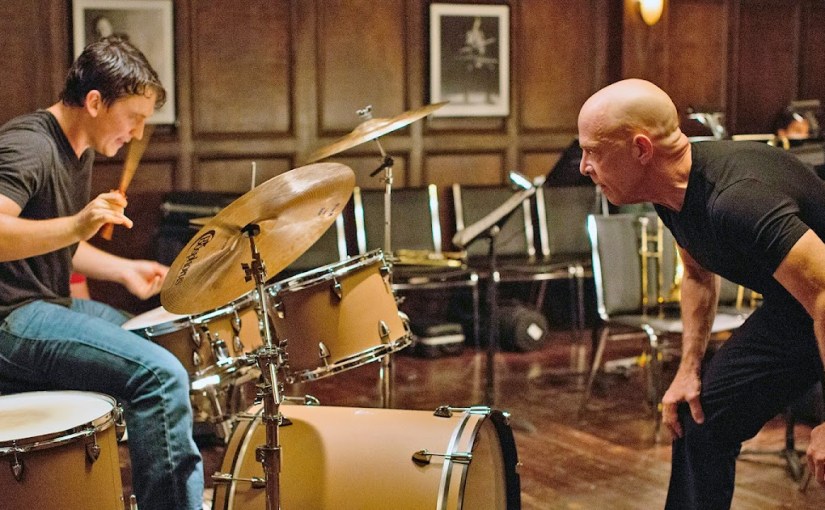
Andrew (Miles Teller) is a talented young jazz drummer who has just started his first year at the fictional Shaffer Conservatory of Music.  He is anxious to gain the attention of Terence Fletcher (J.K. Simmons), the leader of the school’s prestigious jazz ensemble, The Studio Band.  Fletcher is a piece of work.  To say he engages in mind games is like saying Bill Gates dabbles in computers.  He recruits Andrew for his own band in the middle of someone else’s music class.  On his first day with the Studio Band, Fletcher berates another musician for playing off key.

Did I say “berates?”  Fletcher belittles, humiliates, and degrades the poor guy with a stream of profanity that would have made the drill sergeant in Full Metal Jacket envious.  He fires the guy on the spot.  When the guy leaves, Fletcher looks around and confesses that he wasn’t really out of tune, but he didn’t know he wasn’t, which is just as bad.  Accurate?  Technically yes.  Does that kind of teaching method belong anywhere outside of a military unit?  I’m going with “no.”

Andrew is willing to go along with this because he doesn’t just want to be good, he wants to be GREAT.  He wants to be remembered in the same breath with Charlie Parker and Buddy Rich, and he believes, like Fletcher, that greatness is not achieved without struggle and sacrifice.  Again, technically true.  Would Rembrandt have painted half as well with both ears?  Would Beethoven’s Ninth be remembered today if Beethoven hadn’t been totally deaf by the time it was finished?  The rolls of the Screen Actors Guild are littered with actors from broken or abusive homes.

There’s a revealing scene when Andrew eats a meal at home with his father and uncle and his two cousins.  The table conversation rings with praise for the two cousins who play football at their school and scored a long touchdown, etcetera.  When Andrew talks about being a “core” member of the best conservatory jazz ensemble in the country, he’s met with polite congratulations and that’s about it.  No one seems to think he’s going to make it as a musician, not even his own father.  “I’d rather die drunk, broke at 34 and have people at a dinner table talk about me than live to be rich and sober at 90 and nobody remembered who I was.”  Like Charlie Parker.  Like Amadeus.  Andrew’s only goal is to be great.  If he has to give up friends, romance, even family to achieve it, so be it.

But at what cost?  Fletcher pushes Andrew so hard that his hands bleed during rehearsals.  He demotes Andrew, then puts him back in the core, demotes him again, then basically makes him re-audition for the core spot against two other alternates until 2 am.  In one excruciating scene, Andrew actually tries to play in a competition after being in a freaking car accident.  It’s a truly desperate act from someone who is so afraid of being anonymous that only a body cast will stop him from taking his shot.

Make no mistake, the rehearsal scenes and the verbal and mental abuse from Fletcher are not pleasant.  They’re emotionally engaging, but they were also off-putting.  In a strange way, I was reminded of Requiem for a Dream and its disturbing subject matter that was nevertheless compelling to watch.  When we get to what happens to Andrew after the car accident, I was getting thoroughly depressed, despite the powerful emotional beats of what came before.

But then the movie enters its final act, and that’s where Whiplash finds another gear story-wise.  Andrew and Fletcher meet in an out-of-school setting, and Fletcher has an interesting speech where he says, among other things, “There are no two words in the English language more harmful than ‘good job.’”  He admits his tactics were brutal, but he devoutly believes in the necessity of pushing people beyond what is expected of them.  “Otherwise, we’re depriving the world of the next Louis Armstrong.”

Fletcher convinces Andrew to play for a new jazz ensemble one last time.  What happens at that concert is so horrifying that I watched most of it through my fingers.  I kid you not.  But then the screenplay transforms that situation into something magical, almost religious.  You get the sense that all of the horrible and despicable things Fletcher did and said during the whole film, all misery we had to endure with Andrew, during which time I wondered, “Why am I watching this??” – all of that unpleasantness was just the setup for the finale.  And that finale only means something because of everything that came before it.

In other words, just like Andrew, I was only able to experience that tremendous cathartic moment at the end because of the suffering I had experienced in the movie’s first 90 minutes.

…which leaves me feeling torn because that’s exactly the kind of thing that Fletcher believes in, but which I feel is unnecessary outside of a boot camp.  Ideally, yeah, I think that you catch more flies with honey than with vinegar.  I’ve directed my fair share of community theatre productions, and I’ve never had to resort to yelling or humiliation as a method to get what I’m looking for.  But then, I’m directing community theatre, not a multi-million-dollar film that may live or die on the performances I’m getting or not getting from my star.  Nor am I a drill sergeant training men to become soldiers.  It seems there is a line, but apparently to get certain kinds of results, it must be crossed.

It’s this dichotomy that will likely keep me awake the next couple of notes.  That and the senses-shattering finale.  I mean…I did not see that coming.  (And man, I am a jazz fan, so to me it was like eating a perfectly-cooked steak.)  It was not a pleasant road to get there, but it had to be unpleasant.  Otherwise, it wouldn’t have been great.

21 BRIDGES

By Marc S. Sanders

What a huge loss it is to no longer have Chadwick Boseman after being taken so early in life by cancer.  His heroic role in Black Panther is what is arguably celebrated most.  However, even a small, standard cop film like 21 Bridges is evidence of his magnetism on screen.

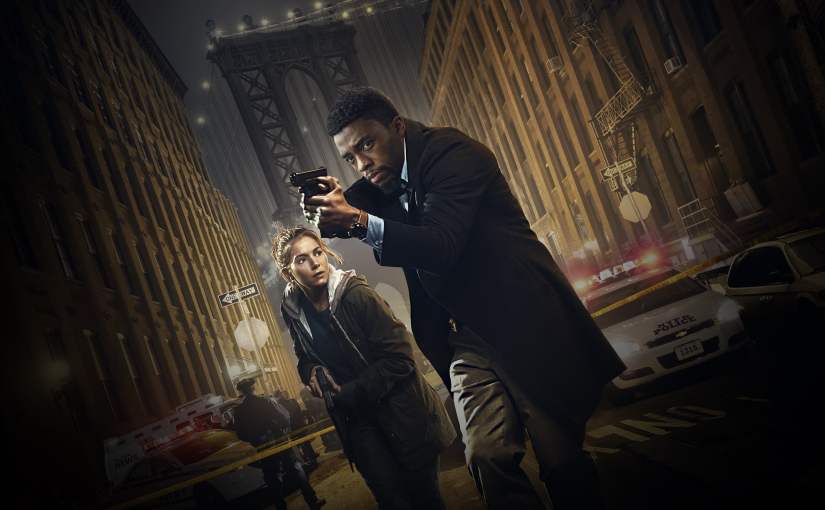
In this movie, Boseman portrays Andre Davis, a New York police detective who is under investigation by Internal Affairs for an abundance of shooting incidents.  Yet he is still on the beat.  When he is summoned to the aftermath of a violent crime scene after midnight in Manhattan, it is up to Andre and his new partner Frankie Burns (Sienna Miller) to track down two killers who ran off with a large supply in cocaine while taking out seven police officers in the getaway.   The best way to catch the bad guys is to shut down the twenty outlets off of Manhattan Island. That means all bridges, tunnels and ferries are closed off until sunrise.  Now it becomes a closed off maze to locate and apprehend the men.  One problem for Andre and Frankie is that the entire police force is looking to taking out the suspects as punishment for killing their comrades.  Andre is actually not the shoot first cop he’s unfairly being characterized as, though.  Sounds simple and familiar, yes.  However, Andre slowly realizes that there may be a complicated conspiracy involved. 

Directed by Brian Kirk, 21 Bridges won’t rank up there with Andrew Davis’ The Fugitive or even the best of the Dirty Harry installments, but the film moves at a brisk pace and the action is spectacular, and at times unexpected.  The early heist of the drugs from an underground wine cellar is fast and shocking when a shootout erupts that goes for a thankfully suspenseful long time.  Kirk doesn’t make it easy for the bad guys (Steven James, Taylor Kitsch) to make their escape.  When they do, the desperation is engaging. 

While this picture didn’t generate much box office success, there’s no question that Boseman would have been a go to leading man in the same vein as Keanu Reeves or Tom Holland has become. My theory: it should not have been released against blockbuster power hitters. Had it come out in January or February, this would have been a sleeper hit for sure. Boseman looks great as the hero and righteous cop, competing with the standard police veterans (JK Simmons) who remind the hero he doesn’t know what he’s talking about, etc.  We, the viewers, know better though.  Boseman looks very cool and athletic in his dark blue overcoat and drawn pistol, running through the streets of Chinatown or within apartment staircases and hallways as he maintains the chase.  Chadwick Boseman is just a solid leading man.  No question about it.

The script by Adam Mervis and Matthew Michael Carnahan is full of surprises that fit in the sense of the picture.  Nothing comes out of left field, but I wasn’t looking for surprises either.  So, when a new development presented itself, I appreciated it.  It kept the movie alive.

So again, Chadwick Boseman is huge loss within the Hollywood ranks.  I read that a sequel was considered.  I would have liked to see that with Boseman reprising his role because it’s a good part for him.   

If you have grown tired of watching the Marvel and Star Wars films and series for the 50th time and you’re looking for something new, seek out 21 Bridges.  It’s a first-rate solid crime thriller.

KLAUS (2019)

by Miguel E. Rodriguez

KLAUS (2019)
Directors: Sergio Pablos, Carlos Martínez López
Cast: Jason Schwartzman, J.K. Simmons, Rashida Jones, Norm MacDonald, Joan Cusack
My Rating: 10/10
Rotten Tomatometer: 94% Certified Fresh

PLOT: The origin story of a certain jolly fellow in a red suit is told with beautifully enhanced hand-drawn animation in a film that deserves to be ranked with the best holiday classics.


I was not prepared for this.

Netflix’s Klaus from 2019 is one of the most beautiful, magical, and relentlessly original holiday films I’ve ever seen.  And heart-rending.  There are emotional beats in Klaus that rival anything in Pixar’s catalog, from the opening sequence of Up to the finale of Inside Out.

Short review: Go. Watch it now. Why are you still reading this?

Long review:

It starts an unspecified number of years ago somewhere in what appears to be Scandinavia, but it could be anywhere.  Or nowhere.  Jesper (Jason Schwartzman) is the ne’er-do-well son of the postmaster general, or something like that.  Determined to make a man out of his son, Jesper’s father assigns him a task: start a post office in a remote northern village on a desolate island and generate 6,000 letters in a one-year period or get cut off from his family’s substantial wealth.

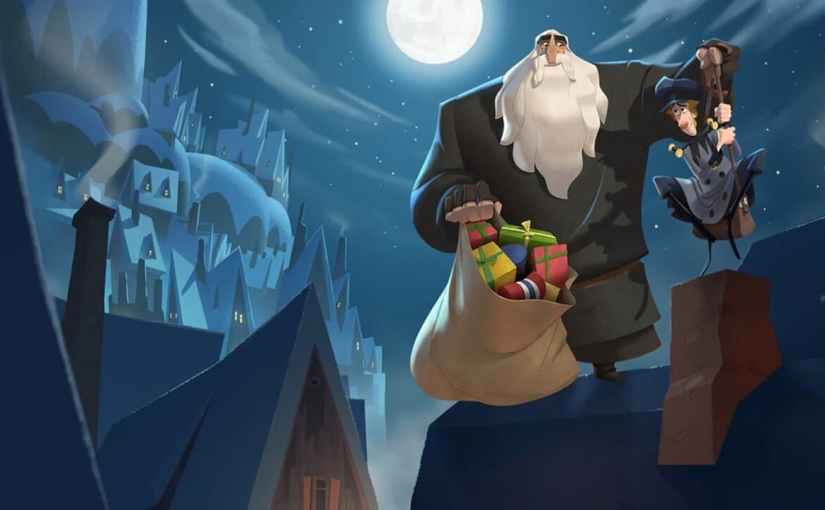
The visuals in this forbidding village could warm the surrealist cockles of Tim Burton’s heart.  Rooftops aren’t so much pointed as sharpened.  Wide-eyed children make snowmen that would give Calvin nightmares.  A generations-long feud between two families on either side of town seems to be their only purpose for staying in town in the first place.

(So far, I’m thinking, okay, kinda weird, not sure where they’re going with this…is this scrawny dude gonna be Santa?)

One thing leads to another and Jesper travels to the other end of the island to visit the isolated house of someone known locally only as the woodsman.  Here he discovers shelves and shelves of handmade toys, gathering dust.  One of these toys finds its way into the hands of a child back in town who wrote a letter asking for a toy…

And here is where the story’s streak of inspired originality really took off.  Virtually every aspect of the legendary Santa Claus is given its own special origin story, from the reindeer to the sleigh to the concept of a Naughty List, right down to getting coal in your stocking instead of a present.

Aha, you say, but this has already been done!  I liked it better when it was called Santa Claus is Comin’ to Town, on TV in 1970, with Fred Astaire, Mickey Rooney, and Keenan Wynn!

True enough.  But Klaus ups the ante by imagining this tale in a way I’ve never seen before.  I’m finding it difficult to express my admiration without giving away key aspects of the film that make it such a delight.  It’s all done so organically, so naturally, that something happens, and you think, “Well, of course they think reindeer can fly, after seeing that!”  I found myself laughing out loud due to the sheer ingenuity on display.

I think it’s a great companion piece to that much-maligned holiday classic, The Polar Express.  Both films approach the Santa legend from different angles, but neither one talks down to its intended audience.  Here is a mystical figure, possessed of magical abilities beyond mortal man.  Both films treat him with the kind of childlike reverence he deserves, and if he’s a little scary sometimes, well…he is always watching…

But none of that would be enough to achieve perfection on its own.  What makes this movie perfect are the heart-rending emotional beats that come as complete shocks to the viewer.  You may notice that I haven’t mentioned Mrs. Klaus, nor is she listed on IMDb.  There’s a very good reason for that, but you won’t get it out of ME.  You may also be asking yourself, well, if this hermit woodsman turns into Santa Claus, what’s the deal with the postman?  Great question!  Watch the movie and find out.

(Pay attention to the wind…that’s all I’ll say.)

These and other surprises pop up here and there, like searching through old clothes and finding folding money in the pockets.  The finale might make you cry like a baby if you’re not careful.  You’ve been warned.

Klaus is buried treasure, lost amid the hubbub of many other films from that year that have been forgotten.  This one does not deserve to be forgotten.  It belongs on any list of classic holiday films, old and new.  If you’ve made it this far in the review, congratulations, thanks for reading, but now it’s time to GO WATCH THIS MOVIE.

Now available on Netflix.