
AMERICAN GANGSTER

By Marc S. Sanders

My favorite kind of crime dramas are the ones that tackle the grit.  The screenwriters and directors go for where the itty-bitty stuff scrounges up into something bigger for either the career criminal or the low-level cop.  These guys start out as butterflies flapping their wings and before you know it their legacies and pursuits are as big as hurricanes.  Movies like The French Connection or Heat operate on these trajectories.  How did we get from there to HERE?

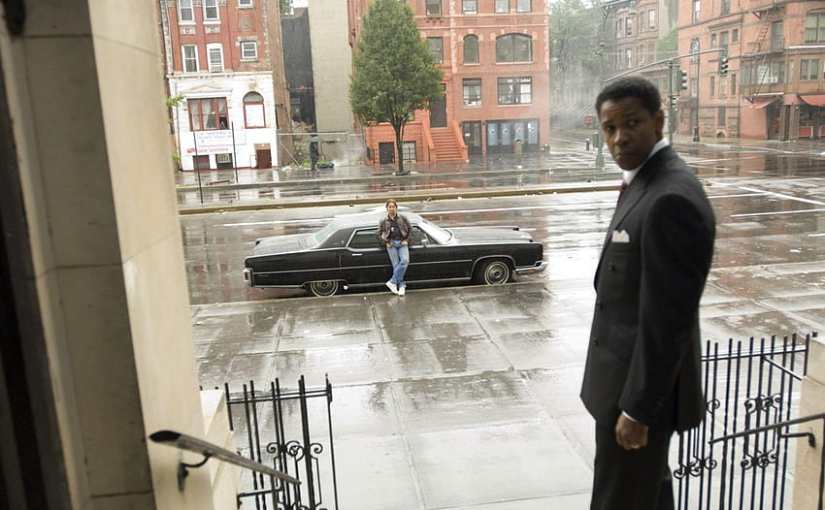
Ridley Scott went in an unconventional direction away from his science fiction eye and ancient history recollections when he directed American Gangster with a screenplay by Steve Zallian based on the true stories of Harlem drug kingpin Frank Lucas (Denzel Washington) and narcotics detective Richie Roberts (Russell Crowe).

These two sensational actors don’t share one scene together until the epilogue of this always interesting three-hour opus.  Yet, in their second film together their pairing is as classic as DeNiro and Pacino or Newman and Redford.  I hope before they retire, these men pair up for at least one more film.  

Ridley Scott and his nominated art directors, Arthur Max and Beth A Rubino, capture a gritty urban, crime ridden Harlem of the 1960s/70s.  The streets are filthily here, as well as in the five New York boroughs and all the way across the bridge into New Jersey.  Frank’s markets carry a very wide berth. The buildings are distressed and cracked.  The clothes are of the hippie era with polyester suits.  This is where Frank Lucas moves his imported contraband, white powder heroin, labeled exclusively as “Blue Magic.”  The film provides a convincing source locale deep within the jungles of Vietnam where thousands of kilos are shipped to Frank for sale on the street.  The purity of the drug is beyond compare.  Scott and his art designers place you directly in this time period of dingy grime and among the sweaty Viet Cong and rivers to finally arrive at the crop Frank purchases his products from.

Once he finds his footing by eliminating the competition and recruiting his brothers and cousins to run his business, Frank invests in creature comforts with a furnished penthouse apartment for himself and a beautiful mansion for his mother (Ruby Dee in an Oscar nominated performance that comes off so naturally; you’d think she’s sitting at the Thanksgiving table with you).  He marries a beautiful Puerto Rican wife that he treats like a princess. Frank is smart.  He stays under the radar by wearing conservative suits and not making many waves like going out at nights and showing himself around the social scene.  He knows famous athletes like boxer Joe Lewis or the staff on the New York Yankees that could give his nephew a shot at being a pitcher. Still, his profile manages to stay low. Like his mentor, he just operates a business with a viable commodity.  He tells his younger brother (Chiwetel Ejiofor) that the loudest one in the room is the dumbest and the most likely to get caught.  So, mind how you carry yourself, how you dress yourself and how you flaunt yourself.

A separate story has no business intersecting with Frank’s plight until something gives.  Richie Roberts is a good, honest cop. Though he’s also a lousy husband and father. He has been assigned to head up a task force that will bust the top of the assorted drug empires.  He needs those rare breed cops who are not on the take and follow a strict policy of law enforcement ethics.  His team will not bust a common street hustler.  They will be looking for the kingpins with unquestionable evidence to put them away for good.

American Gangster follows two separate stories for most of its running time.  At least during the first two acts of the film, Frank and Richie are unaware of one another.  It’s only through some gradual surveillance that the cop finally gets a whiff of an idea and starts to move methodically towards a conclusion. The methods are the fascinating parts the movie.

When Denzel Washington plays a villain it’s always memorable and contrary to popular opinion, Frank Lucas is my favorite of his antagonists, especially compared to his Oscar winning work in Training Day.  Watch how he walks or sits on a sofa and broods over how his family and his business are functioning.  He’s the only African American actor I can see playing this guy because I’m always convinced that whoever Denzel Washington portrays, it’s a character who will never be intimidated.  This guy faced down Gene Hackman during a threat of nuclear holocaust. Not many other actors can do that so authentically.

Russell Crowe works like that hero who doesn’t want to wear the cape.  Richie Roberts succeeds on so many levels where his peers surrender to their inhibitions.  This cop passes the bar exam while fighting for custody of his kid on top of going after the empirical criminals who litter the streets in drugs and murder.  I’m reminded of his role in The Insider, where he used a similar American accent.  Richie is not as temperamental or hard wired as that guy, but he is at least as focused on doing what’s right regardless of threat or distraction.  Russell Crowe has a way of getting audiences to admire the concentration needed for many of his complicated characters.  You have as much tunnel vision as he wants the men he’s portraying to have. You are zoned in with what his characters live by.  You only trust their standards.

There are signature staples within the construct of this true story adaptation.  There are gunfights.  Punches are thrown.  The guy at the top beats up one of his cronies when he gets out order.  Yet, what stands this material apart from others is that now I’m watching how Denzel Washington and Russell Crowe handle everything.

The truth behind the story of a black gangster defying the dirty cops and the Italian mobsters who were thought to run the metropolitan undergrounds is amazing.  It’s so interesting to see how novel Frank is with smuggling the product from one side of the world to the other. Then, you see how he uses his family members to distribute to the consumers and collect the monies. Ridley Scott provides all the breadcrumbs in an easy-to-understand fashion.  

Painted against the landscape of an unwinnable Vietnam War that just won’t end, power is acquired and thus the best police officers are forced to change their approach.  So again, you see two different stories that start out small and undetected.  Frank and Richie are the most careful and meticulous of guys in their respective fields.  Therefore, it only makes sense that their paths don’t cross until their missions are nearly over.

There’s much to learn from American Gangster.  

You get an idea of how the harm of the war was not exclusive to just what was happening over in Vietnam.  There were more indirect effects to that crisis impacting the streets of New York and New Jersey.  

You see what subtleties an investigation will collect upon before pouncing on to a bigger stake.  You also learn how to handle a criminal empire with trust and dignity rather than announcing your immorality. You witness the sheer defiance of a righteous guy in what is supposed to be a law-abiding field. Steve Zaillian’s script is not just good guy vs bad guy. It’s each of these guys holding on to the top while trying to catch up with or stay away from each other.

American Gangster is a very thorough and well-planned biographical thriller.  

JERRY MAGUIRE

By Marc S. Sanders

Writer/Director Cameron Crowe loves all of the characters he creates.  He loves them so much that I bet he’s got volumes of background histories on each one ranging from a nanny – sorry Au Pair – to a cute seven-year-old kid to a brash, hot shot professional sports agent like Jerry Maguire.  Everyone, absolutely EVERYONE, in Crowe’s films has to have a substantial amount of dialogue to bring them attention.  Often it works.  Yet, it’s also his Achille’s heel. 

Roger Ebert called Jerry Maguire a very busy picture and I could not agree more.  Do not mistake me.  I’m quite fond of the film, but yeah, Cameron Crowe unloads a lot in its over two-hour running time.  The title character, played by Tom Cruise in one of his best roles, is the superstar agent who has everything going for him.  He’s engaged to a beautiful talent scout named Avery (Kelly Preston), he has a knack for negotiating the best contracts for the greatest up and coming athletes, and he’s loved – strike that…adored by everyone.  Well…not everyone.  A hockey player’s kid tells him to eff off after his dad suffers his fourth concussion and can barely recognize his family or remember his own name.  It’s only then that he has a revelation in the middle of the night to document a multi-page memo inspiring his colleagues to sidestep the need to make more money. Less clients, and more personal attention to the ones you represent.  Call for everyone in his firm to get behind him in this mentality.  Jerry Maguire will be their martyr.

Well, that gets him fired, and ultimately he’s deemed a loser which is something that poor Jerry cannot learn to live with comfortably.  His one last hope at redemption lies in a promising wide receiver named Rod Tidwell (Cuba Gooding Jr – in a still very memorable role, likely the greatest of his career).  Rod remains committed to sticking with Jerry, but that is not going to make it easy.  He’s often uncooperative.  His pregnant wife, Marcy (Regina King) will not stand for any BS.  Rod is more concerned with obtaining the million-dollar contract, and it takes every last breath of Jerry’s to convince his client that it starts with getting back to just loving the game.

There is also another chance for Jerry to try his hand at love.  Wait, is it love, or is it that Jerry cannot handle being alone?  The test will lie in his relationship with his assistant Dorothy (Renee Zellweger in her breakthrough role), a twenty-six-year-old widow with the cutest kid (Jonathan Lipnicki, impossible not to fall in love with) for a son and a divorced sister named Laurel (Bonnie Hunt) who only has the support of her crying, pessimistic divorced wives support group.

Are you catching on yet to what Roger Ebert was trying to say?  There’s a lot of ingredients to make this stew.  Fortunately, all of it is good material with a great cast, but they are all distractions for one another as well.  At times there seems to be three movies going on at once.  Jerry the agent needs to get back on the horse.  Rod needs to humble himself and listen to his agent.  Dorothy needs to decide if this handsome guy who is the spitting image of Tom Cruise is best for her while she’s trying to be a single mother with a seven-year-old. 

The kid’s Au Pair has ten pages of dialogue.  Marcy has fifteen.  Avery has maybe five, but that’s quite a lot too.  It feels like Laurel and her divorced wives group have fifty pages.  Then there is the jerky antagonist who fired Jerry played Jay Mohr.  There’s just a lot of stuff here.

Jerry Maguire is a well-made film with a natural, feel-good comedic approach.  Cameron Crowe has feelings for all of his characters.  I think he doesn’t even want the Jay Mohr character to get hurt.  Crowe just wants to cradle everyone and kiss them goodnight and give them all a big part in the school play.  It’s a blessing the cast has terrific chemistry.  Anyone sharing a scene with Tom Cruise is doing brilliant work, especially Renee Zellweger and Cuba Gooding Jr.

Crowe’s dialogue might feel schmaltzy during the love story aspect, but it’s captivating.  Cuba Gooding Jr performs like he wrote the character, not Crowe.  He must have invented more to his Oscar winning portrayal of a cocky wanna be football star than the writer could have ever imagined.  “Show me the money!!!!” is still hailed as an all time great scene, chartered by the actor. 

As a director, Cameron Crowe is doing some of his best work.  I recently watched the movie with my Cinemaniac pals and noted to them how much lighting is pointed at the handsome faces of the cast.  It could be Cruise making a negotiation with a promising football star and his no nonsense dad (Jerry O’Connell, Beau Bridges) around a coffee table, or it could be a seductive scene between the romantic leads on a porch.  You never saw so many faces with flawless complexions and the photography of the film looks great from beginning to end.

As overstuffed as Jerry Maguire is, the film ultimately belongs to Tom Cruise, and he delivers Cameron Crowe’s character arc beautifully.  It is such a dynamic portrayal with a lot for Jerry to redeem, learn from and surmise.  The conceit I expect from Cruise is evident.  Sure!  However, it is still a well-constructed portrayal. 

This movie makes me yearn for Tom Cruise to seek out those roles that would come from nowhere and with surprise.  The roles that on the surface never seem like he should be occupying.  Think about this for a second.  This guy has played the seductive Vampire Lestat which was initially poo poo’d by Anne Rice.  He was crippled Vietnam War veteran/protestor Ron Kovic, soon after he played fighter pilot Maverick.  He played the cruelly extreme chauvinistic motivational speaker Frank TJ Mackey amid another crowded cast of exceptional talents and characters. He’s also portrayed Jerry Maguire.  The range of this actor’s talent can only be stretched further and further.  I’d rather know what wonderous role Tom Cruise has in store next, rather than what ridiculous stunt he wants to accomplish for another Mission: Impossible set up. 

Jerry Maguire is a gluttonous picture, but fortunately every entrée is served with heart, genuine emotion, and relatable caricatures.  It’s one of Cameron Crowe’s best films.

A FEW GOOD MEN

By Marc S. Sanders

A Few Good Men really does hold up.

Anyone with even minimal movie going experience can predict how it is going to end almost as soon as it starts, but that doesn’t take away from Aaron Sorkin’s first screenplay based on his original stage play.

It is well cast. For the film, no one else could ever play the intimidating and terrifying Colonel Nathan R Jessup other than Jack Nicholson. It’s not that it is just him in the role. It’s really Nicholson’s whole career legacy against the arguably still ripening careers of Demi Moore, Kiefer Sutherland, Kevin Bacon, Kevin Pollack and Tom Cruise. Nicholson’s timed grandstanding is necessary for the role to work.

Cruise on the other hand left me feeling a little too overplayed. The role calls for cockiness, yes, but is Cruise too cocky? Some of the gags he does work. Some don’t, like impersonating Nicholson momentarily (leave that for the guys on SNL, Tom), or when he’s poking fun at Moore’s character to his own delight. It’s a little too much. Still, his courtroom scenes are like watching the best in live theatre. Those scenes play like great sport, notably thanks to Tom Cruise.

Major props go to JT Walsh as a conflicted witness. When I say conflicted, I mean he authenticates a seriously valid and personal dilemma beautifully. Had it not been for Jack Nicholson, Walsh might have had an Oscar nomination. A shame he didn’t come close to such recognition while he was alive. He was such a great character actor.

Recognition also goes out to Kevin Bacon as a well versed prosecutor/Marine. His timing exudes the experience his character has, despite his youthful appearance.

Demi Moore might be caught trying too hard, I think. Kevin Pollack is the wise mentor sitting quietly waiting for his great moments. Kiefer Sutherland is great in almost anything he does. He doesn’t ever steal the spotlight like Cruise, Nicholson or Moore but he makes a great presence; conniving and bold.

The direction is nothing special really. Rob Reiner does fine but honestly Sorkin’s script sells itself.

Yeah, yeah. “You can’t handle the truth.” Great line, but I got news for you. I’d argue there’s even better lines in this 1992 film. It’s worth revisiting.