SILKWOOD

By Marc S. Sanders

As the 1980s were setting its stride, Silkwood might have been one of the earliest in a line of films to focus on the union worker who fights back at the billion-dollar corporation.  Some might unfairly regard the movie as The China Syndrome, Part II. Other well-known pictures of this mold are even more familiar to me like Michael Mann’s The Insider.  However, director Mike Nichols, working with a first screenwriting effort from Nora Ephron who partnered with Alice Arlen, showcases the aggravation on not just Karen Silkwood, the real life potential whistleblower, but also her friends and co-workers in a one factory town just outside of Oklahoma City.

Karen (Meryl Streep) lives with her boyfriend Drew (Kurt Russell) and her best friend Dolly (Cher) in a run-down house in the middle of nowhere.  They ride to work together at the local plutonium manufacturing plant where they dress in scrubs and gloves. Punch in, punch out kind of days, and often they are expected to work double shifts and weekends.  Karen works an assembly line where she places her hands in rubber gloves and assembles dangerous combinations of chemicals in an enclosed box.  It’s also routine that before you leave your station you wave your hands over a sensor to ensure you have not been exposed to radiation.  There’s even sensors you walk through as you enter and leave the plant.  When those sensors go off, a calm kind of film seemingly turns into a horror movie.  The last thing anyone could ever want is to get “cooked.”

Karen does not live a perfect life.  Her three kids reside with their uncompromising father in Texas.  Money is not ideal.  Dolly is a slob and has also invited her girlfriend to live with them.  Karen can manage with all of this, but when she observes some unconventional activities around the factory she gets up the nerve to head the union for better protection and working conditions.  However, the further she goes looking at files and photos, jotting down notes of what people say and do, plus taking trips to Washington DC, and getting phone calls from attorneys at night, she becomes more and more isolated from Dolly and Drew, along with the rest of her close-knit workers.  Karen is not just risking her job, but everyone else’s jobs and worse her own life.

The attorneys lay it out to the townsfolk and the union of the horrifying statistics that go along with radiation exposure.  The tiniest fraction of a miniscule of exposure to the smallest crumb of chemicals could increase a human’s bearable limit towards radiation and cancer.  The sad irony is that the more that is learned, the more the people of this area smoke and smoke some more.  Granted, this story takes place in the early 1970s, though.    

The company is primarily represented by an intimidating Bruce McGill.  He’s great in everything he does and is worthy of an Oscar nomination somewhere.  M Emmet Walsh has no lines but his presence is enough to shake you; the slimy guy you easily recognize from every other movie you have seen.  While the company’s overbearing intrusion is shown plenty, the script for Silkwood focuses more on how these working people get by.  They are treated unfairly and in dangerous working conditions, but they also know this is the only place that offers steady income in the area.  Without this factory, the whole town would be left in dire straits.  Karen is repeatedly told or implied to leave well enough alone.

Meryl Streep notches another harrowing performance on her resume and bears such a departure from more sophisticated characters found in Sophie’s Choice and Kramer Vs Kramer.  Karen Silkwood is not educated and she bears an unmistakable white trash dialect but she’s also not stupid and the more progress she makes at exposing the plant’s shortcomings the more unfairly she is treated with department transfers and workplace shake ups that she is indirectly blamed for.  Potential threats on her life begin to build, but she only upholds a bravery.  You really observe the strength of Meryl Streep.  She’s at the top of an elite class of actresses at this time that also included Sally Field, Jessica Lange and Glenn Close.

Cher plays Dolly in her first on screen role.  The variety act performer probably subjected herself to a bigger departure than Streep.  She was not a professionally trained actress at the time.  Mike Nichols insisted on no makeup along with her hair unkept and flat, while dressed in green chino pants and baggy sweatshirts.  The new actress carries herself so well without the usual glitz that accompanies her.  Her scenes with Streep are workshops in acting technique. 

Kurt Russell delivers another understated performance.  One of the best actors out there who has never been enough of a critical darling.  Drew is likable and Kurt Russell plays him as a settled in match for Streep’s portrayal of Karen.  Watch how they tangle up in each other’s arms in bed or when he snaps at her as she carries on her crusade while he’d rather things be left alone.  His timing is perfect for the script.

Mike Nichols keeps his film calm, except when the go by the numbers narrative must be disturbed.  A radiation cleanse with high pressure hoses will make you wince.  The factory alarms will terrify you.  Meryl Streep accepts the physical taxations necessary for this setting.  Nichols gets in close with his camera to show how cleansers dressed in scrubs and masks rub Streep down until her skin is a burning red.  I distinctly remember how her right ear appears in this scene, getting flushed by something just short of a fire hose, and the aftermath of her sitting in a chair is so discomforting while a company doctor assures her that there’s not much to worry about as long she brings in her urine samples daily.  In fact, soon all of the employees are tasked with delivering their urine samples.  What kind of place is this?

While Silkwood is based on a true story with a burning question left behind, I do not want to reveal too much.  Many have seen Silkwood since it was released over forty years ago, but as the third act begins, the fallout only becomes more disturbing and Mike Nichols directs a horrifying sequence built primarily on the pealing of old wallpaper.  That’s all I want to suggest. 

Karen Silkwood was a very unlikely crusader.  She probably never envisioned what she would become and what she would fight for.  Yet, she uncovered horrible truths that should not have been occurring under the eye of billion-dollar corporate America.  After watching Silkwood, I can only imagine what else was there to turn over.

NOTE: Another good reason to watch Silkwood is to discover early performances from some amazing character actors who were either just starting their careers or continuing to hide in the crowd. 

Scavenger hunt for Anthony Heald, James Rebhorn, David Strathairn, Ron Silver, Fred Ward, Diana Scarwid, Bill Cobbs, M Emmet Walsh, Craig T Nelson, Tess Harper, Will Patton, Richard Hamilton and Josef Sommer.

SILKWOOD (1983)

by Miguel E. Rodriguez

DIRECTOR: Mike Nichols
CAST: Meryl Streep, Kurt Russell, Cher, Craig T. Nelson, Fred Ward, Ron Silver, Bruce McGill, David Strathairn, M. Emmet Walsh, James Rebhorn
MY RATING: 8/10
ROTTEN TOMATOMETER: 77% Fresh

PLOT: On November 13, 1974, Karen Silkwood, an employee of a nuclear facility, left to meet with a reporter from the New York Times. She never got there.


The tagline for Silkwood (quoted above) almost feels like it gives the game away, but it doesn’t really.  Even if Karen Silkwood’s name isn’t exactly part of the cultural zeitgeist anymore, I am willing to bet that a lot of people know what her name signifies in one way or another.  So, it’s not like the movie’s poster or trailers are spoiling what happens at the end of the film because most of us know.

In any event, Mike Nichols’ film isn’t a nuclear-based thriller, like The Day After (1983) or WarGames (1984), that depends on an unexpected resolution.  Silkwood isn’t about theatrical heroics or bombastic personalities.  It’s a quietly intense character study of an everywoman with an untidy personal life who experiences a seismic shift in her perception and decides she simply can’t stand by and do nothing.  This isn’t a crowd-pleaser like Erin Brockovich (2000), but this film’s story and central character are no less important.

The film goes to great pains to show us how ordinary and messy Karen Silkwood is.  The incidents at the Oklahoma nuclear facility where she works (along with her live-in boyfriend, Drew, and her roommate, Dolly) are almost secondary to the plot, at least for the first half of the film.  Karen has kids that live with her ex-husband and his girlfriend in Texas.  Her relationship with Drew isn’t stormy, but it’s not perfect.  Dolly seems tolerable as a roommate, but is not shy about speaking her mind.  Dolly brings a girlfriend home one night, and there is a slyly amusing conversation between Karen and Drew about Dolly’s sexual preferences.  (“I can handle it.”  “Me, too.”  “…so why are we talking about it?”)

I don’t want to go into too many details about the true-life incidents that occurred at the facility where Karen worked because, if you’re not intimately familiar with the facts of the story, they should be as surprising to you as they were to me.  Plutonium is involved, but probably not in the way you’re thinking.  Karen learns enough to know she should be more involved in the factory’s union…a LOT more.  One plot thread almost feels like it’s ripped off from The China Syndrome (1979), until you realize Syndrome was released four years after the events of Silkwood, so if anything, Syndrome was probably inspired by Karen’s discoveries.

I also have to mention Cher as the roommate, Dolly.  Of course, Meryl Streep is amazing and convincing as an everyday, average divorced mom, but Cher more than holds her own in every scene.  There is absolutely no hint of the pop music megastar of the ‘70s in this film.  Director Mike Nichols insisted she wear little or no makeup in her scenes, which went against every fiber of her instinct as a performer.  She understood the assignment: she never upstages anyone.  This is not a grandstanding kind of supporting role, like Tommy Lee Jones in The Fugitive (1993) or Cate Blanchett in The Aviator (2004).  It required subtlety and understatement, and Cher delivered.  I tried to spot her “acting,” and I never could.  She was unbelievably natural and, at times, heartbreaking.  The movie is almost worth searching out just to see her performance.  It’s a clinic in how to own a small role and make it stand out by doing less than you might expect.

Silkwood may not feel as thrilling as some of the other thrillers I’ve already mentioned, but it is just as compelling, specifically because we’re watching an ordinary person under extraordinary circumstances.  We’re not watching a hero triumphantly rise to the occasion.  We’re watching a struggling divorcee who’s trying to do the right thing after years of inaction, even if it means losing the trust of her co-workers or sacrificing her other personal relationships.  I identified more with Karen Silkwood and her situation than I did with Jane Fonda in The China Syndrome or Julia Roberts in Erin Brockovich

The ambiguous nature of the film’s ending mirrors what happened in real life, and when the credits rolled, I felt a surge of empathy for the people left behind and the unanswered questions they live with to this day.  That doesn’t happen to me very often.

POLTERGEIST (1982)

By Marc S. Sanders

The original Poltergeist holds together based only upon its visual imagination.  The characters?  Well, they’re pretty thin to me. 

The Freeling family are JoBeth Williams and Craig T Nelson as mom and dad, with a teen daughter (Dominique Dunne), a preteen son (Oliver Robins) and an angelic five-year-old girl named Carol Anne (Heather O’Rourke) who speaks to the “tv people” through the white noise channel in the middle of the night.  Following odd occurrences that include unexplainable trickery from the kitchen chairs, a monstrous oak tree comes alive during a violent thunderstorm ready to consume the boy, while little Carol Anne is abducted by her closet into another realm that “exists” somewhere within the suburban house.

Mom and dad recruit help from ghost whisperers to uncover the mysteries that reside in the home and hope to rescue Carol Anne.  Beatrice Straight is the leading scientist of this team.  She introduces dialogue that says their home might be not be so much haunted as it is consumed by a “poltergeist.”  That little nugget to ponder stops there though, and is never explored further.   Who cares, actually?  Poltergeist!  Haunting!  Tomato! TomAto!  The piano is still moving by itself, and the toys are still floating around the children’s room.  Since the unexplainable can never be explained, a psychic is brought in, perfectly played by Zelda Rubinstein as a withered old lady with a kinship for the supernatural.  She knows how mom and dad should direct Carol Anne back to their dimension, and has a pretty good idea how they need to enter the other realm and physically rescue her.

Watching Tobe Hooper’s classic haunted house film from 1982 (rumored to primarily be directed by producer/writer Steven Spielberg), almost feels like I’m touring a warehouse of monster creations at a movie studio with all the lights turned on.  Most of the inventions offer little depth or curiosity.  I could care less about any of the characters like the parents and three kids that make up the Freeling family, or the squat psychic who enters the second half of the picture.  Beatrice Straight is an interesting actress with a humorous shiver and terrified whisper.  She leads two ghost hunter assistants who lack the speak to talk with researched authority.  I run down this list though, and all I get from the movie is an arts and crafts display of the dazzling and grotesque creations spawned from the imaginations of Industrial Light and Magic.  The artistry is to be admired.  Yet, I question if anything I saw ever served a story. 

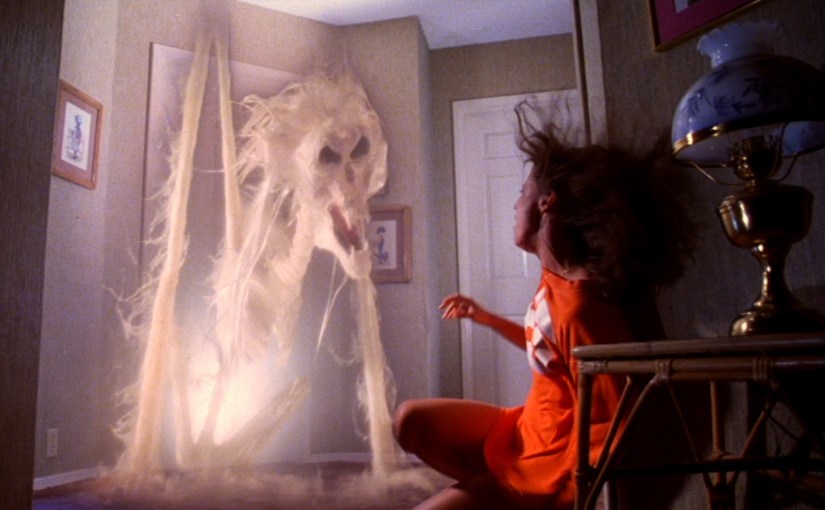
I don’t watch Poltergeist as often as others I know, simply to avoid experiencing the terrorizing clown puppet that dons a wicked tooth like expression and strangles the young boy.  Still very effective.  Coffins burst from the muddy swimming pool to pour out skeletons upon a screaming JoBeth Williams.  A ghostly white phantom guards the door to the children’s room and the closet entrance becomes a gaping, hellish monster mouth ready to swallow what it inhales.  Raw meat crawls across the kitchen counter.  A chicken leg turns into maggots and let’s not forget about the guy who hallucinates in front of mirror while pealing the skin off his face.  These are just lists!  Lists of scary things to do.   

Poltergeist is a simplistic fun house of haunts.  Nothing further.  I appreciate that only to a degree, however.  I wanted more.  An explanation is given for these occurrences in a tiny exchange of dialogue during the terrifying climax.  Beyond that, there is nothing I can say about these characters or what they stand for.  The kids toss cereal at each other at the breakfast table, and the parents smoke pot in bed, but there’s really no affection, or conversely, animosity shared among the family members.

If I were to compare Poltergeist to other fright fests like Hitchcock’s The Birds or even the original Predator or Alien, I would undoubtedly say those are superior films because beyond the monsters that terrorize the characters there’s also room for mistrust and paranoia among the players.  There’s time to devote towards care that those characters may have for one another.  A suburban mom is seemingly expected to want to be reunited with her little girl.  That’s a give in.  It’s standard.  Completely apparent in every way.  Couldn’t some competition from mom and dad come into play though?  Some blame pointing tossed about for example?

I guess I get a little bored with Poltergeist because it doesn’t stop to acknowledge the value of its cast of characters.  There are only a few moments of suspense that come upon me like when I’m trying to figure out where the scary clown puppet went off to.  Another terrifying moment is watching JoBeth Williams hustle as fast as she can to her children’s room while the hallway seems to stretch the bedroom door further and further away from her.  These are all things to look at though.  These are not moments that I connect with emotionally.

Some close friends of mine absolutely love this movie.  They can’t get enough of it.  They recite the lines.  They get caught up in the supposed “Poltergeist Curse.”  They watch all of the making of documentaries and return to the film for the nostalgia.  For me though, I never felt an intimacy with the mystery, or the family being victimized.  On that level, it’s almost on the same plane as a disposable Jason or Freddy movie.  I’d like to shed at least one tear before that teen gets their head chopped off, or the screaming kid gets eaten by the tree trunk.

THE DEVIL’S ADVOCATE

By Marc S. Sanders

The Devil’s Advocate does not get the accolades it truly deserves, and I’ve never understood why. It is more than just a supernatural thriller or a legal drama. It’s both actually, and most films cannot lay that claim.

Director Taylor Hackford has assembled a brilliant cast that boasts a debut from Charlize Theron in the incredibly complex role of Marienne, wife to Keanu Reeves’ hot shot southern drawled, Gainesville attorney. Theron hits every pulse perfectly beginning with loose, beautiful and cocky to insecure, haunted and victimized. When I first saw the film in theatres, I left believing she’ll get an Oscar nomination. Alas, the powers that be never gave her consideration and they were wrong. Beyond a relishing Al Pacino as the lord’s most infamous fallen angel, Theron’s performance sends the script home into absolute believability. The power of Satan is executed on Marienne, and the visual and audible evidence lies in Theron’s delirious performance. She’s astonishing.

Next up, Reeves is entitled to lots of credit. The role of Kevin Lomax is his best role (Ahem…Sorry, Neo. Sorry John Wick. Sorry Johnny Utah.). He carries a disillusioned swagger that he is as good as his record of trial wins implies. Yet, is he as good as the best of the best New York City attorneys? When you are the son of Satan, maybe so. What works best though are the ongoing tests of will for Reeves’ character. His inescapable hillbilly dialect blends perfectly with a script that questions temptation against instinct, against opting for what is right. At the time of release, Keanu Reeves might have been perceived as his surfer dude Bill & Ted character not be taken seriously enough here. I never let that be an interference for me, however. Reeves doesn’t compromise and he avoids the wholesome, God-fearing kid that Kevin Lomax is meant to be. Instead, his Christian teachings seem like a nuisance for him; an obstacle to a more satisfying life regardless of sin. Reeves balances the dimensions beautifully.

Then there’s the machine behind all this. Al Pacino is John Milton, hardly disguising his true identity. He’s too proud of who he is to do that. Sure Pacino is chewing the scenery. Yet, shouldn’t he? This is Mephistopheles he’s playing here; an entity ready to undo the will of the Lord. He carries no honor for God. However, he maintains a rule book and before he accepts a disciple, he’ll make certain that it is by the follower’s choice alone. He administers the test, but he doesn’t take it. Pacino gets the best lines and the best monologues. He’s treated with an opportunity to two step along to Frank Sinatra. He’s given free reign to operate based on his legendary career. He’s my favorite devil of any and all films.

Taylor Hackford is meticulous in his direction. There’s a great moment near the beginning where Kevin is saying goodbye to his God loving and very Christian mother. He goes to her church. This is the first of many smart choices for Hackford. He does not allow Kevin to step inside the church. Rather, he paces just outside the door. Kevin does not have a relationship with God, thus opening an opportunity for Satan. Other moments are there too, such as Milton always insisting on traveling by subway…underground. Heck, there’s even a moment where a man with a box that says “Halo Industry” walks by Kevin and John; nice subtle nod. New York City is treated like a character boasting its numerous, sky-high cathedrals and angelic artwork. Pacino is the ultimate NYC resident; a creature of the concrete jungle. Hackford also recruits the notorious to boost the lair surrounding Reeves and Theron with appearances from the likes of Don King and Alphonse D’Amato. (Satan’s disciples, perhaps?)

This is one of my favorite films. It carries not one single flaw. It is richly assembled in dialogue, story, cast, set design and direction.

The Devil’s Advocate is one of those films that you want to watch over and over and delight in Pacino’s thought provoking one liners, debate with your conscience vs Satan’s own argument (he makes some good points here) and question the power of free will. It’s a fun, thinking picture.

INCREDIBLES 2

By Marc S. Sanders

Disney/Pixar and (yeah, let’s single him out) Director Brad Bird continue to impress with marvelous feats of imagination. Yet I’m not necessarily referring to the art of their animation, outstanding action scenes or the colorful superhero names. Rather, it’s the story that usually stands above all else in each entry that’s released year after year.

Allow me to sidetrack for a moment. Consider a film like Lethal Weapon 2. It’s a fun movie that I’ve always liked, but it was not just an action movie. I mean, think about it. There’s a reason the first film was on Roger Ebert’s Top 10 list of 1987. It focused on the trauma and suicidal tendencies of a burned out cop along with some great action and humor. It’s sequel however, just did the same thing. Just more of the same stuff, despite a very capable partner that was featured in the film. The partner remained the sidekick again. Not much effort in thought the second time around (or 3rd or 4th).

Incredibles 2 avoids the same trap. While the first one focused on Bob Paar and his alias, Mr. Incredible, this new film relies on Holly Hunter’s Elastigirl, known by day as housewife Helen Paar. Yeah, as I’m writing this, I’m realizing she’s kind of recruited for a mission the same way her husband is, but the perspective seems fresh; consistent in step with other female hero protagonists like Wonder Woman and Katniss Everdeen.

Adding to the effectiveness of this film is that these larger than life characters are humanized. Dad is out of work, following a government mandate. So he stays home with the kids and mixes the pinks with the whites while trying to get the atomic demon baby Jack Jack to sleep. Side note: Jack Jack is an awesome scene stealer. There’s a reason this kid was on every toy shelf and t-shirt in countless variations from the end of summer through Christmas. He’s now up there as one of my favorite Pixar characters.

A surprise reveal is no surprise at all. So don’t set yourself up for disappointment. Just relish in a very cool new villain known as The Screenslaver. He’s no Syndrome but he’s pretty intimidating nonetheless.

As a major comic book geek, another thing I appreciated was that Bird’s script and direction follow a pattern of the golden and silver ages of comics without all the heavy drama that comic film adaptations depend on today. There’s a bad guy wreaking havoc and the superheroes come in to save the day. There’s no heavy pseudo tragedy to get in the way. Often I don’t mind that, but here it’s absence is refreshing. Just make it about a bank robbery and a bad guy with the “mwah ha ha” maniacal laugh and it’ll satisfy. It kept the movie light, playful and especially funny.

So glad that I was able to take time out to see Incredibles 2. Go find your super suit and soar to seat in front of the screen.

NOTE: there is a scene midway through the film that might be disruptive for people prone to having seizures. It contains the equivalent of an actual strobe light effect and it lasts a good 2-3 minutes. Please take that into consideration. If you want to know when it takes place, message me and I’ll clue you in when you might want to excuse yourself from the viewing.