FRANKENSTEIN (2025)

by Miguel E. Rodriguez

DIRECTOR: Guillermo del Toro
CAST: Oscar Isaac, Jacob Elordi, Christoph Waltz, Mia Goth, Charles Dance, David Bradley
MY RATING: 8/10
ROTTEN TOMATOMETER: 86% Certified Fresh

PLOT: A brilliant but egotistical scientist brings a creature to life in a monstrous experiment that threatens to undo both the creator and his tragic creation.


Having never read the original novel by Mary Shelley, I have no idea if Guillermo del Toro’s rendition of Frankenstein is any more or less faithful to the source material.  What’s interesting about this version is that it feels like it is.  There are long passages of dialogue and even some monologuing on the nature of life, death, and the creator’s responsibility to their creation.  del Toro is smart enough to balance these cerebral discussions with enough gothic (and gory) horror to satisfy any fan of the genre.  Call it a good example of a thinking man’s horror film.

Oscar Isaac’s performance as Victor Frankenstein puts a new spin on the stereotypical mad scientist.  He’s no less obsessed than previous versions, but del Toro and Isaac went for a slightly different vibe in his personal appearance.  Rather than a cackling lunatic with a god complex, Isaac’s doctor looks and sometimes behaves more like a self-absorbed rock star…with a god complex.  (I learn on IMDb that this was by design; del Toro wanted Victor to evoke David Bowie, Mick Jagger, and Prince…mission accomplished.)

Jacob Elordi as The Creature does an admirable job of generating sympathy and empathy for perhaps the greatest misunderstood monster of all time.  The unique makeup (which took up to 10 hours to apply!) allows Elordi to emote and lend humanity to the Creature in the second half of the film, especially during his encounter with the blind man.  There is a subtle but ingenious effect where one of his eyes will sometimes glow orange with reflected light as a reminder that, when push comes to shove, this Creature is not to be trifled with.

Mia Goth is a welcome presence as Elizabeth, who is not Victor’s love interest this time around, but fiancé to Victor’s younger brother, William.  I supposed I could quibble that the screenplay does not give Elizabeth much to do.  She comes across as the intellectual equal of Victor in a few well-written scenes, but her encounter with the chained Creature felt a little trope-y, and her character’s payoff left me wanting more.

The visual style of the film is crammed with del Toro’s signature fingerprints: huge gothic structures, elaborate costume designs (loved Victor’s mother’s red outfits near the start of the film), startling dream sequences, and lots of practical effects…well, more than there were in Pacific Rim (2013) and Crimson Peak (2015), anyway.  One image that really struck me was the unique design of two coffins seen in the film.  They looked more like futuristic cryogenic chambers than Victorian-era caskets.  Watch the movie and you’ll see what I mean.

Other things I loved:

  1. Victor’s early presentation of his theories to a disciplinary board, in which we get an echo of that creepy dead guy resurrected by Ron Perlman in del Toro’s Hellboy (2004).
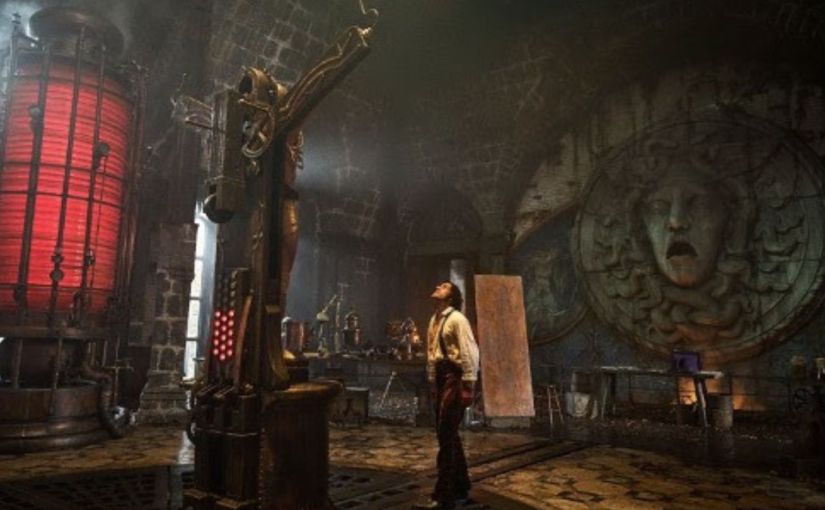
  2. The towering set for Frankenstein’s laboratory.  What it lacks in the whirring, crackling machinery we normally associate with his lab, it makes up for in scale, including a yawning pit several feet across that really should have had a guardrail.
  3. Being able to get inside the Creature’s head this time around.  There have no doubt been other variations where the Creature speaks, but I haven’t seen one where he is this eloquent, expressing his pain and anguish over his unwanted existence and apparent immortality (his wounds are self-healing).  This is another factor that makes this movie feel more faithful to Shelley’s novel, even if it isn’t.
  4. The no-holds-barred aspect to the violence and gore, which can be quease-inducing, but which never feels overdone or exploitative.  In fact, the moment that scared me the most in the film had nothing to do with the gore or violence at all, but with one of the doctor’s early experiments that comes to life in a most surprising manner.

Above all, there’s the tragic nature of the poor Creature’s existence, the misunderstood monster that has been so often satirized or spoofed, and the deeper questions the story raises about our own lives.  It might be tempting to listen to the closing passages of the film and dismiss them as trite and sentimental, but Frankenstein earns those moments, in my opinion.  More than any other Frankenstein movie I’ve seen, this one made me think, and jump a little, in equal measures.  Tricky stuff.
DJANGO UNCHAINED

By Marc S. Sanders

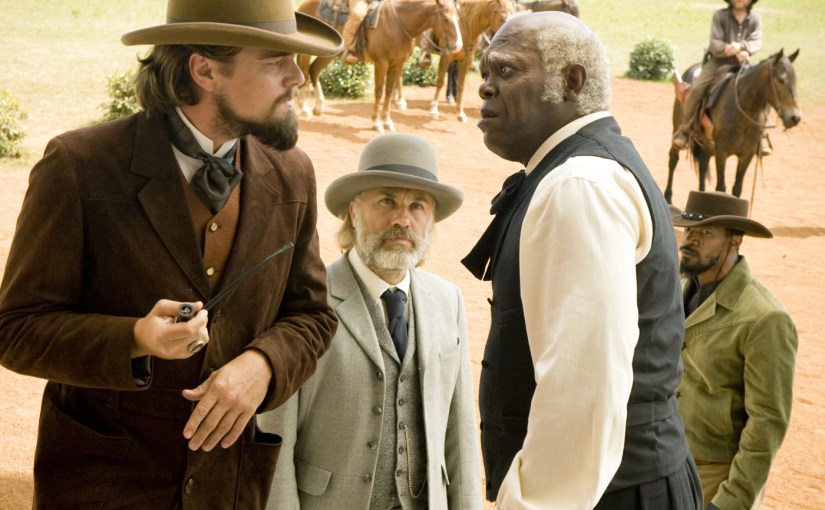
Quentin Tarantino’s scripts have never been shy with using the N-word or any other colorful terminology.  He turns harsh and biting vocabulary into rhythmic stanzas of dialogue.  When he films these scripts, he’s not bashful with the buckets of blood splashed all over the set either.  His interpretation of violence works in a kind of slapstick fashion among his seedy one-dimensional characters.  Normally, I never get uneasy with his approach.  I know what to expect of the guy.  Yet, as well cast, written and formulated his Oscar winning film Django Unchained may be, I wince at both his word play and physical carnage.  I think Tarantino gets a little too comfortable with his slave era storylines and the African American actors he stages in his set ups.  A good portion of this Western may be thrilling, but it’s also cringy like watching a drunk uncle at a three-year old’s birthday party, and I defy viewers not to squint at the movie if they so much as live day to day with even the smallest shred of kindness in their hearts.

Django Freeman (Jamie Foxx) is released from slavery by the former dentist now bounty hunter, Dr. King Schultz (Christoph Waltz, in his second Oscar winning performance cast by Tarantino).  Django is a good man, though uneducated and mostly illiterate.  Once he assists the doctor with locating and collecting a bounty, the two make an arrangement to stick together through the winter collecting further ransoms.  In return for the former slave’s help, Dr. Schultz will assist in rescuing Django’s wife, the German speaking Broomhilda (Kerry Washington).  She is believed to be held at the infamous Mississippi slave plantation known as Candyland, owned by the ruthless Calvin Candie. He is played by Leonardo DiCaprio in one of his best roles while also delivering one of his most unforgiving portrayals.  Calvin Candie is a mean son of a bitch slave owner who has too much fun with investing in slaves for brutal Mandingo wrestling matches that don’t finish until the loser is dead in bloody, bone cracking fashion.  

All of these figures belong at the top of Quentin Tarantino’s list of sensational character inventions, particularly Django.  He has more depth than most of the writer’s other creations.  This guy goes from an unkempt, nearly naked, tortured and chained slave to a free man proudly wearing a bright blue court jester costume on horseback.  His third iteration places him in a gunslinger wardrobe comparable to a Clint Eastwood cowboy and when the conclusion arrives, Django is meaner, more confident and instinctively wiser, glamorously dressed (purple vest with gold inlay designer seems) like a graphic novel superhero ready to take on an endless army of redneck slave abusing outlaws.  Django is taught everything he needs to know from Doc Schultz.  Christoph Waltz and Jamie Foxx stand as an impressionable mentor/student pair.  They are the spine of Django Unchained.

The villainy of the piece belongs to DiCaprio and his head slave in charge, known as Steven, played by the director’s go to player for happy street slang and N-word droppings, Samuel L Jackson.  Steven is Jackson’s best career role because as an old, decrepit and frightening individual it’s this portrayal which looks like no other part the actor has ever played.    Both actors are funny, and you can’t take your eyes off of their unlimited grandstanding, but they will leave you feeling terribly uncomfortable.

I think what is most unsettling about Django Unchained is that the cruelty persists for nearly the whole three hour run time, and it is more so at a shameless attempt of comedic, pulpy entertainment, rather than just insight and education.  A Schindler’s List finds no glee in the torment that kept the Holocaust alive.  Tarantino didn’t even go to great heights with Inglourious Basterds because that film featured ongoing grisly heroics with his assortment of vengeful protagonists.  The Nazis were never celebrated in that film at the cost of innocent Jewish lives that faced peril and threat.

In Django Unchained, it’s hard to watch the Negro characters and extras getting brutally whipped while bound by inescapable chains.  Kerry Washington’s nude character is yanked out of a sweat box on the Candyland plantation and while I’m watching it, I ask myself if I’m too much of a prude.  No.  I don’t think I am.  This teeters on torture porn. The N-word is now being used way too freely to stab at the slaves for gleeful poetry. It grows tiring and, yeah even for a Quentin Tarantino picture downright ugly and offensive. I imagine Tarantino grinning behind the camera every time DiCaprio or Jackson happily drop another N-bomb.

Quentin Tarantino has been applauded time and again for his excessive abuse and tortuous murders committed by his characters.  Because he’s courageously gone so far before, the line of acceptance is either pushed out farther or maybe in the case of Django Unchained it is entirely erased.  

My compliments to a well-known humanitarian like Leonardo DiCaprio for energetically acting through this bastard of a role that requires a twisted pleasure in watching two husky black bruisers beat the bloody tar out of each other in a formal drinking parlor.  Later in the picture, a weeping slave is shredded to pieces by ravaged, bloodthirsty dogs.  These fictional scenes staged by Tarantino and his filmmakers come off a little too real and even by the director’s standards much too over the top for the temperature of this film’s narrative.  

What could these extras cast to play these slave and Mandingo roles have really been thinking while shooting this picture?  Did these men recognize the racially poetic humor in Tarantino’s verbiage? Did they find a commitment to demonstrate a once historic atrocity for a lesson learned? I doubt it. Did these actors simply succumb because they needed the work?  Believe me.  I empathize.  Yet, Tarantino took this film to a very uncomfortable extreme for a movie intended on following his reputable and always admired lurid material.  Here, despite my reverence for his work, I think Quentin Tarantino goes unnecessarily over the line.  The whippings and dog torture are quite uneven from what The Bride commits in Kill Bill when a Crazy 88 henchman gets spanked with a sword and there’s nothing to compare to whatever sick, graphic novel atrocities occur in his later western, The Hateful Eight – both are PG rated compared to what is offered in Django Unchained.

Much of Tarantino’s signature comedy works.  The Ku Klux Klan of the late 1850s are represented with brilliant stupidity by a cameo appearing Jonah Hill and a racist, foul speaking, plantation owning charmer played by Don Johnson, known by what else but Big Daddy.  The filmmaker turns these guys into bumbling stooges who can’t even wear their hoods properly. And yes, they also freely drop the N-word in cruel like fashion. I get it, Mississippi and Southern Plantation owners were not the Mickey Mouse sort, and I’m not asking for whitewashing what the real-life despicable characters stood for or how they carried themselves. Still, when all of this compounded together, it goes too far. In a drama like 12 Years A Slave, I see an authenticity to an ugly slave era. In Tarantino’s world, I see a kid who learned a bad word and dad said go ahead son, play with the machine gun but make sure the vocabulary ammo will riddle the entire script to pieces.

Django Unchained is a gorgeous looking picture.  Tarantino goes to the outdoor plains following the interiors of Pulp Fiction and Jackie Brown.  Jamie Foxx and Christoph Waltz’ cowboy antics look marvelous riding on horseback or even simply camping by the fire as well written exposition is revealed on cold moonlight evenings.  

I can watch this western on repeat and feel a free-spirited energy when Django steps out in his cowboy outfit with boots, spurs, the hat, and a brand-new saddle to ride off on his steed while Jim Croce’s uplifting “I Got A Name” cues into the picture.  I love how Jamie Foxx appears as a super heroic action star, especially in the final act of the movie.  I can absorb the sadism of DiCaprio’s downright mischievous evil, particularly when he uses a bone saw and skull prop to make a point.  I feel like I’ve gained a comforting friend in Christop Waltz’ kindly sensible Doc Schultz, and I welcome a very funny and altogether different Samuel L Jackson that finally arrives.  

It’s the filling within these strong moments and characterizations that is very hard to swallow.  Django Unchained is that great picture that still should have been made but with a modicum of caution. Perhaps one of the Weinsteins, or maybe even these powerhouse, marquee actors who led this piece should have shared some constructive input with the writer/director.

Django Unchained is fun, but it’s not entirely fun.

SPECTRE

By Marc S. Sanders

It’s fortunate that the success of Mike Myers’ Austin Powers franchise did not wash out the best features of the James Bond series. Had it done so, we wouldn’t have been treated to the outstanding production of Daniel Craig’s film, Spectre, with an opportunity to face off against a reinvented Ernst Stavro Blofeld played perfectly by Christoph Waltz. One of my few complaints however, is that we didn’t get enough material for the two-time Oscar winner.

Director Sam Mendes returns following Skyfall to reinvigorate the original traditions and blueprints that attracted audiences to 007 in 1962 with Dr. No. Blofeld lays in wait in his secret fortress of a lair housed within a desert crater (an upgrade from the volcano in You Only Live Twice), ready to offer exquisite hospitality to Bond and his love interest before providing an unrequested guided tour of his technology and hideous plots. No, he never had to show Bond anything. Yet Blofeld was never bashful, with or without his cat. Waltz is the right choice for this 21st century iteration of the staple villain. Gone is most of the camp presented in the character during the later Connery films. Most of the camp actually. He does still have the white cat after all.

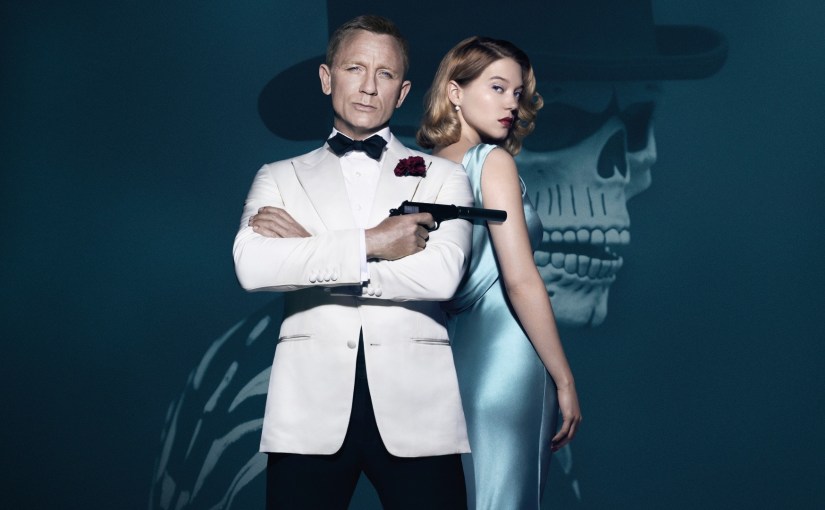
Craig remains a great 007. The role is not a mimic of past Bonds. Craig is everything of the “blunt instrument” that author Ian Fleming described. Thanks to his physique and some great fight choreography, a marvelous fisticuffs scene occurs between him and brutish Dave Bautista aboard a moving train. Craig always looking great in the white dinner jacket tux, even while he’s getting pushed around.

Lea Seydoux is serviceable as the Bond girl, Madeline Swann, daughter of an old enemy of Bond with information necessary in the pursuit. Seydoux is not the best Bond girl. Others have offered more intellect beyond the beauty. Still, that might only be due to the limits of the script. She’s a good actor nonetheless.

Ben Whishaw and Naomie Harris are great as Q and Moneypenny. The roles have stepped up in frankness and skills that stretch out more than a traditional one scene cameo. Whishaw as Q is more of a know it all and Harris as Moneypenny reminds the audience that she has a life outside the office.

Ralph Fiennes is good too as M. Though I do wish his storyline was better here where he is dealing with an over abundant policy in complete government surveillance. The antagonist against Fiennes is nothing special and as quick as this storyline started, you knew how it was going to end. Still, I like watching Fiennes in the role.

Spectre has great scenes, most especially the signature opening taking place on the Day of the Dead in Mexico City that culminates in the destruction of a city block before Bond disables two bad guys aboard a spiraling helicopter. Steady cam and very clear edits make this a knockout.

I also appreciate the gag that not all things work accordingly for Bond. He orders his signature Vodka Martini, shaken not stirred, and is denied as he is at a bar located in an isolated strict health retreat. As well, his Aston Martin is not as reliable thanks to empty hidden machine guns hidden behind the logo in the trunk. Not everything comes as easy for Craig’s Bond, and that allows for some tongue in cheek humor.

I liked Spectre more on a repeat viewing. Mendes shot a gorgeous looking globetrotting picture of Mexico City, Rome, Austria, Tangiers and clear evening London.

Considering the next installment is likely to be Craig’s last film is disheartening. With Spectre, a summation of all the prior Craig films is assembled leading to what has been a great miniseries within the storied franchise. I’ve liked following this James Bond. There are revelations about the character including his orphan history, his faults and his coldness that only serves to protect the Queen’s country. The Daniel Craig Bond is the best following the very different albeit wry interpretation of Sean Connery.

Still, I’ll take what I can get, and once again happily look down the target scope aimed right for 007 before the blood comes pouring down.

NO TIME TO DIE

By Marc S. Sanders

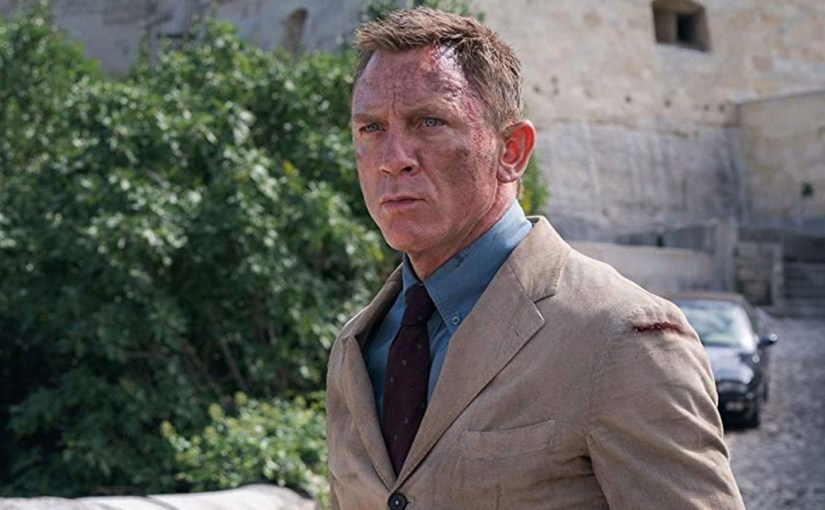
Any die-hard James Bond fan should absolutely love Daniel Craig’s final outing in No Time To Die.  Not only does the film work as a salute to the more serious aspects of past Bond films (not just Craig’s installments), but it is working with its tongue placed firmly in its cheek.  That is not to say that I still did take issue with a few narrative choices the film steers into.

Years have gone by for Craig’s interpretation of the famed secret agent.  He’s comfortably in love with Madeleine Swann (Lea Seydoux) from the prior film Spectre, and known daughter of Mr. White, one of Bond’s prior adversaries.  Suddenly though, Spectre seems to be back with a vengeance.  The imprisoned Blofeld (Christoph Waltz) somehow seems to be involved and 007 puts his guard back on opting not to trust Madeleine or anyone ever again.  The story jumps to five years later and Bond’s CIA friend, Felix Leiter (Jeffrey Wright) has convinced him to come out of seclusion and assist with recovering a kidnapped scientist who holds the formula to a deadly nanobot virus manufactured through plant life.  Bond travels to Jamaica to complete the mission.  From there, the story gets more complicated and more interesting.  Though I dare not spoil what comes next.  This film has a lot to tell in the near three hour running time.

Daniel Craig always had some sort of challenge with the general public while playing James Bond.  First, how dare he be blond?  James Bond is not blond.  He survived that ordeal to continue to make more films.  His second film suffered in storytelling due to a writer’s strike.  During press junkets for his fourth film, Craig was quoted out of context noting that he’d rather “slit his wrists” than play the character again.  As well, his films broke convention in the long running EON Production series, as each film served as a continuing story with much more serious, dramatic and sorrowful undertones than was ever presented before.  None of these challenges seemed fair to me.  After 25 films, you gotta stir the pot a little bit on a character that has been on screen for nearly 60 years.  It’s not enough that his gadgets change with the times of technology. 

I divert into this observation because No Time To Die offers some shocking developments for the Bond character, but when you return back to Craig’s first film, Casino Royale, you really start to understand why this latest picture goes in this wildly off direction.  In other words, the four films Craig performed in prior to this 2021 installment seemingly spell out the inevitable conclusion of his tenure as James Bond.  So, reader, when you go to see this last film from arguably the most controversial actor to play 007 to date, give some thought to what has already been covered before and maybe you’ll agree it beautifully makes a lot of sense.

As an action film, No Time To Die works solidly.  There’s amazing stunts and vehicles with car chases galore and nail biting shootouts.  I think this film has the longest pre-credit sequence of all the films and it’s amazing where one of the feature attractions is the famed Aston Martin DB5 against a slew of Range Rovers and motorcycles.

Rami Malek fills in as the lead villain eerily known as Safin, complete with the signature facial deformity, a shattered kabuki mask and a hell bent determination to destroy the world by means of turning people’s DNA against themselves.  Just go with it.  There’s not much weight to this dastardly mission.  It’s Malek’s performance that works. 

A new agent is also in the works and what’s this?  She is identified as 007????  Again, the newer films bravely go against convention to keep it interesting. Lashana Lynch plays Nomi.  This character was angled extensively in trailers and press junkets but honestly doesn’t live up to the hype enough.  The actor is fine.  She’s just not given much to make any kind of impact.  Ana de Armas is the actor who really makes a splash in a brief moment dressed in a gorgeous evening gown while giving high kicks to bad guys and armed with an adorable naivety about her and a killer machine gun.  Her character is reminiscent of the Bond girls who elevated the tongue and cheek elements of the series.  In a three hour film, more room should have been left for de Armas to play.

Moneypenny (Naomie Harris), Q (Ben Whishaw), Tanner (Rory Kinnear) and M (Ralph Fiennes) all return making for a solid support team for Bond.  It needs to be noted how well cast the Craig films always remained. During the five film series, each one of the characters had their memorable moments for sure.

The regrettable ingredients in No Time To Die lie in the lacking treatments of Lashana Lynch and Ana de Armas for sure.  Forgivable for the most part however.  Still, the story steers into one angle that I wish it didn’t when a young child is brought into the fold.  Children in serious peril was never part of the Bond formula.  So, while this is another new convention for the long running series, I think it was a poor choice.  I see the necessity of the young character to the story, but was it ever really necessary to put a child amid massive gun play, car wrecks and explosions.  There was something a little unsettling about that aspect of the film and the imminent danger to the girl really isn’t needed to heighten any kind of suspense.  Rather than play dramatically, it moves a little too disturbing.  Early on in the film, another child is placed in disturbing peril as well.  The story options here just don’t seem altogether appropriate.

No Time To Die is an appreciated conclusion to Daniel Craig’s version of the character.  There are great puns for Bond to deliver.  His interactions with Q and M are biting and fun.  His love story portrayal with Madeleine works more solidly here than in the last film they shared together, and his tete a tete with the villains, Blofeld and Safin, are equally strong.  These different relationships broaden the dimensions of Bond.  He’s no longer a cookie cutter character.  There’s a motivation to the guy. 

Having seen the film twice, I have an even further appreciation for this new film.  Hans Zimmer comes in to do the original score and particularly salutes the unexpected favorite among fans, On Her Majesty’s Secret Service with select notes and rhythms from that film.  Granted the script for No Time To Die makes obvious references as well.  I also appreciated the wink and nods to Bond’s very first adventure, Dr. No.  There was just a lot of smart, subtle honors presented here. 

Still, the best reference is left for one of the best lines in the film.  When Bond meets Felix’ partner ahead of a mission, Daniel Craig as 007 has to ask “Who’s the popular blond?”  After five hugely successful films, over a fifteen-year span, any one of us better know that the only blond that matters is “Bond.  James Bond.”

INGLOURIOUS BASTERDS

By Marc S. Sanders

If you are going to rewrite history then go crazy.  Go big and bloody.  Go for broke.  Don’t hold back.  Quentin Tarantino didn’t hold back when he penned and directed Inglourious Basterds, my personal favorite of his films.

To date of when this review is published, Tarantino has directed nine films and if ever the maturity of a director is so evident, it really shows with Basterds where three quarters of the picture is performed in either French or German.  English is secondary here, and Italian is limited to only a couple of “Bonjournos!”  and “Gorlamis!”

Tarantino presents early 1940s France when Germany occupied most of the country and practically rounded up all of the Jews.  In 1941, a cunning detective of a Nazi Colonel, Hans Landa (Christoph Waltz performing as one of the greatest villains of all time) visits a French dairy farmer to ensure there are no unaccounted-for Jews scurrying around; scurrying around like their beastly equivalent, the rat.  Landa is the hawk that will most assuredly find them.  This scene is the best written moment within Tarantino’s catalog of various scripts and dialogue exchanges.  The Landa character offers justification as to why a Jew needs to be exterminated to the point that he nearly had me (a conservative practicing Jewish man) believing in his hateful philosophy.  The lines crackle here with Waltz doing most of the talking while the sad dairy farmer can do no more than respond with certifying Landa’s interesting points.  Tarantino closes the peaceful discussion with horrifying violence though.  Hans Landa may be complimentary of a farmer’s milk and his three beautiful daughters.  He may be eloquent in his dialogue albeit French, German or English, but he is a ruthless enforcer of law …of Nazi law at least.  I also would like to note Tarantino’s tactful way of using props like the pipes the characters smoke, the glass of milk that is consumed by Landa and the ink pen and spreadsheet he uses for accounting of the Jews in the area.  There’s an uncomfortable intimidation in all of these items as they are handled by Waltz, the actor.  Later in the film, Waltz will send a chill down your spine as he happily enjoys a delicious strudel with whipped cream.  Inglourious Basterds is a great combination of directing, editing, cinematography and acting.

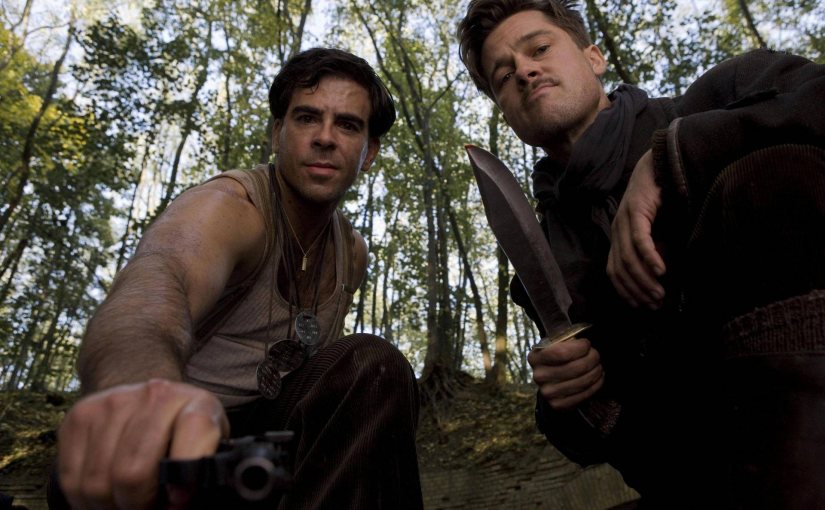
The film diverts into a few separate stories, namely the title characters led by Aldo “The Apache” Raines, played with Tennessee redneck glee by Brad Pitt.  The Basterds consist of mostly Jewish American soldiers tasked with going deep into enemy territory and literally killing and scalping one hundred Nazi soldiers, each.  However, keep at least one alive during each encounter with a carved souvenir on their forehead, to spread the word of the Basterds intent.  This is deliberate B movie Dirty Dozen material and it works because it doesn’t take itself seriously.  Tarantino maintains that pulpy fiction narrative.  A cut to an over-the-top crybaby Adolph Hitler asks, “What is a Hugo Stiglitz?” and then we get a quick pause with big black block letters across the screen spelling out HUGO STIGLITZ.  This guy is a bad ass; a German turncoat who only wants to kill fellow German Nazis.  He’ll shoot them up until they are dead three times over.  He’ll stab them in the face twenty times through a pillow.  He’s not a suave killer.  He likes it violent and bloody messy.  The Basterds are fans.

The heroine of the film is Shoshanna (Melanie Laurent), a Jewish girl who is living undercover as a cinema owner in France.  By implied force she is tasked with presenting Himmler’s proud film of Nazi Germany’s finest war hero, Fredrick Zoller (Daniel Bruhl), recreating his bird’s nest three day sniper battle against an army of three hundred men.  This is where Tarantino does best at writing what he knows, and what he knows best is anything about cinematic film.  He literally uses his knowledge of film and film reels to bridge his story while setting Shoshanna on a mission to actually end World War II in one swift motion.   

In addition, he captures the adoration of film lovers and celebrity status.  Zoller is as heroic a celebrity as John Wayne or Zorro.  When he is recognized in the coffee houses or on the street, he humbly stops his ongoing flirtation with an uninterested Shoshanna, to give an autograph or pose for a picture.

Furthermore, Tarantino applies the scientific knowledge of how 35mm film is more flammable than paper as well as how to edit a film reel to an unexpected moment for Shoshanna’s Nazi audience.  He knows the architecture of a European cinema with its lobby and balconies and seating capacities.  He allows his characters to speak on an intellectual level by discussing great film artists of the time – filmmakers not as well-known as Chaplin here in the United States, but just as great or even artistically better. The art direction of the cinema both inside and out is adorned with washed out, distressed classic noir films.  Shoshanna changes out the lettering of the curved marquee top of the theater as well.  It might sound mundane, but to me it’s all atmospheric.

Beyond the subject of cinematic art, a bad guy will weed out a spy disguised in Nazi garb by recognizing how he signals for three drinks with his hand.  There’s a right way and a wrong way to place an order with a bartender.  Inglourious Basterds may be a fictional historical piece, but it also will give you an education. All of this reminds me that Quentin Tarantino has graduated from the simplicity of Reservoir Dogs to something bigger and grander and glossier.  Production money with a large budget will lend to that status of course, but Tarantino still had to learn to truly know what he was doing.

I will not spoil the ending here.  It’s a bloody blast for sure.  Moreover, it’s shocking.  If anything, Inglourious Basterds introduces an exclusive universe that resides in the mind of Quentin Tarantino where the textbook is thrown away, burned, riddled with bullets and blown up; it is where something else altogether happened, and you know what? I really wish it did actually happen this way.