TOOTSIE

By Marc S. Sanders

Tootsie is my favorite comedy of all time.  At age ten I saw it on Christmas Eve with my family and beyond the Star Wars and Rocky films, I had yet to see an audience respond, or more specifically laugh, so uncontrollably for two hours straight.  I might not have recognized all of the innuendo and I was not yet alert to the idea of women feeling belittled while knowing they should be entitled to equal respect, but the performances, especially from Dustin Hoffman were entirely genuine.  Tootsie still remains the only film where I can forget that a man, a not so attractive or sexy man, is convincingly disguising himself as a woman who possesses internal strength and gusto.

Whether directing or acting on screen, Sydney Pollack was not someone well known for overseeing comedy at the time.  Yet, that’s an attribute to the end product of this celebrated movie.  Other than a typical Bill Murray routine in an uncredited role, no one in this picture is waving their hands in the air to insist they’re funny.  The humor of Tootsie bears from true, raw emotion, fear and desperation.  No one is doing Saturday Night Live sketches and building up to the next punchline.  Despite the cross dressing, Tootsie is not even a farce.  A guy gets a job wearing the necessary garb and modifying his verbiage, but only to earn enough money to survive.  However, it also doesn’t help that he’s falling for his co-worker.  

Dustin Hoffman is an actor living in New York City named Michael Dorsey.  He’s a great, learned performer, especially on the stage, who lives with his playwright buddy Jeff (Murray) in a crummy apartment in the meat packing district.  They need to raise enough money to put on Jeff’s play in Syracuse.  

The problem is that Michael can no longer get cast in anything.  Not on stage or even in a commercial.  His agent (Pollack) says it point blank that nobody will hire him.  He’s just too difficult with short bursts of temper and no tolerance for others who work in the field.  

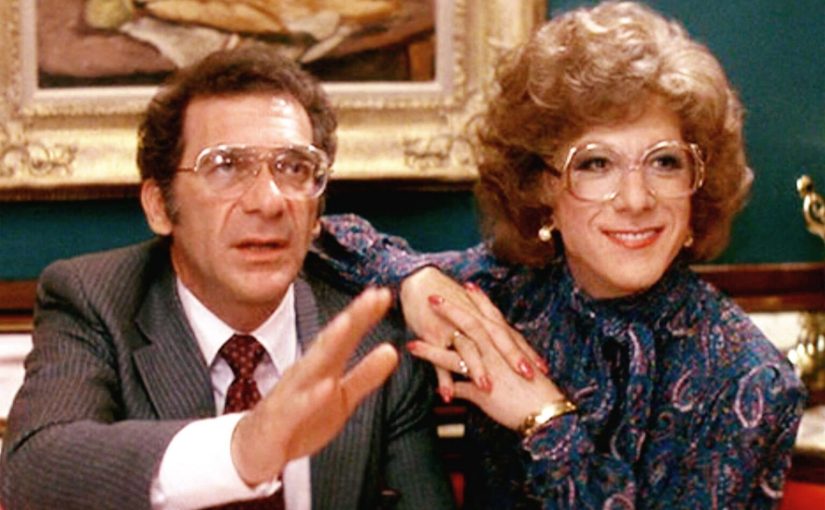
So, Michael surrenders to desperation and puts on the guise of a character actress named Dorothy Michaels.  As quick as she stands up for femininity against a chauvinistic TV director (Dabney Coleman) she is cast on the most watched daytime soap opera.  As long as Michael can perform off and on camera as Dorothy he should be able to earn more than enough money for Jeff’s play.

Complications arise though when he becomes protective of his co-star, Julie (Jessica Lange, in her Oscar winning role), against her unfaithful boyfriend, the TV director.  Julie’s widowed father, Les, is falling for Dorothy though, and then there is Michael’s friend Sandy (Teri Garr) who lost out on the part that he earned, and to keep things maintained has been seduced by Michael into a romantic relationship beyond just their friendship.

With me so far?  I hope so because there’s even more obstacles to overcome.  Tootsie is very economical in its story development, but it’s also a very crowded film.

Don McGuire and Larry Gelbart (TV’s M*A*S*H) wrote this Oscar nominated script with a brilliant collection of characters.  The blessing is while it sounds like farce, Tootsie is never delivered with a slapstick tongue.  In order for the film to work, Dustin Hoffman especially had to portray Michael Dorsey as a guy with natural ticks, motivations and fears.  He accomplishes that because Michael always ensures that Dorothy is as real as she can ever be.  When Dorothy hails a cab or shops for clothes the southern accent must hold while perusing through the city streets in heels.  Michael gets frustrated over what to wear for a dinner visit at Julie’s apartment.  Especially when Julie opens up her heart, Hoffman is precise to make sure Dorothy approaches with a low whispered approach to simply be a consoling girlfriend.  

The comedy arrives when Michael has no other choice but to break this strong powered female persona.  Dorothy will call for a cab but if it just won’t stop, then a deep voiced, bellowing New Yorker will come out of this woman’s mouth with an angry “TAXI!!!”  I like to believe that Sydney Pollack deliberately arranged for Dorothy to yank a Woody Allen lookalike out of a cab that was about to be taken from Dorothy too.  Dustin Hoffman knows Michael Dorsey is such a committed method actor that he has to convince all eight million people in New York he is strong willed Dorothy Michaels – a character actress capable of playing the new Hospital Administrator on Southwest General

There are so many fleshed out pairs of relationships in Tootsie – all going beyond the cross dressing of the film’s main character.  All of these people could get along forever if only for the fact that some characters have befriended a man while others truly believe they have made a connection with a woman.  How long can we have it both ways?  The facade has to undo itself, right?  True.  Thankfully it occurs at the end when every single character can have it explained to them all at once.  I’ve never forgotten the roars of laughter from my mom, dad and grandmother as the end of Tootsie arrived.  Well-placed close-up shots of every actor who had a speaking role in this movie is covered (well except for Sydney Pollack as Michael’s agent). On Christmas Eve in 1982, the packed movie house at the Forum Theater on Route 4 in Paramus NJ only amplified the shocking reactions.  Tootsie is a reason why you sit among a crowd at a movie theater.  

This is Dustin Hoffman’s all-time best performance.  He was nominated against fierce competition from Paul Newman in The Verdict, Jack Lemmon in Missing, and Ben Kingsley in Ghandi (who took home the trophy). Michael Dorsey/Dorothy Michaels is a much more challenging role than what Hoffman superbly accomplished in his two Oscar winning roles (Kramer Vs Kramer, Rain Man).  Robin Williams or Tom Hanks could have played Michael Dorsey who invents Dorothy Michaels.  Yet, what Hoffman emotes are the natural tics of a guy who is constantly broke while he charms an array of women at his birthday party, only with the intention of bedding them and hardly ever listening to what these ladies have to say.  When Hoffman puts Michael literally in a pair of woman’s shoes though, he begins to identify the lack of respect that women endure on a daily basis.  

Watch Dustin Hoffman’s body language.  He becomes angered with his agent upon learning that he lost out on a role which somehow leads to a debate about whether a tomato should walk or talk or sit or stand.  That back and forth is outrageously hilarious.  Having seen Tootsie hundreds of times though, I now appreciate how a schleppy looking Michael hustles across the streets of New York, avoiding traffic and then marches down the hallway to his agent’s office.  Hoffman twitches his head and shrugs his shoulders as if he’s prepping to give the agent a piece of his mind.  Hoffman is so absorbed in this guy he’s playing.  I am not recognizing any other kind of Dustin Hoffman that I’ve seen anywhere else.

Sydney Pollack is also attuned to the cutthroat atmosphere of desperate theater folk trying to survive in this concrete jungle.  Tootsie opens with a montage of quick episodes for Michael.  He is leading a workshop while being candidly ugly with his fellow thespian students about how challenging it is to get work.  In between, are auditions that he goes on where there is one reason after another why he can’t land a role.  Michael Dorsey is an incredibly skillful actor, but that means nothing for this role or that role.

On this most recent viewing I caught on to a detail that never occurred to me.  Bill Murray as Jeff, the broke playwright, is snacking on lemons and wincing while he talks to Michael.  Now I don’t know if this is in the script or if this was Pollack or Murray’s idea.  Nevertheless, it’s a brilliant detail.  These guys are so broke that they have resorted to smuggling lemon slices out of the restaurant they work at to live off of.  Another actor or filmmaker would have used an orange or cookies.  Who snacks on lemons?  Only those with nothing else to rely on.  

Makeup bottles with spirit gum, cannisters of fake blood, prosthetic teeth, props and sloppily hung costume wear are all given focus beyond the broad comedic storylines.  Sydney Pollack pans his camera over all of these items with no actors in frame because he wanted to ensure that being an actor or a playwright in New York is nothing glamorous.  It’s a world of unending torment. All of these nuances and details justify the extremes that Michael has to go through to achieve his goal.  

Jessica Lange never plays her role for laughs.  Her portrayal of Julie, the beautiful, blond celebrity of daytime television, is authentic and she inherits a new girlfriend to confide in. Finally, Julie can share what she values and holds dear.  You can’t not fall in love with someone who only treasures the best parts of her young life and yet only seeks a companion to chat with.  A humble celebrity is hard to find and that is one reason Michael falls hard for her.  Lange is outstanding while being so heartfelt.

Teri Garr’s comedy stems from the insecurities of actors.  Sandy is described as someone who wants to commit suicide at a birthday party.  Doing community theater for over thirty years I know precisely who this person is.  I’ve been this person, and I’ve encountered hundreds of these people.  It’s hard to be a big fish in the small pond of community theater.  Imagine trying to hold on to your sanity when you have to compete with all of New York.  Teri Garr was rightly Oscar nominated for what could have been a throwaway part. Like Hoffman she also has these little gestures that suggest her lack of confidence. After she sleeps with Michael and he’s getting ready to leave, Garr peaks at her naked chest hidden underneath the sheets.  It’s as if she’s wondering was I not attractive enough.  She’s hurting. No matter if she just had sex with one of her favorite people, she is still suffering.

Charles Durning is familiar for having the tough guy, intimidating persona because he’s usually so much larger than life.  However, he offers a sweetness to this guy who’s ready for companionship.  You don’t want Michael or Dorothy to let him down.  Les doesn’t deserve to get hurt.

Again, as I described any of these characterizations, none of it is funny.  They are wrapped in sensitivity. There’s a lonely sadness to people like Michael, Jeff, Julie, Sandy and Les.  Yet, when this variety of sorrow and anguish collide, while poor Michael is only trying to make some money, does it all combust in hilariously, unwinnable scenarios of tremendous proportions.

Tootsie is an amazing film.  It is one of the smartest, most insightful scripts ever written and it is blessed with a cast and director who mastered how to live in an unforgiving and unsympathetic industry.  This picture offers lessons in the human spirit while demonstrating the lengths and boundaries that must be broken in order to survive.  By practically not performing as a comedy, it only becomes that much more funnier and wiser.  

Tootsie is a perfect film!

TWILIGHT’S LAST GLEAMING (1977)

by Miguel E. Rodriguez

DIRECTOR: Robert Aldrich
CAST: Burt Lancaster, Charles Durning, Richard Widmark, Paul Winfield, Burt Young, Melvyn Douglas, Joseph Cotten, Richard Jaeckel, John Ratzenberger
MY RATING: 7/10
ROTTEN TOMATOMETER: 80% Fresh

PLOT: A renegade USAF general takes over an ICBM silo and threatens to provoke World War III unless the President reveals details of a secret meeting held just after the start of the Vietnam War.


Twilight’s Last Gleaming, one of Robert Aldrich’s last films, is a cleverly constructed Cold War thriller whose pointed message about the Vietnam War nearly torpedoes the suspense.  The political message is hammered home in a scene that goes on for a bit too long with people speaking dialogue that feels hammy and trite.  But the movie surrounding this one scene is good enough that I would still recommend it to anyone in the market for something off the beaten track.

The movie is set in 1981, four years after it was released, so no one could draw any real-life parallels between the characters and people in real life.  In an opening sequence that feels reminiscent of Die Hard (1988), General Lawrence Dell (Burt Lancaster) and his team of military ex-cons manage to infiltrate and take command of a US ICBM missile silo in Montana.  While I highly doubt it would be as easy as portrayed in the film, Aldrich films the sequence so that I got caught up in the suspense of the narrative instead of worrying about pesky details.  (If there’s a drawback to these and other sequences featuring military hardware and installations, it’s the overall low-budget feel to the sets and props; everything looks like it was shot on a TV soundstage instead of a big-budget film set.)

Once inside, Dell makes his demands: $20 million for each of his remaining team (Burt Young and Paul Winfield), the President must read the transcript of a secret meeting held just after the Vietnam war started, and the President must hand himself over as a hostage to secure their escape.  Otherwise, he’ll launch nine Titan ICBMs at their targets.

This creates a little tension among the would-be terrorists.  Winfield and Young couldn’t care less about the secret meeting, but Dell is adamant.  Meanwhile, General MacKenzie (Richard Widmark) formulates a plan to eliminate Dell and his crew using a “tiny” nuclear device, the President (Charles Durning) agonizes over the secret transcript, and his best friend and aide uses some “tough love” to get him to make a decision.

Despite the fakeness of the surroundings, I was absorbed by the thriller elements in Twilight’s Last Gleaming.  I would compare them to the best parts of WarGames (1983) and The China Syndrome (1979).  There is some impressively impenetrable technobabble about booby traps and inhibitor cables and fail-safe systems that I just rolled with.  The plan involving that “tiny” nuclear device leads up to a sequence that I would compare favorably with any contemporary thriller you can name.

One of the ways Aldrich achieves this effect is through the use of split-screens…LOTS of split-screens.  It starts at the beginning of the film with two screens.  Then there are moments with three split screens, two on top and one in the bottom section.  Then, during the most intense sequence of the film, we get four splits in each corner of the screen.  At first, I found it disorienting, but it absolutely works when it most needs to.  (I’m trying not to give away too many plot details, so excuse the vagueness.)  I don’t know that I would want to watch an entire movie like this (Timecode, 2000), but in small doses, it’s very effective.

Where the movie bogs down is the middle section of the film when the President expresses his disapproval of the contents of the secret transcript Dell wants publicized.  It’s a bit theatrical to believe a sitting American President would be this vocal about his feelings in the middle of a dire crisis.  I think the scene would have played just as well if we had gotten a general idea of the transcript, or even if the contents had NEVER been revealed to the audience.  It would have been a perfect Macguffin, leaving viewers free to imagine anything they want.  The truth about Kennedy’s assassination?  Area 51?  Pearl Harbor was an inside job?  The Super Bowl really IS fixed?  Who knows?

Instead, the President insists on reading a portion of it out loud to his Cabinet members, enlisting them to read certain lines.  While I admire Aldrich’s intent (to send a cinematic protest to the architects of the Vietnam war), the scene nearly brought the movie to a stop, which is deadly when dealing with a suspense thriller.

But, like I said, the rest of the movie is so good, I am compelled to let it slide.  Later, we get surprise attacks, snipers, helicopters, a crafty fake-out involving torture, and an ending that is as cynical as they come, but which felt like the best way out of the situation for everyone involved…except for the American people, but that’s another story.  Twilight’s Last Gleaming feels virtually forgotten, and that’s a shame.  Aldrich directs this movie with a lot of passion for the material and milks every ounce of suspense he can with the tools at hand.  If you’re prepared to overlook that middle section, you’ll get a kick out of this movie.

P.S. Look fast for an unexpected appearance by William Hootkins, aka “Porkins” from Star Wars (1977).

SCARFACE (1983)

By Marc S. Sanders

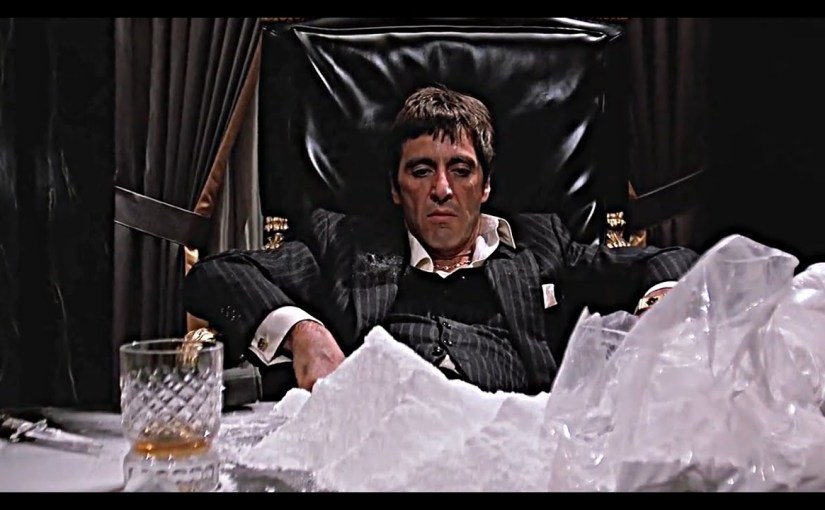
On Thanksgiving Day when we glutton ourselves with an abundance of food, it seemed highly appropriate to watch one of the most self-indulgent pieces ever put on film.  Brian DePalma’s Scarface with a script written by Oliver Stone and featuring Al Pacino.  This is a movie that brags about its boastfulness.  I mean look at everything that is mashed into this thing.  Blood, bullets, lots of cocaine and too much Al Pacino.

Pacino is Cuban refugee Tony Montana.  He is one of a handful of small time criminals who is shipped over to the United States when Castro wanted less people to oversee.  Refugee camps are fenced up under the highways of Southern Florida where no law is enforced among the tented populations.

Soon after Tony arrives he’s hot on the scene of pushing the newest underground product through Miami – cocaine.  With his buddy Manny (Steven Bauer) the two men get in good graces with a well dressed sleaze named Omar (F Murray Abraham), who is second in command to an established drug kingpin named Frank (Robert Loggia).  For Tony and Manny it’ll only be a matter of time before they take over as the numbers one and two bad guys.  That’ll include Tony marrying Frank’s blond trophy girlfriend Elvira (Michelle Pfeiffer in her breakout role) and winning a trusting partnership with a South American drug czar named Alejandro (Paul Shenar).  If you ever expect to get killed, you don’t want to be by the orders of Alejandro.  A helicopter serves much more of a purpose once it takes flight.

Scarface is a step-by-step movie or a climb up a three-hour ladder and then a gradual drop down off a balcony into a bloody fountain below.  There’s no depth and it works like a shopping list that you check off as it moves along. Props and houses and suits and jewelry and cars and cocaine and cash have more significance than what anyone has to say. Other than Tony, none of the people in this film matter. What Tony acquires and what he says about himself is all that is important.

This is a big ass movie with bloody graphics and killings, mountains of drugs and money, a lot of fucks, a gaudy estate home, a way over the top Al Pacino and lots and lots and lots of bullets and guns to go with them.  The film only settles for one chainsaw killing, though.  At the time, I recall that scene was up for big debate on the film’s MPAA rating.  Brian DePalma wanted to up the ante on brutality to grab moviegoers’ attention.  The scene remains quite stomach churning.

DePalma’s best work is at the beginning of the Scarface.  Following the establishing real life footage of the Cuban refugees arriving by boats in search of an American dream, Tony is taken into custody and questioned by a batch of immigration agents.  DePalma only keeps one steady camera focused on a very tan Pacino with a faint signature scar on his left cheek, sitting in the middle of the room and putting on a Cuban accent that only he could uniquely own.  Pacino’s concentration in this moment is admirable as he responds to questions from all different directions.  It’s all done in one take with the director’s camera circling around Pacino.  After this introduction is over, the tone of the movie changes for the next two hours and ten minutes into a gritty interpretation of Lifestyles Of The Rich And Famous.

Oliver Stone’s dialogue with Brian DePalma’s set ups don’t require much of the other actors.  It’s like everything caters to an always inebriated, hyperactive Al Pacino doing his Tony Montana with the gold chains and wide collared shirts over the linen suits.  He’s a motor mouth of endless f-bombs, with a slinky Michelle Pfeiffer in a blond bob-cut, dressed glittery evening gowns, at his side.  She has nothing of significance to say.  This is all you learn about Elvira; what you see of her materialism and all the coke she snorts.  She never smiles or exudes any connection to the Pacino character.  It’s all eye candy.  In fact, there’s never a clear answer of what becomes of this character.  That’s a problem because the movie is so much about Tony Montana, nothing else matters.

Other characters not given enough attention are Tony’s sister Gina (Mary Elizabeth Mastrantonio) and their mother (Miriam Colon).  Momma despises Tony for the criminal thug he is while Gina becomes enamored with the wealth and drug night life.  Unfortunately, Momma only has one meaty scene and Gina’s purpose to the script is to lend reason for another character’s eventual demise.  Both of these actresses are very good with what little they have.  Yet so much is devoted to Tony’s indulgence and the mania that Pacino brings that they are sidelined as well.

Brian DePalma seems to be more proud with how excessive he can make this guy than actually turning him into a guy.  Wait until you see the mansion that Tony gets. His office alone is of black, gaudy exuberance. His master bedroom contains a small swimming pool size tub right in the middle of the carpeted floor.  That setting occupies a fifteen-minute-long scene of Tony in a bubble bath, watching his five TV screens while not talking about anything meaningful except himself as he chastises Manny.  Elvira is only there to uphold her dread for her husband as she snorts coke off of her vanity.  When they both leave, an Oliver Stone monologue ends with a now recognizable sound byte of “Well say ‘allo to da bad guy!” Ah! Big deal! Tony never seemed so bad ass as he does feel obnoxious.

Again, Scarface is about not much else except the conceit of sleazy criminal.

When someone has to die it becomes a long drawn-out process as Tony, aka Pacino, puts on a performance or delivers a sermon.  Tony will meet with kingpins from Columbia along with other South Americans and dirty government officials.  There will be 5-7 guys in the room but for the most part it is only Tony talking.

“Say ‘allo to my little fren!” is one of the most memorable lines to come out of the 1980s decade of excess and it arrives during the ongoing and endless bloody shootout that closes the film.  There’s buckets of blood and truckloads of ammunition fired off.  These machine guns seem designed to kill things twice the size of elephants.  Little Al Pacino, with a ginormous cannon gripped in one hand, gets hit in all places and extremities except the head so that he can keep ranting – I mean this guy never shuts up – and going as he fends off the armies of goons coming at him from all directions.  Truly, it’s laughable and nowhere is it ever absorbing.  It’s like I’m watching someone else play a first-person shooter video game during a sleepover.  My friend is entertained while I’m just watching him be entertained.

Scarface comes to an abrupt halt when the final shootout stops.  There’s no footnote to ponder or real news story to follow up on.  The credits roll and the orchestral strings of the soundtrack cut in. You get the idea that DePalma, Stone, and Pacino became exhausted over this monster of a movie and simply declared “Okay! That’s enough!”

Considering the later insightful pieces that Oliver Stone delivered like Platoon and JFK, I wish he explored more of the politics and Cuban dealings affecting the United States.  As this film arrived in 1983, soon after there would be more of an intellectual standpoint to make us aware of a very real drug epidemic in this country.  It may appear to be sending some kind of message, but Scarface doesn’t challenge the brains that flourished this contraband industry.  Forty five minute episodes of Miami Vice tell more than this three-hour opus.

Plenty of gangster films like Chinatown, The Godfather, and Goodfellas offer up the greed and ego of the criminal mind, but the men of those pictures are never as self-indulgent or off putting as Tony Montana.

Besides, what does it say about a movie called Scarface when no one calls the main guy Scarface, and you hardly ever see the scar graced across his profile?  The real Scarface, Al Capone, would be very disappointed in Al Pacino.

DOG DAY AFTERNOON

By Marc S. Sanders

Sidney Lumet uses his best strengths in this ridiculous Brooklyn bank robbery that is actually based on fact.

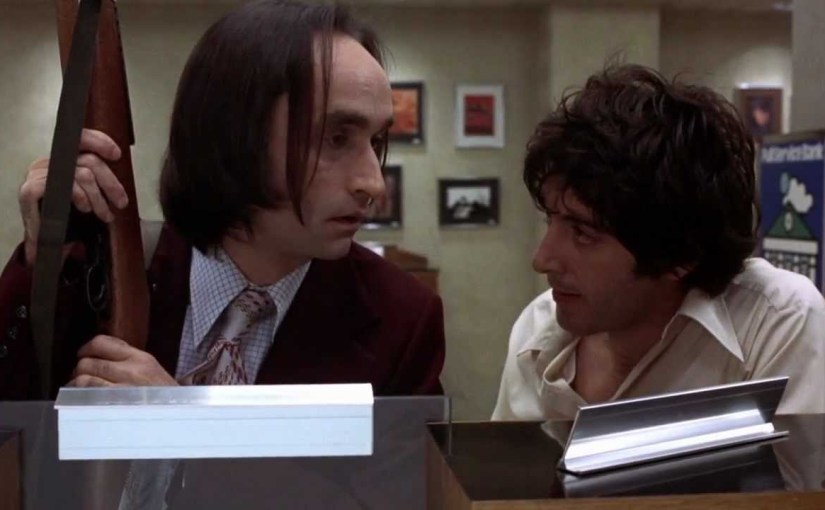
Here, Al Pacino and his cohort, John Cazale, play inadvertent stupidity without compromise. If two of the three stooges went on to do drama, this would be the material they’d use.

A simple bank robbery with little to no planning spirals out of control and into sheer pandemonium. Nothing goes right even when Pacino’s dimwit character, Sonny, is deluded enough to believe all is going in his favor. He immediately earns the support of the encroaching Brooklyn community only to lose them when he shows his true homosexual nature. Then he’s blindsided as to what happened. Layered in drenching sweat, Lumet wisely takes advantage of Pacino’s best up close facial expressions. Utter delirium!!!!!

Once again, Lumet’s camera moves while his best actors remain naturally in place. Al Pacino does his thing and trusts his director will find his shots. As the cop initially in charge, Charles Durning does as well. Pacino and Durning especially have great scenes together in the middle of a heavily populated New York Street as the robber shines off the cop, and the cop does his best to obtain some measure of control. It’s a scream fest for the ages. “Attica! Attica!” Pacino and Durning’s best career performances were always the ones where it looked like neither of them were ever acting. Dog Day Afternoon is one those better examples.

Frank Pierson’s jagged script of wild turns makes every person whose an extra like the pizza delivery man, for instance, caught up in the hysteria. The pizza kid shouts out to the crowd “I’m a star!!!” It’s great reason to applaud Sidney Lumet’s control over a crew and the entire company of extras he’s employed. This film is a rare example where all of the extras (seemingly the entire Brooklyn population) are as integral as the leads. The setting is the main antagonist from the media all the way to the observers who can’t look away and can only cheer, yet mock as well. Brooklyn, New York is a great character here.

Most fascinating about Dog Day Afternoon is that it is all based on fact from the media circus to dumb bank robbers with a need to steal in order to fund a lover’s sex change operation. It’s ridiculous. It’s funny. It’s frighteningly stressful and it’s all true.

This was released following the first two Godfather films and confirms the enormous range Al Pacino possesses with his performance talents. Hyperactive and dumb here as gay bank robber, Sonny; quietly contained, evil as Michael Corleone. His range was through the roof in the 70s before absorbing his loud, crackling, smokers voice. It was when the script outshined Pacino and before the current age of writing being catered to its bankable star.

Lumet also allows great moments for the hostages who become undone to the point of regretfully using foul language, to actually befriending their captors. He’s a director who efficiently leaves no stone untouched.

Chris Sarandon as Leon, Sonny’s male gay spouse is great here too. He’s full of melodrama, panic, worry, and a New York maternal despair. Another great scene is a phone exchange between Pacino and Sarandon. It might appear funny at first, especially in the 70s when homosexuality was lampooned often with the other F-word, but anyone who appreciates the filmmaking of Lumet will quickly contain their snickering when they realize a gay man is equal flesh, bone and feelings like anyone else.

Dog Day Afternoon is very telling of an out of the closet social media future. The story will always get grabbed regardless of danger or sensitivity. People will get swept up in the hoopla (a teller hostage quickly boasts her brief fame on television “Girls, I was on TV!”), police will overextend their privilege, helicopters will swarm, the criminals will demand their moment in the spotlight, and the public will serve as jury per the majority.

It’s a vicious cycle but considering it is a 1975 masterpiece, it’s all disturbingly valid and sensationally true.

THE STING

By Marc S. Sanders

Find me a better combination of script, cast, direction, score, art direction and costume and I guarantee it’ll take you some time and effort.

The Sting, directed by George Roy Hill and written by David Ward, is the kind of movie where you uncover something new every time you watch it. It’s because the film is all in the minute details to assemble the beginning to the middle to the end. The film is wisely edited in step by step chapters; The Set Up, The Wire, The Shut Out and eventually on to the satisfying The Sting.

The audience is even set up but you’ll have to watch to see how. I dare not spoil it.

Cars, trains, drug stores, diners, a carousel, dames, gangsters, Bunko Cops, Grifters; all are elements needed for the best confidence men superbly played by Robert Redford and Paul Newman, along with a supporting cast like no other, Eileen Brennan, Harold Gould, Charles Durning, Ray Walston, Jack Kehoe and the best villain, or rather “mark,” Robert Shaw.

This is one of my favorite movies. When I first saw it, I was probably age 10 or 12. I understand next to nothing of what was going on. It was the music that drew me in first followed by the sharp suits designed by the legendary Edith Head. The movie’s script is its greatest asset but visually it is just as fun. The 1930s Chicago setting is a character in and of itself. Newman cheats beautifully at poker against a temperamental Shaw, and gets him!!! “You owe me 15 grand pal.” When I first saw it, I didn’t know what he was doing or how he did it. How did he switch hands? I was enamored with the hands that were dealt and the poker chips on the table, but I loved it when the better cheat won out.

The second iteration of the Hill/Newman/Redford trifecta (following “Butch…& Sundance…”) is just plain fun. It was the fun that earned it a Best Picture Oscar.

No other film has come close to duplicating it. Maybe the Clooney/Pitt/Damon version of “Ocean’s 11”? I don’t know. However, if you love that film, you owe it to yourself to watch “The Sting.”

The Sting is…”the quill!”