
NOTORIOUS

By Marc S. Sanders

In 1946, Alicia Huberman (Ingrid Bergman) is numbing the shame of her father being convicted for treason by drinking herself silly at a party she’s hosting.  We see the back of the head of a nameless guest, eventually revealed to be a man named Devlin (Cary Grant).  Once Alicia is sobered up, she awakens to the handsome image of this man entering her room with her point of view turning like a clock in a hundred- and eighty-degree direction.  This mysterious fellow is about to escort her into a dizzying labyrinth that will test the limits of her loyalty to him and the patriotism she has for her country.

Devlin is an American agent who has been assigned to recruit Alicia as an insider to an associate of her father’s.  His name is Alexander Sebastian (Claude Rains) and he’s likely a Nazi stooge with a deadly plot ready to set in motion.  Alicia is tasked with reacquainting herself with Alex and uncovering who he is working with and what they all have in mind.  Devlin will check in with her on occasion.

Complications ensue however because just before Alicia begins her mission in Rio De Janerio, she has fallen in love with Mr. Devlin.  Normally, I would not be able to buy into the quick whirlwind romance of Alicia and Devlin.  I never liked it when Sydney Pollack would wedge a love story into his thrillers (Absence Of Malice, Three Days Of The Condor).  However, this is Ingrid Bergman and Cary Grant we are talking about here, and they are being directed by Alfred Hitchcock in the classic film, Notorious.  The famous three-minute kiss in the picture seals the argument.  

Standard film practice of the time would not permit a kiss lasting longer than three seconds.  The actors though expand on this romantic moment with inserted dialogue, none of which is altogether memorable, and focus on a prepared chicken dinner to have on the balcony overlooking the coastline.  This scene occurs early in the film just after the exposition of Alicia and Devlin’s assignment is established.  I still don’t know either of character very well.  So why do I care about them?  Well, it’s how Hitchcock films the script by Ben Hecht.  There’s disturbing shadows and ominous mystery to the world that Alicia is seduced into entering after her drunken binge has ended.  As well, Devlin is warned that he will have to keep his distance from her so as not to alarm Alex or any of his Nazi associates.  Now, I’m genuinely nervous for Alicia’s safety.

Once Alicia is ingrained in Alex’ world, a new romance arrives, and she willingly marries the German aristocrat to uphold her ruse while making efforts to uncover the Nazis’ plot.  Devlin enters and exits her life to collect whatever information and access Alicia can supply.

As Notorious played out for me, sadly the first thing that came to mind was that Tom Cruise’s second Mission: Impossible film is nearly a scene for scene remake of Hitchcock’s classic, minus the over-the-top stunts and rock climbing.  Yet even before that thought popped into my head, I thought this is a film that could be remade into a wonderful modern update, but only in the hands of select filmmakers like Martin Scorsese or Christopher Nolan.  Keep the guns and blood and car chases out of it though.  Notorious succeeds without a single punch, gunshot, curse word, or ball of fire.  It’s the characters and Hitchcock’s use of brooding light, mood and shadows that maintain the suspense.  Select props and costume wear are scarier than Godzilla or The Birds.

Nearly twenty years before he made Psycho, the director was terrifying audiences with a maternal element already.  Madam Sebastian (Leopoldine Konstantin) is such an intimidating force within the castle like estate she shares with her son Alex, who easily falls in love with the beautiful Alicia.  The Madam is upholds a watchful eye on all activity. Bergman’s fear of this foreboding mother is just one of the dynamics she brings to her portrayal.  

Suspense is what Hitch relies on.  Sometimes I felt like I could not trust Mr. Devlin.  The name Devlin bears a sinister reminder of a beast within its spelling. Cary Grant is at first aloof with how Devlin regards Alicia’s potential for self-harm.  Hitchcock eerily introduces Cary Grant in the picture.  First, by only shooting him behind his head, not revealing his face. A little later, I felt reluctant to trust his upside-down appearance as Alicia awakens from her drunken stupor.  Thereafter, he will take a measured risk with Alicia riding horseback and never attempt to rescue her.  He leaves it to someone else to save her. He’s a tricky sort of fellow.

Conversely, Claude Rains as Alex, the supposed Nazi, is utterly charming and attentive towards Alicia.  Despite what he might be involved with, he’s ready to begin a newly loving and glamorous life with her.  I trust Alex.  He maintains a genuine affection for Alicia and it’s hard to presume he is anything else, especially of the sinister sort.

Ingrid Bergman is captivating as soon as she appears on screen, exiting her father’s courtroom sentence.  In fact, she resembles her most famous portrayal as Elsa from Casablanca that easily can be part of this cinematic universe.  With Claude Rains on screen with her again, could this have been a sequel of sorts?  I have much more experience with Meryl Streep’s career and therefore Bergman gives me a lot to reminisce about Streep both when she’s a strong and confident person or a fearful subject.  Either way, the bravery of the character upholds.

There are eye opening camera tactics of Hitchcock working here.  I’m amazed at a zoom in that lowers its focus from a great height at Alex’ mansion down to the grand foyer below where Alicia stands with a vital prop key hidden in her fist.  Amidst all of the traffic of an evening party, this tiny key is what’s most important.  A teacup is given greater scale to enhance a monstrous threat of what’s inside the drink.  A wine bottle suddenly becomes a mystery.  Some elderly, petite men dressed in perfectly tailored tuxedos spell a likely outcome of doom.  The darkness of rooms shot in black and white feels inescapable.  The absolute final shot of the picture is unforgettable.

For years, the adventurers of North By Northwest with Cary Grant in his beautifully fitted blue suit held the crown as my favorite Alfred Hitchcock picture.  That title has now been surrendered to Notorious.  It is signature Hitchcock with twists in character, reasons for mistrust, a MacGuffin (that item that drives the story, yet bears hardly any importance), motherly instincts of fear, obscure camera angles, shadows and dim light which is particularly chilling when shot in black and white.  All of these elements add up to the director’s expert craft at suspense.  

Notorious is a hundred percent perfect example of why Alfred Hitchcock remains celebrated as one of the best directors to ever film a motion picture.  

NOTE:  I am surprised that neither IMDb trivia, nor Roger Ebert in his Great Movie review, ever acknowledged that the story of Notorious begins on April 20, also known as Adolf Hitler’s birthday. A curious date for a spy thriller centered around Nazi espionage.

NOTE: I want to also draw attention to a move that Cary Grant does in the film.  Following Alicia’s drunken party, several guests are passed out on the sofa.  Devlin finishes a drink and rests the glass on the upper torso of a passed-out woman where it balances perfectly.  We may be going after dangerous Nazis, but Grant and Hitchcock still found opportunities to make audiences smirk at their mischief.

TO CATCH A THIEF (1955)

by Miguel E. Rodriguez

DIRECTOR: Alfred Hitchcock
CAST: Cary Grant, Grace Kelly, Jessie Royce Landis, John Williams [no, not THAT John Williams]
MY RATING: 7/10
ROTTEN TOMATOMETER: 93% Certified Fresh

PLOT: A retired jewel thief in the French Riviera sets out to prove his innocence after being suspected of returning to his former occupation.


Alfred Hitchcock’s To Catch a Thief is somewhat of a paradox.  It contains all the hallmarks of the master’s touch during what was arguably his most fruitful decade of work: exotic location shoots, a breathless romance, sly comedy, daring innuendo, and, of course, a vivacious blonde.  But there is little to no suspense.  There’s an intriguing mystery that admittedly left me guessing until almost the very end, but I never felt invested in the hero’s predicament.  I cared way more about L.B. Jefferies [Rear Window] or Roger O. Thornhill [North by Northwest] or even “Scottie” Ferguson [Vertigo] than I did for John Robie.

The story opens right away with a typical Hitchcock wink-and-nod.  The camera pushes in to an inviting travel brochure for the south of France, then there’s an immediate smash cut to a woman screaming.  Is she being murdered?!  This is a Hitchcock movie, after all!  No, she’s distraught because someone has stolen her precious jewelry.  There has been a rash of burglaries, in fact, perpetrated by a shadowy, unseen figure whom French authorities believe is none other than the infamous John Robie (Cary Grant), aka “The Cat.”  But Robie has retired comfortably to a stunning villa and claims he’s innocent of this new string of daring crimes.  To clear his name, he must do what the police can’t: identify and capture the burglar himself.

There’s a subplot about how Robie was involved in the French Resistance during the war, but his former comrades, who now all work at the same restaurant (!), are distrustful of him.  I was never quite clear on why.  Something about how the law could catch up to them if Robie was ever arrested?  But if they were Resistance, why would they be considered criminals?  Did they help him with his previous string of burglaries?  The screenplay is not 100% clear on this, unless my attention wandered at some point.

Anyway, in the course of Robie’s investigation, he meets (by chance?) the stunning Frances Stevens, played by the inimitable Grace Kelly in one of her three films for Hitchcock.  At first, she is aloof towards Robie, but when he escorts her to her hotel room after rebuffing him all night, she boldly plants a firm kiss on his lips before closing the door on him.  Not only that, she reveals the next day she knows exactly who Robie is and practically dares him to steal the fabulous diamond necklace she’s wearing.

While Frances is certainly no shrinking violet, her attitude and character felt…forced.  The screenplay explains (in a roundabout way) that she is a bit of a thrill-seeker, so she’s getting her kicks by tweaking a known criminal.  Okay, fair enough, I guess, but later in the film, she abruptly declares she’s in love with Robie, almost out of the blue.  This and other incidents, too numerous to mention, had me thinking that the new burglar was actually…Frances herself?  Watch the movie and tell me I’m wrong for thinking that way.  She throws herself at him in a male-fantasy kind of way because, duh, it’s a Hitchcock movie, but this aspect kept me locked in to my theory of her as the burglar, because what other motive could she possibly have?

Without giving TOO much away, let it be said that the mystery of the new burglar’s identity is cleverly hidden until the final scenes which demonstrate Roger Ebert’s Law of Economy of Characters.  This law posits that a character introduced with no clear role will turn out to be important to the plot.  In hindsight, it’s an obvious choice, but I must admit, it did keep me guessing.

But, again, while there was mystery, there was no genuine suspense.  The whole film is so light-hearted and airy that to introduce real danger might have ruined the atmosphere.  It’s not just comic, it’s downright slapstick, exemplified in a scene where Robie runs from the police only to fall into a bunch of flowers at a market and the elderly flower-seller starts beating him with a bunch of lilies.  In an earlier scene set in a hotel casino, Robie drops a 10,000-franc chip down the cleavage of a female guest as part of a ruse.  These and other instances almost make me want to classify this film as a romantic comedy rather than a suspense thriller.

Which brings up another point.  To Catch a Thief might be the most unwittingly prophetic film in Hitchcock’s filmography.  Consider:

  1. There is an early scene when Robie gets on a bus and sits next to a woman who is holding small birdcage.  Shades of The Birds, released eight years after To Catch a Thief.
  2. One scene features Robie in a motorboat, running from the police who are chasing him in…an airplane.  Four years later, Cary Grant would be running from another airplane in North by Northwest.
  3. A late scene features a key character dangling from a rooftop, which immediately reminded me of Vertigo, released five years later.
  4. The scene at the flower market takes place at an outdoor market that looks uncannily like the same one Cary Grant visits while looking for some rare stamps in Stanley Donen’s Charade, released TEN years later.  (Not a Hitchcock movie, but one featuring a very similar romantic relationship, this time with Audrey Hepburn.)

Having said all of that, I still must confess that this movie did not exactly stir up my emotions the way many other Hitchcock films do, even after repeated viewings.  To Catch a Thief is beautiful to look at, not least because of its sensational location photography and, of course, Grace Kelly.  The mystery at the center of the plot is sound, and I appreciate Hitchcock’s sense of humor, which occupies front and center as opposed to his other films where it lurks at the edges of the danger.  But I was never on the edge of my seat.  I know, I know, this isn’t Psycho or The Birds, but…there you have it.

NORTH BY NORTHWEST

By Marc S. Sanders

A story of mistaken identity becomes one of the grandest adventures on film with Alfred Hitchcock’s North By Northwest. The movie plays at such a fast pace, moving from one locale to the next and it all feels convincingly possible.

Before James Bond, there was the dashing Cary Grant in his sharp, fitted light grey suit (the best suit to ever be shown on film) portraying advertising executive Roger Thornhill who simply raises his hand in the air while meeting some colleagues at The Plaza Hotel in New York and is suddenly mistaken for a man named George Kaplan. Soon he’s forced into a car by two men and driven to an estate property belonging to someone named Townsend (James Mason) who implores “Mr. Kaplan” to cooperate or else. Suddenly, Thornhill who continues to insist he’s not Kaplan is on a cross country journey while escaping the authorities who want him for murder while he tries to prove his true identity and exonerate himself.

Cary Grant is dashingly fun with Hitchcock’s camera. It’s refreshing for a change to watch an innocent protagonist not lay on the heavy drama and panic so much. Hitchcock with Grant were going for a sweeping story of cat and mouse play.

What Alfred Hitchcock does best is put the viewer right in position of Thornhill. For the most part (definitely through the first forty minutes) the viewer only knows what Thornhill knows. We know he’s been mistaken for someone else and we are only given the opportunity to put a few names with faces and get a hold of a crumpled photograph. That’s all we and Thornhill have to go on.

Later on, it’s only fortunate that Thornhill comes upon one of Hitchcock’s celebrated blond actresses he was always reputed to cast. This time it is the incredibly striking Eva Marie Saint as Eve Kendall who becomes a willingly helpful train companion for Thornhill. Cary Grant and Eva Marie Saint make for a spectacular on screen couple. Their chemistry is so natural together.

Not much else should be said about the story of North By Northwest. The entertainment comes from what each new scene reveals. Hitchcock incorporates all the expected twists and makes sure to use a MacGuffin, of course. This time it involves a statue and microfilm. What’s on it? That does not so much matter really. It’s the need to pursue it that’s important. The pursuit is what drives the picture from New York City to the United Nations, all the way to a curious auction house for fine art and then on to the four famous faces of Mount Rushmore in South Dakota.

Naturally, Hitchcock is the master once again as he points his camera up close on Grant, Mason and Saint and then quickly will cut to one of their points of view to lengthen the suspense. Running after or away from something in the moment is where Hitchcock is very strong as a storyteller. It keeps you alert as a viewer. Very alert!!!

James Mason makes for a terrific villain as Townsend, or could he be someone else? He’s got that sneaky inflection in his voice and short build that makes for a great antagonist against Cary Grant’s tall stature. Mason’s sidekick, Leonard (a mysterious looking Martin Landau) is also a spooky guy to keep your distance from.

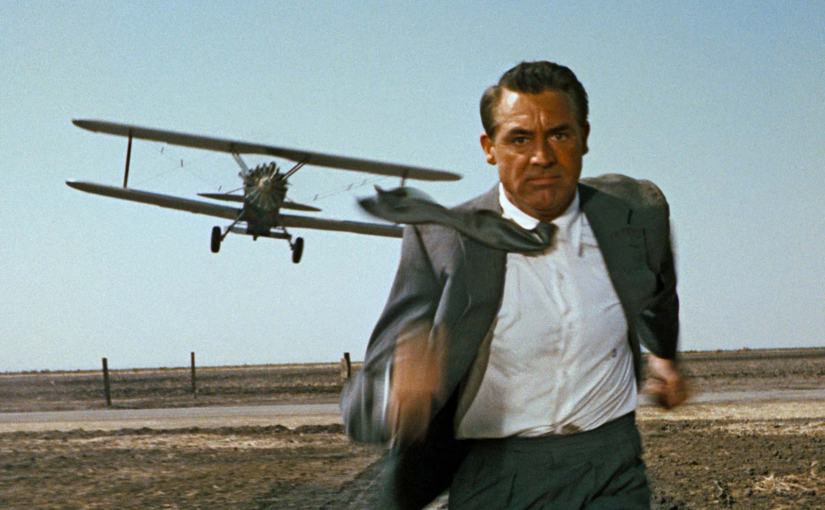
The most celebrated scene probably also contains one of the best captions caught in film. I speak of the very surprising crop duster chase. As Roger Thornhill finds himself in a quiet, Midwestern dirt road intersection, an airplane crop duster turns into a frightening menace. The best shot occurs as Grant runs quickly towards Hitchcock’s camera and the plane flies overhead rapidly getting closer in the upper left side of the screen. As Grant runs and runs, he fills more of the screen, but so does the crop duster. The editing alone is spectacular, as an oil rig eventually comes into play with Grant about to get run over. Story wise, I adore this scene as somehow the life of a man who routinely gets in taxicabs and hob nobs through New York City on a daily basis suddenly has found himself in a dusty field running for his life. What was never expected is suddenly all that matters to this ordinary man.

Hitchcock plays with what’s around to play with. Other than a quick gag in Superman II, l don’t recall many films incorporating Mount Rushmore as such an important element to its picture. Every crevice or ledge or finger hold is important to the edits of the climax in North By Northwest. When Eva Marie Saint is holding on for life, I truly believed she could actually fall. [SPOILER ALERT] Actually, Hitchcock wanted you to believe that as the very last scene doesn’t even truly reveal the solution to her predicament. I like his method of editing this way. Hitchcock seemingly offers no option for survival as Grant and Saint’s hands barely hold on to one another. The editing is just so damn good here.

I’d be remiss if I also didn’t recognize one of the greatest orchestral scores in film. Bernard Hermann’s stirring, fast paced rhythms keep the running man theme in play. The movie seems to play by the beats of Hermann’s conduction. Action films of the future seemed to adopt some measures from he did with this film.

North By Northwest will always remain as one Alfred Hitchcock’s best films. There is not one error in the picture. Every shot is done with deliberate intent to sustain the mystery of suspense. Humor is included even at times on a risqué and subtle measure. Alfred Hitchcock again invites the simplicity of storytelling to introduce the complexity of fear and mystery and outstanding suspense. Not many films compare to North By Northwest.