SALTBURN (2023)

by Miguel E. Rodriguez

DIRECTOR: Emerald Fennell
CAST: Barry Keoghan, Jacob Elordi, Rosamund Pike, Richard E. Grant
MY RATING: 9/10
ROTTEN TOMATOMETER: 71%

PLOT: A scholarship student at Oxford finds himself drawn into the world of a charming and aristocratic classmate, who invites him to his eccentric family’s sprawling estate for a summer never to be forgotten.


What is Saltburn?

I sit in front of my keyboard and try to figure out a way to write a review of Saltburn that doesn’t spoil its surprises in any way.  I ponder.  I rack my brain.  As of this writing (January 2024), the film has already been released theatrically and in the public eye for almost three weeks.  Any avid filmgoer who hasn’t seen it has heard rumblings about some kind of dark undertones and risqué material in writer-director Emerald Fennell’s follow-up to her astounding debut film Promising Young Woman.  The trailers reveal nothing except a plot that seems almost too similar to another film released over a month ago, The Holdovers.

Having just watched it last night, I can say that Saltburn is a pure thriller, masquerading as a dark comedy about class warfare, heavily influenced by The Talented Mr. Ripley and, say, Howards End, but that’s just plotting.  With this movie, it’s all about style and delivery, both verbally and visually.

First, a plot summary.  Young Oliver Quick (nice Dickensian name), played by Barry Keoghan, is a scholarship freshman at Oxford University in the long-ago year of 2006.  Virtually friendless except for an antisocial math whiz, he notices the strikingly handsome Felix Catton (Jacob Elordi, unknown to me), a very rich…what, junior?  Senior?  Probably a senior.  People of all genders are attracted to him like bees to honey.  Oliver is instantly attracted to him, but that doesn’t stop him from making out with one of Felix’s paramours given the opportunity.  He is nothing if not opportunistic.

After a meet-cute involving a flat bicycle tire, Felix gradually folds Oliver into his flock of hangers-on, much to the dismay of Felix’s cousin, Farleigh (who is brown-skinned…that will be important later), and to Oliver’s math friend, who cryptically tells Oliver, “He’ll get tired of you.”  One thing leads to another, and Felix winds up inviting Oliver to stay at his – there’s no other word for it – palatial manor house, Saltburn.  There, Oliver meets Felix’s aristocratic, idiosyncratic family: Felix’s mother, Elspeth (Rosamund Pike); his father, Sir James (Richard E. Grant); his sister, Venetia (newcomer Alison Oliver); a “friend of the family”, Pamela (Carey Mulligan); and the creepiest butler since that guy in the men’s room with Jack Nicholson in The Shining.

Here at Saltburn, and at Oxford, Fennell proves to be a master at creating a certain kind of mood.  There is an air of…something in the offing.  You know how some animals supposedly know when an earthquake or a tornado is coming?  That’s what the movie feels like during its first half.  I kept expecting a gruesome murder to occur, or for Oliver to discover a literal skeleton in a forgotten closet, or an explosion, I dunno, something.  I don’t know how much of that is due to my expectations after Promising Young Woman and how much to the carefully modulated camerawork and editing, but either way, the mood was there, permeating the screen with a sense of foreboding.

Oliver revels in his proximity to Felix, and I remembered with some chagrin my own formative years as a geeky teenager.  Trust me, I recognize hero worship when I see it.  At Saltburn, they sleep in separate rooms with a common bathroom, but there’s no shower, just an old-fashioned bathtub in the middle of the room.  At one point, Oliver hears…noises…coming from the bathroom and takes a peek inside, where he sees Felix lying back in the filled bathtub and – well, I’m given to understand that in Catholic schools, it was called “interfering with yourself.”

And it’s here I must stop with any kind of summarizing.  It’s here where Saltburn abandons its masquerade as a comedy of manners and becomes something else entirely.  It’s still comic, in my opinion, but it becomes less about manners and more about Machiavelli.  Oliver may present a meek façade, but he reveals the ability to do some very quick thinking indeed, especially in a moonlit scene involving Felix’s sister, Venetia, and during a karaoke party when Farleigh suggests a song for Oliver to sing that hits a little too close to home.

I admired how the movie turned my expectations on their head…twice.  There were a couple of times when, I must admit, my conspiratorial thinking led me to a couple of conclusions that turned out to be right in the end, which is something I don’t really like to do.  I don’t like to be that guy who goes to see The Sixth Sense and thinks, “You know, I don’t see how Bruce Willis could have survived that gunshot…”  I want to revel in the mystery, to live in the moment of the film and let its surprises work organically.  When a movie does its job well, I don’t even have to think about it.

What’s cool about THIS movie is that I managed to pick up on little “clues” about what was happening, or about to happen, but as the movie progressed, other things occurred (especially Felix’s little field trip with Oliver), and I found myself thinking, “Nah, never mind.”  And that is pretty ingenious, I think.  To lead the viewer down the garden path, make a left turn, get back to what looks like the main road so you think you know where it’s headed, then to pull a sudden U-turn into something else entirely?  That’s masterful misdirection.  I dunno, I fell for it hook, line, and sinker.  Call me crazy.

I haven’t even really touched on what will no doubt be the most famous elements of this movie.  That would be the scenes involving the bathtub, the cycle of the moon, a surprise midnight visit, a freshly dug grave, and Oliver’s, er, choreographic inclinations.  With the exception of that last one, which occurs too late to mean anything to the plot except as a wonderful ribbon to tie it up with, these scenes were, yes, shocking, but not in a hostile way.  Or even a Hostel way, if you take my meaning.  They were not intended to disgust or horrify the audience.  Or perhaps they ARE meant to horrify, but not in the kind of way that a serious horror movie disgusts people, like The Thing or Hellraiser.  It’s very tongue-in-cheek.  I’d like to believe there was a certain kind of glee in Emerald Fennell’s face when she watched her actors performing those scenes, knowing the material might completely turn some people off to the film without hesitation.  I found them to be yet another example of misdirection.  The off-putting nature of those scenes sort of lulled me into thinking one thing was happening and that the movie would then follow that thread into a more predictable conclusion.  But it didn’t.

I know, I’m being maddeningly vague.  The movie is new enough that I don’t want to risk spoiling anything.  There are supposedly some moths that, once touched by human hands, can never fly again.  Or is that butterflies?  Either way, I don’t want to deprive this movie of flying high in the eyes of a first-time viewer.  It’s refreshing to see a movie that seems to be following all the mile markers towards one thing, when it was really leading you somewhere else.  Saltburn is a treasure.

THE BANSHEES OF INISHERIN (Great Britain, 2022)

by Miguel E. Rodriguez

DIRECTOR: Martin McDonagh
CAST: Colin Farrell, Brendan Gleeson, Kerry Condon, Barry Keoghan
MY RATING: 9/10
ROTTEN TOMATOMETER: 96% Certified Fresh

PLOT: Two lifelong friends find themselves at an impasse when one abruptly ends their relationship, bringing unexpected consequences for them both.


Is The Banshees of Inisherin slow?  Yes.

Is The Banshees of Inisherin sad?  Yes.

Does the movie have a sad ending or a happy one?  Yes.

These are not normally the trademarks of a movie I rush out to see.  In fact, I didn’t see The Banshees of Inisherin at a movie theater for those very reasons.  I had heard that, yes, it is well-written and extraordinarily well-acted, but that it was a bit of a slog.  I had hoped Banshees would be another film like In Bruges, one of the finest dark comedies ever made, but that did not seem to be the case.  So, I stayed away.

Well, I have just finished watching it at home, and I can confirm the film’s slowness and unavoidable moments of sadness, but they are contrasted with unexpected comic beats.  (I was going to say “unintended,” but they were surely intentional, further confirming the ingenuity of the screenplay by director Martin McDonagh.)  I can also confirm that this is one of the most unpredictable stories I’ve ever seen, and I mean literally, like ever.  At first, I was comparing it to Melville’s short story “Bartleby, the Scrivener”, but that turned out to be woefully inadequate.  The Banshees of Inisherin does have the structure of a fine short story, but there its similarities to Melville ends.  I’m not sure if Banshees has a chance of winning the Oscar for Best Picture, but it’s certainly one of the strongest contenders for Best Original Screenplay.

Pádraic (Farrell) lives on the fictional island of Inisherin, off the Irish coast, in the early spring of 1923.  He is stunned one day to learn that his best friend, Colm (Gleeson), has abruptly decided to end their lifelong friendship, cold turkey.  Colm doesn’t want to talk to Pádraic for any reason whatsoever, nor does he give a reason, at least not initially.  When Pádraic persists in speaking to Colm, Colm gives him a warning: Every time he talks to or bothers Colm in any way from here on, Colm will cut off one of his own fingers and give it to Pádraic, until he stops or until Colm has no fingers left.

It was at this point that I sat up and started really paying attention.  I’ve lived long enough to know the specific kind of grief and consternation that occurs when a long-term friend abruptly cuts off all contact for reasons that are not at all clear.  So I felt Pádraic’s pain, I saw it in his face, when he realized how serious Colm was with his threat.  At that moment, I drew mental lines: Pádraic was the protagonist, and Colm was the antagonist.

Of course, Pádraic is the good guy.  He’s nice!  His adult sister, Siobhan (Kerry Condon), confirms it!  I mean, sure, he’s a little dull, and maybe not all that smart, and maybe he has a pet miniature donkey that he lets in the house when his sister isn’t looking, and he’s never heard of Mozart, but is that a crime?  Is that reason enough to end a friendship?  Pádraic doesn’t think so.  I didn’t think so!  Pádraic is so full of righteous anger that he confronts Colm.  Colm is dumbstruck.  Their conversation ends in a bit of an impasse.  And then, the next morning, as Siobhan prepares breakfast, they hear a thunk on the front door…aaand you’ll have to watch the movie for further plot developments.

(While I watched The Banshees of Inisherin, my girlfriend wondered if I was watching some kind of slapstick comedy with the volume of laughter coming from our movie room.  My explanation of why I was laughing, and what I was laughing at, didn’t quite translate.)

What is Banshees trying to say?  In my opinion, perhaps it’s this: you can’t go through life worrying about what other people think of you.  When Colm lays down the law, Pádraic should have just sucked it up and moved on with his life, right?  I was originally comparing their situation to something that might happen on social media, when someone expresses a very negative view of your post or opinion or whatever.  What do you do?  Latch onto it and let it gnaw away at you?  Post rebuttal after rebuttal until you change their mind?  (Spoiler alert: you won’t.)

As I said, that kind of thinking made Pádraic the good guy and Colm the bad guy.  But then Pádraic starts making some very bad, very DUMB decisions.  He starts listening to the advice of the closest thing they have to a village idiot, Dominic (Barry Keoghan), who suggests that Pádraic just needs a new approach: tough love.  At that point, if he’s dumb enough to take advice from a moron, whatever happens next is on him, right?  So now the balance changes.  Now Pádraic is the bad guy/dumbass and Colm is the good guy.  Just leave him alone, dude.

(For the record, Colm does explain his decision, which may shed some light on his own state of mind.  Depression?  Despair?  The screenplay offers clues, but nothing truly definitive.)

All through the film is Pádraic’s sister, Siobhan, who functions as the audience surrogate.  “You’re all f*****g boring!  With your piddling grievances over nothin’!”  She is as dumbfounded as we are at Colm’s stubbornness.  Not to mention at her brother’s foolish attempts to reconnect with someone who clearly doesn’t want to be bothered.  There are a couple of moments when it seems as if all is forgiven, but alas, it is not to be.  Siobhan’s solution to rid herself of their bickering is as simple as it is final.

When the credits rolled, I found myself wondering what kind of review this was going to be.  I liked the movie.  But it is slow and sad.  But its massive unpredictability sucked me in as inevitably as if I were watching Kill Bill or Interstellar.  That’s the key factor to The Banshees of Inisherin.  You may think you know what’s about to happen, but just try to guess exactly how the movie ends, and see how wrong you are.

THE BANSHEES OF INISHERIN

By Marc S. Sanders

You ever hear of the modern term “ghosting?”  Normally, it applies to social media, like with Facebook, Instagram and every other brain cell sucker app we occupy ourselves with on our electronic devices.  It’s where suddenly, for no reason at all, a friend or acquaintance will stop speaking to you.  They will ignore your attempts to talk.  If they do talk to you, they simply will say stop talking to me and do not call me again. They will never share a reason for this new perspective they have for you.  They just want to continue with their lives without you being a part of it.  I have been ghosted on two separate occasions.  It hurts.  It really hurts, and I constantly must remind myself not to dwell on these people.  They don’t care.  They lack any further regard.  It’s just unbelievably puzzling when it happens.

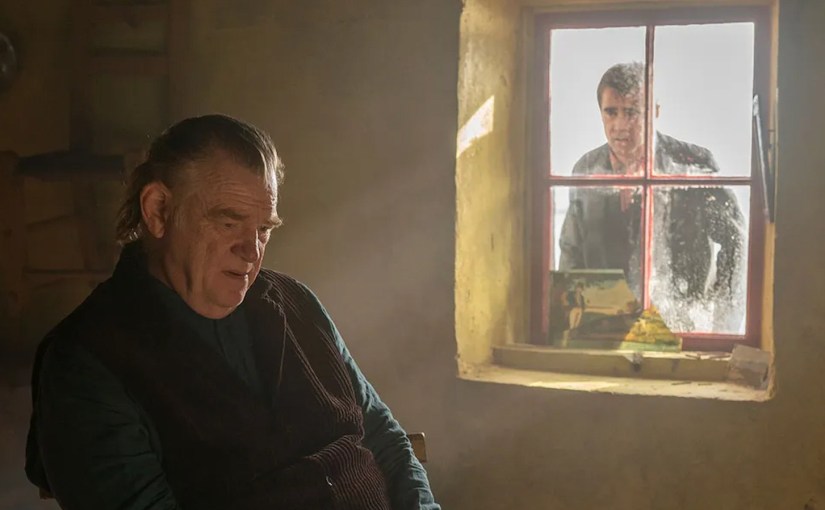
With The Banshees Of Inisherin, director Martin McDonagh reunites Colin Farrell and Brendan Gleeson, who shared the screen together in the well received In Bruges, to portray these two former friends.  Farrell plays Padraic.  Gleeson is Colm.  The film takes place in 1923 on the fictional Irish coastal island of Inisherin.  Padraic strolls over to Colm’s house to walk with him to the pub for their daily 2pm pint together while they chat.  Upon arrival, Colm is seen sitting in his home, ignoring Padraic’s knocks on the door and window.  It’s odd and unexpected. 

When Padraic shows up at the pub alone and later Colm arrives, the other regulars ask Padraic if the two lifelong friends are “rowing.”  Not to Padraic’s knowledge.  Maybe this is an April’s Fools joke?!?!

Colm holds true to his new position.  He explains to Padraic, with no uncertain terms, that he no longer wants to speak with him.  Padraic makes attempts to open up to Colm hoping they can hash this out, but there is nothing penetrating Colm’s stance.

What lends to the sustenance of the near two-hour film is the setting that Padraic resides within.  An island in the middle of nowhere where he has no interests or hobbies or specialties for anything.  He really has only happily lived with his friendship with Colm, which is now suddenly yanked away from him.  He lives well with his sister, Siobhan (Kerry Condon), and his adoring miniature donkey, Jenny.  Siobhan truly loves her brother, but not Jenny or the other animals who reside on their property.  As the Irish Civil War is coming to a close, an educated Siobhan is ready to move on from the nothingness of Inisherin.  Padraic is not.  He’s lived so comfortably on the Irish coastal island his whole life.

Colin Farrell is an actor you want to embrace in this film.  As I’ve experienced something similar to what Padraic endures, I can relate to what stuns him at his sudden loss of friendship.  Padraic is a good man.  Colm knows this which is seemingly why extremes needs to be undertaken to stress exactly how Colm feels about Padraic going forward.  Colm cannot simply plead for Padraic to move on.  He first makes the request.  Later, he has to do something else to deliver his point.  When I say extremes are taken, you can not even imagine what occurs.  It’s shocking, but believable. 

Brendan Gleeson normally offers an intimidating presence on screen.  He falls into roles of men you’d likely only cautiously approach.  The same goes for his character of Colm here.  McDonagh wrote the character with no compromise. Only when a significant turn occurs, does Colm violate his feelings with how he regards his former friend.

Kerry Condon should get an Oscar nomination along with Gleeson and Farrell. Siobhan is both a loving sister but while she’s the younger sibling, she is also the more sensible.  As Siobhan, Condon’s timing for losing patience in the part is well paced.  Condon is awarded with some of the best dialogue in the script.  McDonagh could have written this film from the perspective of her role, rather than Padraic’s, and I bet it would still work thanks to what she lends to the piece.

Barry Keoghan plays a young regular around Inisherin named Dominic.  Kind of like a local idiot who is undeservedly abused by his policeman father.  Keoghan’s role is a side story, but he plays it so well.  Despite Siobhan’s protests, Padraic takes Dominic in.  He’s not meant to replace the void that Colm left in Padraic’s life but it further reminds you of the kindness of Farrell’s character.  It begs the question why someone would ultimately stop speaking with a good person like Padraic, at a given instant.

My wife was not interested in watching this film and asked me to give her a rundown of what happens from beginning to end.  When you describe The Banshees Of Inisherin out loud, you sound ridiculous even though you’ve appreciated some of the surprising moments you just watched.  I told my wife; you have to see it to understand.  I understand Padraic’s yearning for the friendship he once had.  I understand the measures he takes in response to the one thing he valued beyond his sister and his pet donkey.  When you live in a low populated island town with little stimulation beyond the people who have been a part of your entire life, to suddenly lose that is devastating.

Martin McDonagh has crafted an unusual script.  Often, break ups in films go the traditional route of the loving relationship going through a split.  If it’s a friendship, I’d argue I’ve seen it occur more often between two women.  McDonagh’s film acknowledges the impasse among two grown men.  His script could have been occupied only with dialogue constructed of standard duet scenes between two very strong actors.  Fortunately, he doesn’t just rely on that.  McDonagh stretches his imagination further to drive home the point of how these two men respond to this unfortunate outcome.  The actions they take are startling, but as I reflect on the script for the film, I cannot deny how alert McDonagh is with crafting the motives of his characters. At the very least, I’m empathetic for poor Padraic who struggles with the loss of a friend. 

To lose a friend is to lose a part of your soul. What can I say? I’m an overly sensitive guy.  It’s always been my Achille’s heel.  How do I survive, though? I think back to what my father once told me.  He said “Marc, if you have one friend in life, then you’re the luckiest guy in the world.”  Thankfully, I’m rich in many friendships.

Forgive my digression though.  It’s important to know The Banshees Of Inisherin is a very good and a very sound film.

THE BATMAN (2022)

By Marc S. Sanders

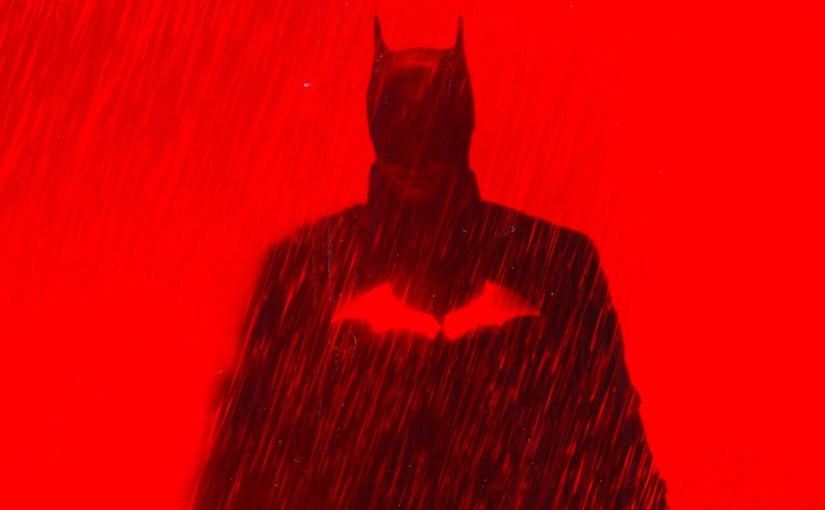
Another year at the movies, means another trip to see Batman on the big screen.  I think we are close to a dozen iterations, no?  Fortunately, the latest reinvention for March 2022, The Batman, is a refreshing interpretation that focuses on the detective skills of the masked vigilante hero who prowls from the rooftops of Gotham City.  Matt Reeves has written and directed a gripping and engaging film that doesn’t rely on simple paint by numbers.  He’s capitalized on using the mysterious Riddler (Paul Dano) as the main villain here, and Batman’s (Robert Pattinson) brains get more exercise than his brawn.   

It is the second year since Batman has introduced himself to the crime ridden city.  The man behind the mask, Bruce Wayne, keeps a journal of his exploits and observations, and through voiceover he questions if his actions have benefitted since it appears that crime has only increased since his first appearance.  A serial killer is taking responsibility for the grisly deaths of important people within the city and he’s leaving greeting cards for “The Batman” with a common scribble of “No More Lies,” along with a “?,” and a riddle for The Batman to solve.  Thanks to a strong partnership with Police Lt. Jim Gordon (Jeffrey Wright), Batman is given easy access to the crime scenes so he can attempt to reveal the mysterious villain and determine exactly what his endgame is. The Riddler doesn’t make it easy, though.

Mobsters like the Penguin (Colin Farrell) and Carmine Falcone (John Turturro) have a grip on the city, as well.  There’s also a possible lead from a woman (Zoe Kravitz) who’s managed to infiltrate the gangsters’ underground headquarters.  She also has the fighting skills and agility that’s comparable to the caped crusader, and maybe she’s a cat burglar as well.  Still, is she pertinent to Batman’s investigation or not?

It’s better not to spoil anything that occurs in Reeves’ film.  The mysteries that are uncovered are part of the fun, and it does take some time and exposition to get there, but I found it worth it.  Barring a few ingredients within the film that I recognized from the Christopher Nolan and Tim Burton films, the picture is worth seeing for a new formula on a character, that although is a favorite of mine, I feel has also been done to death on the big and small screens.  This is a Batman film where I appreciate the thinking approach of its craft, over the action.  When Batman is playing detective with Jim Gordon, it is much more enticing than just another Batmobile chase or another ham-handed fist fight.  This film is a test of Batman’s mental capacity and ability for analysis.

Reeves direction is also appreciated, though I’m expecting the naysayers.  The Batman is a very dark motion picture.  When it’s not dark, the photography is dim and blurred.  There’s lots of rain and dimly lit streets and garages.  There are strobe lit nightclubs.  Windows are blurred, so sometimes you can’t make out the image in front of you.  He makes the viewer work for the focus and that kept me alert.  I believe Matt Reeves was attempting to give the viewer the literal point of view of the characters.  It will not be a surprise, however, to find some movie watchers lose patience with the technique. 

The Riddler especially is most mysterious with a twisted and inspired Zodiac killer approach.  Often, Matt Reeves’ film feels especially reminiscent of David Fincher’s Seven.  I would not be surprised if Reeves wrote his script as a cop/detective story, and then added the Batman flavor to make his final draft.  This is not a picture of grand special effects or superpowers and gadgets. 

It’s definitely not the Batman film that everyone wants.  I foresee the response being very divisive.  Nonetheless, if you’re a Batman devotee like me who grew up on the character in the macabre storied comics (as well as the hammy tongue in cheek material), you’re going to be thankful for this “at last” interpretation.  I’ll definitely be seeing it again.

NOTE: The Batman is not a film for children under age 13. I truly believe that. There are disturbing images and threats within the story, and the violence depicted or left to the imagination is not for celebratory effect and amusement. This is definitely a film for mature audiences. Do not presume it’s meant for all ages based on its misleading marketing approach with companies like Legos and Little Caesars pizza.