THE BRUTALIST (2024)

by Miguel E. Rodriguez

DIRECTOR: Brady Corbet
CAST: Adrien Brody, Felicity Jones, Guy Pearce, Joe Alwyn, Raffey Cassidy
MY RATING: 7/10
ROTTEN TOMATOMETER: 93% Certified Fresh

PLOT: When a visionary architect and his wife flee post-war Europe, their lives are changed forever by a wealthy client.


Maybe I’m a victim of too much hype.  Maybe that’s partly my fault, too, as I waited to see Brady Corbet’s The Brutalist until after it had been nominated for a whopping ten Oscars, including the so-called “Big Five:” Best Picture, Director, Actor, Actress, and Screenplay.  As a result, my expectations were possibly a little too high.  I admit it.  However, even if my expectations hadn’t been inflated, I don’t believe The Brutalist would have affected me any differently.  It never lost my interest during its 3.5-hour running time, but it never achieved the kind of liftoff I felt I was being prepped for.  At the end, I was left with more questions than answers, which can be acceptable for some films, but for this one, I felt like I was left out of the loop.

In 1947, László Tóth (Adrien Brody), an Austro-Hungarian Jew, successfully emigrates to America, fleeing intolerable conditions at home, but is forced to leave behind his wife, Erzsébet (Felicity Jones), and his mute niece, Zsófia (Raffey Cassidy).  He was a respected architect in his home country, but now he is part of the huddled masses, represented in a sensational shot as his ship sails past Lady Liberty, the camera tilting so she is upside-down and cattywampus in the frame.  That really got my attention, for some reason.  If you want to really drill down, it could be visual foreshadowing for how László’s American experience will not be quite as stable as he had hoped.  Or maybe director Corbet just liked how it looked.  Either way.

Although László’s overriding priority is to somehow get his wife and niece to America, he must first get a job (after first engaging in a surprisingly frank and raunchy sex scene with a prostitute).  His first safe harbor is with his Americanized cousin, Attila (Alessandro Nivola), who runs a custom furniture company with his shiksa wife, Audrey.  It’s through this job that László meets American millionaire Harrison Lee Van Buren Sr. (Guy Pearce), a man who will unwittingly shape László’s life for the next several years.  Harrison has a son, Harry (Joe Alwyn), who looks like a distant relative of the Hemsworth clan and is a condescending racist, let us not mince words, but who, in his own words, tolerates László’s presence because of his architectural skills.  (Harrison wants László to design a community center in honor of his late mother.)

This is all just in the first act of the movie, before the intermission.  The Brutalist moves with a deliberate calmness, in spite of its thriller-esque title.  I was reminded of Doctor Zhivago [1965], as it covers large swatches of László’s life with nice attention to detail, never hurrying, but never losing my interest.  The second act finally introduces Erzsébet, László’s wife, for the first time in two hours (hope that’s not too much of a spoiler).  The plot spins out for the rest of the film as a series of conflicts between László, his wife, Harrison and his son, and the crew building the community center that László has designed.  László becomes more irascible as changes are proposed and approved without his knowledge, plus he must deal with a change in his wife’s condition.  There is a detour to Italy where László and Harrison must decide on which marble to use for the center’s, er, centerpiece, and it’s here where an act is committed that, although it feels like it came out of left field, does not seem too surprising considering the behavior of the perpetrator during the first couple of hours.

As I was watching The Brutalist play out, I was repeatedly reminded of another film, featuring another madman with a single-minded focus, also played out in an earlier era of American history, though it takes place decades earlier than The Brutalist: Paul Thomas Anderson’s There Will Be Blood [2007].  Both films have the same deliberate pacing, the same focus on men of industry, their familial and professional challenges, even the same kind of jarring, atonal score playing in the background during key scenes.  But while The Brutalist is at least equally as well made as There Will Be Blood, the latter movie reached out and grabbed me by the lapels and didn’t let go until the final scene, ending with a bang and not a whimper.  I cannot say the same about The Brutalist.  I give props to the craft of the film, to the filmmakers who clearly had a lot to say and needed the time to say it.  The editors knitted everything together and gave the film a very specific voice.  But as the film’s epilogue played out, and I realized how it was about to end, I sank a little lower in my seat and thought to myself, “Well, this is mildly disappointing.”

Sidney Lumet once wrote words to the effect of, “If your movie is over two hours long, you’d better have a lot to say.”  The Brutalist does have a lot to say about the Jewish experience in post-war America, about the single mindedness of gifted artists, about the casual racism embedded in white America that persists even today.  But I couldn’t get away from the feeling that it could have said it in a movie that wasn’t long enough to require an intermission, that didn’t answer questions that were left unanswered (how and when did Zsófia suddenly start speaking?  where did Harrison go??  what exactly happened on that stream bank between Harry and Zsófia???), and that didn’t leave me feeling as if I’d watched a correspondence course video on American architecture instead of a movie.  Again, it’s well-made and occasionally beautiful to look at.  It’s not a BAD movie.  It’s just not a GREAT one.

THE BRUTALIST

By Marc S. Sanders

Before I started writing this article, I had to marinate on my impression of Brady Corbet’s magnum opus film, The Brutalist.  It has the makings of a biography but it’s fiction.  It indulges practically every inch of a Holocaust survivor’s life after immigrating to America.  It takes daring approaches in its photography particularly since it was filmed using an antiquated 35 mm print in Vista Vision. (The director found it appropriate to use the filming methods that were available during the mid-century decades when most of the film takes place. Wise and insightful choice.) Despite using questionable AI techniques, two of the leads use impressive dialects and fluently speak in Hungarian and Hebrew as well.  Set designs, score, sound, visuals.  It’s all here.  Yet, I don’t feel I wholeheartedly enjoyed the experience of watching the picture, and this is coming from a guy who had the entire AMC auditorium #16 to himself on a chilly Thursday afternoon at 4:45pm.  Not a cell phone lit in my line of sight or a crying baby within earshot.  The theater was my oyster.  The Brutalist was not.

Adrien Brody won his first Oscar at age 29 for Roman Polanski’s The Pianist.  He earned his accolades for a heartbreaking performance.  He arguably works even harder as a visionary architect named László Tóth.  This nuanced creation from Brady Corbet is a most convincing historical character…of fiction, that is.  

László arrives on Ellis Island, separated from his wife and niece by concentration camp assignments during the war.  The ladies remain in captivity while he reunites with his brother, Atilla (Alessandro Nicola) and Christian sister-in-law who reside in Philadelphia, operating a custom furniture and carpentry shop.

Enter a raving mad and wealthy industrialist named Harrison Lee Van Buren (Guy Pearce) who arrives home to find out his son Harry Lee (Joe Alwyn) has hired the carpenters to redo a library as a big surprise.  Harrison is outraged at the finished product and denies payment for the job, thus causing a permanent rift between László and Atilla.  László is kicked out of his brother’s home following an accusation of making a pass at the wife, and he can only find refuge within a church shelter.  

Harrison has a change of heart however when his socialite friends take a special liking to the new room.  He tracks László down, pays him for the work, invites him to a Christmas party and subsequently insists he stay on the property while also connecting the Hungarian with an attorney who will make efforts to reunite him with his wife and niece who remain overseas.  

Meanwhile, an ambitious Harrison conjures up big plans right off the top of his head.  He wants to commission László to design an enormous building consisting of a library, a gymnasium, theatre and a chapel on a wide expanse of Pennsylvania land nearby his grand estate.  The building will be erected in honor of his loving mother’s memory.  A humble László accepts the assignment though he’s funding a heroin addiction with the monies given to him by Harrison.  

Though The Brutalist is fiction, I believe it should still be considered a lesson in north eastern American history.  As building gets underway, a perfectly timed intermission in the middle of the film arrives when we learn of Pennsylvania state’s aggressive campaign to manufacture and build with the precious commodity of US steel.  Fictionally speaking, we have Harrison Lee Van Buren and László Tóth to thank for these newly created jobs of construction and commodity developments.

There is a whole lot of story to tell in this three-and-a-half-hour picture that traverses through decades.  Brady Corbet’s depiction of his main character, László, runs the gamut of so many circumstances.  He’s a stranger in a strange land, even towards his newly Americanized brother who has shed his Jewish identity for prosperity.  The Anglo Christian mentality of Harrison Lee Van Buren, along with his family and fellow socialites, curiously study László as the alienated man he appears to be.  Loneliness is not a direct message that Corbet offers in the film, but how can László not feel lonely in this new land without the sensibilities of a wife to help him mind his boundaries and stay away from the poisons of heroin or personal betrayals that will challenge him?

The second half of The Brutalist oversees László growing accustomed to reuniting with his wife, Erzsébet (Felicity Jones), who has drastically changed in her physicality since they were last together.  Their primarily mute niece, Zsófia (Raffey Cassidy), has arrived as well.  The problem is that László has had opportunity to shed his weakness of being a Holocaust prisoner while taking charge of his most mesmerizing architectural design yet. His family’s arrival does not feel conducive with his new way of life, both intimately and religiously. The Brutalist covers a lot of conflicts while also showing massive progress for Harrison’s grand investment and László’s treasured work.  

After providing all of this exposition for the film, I think I’m ready to deliver my point.  It’s too much.  There’s so much story here that some of it feels unwelcome.  László’s heroin addiction never seems to add up or intrude effectively enough.  Because of the long running time of the movie, there are long sections where any reference to his yearning for heroin feels neglected.  This man of energetic and artistic passion is hardly ever weighed down by his vice and I questioned just how important it was for the drug addiction to be included in the film.  The script goes in so many different directions at times, it feels like it forgot about this important monkey that should be on László’s back.

László also gets challenged by Harrison’s American business and architectural partners which is one more conflict.  Unexpected fallbacks also occur that affect both László and Harrison’s years-in-the-making plans.  Then there is László’s friendship with an assistant who started as a fellow drug addict.  Finally, there is László and Erzsébet and the problems they face intimately and as common partners. The reunification of the married couple has new, unexpected dynamics to face.

It’s a lot.  While I never minded the running time of The Brutalist, all of these layers of storytelling become exhausting.  

Guy Pearce actually impressed me the most.  I loved his character and the shrewdness he exhibits to everyone he shares a scene with.  His gruff dialect with a pencil thin mustache, slicked back hair and perfectly tailored suits are distinct, but his presence in a room is always felt even when the camera is not on him or if he has nothing to say.  His stature gave me an impression of Rockefeller, a man with the appropriate and seemingly out of reach dreams that will deliver a future of advanced American building and development.  I may have loved Harrison Lee Van Buren’s story more than László Tóth’s.

However, I got angry with the film as the story was beginning its descent towards the end. Harrison commits a truly unexpected and heinous act that arrives out of nowhere.  This is a fictional story. So, I feel comfortable with my stance that what Brady Corbet opts for Pearce’s character seems wrong and unjust; a downright inappropriate take that did not add up for me.  Guy Pearce is giving a career high performance, but I did not care for how his character’s trajectory concluded.

Felicity Jones is a powerhouse actress as Erzsébet.  She appears so confident within the skin of her character as a defiant woman, unhinged by any sort of attempted intimidation from her husband or the Van Burens.  

Adrien Brody is the sure front runner to win a Best Actor Oscar, though I wish Ralph Fiennes would finally get his due recognition for Conclave.  There are so many directions that László Tóth is pulled in.  This is a very challenging personification for an actor to belabor.  For this one character alone, The Brutalist feels like five different movies are being played at once.  If you have read my reviews before then you may know that I’m a big admirer of multi-dimensional characters.  It’s hard to find a character this nuanced.  Michael Corleone is a comparison that comes to mind.  As I write this review, it astounds me how much depth I’m reflecting on within Corbet’s script and Brody’s performance.

I told a friend who has also seen the film that The Brutalist feels like a marriage between Paul Thomas Anderson’s There Will Be Blood and Milos Foreman’s Amadeus.  While these characters are considered audacious, great artists beyond comparable realms, they are never the most powerful people in the room.  The power belongs to those with the resources of wealth and those who proudly carry the rank and titles bestowed upon them.  For the artists, men of power stand in the way of the achievements they strive for, forcing them to vent their frustrations with self-harm and abuse towards the ones closest to them.

Everything I saw in Brady Corbet’s film is interesting.  Beginning with the arrival on Ellis Island and the Statue of Liberty towering over a lost László, all the way to a visit at the seemingly unreachable mountains of Italy where beautiful, white porcelain exists in the highest reaches of nature.  You feel like you have traveled to places uncharted by most people of this Earth.  It’s breathtaking.  

The Brutalist follows the trajectory of a man arriving in America to accomplish his dreams and obtain a destiny he feels worthy of.  Only there are obstacles that will divert his path and thus a different outcome may arrive. 

Visually and with Brady Corbet’s ambition for this picture, The Brutalist is often astonishing to absorb.  Still, at least on my one and only viewing thus far, the film was overwhelmingly abundant, and I could not feel comfortable with all of it coming at me once.  Then again, that is likely how László and Erzsébet Tóth felt upon their arrival in the land of the free.

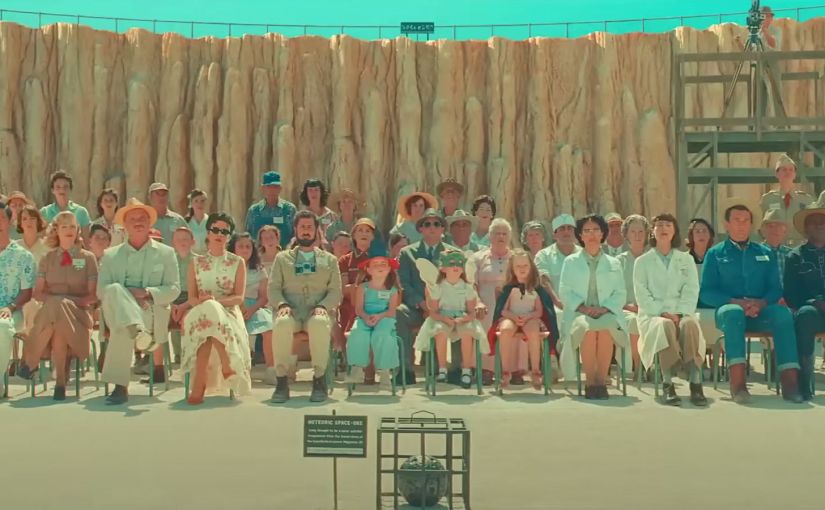
ASTEROID CITY (2023)

by Miguel E. Rodriguez

DIRECTOR: Wes Anderson
CAST: More Actors Than You Can Shake a Stick At
MY RATING: 5/10
ROTTEN TOMATOMETER: 76% Certified Fresh

PLOT: In the mid-1950s, a roadside motel in a fictional mid-Western flyspeck plays host to a junior stargazing event that unexpectedly escalates, changing everyone’s world view forever.  …sort of.


Asteroid City, Wes Anderson’s latest film, feels like a collector’s edition box of Cracker Jack with no prize inside.  Or a cake that has prize-winning decorations, but it’s hollow inside.  It looks phenomenal; one of my fellow cinephiles, Anthony, predicts it will be nominated for cinematography and production design, and I agree with him.  But where the heart of the film should be is simply a crater like the one around which the fictional town of Asteroid City was built.  This is yet another star-studded cast for Wes Anderson, but Anderson has given them very little to do other than wear colorful costumes, look solemnly into the camera, and speak in very precise phrases.

This strategy has served him very well…no…EXTREMELY well in the past.  Moonrise Kingdom (2012) and Grand Budapest Hotel (2014) spring immediately to mind.  But some crucial piece of machinery is missing from Asteroid City.  The characters are colorful and quirky, but at the end of the day, I simply didn’t care about what they did or said.  (Well…except when actress Midge Campbell [Scarlett Johansson] decides to rehearse her nude scene for her next-door neighbor…I did care about that.)

The film opens with a pillarboxed segment in black-and-white.  Our host (Bryan Cranston) explains that we’re about to watch a staged presentation of the newest play from author Conrad Earp (Edward Norton), who proceeds to lay out the “set” for us.  “Upstage right is the crater…upstage left are the motel cabins”, etc.  Then the screen expands to full letterbox and we are treated to eye-popping Kodachrome desert landscapes as we follow a 165-car freight train as it passes by Asteroid City.  Well, “City” should be in quotes…the population is officially listed at eighty-seven.

This is some wacky city.  It’s as if Wes Anderson watched every Coen Brothers film set in the Midwest, from Raising Arizona to No Country for Old Men, and filtered them through a Looney Tunes cartoon written by Charlie Kaufman.  Vending machines on the porch of the rental office sell everything from snacks and drinks to martinis and parcels of local real estate.  (Cost for the real estate parcels: forty quarters…they’re not big parcels.)  An abandoned highway overpass lurks on the outskirts.  Periodically, a police chase roars down the otherwise empty highway, guns firing and sirens blaring.  The residents say nothing about this phenomenon.  And every now and then, the town shakes from nuclear testing being done hundreds of miles away, but close enough that the mushroom clouds are visible.

Man, I love this kind of thing.  The stage is set for one of the all-time great satires, or maybe just a flat-out fairy tale.  We meet the cast of characters who have congregated here to honor young geniuses who have invented everything from rocket packs to particle guns to a projector strong enough to project an image on the moon.  A full rundown of all these characters would wind up being a novella, but if you’re acquainted with Anderson’s work, they will all be familiar to you in one way or another.  (Not least because many of them have worked on Anderson’s other films.)  They have also gathered to witness a rare astronomical event: a solar ellipse.  Not an eclipse.  An ellipse.  The mechanism required to view an ellipse without damaging your retinas looks like something out of Brazil.

Again, I normally love this kind of stuff, really, I do.  But…okay, look, first of all, the film intermittently takes a break from the movie itself to yank us out of the story and show us an event in the playwright’s life that led to the casting of Augie Steenbeck.  Or to show us a rehearsal where an acting coach (Willem Dafoe) encourages the actors – that we’ve already been watching perform in the movie/play – to improvise what it’s like to wake up by first falling asleep.  There’s even a moment where the host shows up where he really shouldn’t be.  And when one of the actors has a moment of existential crisis concerning the character he’s playing, he simply walks off the set, goes backstage and asks the director (Adrien Brody) why he’s doing what he’s doing.

…I mean…what IS this?  Conceptually, I get it, even if it’s a little heavy-handed.  (“What’s my motivation?”  “You’ll have to figure it out as you go along.”  “That’s too hard!”  “Well, that’s life.”)  But…why is it here?  Anderson worked with non-linear structure before in Grand Budapest Hotel, and it worked marvelously.  Here, it feels indulgent.  In fact, many of the scenes in the movie feel that way.  There’s a moment where an army general (Jeffrey Wright) announces he’s going to deliver a speech he’s prepared for the occasion of the “ellipse.”  But this is no ordinary speech.  It’s practically beat poetry, delivered with the kind of conviction that only Jeffrey Wright’s magnificent voice can provide, but…but…why is it here?  Even in this weird, cotton-candy, retro-fever-dream of a movie, this “speech” felt out of place and just plain goofy.  In fact, quite a lot of the scenes between characters felt less like story and more like the kind of dialogues you find in source books for actors.  (101 Scenes for Two and Three Actors…that kind of thing.)

I will provide full disclosure and say the movie did deliver some decent laughs and chuckles.  There is an event that occurs during the ellipse (I’ll have to tread carefully here) that may not be entirely unexpected, but it’s executed and timed so well that I laughed pretty much through the whole scene.  It’s the kind of thing I imagine Buster Keaton and Charlie Chaplin would have thoroughly enjoyed, if I may be so bold.  There is also the problem of the disposition of a Tupperware container holding a valuable, ah, keepsake.  Oh, and that roadrunner was awesome.

But by the time Asteroid City rolled credits, I didn’t feel like I had seen one of Wes Anderson’s best films.  (The Royal Tenenbaums remains his best film, in my opinion.)  This almost felt like a movie made on a whim, kinda like, “Hell, I don’t know if this’ll work, but if I get enough star power behind it, this may turn out to be something.”  Alas, it did not.

THE DARJEELING LIMITED (2007)

by Miguel E. Rodriguez

Director: Wes Anderson
Cast: Owen Wilson, Adrien Brody, Jason Schwartzman, Amara Karan
My Rating: 8/10
Rotten Tomatometer: 69%

PLOT: A year after their father’s funeral, three brothers travel across India by train in an attempt to bond with each other.


In one of the bonus features on the Criterion Blu-ray for Wes Anderson’s charming The Darjeeling Limited, film critic Matt Zoller Seitz compares it to Stanley Kubrick’s 2001: A Space Odyssey because (I’m paraphrasing here) it is the perfect distillation of the director’s method, mood, and style.  I would reserve that distinction for either The Royal Tenenbaums or The Grand Budapest Hotel, myself, but The Darjeeling Limited certainly does capture everything that is typical of a Wes Anderson film: charm, whimsy, troubled souls, a quest of some kind, attention-grabbing camera moves, frequent slo-mo (but not too much), cameos, light and dark material jockeying for position, and a denouement that may signal the end of the film but certainly not the final arc of the main characters.

Meet the Whitman brothers: Francis (Owen Wilson), Peter (Adrien Brody), and Jack (Jason Schwartzman).  A year ago, their father died, and for the first time since that day, they’re about to meet each other and speak to other on board The Darjeeling Limited, a train that will take them across India on a spiritual journey.  Francis, the eldest, is the eager organizer of this little pilgrimage, providing everyone with laminated daily itineraries that are produced by Brendan, his personal assistant who is also travelling in a separate train car.  Francis will spend much of the film wearing bandages on his head and face that make him look as if he lost a fight with a honey badger.  What caused these injuries is not for me to say.

The ostensible reason for this journey is spiritual awakening and reconnecting with each other.  “I want us to become brothers again like we used to be and for us to find ourselves and bond with each other,” says Francis.  Peter and Jack are skeptical and not exactly psyched for this little trip, each for their own reasons.  Peter has a wife back home, 7-and-a-half months pregnant, who has no idea he’s in India.  Jack, a writer, has broken up with his girlfriend, but he obsessively checks her voicemails remotely because he still has the code to her answering machine.  (Hey, this was made in 2007 when you could still do that.)  He has his own return ticket in case he wants to leave the trip early.  Of course, he’ll find that difficult without his passport, which Francis has confiscated.  “For safety,” he argues.  Yeah, right.

There is an ulterior motive for the trip, having to do with who did and didn’t attend their father’s funeral, but ultimately the ins and outs of the characters, while engaging, kind of take a back seat to the trademark Wes Anderson visual style.  This is not a bad thing.  I am not a fan of Anderson’s first film, Bottle Rocket, because I felt it was all posturing with no meat to the story.  However, with each successive film of his, I become more and more endeared and captivated with his trademarks, especially when he uses it to tell stories that I would never have thought would “mesh” with his style.

For example, near the halfway point of the film, an extremely unexpected crisis occurs.  Because the movie has been happy and bouncy and witty up to now, it comes completely out of left field.  But remarkably, in the middle of this action, Anderson’s camera remains as “Anderson-esque” as ever, still performing quick pans and push-ins and keeping me involved in the story.  This crisis might have felt contrived in another film, a plot device to inject some needed drama into the story.  Not here.  Anderson’s storytelling methods made the event feel as random as anything life might throw at us on any given day: the death of a parent, the birth of a child, a snake getting loose in your train compartment, etcetera.

With one or two obvious exceptions (I think), the entire film was shot in India.  The trusty IMDb trivia page informs me the train scenes themselves were filmed inside a moving train travelling from Jodhpur to Jaisalmer.  The beautiful Indian locations are a major feature of the film.  They visit temples, marketplaces, a monastery, and hilltops overlooking vast Indian vistas.

And all the while, Francis, Jack, and Peter struggle to come to grips with their differences and their brotherhood.  “I wonder if the three of us would’ve been friends in real life,” Jack asks at one point.  Great question.  Given what we see in the film, it’s sometimes hard to believe they ever loved each other.  At one point, Francis and Peter get into a wrestling match and Jack has to step in: “I love you, but I’m gonna mace you in the face!”  That’s real love right there.  Right?  I guess…

I’ve heard that if you’re ever not sure what a book or a movie is about, just look at how a character has changed at the end of the story as opposed to what they were like at the beginning.  In The Darjeeling Limited, that’s not so easy to pin down.  I can see that Francis has grown a bit (he eventually relinquishes his brothers’ passports).  But when it comes to Jack and Peter…I’m not sure much has changed with them at all.  Does that make this Francis’s movie through and through?

I’m not sure it matters.  I mean, yes, the story is fun to watch, and I wanted to see where this journey would lead each one of the three brothers.  But for me, the element, or factor, or whatever, that makes The Darjeeling Limited so fun to watch is the directorial style of Wes Anderson.  In this film, as in so many of his films, it’s not about the destination.  It’s about the journey.

[Trivia note: the Criterion Blu-ray also contains a short film called Hotel Chevalier which is intended as a kind of prologue to The Darjeeling Limited.  Don’t make the mistake I did…if you get the Blu-ray, be sure to watch the movie with the prologue.  Don’t wait until after watching the main feature.]

[Super-nerdy trivia note: every musical cue in the film was cribbed from the early films of James Ivory and Satyajit Ray; Wes Anderson wanted to pay tribute to the filmmakers who influenced so much of his style.]

MIDNIGHT IN PARIS (2011)

by Miguel E. Rodriguez

Director: Woody Allen
Cast: Owen Wilson, Rachel McAdams, Marion Cotillard, Kathy Bates, Adrien Brody, Tom Hiddleston, Alison Pill, Léa Seydoux, Michael Sheen
My Rating: 10/10
Rotten Tomatometer: 93% Certified Fresh

PLOT: A nostalgic screenwriter travels with his fiancée’s family to Paris where, every night at midnight, he inexplicably finds himself going back in time to the 1920s.


The best of times is now / As for tomorrow, well, who knows?
La Cage Aux Folles

It’s currently 11:05 at night on a Sunday evening.  I’m getting older, so if I’m smart, I should get off to bed, owing to the fact I have to get up early tomorrow to get ready for work.

But I can’t.  I have just re-watched Woody Allen’s Midnight in Paris for only the second time in my life, and I have revised my original rating of 9 up to a 10.  And I am just bursting to write about how wonderful this movie is.  I’m hoping that I can reach someone who has not seen it before, so I can convince them that, even if they’ve never seen a Woody Allen movie before, this is the one they should start with.  Yes, even over Annie Hall or Manhattan or even Match Point.  In my mind, Midnight in Paris captures the voice of the artist as he is reaching a certain age and has something important to say about nostalgia, and how sometimes it’s not always what it’s cracked up to be.

Gil Pender (Owen Wilson) is a Hollywood screenwriter trying to complete his first novel.  He and his fiancée, Inez (Rachel McAdams), travel to Paris with her family so he can perhaps get inspired by one of the all-time great cities of the world.  He is immediately smitten with the atmosphere of the place; the movie opens with a wordless montage of static shots of Parisian cafés, streets, museums, statues, apartment buildings, and, of course, the Eiffel Tower.  The sequence sounds simple on paper, but the effect is – I don’t know how to describe it.  It captures the ineffable romance of the place.  More so than any other movie set in Paris, Midnight in Paris really, REALLY makes me want to go there.

Gil and Inez seem happy enough, but he is a little more antisocial than she is.  He is star-struck by Paris, but Inez is not incredibly fond of it.  They bump into an old friend of Inez’s, a pleasant enough man who turns out to be a bit pedantic; during a museum tour, he presumptuously corrects the tour guide on details of the life of Auguste Rodin.  This is not the kind of guy I would want to be stuck with on an elevator.

One night, Gil goes walking by himself on the Paris streets and gets a little lost.  Long story short, he inexplicably finds himself transported back to Paris of the 1920s, when the cafés were full of American expats and frequent visitors like Ernest Hemingway, F. Scott and Zelda Fitzgerald, Cole Porter, Gertrude Stein, T.S. Eliot, Pablo Picasso, Salvador Dalí, etcetera.  As a writer, Gil is over the moon; it just so happens his unfinished novel is about a man who runs a “nostalgia shop”, so this pleasant turn of events is a welcome tonic to his vaguely unhappy days back in the present.

Watching the scenes of Gil rapturously conversing with Hemingway, or goggling at Cole Porter playing the piano, I was swept away by the audaciousness of this movie.  It’s illogical and steeped in fantasy and seems to be begging not to be taken too seriously.  But it is a pure joy to watch.  I immediately identified with Gil.  I found myself imagining how I would respond if I were somehow transported back to a time and place when some of my own idols walked the Earth: Hollywood, the 1940s, walking around and conversing with Orson Welles, Alfred Hitchcock, Jimmy Stewart, Katharine Hepburn.  Or even not so far back: the 1970s, having lunch with young Spielberg and Coppola and Lucas, and Pacino and Streep and DeNiro, discussing film and life and getting insight into their inner workings.

From our perch in the present, it’s easy for us to look back at the past and say, well, those were the days.  Just earlier today, I was having an online discussion about the difference between CGI and practical effects in movies like Star Wars or The Lord of the Rings and even Honey, I Shrunk the Kids.  We tell each other that older movies felt more real because the effects were made with real props occupying real space, whether they were miniatures or matte paintings or what have you.  And we say, “Man, they just don’t make them like that anymore.  They knew what they were doing back then.”

That’s Gil.  He looks around at the shimmering jewel of Paris in the 1920s and he’s convinced that this is “where it’s at.”  What can today’s world offer in comparison to sitting in a café and discussing art with Salvador Dalí and Luis Buñuel?  Or the pleasure at hearing Ernest Hemingway tell you he’ll hate your book, even if it’s good, because that would make you a better author than him?  Or getting constructive notes on your novel from Gertrude Stein?

The story progresses.  Gil becomes infatuated with a beautiful woman from the past, Adriana (a luminous Marion Cotillard), and it becomes harder and harder for him to go back to his own present each night.  Inez’s father gets suspicious and hires a private detective to follow Gil during his midnight strolls.  You may ask how a private detective can follow someone who is traveling back in time.  Well, my friend, that is an EXCELLENT question, one which the movie answers in satisfying and gut-busting fashion in the final reel.

But the heart of the movie lies in the touching, revealing segment when Gil and Adriana go even further back in time, this time in a horse-and-carriage, back to the Belle Époque, the “Beautiful Age” of Paris, which lasted from about the 1870s to the 1910s.  Adriana, who lives — lived — in the ‘20s, is entranced with this even more bygone era.  She feels about the Belle Époque the way Gil feels about the ‘20s.  To her, the ‘20s are slow-paced, a drudge.  But, oh, to be back in the 1890s!  Dinner at Maxim’s, the Moulin Rouge, meeting Toulouse-Latrec and Gauguin and Degas!  How wonderful those days must have been compared to the Boring Twenties!

And there’s the message of the movie.  We can grouse and grumble about the modern world all we want.  The movies are dime-a-dozen.  The books even more so.  The music is crap.  Cell phones have turned us into tiny-screen junkies.  But, oh, to be back in the good old days of the 1980s, when the music was gnarly, and the movies were iconic, and the books were amazing, and everything was just better.

But we forget that, in the ‘80s, people were grousing and grumbling about THAT era, and they longed for the more sedate and rosy era of the 1950’s.  And in the ‘50s, people said the ‘30s were the BEST.  DECADE.  EVER.  And so on and so on.

It’s human nature for us not to realize what we’ve got going for us until it’s gone.  We are living in glorious times.  (Coronavirus and politics notwithstanding…gimme a break, I’m trying to make a point here.)  Look around.  Really SEE it.  Embrace it.  We don’t need a time machine to go back to our glory days.  We’re IN our glory days.  Just wait.  In 20 years, you’ll look back on the 2010s and say, “Man, wasn’t that a time?”

If you take nothing else away from the above review, remember this: Midnight in Paris is pure charm, is laugh-out-loud funny, and is the best Woody Allen film since Match Point.  So if you haven’t seen it, you really, really, REALLY need to make a point to do so.

KING KONG (2005)

By Miguel E. Rodriguez

Director: Peter Jackson
Cast: Naomi Watts, Jack Black, Adrien Brody, Andy Serkis (as Kong)
My Rating: 10/10
Rotten Tomatometer: 84% Certified Fresh

PLOT: In 1933 New York, an overly ambitious movie director (Black) coerces his cast and crew to travel to the mysterious Skull Island, where they encounter Kong, a giant ape who is immediately smitten with leading lady, Ann Darrow (Watts).


A cheesy screenplay, stupendous visual effects, breathtaking action sequences…James Cameron’s – sorry – Peter Jackson’s epic remake of THE classic monster movie may not have been the movie that anyone was clamoring for, but I, for one, am glad it was made.  To me, it’s one of the great monster movies of all time, and one of the greatest adventures since Jackson’s own epic adaptation of the Lord of the Rings trilogy.

To make things easier for myself, I’m just going to tick off the highlights.

  • The screenplay lacks any semblance of subtlety, but the dialogue is not exactly the point here.  It serves its purpose.  In fact, the best scenes that approach any emotional depth are the virtually wordless interactions between Ann Darrow and Kong.
  • The visual effects are stunning.  Even putting aside the spectacular action sequences, Kong himself is one of the great triumphs of modern CGI wizardry.  Building on the technology used to bring Gollum to life, Kong’s movements and facial expressions are based on the motion capture performance by the man who really pioneered this new branch of acting, Andy Serkis.  To watch Kong expressing, not just red fury, but also puzzlement, melancholy, happiness, even (for the briefest of moments) fear…to watch it happen, and to feel the character come to life, is awe-inspiring.  You look in his eyes, and you see the mind behind them, working things out.
  • The sequence that begins with Ann’s encounter with Skull Island’s version of the T-Rex, and which ends with Kong in single battle with said beastie, is the kind of thing we go to the movies for, or at least the kind of thing we go to these movies for.  It’s pure blockbuster gold, and mostly without any music in the background.  Blu-Ray/DTS bliss.
  • Okay, yes, Adrien Brody would not be the obvious choice for the hero if the movie.  But hey, in the film someone actually says something like, “Real heroes have lousy haircuts and a skin condition.”  Or something like that.  Which makes Brody, by that definition, hero material.
  • True story: the first time seeing the movie in the theater, there were sniffles in the audience as poor Kong expires and falls to his death.  (Did I ruin that for you?  How did you THINK it would end?)
  • The extended cut is not quite as good as the theatrical version.  With the additional animal attacks, the movie would have been just too exhausting in theaters.  (On home video, though, it’s cool to watch.)
  • Now that you’ve seen the remake, find and watch the original.  You’ll be amazed at how much of the original found its way into this new version.

In summary, King Kong is modern thriller moviemaking, with director Peter Jackson in peak form.  Sadly (at least so far), he hasn’t reached this pinnacle again.  But one can hope.