HOUSE OF GAMES

By Marc S. Sanders

David Mamet is one of the most renowned writers of the last fifty years.  The first film he directed was for his script, House Of Games, with his wife at the time, Lindsay Crouse, and Joe Mantegna.  It’s also important to point out that he recruited well known con artist and card trick player Ricky Jay to consult on the film and join the cast.  When you are constructing a film about the confidence game, a guy like Ricky Jay, who is widely known for his slight of hand and scam artistry, is important to ensure your story remains solid and airtight. (Note: seek out videos of Ricky performing eye popping card tricks and magic on You Tube.  He’ll make you believe that you’ve never seen a card trick before because not many come close to his mastery with a deck in hand.)

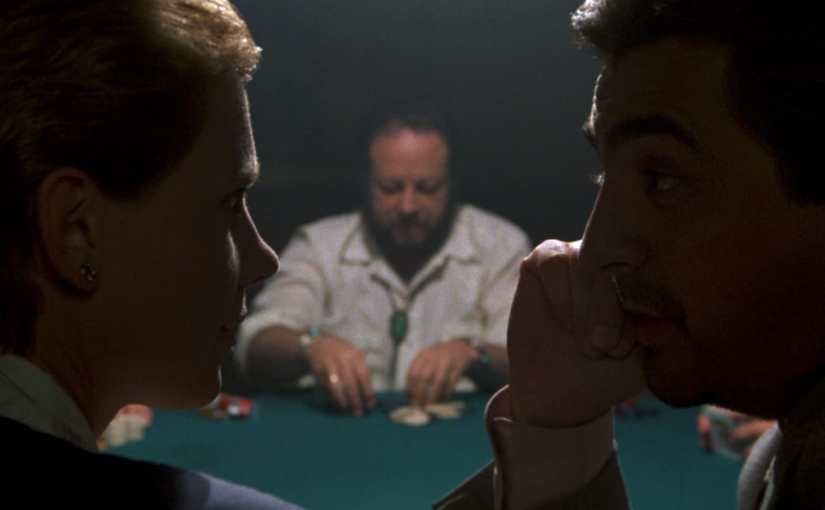
House Of Games plays like an instructional or “how to” video demonstrating how to be a successful con artist.  Crouse portrays a psychiatrist with a best-selling book titled “Driven” that focuses on obsessive behaviors.  One of her clients reveals that his compulsive gambling habits have put him $25,000 in debt with a card shark.  Crouse takes it upon herself to confront the card shark (Mantegna) on behalf of her frightened client.  Shortly thereafter, he’s got her acting as his wife to determine if the guy at the other end of a poker table is bluffing.  Then he’s introducing her to his con artist buddies, and she is becoming enamored, not only with him, but with the art of the con and the steal.  Her mundane life gives her the urge to see more.

The other Unpaid Critic, Miguel, recently reviewed this picture.  At the time of this writing, I have not read his review, but he forewarned me that the performances are stripped down to nothing.  Mantegna and Crouse are left bare to just delivering Mamet’s dialogue.  Miguel hadn’t liked this film the first time he saw it many years ago.  On my first viewing, this past week, I was engrossed.  However, I could foresee the ending as quickly as the film began.  I dunno.  Maybe it’s because I’ve seen several con artist films before like The Grifters and the granddaddy of them all, The Sting.  Films that focus on the best liars seem to always move towards a twist where even the viewer is scammed.  It’s fun to participate in the activity.

With House Of Games, the sequence of events move step by step.  Following the two characters’ introductions to each other, Mantegna is caught in the middle of doing another con but now he’s reluctantly forced to include Crouse in on the game.  This time it is seemingly much more complex and grander than the first time they worked together at the poker table.  It also gets all the more confusing when an unexpected murder is involved.  This con spells out a long night for the couple who are also falling for one another. 

Miguel is right.  The performances are most definitely stripped down and often the dialogue is wooden.  Crouse and Mantegna are deliberately flat.  I don’t even think they laugh or smile if I remember correctly.  It is likely because Mamet wants the viewers to follow along and pick up on how a successful con job is meticulous in its methods.  A con artist is not going to make waves with loud, angry monologues or passionate seductions and outrageous silliness.  What’s important is that everything that plays out seems convincing with no distractions that lead to doubt.  So, when the only African American in the cast (extras included) leaves a key on a hotel counter, you notice it.  It happened for a reason.  Later, when the characters come upon a BRIGHT RED Cadillac convertible, you are going to remember it.  A Swiss army knife with tropical artwork on the handle.  A gun metal briefcase with a large amount of cash.  A gun.  A murder.  Props and scenarios guide Mamet’s picture. Not the characters. 

Fortunately, the film remains very engaging.  As well, while I could figure out what was being played here during the entire course of the picture, as a viewer I had no choice but to feel proud of myself for uncovering the puzzles and riddles at play.  For me, watching House Of Games was like answering “Final Jeopardy” correctly when none of the contestants on screen had a clue. At least I was smiling by the end.

GREAT EXPECTATIONS (1946, Great Britain)

by Miguel E. Rodriguez

Director: David Lean
Cast: John Mills, Valerie Hobson, Jean Simmons, Martita Hunt, Alec Guinness
My Rating: 8/10
Rotten Tomatometer: 100%

PLOT: A humble orphan boy in 1810s Kent is given the opportunity to go to London and become a gentleman, with the help of an unknown benefactor.


Before moving on to full-blown epics like Lawrence of Arabia and Doctor Zhivago, Sir David Lean’s reputation was already assured with his small-scale masterpieces like Brief Encounter [1945], Oliver Twist [1948], and Summertime [1955], one of the finest Katharine Hepburn films you’ve probably never heard of.  Among these little gems is another Dickens adaptation, Great Expectations [1946], co-starring an impossibly young Alec Guinness.

Having never read the source novel nor, in fact, seen any of the other adaptations (there are at least five others, according to IMDb), I was able to go in “cold” with no preconceived notions or, ahem, expectations of my own.  What I found was a surprisingly engaging melodrama full of gothic overtones and the kinds of coincidences and contrivances that are rife in Dickens’ literature.  Yet they do not feel like contrived literary devices.  They feel like the kinds of coincidences, large or small, that populate our ordinary lives.  (I’ll bet the narrator at the beginning of Magnolia LOVED Dickens.)

The movie opens with a young boy, Pip, visiting the graves of his mother and father.  These opening scenes set the tone: dark skies, bare trees creaking in the incessant wind, and an unexpected encounter with an escaped convict who demands food and a file, for the shackles still hanging from his wrists.  Pip is terrified and complies.  Later the convict is captured and has the opportunity to give up Pip as one who aided a criminal, but in an oddly moving scene, he merely says he stole the food with no one’s assistance.

Later, Pip is introduced to the lovely young Estella (Jean Simmons in one of her earliest roles), who lives in a sprawling, decaying mansion owned by the eccentric old Miss Havisham (Martita Hunt).  Miss Havisham has summoned/hired Pip because it amuses her to watch children play, but more importantly because it also amuses her to watch Estella flirt with and continuously berate Pip as being a commoner, a blacksmith’s son, and someone who is otherwise unworthy of Estella’s affections.  The reasons for Miss Havisham’s cruel games may be guessed at by the dilapidated state of the wedding dress she wears day and night and by the crumbling, molding wedding cake sitting on a cobwebbed banquet table.  (Miss Havisham’s mansion is one of the creepiest gothic locations I’ve ever seen.  I half-expected the story to take a macabre turn, a la Edgar Allen Poe, with a deserting bridegroom rotting away under the floorboards or something.)

Time passes, and in the first of those melodramatic contrivances of which Dickens is so fond, Pip is granted the chance to go to London to become a gentleman.  His livelihood will be sponsored by a handsome annual stipend from an anonymous benefactor through a corpulent attorney named Mr. Jaggers.  (Dickens has some of the greatest character names in literature: Jaggers, Magwitch, Herbert Pocket, Uncle Pumblechook, Mrs. Whimple…I love it.)  Pip enters this new stage of his life assuming, as we all do, that his anonymous benefactor is none other than Miss Havisham.  Makes sense, right?

Through the course of this second act, Pip falls in love with the beautiful but heartless Estella, who warns him she has no heart and only seeks to conquer and discard her many suitors.  This is her way of expressing genuine affection for Pip.  Would Pip rather she do the same to him?

He also meets and befriends his London roommate and business partner, Herbert Pocket, played by an inconceivably young Alec Guinness in his first major screen role.  This was, as they say, the beginning of a beautiful friendship, leading to collaborations between Lean and Guinness on The Bridge on the River Kwai, Lawrence of Arabia, and Doctor Zhivago, not to mention Guinness’ very next role as the odious Fagin in Lean’s own version of Oliver Twist.

The rest of the story, involving Jaggers’ mysterious maid, a test of Pip’s loyalty, the identity of his benefactor, and the wholly unforeseen fate of Miss Havisham, I leave for you to discover.  It all ends, it seemed to me rather abruptly, but it is satisfying.

To fans of Lean’s more ambitious films, a small film like this one hardly seems as if it were made by the same director.  In today’s terms, it might be like watching a small character-driven film made by the Russo brothers (Avengers: Endgame, Captain America: Civil War, etc.).  In his Great Movies Review for this film, Roger Ebert points out the difference between these two stages of Lean’s directing style:

“[Lean] was an editor for seven years before directing his first film, and his career stands as an argument for the theory that editors make better directors than cinematographers do. …What the earlier films have is greater economy, and thus greater energy, in their storytelling.”

Indeed, Great Expectations hurtles along breathlessly, not as quickly paced as a Marx Brothers comedy, but certainly without wasting a single moment on anything that is not necessary to move the story along, or at least provide just a small dash of character or color to the proceedings.  (One of my favorite small touches was the gruesome death masks hanging on the wall of Mr. Jaggers’ office.  For me, it was a kind of foreshadowing, alluding to the possible fate of the convict Pip encountered at the beginning of the film.) In his later epics, Lean’s pacing slows down in favor of presenting the viewer with grand desert or mountain vistas, so instead of watching a play, it feels like we’re at a museum. This isn’t a bad thing. It’s merely a different style of storytelling.

There is another, perhaps more famous, adaptation of Great Expectations out there, by the famed Mexican filmmaker Alfonso Cuarón, starring Ethan Hawke, Gwyneth Paltrow, and no less than Anne Bancroft as Miss Havisham, renamed Ms. Dinsmoor in this version.  It was updated to present day, some other character names were changed, and it is supposedly drenched in atmosphere.  I have yet to see it.  Until I do, Lean’s early masterpiece will remain my favorite version of this timeless tale, abrupt finale and all.

HOUSE OF GAMES (1987)

by Miguel E. Rodriguez

Director: David Mamet
Cast: Lindsay Crouse, Joe Mantegna, J.T. Walsh, Ricky Jay
My Rating: 8/10
Rotten Tomatometer: 96%

PLOT: A psychiatrist is led by a smooth-talking grifter into the shadowy but compelling world of stings, scams, and con men.


I’m sitting here trying to figure out how to summarize the story of David Mamet’s House of Games without giving away plot points, and it’s virtually impossible.  Mamet’s screenplay is composed almost entirely of double-crosses, triple-crosses, short cons, long cons, and the kinds of surprises that are greatly diminished in their description.  Remove one surprise, and the whole thing collapses like a house of cards.

A distinguished psychiatrist, Margaret Ford (Lindsay Crouse) pays a visit to a handsome con artist, Mike (Joe Mantegna), on behalf of one of her clients, who is distraught because of how much money he owes to Mike.  Dr. Ford is unexpectedly intrigued by Mike’s business methods, Mike senses this, and takes her to a back room where he and some other gentlemen are playing poker.

(These men don’t talk much, but when they do, it’s almost exclusively in poker patter.  “A man with style is a man who can smile.”  “Damn cards are as cold as ice.”  “The man says you gotta give action to get action.”  “Everybody stays, everybody pays.”  It’s like they learned how to talk from watching endless episodes of the World Series of Poker on ESPN2.)

Mike makes a deal with Margaret: if she helps him beat the hot player (Ricky Jay) at the table, he’ll tear up her patient’s marker.  The hot player has a tell when he’s bluffing.  Mike will go to the restroom.  If the hot player shows the tell, Margaret will tell Mike, and Mike will beat him because he’ll know he’s bluffing.  Mike goes to the bathroom, the hot player reveals his tell, and Margaret tells Mike when he comes back.  The hot player raises the pot, but Mike can’t cover it.  Margaret comes to the rescue: she’ll stake Mike with her own money.  But, uh oh, turns out the hot player wasn’t bluffing…and now Margaret owes $6,000 to a total stranger.

And that’s where I have to stop. If you think I’ve given too much away, you’ve got to trust me – I haven’t.  That’s barely the preface.  What follows is a character study of a woman who suddenly realizes that, after a lifetime of helping patients, she needs some kind of release, a change in routine.  Mike can provide this much-needed change.  The fact that it involves conning innocent people out of their hard-earned money is incidental.

Her fascination lies in Mike’s method.  For a great con to work, you can’t take someone’s money.  They have to give it to you.  They have to trust you to do the right thing.  The trick is working out how to gain the other person’s confidence without them realizing what’s happening.  We are shown two or three examples, and they’re all brilliantly sneaky.  At one point, Mike tells Margaret the cardinal rule of the con: “Don’t trust nobody.”  After watching this movie, I can’t say I agree 100% with this credo, but a healthy dose of skepticism never hurt anybody.

So how does Margaret square that credo, or anything about Mike’s lifestyle, with her profession?  She helps people for a living.  Her livelihood depends on getting strangers to trust her, but not to take their money…although let’s not forget she is well paid for her services.  Is her fascination with Mike an acknowledgement of the similarities between the two of them?

The screenplay doesn’t provide easy answers.  When we get to the final shot of the film, we can clearly see the choices Margaret has made, but it’s still unclear as to why she made them.  This is one of those movies where the complexities only really come alive during lively discussions afterwards.

Before watching it for this review, the last time I had seen House of Games was over thirty years ago.  At the time, I was unimpressed.  I originally gave it a 2 out of 10 on the IMDb website.  It was slow, the actors looked like they were giving bad performances, and nobody talked like real people talked.

Since then, I’ve had the opportunity to see not one, but three films by a French director named Robert Bresson.  (Bear with me here, I do have a point.)  Bresson, who was active mainly in the ‘50s and ‘60s, was famous for his method of shooting scenes over and over again, take after take, until all emotions had been drained from the actor.  His philosophy, in a nutshell, was that, in a film, the story isn’t everything, it’s the only thing.  If a screenplay couldn’t carry an emotional impact just by virtue of the story alone, if he had to rely on someone’s specific performance to make the movie work, he wasn’t interested.  The results are films that are curiously compelling, despite their utter lack of anything modern audiences might recognize as a typical acting performance.  His films are routinely included on the most prestigious lists of greatest films ever made; seven of them made it onto the 2012 critics’ poll by Sight & Sound magazine, a feat unequaled by any other director.

Sitting down to watch House of Games for the first time in three decades, after having seen Bresson’s films for the first time, I think I see what David Mamet was going for, in this, his directorial debut.  The actors aren’t quite dead-panning the entire time, but their performances (with one or two necessary exceptions) are pared down to the bare minimum of emotion.  Vocally, they’re angry, curious, flirtatious, what have you.  Facially, they’re ciphers.  Which, if you’re a good con man, that’s exactly what you want to be: a blank slate for the unlucky mark to interact with, then forget immediately.

I think back to those poker players and their mournful aphorisms, always said in nearly monotone.  And then I think to the film’s finale when Margaret believes she might be able to turn the tables on Mike (long story), and as the frantic words come out of her mouth, there’s not a smidgen of emotion on her face.  Like…a poker player.  Neat.

ALL ABOUT MY MOTHER (1999, Spain)

by Miguel E. Rodriguez

Director: Pedro Almodóvar
Cast: Cecilia Roth, Marisa Paredes, Penelope Cruz, Antonia San Juan
My Rating: 8/10
Rotten Tomatometer: 98% Certified Fresh

PLOT: A single mom fulfills her son’s last wish by going on a search for her estranged husband, whom she has not seen since before her son was born.


Whatever you might think personally of director Pedro Almodóvar’s films, you can’t say he doesn’t have range and/or versatility.  In one of his previous films, Women on the Verge of a Nervous Breakdown [1988], he takes potentially dark material (a suicidal woman’s quest to find out why her lover abruptly left her) and turns it into farce (police officers accidentally eat drug-laced gazpacho intended for another suicide attempt).  In All About My Mother, winner of 1999’s Oscar for Best Foreign Film, Almodóvar takes potentially farcical material (a mother searches for her estranged husband, who happens to be a transvestite named Lola, and makes friends with a pregnant nun) and turns it into solid, albeit soapy, melodrama that is rather unique in its matter-of-fact treatment of its transvestite characters and situations.

Manuela (Cecilia Roth), a single mother and part-time actor, takes her teenaged son, Esteban, to see a local production of A Streetcar Named Desire in Spanish.  (The night before, they watched All About Eve together, so she’s clearly teaching him right.)  Esteban is so taken with the performance of Huma Rojo (Marisa Paredes), the lead actress playing Blanche, that he waits outside the stage door to get her autograph.  Huma absently gets in a cab and drives away, Esteban runs after her, and is struck dead by a car in traffic.  In a scene of poignant irony, Manuela must sign some official forms to release her son’s body as an organ donor, just days after portraying a grieving mother in a hospital video about…becoming an organ donor.

Manuela discovers her son’s journal in which he is literally writing all about his mother, and he mentions his sadness because he never knew his father, and his mother has told him nothing about his father his entire life.  So begins her quest to locate the long-lost father, whom she refers to as either Esteban or Lola, depending on the context.

After she travels across Spain to Barcelona, her first encounter is with an old friend, a transvestite hooker named Agrado, which roughly translates to “liking” or “agreeable.”  Agrado helps Manuela find a job through the social services of a nunnery, where they meet Rosa (Penelope Cruz), a nun dedicated to assisting hookers of all sorts escape their scandalous lives and find wholesome work elsewhere.  Rosa talks about leaving soon to go to El Salvador to assist in similar work there…but alas, she soon finds out she is pregnant herself.

Meanwhile, Manuela also connects with Huma, the actress whose autograph her son was seeking.  Soon she is hired as an assistant and even, through circumstantially suspicious events, manages to appear onstage as an emergency substitute for Nina, the actress portraying Stella, who is also having an on-again/off-again fling with Huma…

And so on and so on.  At times, All About My Mother feels a little too much like a telenovela, those famous Spanish-language soap operas whose plotlines pack more melodrama into one episode than Dynasty did in an entire season.  But as wacky as the situations got, the movie never gets out of hand, so to speak.  It never wallows in the trashy elements, like a John Waters or Russ Meyer movie, for example.  It simply presents the situations, and the characters face it, deal with it, and move on with their lives.  If I find the situations trashy or overly sensational, that’s my problem, at least in Almodóvar’s world.

That’s one of the charms of this film.  There is a running gag where Agrado, the transvestite hooker – pre-op, by the way – gets hit on by both men and women, and neither gender seems to care about her seemingly incompatible sets of equipment, if you get my drift.  (The guy even offers to do to her what she would normally do to him.  I don’t remember the exact line, but at one point the guy says something like, “Hey, if you think it will relax me, I’ll try anything.”)  In virtually any other movie, that scene would be milked for laughs, or it might be the defining scene for the Agrado character.  But instead, it showcases the…I’m not sure what word I’m looking for here…the “non-issue” attitude that everyone in the movie has to transvestites, gays, lesbians, or any other sexual orientation that might otherwise be a distraction in most American films.  Manuela’s husband is himself a transvestite hooker.  Okay, she accepts it, everyone accepts it, even Rosa the pregnant nun accepts it, and let’s get on with the story.

There is a remarkable scene where Agrado has gotten a job as an assistant to Huma, the actress, and for various reasons a performance has to be cancelled.  Agrado goes in front of the curtain, informs the audience, and offers to tell her life story as compensation for anyone who wants to stay.  She proceeds to itemize every bit of cosmetic surgery she has had done to herself in the past few years in order to become…herself.  Eyes, nose, breasts, jaw reduction…all so she can be more authentic.  “And one can’t be stingy with these things, because you are more authentic the more you resemble what you’ve dreamed of being.”

And then the movie moves on.  It’s a bravura moment that might have been the centerpiece of another film, but in this one, it’s just a dash of character color that deepens everything around it.

I should also mention the lighting style throughout nearly the entire film.  On a few occasions, we are treated to scenes from that stage production of Streetcar, and we clearly see the theatrical lighting.  But in many, if not ALL interior scenes throughout the rest of the movie, the lighting is roughly similar to that of a stage production, or maybe a TV production.  Nothing is lit like I have come to subconsciously expect.  Instead, it all has a kind of heightened reality to it, or maybe “un-reality”, which paradoxically makes it more engaging to watch instead of being distracting.  I think I’m being a little contradictory, but it’s the best description I can provide.

Pedro Almodóvar has been directing shorts and feature films since 1974 and shows no signs of slowing down.  I can’t promise I’ll eventually watch everything he’s ever done, but of the two films of his I’ve seen, this one is my favorite so far.  There’s an abundant love of theater, theatricality, and especially for his characters in his work.  You or I may not like all of them, but he doesn’t seem to care.  Almodóvar seems to be arguing there is humanity in everyone, not exactly a groundbreaking message, but certainly one that was still not widely accepted, even as recently as 1999, and even less so today, unfortunately.  He’s saying, “Look at someone, and don’t see their differences.  See them.  And get on with your life.”

ARRIVAL (2016)

by Miguel E. Rodriguez

Director: Denis Villeneuve
Cast: Amy Adams, Jeremy Renner, Forest Whitaker, Michael Stuhlbarg
My Rating: 9/10
Rotten Tomatometer: 94% Certified Fresh

PLOT: When 12 alien spacecraft descend to Earth at seemingly random points around the globe, a linguistics expert (Adams) is recruited to interpret the aliens’ speech in order to find out why they are here, among other things.


“If you could see your whole life from start to finish, would you change things?” – Louise Banks (Amy Adams), Arrival

That seemingly simple question lies at the heart of Denis Villeneuve’s sci-fi brainteaser, Arrival.  Surrounding it is a film of uncommon grace, beauty, and intellectual stimulation that deserves comparison to Kubrick’s 2001 or Tarkovsky’s Solaris.  When I first saw it in 2016, I’ll admit to some slight confusion at the end, but after many repeat viewings, I believe I understand it fully enough to call it a masterpiece.

After a prologue where we witness a montage of her losing a daughter to an unnamed but ravaging disease, we see Dr. Louise Banks (Amy Adams) teaching linguistics at a university.  Classes are interrupted when news breaks of not one, but TWELVE alien spacecraft suddenly appearing at random points around the globe.  Eventually, the military contacts her and reveals that contact has been made between us and the aliens, but to say we can’t comprehend their language is an understatement.  She and a top-notch mathematician, Ian Donnelly (Jeremy Renner) are flown to the US sites in Montana and are given an impossible task: decipher the alien language and ask them why they’re here.

The design of the aliens and their ship are visual masterstrokes.  The ship, in fact, bears a striking resemblance to the famous Cloud Gate sculpture, aka “The Bean”, in downtown Chicago.  (Google it if you’re unfamiliar with it.)  But imagine it standing vertical on end, matte gray-black instead of chrome, and hundreds of feet tall.  Ominous and delicate at the same time.  The aliens themselves…well, I won’t spoil it for anyone who hasn’t seen it, but I will say they are called “heptapods” by the scientists.  Seven legs.  Cool.

The US researchers and military are connected via satellite to every other landing site around the globe, each attempting to make a communications breakthrough, but it’s Dr. Banks who realizes the aliens may have a form of written communication.  Using a whiteboard and simple words at first, she can have very limited conversations with the heptapods.  But when Banks is finally able to ask the all-important question, “Why are you here”, the answer she gets throws the military and government representatives into a tizzy and they cut off all communications to the other landing sites.

Meanwhile, Dr. Banks has periodically been having extremely vivid visions or memories of her daughter at random moments.  At one point, she is struggling to remember the scientific term for a “win-win” situation, and the memory comes back to her in a flash from a previous conversation with her daughter.  Although it is odd that we hear the term first in the present, and then she remembers it in the past…but enough about that.

Arrival may strike some as slow and plodding.  I suppose they’re right, in a sense.  It lacks any of the deliberately manipulative editing of, say, a Spielberg or a Scorsese film, where the cuts are specifically designed to grab the audience member by the collar and propel them to the film’s high and low points.  By contrast, Arrival takes its time.  It stands back and presents us with all the information we need to really, actively watch the film and work those brain cells.

[The score of Arrival deserves special mention.  In a film whose story arc involves linguistics and translations, it’s appropriate that, at key moments, the score includes multiple human voices harmonizing in ethereal chords or pulsing in a rhythm that sounds utterly alien, not just foreign.  A brilliant touch.]

What gives Arrival that extra push is that question Dr. Banks asks at one point in the film.  “If you could see your whole life from start to finish, would you change things?”  This question, when it comes, has poignant undertones that were not even hinted at in previous scenes.  And I find it to be incredibly moving, every time.  In fact, I wonder if I’m not really the prime target audience for this movie.  I wonder if it’s most effective for people who have lost loved ones to disease or accidents – untimely, unbearable deaths.  For those people, I cannot even begin to imagine how they would answer, or if they agree with Dr. Banks’s answer to her own question.

For myself, I have been blessed in this life, knock wood.  I have lost family members, but mostly to old age, although two uncles were taken by cancer in their fifties and sixties.  But I found myself thinking about this question today more than any other time, for some reason.  If I could magically go back in time, while retaining all my current knowledge, would I change things?

It’s deceptively easy to say “yes”, especially when it concerns the big things.  Sure, I would probably not stay as silent as I did when I learned a dear friend was being molested in high school and college.  No, I would probably not have gotten romantically involved that one time with the absolute wrong person.  No, I would most certainly not have skipped work that one day to see Spider-Man 3.  I would have remembered my driver’s license that one time I was pulled over.  I would have rearranged my schedule to go with my father and sister to Spain that one time.  And on and on.

But…if I hadn’t done some of those things…I may not be where I am now.  In a wonderful relationship with my best friend.  Working at a job that has its challenges but is rewarding and accommodating enough for me to do theater.  Surrounded by a support structure of friends that is second to none.  Able to leap tall buildings in a single bound.  Just kidding.

Your answer may differ from mine, or from Dr. Banks’s answer in the film.  That’s fine.  We all have our own reasons for our own answers to that question.  What’s wonderful about Arrival is its ability to couch that existential question in a top-notch sci-fi drama that, in its own unflashy way, is every bit as exciting and though-provoking as ten Independence Days.  It looks great, sounds great, acted great…what more could I ask for?

THE BATMAN (2022)

By Marc S. Sanders

Another year at the movies, means another trip to see Batman on the big screen.  I think we are close to a dozen iterations, no?  Fortunately, the latest reinvention for March 2022, The Batman, is a refreshing interpretation that focuses on the detective skills of the masked vigilante hero who prowls from the rooftops of Gotham City.  Matt Reeves has written and directed a gripping and engaging film that doesn’t rely on simple paint by numbers.  He’s capitalized on using the mysterious Riddler (Paul Dano) as the main villain here, and Batman’s (Robert Pattinson) brains get more exercise than his brawn.   

It is the second year since Batman has introduced himself to the crime ridden city.  The man behind the mask, Bruce Wayne, keeps a journal of his exploits and observations, and through voiceover he questions if his actions have benefitted since it appears that crime has only increased since his first appearance.  A serial killer is taking responsibility for the grisly deaths of important people within the city and he’s leaving greeting cards for “The Batman” with a common scribble of “No More Lies,” along with a “?,” and a riddle for The Batman to solve.  Thanks to a strong partnership with Police Lt. Jim Gordon (Jeffrey Wright), Batman is given easy access to the crime scenes so he can attempt to reveal the mysterious villain and determine exactly what his endgame is. The Riddler doesn’t make it easy, though.

Mobsters like the Penguin (Colin Farrell) and Carmine Falcone (John Turturro) have a grip on the city, as well.  There’s also a possible lead from a woman (Zoe Kravitz) who’s managed to infiltrate the gangsters’ underground headquarters.  She also has the fighting skills and agility that’s comparable to the caped crusader, and maybe she’s a cat burglar as well.  Still, is she pertinent to Batman’s investigation or not?

It’s better not to spoil anything that occurs in Reeves’ film.  The mysteries that are uncovered are part of the fun, and it does take some time and exposition to get there, but I found it worth it.  Barring a few ingredients within the film that I recognized from the Christopher Nolan and Tim Burton films, the picture is worth seeing for a new formula on a character, that although is a favorite of mine, I feel has also been done to death on the big and small screens.  This is a Batman film where I appreciate the thinking approach of its craft, over the action.  When Batman is playing detective with Jim Gordon, it is much more enticing than just another Batmobile chase or another ham-handed fist fight.  This film is a test of Batman’s mental capacity and ability for analysis.

Reeves direction is also appreciated, though I’m expecting the naysayers.  The Batman is a very dark motion picture.  When it’s not dark, the photography is dim and blurred.  There’s lots of rain and dimly lit streets and garages.  There are strobe lit nightclubs.  Windows are blurred, so sometimes you can’t make out the image in front of you.  He makes the viewer work for the focus and that kept me alert.  I believe Matt Reeves was attempting to give the viewer the literal point of view of the characters.  It will not be a surprise, however, to find some movie watchers lose patience with the technique. 

The Riddler especially is most mysterious with a twisted and inspired Zodiac killer approach.  Often, Matt Reeves’ film feels especially reminiscent of David Fincher’s Seven.  I would not be surprised if Reeves wrote his script as a cop/detective story, and then added the Batman flavor to make his final draft.  This is not a picture of grand special effects or superpowers and gadgets. 

It’s definitely not the Batman film that everyone wants.  I foresee the response being very divisive.  Nonetheless, if you’re a Batman devotee like me who grew up on the character in the macabre storied comics (as well as the hammy tongue in cheek material), you’re going to be thankful for this “at last” interpretation.  I’ll definitely be seeing it again.

NOTE: The Batman is not a film for children under age 13. I truly believe that. There are disturbing images and threats within the story, and the violence depicted or left to the imagination is not for celebratory effect and amusement. This is definitely a film for mature audiences. Do not presume it’s meant for all ages based on its misleading marketing approach with companies like Legos and Little Caesars pizza.

THE QUIET MAN (1952)

by Miguel E. Rodriguez

Director: John Ford
Cast: John Wayne, Maureen O’Hara, Ward Bond, Victor McLaglen
My Rating: 6/10
Rotten Tomatometer: 91% Certified Fresh

PLOT: A retired American with a secret in his past returns to the village of his birth in 1920s Ireland, where he falls for a spirited redhead, whose brother is contemptuous of their union.


John Ford’s The Quiet Man won two Academy Awards, one of them for Ford himself as Best Director, his fourth Oscar in that category, a feat which has yet to be equaled by any other director since.  It is on the National Film Registry, on the AFI’s list of “100 Years, 100 Passions”, and is included in the invaluable annually updated book of 1001 Movies You Must See Before You Die.  It currently carries a 91% Certified Fresh rating on the Rotten Tomatoes website and is JUST outside of the IMDb’s top 250 most highly rated films.

(And, as movie nuts will be happy to tell you, this is also the film E.T. is watching on TV when he’s drunk at home and Elliot is at school with the frogs…)

I mention all of this because I want to stress the amazing “pedigree” of The Quiet Man, a film which many have called John Wayne’s finest, one in which the familiar Wayne swagger is on display, but without the kind of Western bravado that was so integral to his success in the movies.  Yet, despite this rather impressive list of accomplishments, The Quiet Man is not quite as timeless as I hoped it would be.  It’s a relic of romantic attitudes that went out of style with the sexual revolution, the Me-Too movement, and – I’ll just say it – common sense.  It has its moments, of course, but aside from one genuine laugh-out-loud moment and a fistfight for the ages, it’s a bit of a chore.

John Wayne plays Sean Thornton, a man looking to escape his past by reconnecting with Ireland, the land of his birth, some time in the 1920s.  In the process, he falls madly in love with Mary Kate Danaher, a fiery-headed and fierce-tempered lass played by Maureen O’Hara.  Such is the chemistry between these two lovebirds that when they first lay eyes on each other, the normally stoic Mary Kate can barely walk ten feet before turning back to stare at Sean’s goofy grin…once, then twice, then THREE times.  Sean asks an old friend, “Hey, is that real?  She couldn’t be…!”  Yeah.  They talk like that all through the picture.

Anyway, one thing leads to another, and they start courting.  But Mary Kate’s elder brother, Will (played by Victor McLaglen with a face that looks like it was put together by a committee of blind men), is against their union because Sean plans to buy a parcel of land he’s been angling to get for himself.  And because this is the ‘20s, the elder brother’s word is law, so no romance for Sean and Mary Kate.  Until, that is, the townsfolk intercede on behalf of the lovebirds.  Small village, you know…the kind where everybody’s private business is an open secret.

The rest of the story is fairly predictable.  Marriage, Will still objects, a new home, the bride’s determination not to consummate the marriage until she gets her dowry, the false crisis, the big fight between Sean and Will at the climax, and so on.  The movie rises and falls on the chemistry between Sean and Mary Kate and the obstacles to their happiness.  Some formulas are old because they still work, and it is competently exploited in The Quiet Man.

For me, though, I must be honest and say that I was never quite engrossed in the story and atmosphere as I would have hoped.  For one thing, John Ford shot much of the film on location in Ireland, an extravagance not commonly indulged in during the 1950s.  However, there are insert shots here and there that were obviously staged and filmed on a studio set.  They are so obvious they became a distraction, something that has never really bothered me in other films of that era.

For another, the attitudes between men and women in The Quiet Man are hopelessly dated, so much so that I’m surprised this film still enjoys such a high rating on IMDb.  For example, there’s a famous scene where Sean intercepts Mary Kate as she’s about to leave on a train because Sean won’t ask her brother for her dowry.  Sean pulls her from the train and drags her home.  Literally drags her.  As they cross a green field, Mary Kate loses her balance and falls, but Sean barely breaks stride, and she is pulled along the grass like so much flour in a sack.  [The making-of documentary on the blu ray reveals the field was littered with sheep droppings which were not removed at Ford’s insistence.  Ah, showbiz.]  One of the female townsfolk witnesses the scene and yells to Sean: “Sir!  Sir! …here’s a good stick, to beat the lovely lady!”  Say what???

Now look: I’m not advocating for “cancellation” of The Quiet Man.  I’m just saying that you should be warned.  It’s a product of its time as much as Gone with the Wind or Some Like It Hot, full of attitudes and jokes that could never be filmed today except as parody or satire.  I get that, intellectually.  For the sake of this story (there’s a lot I’m leaving out), this scene was a necessary beat so Mary Kate could be finally convinced of Sean’s love and determination, equal to hers in every way.  But scenes like that are so glaring that they took me out of the story, and eventually all I saw was this bully who was pulling this poor woman across poop-littered grass.  What can I say.

Now.  Having said all that…I must admit there is one scene that had me laughing out loud at its daring.  It’s so forthright and downright bawdy, I’m frankly amazed it was allowed to make it into the film at all.  I was about to write a full description below with SPOILER ALERT at the beginning, but I won’t.  It involves a misunderstanding between the local matchmaker and broken furniture.  You’ll know it when you see it.  It was such a risqué joke that theaters in Boston edited it out of their film reels when it was released.  I laughed out loud pretty dang hard.

That brilliant joke aside, The Quiet Man is a serviceable film, showcasing two stars, Wayne and O’Hara, at or near the height of their powers, but who are at the mercy of a melodramatic script that is nearly a parody of itself.  I’m not sorry I watched it, you understand.  It’s a piece of Americana as ingrained in cinema history as Singin’ in the Rain.  But on the whole…I would rather watch Singin’ in the Rain for the fiftieth time than watch The Quiet Man again.  At least, not so soon.  Maybe in a few years.

MARGIN CALL

By Marc S. Sanders

Could it have been possible that a rocket scientist and a bridge engineer uncovered one of the biggest market crashes in American history?  Writer/Director J.C. Chandor’s first film, Margin Call, will have you believe that.  It makes sense when you think about it.  Numbers and bar graphs and pie charts and zig zagging lines become so complex with themselves that you have to wonder how people wearing $1500 designer suits and selling products over the phone could decipher such nonsense.  So, it would take a rocket scientist to unravel such an exceedingly large ball of rubber bands in only one night.  Yet, how does a rocket scientist and a bridge engineer come to encounter this predicament.  Easy.  It’s all about money.  You might be the greatest scientist in the world, but if the pay isn’t right, is the science really worth it? 

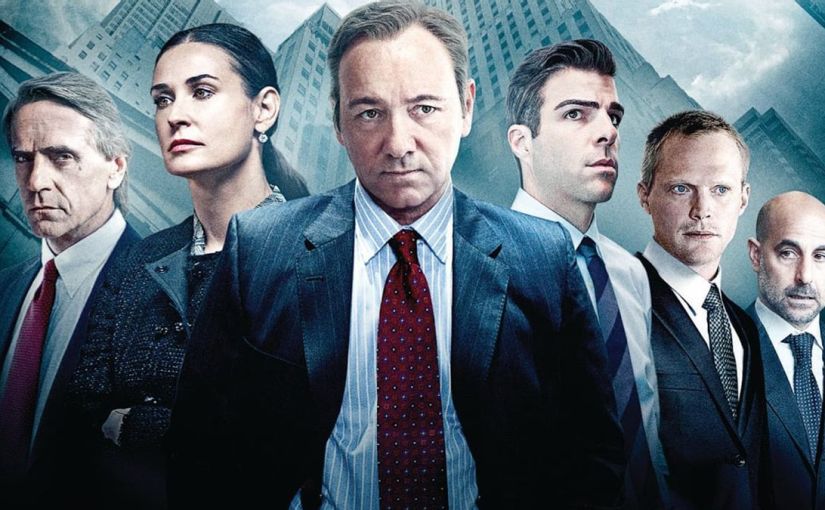
Zachary Quinto plays Peter Sullivan, the rocket scientist from MIT.  Stanley Tucci plays Eric Dale, the bridge engineer.  They abandoned their college majors and specialties to go where the earnings are much more lucrative.  They both work in the risk management department for a large, unnamed New York investment bank.  On a Thursday afternoon, along with a whole slew of other people, Eric is fired.  His company cell phone is immediately shut off and he’s escorted quickly out of the building along with his personal belongings.  Before he leaves, he’s able to pass off a computer file for Peter to have a look at.  Eric was close to completing something deeply impactful, but didn’t get a chance to finish.  When Peter stays late after work to download the file, a stunned look eventually appears across his face, and he’s quickly calling back his workmates at 10 o’clock at night.  Those guys were getting hammered at the nightclub downtown, celebrating that they were not on the chopping block earlier in the day.

The cataclysmic results of Peter’s discovery is first passed on to his buddy Seth (Penn Badgely), then to the next level up which is Will Emerson, supervisor of trading (Paul Bettany).  Will then tosses it over to the higher risk supervisor, Sam Rogers (Kevin Spacey), who then passes it on to the Jared Cohen (Simon Baker), maybe the company’s second in command.  Jared assembles the men to meet with Sarah Robinson and Ramesh Shah (Demi Moore and Aasif Mandvi), who compute risk at even high level. 

Chandor is so genuine with his script and characters that as the earth-shattering news gets shared and then shared again and again, each higher up the food chain demands that it be explained to them in simple English.  By the time, Jared passes on this news to the head, HEAD Honcho, John Fuld (Jeremy Irons in a thankfully scene stealing performance), it is being requested of Peter to speak to John as if he were a golden retriever.  I guess in the corporate world, the sharper your clothes and hairstyle are, as well as the more formal your position title is called, the simpler the explanations need to become.  The ones who earn the big bucks don’t sit on the top floor to be belabored with charts and graphs that lack prestige and personality.

I want to point out a symbolic sequence here as well.  Each higher up seems to work on a higher floor than the other.  So, Seth and Peter accompany Will and Sam up an elevator to where Sarah, Ramesh and Jared are located.  After this meeting, Seth, Peter and Will go up on the rooftop of the building to smoke and commiserate.  Will even considers jumping.  They are then interrupted from an even higher level beyond the pinnacle of the building.  A helicopter arrives with John in tow.  God has descended at this inconvenient hour to tend to his prophets and their disciples.

Margin Call might sound like a complex assembly of numbers and math.  It really isn’t though, because Chandor approaches his film without ever really giving away how complex the issue is.  Instead, he demonstrates how deep it is.  Sam focuses on a computer screen and asks “Wait, is that number right?”  Peter’s nervousness is enhanced with his hands laced behind his head as he paces back and forth.  Will has been chewing on Nicorette gum up to this point.  Midway through the film, he’s back to smoking.  Seth understands that the mass firing he just survived hours earlier will inevitably catch up to him and all he can do is cry on the toilet.  Sarah comforts herself by asking Peter if the report he’s laid out is his work.  She wants to be excluded from being a cause of the crisis.  The best indicator of how serious and intense this has become is when an ice cool looking and handsome Simon Baker (even the blue tie he wears says icy cool) as Jared asks for the time.  It’s 2:15am.  He mutters to himself “Fuck me,” and then asks again for the time.  It’s 2:16. “Fuck me,” with a leap off the chair and a distant stare out the window.

The nature of the problem isn’t so important to grasp.  What’s necessary to take away from Margin Call, is that the gods of currency have irresponsibly and deliberately neglected the warning signs.  The returns have just been too damn good.  Now the boat has taken on too much water to stay afloat, though.  Chandor opts to focus on the response and behavior to the dilemma at hand.  There’s whispered blame to be exchanged.  There’s the need to stay silent.  When Jeremy Irons eventually comes into the fold, he holds a board meeting and calmly asks for someone to explain the situation.  Chandor points his camera on concerned close ups of middle age men not willing to speak up; messengers who truly believe they’ll be killed for delivering the dire news.  Even Jared can’t speak.

The sad outcome of the film is actually how the crash of 2008 with Collateralized Debt Obligations and Sub Prime Mortgage Defaults (see Adam McKay’s The Big Short) played out on the eve of its first day.  The investment bank in the film opts to sell off its worthless assets that enormously exceed the entire net worth of the billion-dollar company.  Chandor’s film reminds us that it’s legal to do so, and the buyers of this “odorous bag of excrement,” are John and Jane Q. Public.  At 9:30am, these brokers will put on the charm and sell at a price of $100/share knowing that by 2:00pm, it’ll be worth .65 cents/share, if they’re lucky.  Their customers paid for porterhouse, but went home with a cold burger in a doggy bag.  It’s the only way to survive. 

There are no heroes in Margin Call.  There are only profit makers.  Profits that are earned at the expense of everyone else on the planet.

BATMAN: MASK OF THE PHANTASM

By Marc S. Sanders

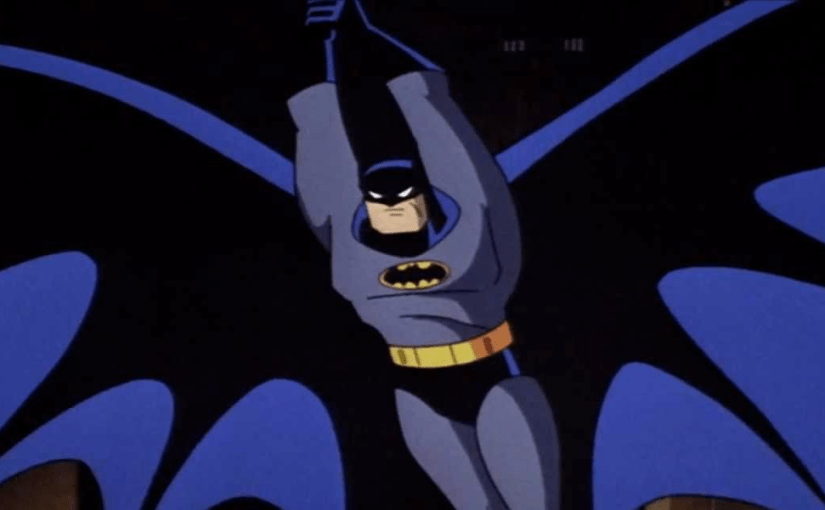
Batman: The Animated Series from Warner Bros was a hallmark in telling more mature stories that could still appeal to kids, but adults as well for the superhero genre. Due to the show’s success, following the release of Tim Burton’s successful live action films, the animated series spun off a film of its own for the theatrical medium, and it works.

Subtitled Mask Of The Phantasm, Batman finds himself to be the blame for some vigilante murders of high-ranking mobsters in Gotham City. Turns out there’s another shadowy caped figure causing the mayhem.

At the same time, Bruce Wayne (Kevin Conroy) is reunited with an old flame (Dana Delany) who has returned. Their history is told in flashbacks, and it could pertain to the appearance of this Phantasm. The Joker (Mark Hamill) is causing interference as well.

The animators and writers for Batman: Mask Of The Phantasm take their film completely seriously. From a story perspective, there are plot developments at stake along with the colorful cast of characters. Batman especially looks great as does his cave, Batmobile, Bat Cycle and Bat Plane. The Art Deco settings of Gotham City’s skyscrapers, and broad angles that enhance the vastness of the city are completely immersive. The voices work too.

The movie certainly ranks better than the Joel Schumacher Batman films, and at least just as good as Tim Burton’s second effort with the Caped Crusader, Batman Returns.

Batman: Mask Of The Phantasm is a great adventure steeped in mystery and big surprises. I really liked it.

PHANTOM THREAD

By Marc S. Sanders

I remember how much I loved Anderson’s 90s films Boogie Nights and Magnolia as well as the hauntingly genuine There Will Be Blood. (Let’s not talk about Punch Drunk Love.) Still, I never expected to like Paul Thomas Anderson’s Phantom Thread, but as soon as it began, I fell in love with it.

Daniel Day Lewis plays a perfectionist dressmaker adept at using women at his behest to sustain and elevate his craft. He’s a ruthless, maybe bipolar, villain and he will remain as one of cinema’s best actors for at least the next hundred years.

Anderson doesn’t just show his characters. He shows their specialties whether it’s dressmaking, porn, show biz or oil. The industry is its own character. Here he masterfully depicted the industry of clothes making.

Anderson offers a convincing education in dress design and fabric construction with the details and measurements it requires. Swatches of fabric never looked sexier amid a mid 20th century European backdrop. The dialogue is uncompromising in its humor, craft and cruelty both from and to its characters.

The ending was very obscure and strange though. Thankfully it happens quickly and is not dragged out, otherwise my opinion might be different.

This Best Picture nominee from 2017 is definitely worth a look.