TEACHERS

By Marc S. Sanders

I grew up watching the television show M*A*S*H with my mother and brother.  Don’t hate me but I have yet to see the Robert Altman film.  Perhaps that is because I was afraid of major disappointment.  The formula for many of the episodes and seasons of the TV show work so well at blending tidbits of comedy within a setting that is nothing else but bloody turmoil.   For those characters to survive required all of them to laugh and lampoon into the face of an uncontrollable situation where their lives could end at any time while they live in misery.

These thoughts came back to me as I watched an unsung and forgotten film from 1984, Teachers directed by Arthur Hiller.  John F Kennedy High School is only going in one direction which is very far south beyond the gates of hell.  A gym teacher is getting students pregnant, a kid shows up at the principal’s office with a stab wound in the arm, and the school psychologist has just lost her marbles because the old fart tenured teacher hogs the ditto copy machine (Remember those?  You could get high off the ink on the paper.).  A mental patient has managed to worm his way into a comfortably welcome substitute teacher position.  The driver’s ed car has been stolen and one student terrorizes another teacher in an assortment of ways beginning with biting and then moving on to theft.

Alex Jurel (Nick Nolte) is the admired social studies teacher who has lost his passion for the profession.  It’s not so much that the student body or the teaching staff is out of control.  The whole administration has taken to a new mentality of profit over proficiency.  The merits that come with an education are all but dismissed.  The assistant principal (Judd Hirsch) used to care as well.  Now, his job is to maintain a façade for the school and churn out one student body after another year after year.  The principal only knows to answer any questions with a genuine “I don’t know.” reply.  Bottom line is no student should ever be flunked from John F Kennedy High School.  If they can read enough, then it’s enough to get the diploma.

A former student of the school is Lisa Hammond (JoBeth Williams), now an attorney and representing a graduated student who is suing the school claiming he is an illiterate who cannot find a job or begin a future due to the negligence of the school. Lisa is a crusader.  She’s not here for the money to be earned from the case.  She’s here to make a change and her lynchpin deposition will come from Alex who will testify about the truth that’s occurring. Hopefully, he will also recruit other teachers in tow to back up the claim.  Naturally, as his former student with the nice ass, Lisa becomes involved with Alex on the side.  Like most movies, this one also does not question the conflict-of-interest circumstance.  We just have to roll with it.

I really take to the dilemma of the school and I understand both sides of the argument.  Now, more than ever, over forty years after the release of this film, I think our educational system is in dire straights with minimal funding, lack of support and respect for a teaching staff, parents who exonerate themselves of being responsible for their children’s lack of progress and behavior, and then of course there is the very real epidemic of school shootings and on campus violence. 

However, school is a necessary element to our society and its where all of us begin.  To uphold a reputation will involve both losses and wins.  Not every student will make it.  Not every student will miss out either.  As Judd Hirsch’s character insists, half of these students will not graduate with a proper education but half of them will.

Okay.  Enough arguing!  How about Arthur Hiller’s movie? Teachers has much to stand on and I wish it had garnered more attention.  It’s undoubtedly worthy of it. 

Like M*A*S*H, there’s organic comedy that comes from the film and a variety of teachers and students appear like they have been cut from familiar cloths.  Most of the comedy works especially well.  I love the ongoing joke of the one teacher who sits at the back reading his paper and dozing off, with the students facing away from him while they complete an assignment during the period.  The punchline to this joke may be predictable, but I’m still allowed to laugh as I watch it play out.  It’s funny. 

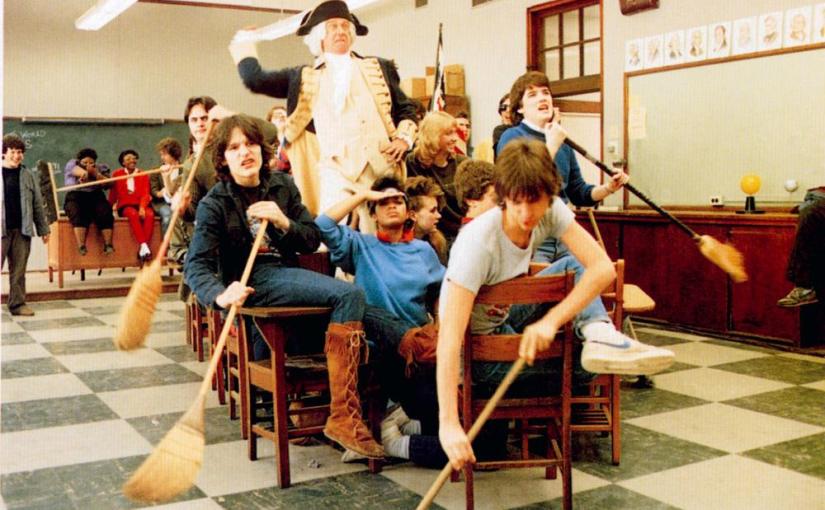
Richard Mulligan (Empty Nest) plays a mental patient that ironically engages his students when he conducts his classes dressed as famous historical figures like Lincoln and Custer.  Watch him reenact George Washington’s crossing of the Delaware with his students “rowing” the boat.  It’s an image I will not forget.  Nor will I forget his final scene in the picture as he encounters Nolte’s character in the hallway.

Where the film falls short is in the one student that is primarily focused on, played by Ralph Macchio, shortly after coming off his first Karate Kid movie.  Just like in The Outsiders, which I recently wrote about, Macchio relies on his dark complexion, stylish black hair, blue jeans and that popped up jacket collar again.  There’s also that strut he always has.  Forgive me for beating up on the kid, but too often I see Macchio donning the same image – that cool kid pose needed for the cover of Teen Beat Magazine.  Nick Nolte shares a lot of scenes with the actor playing the troubled kid with a sixth grade reading level.  However, Nolte is the only one working most of the time.  Another actor in this role would have served better.  It’s a necessary role as it attempts to awaken Nolte’s teacher character to try saving another kid before he gets lost.  Back then, maybe Emilio Estevez or Lou Diamond Phillips would have been more suitable.  Instead, we get Ralph Macchio being Ralph Macchio all over again.

Teachers is a comedy drama that mostly works.  It’s easy to get caught up in the comedy and, sadly, the absurd truth of what goes on in a metropolitan public school system back in the 1980s.  There’s also very dramatic and heavy elements to the film that stay with you.  Before school shootings no longer became shocking (a sad and current truth), Teachers explored the trauma of school bullying and the response the comes with that issue.

Arthur Hiller’s film did not invent the wheel on troubled times within school.  Heck, even The Sweat Hogs from Welcome Back, Kotter were troublemakers too.  Not to mention there are other school dramas to come before, like Blackboard Jungle.  However, Teachers is an very engaging film. I was completely absorbed as soon as the movie began, first in its comedy, and then later in its drama.  A near final scene of the film is eye opening and much like Steel Magnolias will leave you laughing and crying all at the same time.  That happens because you quickly begin to care for most of these characters and the turbulent times they live through as a teacher making next to no money while working under unfair and unreasonable scrutiny.

I think Nick Nolte is delivering one of the best performances of his career.  He has great chemistry with JoBeth Williams, who is good in her role.  The romantic storyline does not go overboard.  It does not get schmaltzy.  It is just enough, and it’s wise to include dialogue where they debate one another from two different sides of a coin.

Teachers also works as a great look back piece.  A lot of well-known, eventual recognizable actors round out this cast including Morgan Freeman, Crispin Glover, Laura Dern, Allen Garfield, and Lee Grant. Anytime Nolte is on screen, he only enhances the scenes he shares one on one respectively with most of these actors.  The moments between him and Macchio only work because of Nick Nolte.  Call Nolte the Alan Alda/Hawkeye Pierce of this picture. 

Teachers might look tame by the turmoil we see today in schools across the country but none of what is seen is untrue or exaggerated either.  Well, maybe except for the mental patient who arguably turns out to be the most engaging and influential instructor of them all.  That’s funny stuff, but you gotta be a little bit crazy to become a teacher nowadays.

A SERIOUS MAN

By Marc S. Sanders

There’s never anything wrong with questioning the Almighty God.  At least that’s what I believe. 

There’s nothing wrong with being faithful to an Almighty God…if you can find comfort and solace in its doctrine.  At least I think that’s what I believe.

The Coen Brothers released A Serious Man in 2009 to solve a great mystery that frankly we should all know can never be solved.

In 1967, Larry Gopnik (Michael Stuhlbarg) is a Jewish family man living in small town Minnesota.  He never steps out of line with his principles or morals.  He attends synagogue regularly.  He’s simply a good Jew; a good husband, father, brother-in-law.  Again, he’s a good Jew. 

Yet, he is also plagued with suffering through the results of what everyone around him commits as sin or violations.  His brother-in-law Arthur (Richard Kind) has overstayed his welcome in the house and is now under suspicion of committing illegal gambling in various bars.  His daughter is swiping money to get a nose job.  His son is listening to Jefferson Airplane in Hebrew school while getting ready to become a Bar Mitzvah.

Most prominently speaking, his best friend Sy Abelman (Fred Melamed) is gently counseling Larry through an unwelcome crisis at home.  Sy is encouraging Larry to agree to a “Get.”  Sy is ready to begin a relationship with Larry’s bitter wife Judith (Sari Lennick), and as they move towards divorce, Sy will need Larry to obtain a “Get” from the Rabbi. The Coens are admirably nervy in their writing because Sy addresses Larry like a child who he’s trying to get to swallow a bottle of castor oil so that he can finally make after two days of constipation.  That’s truly what it feels like.

I never read the book of Job, but I understand that A Serious Man was metaphorically inspired by its contents.  The question residing in both contexts is simply why must all of these unfortunate circumstances occur in Larry’s life? 

For Larry, it is best to get definitive answers.  After all, Larry is a physics teacher which is built on solid formulaic equations and never compromised because it’s a subject of exact science.  His giant blackboard bears the argument of solid answers from top to bottom with endless scribbles, diagrams and numbers.  It looks like incomprehensible gibberish, but at the end of it all, there’s a definite answer.  The proofs do not lie or compromise.

A South Korean student cannot comprehend that wrong answers on a physics test merit a failing grade.  It’s unfathomable because without passing Larry’s physics course, the student cannot obtain a mathematics scholarship.  Larry knows that is true, because how can you study physics without math? The two subjects hinge upon one another.  Larry sees no other way than to fail the student.  He won’t budge on that.  He sticks to his code of ethics.  He’s right all the way. Still, he’s accused of being prejudiced and then an envelope of bribe money is discovered on his desk.  It won’t sway him, but he can’t return it back to the student, if he can’t find him.  So, here’s another thing to weigh on him.

Larry is a healthy middle-aged father and husband, a devout Jew and somehow he’s the one suffering the most from the misgivings of everyone else.  Poor Larry even has to move with nebbishy Arthur into a local hotel.  Sy assures him it’s a lovely place with a pool (the pool is drained empty by the way).  His chance at tenure is also at risk.  There’s the divorce filing from his wife which causes him to hire an expensive attorney (Adam Arkin).  All this “tsouris!”  It’s too much to carry at once.

Midway through A Serious Man, the Coens opt to have their protagonist visit three Rabbis for the exact answers that will tell of his unfortunate circumstances.  The three visits do not so much lend to the story of Larry’s plight as they prove a point.  As satisfying as it might be for a physics teacher to arrive at the exact answer on the right side of an equal sign, one Rabbinical student (Simon Helberg from The Big Band Theory)- filling in for THE RABBI – will tell you to seek the answers you are looking for in an empty parking lot just outside the window.  ?????????

The second Rabbi played by favorite character actor George Wyner (Hill Street Blues, The Devil’s Advocate, Spaceballs) will tell a tall tale of a dentist and his goyish patient that leaves me wanting to know the end all be all.  What’s concluded may leave you shouting OY VEY!!!!

The third Rabbi is the mysterious Rabbi Marshack (Alan Mendall).  He is the elder, maybe the grand prophet, who is concealed in a private office with his long white beard and black hat, sitting behind his desk at the faaaaaarrrrr end of the room.  Will he finally have the answers to Larry’s questions?

This is reminiscent of that animated commercial that asks how many licks it takes to get to the Tootsie Roll center of a Tootsie Pop.  Did Mr. Owl actually have the answers the little boy was looking for?

A Yiddish told prologue that is seemingly unconnected to Larry’s story opens the film and it tells the story of a dybbuk knocking on a couple’s door in the “mitt en drinen” of winter.  The wife sees the curse of this dybbuk – the soul of a dead man meant to haunt them.  The husband does not.  It’s only after you watch A Serious Man from beginning to end that you’ll likely make the connection of a curse that future generations will never be able to escape now that the dybbuk arrived many years prior. Perhaps that is the answer that no Rabbi could clearly define for Larry.  It’s more apt to be my theory but it’s still not entirely clear.  Then again, perhaps it’s just the tale to resort to when a congregant like Larry Gopnik asks his clergymen why his life is in such turmoil.

I adore this film and it might be on a very personal level that others may not appreciate unless they have had an upbringing like mine.  Practically every single character in A Serious Man, all played by relatively unknown actors, look completely familiar to me. 

From Larry’s obnoxious kids (“I’m studying Torah asshole” with a defined middle finger raised), to his bitter wife that I routinely see a caricature of in Shull. Sy Abelman talks like my father-in-law (a great man, who I love by the way) does at Passover Seders, to his co-workers and even Larry himself.  Wearing nerdy black rimmed glasses, he hunches down to scribble on the blackboard with his fat butt sticking out just like my Hebrew teacher Mr. Katz did in my Yeshiva.  It’s all uncannily familiar and easily recognizable. 

There’s a very striking authenticity to A Serious Man that I’d be remiss in not complimenting.  Many may not see it.  You’d have to a be a northern practicing Jew or at least personally experienced with this secular environment to understand. That being said, seek out this unsung Coen Brothers piece and allow your patience to guide you through its various oddities.  It’s Joel & Ethan Coen.  So, you know it’s going to be odd. I expect that it’ll leave you thinking, though.

These actors that you may recognize, but cannot pinpoint what else you’ve seen them in, were meant for these roles. Only a certain kind of Jewish actor could play these people.

For example, no one else but Fyvush Finkle could play a Dybbuk arriving on a doorstep in the mitt en drinen of snowy winter!

A HARD DAY’S NIGHT

By Marc S. Sanders

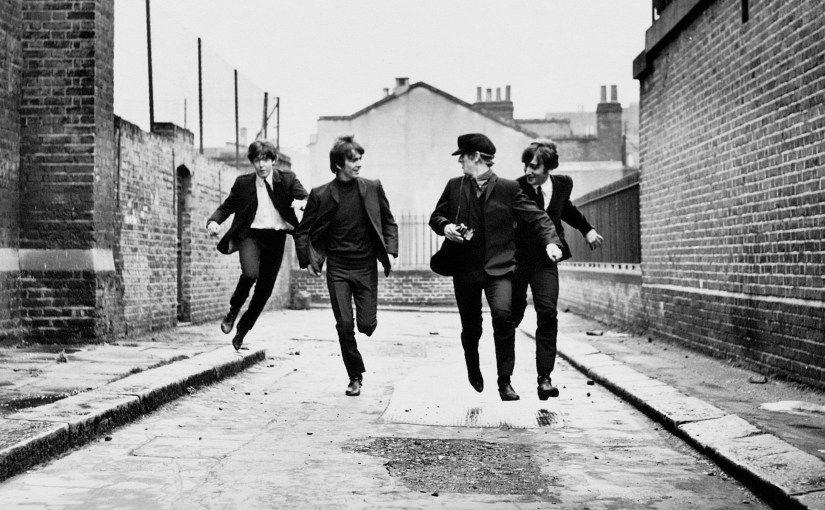
Before there were Swifties or Dead Heads or Parrotheads or Beliebers or Fanilows, there were Beatlemaniacs.  Everyone was screaming for and chasing after The Beatles – John Lennon, Paul McCartney, George Harrison and Ringo Starr.

The musical mockumentary, A Hard Day’s Night, captures the famous foursome from Liverpool over a two-day period, during their time of matching suits and mop top haircuts when they were taking the world by storm with their harmonizing vocals of innocent love and fancy-free celebration.  Richard Lester (eventual fill in director of Superman II) directed with a loose documentary like camera while the young men carried themselves in lighthearted and silly situations that served as a visual vehicle for their hit songs like Can’t Buy Me Love, All My Loving, and I Love Her.  The title song was featured too of course.  Along with Billy Joel and Barry Manilow, I grew up on this music and it helped me appreciate the loose construction of Lester’s film. 

Silly scenarios are set up with McCartney’s supposed “grandfather” (Wilfred Brambel) getting into all kinds of mischief while the guys circumvent through media conferences with improvised dialogue like:

REPORTER: Are you a mod or a rocker?

RINGO: I’m a mocker.

I’m not sure I understand the humor or the existentialism of this exchange, but it had fans, including famed critic Roger Ebert, going ga ga over it.  It even made it on to Premier Magazine’s Top 100 movie quotes of all time.  Then again so did “Plastics!” from The Graduate.  These are the vernaculars of the time.  It’s gotta have something to do with devoted fandom.  Right?

I recall seeing the music documentary U2: Rattle And Hum in the theaters upon release, and there was a moment where The Edge was sitting quietly next to Bono in an interview and snapping his palm on his knee, and the die-hard fan I saw it with could not stop laughing with appreciative glee.  I’m just as guilty.  If someone says in simple conversation “I have a bad feeling about this,” my Star Wars man child wakes up like a dog seeing a squirrel.  It can be politicians, rock stars, movie stars, preachers, athletes or even our parents that center us on an obsession that we respond to.  There’s no denying the Beatles had this kind of magnetism.  With half the band gone, the appeal still upholds much like it does for Elvis Presley and Michael Jackson.

A Hard Day’s Night serves a visual extension of the band beyond just what we would receive audibly over the airwaves and on vinyl.  They had recently finished performing on The Ed Sullivan Show, during their first arrival in America. Their charm, good looks, witty intelligence and even their quiet sensitivity enhanced the worldwide significance of the band.

Richard Lester finds opportunities to show the Beatles being performers of themselves behind the scenes, though most of what is shown in A Hard Day’s Night seems staged.  After all, we famously get to see John acting silly in a bubble bath and when his frustrated manager drains the tub and the suds dissipate, John is nowhere to be found.  A cute gag, much like we would find in music videos on MTV, twenty years after this film’s release.

There is a blend of overhead and wide ground level shots of the four prancing and dancing in an open field while Can’t Buy Me Love echoes through a scene.  It’s silly.  It means nothing.  It’s simply sophomoric fun begging us to appreciate their harmless, mad cap shenanigans.

Each bandmate is given room to shine, but Ringo surprisingly stood out to me the most.  He seemed like the little brother to the other three who was never taken seriously.  Paul’s grandfather even tells Ringo to give up music. He should be “parading.” Suddenly, just before a practice warm up for a television program, Ringo is missing.  The fourth Beatle has seemingly run away.  If I could find character dimension anywhere in this Oscar nominated script by Alun Owen, it surprises me that it came from Ringo; the one who was occasionally considered the least celebrated of the Beatle craze.  At the time, he wasn’t a songwriter.  He sat in the back with his drums.

A Hard Day’s Night is enjoyable simply for the innocence shown of the four guys from Liverpool.  They’re happy with themselves and to be with each other.  It’s very natural and yet it’s a little sad too.  This film predates what was never expected to come of them over the next decade and a half with break ups, marriages, controversies, new career trajectories, and even a sudden death of one of their own, occurring on December 8, 1980.

I can only imagine that in the moment of Beatlemania, A Hard Day’s Night was a celebration of happiness and cheerfulness.  They had a rebelliousness to them, yes.  However, there was never anything like them.  Today, the film serves as a reflection of my earliest appreciations for infectious song lyrics and music.  As a middle-aged man, with two members of the band gone, the picture works like a home movie for me.  It’s like watching archived footage of family members who have long passed away.

When you watch A Hard Day’s Night and sing along to the songs as they enter the picture, the words and the melodies return. You’ll likely find yourself thinking back as if to ask yourself “Remember When…?”

THE SECRET OF MY SUCCESS

By Marc S. Sanders

Reader, it has been a hard week.  Hard because my flat screen has been on the fritz.  Finally, today at last, the Best Buy Geek Squad will be paying me a visit and working on a repair. In the meantime, I have had to relegate myself to one of the smaller flat screens within the household.  I feel dirty.  Cheap.  I can’t even look at myself.  Just look away!!!!  Considering the dire circumstances, I could never look at my next big film to review during the absence of my 9.0 sound system and 65 inches of viewing pleasure.  It would be a sin to watch a Christopher Nolan or Steven Spielberg piece anywhere else (unless it’s in the cinema).  Therefore, I settled, and I hit rock bottom.  I opted to for Netflix meh! 

All I have, all I can give you, all I can offer, all I can claim for you during this dark, sad time is Herbert Ross’ attempt at shaping a Michael J Fox thirty second MTV style 1980’s music video into a film.  The “film” is The Secret Of My Success

I recall seeing this movie at age 14 during a field trip to Washington DC with my eighth grade Yeshiva class.  Every time the dimply cute yuppie Canadian sensation from Family Ties and Back To The Future graced the screen, the girls in my class screamed with puppy love glee.  I liked Fox at that time.  I still do.  He was a bright guy and while not an actor like Brando or Olivier, he had a unique charm that defined the clean cut 1980s with knit ties and Benneton sweaters.  His unforgettable Alex P Keaton was the fictional cheerleader for the era of Ronald Reagan, and no one protested.

I recall the promise of The Secret Of My Success as being the vehicle that would elevate his tv persona to the big screen since he already had luck with Marty McFly and a healthy B-movie following with HBO airings of Teen Wolf (a much better movie than it ever deserves to be). Regrettably, this film never landed.  It’s most glaring failure is that it never even lives up to its title.

The assembly of Herbert Ross’ romantic, New York, yuppie comedy occupies itself so much with music montages.  It’s as guilty of its own indulgence as Rocky IV.  How many times must we see a grinning Michael J Fox hustle through the concrete jungle of the city and then through skyscraper cubicle hallways within a white collared business world?  Night Ranger is the ‘80s hair band who provides most of the movie soundtrack and they owe much to Michael J Fox as the face that accompanies their work with trinkling keyboards and electric guitars with the raspy roar of their lead singer.  If Michael J Fox is not walking down streets where apparently supermodels live to turn their heads (I saw you Cindy Crawford), he’s got a pen wedged between his teeth and he’s pulling huge three ring binders off of shelves while doing an all nighter.  This is oh so boring.  In 1987 however, it is all a couple of Teen Beat readers needed in their lives.  I can watch Meryl Streep or Gary Oldman read a three-ring binder.  Michael J Fox just doesn’t have a knack for this skill.

Fox plays Kansas farm boy Brantley Foster.  Now that he has earned a business degree, he has enormous aspirations to climb the top of the New York corporate ladder and make a success of himself with a “beautiful secretary.”  Because, you know, you can’t make it without a secretary, much less a beautiful secretary. 

Upon relocating into a roach infested apartment, Brantley’s plans fall through, and he has to beg his super rich Uncle Howard (Richard Jordan) into giving him a job in the mail room of his building.  Brantley encounters a beautiful blond executive named Christy (Helen Slater) amid a sea of uptight middle-aged men.  The depth of this attraction only goes so far as fantasizing about her walking towards him in a cheesy, glittery pink evening gown with a keyboard and saxophone chiming in.  On the side is Howard’s bored trophy wife Vera (Margaret Whitton) crowding young Brantley in an illicit Mrs. Robinson kind of affair.  Let me clarify.  Vera is married to Brantley’s Uncle Howard.  So, Brantley is being terrorized by Aunt Vera.

For the purposes of ridiculous farce, that might be funny for a moment.  However, The Secret Of My Success takes forever to arrive at the farce it could have hinged on.  Instead, Brantley has to discover a way into the white-collar world when he comes upon an empty office and bears the fictional name of Carlton Whitfield to justify his suits and his motivation to work in the heart of the corporate world.

I noted that the film does not live up to the title.  When Brantley is working the persona of Whitfield, we never get an idea of his brilliant ideas for business success and operations.  We never learn what turned Uncle Howard’s high-rise building into the towering reputation it apparently stands upon.  We never understand the threat of a shareholder’s takeover that Howard and his team fear is imminent.  Where’s the value in anything that Brantley is doing to be that corporate hero and what is he trying to improve or salvage?

Instead, we are left with a very poor chemistry pairing between Helen Slater and Michael J Fox.  Slater is flat out boring with no dynamic to her.  If you want to see how to deliver any variation of a line in a flat, monotone way, then observe what she has to offer.  Fox is on another level of energy that Slater cannot match and Herbert Ross and the script from Jim Cash and Jack Epps Jr (Top Gun, Legal Eagles) chooses to occupy itself more with this romance than the corporate world at play.

The following two years after this film’s release would do better for this hustle and bustle setting with Oliver Stone’s cynical Wall Street and Mike Nichols romantic comedy Working Girl.  The latter film follows a near exact blueprint of The Secret Of My Success.  Yet, it wins because we actually see the main character, portrayed by Melanie Griffith, actually demonstrate her prowess for the cutthroat world of business power and politics.  By comparison, Michael J Fox just wants to play hooky and make out in the back of a limousine.

A last-ditch effort is made though when the big wigs assemble for a weekend getaway. What seems like an attempt at bedroom farce barely gets started with the players climbing staircases and tip toing behind doors and hopping into bed together and blah blah blah.  It doesn’t serve, however, because the idiot plot intrudes where everyone has to act as if they have no idea of who is sleeping with who and who is Brantley and who is Whitfield amid the fast-talking dialogue edited within.  You want to scream at the screen and tell everyone to shut up because this can all be explained in sixty seconds.

Again, as Mike Nichols’ Oscar nominated film eventually proved, there was a better film to be made here for Michael J Fox.  It could have included all of the cynical realities that go with the natures of a corporate American beast.  Instead, The Secret Of My Success relies on music video montages with the teardrop keyboards and the yearning saxophone that seemed like a requisite for the adoring Michael J Fox of the 1980s. 

Enough already!!!!  I need to cleanse my palette.  GEEK SQUAD, WHERE ARE YOU????? 

MEPHISTO (Hungary, 1981)

by Miguel E. Rodriguez

DIRECTOR: István Szabó
CAST: Klaus Maria Brandauer, Rolf Hoppe, György Cserhalmi, Karin Boyd
MY RATING: 9/10
ROTTEN TOMATOMETER: 80% Fresh

PLOT: In early-1930s Germany, a passionate, prominent stage actor must choose between an alliance with the emerging Nazi party or a life of obscurity in exile.

[Author’s note: this is another in a series of movies I’ve watched lately whose subject matters have intimidated me.  There are topics at play in Mephisto that are beyond my ability to analyze in coherent prose.  I must advise you, this is a BRILLIANT film, even if my review below does not convey that fact…]


Watching Mephisto reminded me of the early days of Covid-19.  As the infection spread and restaurants and other businesses voluntarily closed their doors, I was still naively hopeful that it would all just go away.  A friend asked me, “When will you take this seriously?”  I blithely said, “When all the McDonald’s restaurants close, that’s when I’ll know there’s a problem.”  Not long afterwards, that’s exactly what happened.  Then I was indefinitely “furloughed” from my job, and soon after that, the government shutdown occurred.  In hindsight, I was foolish.  The signs were all there.  Had I paid more attention, I might have been better prepared for the stressful days that followed.

This situation is echoed in director István Szabó’s Mephisto, the first Hungarian film to win the Academy Award for Best Foreign Film.  Mephisto tells the story of a popular actor in 1930s Germany, shortly before and after Hitler rose to power.  Hendrik Höfgen (Klaus Maria Brandauer) is a hot-headed, passionate stage actor who throws himself into his performances with abandon.  We watch him evolve from an actor/director to the leading force behind a “revolutionary” theater company that exhorts its audience to acknowledge the plight of the everyman in their society.  He marries (for money more than anything else), but keeps a mistress on the side, a black German woman named Juliette Martens (Karin Boyd) who doubles as his private dance instructor.  He rails at his wife for riding horses before breakfast – the ultimate in bourgeois behavior – but engages in frantic frolicking with his mistress between dance lessons.

Brandauer plays Hendrik as a man who only feels like himself when he’s pretending to be someone else.  Onstage or when directing his cast, he’s filled with boundless energy, dancing with the chorus line or leaping across the stage with abandon.  Offstage, he is quiet and self-effacing, unless he’s socializing with other cast members.  Mention is made several times of his “limp” handshake, a direct contradiction to the strong characters he portrays, especially his most famous role: Mephistopheles in Faust, a role that brings him even more fame and prominence within the theater community.  The imagery of Hendrik is striking: He covers his face in white makeup like a kabuki player with sharply angled black eyebrows and red lips, the ultimate in being able to disappear inside a character.

But something is happening in the background that Hendrik is reluctant to acknowledge.  A fellow cast member almost gets into a fistfight with him when he criticizes another actress because of her associations with a member of the Nazi party.  His wife warns him about the dangers presented by this man who was just elected Chancellor.  [Interestingly, the name of Adolf Hitler is never once mentioned onscreen.]  She tells Hendrik that many of his friends are leaving Germany, fearing for their livelihoods, if not their lives.  But Hendrik refuses to panic:

“There is still the opposition, no?  They’ll make sure he doesn’t get too big for his boots.  And even if the Nazis stay in power, why should it concern me? … On top of that, I’m an actor, no?  I go to the theater, play my parts, then go back home.  That’s all. … I’m an actor.  You can design sets anywhere or buy antiques.  But I need the German language!  I need the motherland, don’t you see?”

Hendrik is so wrapped up in his profession that he simply cannot accept the fact that his freedoms are about to come crashing down around him.  He would rather formulate a far-fetched scenario based on nothing but hope so he can just stay where he is and keep performing.

(I have to be honest: when we took our first steps out of the Covid lockdown, I felt the same way.  Local theaters announced auditions for shows again, and I assured myself and my girlfriend that I would take the utmost precautions and wear masks at rehearsals and disinfect and wash my hands and I wouldn’t get sick.  And, of course, I eventually got sick.  I recovered, but you can probably imagine my disbelief when I tested positive that first time.  “ME?  But I was so careful!”)

Hendrik stays in Germany.  His wife moves to Paris.  Fellow actors either disappear outright or are arrested by the Gestapo in full view.  Hendrik accepts an offer to direct the official state theater, despite his past affiliations with liberal/Bolshevik causes, because of his prestige in the theater world.  A character known only as the General (probably intended to be Hermann Göring) gives him his marching orders as theater director.  He witnesses several Nazis beating a man on the street and walks in the other direction…best not to get involved.

So, what we have here is an actor willing to trade away his soul and his conscience in exchange for the opportunity to remain in the limelight, performing as Mephisto or Hamlet.  The metaphor is not exactly subtle, but director Szabó manages to land the message in such a way that it never feels like preaching.  It’s a masterpiece of storytelling that lands somewhere between satire and Kafka.

An especially telling scene has Hendrik explaining to an attentive crowd of Nazi journalists that his production of Hamlet will portray the lead character as “a hard man…an energetic, resolute hero”, rather than as a neurotic, “pathetic” revolutionary.  Hendrik tells them exactly what they want to hear so he can stay in the limelight.  He’s made his own deal with the devil.  I will not reveal whether Hendrik’s bill comes due during the film, but I will say the finale evokes the landmark documentaries of Leni Riefenstahl.  I’ll leave it at that.

As I said, watching the film reminded me of the Covid lockdown…but it also made me think about all those many, many times in the past that actors and other celebrities have been criticized for voicing their political opinions in public.  “Shut up and play/act!” is the usual cry.  Many people would prefer their favorite actors to behave more like Hendrik: just keep your head down and let everything blow over, don’t make waves, it’s not your place, etcetera, etcetera.  Mephisto argues that keeping silent in the face of injustice or tyranny is not an option, especially not for people in the spotlight.  Those who do so risk suffering Faust’s fate.  Or Hendrik’s, whose last words in the film are brilliantly contradictory.

INHERIT THE WIND (1960)

by Miguel E. Rodriguez

DIRECTOR: Stanley Kramer
CAST: Spencer Tracy, Fredric March, Gene Kelly, Dick York, Harry Morgan
MY RATING: 9/10
ROTTEN TOMATOMETER: 93% Fresh

PLOT: In 1925, two great lawyers argue the case for, and against, a Tennessee science teacher accused of the crime of teaching Darwin’s theory of evolution.  (Inspired by the real-life Scopes Monkey Trial.)


I have known about the movie version of Inherit the Wind for many years now, but it has taken me this long to get around to finally watching it.  One of the first shows I ever did in community theater was Inherit the Wind.  I played E.K. Hornbeck, probably one of the best-written characters I’ve ever performed.  I hesitated this long to watch the movie, or any of the other various TV/cable versions, because I feared it could never live up to the power of the stage play.  Boy, was I wrong.  Stanley Kramer’s film of the award-winning play is anchored by two of the greatest performances ever to grace the silver screen, courtesy of Spencer Tracy and Fredric March, both 2-time Oscar winners.

It’s 1925, and in the Bible-belt hamlet of Hillsboro, Tennessee, a young teacher, Bertram Cates, has been imprisoned.  His crime?  Teaching Darwin’s theories in high school.  In Hillsboro, you see, it’s against the law to teach anything but Biblical creationism in the classroom.  The arrest makes national headlines, most of them negative.  Example: “Heavenly Hillsboro: Does It Have a Hole in Its Head, or Its Head in a Hole?”  The despairing town fathers rejoice when they discover that the great Matthew Harrison Brady, lawyer extraordinaire and 3-time Presidential nominee, will volunteer to prosecute the case.  Brady is played by Fredric March with gusto, although I almost wish March had dialed it back JUST a touch every now and then.  He comes VERY close to becoming a parody of a character instead of a real person.

Covering the story in Hillsboro is E.K. Hornbeck (Gene Kelly!), a reporter from Baltimore.  Hornbeck is loosely based on the legendary newspaperman H.L. Mencken.  The screenplay reduces Hornbeck’s presence a tad as opposed to the stage play, but Kelly delivers the goods with all the appropriate flair and panache.

Hornbeck’s Baltimore paper uses its influence and checkbook to lure another skilled, big-city attorney to Hillsboro to defend Cates.  This is Henry Drummond, played by Spencer Tracy in arguably the best performance of his lengthy career.  Drummond is a shambling, good-natured fellow whose twinkling eyes disguise a sharp legal mind and a passion for the truth.  It’s a tribute to Tracy’s abilities that we get to see both sides of Drummond’s persona and there is never a sense of any disconnect between them.

After the first half-hour or so of exposition, the remaining bulk of the film takes place in the sweltering Hillsboro County Courthouse, as a jury is selected, witnesses are questioned, and both sides present their case to the judge (Harry Morgan).  In between court sessions, we get short scenes with Bertram Cates’s fiancé, Rachel, who just happens to be the daughter of the town’s religious leader, Reverend Brown (Claude Akins); a prayer meeting where Reverend Brown essentially damns his own daughter to hell; and pleasant interludes where Drummond and Brady sit on a front porch and reminisce how they used to be great friends, fighting for the same cause once upon a time.  But now Brady has combined his faith with his political ambitions, and Drummond dreams of a day when reason and science are not equated with heresy.

I won’t give you a play-by-play of the courtroom scenes here.  But if I were a film director, and I found myself directing a courtroom thriller, I would sit down and watch Inherit the Wind at least ten times before shooting a foot of film.  The scenes where Drummond and Brady butt heads and cross-examine and make objections are simply spellbinding.  I would be remiss if I didn’t mention the camerawork by the great Ernest Laszlo, moving around the courtroom and around each attorney, pushing in, tracking backwards.  I know great camerawork is supposed to become invisible while watching a film, but this was different.  Laszlo’s camera sometimes calls attention to itself, but it never, ever distracts from the story.

Of course, beautiful camerawork only works when it’s photographing something worthwhile, and Spencer Tracy and Fredric March do not disappoint as Drummond and Brady.  For nearly 90 minutes, they bicker, trade jabs, and put on a double-act of Hollywood professionalism and technique that would not be matched until the films of Newman and Redford.  Tracy is especially fascinating to watch.  It’s impossible to catch him acting.  There’s never a moment when he looks anything but authentic.  His speech patterns give the impression of a man whose mouth is just barely keeping up with his brain.  When he occasionally stumbles over a word, the odds are 50-50 whether it was a real slip up or if he just threw it in as a flourish.

If Tracy’s performance is a triumph of realism, or at least naturalism, Fredric March’s performance is one of the last great displays of old Hollywood, full of facial tics and vocal mannerisms and speechifying that would have made even Charles Foster Kane say, “Dude…dial it down.”  It’s still a powerhouse performance, but it’s a good thing Tracy didn’t try to match March.  Otherwise, the whole movie would have become a cartoon.  Because we have two such contrasting performances, the movie achieves a nice balance that makes time pass much more quickly than it might have with two other actors.

Regarding the TOPIC of the film…well, to be honest, if I started to write about all the things I felt while watching the film, about how so many people today, not just random folks, but people I know personally, would have felt right at home in 1925 Hillsboro, asking God to rain hellfire on the non-believers, chanting about hanging the accused teacher from a “sour apple tree”…I’d still be writing this review three days from now.

Besides, I believe the film makes its point much more eloquently than I ever could (especially when it comes to the discussion of how long that first day of Creation was, exactly).  One of my favorite lines from the movie comes when Brady accuses Drummond of attempting to destroy everyone’s belief in God and the Bible.  Drummond replies:

“That’s not true, and you know it.  The Bible is a book.  It’s a good book.  But it’s not the ONLY book.”

Inherit the Wind is not anti-Christian or anti-God or even anti-religion.  It is a plea for tolerance.  The fact that it was released over sixty years ago does not diminish the power of that message.  And even if it did not have that agenda, it would still be one of the most exciting, crackling courtroom dramas I’ve ever seen.

(Fun fact: A quick internet search reveals that, while all US states currently teach evolution, there are some that voluntarily pair it with creationism.)

STILL ALICE

By Marc S. Sanders

Still Alice is the observation of a woman whose mind gradually deteriorates from the symptoms of early onset Alzheimer’s disease.  Julianne Moore won an overdue slew of awards, particularly the Oscar, for the portrayal of the title character.  It’s a magnificently sensitive performance that will have you in tears following the first twenty minutes of the film.

Alice Howland is a revered Columbia professor of linguistics.  She has three grown children (Kristen Stewart, Kate Bosworth, Hunter Parrish) and John, her loving husband (Alec Baldwin).  The sad irony of Still Alice, adapted from Lisa Genova’s novel, is the fact that Alice specializes in teaching word origins and their formations, but she is stricken by the disease that will wipe her memory of the simplest vocabulary.  A highlighter becomes a “yellow thing.” 

The beginning of the film shows Alice functioning at her highest capacity following her fiftieth birthday.  She teaches her classes, does her daily jogs across campus, plays word games on her phone, travels across country delivering seminars and also tries to convince her youngest daughter, Lydia (Stewart) to abandon her dreams of becoming an actor and acquire a college degree.  Mixed in, however, are losses of train of thought, forgetting recipes, misplacing basic objects, forgetting appointments and getting lost during her jogs.  A quick glance over some visits with a neurologist (Stephen Kunken) set the wheels in motion of what we will witness Alice struggle with over the course of the film.  These doctor visits also teach the audience how one is examined for symptoms with simple memory tests and spelling questions. 

The film was directed by Richard Glatzer and Wash Westmoreland.  After I watched the movie, I learned that Glatzer could not speak while he was directing.  Due to his gradual deterioration from ALS, he had to resort to a computer monitor that would express his instructions to the cast and crew.  So now I’m that much more impressed.  To home in on the sensitivity of Still Alice, it only seems fitting that someone with Glatzer’s condition could co-direct this story. 

This is not a glamourous film.  Sometimes we may laugh at ourselves because we cannot think of a word or we forget a year or a name or we put our car keys in the refrigerator as soon as we come home and reach for a cold beverage.  However, when we see Alice discover that she puts a bottle of liquid soap in the fridge it says so much more.  Illnesses like Alzheimer’s and ALS strip people of the basics in living.  Having recently witnessed a friend slowly suffer and perish from ALS, I know that one disease brings you to this point with complete mental capacity while the other seems to tease you with how your mind gradually deteriorates.  Yet, like Richard Glatzer, my friend Joe did not stop functioning and co-wrote a play with me in his final year of life.  He couldn’t speak.  He couldn’t walk, but the man could write.

I have to credit the supporting cast behind Moore’s performance.  The film begins with the ease of conversations between the family members.  Before you know it, the exchange of dialogue shifts and becomes more one sided.  Julianne Moore most often shares scenes with Alec Baldwin and Kristen Stewart respectively.  She hides so well in her character’s mental incapacity that eventually, it looks like Alice Howland is not even applying the intelligence she’s collected and earned over her lifetime.  A scene in a yogurt shop towards the end of the film seems like Baldwin is the only one working.  He’s consuming his yogurt and reminding his wife of where she used to work while she sits beside him in an absolute haze of emptiness.  He simply says she is the smartest woman he’s ever known and by this point, I know exactly what he is talking about.  Moore is so heartbreaking in moments like this that I have to give credit to Alec Baldwin for maintaining his own performance against a scene partner who cannot offer much in return.

Alzheimer’s first affects the victim but also the family.  Still Alice allows time to explore the inconvenience of the illness.  There is the expected residual squabbling among the siblings.  Alice needs to be overlooked more and more as she gets sicker.  Who can be with her?  John still has to earn a living and has an opportunity for career advancement that he cannot afford to pass up.  A relocation is questioned because will it be okay for his wife.  Lydia is on the other side of the country trying to build her acting career.  Anna (Bosworth) is a pregnant, busy attorney, while Tom (Parrish) is in medical school. 

It’s also much more serious when the family learns that the gene Alice possesses has a one hundred percent chance of being passed down to the children.  This angle is touched upon for a brief moment, but then is hardly reflected as the film moves along.

Still Alice is a difficult film to stay with because it feels genuine in its account of living with Alzheimer’s.  Simple mistakes are just as heartbreaking as the big developments.  Leaving a potato in a purse is as hard to watch as seeing a mother speak to her daughter backstage, following a live acting performance. The daughter is now a stranger to the mother. 

Yes.  At times, the film feels like schmaltz you may find on the Lifetime channel, but then again you are seeing authentic, relatable performances from a cast who make up this family, especially the Oscar winner, Julianne Moore.  Alzheimer’s is an unfair and cruel disease that strips away everything a person builds for themselves in a lifetime.  Pardon the pun, but Still Alice makes sure you never forget that.

THE SORROW AND THE PITY (Switzerland, 1969)

by Miguel E. Rodriguez

DIRECTOR: Marcel Ophüls
MY RATING: 8/10
ROTTEN TOMATOMETER: 100% Fresh

PLOT: An in-depth exploration of the various reactions by the French people to the Vichy government’s acceptance of the German invasion.


When writing this review, I initially tried to provide a background to the film’s topic, attempting to summarize what Vichy France was, who General Petain was, and how bitterly French resistance fighters resented Petain and others who believed that acquiescence to the conquering German army was key to survival and avoiding further destruction.  That attempt at a “brief” summary ran to two full pages.  So, rather than teach a history lesson, I thought it better to just review the film and assume that readers will have an even better grasp of history than I do.  So here goes.

My enthusiasm for The Sorrow and the Pity, another sprawling film from documentarian Marcel Ophüls, is tempered slightly by my tenuous grasp of French history during World War II, and by the fact that, at least at FIRST, I did not feel I could pass judgement on the people involved.  One English interviewee says exactly that, in response to a question about whether he felt Petain’s life sentence after the French Liberation was unfair: “It is not my place to judge whether or not people’s anger was justified.  We haven’t been through it, so we cannot say.”

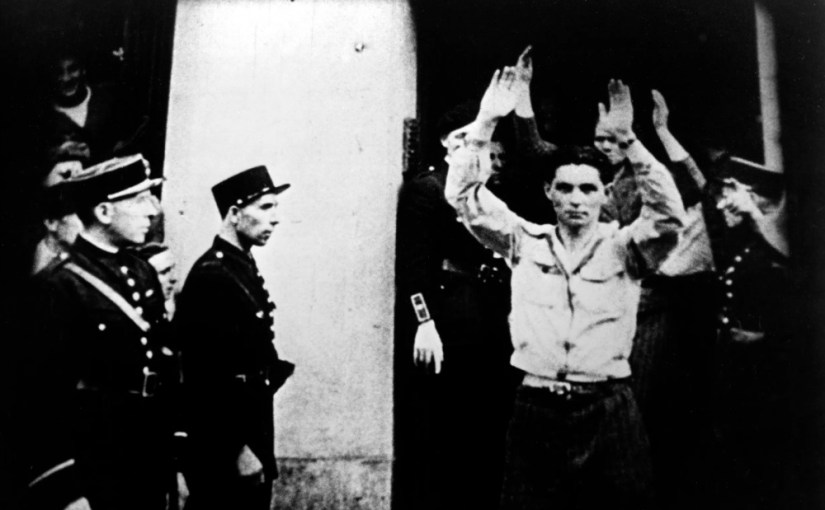
After watching the complete film, I have changed my tune a bit.  Under Petain’s leadership, Vichy France did indeed escape total destruction, but since they were essentially under German rule, they did end up deporting approximately 76,000 Jews to concentration camps during World War II.  Only a small percentage survived.  French Resistance fighters attacked when and where they could with immense dedication, believing it was better to fight and die than to live under the thumb of Nazi Germany.  Pro-Vichy Frenchmen denounced anyone they believed was a member of the Resistance.  In the documentary, the bitterness felt by surviving Resistance fighters towards surviving collaborators is palpable.

This documentary was (I believe) the first from a French filmmaker to openly discuss, on a world stage, the conflict between the Resistance and the collaborators.  Up to that time, it had been a virtually taboo subject, something swept under the rug or kept in the basement.  The attitude was one of, “Why bring up such a painful subject?  Why go over something so historically embarrassing?  Let’s just move on.”  This attitude reminds me of the thinking behind those who are in favor of redacting your kid’s history textbook or banning certain books from the school library.  The people interviewed in the film – people on both sides of the debate, mind you – demonstrate clearly that a national policy of polite silence on the matter is unacceptable.

In this way, The Sorrow and the Pity functions less as a film, an entertainment, and more like a historical record, the kind of thing you might see at a museum or on a college campus as part of a homework assignment.  I can’t promise watching this film will be as gripping as a typical Hollywood war film, but I can say I was never bored during the film’s running time.  I found myself intrigued by the fact this film was released in 1969, just 25 years after the end of the war in Europe, so the people appearing in the film were not just experts or college professors.  They literally lived through the events they were discussing.

A woman who sided with Petain was tortured by Resistance fighters after the Liberation; she still holds to her belief that Petain was a good man.  A Resistance member who was denounced and sent to prison returns and is told by a friend that he knows who denounced him and he will avenge him with a nod of the head.  The man refuses to allow that to happen, even though he knows who the denouncer was; in fact, he still lives around the corner from him.  “It’s something you can’t forget.  But what can you do?”

A former Nazi soldier is interviewed at his daughter’s wedding reception.  (I would LOVE to hear how Ophüls managed to wrangle this particular interview.)  Ophüls asks why he still wears his military medals when many Germans refuse to wear them because they were awarded by a Nazi state.  The former soldier says the only people made uncomfortable by them are men and women who never fought.

Another former soldier (now apparently a waiter in a pub) makes this startling statement: “We’re not stupider than anyone else, and yet we lost the war.  Nowadays we have to wonder if we’re not better off like this.  After all, if we had won, Hitler may have continued, and where would that leave us today?  Perhaps we’d be occupying some country in Africa…or America.”  It’s hard to tell whether his statement is remorseful, grateful, or wistful.

The Sorrow and the Pity is a remarkable record of a time when a nation had to choose between subservience or resistance.  That some chose resistance is not hard to fathom for Americans, whose existence is founded on resistance to tyranny.  That some chose to collaborate is perhaps unthinkable, but if I look inward, can I say with certainty I would have chosen differently?  I’d like to think so.  I hope so.

Just recently I was looking at a bookstore’s window display with a “banned books” shelf filled with novels that have recently been banned by school libraries in several states.  A woman walked by, noticed the display, and said as she walked away, “This store is degenerate.  I can’t believe they’re glamorizing this shit.”  I found myself wondering how many of those volumes she had read herself.  I wondered which side she would have taken in France when Nazi policies banned certain texts.  It never occurred to me to start an argument with her right there in the street.  Will there come a time in this country when it becomes our duty to openly oppose those who support totalitarian policies?  I don’t know, I’m not a political Nostradamus.  But The Sorrow and the Pity argues that, if that time does come, sitting on the fence should not be an option.  And the world will not soon forget those on the wrong side of history.

COP LAND

By Marc S. Sanders

You need look no further than the HBO series The Sopranos to see that the state of New Jersey is often regarded as a red headed stepchild in comparison to the empires of crime found in New York.  In fact, two years before that series debuted, many of the varied cast members (Edie Falco, Frank Vincent, Robert Patrick, Annabella Sciorra, and Arthur J Nascarella) appeared in writer/director James Mangold’s second film Cop Land, which carried the same kind of regards for the two thirds of the known Tri State area.  Tony Soprano always had to surrender to Johnny Sack and his crew if you know what I mean.  There’s Jersey…but then there is New York!

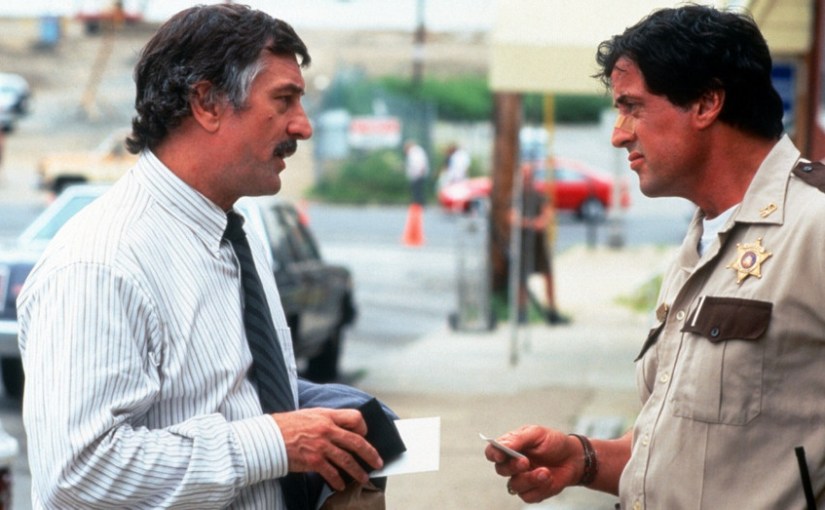
A whose who of staple actors for New York crime and corruption films take center stage including Harvey Keitel, Ray Liotta, and Robert DeNiro.  Yet, the spotlight belongs to Sylvester Stallone in what is arguably the most unsung and best role, next to Rocky Balboa, of his entire career. 

Stallone portrays the pot-bellied schlub Freddy Heflin.  He is the Sherrif of small-town Garrison, NJ where the cops who work within the city, across the bridge, reside comfortably here.  Freddy aspired to be one of those celebrated officers dressed in pressed blue uniforms, but he could not get past the physical due to a loss of hearing in his right ear.  He got that when he was kid and rescued someone from a sinking car that crashed in the river.  Perhaps Freddy wished that never happened.  Maybe his life would have been much more colorful like these New Yorkers.  I can understand the poor guy’s self-reflection.    

An internal affairs investigator named Moe Tilden (another of many convincing New York variations for Robert DeNiro) brings reasonable suspicions of corruption to Freddy’s attention.  How do these guys live so well based on the salary they earn on the police force?  Too often they have been connected with reputed mobsters, and incidents are quickly swept under the rug and kept quiet.  It stands to reason that the cover ups they commit happen in the home state of Jersey, outside of Moe’s jurisdiction.  Moe needs Freddy to quickly offer up anything he knows or witnesses. 

In particular, the leader of these guys, Ray Donlan (Harvey Keitel), might have something to do with the disappearance of his nephew Murray (Michael Rapaport) who was regarded as a young hero cop but is now at the center of a shooting incident gone wrong while driving across the bridge.  Donlan and gang fake a suicide for the kid, but with no body turning up in the river, it’s not so far-fetched to believe that perhaps he’s still alive and hiding out somewhere.

Cop Land works like an Us vs Them observation.  Freddy is the pawn for these guys to keep up appearances while this friendly town operates on other levels.  He’s the guy they can rely on to look the other way and mind his own business.  What I like about Mangold’s script is the dilemma with Stallone’s character.  Who could ever intimidate Sylvester Stallone after Rocky II?  He’s one of the biggest muscle men in film history. Yet here he is the weakling.  Most importantly, he’s utterly believable in this role that’s nowhere in the same league as Rambo or Rocky. 

The cast is as magnificent as you would expect.  Harvey Keitel looks like the family man but he’s got other nefarious ideas bubbling under his exterior.  Robert Patrick fills a role as Keitel’s heavy in a frazzled departure from his anal-retentive evilness that premiered in Terminator 2.  Ray Liotta is the second star of this picture sharing some good scenes with Stallone.  You’d think Liotta was the more seasoned actor even though Stallone came on the scene a few decades before.  Liotta is playing a guy who maybe once lived with a good soul but is now checkered and weary.  How I wish Ray Liotta had more significant screen time during his film career.

The setting works like an intimidating character here. The other supporting players flesh out the environment of Stallone’s sheep herding through a bed of wolves.  Those actors consist of Cathy Moriarty, Annabella Schiorra, Peter Berg, John Spencer and of course Frank Vincent who is a regular in these kinds of pictures.

Cop Land teeters on what Martin Scorsese or Sidney Lumet might have done with this picture.  It only falls short due to a wrap up ending with an unsurprising shootout.  What works so well as a pressure cooker crime drama devolves into blood and bullets and that is a letdown because it’s an easy way out.  In Lumet’s hands for example, the film would have taken advantage of at least an additional half hour to drive the piece into the arena of the public court system (a welcome opportunity for another all-star cameo from the likes of Al Pacino or Sean Penn.   I think the film would have been even smarter for doing so.  The avenue that James Mangold takes with his film is not terrible.  It just feels a little unrewarding or worthy of everything that was wisely executed before.

Cop Land should be seen for the dilemmas it hinges on and then for the various acting scenes among this terrific all-star cast.  Usually, actors will boast that they got to share screen time with Robert DeNiro.  I’m sure guys like Robert Patrick and Michael Rapaport place those experiences high on their mantles.  However, I bet all of these guys said what an honor it was to share the screen with Sylvester Stallone in a performance uncharacteristic of his usual criteria. 

James Mangold’s Cop Land is a terrific crime drama.

BREAKFAST AT TIFFANY’S

By Marc S. Sanders

Holly Golightly.  

Name sounds almost whimsical with a noun, a verb and an adverb.  Holly go lightly!  Puts a smile on my face.

Actually, the creation of this character from Truman Capote might follow the advice that her own name implies, and Audrey Hepburn portrayed the young self-inventive socialite – well let’s be honest as it is no longer 1961 and say “call girl” – with an enthusiasm for living better than anyone expected or could have imagined.  Hepburn was self-conscious of her portrayal.  Capote insisted on casting Marilyn Monroe.  None of it matters as Audrey was endearingly perfect.

Blake Edwards adapted Truman Capote’s novel Breakfast At Tiffany’s, and while I never read the source material I can recognize the director overstepping for sight gags, slapstick and exaggeration before he gains focus with a need to conclude his film on a turned character arc. 

I’ve had mixed feelings on Edwards career.  Days Of Wine And Roses was a rare drama for the filmmaker and yet I believe Jack Lemmon soars way over the top in his alcoholic performance.  The Great Race? Let’s just say there always needed to be “More pies!  More pies.”  I have tried multiple times to get through Victor/VictoriaThe Pink Panther was where Blake Edwards was most suitable.  However, with Breakfast At Tiffany’s he initially shoots for the silliness of Holly Golightly’s carefree life. She lives off of other people’s money while they obtain an increase in social stature for just being in the same room as her.  Holly was one of the pioneers of social media influencers.  Before a single Kardashian was ever born, there was Holly Golightly.  In an updated time, Holly would be on every reality show with countless podcasts, and a talk show hosted out of her own apartment where she’d lift her Tiffany blue sleep mask and wake up just as you turned to your Instagram account or Facebook string.

Paul Varjak (George Peppard) is Holly’s new neighbor who is on the brink of being a successful novelist with a little help from a middle age wealthy man’s wife who pays him for favors in return.  For Paul, Holly appears so foreign to him, and yet he’s living by the means he earns from what others leave on his night table.  Holly and Paul’s trajectories are quite paralell.

Capote’s film adaptation is appealing because of how air headed the picture seems at first.  Later though, it makes way for a sincere account of a young woman lost with no direction and full of lonely despair within the very large city of New York.  It makes sense that Holly Golightly finds simple solace from her need to tread in social gatherings and in the arms of wealthy men by visiting the window displays of the Tiffany jewelry store on 5th Avenue. 

We don’t yet know why but as the film begins with Henry Mancini’s Oscar winning Moon River (one of cinema’s greatest songs), Holly exits a cab in front of Tiffany, just as the sun is rising to consume a pastry with her cup of coffee.  The honest girl hides behind her thick sunglasses, a done-up hair do and a little black dress.  It’s an iconic scene in film, maybe the greatest that Blake Edwards ever shot, but what does this introduction truly mean?  Even Holly Golightly yearns for isolation from a crowded metropolitan city of eight million people, and the window display at Tiffany is her hiding spot. It is only for her to occupy all by herself on a brisk morning after sunrise.

A far cry from this opening scene soon occurs.  Holly crams at least fifty people into her apartment shortly after Paul arrives.  He witnesses the silly swinging attributes of the people who are welcomed to this social gathering of drinking and joyfulness.  He is puzzled that no one takes notice of Holly’s cigarette setting a woman’s hair on fire (typical Blake Edwards silliness) only to be put out by Holly when she is unaware she spilled her drink and doused the flame.

Later, an honest past comes back to haunt her, and Paul begins to see through the charade of her proud debauchery.  Further on, tragedy strikes and the gleefulness of life is no longer realized.  Misfortune will come upon all of us no matter how Holly Golightly we could ever be. 

Breakfast At Tiffany’s seems like a film meant to be light as a feather.  Yet, it’s not so easy to grasp the story’s purpose right away.  Capote, however, wrote an insightful observation of a young twenty something character occupying a world and a past that is much larger than she could ever handle at her young age. Turns out she is on her own with no financial means or purpose in life to show for her identity.  Holly will host a crowd in her tiny apartment, but she dresses in her bed sheet.  Fashionably dressed of course, but why a bed sheet?  She takes in a cat, but the cat has no name.  It’s just called cat.  Holly Golightly is devoid of depth or basic means, but she’ll still celebrate herself among the masses while trying to live off the wealth of others.

I appreciate what’s gained from watching Breakfast At Tiffany’s all the way to its ending. Holly appears to be crumbling beneath the weight of life that she’s ill-prepared to accept.  Just ahead of the epilogue, new and unexpected problems arise. There’s little option for escape.  Her one true blessing is Paul, the man who also evolves to grow up before Holly is ready to do so. Part of his maturity, progressed very well by the actor George Peppard, entails guiding his darling friend Holly along the way.

Holly Golightly is a tragically lost character.  Yet she’s a lot of fun thanks to Blake Edwards and Truman Capote, and most especially to the enormously engaging talents of Audrey Hepburn.

NOTE: Sadly, a terrible stain exists on Breakfast At Tiffany’s final cut, due to arguably the worst casting decision and worst written character in film history.  Mickey Rooney as Holly’s frustrated Japanese upstairs neighbor Mr. Yunioshi.  This is where Blake Edwards once again oversteps in his need for unnecessary slapstick.  It’s not enough that the character serves no purpose to any of the storylines.  He repeatedly bookends scene changes with unwelcome goofiness as Yunioshi endlessly bumps his head, startles himself or pratfalls in his bathtub, complete with overexaggerated buck teeth sticking out from beneath his upper lip.  These are unfunny Three Stooges gags. 

What’s way worse is that a Caucasian well loved character actor of legendary status was cast to invent buffoonery that apparently exists within Japanese culture.   A truly insulting and unfair representation of an entire people.  Poor Mickey Rooney. The existence of this character along with who occupies the role is the most egregious of film appearances ever put on screen.  Politically speaking, we are much more attuned and sensitive to all races and nationalities today.  Yes, many still have a lot to learn, but even in 1961 this was a horrible slap in the face taking pop culture back to the ill-conceived material that might have been found in Amos N Andy routines or even a Little Rascals Buckwheat personalization. 

I guess Blake Edwards and screenwriter George Axelrod must have thought the Japanese were due for a stooge.  Boy, were they ever wrong!