HIGH PLAINS DRIFTER

By Marc S. Sanders

Because Clint Eastwood’s career of acting roles is thematically the strong, silent type, it’s easy to appreciate that in one film he may be The Man With No Name, while in another picture he’s simply The Stranger.  In the second film he directed, High Plains Drifter, he’s an intimidating force riding on horseback into the lakeside town of Lago.  

He may enter the saloon for a beer and a bottle and then cross the street to the barber for a shave and a bath, but you likely do not want to ever involve yourself with him.  He is also horrifically unkind to one of the few women in these parts.  Let’s just say it ain’t no roll in the hay.  This Stranger is a scary dude in a black hat.

The townsmen recognize a convenience in this man’s arrival though.  He’s demonstrated what he is capable of and therefore he appears to be the one qualified to kill three outlaws who were just released from prison with vengeance on their minds as they make a return to Lago.

There’s a hint of supernatural play in High Plains Drifter.  The Stranger recalls a harsh night when the local Marshall had been whipped to death by the townsfolk.  Could the Marshall be the Stranger?  Perhaps.  The victimized Marshall is portrayed by Eastwood’s long time stunt double and occasional director Buddy Van Horn (Pink Cadillac, The Dead Pool).  While that bloody slaughter occurred, the townsfolk simply watched with no offer to help.  For a while, High Plains Drifter was rumored to have been inspired by a real-life rape from the mid-1960s which ultimately led to the need for calling 911 in the event of an emergency.  Art imitates life even in the Old West.

The Stranger agrees to help the town prepare for the outlaws’ violent return, but like a fantasy character he makes special requests of his own including reassigning the sheriff’s badge to the town dwarf, plus taking whatever merchandise he wants from the mercantile and occupying the two best rooms in the hotel.  Also, he gives instructions to load up on a large supply of red paint.  Is the town of Lago getting what they bargained for or are they dwindling into a worse fate? Could be a deal with the devil or as Jewish mysticism might imply, the town of Lago might be inheriting a gollum.

Clint Eastwood salutes his prior directors that prepped him to become an esteemed filmmaker.  Don Siegel’s (Dirty Harry) and Sergio Leone’s (The Dollars spaghetti westerns) names are engraved on tombstones within the nearby cemetery built for the set.  Eastwood adopts some of their famed techniques while not setting himself apart from what those influencers accomplished.  He was still finding his footing behind the camera. High Plains Drifter is just a tale of revenge with recognizable set ups found within typical Hollywood westerns.  

Visually, the film starts out mysteriously with The Stranger’s arrival out of a sun soaked desert boil.  The photography looks deliberately grainy before the modern twenty-first century film restoration appears. Not a word of dialogue is uttered until after the picture has run for over seven minutes.  

Lago becomes a town with a new kind of identity later in the film as mandated by the script.  This is where Eastwood finds opportunity to do things with his western that his earlier pictures had not offered yet.  A bloody, hellish war is expected.

High Plains Drifter traverses in different directions while primarily staying in this one small town and you may wonder what this storyline has to do with that storyline.  Well, the commonality of its various parts is The Stranger’s arrival.  

You’ll may question who this unnamed man truly was by the time film ends.  Maybe it was not a man at all.  There are moments included by Eastwood’s direction to question what precisely occurred.  

Is High Plains Drifter a western or is it a ghost story? Like me, perhaps you’ll uncover moments that support either argument.

THE EXTERMINATING ANGEL (Mexico, 1962)

by Miguel E. Rodriguez

DIRECTOR: Luis Buñuel
CAST: Silvia Pinal, Jacqueline Andere, José Baviera
MY RATING: 9/10
ROTTEN TOMATOMETER: 94% Fresh

PLOT: The guests at an upper-class dinner party find themselves unable to leave the drawing room in Buñuel’s famous, none-too-subtle satire.


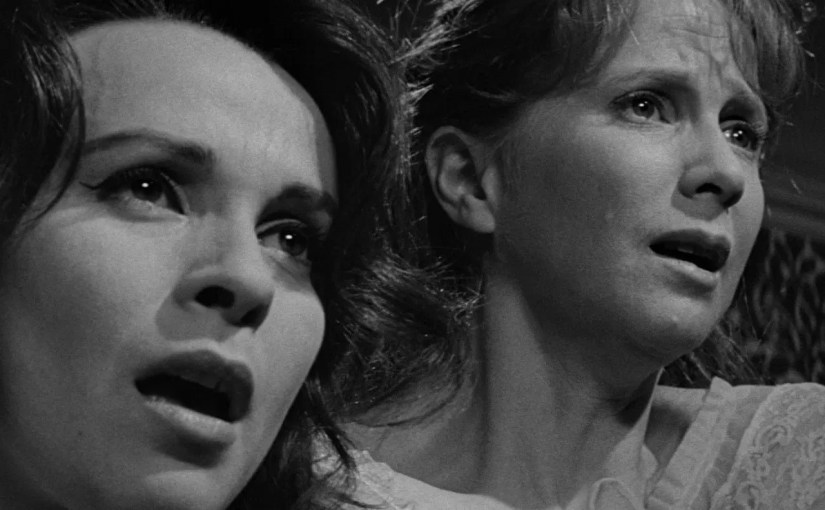
Buñuel’s The Exterminating Angel has many moods.  On the one hand, it’s a dark comedy of manners railing against the entitlements of the upper classes, much like the more recent Triangle of Sadness (2022), which owes much to this film.  On the other, it’s a Serling-esque horror story mining a common occasion for unexpected suspense, like The Ruins (2008) or Open Water (2003).  On a deeper level, perhaps it’s a Lynchian exploration of the human psyche, regardless of class, like Mulholland Drive (2001) or…well, with Lynch, you can probably just take your pick.

I experienced all of those moods while watching The Exterminating Angel.  I haven’t seen such an effective juxtaposition of tone since Everything Everywhere All at Once (2022).

The weirdness starts right away, in scenes that seem to be setting the stage for a Marx Brothers comedy.  Edmundo Nobile (“Nobile”, “noble”, get it, wink, wink?) has invited a large number of his posh friends to his mansion for dinner following an opera.  The moment they arrive, Nobile notes that his servants are not stationed at the door to take the visitors’ coats.  This is because most of the servants felt the sudden need to take the night off and left, being careful to avoid their employer.  He makes a statement about his servants, then everyone troops up the grand staircase to the dining room.

Moments later, this scene literally repeats itself, not by re-using the same footage, but in a separate take.  This kind of repetition occurs multiple times during the actual dinner scene, as well.  If there’s a deeper meaning to this device, I’ll have to leave it to film scholars to analyze.  For myself, it simply added a layer of oddness to the proceedings, but not in a bad way.

The dinner scene contains pratfalls, repeated conversations, and a visit to a side room containing three or four lambs and a bear on a leash.  What the WHAT…?  I remember thinking, okay, so this is going to a broad comedy turning upper-class manners into slapstick.  Seen it before, so I hope this movie executes it well.

The weirdness escalates when everyone retreats to a drawing room just off the dining room, where one of Nobile’s guests entertains everyone with a piano solo.  But when one of them tries to leave, he finds he can’t.  Not physically, like there’s suddenly an invisible wall, but one by one the guests discover they’re simply unable to leave the room.

They slowly realize the logistics of this bizarre situation.  The drawing room has no food.  Water runs low.  The one servant who remained outside manages to bring in a tray of water and coffee, but when he tries to leave to bring food…he can’t.  There’s no phone for them to call anyone about their predicament.

Outside the house, people find themselves unable to enter the grounds, so no one can tell what has happened to the people inside.  Curious crowds gather.  Inside, social structure starts to degenerate.  There are no restrooms, but one quick shot reveals a closet full of nothing but vases, and we see people entering and exiting these rooms repeatedly.  Ick.  Arguments are started with the drop of a hat.  One couple finds a unique, but undesirable, method of escaping their prison.

I responded to this material very unexpectedly, due mostly to its unpredictability.  I wasn’t cheering at the sight of upper-class twits being brought low when faced with bizarre circumstances, but I was more in tune with the horrific aspects of this story.  Buñuel has stated in interviews that he regretted not being able to take the story even further by including cannibalism, which is honestly where I thought things were headed.  It would have made a marvelous satirical statement, hearkening all the way back to Jonathan Swift.

(So, what DO they eat, you may be asking yourself?  Wouldn’t EWE like to know?)

I realize this review of the film hasn’t been much more than just a summary of its events, minus the surprising, “circular” ending.  A more detailed analysis might require listening to the commentary or reading Roger Ebert’s review or something.  But I hope I’ve conveyed how much I enjoyed The Exterminating Angel.  It was weird and surreal and absurd, and comic and horrific, and slapstick and satiric, and totally unpredictable all the way to the final frame.

P.S.  Now that I’ve seen this movie, the Woody Allen film Midnight in Paris (2011) has even deeper resonance when Gil meets Buñuel at a party and gives him the idea for The Exterminating Angel, and even Buñuel can’t understand it: “But I don’t get it. Why don’t they just walk out of the room?”  Funny stuff.

ASHES AND DIAMONDS (Poland, 1958)

by Miguel E. Rodriguez

DIRECTOR: Andrzej Wajda
CAST: Zbigniew Cybulski, Ewa Krzyzewska, Waclaw Zastrzezynski
MY RATING: 7/10
ROTTEN TOMATOMETER: 96% Fresh

PLOT: Against a backdrop of internal political turmoil at the end of World War II, a Polish resistance fighter faces a crisis of conscience when ordered to assassinate a Soviet official.


The Polish film Ashes and Diamonds is reportedly Francis Ford Coppola’s favorite movie, and Martin Scorsese has stated in interviews that he used it as an answer for one of his finals at film school.  From a technical standpoint, I can see why.  Echoes of this film (and perhaps others from director Andrzej Wajda’s filmography) are overwhelmingly evident in the bodies of work of both directors, from the mobile camera to the shocking moments of violence to the psychological makeup of the characters themselves.  As an emotional experience, I confess I didn’t get “worked up” over it, but it was interesting to see where two of the greatest American film directors got a healthy dose of inspiration.

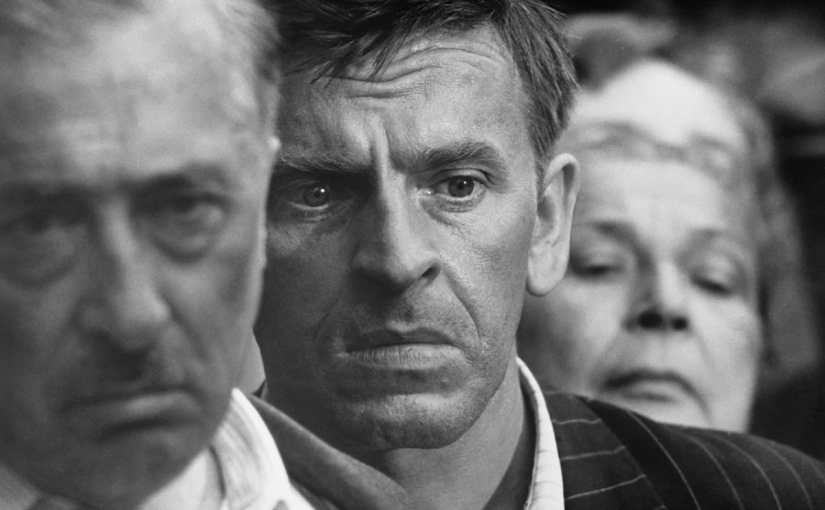
Ashes and Diamonds opens on May 8, 1945, with an idyllic scene outside a country church that quickly degenerates into a brutal double murder.  The killers are the calm, detached Andrzej and the flighty, charismatic Maciek, who spends most of the movie behind dark sunglasses.  We quickly learn their victims are not who they thought they would be.  Instead of killing two Soviet/Communist officials, they have killed two innocent factory workers.  War is hell.

Later, through circumstances that feel very Hitchcockian, Andrzej and Maciek hole up in a hotel bar, only to discover that one of their real targets, Szczuka, has booked a room in the very same hotel.  Maciek books a room directly below Szczuka’s, and the rest of the film plays out with that element of suspense hanging in the background, leaving us to wonder when and how Maciek will complete his assignment.

Complications arise when Maciek becomes infatuated with the hotel bartender, Krystyna, a blond beauty who rebuffs Maciek’s advances at first.  Later, they connect, but she doesn’t want to get involved with someone when it will eventually have to end: “I don’t want bad memories when memories are all I have left.”  Maciek falls for her so hard that he starts to doubt his resolve to kill his target.  “Will he or won’t he?” becomes the movie’s prime conflict.

Where to begin with the comparisons to Coppola and Scorsese?  The most obvious one is the unblinking attitude towards violence.  The two killings at the beginning of the film are done with very few cutaways as we see the multiple bullet hits on each victim, with one of them getting hit in the eye and another shot in the back at point blank range with such force his shirt catches fire.  (Malfunctioning squib?  Possibly, but it’s still effective.)  It’s interesting that this movie predates Bonnie and Clyde (1967) by almost a decade, but its depiction of onscreen violence feels very modern, even by today’s standards.

Then you’ve got the moral struggle of the main character, a man of action capable of casual murder who is suddenly given a reason to make something different with his life.  This reminded me of Scorsese’s The Departed (2006), with DiCaprio’s character undergoing the same internal conflict.  Maciek has multiple opportunities to kill Szczuka throughout the film, but something always pulls him back from the brink.  His partner, Andrzej, becomes impatient and reminds him what happens when soldiers let personal feelings interfere with their duties.  I had a vivid flashback of Michael Corleone’s credo: “It’s not personal, Sonny.  It’s just business.”

(I also felt that the dynamic between Maciek and his more level-headed partner Andrzej were evoked in Scorsese’s Mean Streets [1973], with De Niro’s Johnny Boy and his more level-headed partner Charlie, played by Harvey Keitel.)

But, cinematic comparisons aside, I didn’t find Ashes and Diamonds to be as gripping as other war or crime dramas of that era, such as Elevator to the Gallows, Touch of Evil (both 1958), or Rififi (1955), to name a few.  It’s a little weird to me, because all the pieces are there for a first-rate thriller.  I’m not asking that every drama pack the exact same kind of emotional gut punch every single time because I know that’s unrealistic.  But the fact remains: Ashes and Diamonds, while clearly very influential on future filmmakers, did not get me as involved as I would like to have been.  I was never bored, but neither was I over the moon.  It was…average.  Perhaps one day I’ll watch it again with a fresh eye to maybe see what I missed the first time around.

THE MUMMY (2017)

By Marc S. Sanders

The Universal logo comes up with that familiar music across the blue globe. Then it goes in reverse and turns black and gold to introduce a new franchise known as the Dark Universe.  This is the first installment.  The problem is of all the famed monsters in the studio’s library, they probably shouldn’t have started with The Mummy.  Brendan Fraser’s attachment to this mythical Egyptian horror is still widely accepted, and Tom Cruise is no Brendan Fraser.

This reinvention begins much like the 1999 film by telling of a Pharoh’s daughter who believed she was the sole heir to the kingdom.  Yet, betrayal happens and the beautiful princess is mummified into eternity, buried deep under the desert and laid with vengeance on her mind.  Elsewhere, another tomb is discovered under the streets of London. Could there be a connection? A dagger with a red stone might have the answers.

Jump to present day and Tom Cruise is back with another character who can run very fast.  He is Nick Morton and with his partner he clumsily runs and jumps over rooftops in the Egyptian desert while closely evading military air strikes from above.  Why the military is dropping bombs is apparently irrelevant.  Tom Cruise just needs something to run away from.

A massive crater opens up and the pair along an expert archeologist named Jenny Halsey (Annabelle Wallis) come upon a tomb.   Nick mistakenly frees the Egyptian princess buried within and they transport her, still contained in her coffin, back to London aboard a cargo plane.  Only now Nick is seeing visions of what once was and becoming familiarized with an ancient language with which he had no prior knowledge.  Nick has been chosen.

When you place Tom Cruise on board a military cargo plane, what do you think happens? It doesn’t have to be called Mission: Impossible to be a seemingly impossible mission. The crashing airplane sequence is impressive, not the best, but I’ve seen this stuff already. I’ve seen this stuff already with Tom Cruise. I do not need to see it again. 

The Mummy cannot decide what it wants to be.  It has some good ideas but just when I think I’m watching another Brendan Fraser swashbuckler with a monster, Tom Cruise must pound it over my head that this is a stunt filled trajectory.  

Russell Crowe is a mysterious character offering voiceover narration during a prologue. He later reveals his identity to Nick.  I will not spoil who he turns out to be.  Let’s just say it is likely you heard of this guy.  It’s hard to believe that Nick has not, and Mr. Cruise does not play dumb very well. This man has an interesting laboratory that contains relics and possessions that belonged to other well-known cinematic monsters.  Frankly, this picture should have exclusively belonged to Crowe’s character who comes off very dynamic and fresh while setting up a whole – forgive the pun – universe for a long line of films to come.  

Alas, Tom Cruise sets the stage.  He’s okay in the role, but between his temptation to be Ethan Hunt while adopting a Robert Downey Jr sarcasm and the imperfect Brendan Fraser/Indiana Jones hero, it all gets muddied. I just didn’t like this guy.  Cruise delivers what each chapter of the script demands of him and none of it is consistent. Near the end of the film during the final battle, Cruise offers up a one liner that comes nowhere near as close to what Downey, Fraser or even Arnold Schwarzenegger could have accomplished.

The only clarity I find in the visual effects is that they look rushed for final print towards a summer blockbuster release.  The Mummy Princess (Sofia Boutella) unleashes her monster minions to pursue Nick and Jenny while they are escaping in a clumsy looking ambulance.  As the creatures attack the top and both sides of the vehicle they are shaken off, thrown into trees, or run over.  They all look like monster vomit accompanied by loud hissing to startle your hearing.  

This iteration of The Mummy is partly assembled by the guys who made the Transformers movies where the robots look like metallic throw up mush.  Guys like Robert Orci and Alexander Kurtzman, the director, are poor artisans at the sci-fi/adventure/horror genre.  They know how to helm movies like this about as well as I do.  I don’t know shit, but I do know the visuals here are pure junk while being an enormous step back from the Fraser films of twenty-five years ago.  

The Mummy ends like the Marvel movies with the hanging threads of what we should expect.  I’m game!  Only, don’t do it like this.  Anything but this, please.  

Sadly, as quick as the Dark Universe got started it all got canceled.  This film was poorly received and did not generate the box office bonanza the studio was counting on.  I recall a fascinating publicity photo that assembled Cruise, Crowe, Boutella, along with Javier Bardem, and Johnny Depp. All were publicized to occupy upcoming installments of this new franchise.  The potential was so strong to see the likes of The Mummy, the Invisible Man, the Bride of Frankenstein, the Creature From The Black Lagoon, The Wolfman, Dracula and Jeckyl/Hyde sharing the screen together.  This could have been the antithesis to The Avengers and Justice League with gags of gore to delight audiences.

I swear when I saw that Dark Universe logo at the beginning, I was ready to love this movie.  I really was.  Unfortunately, The Mummy works hard to be a Tom Cruise actioner with his preserved thirty something looks adhered to an assortment of unfinished and indecipherable special effects.  Its script from David Koepp (Jurassic Park) is exhaustingly incoherent.  

The Mummy was a long-term investment by a million-dollar corporation.  It’s too bad the wealth went into junk bonds though. I urge Universal to try again. There is something to be made here, and it cannot get worse than this.

GET OUT

By Marc S. Sanders

Consider this for a second.  You’re an African American thirty year old who has recently begun a promising relationship with an affectionate, loving Caucasian woman.  As she attempts to ease your apprehension about meeting her parents for the first time she tells you her dad would have voted for Obama if he could have run for a third term.  When you arrive at their upstate home, one of the first things dad tells you is that if he could, he would have voted for Obama for a third time.  Exactly why is that so important to say?  From her?  And later from him?  Why is it necessary for an audience to hear the statement twice within a span of less than fifteen minutes? While it should sound assuring, it feels anything but trusting.  That’s how smart Jordan Peele’s debut horror/thriller is.  He has a way of delivering two different perspectives with one simple statement.

In Get Out, Daniel Kaluuya is Chris.  His girlfriend is Rose played by Allison Williams.  These actors are a perfect pair on screen but that’s about all I want to share with you considering their relationship.  

Chris is meeting Allison’s family at their home for their weekend.  It’s a beautiful, quaint estate off the beaten path from any intrusive neighbors.  Burrowed within the woods, this is a place to escape the stresses of city life.  Just like with any horror film though, the characters do not know they are operating inside a horror film.  The audience always does, and the best filmmakers find those frequent moments to get their viewers to squirm in their seat, tuck their knees under their chin, clench the butt cheeks maybe and say, “Don’t do that!,” “Don’t go in there,!” or maybe they’ll urge you to “GET OUT!!!!”

Nevertheless, the storyteller finds it important to bring up Barack Obama on more than one occasion???? 

Before they even get out of the car, the landscaper, a black gentleman, seems curious to Chris.  Friendly handshakes and welcoming hugs on the porch segue into the furnished home and there’s the maid, a black woman, who is as intriguing as the first black person to be seen.  Wouldn’t you know it but over lunch, you learn that tomorrow there’s the annual party gathering of friends.  Oh my gosh, was that this weekend?  

Jordan Peele doesn’t turn on the creepy music you may expect.  He relies on his visuals and while you are being as observant as Chris, you just might be alarmed and less sensible than he is.  That credit goes to Kaluuya, giving a reserved, contained performance.  This guy does not look like a hero in the least because he has instincts but seems to never look for a fight or a debate or the need to set an example.  An unexpected stop on the drive over demonstrates where Chris stands in a topsy turvy world of political divides in the twenty first century.  He just wants to make life easy.  So, he also will not make waves when that groundskeeper runs directly at him in the middle of the night.  This is just too freaky, but Chris tells us to just get through the weekend.

Rose’s brother seems like a weirdo from a Judd Apatow comedy, but he’s not being a clown.  Dad (Bradley Whitford) is a successful surgeon always ready with a relaxing tone and an open hug.  Mom (Catherine Keener) has done well as a psychiatrist performing hypnosis on her patients.  Yet, a late-night encounter with her leaves Chris feeling uneasy. Visually, it’s disturbing when he reflects on what he thinks he experienced with her.  However, he tries to give the family the benefit of the doubt especially when he shares his concerns with Rose.  Allison Williams is quite good with being convincingly dismissive.  I trust her, and I like her too. 

Then there’s the party the next day.  All the guests, primarily white, arrive exactly at the same time in a convoy of tinted black sedans and SUVs.  Chris doesn’t hide himself despite feeling awkward, and he doesn’t initiate the odd conversations with these middle age WASPs, but he politely keeps engaged with them.  Ironically, the strangest conversation he experiences is when he approaches a fellow black guest who is oddly dressed inconsistently compared to everyone else while his demeanor looks like he’s in a trance.

For comedic effect, Jordan Peele incorporates a best friend for Chris to confide in with opportune cell phone calls.  Lil Rey Howery is Rod and I can say, unequivocally, he is the best endorsement for the TSA. I do not recall seeing Howery in other films of late, but this actor deserves a long career for making a big splash in Peele’s busy picture.  Get Out would never be as inventive if Howery’s role is edited out.  Rod is the only other guy who, from a distance, can tell something is not right, here.

Get Out closes on an airtight ending.  Explanations for everything that is questionable is provided.  Yet, on both occasions that I’ve watched the movie, I think about it long after it’s over.  It takes some of the best elements you might uncover from The Twilight Zone, plus what you might have seen in the original Texas Chainsaw Massacre, and builds new ideas off of those circumstances.  

It is especially fun to read the IMDb trivia about the film to uncover a wealth of appropriate symbolism that does not jump directly at you.   You’ll appreciate how clever Jordan Peele is as a writer.  Froot Loops without milk in a bowl says much about a character.  Another character is engorged with the antler of a taxidermic deer head.  One character scrapes cotton stuffing out of an armchair.  Jordan Peele approaches his scary fiction with an educated eye.  

This movie is inventive.  Its horror does not seem redundant and thankfully the monsters are not vampires and zombies all over again.  There are new tactics at play.  There are fresh approaches to victimize the heroes, and there are creative ways to surprise the audience.  

Get Out is amazing the first time you watch the film.  On a second viewing, Jordan Peele’s story works like a class experiment in social standards while it still has fun by keeping you in triggering suspense.

FRANKENSTEIN (2025)

by Miguel E. Rodriguez

DIRECTOR: Guillermo del Toro
CAST: Oscar Isaac, Jacob Elordi, Christoph Waltz, Mia Goth, Charles Dance, David Bradley
MY RATING: 8/10
ROTTEN TOMATOMETER: 86% Certified Fresh

PLOT: A brilliant but egotistical scientist brings a creature to life in a monstrous experiment that threatens to undo both the creator and his tragic creation.


Having never read the original novel by Mary Shelley, I have no idea if Guillermo del Toro’s rendition of Frankenstein is any more or less faithful to the source material.  What’s interesting about this version is that it feels like it is.  There are long passages of dialogue and even some monologuing on the nature of life, death, and the creator’s responsibility to their creation.  del Toro is smart enough to balance these cerebral discussions with enough gothic (and gory) horror to satisfy any fan of the genre.  Call it a good example of a thinking man’s horror film.

Oscar Isaac’s performance as Victor Frankenstein puts a new spin on the stereotypical mad scientist.  He’s no less obsessed than previous versions, but del Toro and Isaac went for a slightly different vibe in his personal appearance.  Rather than a cackling lunatic with a god complex, Isaac’s doctor looks and sometimes behaves more like a self-absorbed rock star…with a god complex.  (I learn on IMDb that this was by design; del Toro wanted Victor to evoke David Bowie, Mick Jagger, and Prince…mission accomplished.)

Jacob Elordi as The Creature does an admirable job of generating sympathy and empathy for perhaps the greatest misunderstood monster of all time.  The unique makeup (which took up to 10 hours to apply!) allows Elordi to emote and lend humanity to the Creature in the second half of the film, especially during his encounter with the blind man.  There is a subtle but ingenious effect where one of his eyes will sometimes glow orange with reflected light as a reminder that, when push comes to shove, this Creature is not to be trifled with.

Mia Goth is a welcome presence as Elizabeth, who is not Victor’s love interest this time around, but fiancé to Victor’s younger brother, William.  I supposed I could quibble that the screenplay does not give Elizabeth much to do.  She comes across as the intellectual equal of Victor in a few well-written scenes, but her encounter with the chained Creature felt a little trope-y, and her character’s payoff left me wanting more.

The visual style of the film is crammed with del Toro’s signature fingerprints: huge gothic structures, elaborate costume designs (loved Victor’s mother’s red outfits near the start of the film), startling dream sequences, and lots of practical effects…well, more than there were in Pacific Rim (2013) and Crimson Peak (2015), anyway.  One image that really struck me was the unique design of two coffins seen in the film.  They looked more like futuristic cryogenic chambers than Victorian-era caskets.  Watch the movie and you’ll see what I mean.

Other things I loved:

  1. Victor’s early presentation of his theories to a disciplinary board, in which we get an echo of that creepy dead guy resurrected by Ron Perlman in del Toro’s Hellboy (2004).
  2. The towering set for Frankenstein’s laboratory.  What it lacks in the whirring, crackling machinery we normally associate with his lab, it makes up for in scale, including a yawning pit several feet across that really should have had a guardrail.
  3. Being able to get inside the Creature’s head this time around.  There have no doubt been other variations where the Creature speaks, but I haven’t seen one where he is this eloquent, expressing his pain and anguish over his unwanted existence and apparent immortality (his wounds are self-healing).  This is another factor that makes this movie feel more faithful to Shelley’s novel, even if it isn’t.
  4. The no-holds-barred aspect to the violence and gore, which can be quease-inducing, but which never feels overdone or exploitative.  In fact, the moment that scared me the most in the film had nothing to do with the gore or violence at all, but with one of the doctor’s early experiments that comes to life in a most surprising manner.

Above all, there’s the tragic nature of the poor Creature’s existence, the misunderstood monster that has been so often satirized or spoofed, and the deeper questions the story raises about our own lives.  It might be tempting to listen to the closing passages of the film and dismiss them as trite and sentimental, but Frankenstein earns those moments, in my opinion.  More than any other Frankenstein movie I’ve seen, this one made me think, and jump a little, in equal measures.  Tricky stuff.

INTERVIEW WITH THE VAMPIRE: THE VAMPIRE CHRONICLES

By Marc S. Sanders

Fantasy of the supernatural or science fiction work best when the writer can teach the reader or the viewer how its foreign worlds work and how the characters who occupy the environments function and live.  Anne Rice had her own interpretation about how creatures of the afterlife live by night.  Her vampires possessed theatricalities.  Some were charming and sophisticated, and relished how they lived immortally while satisfying a hunger for the blood of living humans.  Some struggled with the discomfort that comes from being a remorseful bloodsucker.  The first of Anne Rice’s series of vampire novels, Interview With The Vampire, runs a very wide gamut of perceptions.  By the end of the film adaptation, directed by Neil Jordan, I’ve earned quite an education.  (Frankly, Rice’s novel was tediously slow moving and bored me to tears.)

In present day San Francisco, a young man (Christian Slater) sets up his tape deck to record a conversation with a soft spoken pale faced man in a dark suit with a neat ponytail in place.  This mysterious person is Louis, played by Brad Pitt.  His story begins two hundred years earlier, in New Orleans, back to the day when he was incepted into an immortal life as a vampire. His agent of delivery is the devil-may- care and mischievous Lestat, one of Tom Cruise’s most surprising and unusual portrayals.  He gives a brilliant performance that’s as far a cry from his lawyer roles or his Maverick and Ethan Hunt heroes as possible.  

Lestat is eager to guide Louis into the benefits of vampire life.  Louis, having already been depressed following the loss of his wife and daughter during childbirth, cannot grow comfortable with Lestat’s insatiable appetite to feast on aristocratic figures or plantation slave servants.  This is not a match made in heaven and their chemistry as a couple is tested. Louis would rather miserably feast on chickens and rats, while Lestat grows frustrated by unsuccessfully swaying his partner to taste the sweet nectar of blood dripping from the wrist of a lovely young lass.  Lestat turns towards a grander extreme to maintain his embrace of the morose Louis.

Through deception, the men welcome an eleven-year-old “daughter” into their underworld.  Her name is Claudia, played Kirsten Dunst in her introductory role.  I still believe this is her best performance, worthy of an Oscar.  The life of a vampire is delightful to the child, the same as Lestat perceives it.  However, as the decades move on, with changes in fashions and industry quickly developing, so does Claudia’s understanding.  Her body never matures, destined to always remain within the shell of a preteen child, and thus she commiserates with Louis.

It appears like I’ve summarized Anne Rice’s entire story, but I have not even come close.  Interview With The Vampire is to gothic horror the same way The Godfather is to mafia gangster life.  Both communities victimize people of an innocent world, but their members are expected to follow codes of decorum and respect.  The conflict lies in living as a bloodsucking vampire or a criminal gangster.  When a peer interferes or does not cooperate, then the individuals of these respected worlds become violent unto each other.    The viewer/reader observe how their patterns of behavior all play out and how one action or policy generates one response after another.  These films are high ranked authorities on their subject matters.

Louis explains to his interviewer how Bram Stoker’s celebration of vampires is dreamed up escapist fiction, though coffins and the avoidance of sunlight are absolute necessities to carry on.  Just like any person, vampires want to live happily, but life gets in the way and that can be frustrating on any number of different levels.  

Neil Jordan’s film is a marvelous exploration into the mindset of being a vampire.  Tom Cruise perfectly exudes Lestat as a vampire ready to joyously live with sin while he savors and lives a life of eroticism and material wealth.  A child like Claudia sees the attraction of being spoiled and spoiling herself, and she cannot get enough consumption of blood. Eventually though, her mentality outgrows what becomes redundantly mundane.  Louis is relatable like many people.  He is unhappy living the life he was born into.  Lestat grows aggravated with his family’s resistance to partake of what he relishes.  There is an extensive range of emotions on display with Interview With A Vampire. To be a vampire can be a privilege or a curse. It all depends on who you interview.

The look of this film is astonishing.  I know it was shot within New Orleans, Paris and San Francisco locations.  However, I can easily recognize some sound stage locales, and I have no complaints.  The art designs from Dante Ferretti are thoughtfully crafted with lantern lit, rain-soaked cobblestone streets of the seventeenth century to mucky, moonlit swamps.  Horse drawn carriages transporting abundances of coffins serve a purpose of humor and narrative as character misdeeds are routinely committed by Louis, Claudia and especially the trickster Lestat.  The furnishings of the aristocracy are embracing too.  It’s a remarkably convincing step back in time.  

The periodic costume wear by Sandy Powell completes the settings with colorful, silk garments, white ruffled shirt sleeves and buckled shoes for both the men and women as well as for Kirsten Dunst and some cherub cheeked children who come into play.  Everything looks so rich. The whole picture feels like stepping into one of those late-night ghost walking tours I’ve taken in small southern towns like Savannah and St Augustine.  Every scene, even when the film jumps to late twentieth century, is immersive.  

Anne Rice’s screenplay adaptation tells so much within two hours.  She allows time for the characters to sail to Europe seeking out others like them.  The second half of the film teaches us more about what it means to uphold oneself as a vampire.  

Neil Jordan sometimes delivers his film like a how-to documentary because you are consistently learning new details, not so much about plot but about a people you are not as familiar with. Often, the film segues into theatrical play as you might expect from Phantom Of The Opera.  It’s no wonder since eventually Anne Rice puts us in touch with the cabal known as Theatres des Vampires. Stephen Rea and Antonio Banderas get to take center stage within a literal theater where the facade of behaving like a vampire can be executed beyond the suspicions of a – ahem- live audience.  

Rice and Jordan get playful while also performing with horrific familiarity.  The bites on the neck are known to many of us for drinking blood.  Did you also realize that a vampire can drink from a crystal wine glass? There’s an elegance to how the actors’ characters consume the blood of humans.  Cruise and Pitt begin by going in for a passionate kiss, either on the neck or the weightless wrist of a victim.  Lestat is more aggressive. Louis caresses his meals on the rare occasion he dines. Claudia gives a puppy love bite. Cruise especially finds new and titillating ways to dine with each new feast.  Both actors are deliciously homoerotic, but on different parental planes with their child. Their love/hate relationship operates like Shakespearean stage work. That’s why I really take to Neil Jordan and Dante Ferretti’s choice of soundstages.  

I’ve become so bored with zombies and vampires.  How many iterations must be churned out of the same kind of monster.  This year’s horror hit, Sinners, was superb until it stopped being eye opening with surprise.  It eventually became the same old thing and offered nothing new to show me in its final blood-shedding act.  

Interview With The Vampire is one of the best vampire films though.  The film never ceases to speak directly to its audience.  The settings describe how life is lived.  The characters grapple with both internal and external struggles.  

It’s one shortcoming is that Anne Rice, Neil Jordan and cast/crew did not follow up with the author’s subsequent tales.  The subtitle, The Vampire Chronicles, seemed to promise an extension of this universe. I know of other Anne Rice film adaptations that chose not to continue on from what was done here, and the execution was terribly poor and disappointing.  There’s a biographical intelligence to Neil Jordan’s film that many films of all genres lack.

Anne Rice’s first film adaptation set the standard on vampire culture, and I have trouble thinking of anything since its release that closely matches it.  

Interview With The Vampire is the only one with a blood curdling bite.

SPECIAL GUEST REVIEW: STRANGE JOURNEY

By Ronnie Clements

A fan once said, “It’s not a movie, it’s a way of life.” And for so many, that sentiment still rings true!

Directed by Linus O’Brien, son of Rocky Horror creator Richard O’Brien, this long-awaited documentary stirred immediate excitement among die-hard fans and it delivers in spades. The fact that the story is told by the creator’s own son lends it an undeniable authenticity, yet Linus maintains a respectful distance from both his father and the legacy itself. The result is a documentary that’s not only superbly structured but also refreshingly objective and emotionally resonant.

I have often said that two of the most unforgettable Saturday afternoons of my life were spent watching live matinee performances of The Rocky Horror Show, years apart, yet equally electric. And while the film adaptation, The Rocky Horror Picture Show, may lack the raw immediacy of the stage, it remains endlessly enthralling. Its brilliance lies in its audacity. The score alone is a genre-defying rollercoaster, veering from tender ballads to glam rock anthems, with not a single misfire among them.

What makes “Strange Journey” so satisfying is its dual focus: we’re treated to behind-the-scenes insights into both the original stage production and the 1975 film. It’s a double serving and both courses are “delicious”.

So, what is the origin story of this campy, chaotic, Frankenstein-infused celebration of identity, desire and rebellion?

The documentary begins at the roots (literally) with Richard O’Brien re-visiting his childhood home in New Zealand, accompanied by Linus. Richard also returns to the spot where he once worked as a barber, now immortalized by a statue of him as Riff Raff. From there, the narrative shifts to London in the early 60s, where Richard took on menial jobs and honed his acting chops. His talent caught the eye of director Jim Sharman, who was intrigued by Richard’s side project: a musical.

That musical, originally titled “They Came From Denton High”, evolved into The Rocky Horror Show, premiering on June 19, 1973 at the Royal Court Theatre Upstairs, a modest, 60-seat venue. The rest, as they say, is history. The show’s success led to larger stages and eventually the cult film that would re-define midnight cinema.

Linus charts this journey with precision, revealing that the original production was anything but smooth. The original script was skeletal, the process chaotic, and yet (somehow) it all came together. Out of that artistic mayhem emerged a masterpiece!

Fans will revel in the treasure trove of interviews and archival gems. A few spoilers ahead: Jim Sharman cast actors based not on their voices, but their “presence”. And Tim Curry’s discovery of the “Frank-N-Furter voice”? A revelation. The documentary also positions Rocky Horror as a precursor to immersive entertainment, an idea that feels both timely and thrilling.

And now here’s my one hole in the fishnets, so to speak …

The documentary rightly highlights Rocky’s extreme significance to the LGBTQ+ community, its role in coming out, pride and self-acceptance. But I’ve never felt the piece belonged exclusively to any one demographic. From the very first viewing, the sexuality theme, while unmistakable, wasn’t the core for me. At its heart, Rocky Horror is a metaphor: a flamboyant, defiant anthem against conformity. It’s a rallying cry to reject the herd and embrace your truest self. “Don’t Dream It, Be It.” And that’s why Rocky is both infinitely universal and a pure masterpiece!

In the end, Linus O’Brien has crafted something truly special: a documentary that’s beautifully paced, richly detailed and emotionally uplifting. Millions of fans will no doubt echo my sentiment: “You’ve done your Dad proud. Respect!”

Trailer (with an introduction by Richard O’Brien) … https://youtu.be/G9oCkTag69E?si=KGyNqRtravCHGo6I

DOCTOR SLEEP

By Marc S. Sanders

I never yearned for a sequel to The Shining.  Yet, color me surprised at how well I took to Mike Flanagan’s adaptation of Stephen King’s return to psychic Danny Torrance and the haunting baggage he carries as a middle-aged adult in Doctor Sleep.  This is a time jump sequel that is nearly forty years in the future.

The film version of this story had a tricky challenge.  King notoriously despised Stanley Kubrick’s horror classic adaptation of The Shining. Several important details were not consistent between his book and the movie.  So, what was Flanagan to do?  Well, he got his blessing from the author to move ahead as a sequel to Kubrick’s interpretation because he also ensured that he would not veer too far away from how the novel was edited.  The director reasoned with King that more people are familiar with Kubrick’s product than what’s in King’s pages. Mike Flanagan found the right balance to please not only Stephen King, but also the respective fans of the novels and Kubrick’s unforgettable film.

Danny is played by Ewan McGregor.  He’s often reflecting on his childhood following his survival from his stay at the haunted Overlook Hotel in the snowy mountains of Colorado, where his delirious and murderous father terrorized him and his mother Wendy with an axe.  Now Danny is making efforts to recover from alcoholism as he takes a job as a hospice orderly in a small New Hampshire town.  It keeps him isolated while the ugly hauntings that he shines on stay contained in his mental lockboxes.  He also uses his gift to allow patients to peacefully carry over to the other side.   Danny becomes known as Doctor Sleep.

Elsewhere in the country there is a traveling cabal of people who devour the energies off of young children with similar shining abilities like Danny.  This small cult is known as The True Knot and their leader is the charming Rosie The Hat (Rebecca Ferguson).  The presence of one very special child is Abra (Kyliegh Curran).  Flanagan gets very creative in showing how Rosie, Abra and Danny locate and communicate with one another from faraway points.  Rosie’s technique is reminiscent of an amusing sequence in The Big Lebowski, though as you might expect the mood is altogether different in Doctor Sleep.  

Doctor Sleep is a longer picture than it needed to be.  The exposition goes on for quite a while where three separate stories are proceeding, and it becomes cumbersome to see how the dots are connected.  Yet, the movie eventually finds its way as things become more simplified.  Flanagan works some action scenes and neat visuals into the picture, but he does not neglect Stephen King’s penchant for nauseating and grotesque horror either.  Normally, I feign at seeing victimized children in deadly peril for the sake of escapist entertainment.  Here, it is repulsive on more than one occasion, but the moments serve the story and enhance the motives of the villains.  

The payoff of the film is the third act where this adaptation relies on much of Kubrick’s treatment of The Shining.  As the book was entirely different with its ending, Flanagan had to take a chance with some creative liberties.  Amazingly, his efforts score very well.  I’m not the biggest fan of Stanley Kubrick’s film (read my review on this site), but I had to cheer as more developments gradually unfolded.  There’s much to explore through the eyes of Ewan McGregor as Danny.

Mike Flanagan’s craftsmanship with a cast of supporting actors, including Henry Thomas (E.T.: The Extra-Terrestrial) assuming Jack Nicholson’s role, are quite uncanny and lend to the argument to not depend on AI or “de-aging” visuals to recapture what once was.  Carl Lumbly effectively takes over for Scatman Caruthers and Alexandra Essoe does a very good pick up from Shelley Duvall’s performance as Wendy – a little flighty, melancholy and zany. The little ticks and inflections in these newly cast actors are mimicked quite well without going over the top.

Set pieces etched into anyone’s subconscious who has seen The Shining are impressively recreated by Flanagan’s team, from stained walls, big curtains and chandeliers to that very familiar orange, brown/black sectional pattern on the carpet of The Overlook.  At one point in film, Danny goes for a job interview and the office he sits in is an exact recreation of when his father Jack met with the managers of the hotel at the beginning of Kubrick’s film.  This kind of attempt at consistency has to be saluted.  It’s really amazing.  Mike Flanagan shows his painstaking efforts at recapturing Kubrick’s designs. I do not look at these efforts by Flanagan as commemorations so much as I see an omnipotence that observes Danny like it did to his father Jack before him. Danny might have survived, but the demons of his past and the sins of his father remain. He can never escape where he came from even if he relocates to New Hampshire, or wherever he goes.

Doctor Sleep offers the disturbing imagery you’d expect from Stephen King.  I’ve never been the author’s biggest fan.  Still, I really appreciate the creativity he lent to his sequel nearly a half century later.  It makes sense to have waited this long for the writer to pick up where he left off with some of his most well-known characters and locations.  

This dark fantasy works for its collection of heroes and their villains.

NOTE: I viewed the Blu Ray Director’s Cut which Miguel informed me is the better way to watch the film. I agree. There are more nods to Stanley Kubrick’s original film, and the outline of the picture performs in chapter sections like you might expect in Stephen King’s novel. Mike Flanagan never lost sight of either storyteller’s accomplishments. Doctor Sleep is an undervalued achievement in film. A very worthy sequel.

THE LIFE OF EMILE ZOLA (1937)

by Miguel E. Rodriguez

DIRECTOR: William Dieterle
CAST: Paul Muni, Gale Sondergaard, Joseph Schildkraut, Gloria Holden
MY RATING: 9/10
ROTTEN TOMATOMETER: 92% Certified Fresh

PLOT: Prolific novelist and muckraker Emile Zola becomes involved in fighting the injustice of the infamous Dreyfus affair.


If you want to get me angry at the movies, you can do one of two things (besides leaving your phone on): Make a really terrible movie that makes me sorry I’ll never get those two hours back…or make a really good movie about some kind of social injustice, where those in power are so empirically wrong that any fool can see it, except those in power.  Matewan (1987) comes to mind, as do I, Daniel Blake (2016) and Do the Right Thing (1989).  William Dieterle’s The Life of Emile Zola falls neatly into that category, as well.

I’m tempted to give a play-by-play summary, but that would take too long.  In short, novelist and muckraking author Emile Zola is approached by the wife of Alfred Dreyfus, a French officer wrongly convicted of espionage and sentenced to Devil’s Island.  Mme. Dreyfus convinces Zola of her husband’s innocence, and Zola pens the famous J’Accuse…! article, an open letter published in the paper accusing the French military of antisemitism (Dreyfus was Jewish) and conspiracy.  The last act of the film covers Zola’s trial for libel.

The scenes that really made me angry were the ones where French officers planted, suppressed, or burned incriminating evidence of their own treachery.  Outright lies were paraded as fact, and the actual spy was acquitted in a court-martial of his own, just so the French government could continue the façade of Dreyfus’s guilt.  When the comeuppance arrives for the parties involved, it is immensely satisfying.  No one is drawn and quartered, which is what I would have preferred, but it’s good enough.

While the actor playing Dreyfus himself (Joseph Schildkraut) won the Oscar for Best Supporting Actor, it seems incredible to me that Paul Muni did not win for Best Actor that same year.  It went to Spencer Tracy for Captains Courageous, and I’m sure Tracy’s performance was exceptional, but Muni as Zola is pretty amazing.  He ages convincingly with Zola, from starving artist to a well-fed member of respected Parisian society, never less than convincing while playing a man much older than himself for much of the film.  The highlight is a late courtroom monologue that runs about six minutes.  It’s not exactly subtle screenwriting, but Muni makes the most of it.

The same could be said about the film’s screenplay as a whole.  It’s not the kind of story where the two sides have equal validity, so the script doesn’t have to be coy about where its sympathies lie.  There may be a few moments that feel like the film is preaching to the choir, but it nevertheless has great power.  That might just be me, though, given my proclivity for rooting against social injustice at the movies.

On the whole, The Life of Emile Zola is the tale of a life well-lived, punctuated by an incident that made Zola’s name immortal, and contains one of the best courtroom sequences I’ve ever seen.  It’s biography at old Hollywood’s best, not 100% historically accurate (as stated in an opening title card), but capturing the emotional essence of the story in a way no history textbook ever could.