
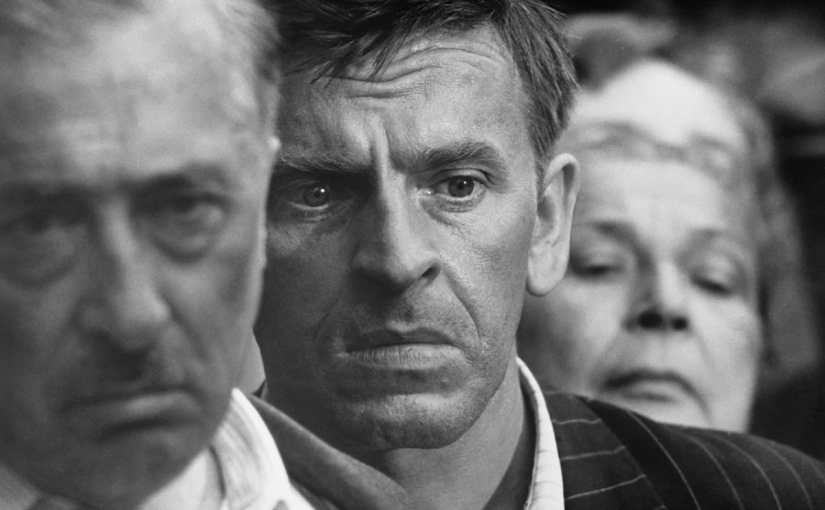
by Miguel E. Rodriguez
DIRECTORS: Ján Kadár, Elmar Klos
CAST: Ida Kaminska, Jozek Kroner
MY RATING: 10/10
ROTTEN TOMATOMETER: 100% Fresh
PLOT: During World War II, a carpenter in the Fascist Slovak State is appointed “Aryan controller” of a Jewish widow’s store.
The first hour or so of the 1983 TV movie The Day After features some of the tensest filmmaking I’ve ever seen. There is something terrifying about how these people go about their normal lives as their world spirals towards Armageddon. As the sirens begin, the tension reaches a breaking point when you realize it’s only a matter of a few unstoppable minutes before the literal apocalypse.
Oddly enough, that movie came to mind as I watched the Czech film The Shop on Main Street from 1965. Set around the year 1942, it takes place in a small town in Fascist-controlled Slovakia. Tono Brtko is a poor, timid carpenter with a nagging, avaricious wife whose sister is married to a high-ranking official in the local Fascist government. Tono is not a fan of the Fascists, not for any overtly political reasons, but because he doesn’t like his brother-in-law, who has always treated him as a peasant, even before he was a local bigwig.
One drunken night, the brother-in-law, Markus, gives him some news: as part of a new law, Tono has been appointed as the “Aryan controller” of a small shop owned and operated by an elderly Jewish woman, Rozalia. It’s now Tono’s job to take over the shop until the government figures out exactly what to do with Rozalia and the other local Jews.
(Interestingly, the Nazi swastika is not seen until the film’s closing sequences, but the Third Reich crouches just out of sight.)
What happens next is a curiously effective combination of suspenseful drama and outright comedy, approaching farce. In that sense, it’s tempting to compare this movie to Roberto Benigni’s Life Is Beautiful, but the tones are very different from each other. In Benigni’s film, the main character was impish and clownish, an Italian Marx brother. In The Shop on Main Street, Tono’s dimwittedness leads more organically to scenes of comic misunderstanding between him and the hard-of-hearing Rozalia. When he tries to explain the situation to her, she believes he’s been hired to be her assistant. When he arrives to the shop on Saturday morning, he can’t understand why the shutters are still closed well past opening hours. “It’s the Sabbath,” she says simply as she potters around the back room where she lives.
The comedy of these situations made me laugh, but the underlying seriousness of the plot snuffed it out. Tono’s wife is constantly nagging him to find out where the old lady has hidden her wealth, since everyone knows Jews are miserly and stingy. Tono and some of his friends talk about being careful not to be branded as a “Jew lover.” Tono, to his partial credit, is not as gung-ho as some of his other friends or his wife. He even mocks Hitler in a strangely tense scene, using a comb as the infamous moustache. But his conscience only goes so far, and he does his best to just stay under the radar.
Meanwhile, a tower is being built at the center of town to celebrate the Fascist government, and Tono’s Jewish friends can see where this is going and have started packing. Tono remains certain that, surely, things won’t get TOO bad. A loudspeaker is installed near the town square. And then every Jewish citizen receives a notice in the mail…
Beneath the comic personalities and situations, the looming threat of something even worse than run-of-the-mill fascism hovers over the town. Tono wages a constant war with his conscience. He’s unable to flout the law by simply refusing to take over Rozalia’s shop because that would mean possible arrest. But he has no interest in forcing this elderly woman out on the street. (He’s like me in the early days of Covid: things just can’t POSSIBLY get THAT bad…can they?)
I was riveted by this film. It felt shorter than its 2-hour-plus running time because of the tension running under everything like a thrumming power line. In that way, it’s almost Hitchcockian. And to top it off, this movie had to pass Soviet censors before being released, which absolutely blows my mind for some reason. The Shop on Main Street plays like a scaled-down version of Schindler’s List, or maybe more like a prologue. By focusing on a tree instead of the forest, this small-scale movie makes its point just as eloquently and as powerfully as Spielberg’s masterpiece.


 2 UNPAID MOVIE CRITICS!!!!