EAST OF EDEN (1955)

by special guest Ronnie Clements

“A special, re-written review of my favourite Jimmy film, to mark the 70th anniversary of his death on September 30, 1955. Forget Rebel, this is James Dean’s defining performance!”


East of Eden is unmistakably a product of 1950’s cinema, steeped in the era’s stylistic restraint and tonal sincerity. But that’s not a flaw, it’s a virtue. The film unfolds with a deliberate pace, anchored by a thoughtful script, evocative cinematography and deeply felt performances. There are no dazzling effects or adrenaline-fueled sequences here. Instead, the piece leans into emotional truth.

Despite its vintage aesthetic, complete with a sweeping overture and classic framing, the themes of East of Eden remain timeless. Set in 1917, it explores the fractures of a family in turmoil and a young man’s aching search for identity, love and belonging. These struggles resonate just as powerfully today.

Adapted from John Steinbeck’s novel and directed by Elia Kazan, the story takes place in Monterey, California. At its heart is Cal Trask (James Dean), a brooding, impulsive and emotionally raw young man, desperate for the approval of his stern father, Adam (Raymond Massey). His brother Aron (Richard Davalos) and Aron’s girlfriend Abra (Julie Harris) form the emotional triangle that complicates Cal’s journey. As buried truths surface, the drama deepens with quiet intensity.

Kazan’s direction is masterful. His use of framing and camera angles, especially in intimate scenes, reveals a deep understanding of character psychology. You feel the tension, the longing, the isolation … all through the lens.

This film holds a special place in cinematic history as Dean’s first major role, preceding Rebel Without a Cause and Giant. Tragically, he wouldn’t live to see either of those released. But here, in East of Eden, he is alive and electric. Every gesture, every glance, every awkward pause speaks volumes. This isn’t just a performance, it’s a revelation. Forget Rebel. Forget Giant. East of Eden is Dean at his most vulnerable, most human, most unforgettable!

Raymond Massey delivers a chilling portrayal of the emotionally distant father. The real-life tension between Massey and Dean (Massey’s rigid traditionalism clashing with Dean’s improvisational method acting) only enriches their on-screen dynamic. Kazan, ever the tactician, allowed that friction to simmer, knowing it would serve the story.

The supporting cast is equally compelling. Richard Davalos brings quiet strength to Aron. Jo Van Fleet is haunting as Cal’s estranged mother. And Julie Harris, caught between three emotionally volatile men, brings grace and complexity to Abra.

Revisiting East of Eden is always a bitter-sweet experience for me. Dean’s tragic death in a car accident not long afterwards casts a long shadow. Watching him as Cal Trask, so alive, so raw, makes you ache for the roles he never got to play. But through this film Jimmy becomes immortal!

Cal Trask lives!

42nd STREET (1933)

by Miguel E. Rodriguez

DIRECTOR: Lloyd Bacon (with choreo by Busby Berkeley)
CAST: Warner Baxter, Bebe Daniels, George Brent, Ruby Keeler, Una Merkel, Ginger Rogers, Dick Powell
MY RATING: 9/10
ROTTEN TOMATOMETER: 92% Fresh

PLOT: The unglamorous side of life on Broadway is laid bare in this unexpectedly enthralling musical from Hollywood’s golden years.


I’ll admit it: I was a victim of my own expectations.

For decades, I assumed that Lloyd Bacon and Busby Berkeley’s 42nd Street was your standard Hollywood fluff musical from an era when the genre had been beaten nearly to death, filled with wall-to-wall corny songs and even cornier story lines.  I was aware of the famous line from the film: “Sawyer, you’re going out a youngster, but you’ve got to come back a star!”  I was certain I knew everything I needed to know about the movie right there.  Unknown chorus girl gets a lucky break, becomes a star, a little song, a little dance, happy endings for everyone.

I’ve said it before and I’ll say it again: I love it when I’m wrong.  42nd Street defied all of my expectations, and even when it felt like it was caving to the genre, it did it so exuberantly that I caved into it myself.

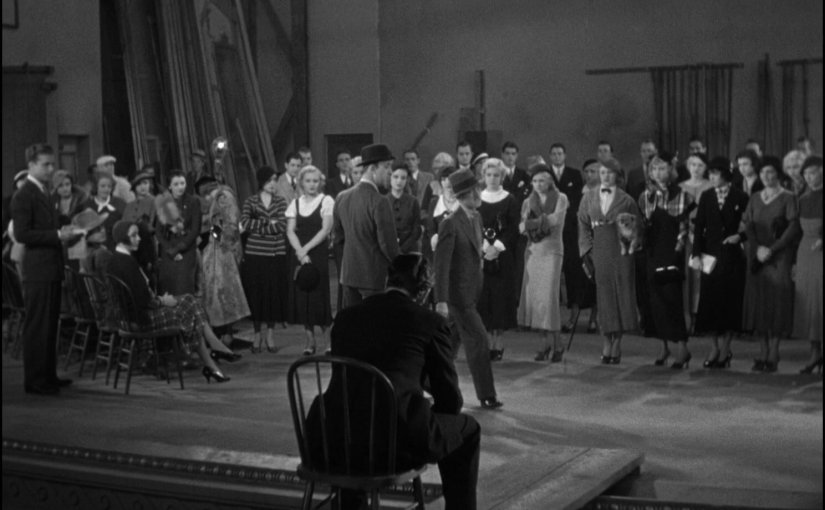
The story is ancient: A Broadway show is holding auditions at an unnamed theater on New York’s famed 42nd Street.  A rookie actress, Peggy Sawyer (Ruby Keeler), is one of scores of hopefuls at the cattle call, among them seasoned veterans Lorraine Fleming (Una Merkel) and Ann Lowell, played by Ginger Rogers the same year she was first paired with Fred Astaire in Flying Down to Rio…a legend in the making.  The show’s director, Julian Marsh (Warner Baxter), is a taskmaster who wants this show, “Pretty Lady”, to be his final masterpiece before he retires on advice from his doctors.  Then there’s Dorothy Brock (Bebe Daniels), the diva whose sugar daddy ensures she will get the plum role; Pat Denning (George Brent), Dorothy’s penniless paramour; and Billy Lawler (Dick Powell), the show’s “juvenile”, aka “mangenue”, who takes a shine to Peggy Sawyer when she interrupts him in his underwear in the dressing room.  Long story.

So, all the stock characters are here for a plot that was probably old even before the introduction of sound.  But 42nd Street subverted my assumptions by doing several things.

First, it is definitely NOT wall-to-wall with song and dance.  In fact, before we hit the final tune-filled 15 minutes, only one full number is performed.  Everything else is rehearsals, endless rehearsals with masses of dancers in their practice clothes or solo singers at the piano.  The backgrounds of the main characters are fleshed out in several scenes outside the theater, but the filmmakers were smart enough to keep those scenes to a minimum.  The real drama is on the stage, where it belongs.

(I loved those rehearsal scenes.  As an amateur actor in community theater myself, I had all sorts of flashbacks to my first shows as an ensemble member of big shows like The Music Man and Camelot, going through endless repetitions of musical numbers or just SEGMENTS of musical numbers until the director was satisfied.  I particularly loved one number being rehearsed on stage while the camera showed most of the cast and crew watching from the wings.  Pitch perfect.)

Second, the screenplay was not as cornball as the plot summary makes it sound.  I expected kitsch, but instead I got unexpected drama and grittiness, interspersed with comic relief and some outstanding zingers.  (“It must have been tough on your mother, not having any children.”)  Peggy Sawyer, the rookie, faints during rehearsal; Julian, after first making sure she’s not dead, yells at the stagehands to remove her from the stage so rehearsals can continue.  And they do.  When Julian learns of Dorothy Brock’s affair with Pat Denning, an affair which could jeopardize her participation in the show, he reaches out to an unsavory connection who agrees to rough Pat up as a warning.  Granted, this is all handled with a light touch, but this is serious business.  Putting a “hit” on someone?  Would a Broadway director ever actually do such a thing?  (Spoiler alert: probably.)

Third, by easing off the musical numbers until the last reel, 42nd Street positively had me eager for a full-blown song and dance.  And, brother, does it deliver.  The mythical Busby Berkeley pulls out all the stops for three sensational numbers that begin within the confines of a Broadway stage, and then magically “open up” into a cinematic tour de force.  I especially enjoyed the number where Ruby Keeler is clearly doing a complicated tap dance for real, but the best of the three is the film’s namesake, “42nd Street”, which is basically a travelogue of NYC, and which contains wild mood swings and some show-stopping choreography.  Watch for the moment when a young woman escapes a bad situation in her tenement apartment by running to the 3rd floor fire escape and then leaping to the street below.  I’m sure there were safety measures in place just out of camera range, like Harold Lloyd dangling from that clock, but in the moment, it genuinely looks like the cameras captured an actress leaping to her death.  Not to mention the sequence where the chorus transforms into the NYC skyline.  (In fact, I’d say the movie’s worth watching just for that final dance sequence…it’s astonishing.)

Fourth, the very end of the film took me totally by surprise.  At the risk of spoiling it, I’ll say that it takes place after I thought the movie WOULD end, and that it perfectly captures the combination of emotions that go through a stage director’s mind and soul after a show goes up and is an apparent success.  It’s another moment that felt absolutely real, with no overcooked dialogue or mugging.

It’s said that, before the release of 42nd Street, the movie musical was dead in the water.  Too many musicals had come before it, musicals that overdid the song and dance or had a half-baked story, etc.  Not only did 42nd Street singlehandedly revive the genre for decades to come, it also apparently saved Warner Bros. Studios from bankruptcy.  As someone who is not a particularly huge fan of older movie musicals, I wholeheartedly recommend this movie to anyone who is like me and has put off watching it because you think you already know everything about it you need to know.  I’m here to tell you: you probably don’t.  (And I especially recommend it to theatre aficionados who are familiar with the stage musical “42nd Street”, which pads the running time with dozens of additional songs, most of which were taken from Gold Diggers of 1933 [1933].)

GONE BABY GONE

By Marc S. Sanders

Ben Affleck’s directorial debut, Gone Baby Gone, is crime drama mystery thriller that never offers easy answers and concludes with great debate.  You’ll ask yourself if right decisions were made.  You will argue with your best friend or significant other about the endings.  What’s undeniable though is that the film, adapted from Dennis Lehane’s novel, is full of an array of characters, most operating with the best of intentions, and yet they wind up doing everything wrong or against their sworn principles.  In order to work the problem, these people will have to betray themselves. 

One of Affleck’s many best decisions was casting his brother Casey Affleck in the lead role of private detective Patrick Kenzie.  With his girlfriend, Angie Gennaro (Michelle Monaghan), they specialize in tracking down missing persons in and around the Southeastern Boston area.  The brothers’ pairing is especially effective as Boston, Massachusetts is where they were born and raised.  They know this setting intimately. Unpolished multi-floored tenement neighborhoods near seedy watering holes are where the crimes of Gone Baby Gone occur.  Casey can ensure that his character, Patrick, can speak the slang, use the thick dialect, and feel comfortable amid a crowded and overpopulated area. As director, Ben ensures the setting is captured in great detail from Red Sox caps to beat up cars and dirty unkept apartments and secret hang outs.

In the middle of the night a little girl has gone missing and her deadbeat, drug addicted, careless mother Helene (Amy Ryan) is unmotivated to offer the police much to go on. Helene’s brother and sister-in-law (Titus Weliver, Amy Madigan) take it upon themselves to hire Patrick and Angie to find their niece.  The only leads that Patrick, Angie and the police (Ed Harris, John Ashton and occasionally Morgan Freeman) have to go on are Helene’s contacts within the drug peddling underground.  Someone within that community might have taken the girl or know someone who did.

Gone Baby Gone may feel like a Law & Order episode where red herrings are offered early and then dismissed for the actual truth.  However, Lehane’s story twists much deeper beneath the surface.  Not one character is wasted in this film.  Each serves a purpose to how and why this crime ever occurred.  Mysteries get resolved but the answers are not simple because they are multi-layered with many different people spinning twice as many plates.

Ben Affleck seems nothing like an amateur director here.  He does not always rely on dialogue to describe a scenario because he films quite a bit of a disheveled room or kitchen, or an outdoor area.  A daylight scene will take place in a darkly lit bar where only people need to hide from their troubles on an ordinary workday, or maybe they are in there to suppress something uglier.

The cast is outstanding.  While the characters belonging to Freeman, Harris and Ashton seem familiar from much of their other career films, they look like they lived within this environment of three-story houses bordering the harbor, across town from Fenway.  You believe these guys know every alleyway, street corner or contact among the city’s small-time deadbeats. 

Amy Ryan was nominated, and perhaps should have won, for her trashy Bostonian performance as Helene, the missing girl’s mother.  This actress is buried so deep in this role, from her worn out facial features to her New England dialect that blends so well.  She is completely believable, which is why you would not be able to stand sharing the same space with her.

Titus Welliver dons a thick, wide Irish mustache.  I read he had to keep it because he was shooting his HBO series, Deadwood, at the same time.  Nonetheless, it builds his character into the blue-collar working man whose greatest achievement is getting out of the life of small-time crime in order to put food on the table, while his sister could not.  His wife played by the great Amy Madigan, an actress that does not get enough coverage, is perfect.  Just her facial expressions with a pale, freckled complexion, tight chin and pinched lips show her biting her tongue while in the same room as her loser sister-in-law.  It sickens her that a sweet little girl like her niece is missing.  Everything is read on her face.  I know Madigan best as Kevin Costner’s midwestern cheerful wife in Field Of Dreams.  She played this role almost two decades later and she absolutely hides herself.  You forget you are watching her.  An outstanding character actress.  (I’m glad she’s getting new recognition with 2025’s hit horror movie Weapons.)

Michelle Monaghan as the girlfriend Angie is the sidekick to Casey Affleck’s Patrick.  Yet, she makes the horror of this movie convincingly real.  Early on, Angie is reluctant to accept the case because she doesn’t “want to find a kid in a dumpster.”  Now this isn’t some Dirty Harry or Lethal Weapon cop showcase.  It’s not glamourized with Hannibal Lecter glee.  This has not become much further materialized.  I don’t want to see a horrifying outcome for a child either, but Ben Affleck’s direction does not make any promises.  There are some repulsive, scary people in this world, right outside the front doors where people listen to the game on the radio and kids play stickball in the street.  Monaghan seems like that young woman who came from another place in the country with a fine upbringing and fell in love with Affleck’s character. With her brains, instincts and empathy, Angie took up the cause as a fellow crusader.  None of this is spelled out in the film and I have not read Lehane’s books, but I can see it in Michelle Monaghan’s performance.

Casey Affleck is a perfect surprise.  He dons the appearance of a thin, shrimpy kind of kid (supposedly age 31), and yet no matter who he is coming face to face with he never shows any sort of apprehension.  I truly believe that Patrick is not afraid of his work or the people he has to confront while trying to solve his various mysteries.  If a large gun is introduced into a scene, Patrick’s reaction is an act of “whoa, what’s this?”  Another character in another film would tighten up and hold their breath, or they would knock the weapon out of the way for an action scene.  Patrick has put this kind of act on before to outlast a situation.  Angie has definitely seen it before. 

Casey Affleck is great at just listening.  Shortly after he accepts the case, Patrick and Angie are in one of these darkened bars trying to collect information.  Ben Affleck shoots his camera above Casey sitting in a booth with a beer.  The actor keeps his head tilted as if he is listening to nothing spewing from a possible lead sitting across the table.  When a gun is pulled though, Casey stands three feet taller than his posture implies and controls the scene.  That is Dennis Lehane’s character Patrick Kensie completely defined because Casey Affleck has a full understanding of this guy.  Someone like Patrick knew that if he was going to take this kind occupation on full time, he had better be aware he would not survive on brawn that he cannot show.  It’s a confidence that has to come through. 

Gone Baby Gone is a gripping and engaging thriller shown with varying degrees of light and perfect cinematography to offer genuine on-site locations of Boston and the surrounding areas.  Ben Affleck chose not to compromise any of his set pieces.  With handheld cameras, when a missing person’s search is happening, it feels like a documentary of procedure is being shown. 

The various directions and endings are entirely unexpected and yet very, very plausible.  This is a smart, sensational crime drama that deserves a resurgence of attention nearly twenty years after its release.

A CLOCKWORK ORANGE

By Marc S. Sanders

What is Stanley Kubrick attempting to demonstrate with A Clockwork Orange, arguably the most controversial and shocking film of his career?  The film is considered an almost precise adaptation of Anthony Burgess’ novel.  I never read the book, but the sources I found on Wikipedia and IMDb are consistent with their claims.  Kubick’s vision is never not odd or strange.  It’s almost always repulsive and I have to believe the director is proud of the finished accomplishments left in every caption and scene.  Yet even Kubrick was disgusted by some copycat attempts that spawned from what the story’s protagonist troublemaker executes within this context.  Regrettably, in 2025, it would be easier to ask what did you expect Mr. Kubrick?

In a dystopian future of England, young Alex (age 17, but 15 in the book) relishes on walking the streets each night, accompanied by his three droog companions, committing the worst atrocities imaginable.  They beat up a homeless beggar, engage in gang brawling, and brutalize and rape a wealthy couple in their own home to the celebrated tune of Singin’ In The Rain.  I’m curious how reminiscent A Clockwork Orange is to people who only wish to watch the cheerful and innocent fare of Gene Kelley.  Is their subconscious intruded by Malcolm McDowell as naughty boy Alex with the one eyelash, bowler hat, protective jock strap and erection mask?

Mayhem is the specialty of Alex and his degenerate friends.  However, Alex who is the leader of the pack is challenged to uphold his command on the gang of four, and once the others betray him, the poor boy is sentenced to a militaristic, concentrated prison where he must don an academy uniform while studying the gospel of the Bible.  

What happens though if the student sees himself more as the Roman with the harsh whip, and less as the savior willing to die for our sins?  Are people like Alex only inherently wicked, vile, and perverted?  Can nothing change their insatiable appetites for harm and evil doing?

I thought about One Flew Over The Cuckoo’s Nest while watching A Clockwork Orange.  McMurphy fakes an impression of insanity to be institutionalized. He operates under the presumption the circumstances will be more accommodating than a jail cell.  Alex campaigns to be a guinea pig for a new kind of therapy believed to eliminate all temptations of violence and cruel sexual escapades. This could be a means to free him from a forty-year prison sentence. I never believed he wanted to be liberated from his appetite of rape, torture and murder, though.

Following an abundance of sickening, visual exposition, Stanley Kubrick is ready to test some possible outcomes by forcefully prying open the subject’s eyes to witness footage of violence, extreme rape, harsh pornography, and Nazi propaganda.  Will this overexposure repulse Alex away from being the monster he used to be?

I’m not sure A Clockwork Orange provides any definitive answers but the weirdness of this off scale and ugly England is nothing but apparent.  Nothing is normal looking or relatable in this film.  Everything from the colors to the costume wear to the slang verbiage of the dialogue and even the furniture is completely twisted.  Kubrick would offer a similar approach in The Shining. No director is louder and more offensive with colors in a film. A green bedroom ceiling or a blue typewriter or even a glass of milk and stark white sexually posed mannequins used as furniture pieces in a hangout joint are so much more than discomforting.

Even the infamous rape scene is uncharacteristically done.  The Droogs happily sing while brutalizing this couple.  Before Alex commits his “push in, push out” he scissors the woman’s red jumpsuit around her individual breasts before cutting her out of the fabric to be entirely nude.  I’ve seen plenty of staged rape scenes but then there is what Kubrick envisions. Not to mention, how notoriously redundant he is with repetitively shooting his scenes over and over again. Kubrick is an auteur filmmaker but his desire for perfection in his shots are as twisted as many of his films.

A woman is brutally killed by being pummeled with a sculpture of a penis/taint/anus piece. (I don’t know what else you call this!) A typical baseball bat, stick or hammer is not the bludgeoning weapon of choice. Stanley Kubrick wants to ensure this perverted item of art owned by a wealthy woman is used to commit the crime. A mix of sinful natures ranging from sexual to violent.

Why go to all of these lengths to be so unusual?

A Clockwork Orange is deliberately shocking and thus everything on display is disorienting.  With all the movies and TV shows I’ve watched, on top of some of the most unusual fetishistic material I’ve witnessed, I imagine I’m like most viewers where I’ve grown accustomed to the violent and sexual debauchery on display.  I’ve seen so much I am practically desensitized to it all.  When I read about another school shooting in the news, regrettably and with sick sarcasm, I’ll think to myself, “Huh!  Must be a Tuesday.”  It feels so wrong but there is truth in this ongoing epidemic. Stanley Kubrick, back in the early 1970s, had to work that much harder to grab the attention of the viewer.  Nothing can prepare you for an initial viewing of A Clockwork Orange. Back in 1971, I’d argue no one was prepared for this film’s content. It’s a pioneering document of extreme violence and sexual perversion. Filmmakers, like Martin Scorsese, David Lynch, and Brian DePalma hereafter would push their own limits while bridging these activities with the natures of their challenged characters.

Is there a confidence to seeing if a heathen like Alex can be cured of his original nature? Can he be returned to a society where his once menacing threat is nonexistent?  Plus, can Alex live a peaceful and nurturing life?

Alex is not the only villain to this piece.  While we do not get to know his parents well enough, how sadistic are the individuals behind his therapy process? Alex’ “recovery” becomes politicized and treated like scientific doctrine at the expense of his own humiliation. He is used to prove a point by beating him up publicly and forcing him to lick the bottom of a man’s shoe and exposing him to a naked woman, as well. Those that he encounters again, like former victims and fellow Droogs, following his therapy are not perfectly complimented to this new Alex. Scenarios that re-introduce him to society imply that Alex’ conditioning process might have overlooked what was to come following his release. Were they truly “healing” their patient?

A Clockwork Orange is never a refreshing film.  It’s always alarming right down to its final frame.  The picture certainly does not endorse the merits of psychotherapy or psychological reform.  Maybe, that’s why I believe that anyone specializing in the field of mental health should watch the picture. See what works and what doesn’t. Kubrick is uncompromising with getting his cast to do what he wants, no matter how off putting the material is. If anything, I wonder if this movie is more relevant today. Can anyone who traps themselves in an impersonal and isolated environment of social media influence attain the capability to shed their destructive proclivities for a natural desire to live, care and cherish fellow human beings?

Like most of Kubrick’s films, A Clockwork Orange is not an easy watch.  I know a friend who describes the movie as a comedy.  I know what she’s talking about and why. Still, how can anyone allow themselves to guffaw at someone who is an agent of death, torture, destruction and chaos? 

I don’t know what else I can say about A Clockwork Orange.  I do not recall asking so many questions in one review as I demonstrate here. Watch the film on mute or with Alex’ voiceover against an assortment of classical music as Kubrick intends simply because Alex’ only friend, only ally, is “Ludwig.”  No matter how you observe the piece, it is likely your jaw will drop, and your eyes will wince.  You will cringe and you will unquestionably test your tolerance.  You may just turn the movie off.

Regardless of how you respond to the picture, be assured that Stanley Kubrick successfully completed what he set out to do.

BLOW OUT

By Marc S. Sanders

Brian DePalma’s Blow Out is an inventive approach to the political conspiracy thriller.  In 1981, following a mask of innocence the United States lost with the assassination of President Kennedy, later his brother Bobby, plus the drunken, liable carelessness of their brother Ted, and then finally the Watergate scandal, DePalma capitalized on newsworthy incidents to make a paranoid thriller of present day while incorporating what he likely knows much about which is sound effects editing.  Despite the cheesy music soundtrack that is highly intrusive and poorly composed, Blow Out is a good blend of hysteria and suspense.

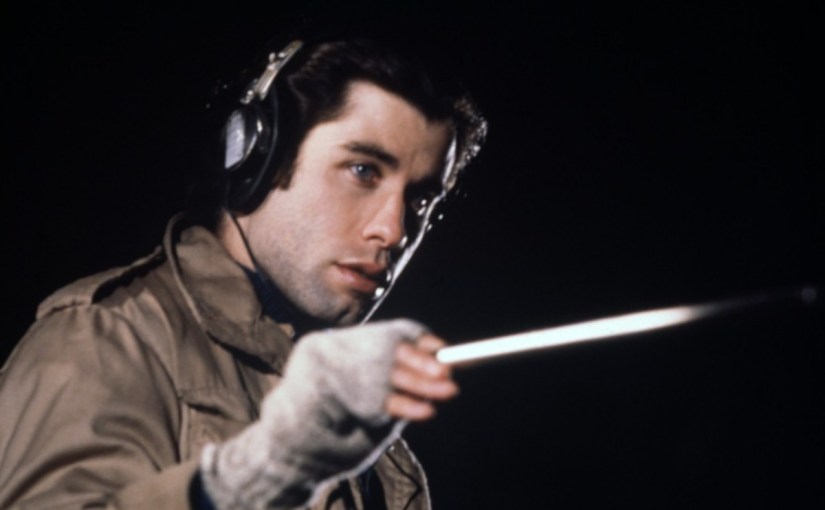
John Travolta plays Jack Terry, a Philadelphia sound effects recording artist for b-grade schlock horror movies.  One night, while out in a park trying to pick up sounds of outdoor nature, he witnesses a car suffer a blown-out tire and crash into a nearby river.  Jack is able to rescue a woman named Sally (Nancy Allen) but cannot save the Pennsylvania governor who was driving the car.

As he is about to leave the hospital, he is specifically instructed to never speak to Sally nor acknowledge to anyone about any of his own involvement in this incident.  However, Jack cannot help but recount the sequence of events in his head and as new details come to light, he knows that there is a cover up at play.

Blow Up operates like a how-to kind of picture.  The expertise of a sound effects recording artist is demonstrated as Jack replays every sound that his equipment picked up. Later he’s able to manufacture his own film by assembling a series of published photographs that also captured the crash.  Sync up the sounds with the sights and a new theory surfaces.  Other mysteries change the course of the riddle through dialogue.  This character has to work by himself using the skills he’s acquired to learn the truth.  He hardly has anyone to commiserate with.

John Travolta is convincing within this occupation that’s not as common as a cop or a private eye.  I like how I can pick up how he uses his recording equipment and even the minute details like labeling what he has preserved within his inventory.

It took a little bit of patience to get used to Nancy Allen’s damsel in distress who plays it up like Judy Holliday or Jean Hagen with the squeaky, dingbat voice.  When we first meet her, she is in an intoxicated stupor that goes on a little too long. Nevertheless, I came around because the tension of the film builds quite well.

John Lithgow is the sadistic adversary – a serial killer and assassin rolled into one.  He’s got the weird, unwelcome appearance like any bad guy in a Hitchcock film.

DePalma is known for his split screen cuts that he offered in Carrie and later in Mission: Impossible.  More well known is his reliance on bringing a character in zoom close up, while in the same frame, another object will be zoomed out at a distance.   During an outdoor evening in the park, an owl hoots and stares us down while John Travolta is far in the background standing on a bridge. Within this same moment, DePalma does it again with a toad ribbiting up close with the actor again positioned out. It’s a disorienting approach that works well at maintaining the perplexity of his story.

I think the final act of Blow Out falls apart a bit.  Travolta is on the heels of rescuing Sally by rampaging his jeep through a crowded parade.  The scene is shot so aggressively that it was hard for me to believe he would survive much less not run down a cop, spectator, or the entire marching band.  DePalma could have tightened this up a bit.

Blow Out ends on a bleak irony that’s quite surprising and definitely against formula.  There’s a running gag for Jack and a film director as they edit a silly problematic issue for a new slasher flick.  I guessed early on how this was going to resolve itself.  Though I was right, I didn’t expect how the conclusion arrived at my predication.  

As well, there are some notable questions left unanswered.  I had to roll back and see if I missed something.  I didn’t.  DePalma’s script neglects some key points with unfinished resolutions. So, I was not entirely satisfied. Still, the how-to procedures along with the pursuit of the truth, while also evading demise, are very engaging.

When I conduct workshops on playwriting, I always recommend keeping up with the news.  An unending wealth of ideas are there to be discovered.  As a sincere compliment to Brian DePalma, it could not be more apparent where his creativity took off with this film.  As a skilled and educated filmmaker, he also writes what he knows.  

Blow Out is very close to being a smart nail biter that echoes the sad truths of political rule breaking by means of savage crime. I wish modern films would be as risky today.  There are so few of these kinds of thrillers being made anymore.

À NOUS LA LIBERTÉ (1931)

by Miguel E. Rodriguez

DIRECTOR: René Clair
CAST: Henri Marchand, Raymond Cordy, Paul Ollivier, Germaine Aussey
MY RATING: 7/10
ROTTEN TOMATOMETER: 100% Fresh

PLOT: A convict escapes prison and becomes a wealthy industrialist, but his life of leisure is threatened when his former cellmate turns up unexpectedly.


À nous la liberté (rough translation: “freedom for all”) is a charming, if slight, romantic farce from celebrated French director René Clair, who would later make his mark in Hollywood films with I Married a Witch (1942) and And Then There Were None (1945) before returning to French cinema for the rest of his career.  It won’t go down as my favorite French film, or classic film, or anything like that, but as a snippet of cinema’s early years, along with some mildly scandalous history of its own, it’s worth a look for cineastes.

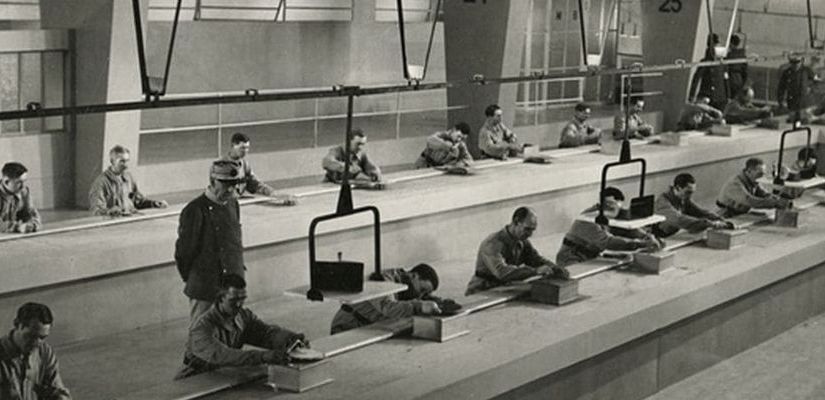
Louis and Émile are cellmates in a French prison.  Their daily routines are marked by hours and hours of assembling children’s toys on an assembly line that looks and feels a lot like the one from Chaplin’s Modern Times (1936) or even that one at a chocolate factory in a famous episode of I Love Lucy – but we’ll come back to that.  They sing, too, while toiling.  There’s a LOT of singing in À nous la liberté, not all of it clearly motivated, but serving as a kind of punctuation mark or accent piece to various scenes.

Émile and Louis attempt to escape their prison, but through no one’s fault, only Louis gets away, while Émile remains behind.  After some amusing episodes involving Louis trying to blend unobtrusively back into society, he lands a job hawking phonographs to pedestrians for a department store.  He gets so good at it that eventually he’s running the store…and eventually, improbably, he becomes the owner of the factory that BUILDS the phonographs, making him rich beyond his wildest dreams.

Trouble arrives in paradise when Louis’ cellmate, Émile, unexpectedly shows up, recently released from prison.  But he’s not looking for a job or to “touch” an old wealthy friend.  He’s in love with a girl who works at Louis’ factory, and getting a job there is the easiest way to stay close to her.  (I don’t THINK her name is ever said aloud, but she’s listed on IMDb as “Maud”, so that’s what I’ll call her.)  If Émile’s behavior sounds mildly stalker-y, well, it is, but what are you gonna do, love is love, and I’m sure I could dig up a modern rom-com or two that feature stalking as a romantic element.  Somehow.

Plus, there’s this whole ironic subtext that shows how the assembly lines at Louis’ phonograph factories are no different from the assembly lines at the prison.  The movie is not subtle about their similarities, but how could it be?  This fluffy material is corny as all hell, but the movie never gets too schmaltzy.  And if you think you know how the romantic subplot plays out in a romantic comedy from the 1930s, check your assumptions.

The centerpiece of the film is an assembly line sequence at the phonograph factory, a scene that has been imitated many times.  More modern movies and TV shows may have improved it, but having seen this movie, it’s clear where their inspiration came from.  In fact, the most interesting backstory of À nous la liberté is the fact that, after Charlie Chaplin released Modern Times in 1936, the producers of the French film sued Chaplin for plagiarism.  Both films feature bumbling but charming protagonists who wind up working on, and screwing up, assembly lines, and both films were making a point about the increased mechanization and dehumanization of the labor force.  After dragging on for ten years, Chaplin ultimately settled (without admitting guilt), but remained friends with René Clair for years afterward.

Having seen both films now, my opinion is that the similarities between the two films are purely incidental.  You might as well say that Star Wars plagiarized Star Trek because they both have “Star” in the title.  Modern Times is funnier and faster-paced, while the most farcical scenes in À nous la liberté are played, not for laughs, but smiles, if that makes sense.  It does to me, so I’m sticking with it.

It’s also interesting to observe how Clair used sound in this film from sound’s early years.  As I said before, there’s a lot of singing, but scenes with dialogue are few and far between.  Ambient sound is almost non-existent.  Where you might expect to hear lots of noises – scenes on the assembly line, for example – we only hear background score.  It’s almost startling when one scene plays street noises during an outdoor shot.  It’s almost as if Clair – like Chaplin – was reluctant to completely abandon silent storytelling in favor of this new sonic “trend.”  As a result, while it’s not a laugh riot, the film does have a quaint likability that is hard for me to describe.

À nous la liberté is an interesting peek backwards in time to when many of the film tropes we take for granted today were shiny and new.  It didn’t get me all “riled up” at an emotional level, but it wasn’t a waste of time.  And, like I said, there are one or two surprises story-wise.  That’s never a bad thing.

WALTZING WITH BRANDO

By Marc S. Sanders

You think you know someone, but then you learn a whole other side about the person.

I only know Marlon Brando from his achievements in The Godfather, Superman, A Streetcar Named Desire and On The Waterfront.  There’s also his final picture, The Score, with his Vito Corleone counterpart, Robert DeNiro.  I’ve seen him spoofed on Saturday Night Live and know that he’s even poked fun at himself in a film like The Freshman.  He was notoriously and proudly quirky.  I guess Brando was so content to appear odd to everyone else beyond the island of Tahiti, which became his escape to paradise, away from autograph hounds, environmental abuse and Hollywood barbarianism.  Brando simply endured his greatness as one of the most incredible movie actors ever to subsidize how he really wanted to live in utopian isolation.

Billy Zane seamlessly inhabits the persona and physical appearance of Marlon Brando in Waltzing With Brando.  The film presents a slice of the actor’s uncompromised efforts to build an ecological home, and maybe a hotel, on an uninhabited island next to Tahiti.  To bring this idea to fruition, Brando recruits a young, undaring Los Angeles architect named Bernie Judge (Jon Heder) to helm the project.  This will be an undertaking that Bernie could never expect and can hardly circumvent around impossible challenges in the face of proven scientific engineering, chemistry, and physics.  Brando seems to have an answer for everything though.

By breaking the fourth wall to speak to the viewer along with voiceover narration, Heder is charming about his unexpected adventures.  The white-collar shirt and necktie of city life is abandoned for shorts and conch shell necklaces.  Actually, as Brando demonstrates its better and less inhibited to just be nude like the rest of the cheerful islanders.  Despite his reservations, Bernie gets more and more accustomed to Brando’s perceptions but still he has to find ways to be practical to complete this unconscionable project.

Drinking water is needed.  Marlon’s answer is to filter it from his own urine.  Electricity needs to be installed on the island.  Though, is Marlon truly serious when he suggests that energy stem from a power source like electric eels?  Bernie soon learns that there will never be a client as unpredictable as Marlon Brando.  Money is not an obstacle he cares about.  Oscar trophies serve a menial, floor level purpose that is only a little more useful than resting on a mantle.  An upcoming gangster movie is not really his thing.  A paradise devoid of man-made contamination and pesky societal intrusions is where his focus lies.

Watching Bernie Judge struggle with being away from his wife and daughter, while working with islanders to start at the basics like building an airplane landing strip first, I was reminded of The Brutalist, the fictional period piece that centered on building a grand, outrageously expensive structure within a mountaintop.  That film watched its architect wither away into haunting madness.  The Mosquito Coast with Harrison Ford also came to mind.  Thankfully, Waltzing With Brando does not take these directions.  I know nothing about architecture or engineering or practically any kind of science.  Yet, I know that whatever Marlon Brando conjures up seems unheard of and impossible.  Brando’s friend, Bernie Judge, did not allow these considerations to stop him though.  Why shouldn’t we explore our ideal paradise no matter how exuberant it seems? (Mosquitos are also a problem to deal with and Brando frowns on using pesticides.  Hmm. What can be done?)

Still, we have to be realistic.  Richard Dreyfuss plays Brando’s money manager and represents the challenge of making resources obtainable.  Brando has to go back to work.  Judge needs more and more funds for material and labor.  He takes daring personal risks.  Even the banker does.  Utopia is expensive and never merciful. 

Director Bill Fishman wrote and adapted Bernard Judge’s biographical tales of his encounters with Marlon Brando.  His film is lighthearted, hardly stressful in any kind of dramatic weight.  Perhaps that is because Bernie Judge did not respond to Brando’s ideas with frustration like The Brutalist would have you believe.  While I was not entirely fond of the voiceover narration because I did not recognize its necessity, Jon Heder is magnetically likable.  He’s a cheerful friend telling a bedtime story that took place in a small corner of the world.  Most people never explored these crystal waters and white sands traversed only by Marlon Brando and the native islanders.  This is a civilization unaware of the burden of conflict and pressure. 

Billy Zane does not go over the top with his portrayal of Marlon Brando.  The more subtle and aloof he is in each scene, the more convinced and accustomed I became to his peculiarities.  With Fishman’s script, Zane delivers a handful of dynamics to Brando.  Early in the film, Brando tells Judge that his desire is to live in this Tahitian paradise forever.  He knows however that he must continue to make movies to eventually fund this lifestyle permanently.  Later in the film, it is easy to surmise why Brando feels that way.  While filming The Last Tango In Paradise, he is trapped in a phone booth where his fan base recognizes him.  It’s one of the few times when Billy Zane performs on Marlon Brando’s genuine discomfort, and it is terribly unsettling.  It’s awkwardly ironic that the most famous actor in the world is out of his element among a worldwide community of followers and devotees begging for pictures and autographs.

Like Marlon Brando and an eventual Bernie Judge, Waltzing With Brando wants you to leave the theater with a smirk on your face.  An attempt at achieving the impossible with absolute content does not have to be a miserable journey.  An effort to find ways to overcome challenges can deliver lifelong friendships and personal experiences that belong only to you.  Bernie Judge learned this through his friendship with Marlon Brando.

Waltzing With Brando is a thankfully rewarding experience, a brush with perfect happiness.

NOTE: Stay through the end credits because this “Marlon Brando” has a few treats in store for you.

TRUE LIES

By Marc S. Sanders

James Cameron’s True Lies never had to be believable.  It only had to be fun, and it is fun for the first act and most of the third act.  Too bad the sitcom like, chauvinistic second act pretty much overthrows the whole picture.

When you watch an Arnold Schwarzenegger pic, you have to take it with a boulder of salt.  Throughout his career, he’s been pregnant (never saw Junior), he’s begged God to give him the strength to fight Satan (I’m being honest here. It happened in End Of Days), he’s been tossed out of a plane at thirty thousand feet with no parachute and lands safely in a dumpster (Eraser) and his twin brother has been Danny DeVito.  (Do I really need to share the title of that movie?) In True Lies, I have to accept the fact that the muscular body builder with an Austrian accent, and pretty good line delivery, convinces his wife and daughter, played by Jamie Lee Curtis and Eliza Dushku, that he’s simply a boring computer salesman.  It’s shocking, utterly shocking, to realize that he is actually a clandestine spy, and his family is completely unaware.  See if Bruce Willis or Harrison Ford or Mel Gibson were in this role, then I’d buy it.  Tom Arnold might have been a good pick, but James Cameron settled to make Roseanne’s ex-husband Schwarzenegger’s secondary partner with some comedy bits. He might be the best part of the movie.

A brilliant 007 inspired opening gets this adventure started off with a literal bang at a black-tie affair at a wintery German mansion. Harry Tasker (Schwarzenegger) infiltrates the party along with support from his partner Albert (Tom Arnold) who hides in a tech equipped van that’s close by.  Harry does the tango with Tia Carrere, which is charming and something new for the Terminator.  The outcome of this shoot ’em up episode puts these super spies on the trail of an Arab terrorist who has the capability of unleashing a nuclear arsenal on the United States.  When Harry is not chasing this guy on horseback and up high-rise elevators, with the equine in tow, he and Albert report to an eye patch played by Charlton Heston.  

Somehow, I sleepwalked into another movie, though.  Harry has not been the model family man and when he tries to make amends, he inadvertently hears his wife Helen (Jamie Lee Curtis) chatting with a sleezy car salesman (Bill Paxton).  Now all of the spy department’s resources change course to surveille Helen and this moron she’s been talking to because this is the episode with the misunderstanding.  James Cameron’s script makes very poor efforts to achieve sitcom level comedy.  A laugh track couldn’t even save this tripe.

Bill Paxton is a great actor, but he accepted a terrible, unfunny role as he ironically pretends to impress Helen by actual being a spy.  Ha!!!! Go figure!!!!

Jamie Lee Curtis is a great actor too, but she agreed to play one of the dumbest women to ever grace a screen.  She believes this moron’s lies as easily as she believes the one and only Arnold Schwarzenegger is just a computer nerd.

One of the most intolerable scenes I can ever think of occurs after Harry learns what is really going on. He gladly continues to play one over on his neglected and unhappy wife by believing he’ll give her a fun adventure he thinks she deserves.  Helen is convinced that she must abide by the wishes of a clandestine government group who apprehends her.  She arrives at a dark hotel room with Harry sitting in the shadows, mere feet away, and convinces his wife to do a striptease dance in front of a stranger.  This routine goes on for the longest five minutes.  It’s not funny.  It’s not sexy.  It’s eerie and perverted with sick narrow mindedness. 

At the risk of getting political and prudish, Jamie Lee Curtis has always been one of the most outspoken celebrities for equal treatment between men and women and has ostracized those in positions of power who work towards their own self advantage.  Yet here she allows herself to be objectified by James Cameron and Arnold Schwarzenegger to be a punchline for male chauvinistic pranks.  If this scene ended with Curtis breaking Schwarzenegger’s nose with a karate chop while holding him at gunpoint, then this becomes something else.  That’s a no, however.  Instead, she is a scantily clad victim of sexual deviants, and she never stands up for herself, or exudes any kind of pride.  I recall in 1994 not liking this sequence.  Over thirty years later, well after the tides of the Me-Too movement have passed, I still hate this material.  With all of the high-flying stunts and action thrown in to other parts of the movie, it is this scene that stays with me.

Once this stupid story detour is over with a cast of actors enhancing its inanity, do I sleepwalk my way back into the movie I was watching before.  Whattya know?  The Arab terrorist who has not been discussed for the last forty-five minutes, still exists. So, while being held captive, this becomes an opportune time for the unhappy couple to sort through their baggage.

True Lies starts out so fun and when the action is turned on, James Cameron and his team are offering some solid footage.  Helicopters, limos, and missiles fly over a bridge running from the Florida Keys.  Then it is ridiculous silliness with a fighter jet piloted by Schwarzenegger who uses the entire cache of weapons to wipe out the one bad guy while trying to rescue his daughter who his hanging from a crane high in the skies over Miami.  Some say the slapstick of The Three Stooges is a demonstration in violence.  I ask if those critics have seen True Lies because the mayhem is absolutely bonkers. 

I can’t endorse this movie because I think it is one of Arnold Schwarzenegger’s worst films.  It’s also one of James Cameron’s most awful efforts.  The action is marvelously over the top, but the characters are reprehensibly idiotic and the film gets hijacked by a whole other storyline that is neither funny nor worth caring about.  There are so many better options to select from this writer/director, and this entire cast. 

With an absence of untruth, I am being forthright by declaring that True Lies belongs back within the scummy cauldron from it was stirred up from.

WINGS (1927)

by Miguel E. Rodriguez

DIRECTOR: William A. Wellman
CAST: Clara Bow, Charles ‘Buddy’ Rogers, Richard Arlen, Gary Cooper
MY RATING: 10/10
ROTTEN TOMATOMETER: 94% Certified Fresh

PLOT: Two young men, one rich, one middle class, who are in love with the same woman, become fighter pilots in World War I.


Not long ago, I purchased a copy of the 1927 classic Wings, based mostly on the favorable review by my friend and colleague, Marc Sanders.  I was more or less aware of its place in cinema history: the very first winner of the Best Picture Oscar, essentially the birthplace of Gary Cooper’s career (despite appearing in the film for just over 2 minutes), legendary aerial footage, and so on.  But I never felt compelled to seek it out.

Having finally watched it, I am very glad I did, and you should, too.  Wings is pure entertainment from start to finish.  Unexpectedly engrossing, captivating, thrilling, the whole enchilada.  High melodrama, comedy (borderline slapstick, what are you gonna do, it was 1927), romance, comic misunderstandings – and some not-so-comic – and eye-popping aerial footage, true to its reputation.  A neat camera move gliding over several cabaret tables even showcases director William A. Wellman’s desire to push the boundaries of what was possible with the massive cameras of his day.  I once wrote that Sunrise (1927) was my favorite silent film of all time.  If I ever make another 100-Favorite-Films list, Wings and Sunrise are going to have to duke it out…

Wings sets a surprisingly modern tone from the start.  In the very first sequences of the film, Jack Powell (Charles ‘Buddy’ Rogers) does not “ham it up” like some of the more typical Hollywood actors of that era.  Obviously, his mannerisms are exaggerated, but there is a restraint to his face and body that seems at odds (in a good way) with nearly everyone else in the film…except Gary Cooper, who, if he underplayed his role any further, would have become a still painting.  That restraint is also evident in Jack’s foil/nemesis, David Armstrong (Richard Arlen), the rich aristocrat to contrast Jack’s more humble background.  This moderation lends a very contemporary feel to a movie that’s nearly a century old – quite a feat.

In sharp contrast to the two male leads, the fabled Clara Bow plays her role, Mary Preston, with complete abandon.  She never truly overacts, exactly, but she throws herself into her supporting role with abandon.  Mary is hopelessly infatuated with Jack, who is actually in love with the debonair Sylvia Lewis (Jobyna Ralston), who is already involved with David, though they haven’t made anything official.  (If Facebook had been a thing back then, their relationship status would have been “It’s Complicated”.)  So, when Jack makes eyes at Sylvia, poor Mary is in the background as her hopeful smile deteriorates into sobs.  She may not be subtle, but Clara Bow makes sure you know EXACTLY what is on Mary’s mind at any given moment.

In the middle of this would-be soap opera, World War I intervenes.  Jack and David both enlist to become aviators.  A crucial scene shows Jack asking for Sylvia’s picture to keep as a good luck charm, a picture that has already been signed over to David.  Then, as he says his farewells to the lovelorn Mary, she offers him her picture.  How this scene plays out, and how it comes to bear much later, is one of the high points of the film’s ground-based drama.

But the real marquee attraction Wings comes during the aerial training and combat scenes.  Watching this movie, you understand why modern filmmakers today strive for realism as much as possible.  Ron Howard wanted to show weightless environments for Apollo 13, so sets were constructed inside a military jet tanker that flew parabolic arcs to simulate weightlessness…for real.  The makers of Top Gun: Maverick wanted to draw audiences into the film, so they had their actors train for weeks and months so they could be filmed inside the actual cockpits of F-18 fighters as they performed simulated combat maneuvers…for real.  Those filmmakers knew what had already been demonstrated decades earlier by Wings: nothing beats reality.

(Almost nothing…Ready Player One was pretty damn cool…BUT I DIGRESS…)

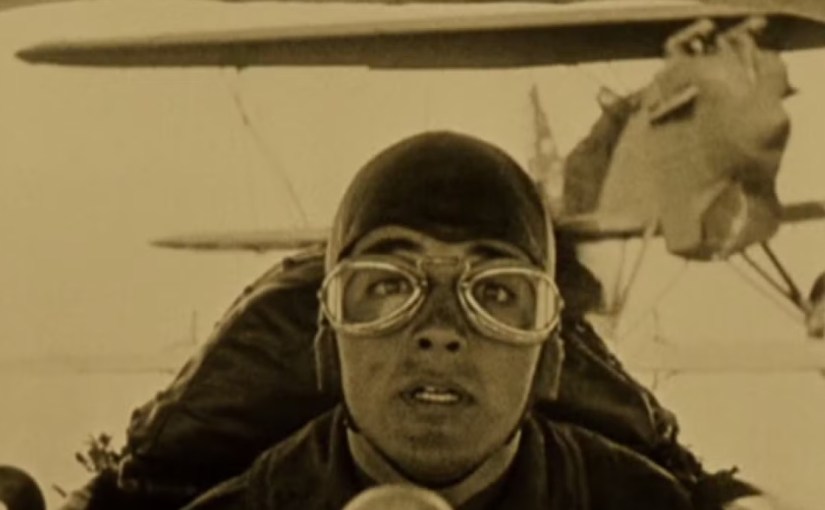
For Wings, director Wellman, a combat pilot himself during the war, knew that the best way to grab the audience by the lapels would be to get his actors up in the air for real.  To put it very briefly, he got his two lead actors to become certified pilots, got them into the air with small cameras strapped to the front of their planes, and had them act, fly their own planes, and be their own camera operators, all at the same time, while other stunt pilots flew around them, sometimes in VERY close quarters, simulating aerial combat.

The results are staggering.  There is a visceral mojo to these scenes that cannot be overstated.  Sure, it looks “old” because it’s black and white and grainy, but it is also undeniably real, and when you see long shots of a biplane going into a death spiral after being shot out of the sky, your intellect tells you there’s a real pilot flying a real plane hurtling at high speed towards the real ground, and you either sit back in awe or you lean forward with excitement.  There are a few scenes where real planes crash to the ground in various ways; one of them crashes into the side of a freaking HOUSE…for REAL.  IMDb mentions one staged crash where the plane didn’t do exactly what it was SUPPOSED to do, and the stunt pilot literally broke his neck…but survived and returned to his job six weeks later.  And it was all done in camera with no trickery or fake dummies in the cockpit.  It is literally mindboggling.

However, it should be noted that these accomplishments by themselves would mean very little if they weren’t hitched to a compelling story.  The love story among Jack, David, and Mary is a constant thread through the whole film.  Mary, having volunteered as an ambulance driver in the Army, miraculously finds herself stationed overseas…right next to Jack and David’s unit, wouldn’t you know it!  Contrivances aside, Wings expertly balances the exciting elements with the melodramatic flourishes.  The melodrama comes to a head when Mary finds herself alone in a hotel room with Jack, who is so drunk on champagne he doesn’t recognize her.  (She is dressed as a cabaret dancer, but that’s a long story…)  This movie truly contains the best of both worlds, genre-wise.

This might be crass of me to mention, but I’m going to anyway…Wings is also notable for some of the earliest on-screen nudity (in an AMERICAN film, anyway) that I can recall seeing.  There is a scene in a recruitment office where a line of bare male bums are lined up in the background, awaiting health inspection.  Then later, we see a woman’s bare breasts…just a brief glimpse, but it’s there.  Not only THAT, but during a fancy camera move in a French cabaret, we see a woman caressing another woman’s face…are they a couple?  Scandalous!  Who needs the Hays Code?  Not this guy!

(I could also mention the homo-erotic overtones during a pivotal scene towards the end of the film, but they pretty much speak for themselves [like the volleyball scene in Top Gun], so I’m just gonna move on…)

To sum up: Wings ranks as one of the greatest pure entertainments that Hollywood has ever served up.  Marc mentioned that it perhaps doesn’t get the love it deserves.  He’s probably right.  I’m sure it’s revered among cinephiles, but it is certainly not in the general public consciousness when it comes to silent films.  Regardless, it is exceptionally well-made and uncommonly effective.  If ever an old film deserved to be rediscovered by the general public, Wings is it.