INSOMNIA

By Marc S. Sanders

Insomnia is an unusual kind of crazed killer pursuit because the hero is initially implied to be compromised, and before the first act of the picture ends, we see that he truly is not as noble as he is described.  This Christopher Nolan film, one of the few that neither he nor his brother Jonathan wrote, is headlined by three Oscar winners and they beautifully absorb this insightful script from writer Hillary Seitz.

Al Pacino is a celebrated Los Angeles Detective named Will Dormer.  When we see him arriving aboard a propeller plane into the foggy town of Night Mute, Alaska with his partner Hap Eckart (Martin Donovan), he looks weary and worn out.  Greeted with warm welcomes by a fan of his is Ellie Burr (Hilary Swank) and his old friend Chief Nyback (Paul Dooley).  Will has been special requested to investigate the murder of a young girl found in a trash heap, strangled to death.  Happenings like this do not occur often in Night Mute.  So, it is best to use the assistance of an expert.

Right away, Will is ready to get to work by visiting the girl’s boyfriend at school.  What he doesn’t realize is that it is ten o’clock at night. At this time of year, a midnight sun lasts twenty-four hours over this little getaway.  After he’s had a chance to investigate the victim’s body and go over the autopsy notes, the discovery of her bookbag leads to the prime suspect, mystery writer Walter Finch (Robin Williams).  A raid on his home near the beach is initiated and it does not go as planned.  Will screws up while chasing down the guy who gets away. 

While it seems that with some cover up, Will can keep his terrible error in judgment to himself, Walter knows everything. Now, with taunting phone calls in the middle of broad sunlit evenings, Will’s insomnia is becoming a hinderance as he tries to do his job while suppressing his own personal guilt and egregious acts.

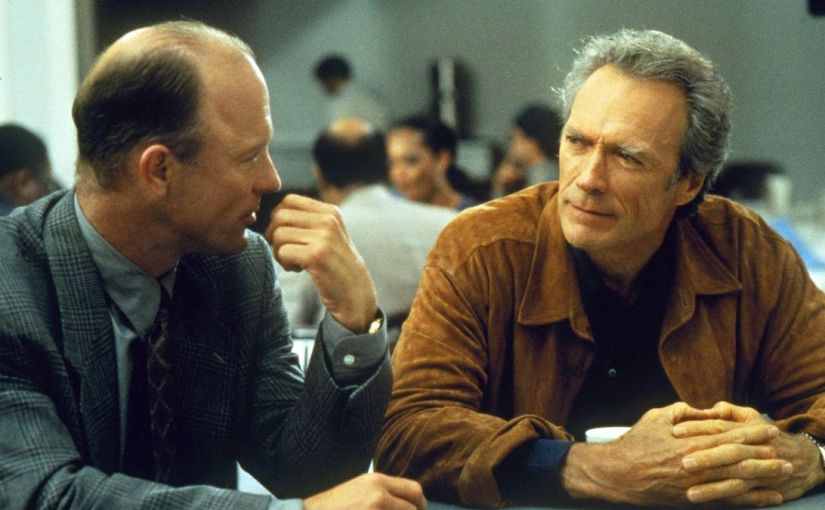
The duality of Pacino versus Williams is reminiscent of Eastwood against Malkovich in In The Line Of Fire.  It works very well especially because of the departure that Robin Williams takes from his usual fare.  Ironically, he portrayed another creepy guy in the year of this release with a movie called One Hour Photo.  Williams is just a different kind of cut from Al Pacino and that’s why their conflict works well.  Pacino’s gruff tone, which is all too familiar within the second half of his career, has a roughness against the smooth and calm demeanor that Robin Williams relies on with his dialogue.  Walter Finch appears relaxed, rested and neat.  Will Dormer is wrinkled, tired, and lonely with guilt.  This killer has an inescapable edge over the cop, and thus Insomnia stands apart from the other fare of its time from the likes of Fincher, Demme or the Scott brothers’ respective films.

Christopher Nolan captures a creepy and uncomfortable setting for an environment bright with daylight amid a corner of the world that still embraces the nature of Earth.  He is thorough explorer with his go-to director of photography, Wally Pfister.  Clouds and the blurs of fogs keep moments unclear.  The sun blaring through windows is disorienting.  You can also feel the chill of Alaska, even if you are like me and have never visited the state. 

Though the film was primarily shot in Canada, there are amazing bluish/white overhead shots of snow-capped mountains and expansive rocky lakes surrounded by green woods.  A foot chase midway through the picture uses this unusual environment as Dormer chases after Finch across an expanse of floating logs that trap him underwater.  As Pacino desperately looks for an opening to the surface, Nolan really makes you feel like you are drowning amid this unexpected trap.  (Try to watch Insomnia on with at least a 5.0 surround sound.)

Hilary Swank’s role appears like a forgettable partner early on, but her significance opens up later in the story as more is revealed.  I look at her character of Ellie and it occurs to me that a theme of mentorship builds the backdrop of Insomnia.  Ellie has studied Will’s most famous cases and he’s much like a celebrity in her presence.  Finch is a well-known author that built a connection with the murder victim who avidly read his novels.  This film is a good reference to the adage that perhaps it is best to never meet your heroes.

I was very surprised by the directions that Insomnia takes, and quite early on.  There are unexpected moments that occur very quickly after the exposition is covered.  Nolan’s film is not a carbon copy of the tough cop working to nab the intelligent killer that’s on the loose.  Bodies do not just turn up before the final showdown, and the office Captain does not unleash on the detective threatening to pull him from this case.  What you observe in Insomnia is not what you have seen a thousand times before. 

Will Dormer is in an unsolvable conundrum of doing the right thing, but can he afford to surrender to his own misgivings after a decorated thirty-year career?  I could not predict how he would get himself out of this situation where Walter Finch, his antagonist, has got the clear advantage. 

Insomnia is a well thought out script superbly brought to vision by Christopher Nolan.  A thinker’s thriller.

NOTE: It’s a nice touch to call Pacino’s character “Dormer” which in French and Latin means “to sleep.”
MEMENTO

By Marc S. Sanders

Christopher Nolan’s Memento was Oscar nominated for his screenplay, adapted from a short story by his brother Jonathan, as well as for editing.  You’d be hard pressed to find a better example that lives up to the merits of these categories because without the inventive storytelling and how it’s cut together, Memento would not be so memorable.  

Guy Pearce plays Leonard, but he distinctly remembers that only his wife called him Lenny.  We observe him in two different narratives.  A black and white collection of scenes has him in a hotel room chatting on the phone with an unknown caller.  In modern color, Leonard is wearing a tan suit and driving a dusty Jaguar while traipsing from one place to another.  He’s trying to make progress with uncovering who murdered his wife.  The scenes in color though must be shown in reverse.  In other words, a scene is shown, then it will cut to Leonard back on the phone, and then another scene is revealed showing what occurred literally just prior to the last color scene we saw.

It must be done this way so we can be just as discombobulated as Leonard.  He suffers from a condition where he has no short term memory.  Therefore, if Leonard learns something or meets someone or arrives at a location, he’ll soon forget anything he just encountered minutes ago.  

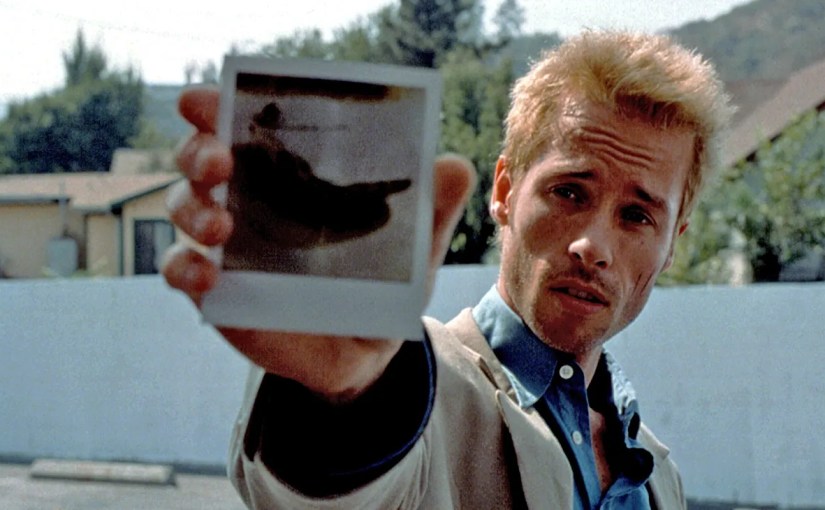
While he pursues the mystery of his wife’s killer, Leonard tattoos his flesh with notes to help guide him when his short attention span can’t. He also takes instant Polaroids of people he meets and the places he goes.  As quick as he can, he’ll jot a note on the photos to aid him as he carries on.

Memento starts at the end of the story and when the film concludes, the viewer arrives at the beginning.  Perhaps the beginning will explain the end that was shown almost two hours before.

Christopher Nolan had a small budget to work with and the California city locales are nothing dazzling.  There’s little to offer with special effects as well.  So, it is impressive that he uses Jonathan’s idea to create a mystery we want to see resolved where the information we get seems to erase itself as quickly as it is told.

Leonard can’t remember anyone he’s recently met, but oddball cases like Teddy (Joe Pantoliano) and Natalie (Carrie-Anne Moss) certainly remember him.  Are these folks working with Leonard or against him?  Even with seeing the ending first, I could never spoil anything, and you’ll find it hard to decipher what these are these characters’ best interests.  

Nolan exercises some neat visuals to keep you on track.  We see a broken car window before we see how it got shattered.  Leonard can’t recall how that happened.  Leonard is also unable to remember why a bar patron is chuckling at him.  Christopher Nolan maintains well placed book marks to aid the viewer in this story that makes an effort at throwing off its protagonist as well as the audience.

What also helps is that when all the secrets are revealed, at least to the viewer, it’s a pretty solid crime set up that does not come off like a stale Murder, She Wrote episode.  It’s clever, tricky and unexpected.

Guy Pearce is really good in his role that eventually reveals some duality, but that’s where I’ll stop.  Carrie-Anne Moss always seems questionable, but what’s her agenda?  Joe Pantoliano is the sleazy guy with the mustache.  So why is he always turning up in Leonard’s way?

Like his future efforts to come, Christopher Nolan layers his films in great depths of dimension.  It never stops thinking. Often, he answers a riddle with one or two or three more conundrums.  What’s especially appreciative is that he eventually reaches a final answer to all of his questions.  Still, that doesn’t mean he ever would want you to stop thinking about what you ascertained from Memento.

SHANE (1953)

by Miguel E. Rodriguez

DIRECTOR: George Stevens
CAST: Alan Ladd, Jean Arthur, Van Heflin, Brandon De Wilde, Jack Palance
MY RATING: 8/10
ROTTEN TOMATOMETER: 97% Fresh

PLOT: A drifter (who may or may not be a retired gunfighter) comes to the assistance of a homestead family terrorized by a wealthy cattleman and his hired gun.


Shane affords me the opportunity to use a word I never get to use in daily conversation: archetypal.  John Ford’s Stagecoach [1939] may be the granddaddy of the modern Western, but Shane taps into something even more primal.

Alan Ladd as Shane is the archetype of the mysterious stranger riding out of the mountains, either coming to the aid of a community who has lost hope (Pale Rider, 1985) or wreaking havoc as an avenging angel (High Plains Drifter, 1973), and then disappearing into the sunset or riding back into the distant mountains.  This formula was probably already old when Shane was made, and the film does little to dress it up or add any kind of pretentious spin to the story.  But by sticking to the formula and really nailing it home, director George Stevens achieved a weird kind of clarity that elevates Shane into a mythical realm.  If it’s not terribly realistic, well…who wants realism mixed in with their magic?  Not me.

Shane is set in the high plains of Wyoming in 1889.  (I don’t remember the exact year being mentioned in the film – I pulled it off IMDb – but we can tell it’s after the war because a running gag involves a harmonica player who always starts playing a Union song whenever a homesteader called Stonewall, who fought for the South, walks into a meeting.  It’s a mark of faith in the intelligence of the average viewer that the screenplay never comes out and explains that’s what’s happening; we just see it and have to put two and two together.  Nice.)

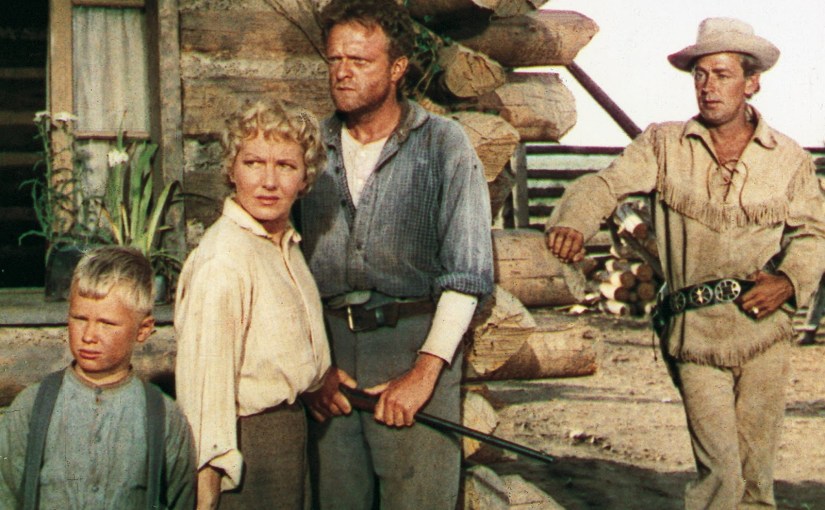
ANYWAY…it’s 1889, and a land baron named Rufus Ryker is trying to run homesteaders off some land that they rightfully own, but which is preventing Ryker from expanding his cattle ranch.  Among these homesteaders is Joe Starrett (Van Heflin); his wife, Marian (Jean Arthur); and his little boy, Joey (Brandon De Wilde, who earned an Oscar nomination for Best Supporting Actor, but don’t ask my opinion of his performance…just don’t).

One day, true to mythical form, a lone figure rides out of the mountains and up to Starrett’s patch of land.  He is improbably good looking, wears a fringed buckskin jacket, two ivory-handled revolvers, and identifies himself only as Shane.  After earning Starrett’s trust, he agrees to stay on as a hired hand and possibly help with the struggle against Ryker…

…and if you’ve been watching movies as long as I have, you could practically write your own screenplay for the rest of the film, because you’ve seen it before, many times.  The stranger proves his worth, defends his new friends, makes friends with the wife (but not TOO friendly), gets hero-worshipped by the little boy, and eventually runs them cattle barons plumb out of business.  But I’ve never seen it done quite like Shane.

For example, there’s a bar fight that ought to be in the Bar Fight Hall of Fame.  Shane, in what HAS to be a deliberate move to goad the bad guys into action, walks into a saloon filled with Ryker’s men to return a soda-pop bottle for the deposit.  A fight predictably breaks out, first one-on-one, then 1-on-2, then 3, then 4.  (Who does this guy think he is?  John Wick?)  The fight gets to a point when it’s winding down…then it picks right up again.  Then they get Shane on the ropes and start waling on him…until Starrett sees what’s happening, grabs an axe handle, and cracks it over someone’s head.  That may not sound like much in writing, but it’s pretty impressive visually, especially from a 1953 Western that feels at times like a Disney product.

(It almost feels like what Tarantino did with the fight between the Bride and the Crazy 88 in Kill Bill, Vol. 1 (2003).  George Stevens said, “Okay, these people want a bar fight?  I’ll give you a damn bar fight.”)

But while I was watching it, I started to analyze it a little bit.  Bar fights…seen one, seen a thousand.  But Shane felt to me like it was embracing the cliché, making friends with a trope, and in so doing the fight became a myth of a bar fight, a fever dream of itself.  It’s not just a bar fight.  It’s THE bar fight.

A lot of Shane works that way.  Shane isn’t just a mysterious stranger, he’s THE mysterious stranger.  An argument could be made for Eastwood’s “Man with No Name” as the archetype of this character, at least in the Western genre, but it’s clear that Eastwood took a lot of cues from Shane when writing and directing his own films.  I’m not suggesting that Eastwood plagiarized Shane.  I’m suggesting that Eastwood’s creations are infused with Shane’s DNA in all the best ways.  (I wouldn’t presume to speculate how much of Shane is in Sergio Leone’s spaghetti westerns starring Eastwood, though I would say those have more of Kurosawa in them than George Stevens.)

There are just two items that bugged me while watching Shane.  One, the editing was occasionally erratic, using a lot of fades or cuts to virtually empty frames in the middle of the action.  I don’t normally pick that kind of thing apart in a review, but it was glaringly apparent in a lot of places.

Two…the tragic waste of talent by casting Jean Arthur as Mrs. Starrett.  Jean Arthur is the fast-talking, quick-thinking actress who appeared in such classics as Mr. Deeds Goes to Town [1936], Mr. Smith Goes to Washington, and Only Angels Have Wings [both 1939].  She goes (or OUGHT to go) on the list of intelligent female actors like Katharine Hepburn and Rosalind Russell.  By 1953, she was semi-retired and only appeared in Shane as a favor to her friend, director George Stevens.  When I saw her name in the credits, I had visions of her delivering fiery speeches, shaming and out-thinking the menfolk, declaring her admiration for Shane without exactly laying out her TRUE feelings for him, and so on.  Instead, she is reduced to spending the majority of her screen time fretting over her husband’s safety, casting loaded glances at Shane while her husband isn’t around, baking pies, and reading bedtime stories to Joey.  I know I just got done writing about how the movie embraces clichés and becomes mythological, and there’s nothing more clichéd than the “little woman” supporting her husband, etc., but something about her role just rubbed me the wrong way.  After this film, Arthur retired from film completely, and although Shane was a massive popular and critical hit, I can’t help but wish she had been given more to do in her last film.

By the time Shane reaches its famous finale (“Shaaane!  Come baaack!”), justice has been meted out and the little guys have won…all is right with the world.  Echoes of Shane still linger today, because who doesn’t like a good old-fashioned bad-guy beatdown, administered by the archetypal mysterious stranger?  This may not be my favorite Western of all time, but from now on, whenever I do watch my favorite Westerns, I’ll keep an eye out for Shane’s shadow, looming large over all who came after it.

FOLLOWING

By Marc S. Sanders

A young filmmaker scraped up six thousand dollars to make a short movie clocking in at just over an hour called Following.  The writer/director is Christopher Nolan.  While he may have been very limited on resources, his reach for imagination was already infinite at the start of his career.  Following is…well…challenging to follow, and I had to watch it twice to grasp the novel curves in time jumps and twists.  However, on my second go round I enthusiastically applaud its brilliance.  The wrap up to this short film is genius.

Gone for nearly fifty years, Alfred Hitchcock’s attempts at pursuing the questionable temptations that people undergo remain wholly intriguing.  His movies are still watched, studied, referenced, and duplicated.  Most importantly, they inspire filmmakers like Christopher Nolan.  Following leaps into its story with parallels from Rear Window and then segues into brief encounters like Strangers On A Train commits.  Mischief is at play which gradually develops into deceit and maybe murder.

Nolan makes an hour and ten minutes feel like a breezy fast moving two hours.  The script for Following throws a lot of information at you at a fast pace, which is something the famed director continued to do with the majority of his later films.  It’s to your advantage to stay alert and explore what’s shown in every frame.  Much of what comes at you will circle back for a twist or two.

Bill (Jeremy Theobold) is an unemployed writer who occupies his time by simply shadowing random people going about their lives within the streets of London.  There’s no particular reason for his behavior.  He relays to an older man that perhaps he’ll learn or become inspired by what he sees people do during their day-to-day business.  

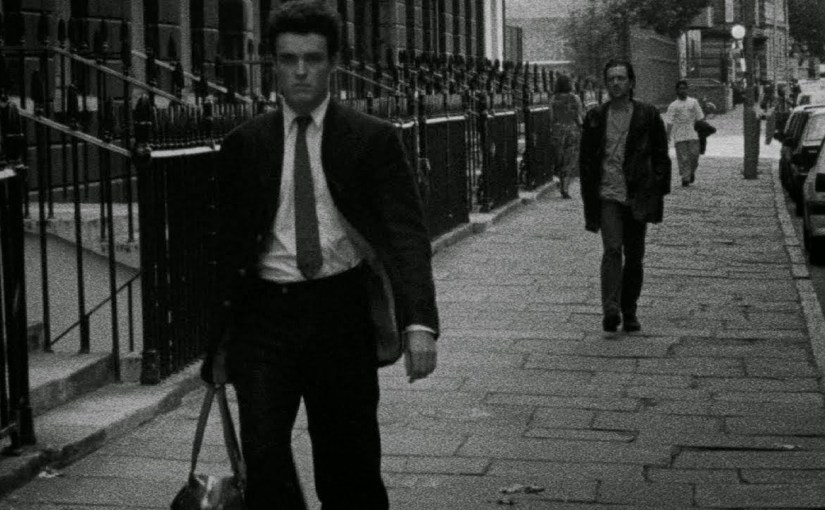
A man in a suit carrying a large tote bag (Alex Haw) becomes Bill’s latest observation.  Bill keeps his distance and follows the man into a cafe.  As the man gets up to leave, he makes a surprising stop at Bill’s table.  He calls himself Cobb, and he has an unusual habit of his own.

Cobb demonstrates to Bill how he takes interest in learning about random people by entering their flats when they are not home.  He’s not there to necessarily burglarize.  Though he will tease the owners by planting a pair of women’s panties in their laundry or emptying their little box of knick knacks on the desk.  Maybe he’ll hide one earring to turn up later. In particular, he shows Bill how much you can learn about people by looking at how they keep their home, what they collect or what they furnish the place with.  So, how about the gentlemen pop the cork on a bottle of wine and have a chat while they stay a while.

These two strangers build a warped kind of mentality for this behavior, but as Bill becomes more natural at what Cobb has introduced him to, so do the risks become more apparent.

Following has some unusual ideas; the kind that are perverted enough to only see in the movies.  If I were to meet guys like Bill or Cobb at a bar and they started telling me of their derring do, I might excuse myself as subtly as possible.  In Christopher Nolan’s film though, I’m intrigued of what these men gain or how they entrap themselves.  

On occasion, it is hard to follow where the film turns its attention.  There are time jumps that come out of nowhere.  We see Bill with a different haircut.  At another time he has cuts on his face.  His wardrobe is different. Because of the small budget, the editing and cinematography must have suffered making these time jumps feel seamless.  So, on my first watch I was confused and wondered if the movie had some scenes cut or if I dozed off while watching it.  Then again, this is Christopher Nolan who is notorious for not keeping a straight and narrow narrative.  His well-known movies like Memento, Interstellar or Oppenheimer have all of his best tools at play to emulate different periods of time.  Following is presented in black and white and so it’s a challenge to focus on where you are in the story and where you left off.

The second time I watched the movie, it was much clearer to bridge everything together and you recognize when one twist occurs at the halfway mark followed by something else until it reaches its fascinating conclusion where every prop you see or line that was uttered serves their ulterior motives.

Following is a thrilling play on your thought process where one character might be performing a cruel sleight of hand on another.  Do not trust anything you see or hear.

Currently, Following is on You Tube and streaming on TUBI, but I had to watch with some limited commercial interruptions.  I encourage you to deal with it because Christopher Nolan’s first film shows some of the storytelling tricks he’s most appreciated for.  What you see in Memento, The Prestige or Inception was attempted early on with Following.  It was not as flashy, but it was just as inventive and brainy.

At just over an hour, Following is that perfect story to watch just after you’ve crawled under the covers and turned off the lights.  It’s a thrilling bedtime story.

TIGHTROPE

By Marc S. Sanders

The most recognizable cop Clint Eastwood portrayed is of course Dirty Harry Callahan, San Francisco’s finest.  Tightrope introduces a different kind of policeman though.  Wes Block covers New Orleans, and he balances the seedy underworld of crime in and around the French Quarter while being a single dad to two preteen daughters (the elder one played by Eastwood’s real life child Alison Eastwood).

There’s a serial killer on the loose whose victims of choice are ladies who work in the sex industry.  A skeleton in Wes’ closet is his penchant for getting involved in the world of kinky sex for satisfaction.  This killer seems to follow closely behind Wes’ investigation and his personal trysts.  Best he knows about this creep is he wears tennis shoes and he’s likely a Caucasian.  If Wes didn’t know any better, he could be as likely a suspect as the mayor.

Tightrope is a surprising film considering Eastwood’s resume in the nineteen seventies through eighties.  Usually, his tough, quiet persona never emulated weakness or questionable morals pertaining to rough sexual treatment of women.  Tightrope is not an action picture, but it implies ugly portraits of victimization for women.  It does not hold back on the nudity or the peril that the killer’s victims find themselves in.  It’s an uneasy crime thriller that does not compromise.  

On the flip side of Wes Block’s kinky obsessions is a genuine relationship he begins with a woman named Beryl (Geneviève Bujold). She specializes in helping women protect themselves from rape attacks as well as recovery.  The two have a good chemistry that begins with different interests with sex crimes. Later, they find a mutual appreciation for one another.  Wes might carry shame and fault, but considering Beryl’s background she might be the only grown woman who understands his personal demons.

What I like about this section of the story is that Wes and Beryl’s relationship does not rush itself.  He has an armor that covers his weakness.  She has a bold strength and will not be intimidated.  In order for them to connect, they’ll need to alter their nature when it comes to affection and respect.

There’s also a good dynamic with the two daughters.  To watch Clint Eastwood try to maintain composure while explaining a hard on to his youngest daughter is both hilarious but also stands for another conflict for this protagonist with a checkered background.  This is a different kind comedy routine than his prior connections with an orangutan or a bulldog named Meat Head.

I like that his older daughter played by Alison Eastwood offers empathy with little dialogue.  A great moment has her lie down on her father’s back while he’s in an anguished, drunken stupor. A young girl lending comfort to her pained father.

Eastwood lends a convincing portrayal of guy dealing with personal torment as both a parent and a cop.  The more he digs into what makes this psycho tick the more he seems to endanger what could be another victim for prey and even his own children, plus Beryl.

Writer/director Richard Tuggle captures great location shots of New Orleans along Bourbon Street and within the French Quarter, sometimes celebratory and frequently frighteningly lurid.  Jazz trumpets deliver an atmospheric soundtrack.  A lot of cuts, edits and photographic shots seem reminiscent of Eastwood’s techniques. It would not be surprising, especially since he’s a producer, if he sat in the chair behind the camera to bring the film to completion.

Tightrope is a slow burn potboiler with convincingly ugly material.  It’s disturbing but wholly engaging with different reasons for a familiar Clint Eastwood to quietly brood.  The suspense and frustration build as the danger heightens.  This is the kind of movie you watch after midnight when the rest of the household has gone to bed.

ABSOLUTE POWER

By Marc S. Sanders

As Clint Eastwood’s Absolute Power was unfolding I started to think this plays like one of those hardcover bestseller political thrillers from the 90s that my dad would scoop up off of the neatly designed stack at the front of Barnes & Noble.  You know with the glossy book jacket that has the blood stain and a dead girl’s nail polished hand next to a bloody letter opener.  The graphics are elevated to feel the crime scene with your fingertips.  The intrigue is summed up on the inside tab.  You turn to the back of the book to see the picture of the author.  Then you buy it with your membership card.  Go figure!  William Goldman adapted the screenplay from a novel by renowned author David Baldacci. Absolute Power has an engaging set up, a who’s who of a cast, it’s directed, produced and starring Eastwood. Still, it evolves into utter eye-rolling preposterousness.

Eastwood directs his own portrayal Luther Whitney, an expert jewel thief.  He might be getting up there in age but he scopes out the mansion of a billionaire tycoon (E.G Marshall, in his final on-screen role) and locates the vault hidden behind a large two-way mirror.  Everything is going to plan as Luther bags up the valuables and a lot of cash but then a drunken couple enter with Luther hidden behind the mirror to watch their tryst turn deadly.  The President of the United States (Gene Hackman) avoids being stabbed to death by the young lady (Melora Hardin) when his secret service detail (Scott Gleen and Dennis Haysbert) enter to shoot the girl dead.  The President’s Chief of Staff (Judy Davis) arrives soon after.  Luther observes the four as they rush the Commander In Chief out of the house and alter the crime scene.  They get careless and just as Luther makes a quick exit, he retrieves evidence that will hopefully work to his advantage.  Now he’s in danger of the President and the other three as they work to permanently contain the situation.

Elsewhere is Ed Harris as the detective out to solve the murder and uncover everything we already know.  When he realizes a thief must have been at the scene of the crime, he actually approaches Luther for some guidance as to who could have been there.  Later, he will use Laura Linney, playing Luther’s daughter, for assistance as her father seems to be the prime suspect. 

The tycoon, the President’s biggest supporter, also wants to resolve his personal vendetta by hiring his own sniper (Richard Jenkins) to take out Luther. 

Absolute Power has all of these players, with recognizable actors in the roles, and yet cannot work the magic necessary to fix this outrageous conundrum.  I can believe that a President could get in more trouble than he needs with a one-night stand and a dead girl on the floor.  I can believe members of his staff will work to tie off all the loose ends, even if it means more murder and mayhem must occur. 

What is hard to swallow is how neatly the story wraps up literally within one afternoon leading into an evening.  It’s fortunate that window washers are present to throw off a couple of snipers with an inconvenient glare at the most inopportune time.  Otherwise, there will be no more movie.  It helps that a character with remorse happens to take his own life, thus exposing the conspiracy, just as Eastwood’s character is steering his own way to exoneration.  All in the same night!!!!

To ramp up the suspense, the bad guys go after Linney’s character, the one person Luther cares for the most.  She ends up in a hospital.  Message has been sent.  Luther better surrender himself along with what he knows to the President’s squad.  Yet, they try one more time to permanently eliminate her and I asked why.  What purpose does that serve to kill her now?  If you kill her, then Luther has nothing to protect or care about anymore.  He can just reveal the entire breakdown of what really happened complete with evidence and so on.

A few years earlier, Eastwood starred in In The Line Of Fire where John Malkovich played a master of disguise assassin.  Luther is also a craftsman at hiding in plain sight.  However, there’s no way I can believe that.  We are looking at Clint Eastwood here.  He’s got his own unique and very tall and square stature.  Put a white mustache and a pair of glasses on the guy, and it is still Clint Eastwood.  Put a hat and beard on him and it is still Clint Eastwood.  Wrap him up in a trench coat and have him walk the city streets in broad daylight where fifty cops are awaiting his arrival and you’ll be able to see the one and only Clint Eastwood.  It just can’t work.  James Bond can hide in disguise.  John Malkovich can hide in disguise.  Go anywhere in the world and Shaquille O’Neal and Clint Eastwood would never be hidden in plain sight. 

William Goldman (The Princess Bride, Butch Cassidy And The Sundance Kid) is one of Hollywood’s most celebrated screenwriters.  He did not think this story all the way through.  You may believe Gene Hackman (second billing behind Eastwood) would have had more of a presence in this picture but oddly enough he’s hardly there. The real bad guy roles belong to Judy Davis and Scott Glenn who are not nearly as exciting as what Hackman could have delivered.

There was a potential for a good conspiracy thriller. The problem is the audience knows too much following the first fifteen minutes of the film.  We know everything that happened and therefore I could care less about the progress that Ed Harris’ detective makes.  Absolute Power likely would have performed better had it opened after the crime had occurred.  Run the opening credits over the dead girl in the room and open the two-way mirror for Luther to enter the frame.  He makes a run for it and then the film can gradually reveal what precisely happened.  A mystery for the characters and the audiences who are watching them only works if the questions are offered before the answers are revealed.

Absolute Power offered a lot of promise with a lot of talent but it’s devoid of both.