SILKWOOD

By Marc S. Sanders

As the 1980s were setting its stride, Silkwood might have been one of the earliest in a line of films to focus on the union worker who fights back at the billion-dollar corporation.  Some might unfairly regard the movie as The China Syndrome, Part II. Other well-known pictures of this mold are even more familiar to me like Michael Mann’s The Insider.  However, director Mike Nichols, working with a first screenwriting effort from Nora Ephron who partnered with Alice Arlen, showcases the aggravation on not just Karen Silkwood, the real life potential whistleblower, but also her friends and co-workers in a one factory town just outside of Oklahoma City.

Karen (Meryl Streep) lives with her boyfriend Drew (Kurt Russell) and her best friend Dolly (Cher) in a run-down house in the middle of nowhere.  They ride to work together at the local plutonium manufacturing plant where they dress in scrubs and gloves. Punch in, punch out kind of days, and often they are expected to work double shifts and weekends.  Karen works an assembly line where she places her hands in rubber gloves and assembles dangerous combinations of chemicals in an enclosed box.  It’s also routine that before you leave your station you wave your hands over a sensor to ensure you have not been exposed to radiation.  There’s even sensors you walk through as you enter and leave the plant.  When those sensors go off, a calm kind of film seemingly turns into a horror movie.  The last thing anyone could ever want is to get “cooked.”

Karen does not live a perfect life.  Her three kids reside with their uncompromising father in Texas.  Money is not ideal.  Dolly is a slob and has also invited her girlfriend to live with them.  Karen can manage with all of this, but when she observes some unconventional activities around the factory she gets up the nerve to head the union for better protection and working conditions.  However, the further she goes looking at files and photos, jotting down notes of what people say and do, plus taking trips to Washington DC, and getting phone calls from attorneys at night, she becomes more and more isolated from Dolly and Drew, along with the rest of her close-knit workers.  Karen is not just risking her job, but everyone else’s jobs and worse her own life.

The attorneys lay it out to the townsfolk and the union of the horrifying statistics that go along with radiation exposure.  The tiniest fraction of a miniscule of exposure to the smallest crumb of chemicals could increase a human’s bearable limit towards radiation and cancer.  The sad irony is that the more that is learned, the more the people of this area smoke and smoke some more.  Granted, this story takes place in the early 1970s, though.    

The company is primarily represented by an intimidating Bruce McGill.  He’s great in everything he does and is worthy of an Oscar nomination somewhere.  M Emmet Walsh has no lines but his presence is enough to shake you; the slimy guy you easily recognize from every other movie you have seen.  While the company’s overbearing intrusion is shown plenty, the script for Silkwood focuses more on how these working people get by.  They are treated unfairly and in dangerous working conditions, but they also know this is the only place that offers steady income in the area.  Without this factory, the whole town would be left in dire straits.  Karen is repeatedly told or implied to leave well enough alone.

Meryl Streep notches another harrowing performance on her resume and bears such a departure from more sophisticated characters found in Sophie’s Choice and Kramer Vs Kramer.  Karen Silkwood is not educated and she bears an unmistakable white trash dialect but she’s also not stupid and the more progress she makes at exposing the plant’s shortcomings the more unfairly she is treated with department transfers and workplace shake ups that she is indirectly blamed for.  Potential threats on her life begin to build, but she only upholds a bravery.  You really observe the strength of Meryl Streep.  She’s at the top of an elite class of actresses at this time that also included Sally Field, Jessica Lange and Glenn Close.

Cher plays Dolly in her first on screen role.  The variety act performer probably subjected herself to a bigger departure than Streep.  She was not a professionally trained actress at the time.  Mike Nichols insisted on no makeup along with her hair unkept and flat, while dressed in green chino pants and baggy sweatshirts.  The new actress carries herself so well without the usual glitz that accompanies her.  Her scenes with Streep are workshops in acting technique. 

Kurt Russell delivers another understated performance.  One of the best actors out there who has never been enough of a critical darling.  Drew is likable and Kurt Russell plays him as a settled in match for Streep’s portrayal of Karen.  Watch how they tangle up in each other’s arms in bed or when he snaps at her as she carries on her crusade while he’d rather things be left alone.  His timing is perfect for the script.

Mike Nichols keeps his film calm, except when the go by the numbers narrative must be disturbed.  A radiation cleanse with high pressure hoses will make you wince.  The factory alarms will terrify you.  Meryl Streep accepts the physical taxations necessary for this setting.  Nichols gets in close with his camera to show how cleansers dressed in scrubs and masks rub Streep down until her skin is a burning red.  I distinctly remember how her right ear appears in this scene, getting flushed by something just short of a fire hose, and the aftermath of her sitting in a chair is so discomforting while a company doctor assures her that there’s not much to worry about as long she brings in her urine samples daily.  In fact, soon all of the employees are tasked with delivering their urine samples.  What kind of place is this?

While Silkwood is based on a true story with a burning question left behind, I do not want to reveal too much.  Many have seen Silkwood since it was released over forty years ago, but as the third act begins, the fallout only becomes more disturbing and Mike Nichols directs a horrifying sequence built primarily on the pealing of old wallpaper.  That’s all I want to suggest. 

Karen Silkwood was a very unlikely crusader.  She probably never envisioned what she would become and what she would fight for.  Yet, she uncovered horrible truths that should not have been occurring under the eye of billion-dollar corporate America.  After watching Silkwood, I can only imagine what else was there to turn over.

NOTE: Another good reason to watch Silkwood is to discover early performances from some amazing character actors who were either just starting their careers or continuing to hide in the crowd. 

Scavenger hunt for Anthony Heald, James Rebhorn, David Strathairn, Ron Silver, Fred Ward, Diana Scarwid, Bill Cobbs, M Emmet Walsh, Craig T Nelson, Tess Harper, Will Patton, Richard Hamilton and Josef Sommer.

NEVER SAY NEVER AGAIN

By Marc S. Sanders

If it walks like James Bond, if it talks like James Bond, it is…STOP RIGHT THERE! 

Sean Connery in Never Say Never Again is not James Bond…at least not the James Bond that I know.

Why was this movie even made?

I know.  You don’t have to tell me. 

For the most part it was a legal blessing for a gentleman named Kevin McClory, a contributing writer to the film Thunderball.  McClory sued the Ian Fleming estate for the rights to such named properties as the villainous “Ernst Stavro Blofeld” and the organization he heralds known as “SPECTRE.”  Eventually, it came to be that none of the films could use these copyrighted terms going forward.  (Hence, why Roger Moore never uttered these names in any of his films.  He just dropped a wheelchair bound bald man down a smokestack.)  Anyway, the courts allowed McClory a second chance at his Thunderball creation by granting him the blessing to remake the film with certain moments and developments that upheld the structure of the story.  So, in 1983 a competing studio to United Artists called Warner Brothers greenlit the release of this new film and banked on Sean Connery’s return to the famed secret agent.

Frankly, the backstory is a much more tantalizing adventure than this misfire.

Never Say Never Again always eluded me.  I never had a desire to see it.  I regarded it like a generic brand.  I turn to the EON productions for my James Bond fix the same way I turn to Heinz ketchup, never, ever Hunts.  What I’d heard of this film and the scant moments I saw of Connery in the picture over the years made me question how necessary this movie ever was.  It’s like that Gus Van Sant shot for shot remake of Psycho.  Why do it?  Because you can?  Is that all you need?

So, Connery opted to return for a large salary and for the only time in history two James Bond films were released in the same year, 1983, when Moore’s Octopussy also made it to the big screen.  Connery’s picture is a direct remake of Thunderball. One of SPECTRE’s top agents Maximillian Largo (Klaus Maria Brandauer) catches possession of two United States nuclear missiles and hides them in the Bahamas.   Bond is older now, reflective of Connery’s age at the time, and practically retired as he loses a bit of his step in a training simulation.  Soon, however, he is on the case and contends with a female henchman by the name of Fatima Blush (Barbara Carrera) while also womanizing Largo’s main squeeze Domino (Kim Basinger, in a very early role).  His primary gadget is an exploding fountain pen.

Other than Carera who was Golden Globe nominated for her role, I can’t say anyone is doing anything terribly wrong here.  It is simply that this reiteration seems altogether flat.  This film is certainly missing the exhilarating pace of director Irvin Kershner’s The Empire Strikes Back.  Here, James Bond the hero just seems to walk and sit and stand in and out of frame.  A lifeless tango occurs midway between Connery and Basinger as an opportunity to share some confidential information.  I don’t care if 007 is adorned in his tuxedo next to a 1980s hair sprayed Kim Basinger, the tango is boring to watch.  It is a dance that goes nowhere or builds to anything. 

Games are updated as well.  We are not in the casino watching baccarat or poker anymore.  James Bond plays video games against Largo and the only threat is a shock on the joystick when a parlay is struck.  I can’t feel the zap that is supposed to happen, and Sean Connery is hardly displaying any anguish as Klaus Maria Brandauer smirks in triumph.  So, where’s the suspense here?  Sound effects from an Atari 2600 while the hero and villain sit at a table with joysticks doesn’t send this scene into astonishment. In 1983, in the movie theatre next door, Roger Moore is undoing a cheating Louis Jordan in backgammon while the muscle headed henchman crushes the dice into dust.  That’s much more frightening. 

A midway motorcycle moment with smoke and missile gadget tricks is fun but still not as escapist as most other Bond pursuits. Maybe it’s because 007 wears a dark helmet and thus hiding his charm.  It’s a lot more fun to see Connery or Moore give a wink and nod as the chase continues.  Here there is no reaction and no response to the environment of the Bahamas.  Couldn’t a banana tree topple over or something?  Maybe some coconuts?  Could a yacht or boat capsize?

I always remember the infamous shark scene in Thunderball as Bond gets trapped in a swimming pool with a couple of great whites.  That scene is now changed to an ocean floor shipwreck setting.  For the most part this works as Bond circumvents through the wreckage trapping one shark after another.  This is one of the film’s few improvements.

The big regret is that Klaus Maria Brandauer as the main villain Largo was not served a better product. He is gleefully good.  He’s at least trying as hard as he can. He has the evil grin and short fused temper, but he’s also sophisticated among his wealth. 

He’s certainly working much harder than Sean Connery who seems to just be going through the motions and hardly exerting himself.  The actor is much too relaxed in his role here.  It looks like he memorizes his few lines minutes before the camera starts shooting.  Then he says what needs to be said.  You can subconsciously visualize Connery walking back to his trailer take after take.  There are some decent one liners, but none of his delivery soars anymore.  I think Connery was out of the role far too long since his last turn in 1971 and he just didn’t pick up where he left off.  He’s never applying himself.  His wardrobe, from the tux to a camouflage uniform, or even his swimsuits do not seem to rest well on him.  The tailoring looks off.  He’s not wearing anything as well as he used to.  Not even his hair piece, which is far too thin and uncooperatively resting on his scalp, sits well.

Kim Basinger is the blond.  Nothing more needs to be said.  Rowan Atkinson debuted on the screen with some silly escapist humor but either he’s not on long enough or he’s there too much.  The part should have just been cut altogether.

You don’t forget Barbara Carrera but that’s not necessarily a compliment.  She’s working like a dastardly cartoon from the Adam West Batman TV show and Connery is hardly responding to her screaming or antics.  Funnily enough, the screenwriter is Lorenzo Semple Jr, writer of the Batman show and Flash Gordon, from 1980.  So, while the tongue is trying to touch the cheek it’s only reaching the roof of the mouth this time.  Carrera is a headache. She acts like a misbehaved child.  Somebody loved her though for that Golden Globe nomination.  How? Why?

Another bit of buyer’s remorse is the casting of Max Von Sydow as Blofeld.  Inspired casting.  Yet, why is he given nothing to do?  This is Max Von Sydow!!!!!  He’s been hired to watch a Sony monitor with his white cat tucked into his lap, but that’s it.  Between Brandauer and Sydow, these are some heavy hitters.  Plus, Connery, and a built-in storyline.  It should have all worked but it doesn’t.

The theme song is a painful earworm.  It is performed by Lani Hall, doing a Holiday Inn barfly lounge act that will never leave your consciousness.  You can practically see that wet, shiny lipstick slobber all over the microphone while she’s wearing a blingy sparkle dress and a red, leafy boa around her neck.

Never Say Never Again is a lifeless, uninteresting, tedious and sleep-inducing picture that no one but a Mr. Kevin McClory wanted. 

Like Jeff Goldblum would say ten years later, just because you could doesn’t mean you should.

CIAO, MAMA

By Marc S. Sanders

I’ve been listening to a podcast covering Martin Scorsese’s Goodfellas, and one of the commentators pointed out that too often Italian Americans are only depicted within a vacuum of mobster mentality.  Wracking my brain, I couldn’t disagree.  However, a small film written and directed by Luca Perito called Ciao, Mama sways away from that stereotype.  The mama of the title, whose name is Gloria, has passed on.  Family and friends gather in upstate New York to celebrate her life.

The film primarily focuses on Tony (Micah Joe Parker), the son who went to Hollywood with an ambition of becoming a successful actor.  Away for nine years and the best he’s doing is trying out for Cop #3.  He gets a call from his one-time girlfriend Danielle (Rebecca Radisic) that his mother has passed away from cancer.  Tony was never supposed to know until she was gone.  Gloria specifically told Danielle and his childhood friend Marco (Johnny Wactor) to keep her illness a secret.

Back in New York, the house is full of all who knew Mama, including her husband who is experiencing early onset dementia, plus Marco and Danielle, but Tony cannot bear to go inside.  It’s clear he is shell shocked by this news and holds his internal vigil in the backyard while nursing a beer.

Ciao, Mama needed to be a longer film, clocking in at roughly only an hour and fifteen minutes.  Especially because I quickly grew to love this collection of characters.  The problem is I did not learn enough.  What is fortunate is that I grew to love Mama (Alessia Franchin) through flashback. 

Perito’s film, adapted from his one act play, demonstrates how full a home is with the matriarch there to connect all who enter through its front door.  The past life moments of Franchin’s character makes whoever she is talking to the most important person in the world at any given moment.  A touching scene shows her being the inquisitor as she interrogates Danielle and then later Bianca, Marco’s girlfriend (Emily Alabi), on their favorite color, favorite drink, what makes them happy, what makes them sad and so on.  The natural chemistry of the two young ladies in front of this middle-aged woman set on a tranquil patio setting is so comfortable.  The girls enjoy her presence.  They want to be nowhere else and Mama does not have desire to do anything other.  I wanted Mama to question me next.

Shortly after, the temperature changes and Marco is learning that Mama’s cancer is getting worse and treatment is too expensive.  This lifelong friend of the family insists on paying for her medical bills.  I’ve seen conversations like this before.  It’s in every WB drama or Hallmark film.  I know where it always goes and what notes it hits.  However, Johnny Wactor, as Marco, with Alessia Franchin strike a special chord.  This is one of the few scenes they share in this short film, and I feel like I’ve seen a whole relationship.

Michah Joe Parker as Tony does good work as the anguished son who seems to be ten steps behind everyone else when he returns home.  His early confrontations with Marco are peppered with the f-word and angry roughhousing in the grassy backyard.  Wactor and Parker have good chemistry.  I do wish there was more substance to their conflicts, however.  When a film takes place over one afternoon into night with less than ninety minutes of running time, it’s important to be economical with these exchanges of dialogue.  Before Tony reveals that he hooked up with Marco’s sister, Danielle (Rebecca Radisic), what was truly eating away at these childhood best friends? Good scenes but there is definitely some treading water in a pool of f-bombs and not much else. I needed more back story for these two guys.

I also wanted to learn more about Danielle and Tony and what drew them together.  There’s an adorable flashback scene where they finally attack one another with passion only to get interrupted by Gloria, who has no serious objection. However, then not much else is shared beyond Danielle consoling Tony after the funeral and trying to fence off her inebriated brother Marco.

Great humor comes from the minister (Pete Gardner).  In between confrontations or flashbacks, the film cuts back to Father O’Malley in the kitchen, near the buffet table, savoring the delicious Italian food while chiming in with terribly inappropriate jokes.  To see a priest declare that he hates funerals…because he’s not a mourning person is hysterically ill timed.  To further see him roll his eyes to the back of his head and lose his footing while he chows down on lasagna with one hand and homemade brownies in another introduces a whole other dynamic.  Whenever Gardner shows up on screen, I fell in love with Perito’s film all over again.  This priest should be containing himself more with decorum. Yet, it’s hilarious that he does not.  This was a such a wise choice of Perito to uphold this side bit because it also welcomes an appreciation of Italian culture and cuisine…from an Irish minister.

It’s a terrible sadness to learn that Johnny Wactor was tragically murdered just before this film was completed.  Marco is a tormented soul plagued by addiction and pain, while appearing like he has it all together.  Wactor beautifully sets up a lot of different dimensions from Perito’s script of effective dialogue. I would have liked to see Johnny Wactor’s career flourish.  My wife watched him on General Hospital, a young actor with such promise.  Thankfully, he can be seen here in a delicately sensitive and unstable character performance. I welcome a sequel, perhaps at Marco’s funeral, where Wactor’s invention of the character can be celebrated next. Because of the short length of Ciao, Mama there is definately more to tell about this family and the surrounding community.

An adjustment I wish was considered was the instrumental soundtrack.  Often it is intrusive and unnecessary. Rather than amplifying any given scene, it is used as a crutch to build up emotions.  I found it too loud. On occasion, it was hard to hear the actors’ dialogue.  More importantly, this cast is very capable already.  So, I did not need a soundtrack to feel a connection.  These actors and this script had me already. 

Ciao, Mama is worth the watch, but again it begs for more.  There’s a lot of good, substantial baggage offered, but the film requires additional material to breathe and cover the promising stories that I was not ready to let go of. I was taken with the piece all the way through until its conclusion when a final farewell from Mama is read to Tony on a north shore beach. Otherwise, Ciao, Mama is a beautiful film.

BATMAN BEGINS

By Marc S. Sanders

The merits of a lot of action/adventure films is predicated on how strong the villain is to the story.  Often the hero is the straight character in the heroic garb ready to enter the scene just as the bad guy is on the brink of maniacally destroying the world.  In the early 2000s however, the focus diverted to the hero when big franchises opted to reinvent themselves.  James Bond’s origin was finally offered up in the best film of the series, Casino Royale.  Christopher and Jonathan Nolan served up one of the best cinematic Batman stories on screen.  The title said it all.

Batman Begins gets every note right with the all too familiar back story of Bruce Wayne’s drive to become Gotham City’s Dark Knight vigilante.  The film has its collection of villains but the center of the picture is always circumventing around Bruce Wayne, perfectly played by Christian Bale, with somber truth hidden by handsome playboy disguise.  As a child, he discovers his fear of bats and then attends the theater with his billionaire parents.  Upon their exit through a back alley, he witnesses their death and is left to be raised by his trusty butler, Alfred Pennyworth (Michael Caine, my favorite actor in the role to date).

This film achieves my undivided attention because it paints a full canvas of this character before he ever adopts an alter ego in a black costume.  We explore how he becomes motivated followed by his intense training in the zenith alps, on the Asian continent.  Then we see how he supplies himself with all of the familiar gadgets and costumes when he befriends an ally within his father’s company, Lucius Fox (Morgan Freeman). 

Jonathan Nolan’s script diverts away on occasion to embrace the capable villains of this story with the Scarecrow (Cillian Murphy), Rha’s Al Ghul (Ken Watanabe) and mob boss Carmine Falcone (Tom Wilkinson).  Bruce’s mentor, Ducard (Liam Neeson), is a big factor in the hero’s development as well.  Lastly, there’s Bruce’s childhood friend and legal connection, Assistant D.A. Rachel Dawes (Katie Holmes).  Lt. James Gordon is the uncompromised police detective that Bruce singles out to trust within this dense world of corruption.

Just to read this cast list is impressive as they fall beautifully within the matrix of Nolan’s blueprint.  Everyone is given enough time to make more than one impression as their storylines twist and alter.

Christopher Nolan’s films are always moving like a smooth ride on a never-ending stretch of road with no traffic in the way.  Nothing bears repeating from what was already shown in an earlier scene.  There’s something new to learn as the pace continues.  Nolan is one of the few filmmakers where you do not mind the time jumps he incorporates into his stories.  Bruce will first be seen as a ten-year-old boy, then in his muscular fit thirties in a Chinese prison completely departed from the wealth of Wayne Manor.  A step back before that shows him as a Princeton drop out with a mop top haircut.  Every different appearance of Bruce is interesting and you become intrigued with how he ends up in one place after another. 

Like the first appearance of Daniel Craig in the Bond series, this Batman/Bruce Wayne is repeatedly imperfect.  He’s flawed because he still needs to learn and the characters that enter and exit and reenter his life must teach him.  Alfred will lecture a short-triggered Bruce when he’s on the cusp of risking the reputation of his father’s legacy.  Rachel will slap him when he’s prepared to kill in cold vengeance.  Ducard will teach him the ways of physical survival and will test Bruce’s loyalty and the measures of crime with punishment.  Even the Scarecrow is smarter than Batman when he springs an unexpected trap.

The ongoing education of Bruce Wayne is the theme of Batman Begins, all the way to the end, when he finally learns to mind his surroundings.

Christopher Nolan made Batman exciting in a new unfamiliar way.  The Batmobile is a not a sporty kind of vehicle.  It’s a tank called The Tumbler and it bears a thunderous series of sound edits as it barrels through Gotham City.  After some slip and falls off rooftops, Batman becomes much more covert than in other interpretations.  You don’t have to physically see Batman to observe him operate.  If a thug gets swallowed into a void of darkness, you know what has ensnared him.  The crusader’s devices which stem from his gold utility belt are demonstrated with explained reason for why he selected them for his fighting advantage.  The Nolans proudly recognize the theatricality of this guy.

Cillian Murphy is unforgettable as he lives up to the name of Scarecrow, also known as Dr. Jonathan Crane, a criminal psychologist.  His choice to put his victims into a hypnotizing sense of fear lend to the back story of Bruce Wayne’s intent to become a frightening figure himself, where his enemies will recognize his dread.  Tom Wilkinson claws his gangster persona straight from a Godfather kind of picture, but he represents an old guard of Gotham City before costumed and makeup identities take over.  Gotham will transition from the sharp dressed mobsters over to the crazed clowns yet to come. 

Gary Oldman invents another unique personality – a strait-laced city guy who might have come from a 1970s ABC cops and robber show like Dragnet.  No two characters of Oldman’s are ever the same.  So much so, you almost wish they would all assemble in a movie for the various personalities to interact.  Morgan Freeman and Michael Caine are like comfort food who are so subtle and relaxed in front of a camera.  Neither one makes big waves with their characters.  Jonathan Nolan wrote their respective purposes for this Bruce Wayne and they execute their techniques of less is more beautifully.

Liam Neeson delivers the second-best performance of his career thus far, after Oskar Schindler.  He adopts the same kind of method that Freeman and Caine work with, but then he sways from that behavior when Ducard has to surprise Bruce as a means for his pupil’s development. Some of what he does comes from nowhere.  Early in the film, his first two scenes could not be more different.  Neeson works like an unpredictable entity.

The next film in this trilogy replaced Katie Holmes with Maggie Gyllenhaal.  I was disappointed because Holmes was maturing as a very formative actor by this time.  She was blessed with a well written character in Rachel Dawes.  When I watch the next film, The Dark Knight, I cannot help but wonder how she would have performed the role for a second and much more developed opportunity. 

There is not one flaw in Batman Begins.  This is the movie that placed Christopher Nolan in the echelon of top blockbuster directors like Spielberg and Hitchcock, along with Lumet and Mann.  Hans Zimmer’s soundtrack is thrilling as it speaks for The Dark Knight who is of few words.  Zimmer’s scores announce the introduction of Bruce Wayne first, and then later Batman. 

Gotham City makes for a sensational character with various rooftops, fire escapes, tunnels, bridges and a gorgeous, elevated train at its center.  The entire city breathes steam amid the distressed decay, wet streets and rusted architecture. 

Wayne Manor has a ghostly effect as Alfred and Bruce climb the large staircases and floors.  Further down under its platforms rests the cave that’ll serve Batman well.  The waterfalls and rocky caverns are immense. 

Batman Begins is not one of the best films of a genre like any other superhero movie.  I refuse to recognize it that way.  Instead, I see a character study where a man accepts a responsibility to fix what scarred him at a young age.  He wants to right a world that once had promise.  I don’t see the costumed protagonist announce himself as a superhero.  I don’t see the costume.  With the cape and the horns on the head and the car and the tools, I see an image, never a superhero.  With Christopher Nolan’s first film in what will become a well-received trilogy, I always see the man underneath the mask. 

LETTERS FROM IWO JIMA

By Marc S. Sanders

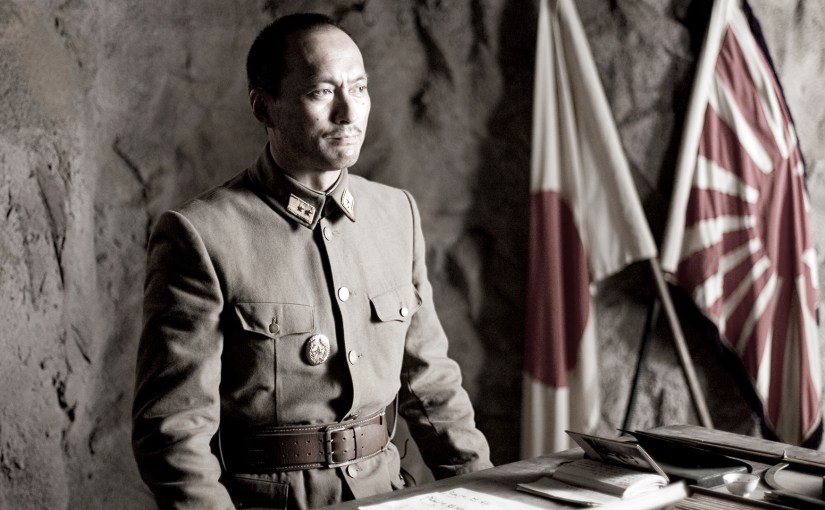
The companion piece to Clint Eastwood’s World War II film, Flags Of Our Fathers, and shot back-to-back, is Letters From Iwo Jima.  It’s not so much a war film as it’s a perspective of a losing battle during the height of the war, shown through the eyes of Japanese soldiers bearing little ammunition, food, and supplies while being plagued with dysentery and starvation. 

Right from the start, what I found interesting is how similar the Japanese mentality is to that of American soldier characters I’m all too familiar within other cinematic retellings. Paul Haggis recruited Iris Yamashita to write the screenplay, entirely in English, and then translated into Japanese.  The subtitles seem to read with a familiar English vernacular that my limited knowledge of Japanese culture would never expect.  I also find it interesting that rankings are the same from General to Lieutenant for example, and the salute to officers is precisely identical.  All of these similarities, and still the world powers find reason to fight one another.

The running theme of the picture reminded me of the television show M*A*S*H.  An assortment of characters take the time to write home about their experiences and fears along with the hardships they are enduring with unpure water, sweltering heat, infectious bugs and exhaustion.  One soldier’s letters are told will get censored if they ever reach the mother land.  These men are bakers and scholars, forced to serve a power that controls them.  They are not spies or regular army men.  They had no choice but to be here digging and preparing to kill.

Ken Watanabe portrays General Kuribayashi.  In the beginning of the film, he is writing a letter to his wife as he is landing on the island days ahead of the battle to come.  One of his biggest concerns is that he did not finish installing the kitchen floor in his home before leaving. Kuribayashi is a celebrated strategist and hero, who actually studied and worked abroad in the United States.  He even broke bread with famed American military leaders and carries a valuable gift from them in his holster.  Yet, he is committed to his country’s Imperial Army and he knows he will not return home from this island.  He also knows that he will have to kill the very same men that he shared a meal with just a few years earlier. That kitchen floor is what is on his mind. 

A young infantryman named Saigô (Kazunari Ninomiya) was forced to enlist while his loving wife is carrying their child.  I’ve seen character situations like these before.  It’s much more revealing to see what cinematic history has described as the enemy to my John Wayne and Clint Eastwood heroes, though.  Recently, I listened to The Cine-Philes podcast recap of the film Crimson Tide, and they focus heavily on the midway dinner scene among the officers.  Denzel Washington’s character concludes that “…the true enemy of war is…war itself.”  Letters From Iwo Jima delivers on that argument.

Ahead of the well-known battle, there’s a quiet tranquility among the Japanese troops.  They debate about digging trenches and even fighting on the island which is devoid of any stronghold or power.  It’s also an unwinnable battle as the Japanese have realized that they are getting no air or naval support because much of their military cavalries have already been decimated.  The ultimate purpose for these men is to hold off the Americans, who are ten times more powerful, for as long as possible.  No man serving the Imperials is to surrender.  They will fight until they are as good as dead.  General Kuribayashi’s best idea to hold out is to dig caves within the mountainsides, thus making it challenging for the American soldiers to locate Japanese within the darkness of the caverns.  It worked longer than it should have as the engagement that was expected to only last five days went as long as thirty-six days instead.

Disturbing moments within the film do not compromise.  A small unit’s unified shout of “BANZAI!” will live with you forever when you see what they jointly commit within the cave they occupy.  Eastwood convincingly shows you the carnage.  Another character recollects how he was enlisted for five days in the military before he was forced to serve at this miserable place for disobeying a direct order. His humanity undid him.  Letters From Iwo Jima tells the stories before the occurrences that left gravesites (estimated to be ten thousand Japanese men lost) on its black sand beaches.

In a way it makes me proud that Clint Eastwood chose to direct Letters From Iwo Jima.  While his war pictures (Where Eagles Dare, Kelly’s Heroes), and even his Dirty Harry films which lean on prejudice for the truth found in humor, are endlessly memorable, he opts to take a sensitive position to the other side of the coin.  Eastwood does not lose sight of the fact that his heroes celebrated during the first half of his career were heroically killing and taking out fellow humans.  Letters From Iwo Jima recognizes the loss of humanity amidst the rocket fires and artillery of violence.  Six Japanese men will take to killing a captured American by beating and stabbing him into lifelessness.  Later, faceless Americans concealed by the director’s familiar shadows of photography will point blank kill a pair of unarmed Japanese men. 

Flags Of Our Fathers points a critical eye at the celebrations of victory.  Letters From Iwo Jima acknowledges victory is beyond reach but the enemy of all of us, war, is never done with any of us.

THERE’S SOMETHING ABOUT MARY

By Marc S. Sanders

Love never dies.  Sometimes it just gets jammed in your zipper.

Ted (Ben Stiller) can’t put his finger on it.  Neither can Pat (Matt Dillon) or a couple of other obsessed, stalking paramours.  There’s Just Something About Mary.

In 1985, brace faced, insecure Ted gets the opportunity to go to prom with the prettiest girl in school, Mary (Cameron Diaz).  He’s a good guy, but disaster strikes in truly one of the most unimaginable ways and prom never works out for these kids.

Jump thirteen years later to 1998 and Ted gets the idea to hire Pat, a private investigator, to track down Mary in hopes of rekindling a new romance.  She’s in Miami, Florida now, working as a chiropractic surgeon and even more beautiful than ever.  Problem is that Pat has lied to Ted about what has come of Mary and wants to pounce on her all for himself.  Ted eventually gets up the gumption to trek from Rhode Island to Florida anyway.  Along the way complications ensue.  Let me change topics for one second and remind you to be mindful of rest stops when you are road tripping.

There’s Something About Mary is one of the all-time great comedies and my favorite of the Farrelly Brothers’ collection (Kingpin, Dumb & Dumber, Me, Myself & Irene).  I’ve described the spine of this film, but it’s the guts of endless sight gags within that uphold this picture.  Everything from a dog that gets drugged, electrified, drugged a lot more, and body casted to a handicapped friend of Mary’s who simply cannot pick up his keys without instigating terribly guilt-ridden chuckles. (I’m laughing as I write this.)  Special needs adults lend to the comedy as well.  The Farrellys are proudly nowhere near politically correct. Yet the material manages to not be horribly offensive either.  You need not worry, you will still get into heaven even if you laughed at There’s Something About Mary.  Still, that’s what comedy is.  Somebody always needs to be the victim of the stooges who lend to the mayhem.

This comedy is also perfectly cast from the three headliners all the way down to the extras.  A South Carolina jail cell setting draws big laughs at poor Ted’s demise. 

Cameron Diaz is such a sport though, always looking beautiful while willing to be the fool.  It was great to watch this with my seventeen-year-old daughter since she had no idea of that hair gel scene.  If you don’t know, don’t read about it.  Just watch and look at how well Diaz holds the moment together.  I remember SCREAMING in the movie theatre next to Miguel.

Stiller and Dillon are two dumbasses you likely never would have envisioned in a film together.  Nevertheless, they are perfect foils of stupidity against one another.  Matt Dillon is often recognized for his tough guy dramatic roles.  Yet, he puts it all on the line.  Stiller is primarily known for comedy, and this film is the first of a series where he becomes the unfortunate victim of circumstances (Along Came Polly, Meet The Parents).  I wouldn’t want anyone else in these scenarios though.  You laugh at what Ben Stiller ends up in but also feel sorry for the poor guy.  I would have no objection if Matt Dillon and Ben Stiller paired up again for another comedy, even all these years later.

Other cast members also lend their level of comedy from Chris Elliott to Lin Shaye to Sarah Silverman, Jeffrey Tambor, Markie Post and especially Keith David, who knows he belongs nowhere in this movie, but that’s exactly why he should be part of the cast.  He’s utterly hilarious.

A nice touch to the movie are the series of outtakes during the end credits while the cast lip sync to The Foundations celebratory number “Build Me Up Buttercup.”  This had to have been such a party to film and finally the audience is assured that they can laugh along in front or behind the camera as well. 

There’s Something About Mary is the movie so many of us need right now.  Turn off the news and turn on what went on between Ted and Pat and their pursuit of Mary. 

FROM THE WORLD OF JOHN WICK: BALLERINA

By Marc S. Sanders

Her father gets killed.  She grows up to become a skilled assassin.  She seeks revenge.

There’s your story.

Ana de Armas headlines this extended branch off the John Wick franchise called Ballerina.  She plays Eve.  I like her.  The same way I liked her all too brief appearance in No Time To Die.  

Keanu Reeves’ Mr. Wick makes some scant appearances to escort Eve into the ring where she can use guns, lots and lots and lots of guns, plus a bunch of knives too. Kitchen utensils including stacks of dish ware along with pots and pans.  Grenades to tape inside an goon’s mouth.  There’s also a flame thrower and to counteract against another flame thrower, there’s a fire hose.  

Ballerina takes a break acknowledgment when a flat screen appears behind Eve to quickly show the channels change from the slapstick beatings by The Three Stooges and then over to a Looney Tunes short.  Get the idea?

If there’s a story, it’s not even a full one note.  Gabriel Byrne is the distinguished Chancellor who Eve has a target for.  Despite his armada of endless assassins that come from every corner of the screen, and maybe they leap off from Lilo & Stitch playing in the theater next door, The Chancellor demands that Eve’s controller known as The Director (Anjelica Huston) call off her underling’s agenda.  Clearly though, Eve is under no one’s control.

Ballerina is high stakes action, and you get what you pay for.  However, I’d also pay for the 64 oz porter house and my middle age body will plead with me to slow down my pace before my gastrointestinal system implodes.  Every morsel of this movie is great and terrifically assembled but man is it an overindulging two hours and four minutes of slashing, shooting, exploding, breaking, crunching, pounding, punching, elbowing, kneeing, kicking, choking and strangling.  You drown in the beefy mayhem.

This actioner plays like a combat video game.  Drawn out fight sequences happen in one setting.  Then, Eve traverses to another location and the violence resumes.  It amuses me how Eve will do a number on one bad guy and once he’s permanently put away, only then does the next guy enter.  Wash, rinse, repeat. Whoa!!!! Here’s the next guy and then the next and next thereafter.  No one thug walks in to interrupt a one-on-one fight until Eve’s current opponent is put down with a bullet to the head or a grenade in the mouth or a flame thrower scorching.

It’s fun.  Yes.  However, there is a character that Eve encounters played by Norman Reedus, and I told Miguel later that I could not recall what his final fate was when we last left him in the picture.  I truly forgot that he’s a proud dad to a nine-year-old girl.  I mean, I truly forgot there was a little girl who was seen earlier in the movie.  I don’t even recall Reedus’ pertinence to the film. My mind was so paralyzed of thought process with the action overdose, that the few minute details there are, have escaped my short-term memory. I must have been suffocating in the fast-moving edits of the fight choreography and ballistic weaponry at play.  

After the film ended and considering what I know was left off with last year’s John Wick 4, I inquired of Miguel to piece together when this movie took place.  He looked it up.  I pondered for a millisecond at best, before I finally concluded it makes no difference.  Finally, after the production expended every penny on the last stunt man extra, the movie stops and the credits roll. Time to escape to the peaceful tranquility of my home.

The settings for Ballerina are marvelous and truly worthy of an Art Design Oscar.  I loved running up and down staircases and through underground corridors with Eve leading the way.  A snowy, mountaintop village occupies all of the action in the second part of the film, beginning in the saloon/dining hall, then going upstairs, then out a window, or three, and all over.  Director Len Wiseman cuts in great close ups of Ana de Armas in intense black leather with her hair in a neat ponytail.  Keanu Reeves is granted his own well-placed shots too.  

Wiseman also gets overhead shots to see the twisted stone walkways and stairwells of this area and where they navigate towards.  There are cuts to what comes around the corner and what’s thrust through doorways and windows, or down from the ceilings and rooftops.  It’s maddening and precisely cut.  The editing is superb despite how overstimulating all of the action becomes.  Eventually, you want to say “Oy!  Enough already!”

The script for Ballerina can’t be more than five pages.  It’s short on dialogue and what stands out to me is after Eve has set the whole town on fire and dispatched about three-thousands of The Chancellor’s militia, does his top henchman approach him and request to “Give the order!”  Buddy, after all this, if you have to ask, then this must be your first rodeo.  The Chancellor clearly overpaid for your services.

Ballerina is the female equivalent of the John Wick franchise.  Ana de Armas stands where Keanu Reeves stood for four pictures thus far.  If you’ve seen his four entries in this series, then you’ve seen Ballerina.  

Is it entertaining? Yes.  Is it mind numbing? After fifteen minutes? Definitely!  Do the filmmakers serve the product that was promised? Absolutely!  However, how does that ginormous porter house steak feel when it’s still lodged in your gut two hours later, and on until sunrise?

BOBBY (2006)

By Marc S. Sanders

There’s the distinguished doorman who is retired now but returns each day to play chess with a colleague in the hotel lobby.  There’s the open-minded girl who is inspired to prevent a young man from getting drafted into the Vietnam War by marrying him.  Her hairdresser is married to the hotel manager, who happens to be having an affair with the beautiful switchboard operator.  As well, the dining manager is a bigot who will deny his Mexican employees enough time to leave work and exercise their right to vote.  A busboy will have no choice but to miss what will likely be Don Drysdale record breaking sixth shut out game in a row.  A drunken night club performer can hardly stand up straight while she is completely dismissive of her caring husband.  A wealthy man is ready to introduce his trophy wife to an eventful evening in modern politics.  Two young campaign workers sneak away to drop acid for the first time.  A black man is at a loss following the recent assassination of Dr. King. Though he has hope that at least Bobby Kennedy will uphold his faith for a promising future in America for African Americans to carry equal rights. 

So, what does any of this have to do with Robert F Kennedy?  Not much I’m afraid.  Writer/Director and star Emilio Estevez tells us that all of these stories occur in the Ambassador Hotel on the fateful night when the Senator was assassinated in the hotel kitchen by Sirhan Sirhan.  In Bobby, the only character that is not a character is Bobby Kennedy and that is unfortunate.  More to the point, all of these short stories and other characters are precisely boring.

Estevez committed himself to grinding out stories that occur in the Ambassador that would lead up to Kennedy’s tragic death.  He’s admitted that they are all fictional. Based on his research and photographs, these characters are very loosely inspired by those that were there that night.  Before gathering in the ballroom to hear Kennedy’s victory speech after winning the California primary, these people were going through own personal ordeals.  If Emilio Estevez was not so personally inspired and researched in Robert Kennedy’s purpose to American history and politics, then perhaps Arthur Hailey (Hotel, Airport) would have pieced together this script of anecdotes and vignettes.

I commend Estevez’ efforts here.  The film looks great and even though the Ambassador was being demolished at literally the same time as this film was being shot, the scenic designs are very authentic.  The cast is even more impressive as the director reunites with many co-stars that he’s worked with before including Demi Moore, Anthony Hopkins, Christian Slater and his real-life father Martin Sheen, a lifelong loyalist to the Kennedy family.  The “importance” of this movie seems to sell itself.  Yet, everything is incredibly mundane and of little interest.  When your cast and your characters are just items on a grocery list to check off, there’s not much that’s interesting beyond the coupons.

The juicy gossip that surrounds the real-life actors is more captivating. Estevez cast Ashton Kutcher (Demi Moore’s real-life husband at the time) to play the drug dealer who provides acid to the campaign workers (Shia LeBeouf, Brian Geraghty).  Moore is also Estevez’ ex-girlfriend.  Yet, to watch Kutcher, LeBeouf and Geraghty experience an acid trip with weird visions they see when they open a bedroom closet is unfunny and not captivating.  Emilio Estevez is not living up to the Coen Brothers (The Big Lebowski).

A tryst with the boss (William H Macy) and his young, attractive and naïve switchboard operator (Heather Graham) is nauseatingly hokey.  The aged wife who works in the hotel salon (Sharon Stone) turns it all into squeamish soap opera tripe.

Bobby has an alarming opening.  A false alarm fire call is wrapping up at the Ambassador Hotel and you may feel like you are entering the middle of a panic storm, but things quickly calm down and the film resorts to cookie cutter editing to introduce its all-star cast.  None of what they say matters.  This is a game of who you can recognize.  Joshua Jackson, Nick Cannon, Harry Belafonte, and eventually the guy with the most significant role, Laurence Fishburne, is given his moment, the best scene of the whole film.  Fishburne is the kitchen chef who allegorically uses his creations in cuisine to compare the black man’s experience to the brown man’s, or Mexican. 

Having finished a trip to Martha’s Vineyard, I wanted to show my wife the under-the-radar and captivating film, Chappaquiddick, which covers Ted Kennedy’s personal story of controversy.  (My review of that film is on this site.) To continue on the Kennedy parade, we were motivated to follow up with Bobby.  Yet, this picture offers very little to the significance of Senator Robert F Kennedy.  There are samples of news reports complete with Cronkite.  Plus, the Senator’s own words ring through the epilogue of the picture.  Yet, I felt cheated of learning nothing new about the historical figure. 

Reader, you may tell me to kick dirt and go find another movie or read a book.  Fair!  However, this is film is called Bobby, and if I’m not going to learn about Bobby Kennedy from the man himself, then allow me to get to know the man through the eyes of these individuals.  Who hates him?  Who loves him? Who has a crush on him?  Who is inspired by him?  Who wants him dead and why? 

Estevez’ script does not allow enough material to describe what Kennedy meant to these campaign workers or hotel workers or guests.  They are primarily self-absorbed in their own personal battles to think enough about the fact that Bobby Kennedy is expected to make an appearance later this evening.  Again, their personal concerns for each other is very dull.  I don’t want to be around a drunk and obnoxious Demi Moore.  I don’t want to drop acid with some guys who hide behind a façade for caring about the candidate they are supposed to be serving.  I feel sorry for the busboy who will miss that big game, but that’s not enough to get me engaged in the entirety of the picture.

Bobby lends very little to the confusing times of the late sixties when an unwinnable war was persisting and championed leaders were being killed for others’ agendas.  Any of these stories could have been yanked from this script and slotted into a disaster flick like The Poseidon Adventure or The Towering Inferno

Bobby only picks up momentum when it arrives at its end that many of us learned about in school or witnessed firsthand in documentaries or directly from that very sad and unfortunate evening, June 4, 1968.  This day in history is so much more important than a Helen Hunt character trying to convince her Martin Sheen husband to let her buy a new pair of black shoes.  Bobby Kennedy deserves more recognition than what Emilio Estevez offered.

BRING HER BACK (2025)

by Miguel E. Rodriguez

DIRECTORS: Danny Philippou & Michael Philippou
CAST: Billy Barratt, Sally Hawkins, Jonah Wren Phillips, Sora Wong
MY RATING: 9/10
ROTTEN TOMATOMETER: 89% Certified Fresh

PLOT: A brother and sister uncover a terrifying ritual at the secluded home of their new foster mother.


Bring Her Back is a supremely disturbing modern horror film from the two directors of 2022’s celebrated debut film Talk to Me; it’s right up there with Hereditary [2018] and The Babadook [2014].  It brazenly opens with creepy black and white footage of…something…then appears to drop into “Lifetime-movie” mode, lulling us along until WHAM, something truly unbelievable occurs, and it’s just a roller-coaster ride the rest of the way.  It’s bloody ingenious.  (Emphasis on the “bloody.”)

Andy (Billy Barratt) and the visually-impaired Piper (Sora Wong) are step-siblings who experience an early tragedy, resulting in the two of them being assigned as foster children to Laura (Sally Hawkins), a single mother who has experienced a tragedy of her own.  Her child is Oliver (Jonah Wren Phillips), a 10-year-old boy who has been voluntarily mute since his sister, Laura’s daughter, drowned in their pool, now kept empty.

Ominous signs abound.  Laura’s house is completely encircled by a strip of white paint.  She locks Oliver in his room whenever she leaves the house.  At a funeral, Laura surreptitiously clips some hairs from the body in the casket.  Andy discovers he has started wetting the bed, but he’s 17 years old; Laura ascribes it to stress, but the real reason is far more…invasive.  And over everything is the mute Oliver, lurking in the background, occasionally banging on doors and windows, and more.

Another superb element to the story is the character of Piper, Andy’s visually-impaired sister.  I mention this because the filmmakers deliberately held a casting call for actual visually-impaired actresses, settling on the completely non-professional Sora Wong.  This aspect of her character is utilized to the hilt throughout the movie, in ways I can’t even hint at without spoiling any surprises.  (Okay, I’ll mention one moment…where she knows someone is front of her, feels their head, then turns and asks someone else, “Who is this?”  BRRRRR…)

When the Philippou brothers do drop the hammer and get started with the real horror elements, they do not hold back.  There are scenes here as terrifying and as off-putting (in a good way, I guess?) as anything in [insert your favorite horror film here].  There are images here that I will not soon forget.  In a perfect world, this movie would become so popular among horror fans that those scenes would become part of a pop-culture shorthand.  “The knife scene.”  “The table scene.”  “The Russian videos.”  “The ‘self-snacking’ shot.”

I initially had an issue with the very ending, which felt more, shall we say, heartfelt than the rest of the movie implied was coming.  However, I learn from IMDb that the Philippous had a much grander ending planned.  But everything changed when a close friend of theirs passed away unexpectedly during production; the film is dedicated to him in the closing credits.  Danny Philippou is quoted: “[The film’s ending] goes against the conventions a little bit, but it feels more true to life.”  Watch the film and judge for yourself if he’s right.  As for me, now that I know that piece of trivia, the film’s ending is easier for me to accept.

Here’s hoping that Bring Her Back becomes at least a cult classic.  For someone like me, who’s a bit picky with this genre, it’s an easy pick for a new movie to throw into my annual Halloween rotation.  I enjoyed the hell out of this movie.

THE SUGARLAND EXPRESS (1974)

by Miguel E. Rodriguez

DIRECTOR: Steven Spielberg
CAST: Goldie Hawn, Ben Johnson, Michael Sacks, William Atherton
MY RATING: 6/10
ROTTEN TOMATOMETER: 87% Certified Fresh

PLOT: A young wife breaks her husband out of prison in 1969 Texas so he can help reclaim their infant from a foster family.  The ensuing media circus takes everyone by surprise.


Watching Steven Spielberg’s The Sugarland Express is like looking at one of those historical medieval tapestries of fierce battles, created by artists who didn’t yet know how to depict perspective.  There is plenty of action on display, but everything looks and feels flat.  The film took an award at Cannes that year for Best Screenplay, probably (at least partly) in recognition of how it shies away from a traditional Hollywood resolution, but even its downbeat ending is reminiscent of earlier, more resonant films like Bonnie and Clyde [1967] or Butch Cassidy and the Sundance Kid [1969].  As a stepping stone in the career of an eventual legend, it’s worth a view.  As a stand-alone film, it never quite achieves liftoff.

Based on real events, The Sugarland Express tells the story of Lou Jean Poplin (Goldie Hawn at her irrepressible, bubbly best), the young wife of prison inmate Clovis Poplin (William Atherton).  During a conjugal visit, just four months before Clovis is to be released, Lou Jean boldly busts him out because she needs his help to reclaim their infant, Langston, from a foster home.  Lou Jean herself has just finished serving time at a women’s prison, and the state, probably very wisely, determined Langston was better off with a foster family.  But they need to hurry because “I bet those Methodists are gettin’ ready to move out of state.”  Lou Jean’s delivery of “Methodists” tells you all you need to know about her feelings on the matter.

After Lou Jean breaks him out, a comedy of errors ends up in a situation where she and Clovis have hijacked a police cruiser and are holding a police officer at gunpoint.  They demand to be left alone while they drive to Sugarland, Texas, and retrieve their son, at which point they’ll release their hostage.

Now, this has all the makings of a smart, character-driven “road” movie, instigated by desperate people with no real plans for their end-game.  But for reasons I can’t put a finger on, nothing ever happens in the film that got me on the edge of my seat, figuratively speaking.  I fully comprehended the situation intellectually, but the film never got to me at an emotional level.

Could it be because we never really learn a lot about Lou Jean and Clovis in order to make them more empathetic?  No, I don’t think so, because over the course of the film, we’ll hear all about their past histories and previous brushes with the law.  The very fact they’re executing this plan to essentially kidnap Langston is proof of how unfit they are as parents.

I think part of the problem with the movie is…

…I’ve been sitting here for the last fifteen minutes trying to finish that sentence.  I can report that the film didn’t get to me emotionally, but I am struggling to explain why.  Could it be as simple as I think they’re not such great people, but the film seems to be siding with them as the movie progresses?  I mean, the movie HAS to side with them at least partially in order to make their journey mean anything.  Look at Butch Cassidy and the Sundance Kid.  Bank robbers, lawbreakers, but clearly the good guys because, duh, Paul Newman and Robert Redford are playing them.

So, maybe it has to do with the casting?  The Sugarland Express had one of America’s sweethearts as a woman willing to resort to kidnapping just to commit another kidnapping in the name of maternal love.  So, we’ve gotta root for her, right?  But then we see her behaving in the most inane, brainless way for so much of the movie.  I found it difficult to side with her when I just wanted to, forgive the expression, slap some sense into her.

What about Clovis?  I could side with him.  He appears to have misgivings throughout the entire film, right up to the point of no return.  But the way he willingly goes along with the scheme because, dammit, it’s his wife…something about that also turned me off on him.  There are moments I felt sorry for him, for them both, because I could see where this movie was headed early on.  But that empathy wasn’t enough to make me feel a catharsis of tragic energy at the film’s finale.  There’s just something about Clovis and Lou Jean that wouldn’t allow me to get too worked up over their fate.

I guess I identified most with the kidnapped police officer, Slide (Michael Sacks).  Maybe too much.  From the beginning, Slide is begging them to drop their weapons and turn themselves over to the police.  At first, he looks like he’s just following his training.  But then the movie progresses, and doggone it, he starts to like these two loonies, even though Clovis handcuffs him and even shoots at him a couple of times in the heat of the moment.  He can see where this road ends, and he pleads with them not to do exactly what the Texas state troopers expect them to do, because he doesn’t want to see them dead.  Because Slide never stops imploring the Poplins to see sense and do the smart thing, I guess he’s who I sided with for the entire movie.  (Well, him and his superior, Captain Tanner [Ben Johnson], who also doesn’t want to see them die.)

But…isn’t that the wrong way to approach this movie?  I shouldn’t be siding with the cops, for cryin’ out loud, should I?  At least, not in this movie.  Discuss.

From a technical standpoint, it is pretty cool to see how Spielberg, in only his second film, was able to marshal vast resources to create some arresting imagery.  The sight of what looks like literally hundreds of cop cars following the Poplins is a deceptively difficult feat, logistically speaking.  There’s a tense shootout in a used car lot that would have been right at home in The French Connection.  And everywhere, there’s bits of humor that made me smile.  From the elderly couple abandoned on the road (long story) to the solution of how to get Lou Jean to a toilet while in the middle of an extended police chase, Spielberg constantly pokes us in the ribs.  If this had gotten to the hands of someone like John Landis, it’s easy to see how this could have been turned into an out-and-out comedy with thriller elements, instead of the other way around.

One other aspect I did like was the media circus that blew up around the Poplins’ plight.  I’m sure it is yet another link to previous anti-heroic films, but while I was watching it, I was reminded of only one film: Oliver Stone’s Natural Born Killers [1994].  The outpouring of affection from the general public for these two, let’s face it, outlaws was both funny and sobering at the same time.  It would have been interesting to see a scene or two at the end of the film as an epilogue, so we could get a reading on what the public thought about how the police should have handled the situation.

If comparing The Sugarland Express to most of Spielberg’s later films, it certainly comes up lacking, no question.  As a lifelong Spielberg fan, I am compelled to say it SHOULDN’T be compared to his later films because it was made before he’d had a chance to hone his skills and become the populist/mainstream film icon he is today.  Look carefully at the two-dimensional storytelling and you can see the outlines of what was coming around the bend for this modern-day master.