MEGALOPOLIS

By Marc S. Sanders

Francis Ford Coppola’s Megalopolis is undeniably the director’s most ambitious project of his long career.  Like other films, Coppola put up the entire $120 million to finally make the picture, including selling his well-known vineyard to make it happen.  Every penny he invested is well spent.  Especially seeing it on IMAX, this is an absolutely gorgeous motion picture, like James Cameron’s Avatar films.  I mean…wow do the colors pop and shine.  

However, as beautiful as the visuals are in Coppola’s self-described “Fable” (it literally says that in the title card), it is mostly devoid of substance beyond the paint by numbers debates that cause conflict among these very strange characters.

In New Rome City, an alternative reality to the Big Apple (the Statue of Liberty holds the torch in her left hand), Caesar Catalina (Adam Driver) is a “designer” who recently invented Megalon, a substance that he believes is the answer to a utopian future.  It’s indestructible and it can be molded to serve practically any purpose.  For example, you don’t even have to walk to where you’re going.  Step on the Megalon puddle and it will move you there.  Not much of a departure from the flat movable floors you find in nationwide airports.  This is one of Megalon’s major innovations, designed to impress me?

Megalon can also be used for healing, and it has the ability of transparency.  It is more durable than wood, steel or concrete.  It’s truly the next greatest wonder of resources.  Frankly, I was more dazzled by the Vibranium found in Wakanda.

As Caesar the artist pushes his agenda for absolute Utopia, the hardened Mayor Franklyn Cicero (Giancarlo Esposito) is the opposing side of the argument declaring Utopia to be an impossibility.  Caught in between the two figures is Julia (Nathalie Emmanuel), daughter of Cicero and in love with Caesar.  Gotta have a soap opera element to this piece so the stubborn divide between these two men remains firmly in place.

Just as in typical political rings, the Mayor works to smear Caesar the idealist who is solely focused on his end goal design.

Outside the boundaries of their public quarrel are other overly colorful and garish looking characters such as the banker Hamilton Cressus III (Jon Voight), his wife, the gossip reporter Wow Platinum (Aubrey Plaza), Constance Cassius Catalina who is Caesar’s mother (Talia Shire), a lone, crazed revolutionist and nephew to the Mayor called Clodio Pulcher (Shia LeBeouf) and Nush “The Fixer” Berman (Dustin Hoffman).

These names are exhausting.  Coppola’s film is even more tiresome.  The filmmaker truly must believe he is the second comings of both Nostradamus and William Shakespeare.  The ego of this picture could not be more apparent.  The director’s head must be THAT BIG to believe he has the nerve to tell this story of such biblical proportions.

Much of those character names, and the actors who play them, are here for show and tell.  Their value to this piece is nowhere near as prized as anyone living in Harry Potter’s world, though. Megalopolis only takes time to calm itself down when the three principal players have scenes isolated to themselves or when they only occupy the screen together.  Otherwise, this movie serves as vehicles for much of the cast to be adorned with updated and trendy Roman costume wear, from fig leaf crowns to golden armored chest plates.  At times, LeBeouf is so unrecognizable in hair, makeup and clothes you don’t even realize you’re looking at him.  

The performances are all over the place.  I never once believed that whatever Dustin Hoffman was talking about that he knew what he was even saying or representing.  Shia LeBeouf mostly runs with the privilege of getting to say “Fuck Caesar!” while finding motivation only in whatever weird appearance he’s dressed in.  Adam Driver can lead a picture for sure, but here he looks like he showed up for filming with a bewitching overnight hangover.  

This is a film that cannot be ignored for its technical achievements at Oscar time.  For no reason other than aesthetics, Driver and Emmanuel will share a scene while balancing themselves on swinging steel construction beams high above the city. The view is spectacular.  All undeniably eye opening.  You also cannot look away from the costumes or scenic art direction.  The sound mixing in an IMAX theater totally envelops you in this weird world.  It’s a digital film’s dream just like James Cameron banks on.  

Still, maybe none of these efforts will be recognized because frankly much of the visuals, audio and physical construction make zero sense or relevance to the central storyline that Coppola is striving for.  Namely, the possibility for Utopia versus the practicality of simply living through life with the necessity for economics, technology, healthcare, fuel and on and on and on.

Of all films I thought about while watching Megalopolis, my mind went to William Shatner’s Star Trek V: The Final Frontier.  Shatner had the idea to have the Enterprise crew meet face to face with the almighty God.  Well, if you’re going to deliver God to a movie house, without George Burns or Morgan Freeman in the role, you’re setting yourself up to disappoint at least half or maybe even one hundred percent of your audience.  When you factor in the tremendous assortments of beliefs and religions, I’d argue no two people who believe in God, see the ethereal, omnipotent entity in the same way.  The same goes for Utopia.  How can Francis Ford Coppola be so audacious as to believe audiences will accept Caesar’s vision of a perfect land?  

Reader, he can’t!

My Utopia is different than your Utopia.  This is practically an untouchable subject and Francis Ford Coppola is far from the fabled prophet that the world needs or will draw their attention to.

Still, I remained as open minded as I could with Megalopolis all the way towards the ending that finally arrived.  The Utopia shown on this giant IMAX screen was told by the film’s narrator (Laurence Fishburne, also paying Caesar’s chauffeur) that the world was showered in gold dust.  A far cry from the Bible’s claim of arriving upon a land of milk and honey.  Why should I ever need the nourishment of milk and honey when I can have gold dust?

Think about that for a second.  Gold Dust.  I know.  The narrator is being allegorical.  Still, couldn’t that be interpreted as a little too materialistic for the Utopia we yearn for?  Gold is only a precious metal the same way a diamond is only a precious stone, or the Atari 2600 is now an expired precious commodity among former twelve year old kids in the 1980s.  

I have little shame.  I’m an admitted materialistic kind of guy.  My Mustang and my flat screen TV and my Star Wars collectibles mandate that I am. Yet, none of these possessions have ever delivered me into a paradise of perfection.  The Mustang needs precious fuel to operate.  Try as I might, I can’t collect everything.  My flat screen TV is still on the fritz.  (DAMN YOU BEST BUY GEEK SQUAD!!!)

Coppola contradicts himself with the conclusion of his fantasy opus.  He pans over the extras who occupy this film with big toothy grins of enormous gratitude while the very well dressed and bejeweled surviving characters of his story seem to be shot from an elevated stage above me, the viewer, and all who occupy a brightly lit Times Square located within the heart of New Rome City.  I am meant to look up to these giants!!! 

THIS IS UTOPIA???  

No!  I could never accept this interpretation of grand decadence as the enigmatic paradise we have all envisioned in dreams and discussion and literature.  Shouldn’t Utopia consist of a life where stress is absent, and pain is a foreign unfamiliar word and feeling? I’m not even giving Utopia its fair due.  It’s practically impossible to describe, but I’m at least certain that the rich shades of gold and black glamours within a Times Square shopping district is not the way to go.  Yet, Francis Ford Coppola is suggesting this is all that it is.  A Times Square showered in gold dust.

Frankly, I normally would give much more credit to the man who pioneered the stellar Godfather films along with the bombastic Apocalypse Now and the intimate The Conversation.  He’s never been more short sighted though, than when he finally made his “fable,” Megalopolis.

The greatest flaw and tragedy of Megalopolis is the very broad contradiction that Francis Ford Coppola declares within his fictional, fantasy-like prophecy.  Once the “fable” is all over, I feel like I paid an enormous amount of money for a cult like weekend seminar meant to brainwash me into broadening heights of positivity and awareness, showered in gold dust of course.  

Where’s The High-Level Minister Coppola?  

I’d like my money back because this preach is no more believable than an L Ron Hubbard doctrine.  Battlefield Earth just might be a little more convincing Megalopolis.

REAGAN

By Marc S. Sanders

I read that Reagan completed shooting in 2021 during the height of Covid.  It was not released until three years later because it had trouble finding a distributor.  Everything happens for a reason, because it is more fitting that the cinematic biography of America’s fortieth President be released during an important election year.  I do not believe it matters what political party you lean towards, this telling of Ronald Reagan’s life demonstrates a man of principals with an adoring sense of humor, even when death’s door might be knocking. 

Reagan is one of the best films of 2024.

Dennis Quaid is an early Oscar contender for Best Actor as the title character.  It’s easy to fall into the trap of a Saturday Night Live impression or what Johnny Carson famously did on his show.  Quaid, with the assistance of some flawless makeup, finds Ronald Reagan’s crooked grin that shows a welcoming and open-minded figure, but also makes use of a slight scowl when the President emulated a need for tough policy, particularly with a bullying Soviet Empire and their possession of over thirty-five thousand nuclear missiles against America’s twenty-two thousand.  Like most of this cast, you absolutely believe that Dennis Quaid is Ronald Reagan, in a performance that quickly attracts a likability for the man, laughter when the film calls for it and earned sorrow when the figurehead is facing death or illness.  I cannot say I’m a big admirer of Dennis Quaid’s long career.  None of his films ever stood out to me, until now.

The film directed by Sean McNamara follows a pattern like another celebrated biography, Amadeus.  An outside observer narrates a person’s life to someone else.  This time it is a retired KGB spy named Viktor Petrovich portrayed delicately by Jon Voight.  Viktor claims that in the early 1940s he was assigned to penetrate the ranks of American activities to allow the Russians a leg up during pre-Cold War.  He thought a good route was through Hollywood as there were some connections between that industry and politics.  Viktor zeroed in on the eventual president of the Screen Actors Guild, a young Ronald Reagan, whose espouses of policy against Communist doctrine seemed to be overshadowing his budding acting career.  At the same time, he was frustrating his first wife, actress Jane Wyman (Mena Suvari).  Viktor could never anticipate this man would ever go from movie star to a life mired in divorce and bankruptcy, but then on to Governor of California and eventually a two term President of the United States.

It’s hard to find a way to get a biography off its feet and hit the ground running.  Where do you begin and how do you start the story? Fortunately, McNamara is working with a script by Howard Klausner and Paul Kegnor who find the most unexpected storyteller and Jon Voight is perfect in the role, perhaps a supporting actor nomination should be considered for his Russian interpretation that is utterly convincing.

After the film hops around in time for a bit, beginning with the day of Reagan’s assassination attempt (March 30, 1981) to young actor to early childhood when he was addressed with the nickname “Dutch,” does the story move on a straighter path.  The months, years and decades move in a chronological pattern.  I’m grateful for it because I can easily connect the dots.  

McNamara and Quaid show developments that lead to the next big moments, including time for Ronald to meet Nancy.  Penelope Ann Miller plays the First Lady and I’ve been missing her on the big screen.  She’s also perfectly cast and the picture allows her character to become fully developed so that a solid marriage of affection, love and image seems complete. 

Two stories I had heard before are included in Reagan.  Nancy enters the hospital just after the President has been shot and Ron tells his wife “Nancy, I forgot to duck.”  Years later, ahead of the very important Geneva Convention with Mikhail Gorbachev, Nancy insists that her husband not appear with a winter coat on when he goes to meet with the Soviet Prime Minister.  Ronald will be able to handle the cold air while Mikhail, the Russian, cannot.  It was an image of a strong, defiant leader standing in front of the world. 

In less than two and a half hours so much is covered in Reagan, but like any biography it cannot cover everything.  That is okay here.  A lot of details are explored and you do not need to be familiar with the history that was made during this man’s life.  Sean McNamara’s film never makes it overly complex.  News articles flash in front of you depicting some challenges that John F Kennedy faced which compounded on what Reagan would contend with nearly twenty years later.  Much of it has to be blink and miss it moments to allow other details and events to be presented.  You get an idea, but you do not need to reference an encyclopedia to understand the film. 

Reagan is primarily a favorable depiction of the famous President.  He’s almost always faced in a positive light.  I’d argue it is fair actually.  In his second election, he beat Walter Mondale by a landslide of forty-nine states to Mondale’s one.   Ronald Reagan remains a celebrated statesman among both sides of the aisle.  He was a bi-partisan man.  Room is allowed for Ron to have a friendship with the Democratic Speaker Of The House Tip O’Neill (Dan Lauria) despite their disagreements in ideals. 

I try to avoid getting too passionate and political as I write this article, and I know it is just a movie, but Reagan serves as a reminder when a political system was not hinged on the extremism that is demonstrated today.  The politicians did not seem to be running for themselves ahead of the party they supposedly represented on a ballot.  My family and I leaned Republican during the time of Ronald Reagan and Bush after him.  My ideals have had no choice but to change however, because as Reagan demonstrates, the Republican party of today is not what it stood for thirty and forty years ago. 

This film glosses over Ronald Reagan’s faults and shortcomings, particularly the scrutiny that came with the Iran-Contra Hearings and his possible negotiation with terrorists to rescue hostages.  However, while Reagan may have contradicted his line in the sand of no negotiations with terrorists, his intent steadfastly never remained with a personal self-interest.  Whatever he opted to do, he acted on behalf of the greater good of the nation he was elected to oversee.  That mentality is not easy to find today.  Presently, ego and self-entitlement drive many of the candidates to run for office, and at least I believe that is a very unhealthy mantra. 

Sean McNamara’s film is a sensational biography with a superb cast.  Many faces are familiar and only appear for minutes on screen to portray important members of Reagan’s cabinet or other political leaders.  Time of course is given to Gorbachev (Olek Krupa) as well as the Iron Lady, Margaret Thatcher (Lesley Anne-Down).  There’s also George Schultz (Xander Berkeley) and a California hippie named Dana (Derek Richardson in a scene stealing performance) who apparently was Reagan’s go to speech writer and created the line “Mr. Gorbachev, tear down this wall!!!” Never heard of Dana, and he seems like a far cry from who would exist significantly within the President’s career.  However, McNamara and the writers allow for some entertainment in the picture.

You see jars of Reagan’s jellybeans on tables everywhere and you cannot help but grin.  A door-to-door campaign for Ron and Nancy has a hilarious outcome with a housewife.  As President, Ron is tasked with feeding a goldfish belonging to the daughter of the Swedish Prime Minister.  The Secret Service even has the challenge of finding an agent to ride horseback alongside the President. These are issues that people face and live with, and the attention that McNamara lends to Ronald Reagan shape the kind of person he was.

The most memorable sequence is circumstantial when it is quickly depicted how three Russian Prime Ministers in a row suddenly die ahead of Gorbachev taking the spot.  Jon Voight is especially funny here amid his subtle expressions.  McNamara is working in the same mindset that Robert Zemeckis did with Forrest Gump’s fictional history.  Ronald Reagan even has a zinger of a line in response to this series of unexpected deaths.  Trust me.  If you watch this film with a crowd, you’ll be laughing among the masses.  It’s so unbelievable that it could only be true.

It makes no difference where you stand politically to appreciate Reagan.  It’s another biography to take advantage of and quickly gather a lesson in history.  The film is favorable and not overly judgmental of the figure it depicts.  That’s okay. 

The United States of America and its leaders were never entirely great.  No President ever satisfied an entire nation of people.  Reagan was not favored among the young adults of his time in an MTV age faced with the adversity of an unfamiliar AIDS crisis.  He faced challenges from his opposing party and he could have been the President that led the world into a World War Three of nuclear destruction.  All of these considerations are touched upon in a two- and half-hour movie and any world leader must be scrutinized in the same way they can be celebrated.  Yet, for a movie, this is about all we can ask for.  If you want to dive deeper, then I encourage you to do your research, find a podium or a college class or forum and declare your passions. Use a website like I do.  You absolutely have that right.  A movie does not have that luxury of time to go that far into the entirety of a man’s near ninety years on Earth.

I reiterate just how accomplished Reagan is.  Sean McNamara is a director to lookout for.  If he does not receive award recognition for this picture, and frankly I doubt he will (though I want to be wrong), his time will come.  This is a guy who only recently was directing silly Nickelodeon and Disney TV shows.  Yet, this director has a great vision for film assembly and a telling insight.  Ahead of the movie, I saw a preview for a Holocaust picture that he recently completed called Bau: Artist Of War. Because of McNamara’s work here, that film is on my radar. 

The cast of Reagan is also outstanding, worthy of Oscar nominations for Dennis Quaid, Jon Voight and Penelope Ann Miller.  As well, a host of character actors really embrace their short time on screen such as Dan Lauria, Lesley-Anne Down and Xander Berkeley (always a celebrated character actor), plus this bearded hippie guy Derek Richardson.  At the very least, the SAG awards should recognize this cast with a nomination for Best Ensemble.

Reagan is a very important film to see regardless of whatever generation you stem from.  At the very least, no one can argue that Ronald Reagen lived his life touting his own name and his own special interests.  Like the greatest of Presidents, he willingly served, only to serve the best interests of a country.  Watch the film that explores the life of one of American history’s greatest servants. 

For our country’s own future and prosperity, Ronald Reagan needs to be remembered.

WHITE MEN CAN’T JUMP (1992)

By Marc S. Sanders

I’m not enamored so much by sports unless they are dramatized effectively in the movies.  If I can see Woody Harrelson and Wesley Snipes making magnificent trick shots with a basketball in White Men Can’t Jump, my attention will be had.  There’s lot of street corner basketball depicted in Ron Shelton’s film and for the most part it is sensational and quite funny when partnered with the on court ribbing that guys toss at one another.  This film arrived with the oncoming trend of “Your momma is so…” insults, which still bring out the sophomoric glee in me.

Fortunately, White Men Can’t Jump doesn’t just rely on the basketball antics. There’s a good set up here and some well-drawn characters.  It’s one flaw may be that I think the film overstays its welcome.  Just when you think the picture is over and every loose end is tied, a new development occurs.  That’s because every sports movie demands a final championship game.  Who made up that stupid rule?

Billy Hoyle (Harrelson) makes quick cash on the court by being the fish out of water on Venice Beach.  He’s the pasty white kid with the dorky rainbow-colored cap that any urban black athlete will happily challenge for a game of one on one or two on two.  That’s the trick to his con because he’s a magnificent player actually, and regular player and loudmouth Sidney Deane (Snipes) sees an opportunity for them to partner up and clean up.  Like most competitive sports, you gotta taunt your opponent and when they have gone overboard, you lay on your conceit and declare that you can beat them any day with any guy they choose to partner them up with, such as the blond, white guy sitting on the bench doing morning stretches. 

They each have their own motivations.  Billy is up to his neck in debt to some bookies who he wouldn’t throw a game for. They are ready to collect or shoot him in the head, or both.  His girlfriend Gloria (Rosie Perez in a standout performance) aspires to land a spot on Jeopardy!. Sidney lives with his wife Rhonda (Tyra Ferrell) and baby in the criminal area of Watts.  She’s pressuring him to get them out of the slums and buy a house in a nice neighborhood. 

At first, the cons work for the pair, but the question is can Billy and Sidney trust one another.  Will they scam each other while trying to work together?

Ron Shelton’s script works because it turns in various directions when you do not expect it.  These are unusual characters. Lovable, but not all that they seem either and they are built with flaws that will undo them while they try to make a further leap ahead.  Billy is a smart kid on the court but he’s not smart with money like Gloria.  Sidney is smart at putting up the façade of a dumb loudmouth on the court but that’s his M.O. for being a responsible family man.  Gloria seems like a zany dingbat on the surface but she may be the smartest character of them all.  It’s definately not because she has memorized every kind of food that begins with the letter Q for the game show.  She has true instincts and knows to see through the B.S. of people that her boyfriend Billy can’t. 

White Men Can’t Jump is a both a con movie and a sports movie, but it’s not the greatest of each of those categories.  Still, it’s very, very entertaining thanks to Harrelson, Snipes and Perez working in top form. Wesley Snipes is doing the fast-talking wise ass routine that Eddie Murphy built his career on.  You don’t see this kind of guy in every Wesley Snipes movie though, like you do in Murphy’s films.  That’s what impresses me with Wesley Snipes.  He’s not known to be an Eddie Murphy or a Chris Rock.  He’s an actor, not a comedian, and yet he’d convince me otherwise if this was the only performance I ever saw.  

Other than his obvious role in Cheers, Harrelson normally portrays smarter guys.  Billy is smart, but he lacks instinct and not just with money but with how he considers Gloria.  The best thing Ron Shelton could have done after perfectly casting this trio was to give these characters heart followed by the flaws that weigh them down.  All that maintains what could have been a one note and flat story.

However, the film runs a little longer than I cared for.  While basketball is at the forefront of the script, I believed the film was concluding when I saw the two guys had finally grown up and learned.  Only then, a new development occurs for Sidney and his family. Suddenly, it’s up to the two guys to get back together for one more game.  I didn’t need that one more game.  I had my fill and that final tournament is shot in slow motion – literally every shot the guys make, and I’m starting to lose my patience.  Don’t get me wrong.  I’m impressed.  Harrelson and Snipes are not stunt doubled.  That’s them doing the doing the shots and accomplishing enormous efforts of agility to wow the audience.  They’re great, but by this point, I had seen enough basketball to deliver the message and I found the tacked-on twenty-minute epilogue mostly unnecessary. 

Granted some may argue that something occurs in that last game to justify the literal title of the movie.  I know what you’re talking about.  Yet, that could have been covered a lot more efficiently, I believe.  Less would have been more in this situation.

White Men Can’t Jump is great comedic entertainment, full of improvised dialogue and characters that are easy to like while keeping up a skeptical guard on them.  That’s good.  It states that Shelton’s characters are complex and that holds my interest.  Even the extras are ones to appreciate in their sweaty t-shirts while delivering urban vernacular to harass one another.  It’s a great culture to get a peek into.  I love the one guy who is a sore loser and whips out his knife, but then just as his girl calms him down, he says forget the knife.  He’s gonna get his gun. I challenge anyone not to laugh as all the other guys on the playground make a mad dash escape in a hundred different directions.  It would likely go down this way.  We hear of violent stabbings and shootings all the time. In this movie however, Ron Shelton and his cast find the natural humor of this opposing conflict.

I guess that’s the best compliment I can give the writer/director.  He didn’t sensationalize his characters.  Ron Shelton has a way of just letting his creatures of the court play.  Into—the—basket it goes. 

SWISH!!!!  It works.

THE HOT ROCK

By Marc S. Sanders

I’m a sucker for a good caper.  Capers play like strategy games.  An object (Hitchcock called them MacGuffins) needs to be acquired.  It doesn’t matter so much what the object is.  The importance falls within the pursuit. 

William Goldman wrote The Hot Rock, adapted from a novel by Donald E Westlake who penned a series of books focusing on the ex-convict John Dortmunder and his further adventures.  In the film, he’s played by Robert Redford. 

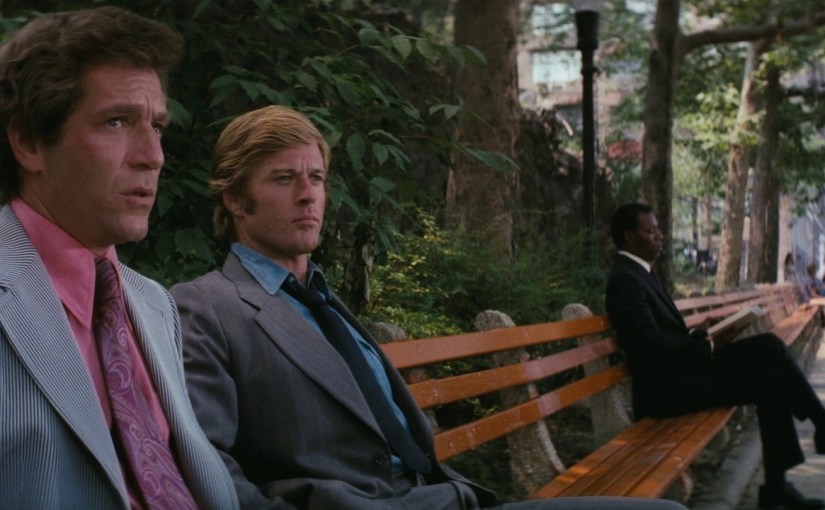
On the day that John is released from a New York state prison he’s picked up by his inept brother-in-law Kelp (George Seagel) who escorts him to Central Park.  Kelp wants John to be the fourth member of a team and steal a priceless diamond.  A man by the name of Dr. Amusa (Moses Gunn) sits about five feet away from them on a park bench.  Amusa breaks it down for the men, but they get interrupted by an elderly woman who sits between them to feed the pigeons.  This is what you can expect from The Hot Rock, a film structured under one pesky inconvenience after another.

This rock is currently on display at the Brooklyn Museum, on loan by an African country who has no business having possession of the valuable.  The stone belongs with Amusa’s country and he’s ready to pay Kelp and his crew $25,000 each to pull of the heist.  He’ll also, reluctantly, front some funding monies ahead of the theft for preparations. 

Like in all of these kinds of movies, John is ready to do one last job.  Then he’s out for good.  However, one last job turns into four last jobs.  Without spoiling too much, the rock gets relocated from one place to another.  So, a late-night heist at the museum turns into a break in a prison, and then it’s somewhere else and somewhere else after that.

As Hitchcock describes, you never care about the MacGuffin.  For movie purposes, you see it on display in its majestic glory, encased in a glass box right in the center of the museum, but so what.  The question is to uncover how the guys are going to get it out of there.  The Hot Rock doesn’t work nice and neatly like Ocean’s 11 or The Score.  In those movies, there are things that don’t go according to plan.  In The Hot Rock, nothing goes the way it should. Honestly though, it should be funnier than it really is. 

I recall there was a movie called Quick Change with Bill Murray doing his best to get out of New York City following a bank robbery.  It was comedic all the way through and maybe that’s because it was Bill Murray of Caddyshack and Ghostbusters fame, not to mention Saturday Night Live.  Robert Redford is the rugged actor of the time in 1972, though.  Not a comic and he plays Dortmunder like a serious kind of thief, even with his famous blond locks and toothy grin.  George Segal along with Ron Leibman and Paul Sand are bumbling chatter mouths, but are they funny?  Segal’s character steals a car to pick up John and we see him trying to figure out how to drive the dang thing, nearly running over Redford.  I never believed he did not know how to not drive the car. 

BY THE WAY: Ever notice in movies that they’ll show someone does not know how to drive a car by having them accidentally turn on the windshield wipers?  That’s all that is done.  That and having the car drive in S shape patterns as if the steering wheel suddenly took on a life of its own.  Then the scene comes to a halt with a startling slam on the brakes.  Never fails.  This happens over and over again in the movies.

Zero Mostel appears as the father/attorney for Paul Sand’s character.  It’s Zero Mostel, but Goldman’s script doesn’t give him much material to play with.  It’s not a silly caper flick because suddenly Zero Mostel of The Producers makes an appearance.  Look at Ocean’s 11, and see what Carl Reiner is doing.  There’s an organic affection for Reiner’s character that Mostel never achieves here. 

Peter Yates directed The Hot Rock a couple of years after the car chase thriller, Bullitt with Steve McQueen.  He impressed audiences with what two cars pursuing one another across the hilly streets of San Francisco could accomplish.  In this film from the early 1970s, Yates attempts to dazzle the audience with a few more speeding car stunts but they just don’t cut the corners.  Everything on screen looks like Yates and his crew are trying too hard.  There’s a helicopter sequence and much time is devoted to seeing how the chopper flies low over the Hudson River and then soars above the Twin Towers, still under construction at the time.  Look everyone!  Ron Leibman is flying a helicopter and Robert Redford and the rest look woozy about it all.  Thing is that James Bond movies were already doing this kind of schtick (with special effects) year after year by this time.  Peter Yates just doesn’t offer up anything that looks like a new sensation.

I’m actually surprised The Hot Rock has not been remade like Ocean’s 11 or The Italian Job.  In this film, the tools and skills are left to the guys and their cons. There’s no computer overrides or laser sensors to assist them.  Today, all of the techno stuff would be there with lots of closeups of fingers tapping away on a keyboard and then data entries appearing on a monitor.  In between, would be the comedy and would you believe of all people, I thought Will Farrell would be the guy to play the straight man and lead the charge.  The comedy of the situations would remain, but the thieves would be nerdy geniuses, each having their unique abilities and quirks. 

The set up is there for a remake.  Who you cast and what is done with it is up to the filmmakers. 

TEACHERS

By Marc S. Sanders

I grew up watching the television show M*A*S*H with my mother and brother.  Don’t hate me but I have yet to see the Robert Altman film.  Perhaps that is because I was afraid of major disappointment.  The formula for many of the episodes and seasons of the TV show work so well at blending tidbits of comedy within a setting that is nothing else but bloody turmoil.   For those characters to survive required all of them to laugh and lampoon into the face of an uncontrollable situation where their lives could end at any time while they live in misery.

These thoughts came back to me as I watched an unsung and forgotten film from 1984, Teachers directed by Arthur Hiller.  John F Kennedy High School is only going in one direction which is very far south beyond the gates of hell.  A gym teacher is getting students pregnant, a kid shows up at the principal’s office with a stab wound in the arm, and the school psychologist has just lost her marbles because the old fart tenured teacher hogs the ditto copy machine (Remember those?  You could get high off the ink on the paper.).  A mental patient has managed to worm his way into a comfortably welcome substitute teacher position.  The driver’s ed car has been stolen and one student terrorizes another teacher in an assortment of ways beginning with biting and then moving on to theft.

Alex Jurel (Nick Nolte) is the admired social studies teacher who has lost his passion for the profession.  It’s not so much that the student body or the teaching staff is out of control.  The whole administration has taken to a new mentality of profit over proficiency.  The merits that come with an education are all but dismissed.  The assistant principal (Judd Hirsch) used to care as well.  Now, his job is to maintain a façade for the school and churn out one student body after another year after year.  The principal only knows to answer any questions with a genuine “I don’t know.” reply.  Bottom line is no student should ever be flunked from John F Kennedy High School.  If they can read enough, then it’s enough to get the diploma.

A former student of the school is Lisa Hammond (JoBeth Williams), now an attorney and representing a graduated student who is suing the school claiming he is an illiterate who cannot find a job or begin a future due to the negligence of the school. Lisa is a crusader.  She’s not here for the money to be earned from the case.  She’s here to make a change and her lynchpin deposition will come from Alex who will testify about the truth that’s occurring. Hopefully, he will also recruit other teachers in tow to back up the claim.  Naturally, as his former student with the nice ass, Lisa becomes involved with Alex on the side.  Like most movies, this one also does not question the conflict-of-interest circumstance.  We just have to roll with it.

I really take to the dilemma of the school and I understand both sides of the argument.  Now, more than ever, over forty years after the release of this film, I think our educational system is in dire straights with minimal funding, lack of support and respect for a teaching staff, parents who exonerate themselves of being responsible for their children’s lack of progress and behavior, and then of course there is the very real epidemic of school shootings and on campus violence. 

However, school is a necessary element to our society and its where all of us begin.  To uphold a reputation will involve both losses and wins.  Not every student will make it.  Not every student will miss out either.  As Judd Hirsch’s character insists, half of these students will not graduate with a proper education but half of them will.

Okay.  Enough arguing!  How about Arthur Hiller’s movie? Teachers has much to stand on and I wish it had garnered more attention.  It’s undoubtedly worthy of it. 

Like M*A*S*H, there’s organic comedy that comes from the film and a variety of teachers and students appear like they have been cut from familiar cloths.  Most of the comedy works especially well.  I love the ongoing joke of the one teacher who sits at the back reading his paper and dozing off, with the students facing away from him while they complete an assignment during the period.  The punchline to this joke may be predictable, but I’m still allowed to laugh as I watch it play out.  It’s funny. 

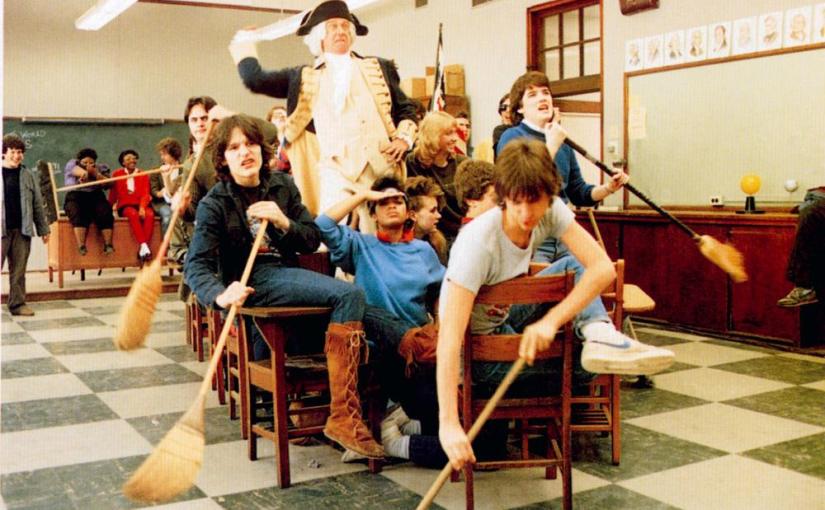
Richard Mulligan (Empty Nest) plays a mental patient that ironically engages his students when he conducts his classes dressed as famous historical figures like Lincoln and Custer.  Watch him reenact George Washington’s crossing of the Delaware with his students “rowing” the boat.  It’s an image I will not forget.  Nor will I forget his final scene in the picture as he encounters Nolte’s character in the hallway.

Where the film falls short is in the one student that is primarily focused on, played by Ralph Macchio, shortly after coming off his first Karate Kid movie.  Just like in The Outsiders, which I recently wrote about, Macchio relies on his dark complexion, stylish black hair, blue jeans and that popped up jacket collar again.  There’s also that strut he always has.  Forgive me for beating up on the kid, but too often I see Macchio donning the same image – that cool kid pose needed for the cover of Teen Beat Magazine.  Nick Nolte shares a lot of scenes with the actor playing the troubled kid with a sixth grade reading level.  However, Nolte is the only one working most of the time.  Another actor in this role would have served better.  It’s a necessary role as it attempts to awaken Nolte’s teacher character to try saving another kid before he gets lost.  Back then, maybe Emilio Estevez or Lou Diamond Phillips would have been more suitable.  Instead, we get Ralph Macchio being Ralph Macchio all over again.

Teachers is a comedy drama that mostly works.  It’s easy to get caught up in the comedy and, sadly, the absurd truth of what goes on in a metropolitan public school system back in the 1980s.  There’s also very dramatic and heavy elements to the film that stay with you.  Before school shootings no longer became shocking (a sad and current truth), Teachers explored the trauma of school bullying and the response the comes with that issue.

Arthur Hiller’s film did not invent the wheel on troubled times within school.  Heck, even The Sweat Hogs from Welcome Back, Kotter were troublemakers too.  Not to mention there are other school dramas to come before, like Blackboard Jungle.  However, Teachers is an very engaging film. I was completely absorbed as soon as the movie began, first in its comedy, and then later in its drama.  A near final scene of the film is eye opening and much like Steel Magnolias will leave you laughing and crying all at the same time.  That happens because you quickly begin to care for most of these characters and the turbulent times they live through as a teacher making next to no money while working under unfair and unreasonable scrutiny.

I think Nick Nolte is delivering one of the best performances of his career.  He has great chemistry with JoBeth Williams, who is good in her role.  The romantic storyline does not go overboard.  It does not get schmaltzy.  It is just enough, and it’s wise to include dialogue where they debate one another from two different sides of a coin.

Teachers also works as a great look back piece.  A lot of well-known, eventual recognizable actors round out this cast including Morgan Freeman, Crispin Glover, Laura Dern, Allen Garfield, and Lee Grant. Anytime Nolte is on screen, he only enhances the scenes he shares one on one respectively with most of these actors.  The moments between him and Macchio only work because of Nick Nolte.  Call Nolte the Alan Alda/Hawkeye Pierce of this picture. 

Teachers might look tame by the turmoil we see today in schools across the country but none of what is seen is untrue or exaggerated either.  Well, maybe except for the mental patient who arguably turns out to be the most engaging and influential instructor of them all.  That’s funny stuff, but you gotta be a little bit crazy to become a teacher nowadays.

A SERIOUS MAN

By Marc S. Sanders

There’s never anything wrong with questioning the Almighty God.  At least that’s what I believe. 

There’s nothing wrong with being faithful to an Almighty God…if you can find comfort and solace in its doctrine.  At least I think that’s what I believe.

The Coen Brothers released A Serious Man in 2009 to solve a great mystery that frankly we should all know can never be solved.

In 1967, Larry Gopnik (Michael Stuhlbarg) is a Jewish family man living in small town Minnesota.  He never steps out of line with his principles or morals.  He attends synagogue regularly.  He’s simply a good Jew; a good husband, father, brother-in-law.  Again, he’s a good Jew. 

Yet, he is also plagued with suffering through the results of what everyone around him commits as sin or violations.  His brother-in-law Arthur (Richard Kind) has overstayed his welcome in the house and is now under suspicion of committing illegal gambling in various bars.  His daughter is swiping money to get a nose job.  His son is listening to Jefferson Airplane in Hebrew school while getting ready to become a Bar Mitzvah.

Most prominently speaking, his best friend Sy Abelman (Fred Melamed) is gently counseling Larry through an unwelcome crisis at home.  Sy is encouraging Larry to agree to a “Get.”  Sy is ready to begin a relationship with Larry’s bitter wife Judith (Sari Lennick), and as they move towards divorce, Sy will need Larry to obtain a “Get” from the Rabbi. The Coens are admirably nervy in their writing because Sy addresses Larry like a child who he’s trying to get to swallow a bottle of castor oil so that he can finally make after two days of constipation.  That’s truly what it feels like.

I never read the book of Job, but I understand that A Serious Man was metaphorically inspired by its contents.  The question residing in both contexts is simply why must all of these unfortunate circumstances occur in Larry’s life? 

For Larry, it is best to get definitive answers.  After all, Larry is a physics teacher which is built on solid formulaic equations and never compromised because it’s a subject of exact science.  His giant blackboard bears the argument of solid answers from top to bottom with endless scribbles, diagrams and numbers.  It looks like incomprehensible gibberish, but at the end of it all, there’s a definite answer.  The proofs do not lie or compromise.

A South Korean student cannot comprehend that wrong answers on a physics test merit a failing grade.  It’s unfathomable because without passing Larry’s physics course, the student cannot obtain a mathematics scholarship.  Larry knows that is true, because how can you study physics without math? The two subjects hinge upon one another.  Larry sees no other way than to fail the student.  He won’t budge on that.  He sticks to his code of ethics.  He’s right all the way. Still, he’s accused of being prejudiced and then an envelope of bribe money is discovered on his desk.  It won’t sway him, but he can’t return it back to the student, if he can’t find him.  So, here’s another thing to weigh on him.

Larry is a healthy middle-aged father and husband, a devout Jew and somehow he’s the one suffering the most from the misgivings of everyone else.  Poor Larry even has to move with nebbishy Arthur into a local hotel.  Sy assures him it’s a lovely place with a pool (the pool is drained empty by the way).  His chance at tenure is also at risk.  There’s the divorce filing from his wife which causes him to hire an expensive attorney (Adam Arkin).  All this “tsouris!”  It’s too much to carry at once.

Midway through A Serious Man, the Coens opt to have their protagonist visit three Rabbis for the exact answers that will tell of his unfortunate circumstances.  The three visits do not so much lend to the story of Larry’s plight as they prove a point.  As satisfying as it might be for a physics teacher to arrive at the exact answer on the right side of an equal sign, one Rabbinical student (Simon Helberg from The Big Band Theory)- filling in for THE RABBI – will tell you to seek the answers you are looking for in an empty parking lot just outside the window.  ?????????

The second Rabbi played by favorite character actor George Wyner (Hill Street Blues, The Devil’s Advocate, Spaceballs) will tell a tall tale of a dentist and his goyish patient that leaves me wanting to know the end all be all.  What’s concluded may leave you shouting OY VEY!!!!

The third Rabbi is the mysterious Rabbi Marshack (Alan Mendall).  He is the elder, maybe the grand prophet, who is concealed in a private office with his long white beard and black hat, sitting behind his desk at the faaaaaarrrrr end of the room.  Will he finally have the answers to Larry’s questions?

This is reminiscent of that animated commercial that asks how many licks it takes to get to the Tootsie Roll center of a Tootsie Pop.  Did Mr. Owl actually have the answers the little boy was looking for?

A Yiddish told prologue that is seemingly unconnected to Larry’s story opens the film and it tells the story of a dybbuk knocking on a couple’s door in the “mitt en drinen” of winter.  The wife sees the curse of this dybbuk – the soul of a dead man meant to haunt them.  The husband does not.  It’s only after you watch A Serious Man from beginning to end that you’ll likely make the connection of a curse that future generations will never be able to escape now that the dybbuk arrived many years prior. Perhaps that is the answer that no Rabbi could clearly define for Larry.  It’s more apt to be my theory but it’s still not entirely clear.  Then again, perhaps it’s just the tale to resort to when a congregant like Larry Gopnik asks his clergymen why his life is in such turmoil.

I adore this film and it might be on a very personal level that others may not appreciate unless they have had an upbringing like mine.  Practically every single character in A Serious Man, all played by relatively unknown actors, look completely familiar to me. 

From Larry’s obnoxious kids (“I’m studying Torah asshole” with a defined middle finger raised), to his bitter wife that I routinely see a caricature of in Shull. Sy Abelman talks like my father-in-law (a great man, who I love by the way) does at Passover Seders, to his co-workers and even Larry himself.  Wearing nerdy black rimmed glasses, he hunches down to scribble on the blackboard with his fat butt sticking out just like my Hebrew teacher Mr. Katz did in my Yeshiva.  It’s all uncannily familiar and easily recognizable. 

There’s a very striking authenticity to A Serious Man that I’d be remiss in not complimenting.  Many may not see it.  You’d have to a be a northern practicing Jew or at least personally experienced with this secular environment to understand. That being said, seek out this unsung Coen Brothers piece and allow your patience to guide you through its various oddities.  It’s Joel & Ethan Coen.  So, you know it’s going to be odd. I expect that it’ll leave you thinking, though.

These actors that you may recognize, but cannot pinpoint what else you’ve seen them in, were meant for these roles. Only a certain kind of Jewish actor could play these people.

For example, no one else but Fyvush Finkle could play a Dybbuk arriving on a doorstep in the mitt en drinen of snowy winter!

A HARD DAY’S NIGHT

By Marc S. Sanders

Before there were Swifties or Dead Heads or Parrotheads or Beliebers or Fanilows, there were Beatlemaniacs.  Everyone was screaming for and chasing after The Beatles – John Lennon, Paul McCartney, George Harrison and Ringo Starr.

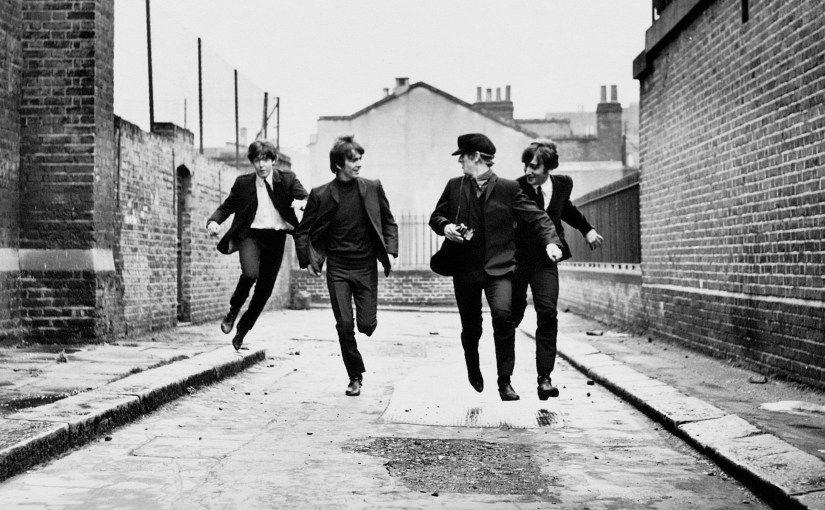
The musical mockumentary, A Hard Day’s Night, captures the famous foursome from Liverpool over a two-day period, during their time of matching suits and mop top haircuts when they were taking the world by storm with their harmonizing vocals of innocent love and fancy-free celebration.  Richard Lester (eventual fill in director of Superman II) directed with a loose documentary like camera while the young men carried themselves in lighthearted and silly situations that served as a visual vehicle for their hit songs like Can’t Buy Me Love, All My Loving, and I Love Her.  The title song was featured too of course.  Along with Billy Joel and Barry Manilow, I grew up on this music and it helped me appreciate the loose construction of Lester’s film. 

Silly scenarios are set up with McCartney’s supposed “grandfather” (Wilfred Brambel) getting into all kinds of mischief while the guys circumvent through media conferences with improvised dialogue like:

REPORTER: Are you a mod or a rocker?

RINGO: I’m a mocker.

I’m not sure I understand the humor or the existentialism of this exchange, but it had fans, including famed critic Roger Ebert, going ga ga over it.  It even made it on to Premier Magazine’s Top 100 movie quotes of all time.  Then again so did “Plastics!” from The Graduate.  These are the vernaculars of the time.  It’s gotta have something to do with devoted fandom.  Right?

I recall seeing the music documentary U2: Rattle And Hum in the theaters upon release, and there was a moment where The Edge was sitting quietly next to Bono in an interview and snapping his palm on his knee, and the die-hard fan I saw it with could not stop laughing with appreciative glee.  I’m just as guilty.  If someone says in simple conversation “I have a bad feeling about this,” my Star Wars man child wakes up like a dog seeing a squirrel.  It can be politicians, rock stars, movie stars, preachers, athletes or even our parents that center us on an obsession that we respond to.  There’s no denying the Beatles had this kind of magnetism.  With half the band gone, the appeal still upholds much like it does for Elvis Presley and Michael Jackson.

A Hard Day’s Night serves a visual extension of the band beyond just what we would receive audibly over the airwaves and on vinyl.  They had recently finished performing on The Ed Sullivan Show, during their first arrival in America. Their charm, good looks, witty intelligence and even their quiet sensitivity enhanced the worldwide significance of the band.

Richard Lester finds opportunities to show the Beatles being performers of themselves behind the scenes, though most of what is shown in A Hard Day’s Night seems staged.  After all, we famously get to see John acting silly in a bubble bath and when his frustrated manager drains the tub and the suds dissipate, John is nowhere to be found.  A cute gag, much like we would find in music videos on MTV, twenty years after this film’s release.

There is a blend of overhead and wide ground level shots of the four prancing and dancing in an open field while Can’t Buy Me Love echoes through a scene.  It’s silly.  It means nothing.  It’s simply sophomoric fun begging us to appreciate their harmless, mad cap shenanigans.

Each bandmate is given room to shine, but Ringo surprisingly stood out to me the most.  He seemed like the little brother to the other three who was never taken seriously.  Paul’s grandfather even tells Ringo to give up music. He should be “parading.” Suddenly, just before a practice warm up for a television program, Ringo is missing.  The fourth Beatle has seemingly run away.  If I could find character dimension anywhere in this Oscar nominated script by Alun Owen, it surprises me that it came from Ringo; the one who was occasionally considered the least celebrated of the Beatle craze.  At the time, he wasn’t a songwriter.  He sat in the back with his drums.

A Hard Day’s Night is enjoyable simply for the innocence shown of the four guys from Liverpool.  They’re happy with themselves and to be with each other.  It’s very natural and yet it’s a little sad too.  This film predates what was never expected to come of them over the next decade and a half with break ups, marriages, controversies, new career trajectories, and even a sudden death of one of their own, occurring on December 8, 1980.

I can only imagine that in the moment of Beatlemania, A Hard Day’s Night was a celebration of happiness and cheerfulness.  They had a rebelliousness to them, yes.  However, there was never anything like them.  Today, the film serves as a reflection of my earliest appreciations for infectious song lyrics and music.  As a middle-aged man, with two members of the band gone, the picture works like a home movie for me.  It’s like watching archived footage of family members who have long passed away.

When you watch A Hard Day’s Night and sing along to the songs as they enter the picture, the words and the melodies return. You’ll likely find yourself thinking back as if to ask yourself “Remember When…?”

THE SECRET OF MY SUCCESS

By Marc S. Sanders

Reader, it has been a hard week.  Hard because my flat screen has been on the fritz.  Finally, today at last, the Best Buy Geek Squad will be paying me a visit and working on a repair. In the meantime, I have had to relegate myself to one of the smaller flat screens within the household.  I feel dirty.  Cheap.  I can’t even look at myself.  Just look away!!!!  Considering the dire circumstances, I could never look at my next big film to review during the absence of my 9.0 sound system and 65 inches of viewing pleasure.  It would be a sin to watch a Christopher Nolan or Steven Spielberg piece anywhere else (unless it’s in the cinema).  Therefore, I settled, and I hit rock bottom.  I opted to for Netflix meh! 

All I have, all I can give you, all I can offer, all I can claim for you during this dark, sad time is Herbert Ross’ attempt at shaping a Michael J Fox thirty second MTV style 1980’s music video into a film.  The “film” is The Secret Of My Success

I recall seeing this movie at age 14 during a field trip to Washington DC with my eighth grade Yeshiva class.  Every time the dimply cute yuppie Canadian sensation from Family Ties and Back To The Future graced the screen, the girls in my class screamed with puppy love glee.  I liked Fox at that time.  I still do.  He was a bright guy and while not an actor like Brando or Olivier, he had a unique charm that defined the clean cut 1980s with knit ties and Benneton sweaters.  His unforgettable Alex P Keaton was the fictional cheerleader for the era of Ronald Reagan, and no one protested.

I recall the promise of The Secret Of My Success as being the vehicle that would elevate his tv persona to the big screen since he already had luck with Marty McFly and a healthy B-movie following with HBO airings of Teen Wolf (a much better movie than it ever deserves to be). Regrettably, this film never landed.  It’s most glaring failure is that it never even lives up to its title.

The assembly of Herbert Ross’ romantic, New York, yuppie comedy occupies itself so much with music montages.  It’s as guilty of its own indulgence as Rocky IV.  How many times must we see a grinning Michael J Fox hustle through the concrete jungle of the city and then through skyscraper cubicle hallways within a white collared business world?  Night Ranger is the ‘80s hair band who provides most of the movie soundtrack and they owe much to Michael J Fox as the face that accompanies their work with trinkling keyboards and electric guitars with the raspy roar of their lead singer.  If Michael J Fox is not walking down streets where apparently supermodels live to turn their heads (I saw you Cindy Crawford), he’s got a pen wedged between his teeth and he’s pulling huge three ring binders off of shelves while doing an all nighter.  This is oh so boring.  In 1987 however, it is all a couple of Teen Beat readers needed in their lives.  I can watch Meryl Streep or Gary Oldman read a three-ring binder.  Michael J Fox just doesn’t have a knack for this skill.

Fox plays Kansas farm boy Brantley Foster.  Now that he has earned a business degree, he has enormous aspirations to climb the top of the New York corporate ladder and make a success of himself with a “beautiful secretary.”  Because, you know, you can’t make it without a secretary, much less a beautiful secretary. 

Upon relocating into a roach infested apartment, Brantley’s plans fall through, and he has to beg his super rich Uncle Howard (Richard Jordan) into giving him a job in the mail room of his building.  Brantley encounters a beautiful blond executive named Christy (Helen Slater) amid a sea of uptight middle-aged men.  The depth of this attraction only goes so far as fantasizing about her walking towards him in a cheesy, glittery pink evening gown with a keyboard and saxophone chiming in.  On the side is Howard’s bored trophy wife Vera (Margaret Whitton) crowding young Brantley in an illicit Mrs. Robinson kind of affair.  Let me clarify.  Vera is married to Brantley’s Uncle Howard.  So, Brantley is being terrorized by Aunt Vera.

For the purposes of ridiculous farce, that might be funny for a moment.  However, The Secret Of My Success takes forever to arrive at the farce it could have hinged on.  Instead, Brantley has to discover a way into the white-collar world when he comes upon an empty office and bears the fictional name of Carlton Whitfield to justify his suits and his motivation to work in the heart of the corporate world.

I noted that the film does not live up to the title.  When Brantley is working the persona of Whitfield, we never get an idea of his brilliant ideas for business success and operations.  We never learn what turned Uncle Howard’s high-rise building into the towering reputation it apparently stands upon.  We never understand the threat of a shareholder’s takeover that Howard and his team fear is imminent.  Where’s the value in anything that Brantley is doing to be that corporate hero and what is he trying to improve or salvage?

Instead, we are left with a very poor chemistry pairing between Helen Slater and Michael J Fox.  Slater is flat out boring with no dynamic to her.  If you want to see how to deliver any variation of a line in a flat, monotone way, then observe what she has to offer.  Fox is on another level of energy that Slater cannot match and Herbert Ross and the script from Jim Cash and Jack Epps Jr (Top Gun, Legal Eagles) chooses to occupy itself more with this romance than the corporate world at play.

The following two years after this film’s release would do better for this hustle and bustle setting with Oliver Stone’s cynical Wall Street and Mike Nichols romantic comedy Working Girl.  The latter film follows a near exact blueprint of The Secret Of My Success.  Yet, it wins because we actually see the main character, portrayed by Melanie Griffith, actually demonstrate her prowess for the cutthroat world of business power and politics.  By comparison, Michael J Fox just wants to play hooky and make out in the back of a limousine.

A last-ditch effort is made though when the big wigs assemble for a weekend getaway. What seems like an attempt at bedroom farce barely gets started with the players climbing staircases and tip toing behind doors and hopping into bed together and blah blah blah.  It doesn’t serve, however, because the idiot plot intrudes where everyone has to act as if they have no idea of who is sleeping with who and who is Brantley and who is Whitfield amid the fast-talking dialogue edited within.  You want to scream at the screen and tell everyone to shut up because this can all be explained in sixty seconds.

Again, as Mike Nichols’ Oscar nominated film eventually proved, there was a better film to be made here for Michael J Fox.  It could have included all of the cynical realities that go with the natures of a corporate American beast.  Instead, The Secret Of My Success relies on music video montages with the teardrop keyboards and the yearning saxophone that seemed like a requisite for the adoring Michael J Fox of the 1980s. 

Enough already!!!!  I need to cleanse my palette.  GEEK SQUAD, WHERE ARE YOU????? 

MEPHISTO (Hungary, 1981)

by Miguel E. Rodriguez

DIRECTOR: István Szabó
CAST: Klaus Maria Brandauer, Rolf Hoppe, György Cserhalmi, Karin Boyd
MY RATING: 9/10
ROTTEN TOMATOMETER: 80% Fresh

PLOT: In early-1930s Germany, a passionate, prominent stage actor must choose between an alliance with the emerging Nazi party or a life of obscurity in exile.

[Author’s note: this is another in a series of movies I’ve watched lately whose subject matters have intimidated me.  There are topics at play in Mephisto that are beyond my ability to analyze in coherent prose.  I must advise you, this is a BRILLIANT film, even if my review below does not convey that fact…]


Watching Mephisto reminded me of the early days of Covid-19.  As the infection spread and restaurants and other businesses voluntarily closed their doors, I was still naively hopeful that it would all just go away.  A friend asked me, “When will you take this seriously?”  I blithely said, “When all the McDonald’s restaurants close, that’s when I’ll know there’s a problem.”  Not long afterwards, that’s exactly what happened.  Then I was indefinitely “furloughed” from my job, and soon after that, the government shutdown occurred.  In hindsight, I was foolish.  The signs were all there.  Had I paid more attention, I might have been better prepared for the stressful days that followed.

This situation is echoed in director István Szabó’s Mephisto, the first Hungarian film to win the Academy Award for Best Foreign Film.  Mephisto tells the story of a popular actor in 1930s Germany, shortly before and after Hitler rose to power.  Hendrik Höfgen (Klaus Maria Brandauer) is a hot-headed, passionate stage actor who throws himself into his performances with abandon.  We watch him evolve from an actor/director to the leading force behind a “revolutionary” theater company that exhorts its audience to acknowledge the plight of the everyman in their society.  He marries (for money more than anything else), but keeps a mistress on the side, a black German woman named Juliette Martens (Karin Boyd) who doubles as his private dance instructor.  He rails at his wife for riding horses before breakfast – the ultimate in bourgeois behavior – but engages in frantic frolicking with his mistress between dance lessons.

Brandauer plays Hendrik as a man who only feels like himself when he’s pretending to be someone else.  Onstage or when directing his cast, he’s filled with boundless energy, dancing with the chorus line or leaping across the stage with abandon.  Offstage, he is quiet and self-effacing, unless he’s socializing with other cast members.  Mention is made several times of his “limp” handshake, a direct contradiction to the strong characters he portrays, especially his most famous role: Mephistopheles in Faust, a role that brings him even more fame and prominence within the theater community.  The imagery of Hendrik is striking: He covers his face in white makeup like a kabuki player with sharply angled black eyebrows and red lips, the ultimate in being able to disappear inside a character.

But something is happening in the background that Hendrik is reluctant to acknowledge.  A fellow cast member almost gets into a fistfight with him when he criticizes another actress because of her associations with a member of the Nazi party.  His wife warns him about the dangers presented by this man who was just elected Chancellor.  [Interestingly, the name of Adolf Hitler is never once mentioned onscreen.]  She tells Hendrik that many of his friends are leaving Germany, fearing for their livelihoods, if not their lives.  But Hendrik refuses to panic:

“There is still the opposition, no?  They’ll make sure he doesn’t get too big for his boots.  And even if the Nazis stay in power, why should it concern me? … On top of that, I’m an actor, no?  I go to the theater, play my parts, then go back home.  That’s all. … I’m an actor.  You can design sets anywhere or buy antiques.  But I need the German language!  I need the motherland, don’t you see?”

Hendrik is so wrapped up in his profession that he simply cannot accept the fact that his freedoms are about to come crashing down around him.  He would rather formulate a far-fetched scenario based on nothing but hope so he can just stay where he is and keep performing.

(I have to be honest: when we took our first steps out of the Covid lockdown, I felt the same way.  Local theaters announced auditions for shows again, and I assured myself and my girlfriend that I would take the utmost precautions and wear masks at rehearsals and disinfect and wash my hands and I wouldn’t get sick.  And, of course, I eventually got sick.  I recovered, but you can probably imagine my disbelief when I tested positive that first time.  “ME?  But I was so careful!”)

Hendrik stays in Germany.  His wife moves to Paris.  Fellow actors either disappear outright or are arrested by the Gestapo in full view.  Hendrik accepts an offer to direct the official state theater, despite his past affiliations with liberal/Bolshevik causes, because of his prestige in the theater world.  A character known only as the General (probably intended to be Hermann Göring) gives him his marching orders as theater director.  He witnesses several Nazis beating a man on the street and walks in the other direction…best not to get involved.

So, what we have here is an actor willing to trade away his soul and his conscience in exchange for the opportunity to remain in the limelight, performing as Mephisto or Hamlet.  The metaphor is not exactly subtle, but director Szabó manages to land the message in such a way that it never feels like preaching.  It’s a masterpiece of storytelling that lands somewhere between satire and Kafka.

An especially telling scene has Hendrik explaining to an attentive crowd of Nazi journalists that his production of Hamlet will portray the lead character as “a hard man…an energetic, resolute hero”, rather than as a neurotic, “pathetic” revolutionary.  Hendrik tells them exactly what they want to hear so he can stay in the limelight.  He’s made his own deal with the devil.  I will not reveal whether Hendrik’s bill comes due during the film, but I will say the finale evokes the landmark documentaries of Leni Riefenstahl.  I’ll leave it at that.

As I said, watching the film reminded me of the Covid lockdown…but it also made me think about all those many, many times in the past that actors and other celebrities have been criticized for voicing their political opinions in public.  “Shut up and play/act!” is the usual cry.  Many people would prefer their favorite actors to behave more like Hendrik: just keep your head down and let everything blow over, don’t make waves, it’s not your place, etcetera, etcetera.  Mephisto argues that keeping silent in the face of injustice or tyranny is not an option, especially not for people in the spotlight.  Those who do so risk suffering Faust’s fate.  Or Hendrik’s, whose last words in the film are brilliantly contradictory.

INHERIT THE WIND (1960)

by Miguel E. Rodriguez

DIRECTOR: Stanley Kramer
CAST: Spencer Tracy, Fredric March, Gene Kelly, Dick York, Harry Morgan
MY RATING: 9/10
ROTTEN TOMATOMETER: 93% Fresh

PLOT: In 1925, two great lawyers argue the case for, and against, a Tennessee science teacher accused of the crime of teaching Darwin’s theory of evolution.  (Inspired by the real-life Scopes Monkey Trial.)


I have known about the movie version of Inherit the Wind for many years now, but it has taken me this long to get around to finally watching it.  One of the first shows I ever did in community theater was Inherit the Wind.  I played E.K. Hornbeck, probably one of the best-written characters I’ve ever performed.  I hesitated this long to watch the movie, or any of the other various TV/cable versions, because I feared it could never live up to the power of the stage play.  Boy, was I wrong.  Stanley Kramer’s film of the award-winning play is anchored by two of the greatest performances ever to grace the silver screen, courtesy of Spencer Tracy and Fredric March, both 2-time Oscar winners.

It’s 1925, and in the Bible-belt hamlet of Hillsboro, Tennessee, a young teacher, Bertram Cates, has been imprisoned.  His crime?  Teaching Darwin’s theories in high school.  In Hillsboro, you see, it’s against the law to teach anything but Biblical creationism in the classroom.  The arrest makes national headlines, most of them negative.  Example: “Heavenly Hillsboro: Does It Have a Hole in Its Head, or Its Head in a Hole?”  The despairing town fathers rejoice when they discover that the great Matthew Harrison Brady, lawyer extraordinaire and 3-time Presidential nominee, will volunteer to prosecute the case.  Brady is played by Fredric March with gusto, although I almost wish March had dialed it back JUST a touch every now and then.  He comes VERY close to becoming a parody of a character instead of a real person.

Covering the story in Hillsboro is E.K. Hornbeck (Gene Kelly!), a reporter from Baltimore.  Hornbeck is loosely based on the legendary newspaperman H.L. Mencken.  The screenplay reduces Hornbeck’s presence a tad as opposed to the stage play, but Kelly delivers the goods with all the appropriate flair and panache.

Hornbeck’s Baltimore paper uses its influence and checkbook to lure another skilled, big-city attorney to Hillsboro to defend Cates.  This is Henry Drummond, played by Spencer Tracy in arguably the best performance of his lengthy career.  Drummond is a shambling, good-natured fellow whose twinkling eyes disguise a sharp legal mind and a passion for the truth.  It’s a tribute to Tracy’s abilities that we get to see both sides of Drummond’s persona and there is never a sense of any disconnect between them.

After the first half-hour or so of exposition, the remaining bulk of the film takes place in the sweltering Hillsboro County Courthouse, as a jury is selected, witnesses are questioned, and both sides present their case to the judge (Harry Morgan).  In between court sessions, we get short scenes with Bertram Cates’s fiancé, Rachel, who just happens to be the daughter of the town’s religious leader, Reverend Brown (Claude Akins); a prayer meeting where Reverend Brown essentially damns his own daughter to hell; and pleasant interludes where Drummond and Brady sit on a front porch and reminisce how they used to be great friends, fighting for the same cause once upon a time.  But now Brady has combined his faith with his political ambitions, and Drummond dreams of a day when reason and science are not equated with heresy.

I won’t give you a play-by-play of the courtroom scenes here.  But if I were a film director, and I found myself directing a courtroom thriller, I would sit down and watch Inherit the Wind at least ten times before shooting a foot of film.  The scenes where Drummond and Brady butt heads and cross-examine and make objections are simply spellbinding.  I would be remiss if I didn’t mention the camerawork by the great Ernest Laszlo, moving around the courtroom and around each attorney, pushing in, tracking backwards.  I know great camerawork is supposed to become invisible while watching a film, but this was different.  Laszlo’s camera sometimes calls attention to itself, but it never, ever distracts from the story.

Of course, beautiful camerawork only works when it’s photographing something worthwhile, and Spencer Tracy and Fredric March do not disappoint as Drummond and Brady.  For nearly 90 minutes, they bicker, trade jabs, and put on a double-act of Hollywood professionalism and technique that would not be matched until the films of Newman and Redford.  Tracy is especially fascinating to watch.  It’s impossible to catch him acting.  There’s never a moment when he looks anything but authentic.  His speech patterns give the impression of a man whose mouth is just barely keeping up with his brain.  When he occasionally stumbles over a word, the odds are 50-50 whether it was a real slip up or if he just threw it in as a flourish.

If Tracy’s performance is a triumph of realism, or at least naturalism, Fredric March’s performance is one of the last great displays of old Hollywood, full of facial tics and vocal mannerisms and speechifying that would have made even Charles Foster Kane say, “Dude…dial it down.”  It’s still a powerhouse performance, but it’s a good thing Tracy didn’t try to match March.  Otherwise, the whole movie would have become a cartoon.  Because we have two such contrasting performances, the movie achieves a nice balance that makes time pass much more quickly than it might have with two other actors.

Regarding the TOPIC of the film…well, to be honest, if I started to write about all the things I felt while watching the film, about how so many people today, not just random folks, but people I know personally, would have felt right at home in 1925 Hillsboro, asking God to rain hellfire on the non-believers, chanting about hanging the accused teacher from a “sour apple tree”…I’d still be writing this review three days from now.

Besides, I believe the film makes its point much more eloquently than I ever could (especially when it comes to the discussion of how long that first day of Creation was, exactly).  One of my favorite lines from the movie comes when Brady accuses Drummond of attempting to destroy everyone’s belief in God and the Bible.  Drummond replies:

“That’s not true, and you know it.  The Bible is a book.  It’s a good book.  But it’s not the ONLY book.”

Inherit the Wind is not anti-Christian or anti-God or even anti-religion.  It is a plea for tolerance.  The fact that it was released over sixty years ago does not diminish the power of that message.  And even if it did not have that agenda, it would still be one of the most exciting, crackling courtroom dramas I’ve ever seen.

(Fun fact: A quick internet search reveals that, while all US states currently teach evolution, there are some that voluntarily pair it with creationism.)