SANTA SANGRE (Mexico, 1989)

by Miguel E. Rodriguez

DIRECTOR: Alejandro Jodorowsky
CAST: Axel Jodorowsky, Blanca Guerra, Thelma Tixou, Sabrina Dennison, Adan Jodorowsky
MY RATING: 9/10
ROTTEN TOMATOMETER: 86% Certified Fresh

PLOT: In Mexico, the traumatized son of a carnival knife-thrower and trapeze artist bonds grotesquely with his now-armless mother.


In years past, whenever I read articles or reviews that evoked the name of Alejandro Jodorowsky, it always seemed to be with the reverence and awe befitting a living saint, or at least a holy fool.  He was mentioned alongside words like “fever dream” and “visionary” and “madman.”  His name pops up a little more frequently these days due to the huge popularity of the new Dune films; he was slated to direct his own version of Frank Herbert’s sci-fi masterpiece, but it stalled in the planning stages around 1976, after $2 million had already been spent in pre-production.  (Storyboards of his intended visions for Dune boggle the mind…Google them some time if you’re unfamiliar.  One of the sticking points was that he wanted the movie to be between 10 to 14 hours long.)

I mention all this because it has taken me this long to finally get around to seeing one of Jodorowsky’s films, Santa Sangre, and I can honestly say that all the hyperbole surrounding his name is justified.  It’s not a perfect film, because how could it be?  It’s a film that tells a straightforward story, but the emotions driving the storyteller are on full display, not necessarily his technique.  Or maybe his technique is flawless because the film conveys such raw emotional power.  I don’t know.  I may be unqualified to break this movie down into its component parts to critique it effectively.  All I can say is, if you ever find yourself starved for new images in cinema, Santa Sangre will satisfy you for months, if not years.

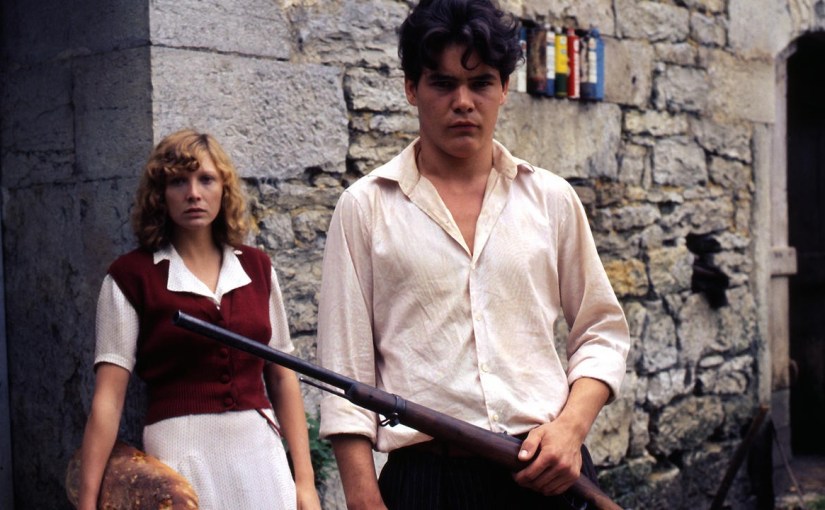
A prologue shows us a naked man in a Mexico asylum who apparently believes he is an eagle.  As orderlies dress him, we flash back to the man as a young boy, Fenix, who performs as a magician in a third-rate travelling circus.  His fat father, Orgo, is the ringmaster and a knife-thrower.  His mother, Concha, is a trapeze artist, but she is also the leader of a bizarre sect of Catholicism that worships the figure of a girl who lost both her arms to vicious rapists.  We also meet a young deaf-mute girl, Alma, and her ostensible mother, The Tattooed Woman (she is never called anything else), who seduces Orgo by letting him throw knives at her.  From the documentary on the very loaded Blu-Ray, I learn that the actress playing The Tattooed Woman volunteered to be the “target” while a professional knife-thrower threw real knives at her…including one that lands in an outrageously small space between her thighs.  Crazy.

Later, when Concha discovers them in bed together, she throws acid on Orgo’s genitals.  Enraged, Orgo takes two of his throwing knives and literally disarms Concha.  He later staggers out of his tent and meets an ignominious end by his own hand.  Concha’s son, Fenix, has witnessed most of this while locked inside one of the circus trailers, which PROBABLY influenced his current state of insanity.

In between these two events, we have seen Fenix despair over one of the circus elephants that is clearly dying, blood trickling out of its trunk as his caretaker looks on sorrowfully.  What follows is a scene depicting a funeral procession for the elephant, but the procession is nothing compared to how the elephant and its massive coffin are disposed of.  This and many other circus scenes feel like Fellini by way of David Lynch.

Back in the present…after an outing with other patients at the asylum (played by real Down syndrome patients) goes bad (they are hijacked by a pimp who offers them cocaine), Fenix escapes and reunites with his now-armless mother.  She co-opts him to be her arms in a vaudeville act and at home, where he sits or stands behind her everywhere and manipulates his arms so effectively the illusion of his arms being her arms is complete.

…but I’m just giving you lists.  There is much more to discover in Santa Sangre that I do not want to spoil.  It is a singular experience, lending itself to many and varied interpretations and certainly not appealing to everyone.  Jodorowsky is okay with that.  He says in an interview that he does not make films to make a living.  He only makes a movie when he has something to say.

So…what is he saying in Santa Sangre?  There are elements of domineering motherhood with Concha virtually subsuming the grown Fenix and his arms.  Later developments show us that she has become the most fearsome mother figure since Mrs. Bates.  Is Jodorowsky exorcising some psychic demons from his childhood?  You tell me.

The strange cult led by Concha features in its temple a large pool of blood, supposedly the blood of the disfigured saint that never evaporated.  There is a lot of blood in Santa Sangre…naturally.  There’s the dying elephant, the death of Orgo, a splatter house murder that looks inspired by Sam Raimi’s The Evil Dead, a hallucination where Fenix imagines he is bleeding out like the circus elephant, and more.  Blood is a central element in the Catholic and Christian faiths.  Is Jodorowsky making a grand statement about the inherently gruesome nature of organized religion, where something that is worshipped on one hand is off-putting and hideous on the other?  You tell me.

Jodorowsky cast three of his own sons in the film (one of them, in a small role as the aforementioned pimp, died shortly after the film was completed).  There are no honorable father figures in the film.  Was the movie intended as some kind of cinematic apologia for his failures as a father?

One scene features a man who spies the older version of Alma, the deaf-mute girl from the circus, on a street at night, and holds her with his gaze.  Then he reaches up to his right ear and slowly performs an act that was only hinted at in Reservoir Dogs.  What is Jodorowsky trying to say with this scene?  Jodorowsky helpfully answers this question in an interview: he doesn’t know.  He just heard about this guy who literally pulled a “Van Gogh” and was able to do this weird little trick, so he drafted him into the movie on the spot.  The scene is only there because Jodorowsky thought it looked cool.  Chew on that.

Based on that “explanation”, how much of the rest of the movie may we infer is there just for the sake of being there?  If everything is a symbol for something else, couldn’t we also argue that nothing is a symbol?  For the sake of argument, let’s say that the whole movie doesn’t really symbolize anything aside from Jodorowsky’s overpowering need to put these visions on the screen.  Why can’t it just be, as I mentioned before, a fever dream, a movie composed entirely of images that are not concerned with placating any Hollywood demographic or studio focus groups?  I am reminded of a line from The Adventures of Huckleberry Finn: “Persons attempting to find a motive in this narrative will be prosecuted; persons attempting to find a moral in it will be banished; persons attempting to find a plot in it will be shot.”

That’s not to say Santa Sangre is plotless, not by a long shot.  There is a definite story arc with clearly established characters, surrounded by phantasmagorical imagery.  If Jodorowsky’s motives or morals are not clearly defined, I’m okay with that.  I just know that I’ll be mentally chewing over some of that imagery for a very long time.

[Note: I must point out that the making-of documentary on the Blu-Ray is one of the most informative and entertaining behind-the-scenes docs I’ve ever seen.  From it, I learn that the film was inspired by, among other things, a rehabilitated real-life serial killer that struck up a conversation with Jodorowsky at a bar one day.  That The Tattooed Lady was unable to shower properly for seven weeks due to the fragile nature of her fake tattoos.  That the deaf-mute Alma was played by a real deaf-mute girl.  That for the older Fenix to walk perfectly in step with Concha to be her arms as she walked around, the actress playing Concha would reach behind her and grab him by his testicles.  It’s one of the few making-of docs that I would consider required viewing after watching the movie itself.]
DISTANT VOICES, STILL LIVES (United Kingdom, 1988)

by Miguel E. Rodriguez

DIRECTOR: Terence Davies
CAST: Freda Dowie, Pete Postlethwaite, Angela Walsh, Dean Williams, Lorraine Ashbourne
MY RATING: 10/10
ROTTEN TOMATOMETER: 80% Certified Fresh

PLOT: A brief family history told in two parts. Distant Voices focuses on the father’s role, while Still Lives follows the children into adulthood and marriages of their own.


About a year-and-a-half ago, I was challenged by a friend to compile a list of my 100 favorite films.  If I were asked to do it again today, Terence Davies’ masterpiece Distant Voices, Still Lives would be on that list.  Here is a movie that is not even ninety minutes long, but it encompasses as much emotion and history as any epic by Bertolucci or Bergman.

The film’s strategy of dividing itself into two distinct sections is crucial.  The first half, Distant Voices, gives us the fragmented, free-associative memories of three children remembering their abusive father and long-suffering mother.  The second half, Still Lives, follows the children as they mature, marry, and cope with their buried emotional issues.

I’m going to attempt to describe how the film works, but it’s a miracle and a mystery to me why it works.  It does not lend itself well to a verbal description.  It’s something you have to see for yourself.

First, music and song play a huge role in both sections.  The movie is by no means a musical, but I’ll bet there aren’t five minutes strung together in the movie where someone isn’t singing or listening to a song on the radio.  Music is either a trigger for distant memories or a catalyst for creating new ones.  I could say the same thing about myself and movies.  Ask me when or where I met some of my oldest friends and I may not remember accurately, but I can tell you exactly when and where I saw Star Wars for the first time, or what my first R-rated movie was (Fort Apache: The Bronx) and who I saw it with.  Distant Voices, Still Lives taps into the mystery of memory and employs an editing strategy that brings it beautifully to life.

In the first section, Distant Voices, time shifts freely back and forth between the ‘40s and ‘50s, between when the three siblings – Eileen, Tony, and Maisie – are young children and adults.  A shot will show the three of them and their mother dressed as if for a wedding.  One of the daughters wishes her dad was here.  The next shot shows a hearse pulling up outside.  It’s the father’s coffin.  The family solemnly piles in.  The next shot we’re back to the wedding preparations as one daughter thinks to herself, “I don’t.  He was a bastard and I bleedin’ hated him.”  Then we flash back again to the past as the father (Pete Postlethwaite) viciously torments her and beats her with a broom.  Then forward again, and back and forward, and so on.

By that description, I worry that some readers will think the movie is chaotic and impossible to follow.  Not so.  It follows the same kind of free-associating logic as our own memories.  I was blessed to have a mother and father who never abused me in any way, but they weren’t perfect.  As I sit here, I am remembering all the good things and bad things that happened years ago, and if you think those memories are streaming through my consciousness in any linear way, you’re fooling yourself.  Memory only takes a linear form after careful editing.  When you’re in the actual process of remembering, everything is jumbled, out of order, but you always come back to yourself in the present.

That’s what this movie evokes, better than any other movie I can remember: the simultaneous juxtaposition of good memories on top of bad ones.  One brilliant sequence shows the three kids sleeping in bed on Christmas Eve as their father tenderly places their meager presents in a stocking at the foot of the bed.  The very next shot appears to be the following morning, the three children sitting nervously at the breakfast table, a meal spread out, and the father sitting at the head of the table, his hands trembling with rage before he pulls the tablecloth to the floor, plates, food and all, and yells off camera, “CLEAN IT UP!”  What a loathsome man.

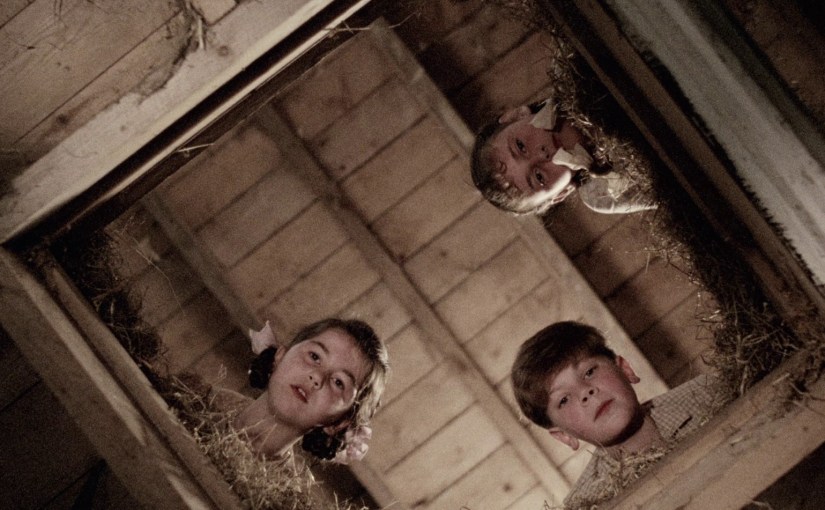
Another brilliant scene: the father sings softly to himself while grooming a horse.  The three young children quietly climb to the hayloft and watch him silently from above.  What’s going through their heads?  I can remember doing something similar when watching my father work under the hood of his beloved Coronet 500, or when he was stretching before his daily runs.  It was a glimpse of a man at peace with himself when he thinks no one else is watching.  The attention to detail in each little scene is meticulous and absolutely accurate.

All these scenes and more build up a precise image of the man who will loom large in the memories of all three children and their mother during the second half of the movie.  A daughter marries and has a child.  The other daughter marries and is happy at the ceremony, but her husband reveals himself to be a selfish man.  The son fends off marriage as long as he can.  A baby’s baptism and the ensuing celebration at the local pub becomes the focal point of the story as memories and flashbacks branch off to flesh out their personal lives.  A moment occurs that is worthy of comparison to Scorsese or Coppola, but I don’t even want to hint what it is because of its immense visual power.

And always, in at least every other scene, are people singing: gospel tunes, hymns, drinking songs, Broadway tunes (“Buttons and Bows”), Bobby Darin, children’s songs, until it gets to the point where a scene feels almost incomplete when someone isn’t singing.  I may be exaggerating a tiny bit, but not much.  It’s almost like the songs release any tension that existed in the scene before it.  It’s one of the best uses of music in a non-musical that I’ve ever seen.

And what of the mother in all this, whom I just realize I’ve barely mentioned?  Despite all the abuses heaped upon the children by the father, she is clearly the one who suffers most of all, both physically and emotionally, but you’d never know it.  When the angry adult son demands to have a drink with his father, and his father refuses, the mother’s voice tenderly urges him to do so.  When her adult children ask her why she married such a man in the first place, she says, “He was nice.  He was a good dancer.”  She suffers in silence, never saying a bad word about her monster of a husband, not even to her children, and when she sings, any happy words are tinged with regret.

When this film was over, I felt like I had watched an epic miniseries.  I don’t mean that in a negative sense.  I mean that, through the economic storytelling and direction, I felt like I knew every sibling, the mother, and most of their friends inside and out.  I may not remember all their names, but I remember their faces, their personalities, their hopes and dreams, their regrets, and how their father’s memory affects them even now.  For eighty-four minutes, they were people as real as you or me.

One of the last shots of the movie shows the son, on the brink of marriage, standing in the pub’s doorway, weeping.  We do not get a contrived scene where a sister or the mother comforts him and asks him what’s wrong and he tells us.  The static camera shot just shows him as he weeps while behind him, in the pub, people sing and sing.  There is more emotional depth in his silent weeping than in fifty monologues.  Distant Voices, Still Lives is one of the best family dramas I’ve ever seen.

DOWN BY LAW (1986)

by Miguel E. Rodriguez

DIRECTOR: Jim Jarmusch
CAST: Tom Waits, John Lurie, Roberto Benigni, Nicoletta Braschi, Ellen Barkin
MY RATING: 8/10
ROTTEN TOMATOMETER: 88% Fresh

PLOT: A disc jockey, a pimp, and an Italian tourist escape from jail in New Orleans.


The bare-bones plot description above sounds to me like a challenge from some bizarre reality show for screenwriters.  “Here’s your plot, aaaaand GO!”  The opening sequences of Jim Jarmusch’s Down by Law look and feel like an ambitious student film, down to its use of music and the black-and-white cinematography and the artsy montage of Bourbon Street and Orleans Parish, where the film takes place.  Having never seen a Jarmusch film before, as I watched these scenes, I was prepared to sit through a dense character study in which nothing much happens but a lot of talking is involved.  In a weird way, I found myself thinking of Clerks, but I despaired that Down by Law would come anywhere near Smith’s film in terms of getting me engaged in the story.

And then…a funny thing happened…

The film introduces us to two characters.  The first one we meet in great detail is Zack (Tom Waits), a gravelly-voiced former deejay living in near squalor with his girlfriend, Laurette, played by Ellen Barkin on the cusp of major stardom.  Their one scene together reveals the strategy for the rest of the film.  As I suspected, not much happens aside from a lot of talking or, in the case of this first scene, a lot of yelling, but there is a vibe or a sensation or something to the dialogue and the crisp black-and-white images that made their scene more immediate.  I am at a loss to explain exactly what it was.  I got the sense that I wasn’t watching two actors playing a scene.  I felt as if I was looking through a crack in the back wall at two real people having a real conversation.

The next character we meet, Jack (John Lurie), is not as savory as Zack.  Jack is a pimp whom we get to know during a conversation with one of his girls, Bobbie (Billie Neal).  Jack is a small-timer who dreams of hitting it big, but we know, as Bobbie does, that Jack’s big talk will never amount to much.  Jack walks and talks like he’s the man, addressing other hookers and pimps by name, and maybe he even sounds a little dangerous.  But his eagerness to expand his operation leads to some questionable decision-making that lands him in jail, to the great surprise of no one.

I just have to mention again the peculiar power of the direction and the dialogue.  The characters sometimes tend to ramble, but there’s never a second that feels superfluous.  There’s a scene where Zack, the deejay, is approached by an old acquaintance who offers him $1,000 just to drive a car from point A to point B.  The little verbal ballet between the two men, performed in mostly one shot as I recall, could have gone wrong any number of ways, as Zack demurs and his friend persists and round and round they go.  Perhaps because the dialogue is a little circular, it feels more natural than the kind of “punchy” dialogue you might get in a film noir.  The style, the camera placement, the acting, everything just sort of comes together and turns potentially boring dialogue into small windows into Zack’s psyche, and everyone else’s, for that matter.  (I think my online colleague, Marc, would enjoy this film very much, because it uses everyday language to illuminate precisely observed and defined characters.)

Zack winds up sharing Jack’s cell in jail for reasons I won’t get into.  It’s here that the story takes a unique turn.  I’ve read Down by Law described elsewhere as dreamlike or even like a fairy tale.  If so, Roberto Benigni is a benign Rumpelstiltskin.  Benigni plays Roberto (of course), an Italian tourist who has landed in jail for…well, let’s just say his offense is a little more severe than what Zack and Jack are in for, which is funny because Roberto speaks mostly broken English and walks and talks like an Italian Charlie Chaplin.  He doesn’t look like he would hurt a fly, much less commit the crime he supposedly committed.

Benigni’s presence in the film brings a lightness to the movie’s center section as the three men stew in their jail cell for weeks and months.  Zack and Jack are world-weary, anxious to tough out their time with minimal connection to each other, much less to Roberto, who is about as different from Zack and Jack as it’s possible to be without being an actual Muppet.  Is there some kind of deeper commentary being made here about how important it is to just connect with each other to make our lives easier to cope with?  How we would all be better off if we were more like Roberto, who delights in the phrase, “I scream, you scream, we all scream for ICE cream” so much that he almost starts a prison riot with it?  I don’t know.  Maybe.  I just know I felt a warm little glow watching Benigni’s performance, and how well he contrasted with Zack and Jack.

Eventually, the three men escape from prison; Jarmusch makes a bold move by never revealing exactly how they escape, because the how isn’t as important as the fact that they escape, period.  Here is where the movie really evokes fairy tales as the three men trudge through the Louisiana swamps, slowly starving, wary of alligators, working together but getting on each other’s nerves.  Even Roberto’s bubbly personality takes a brief hiatus when his comrades appear to desert him…twice.

I would rather not synopsize the plot any further.  The movie isn’t concerned with a Hollywood-style plot as it is with showing the interplay of these three very specific characters under extraordinary circumstances.  When it’s done as well as this, it’s a pleasure to experience a film that seems completely free from cliches and predictability.  As I said, I’ve never seen a Jarmusch film, but even without knowing much about his filmography, I’m glad I started with this one.  When the closing credits rolled, it strangely didn’t feel like the movie was over.  Instead, it felt as if everything I just saw was the prologue for the rest of their lives.  I envisioned a future where each character is sitting in a bar or on a park bench and spinning a yarn to whomever will listen.  “Hey, I ever tell you about the time I escaped from a New Orleans prison with two other guys?”  Maybe that’s not quite realistic, but when you’re dealing with a seriocomic neo-noir fairy tale, anything’s possible.

[Note: there is a late sequence featuring an Italian actress named Nicoletta Braschi.  Roberto falls in love with her, and she with him, and says they will spend the rest of their lives together.  In real life, Braschi and Benigni were married five years after the film was released, and they are still married today.  Fairy tale, indeed…]

LEAP OF FAITH

By Marc S. Sanders

You never know when God may come knocking.  You never know when Jonas Nightengale may come knocking either.  If you’re fortunate enough to reside in small town Rustwater, Kansas, you sir, or you ma’am, or you dear child may be blessed by the healing powers of Reverend Nightengale. 

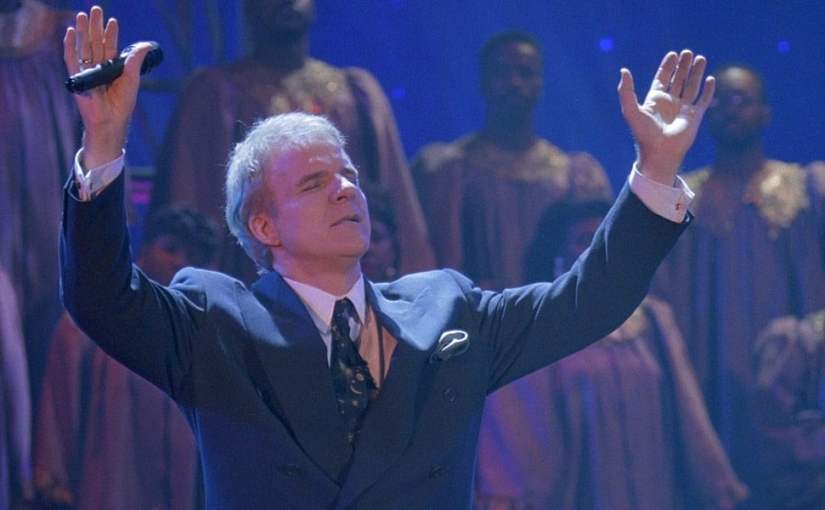
On the surface, Jonas appears like a comedic role for Steve Martin, but in actuality it is not aiming for laughs at all.  When it comes to the confidence scheme that Reverend Jonas offers the townsfolk of Rustwater, Steve Martin plays the phony preacher with nothing but a serious operandi. 

Jonas and his crew travel the states from one big city to the next where he preaches his gospel of deceitful hope in exchange for donations to his traveling church that supposedly serve the almighty lord.  When one of their trucks breaks down in Rustwater, Jonas and his top aide, Jane (Debra Winger) use it as an opportunity for easy cash.  This Kansas town relies on harvests and the infrequent rain that feeds the crops.  Otherwise, this sleepy town has one diner, a movie theater, and a sheriff named Will (Liam Neeson) who is out to reveal the false Oz behind the curtain.  At the same time, Will is romancing Jane who has been eagerly seeking out a flame that never had a chance to flourish because she is on the road so often.

Jonas is wooing Marva (Lolita Davidovich), a waitress at the diner who is also skeptical of the whole act and is protective of her younger handicapped brother, Boyd (Lukas Haas) who suffered a permanent leg injury in a car accident that killed their parents.  Boyd was once told by a preacher that there is not enough faith in his heart for him to be the receiver of healing powers.  Lukas Haas was not just cast because he’s a talented actor.  He also has that angelic face that suggests he’s never committed a sin.

The tricks of Jane and Jonas’ trade are all revealed here.  Jane hides in the back feeding information about certain audience members and their ailments into Jonas’ earpiece.  Eavesdropping by the crew (including an early appearance by Phillip Seymour Hoffman) ahead of the show provides Jane with all the data.  It’s neat to see and it is likely how these outrageous televangelists pull off their miraculous “gifts.”

There’s an interesting argument to Leap Of Faith.  Jane defends Jonas’ façade to Will by him just selling fairy tales that make people feel good and fulfilled.  Will sees the obvious moral dilemma.  Jonas offers another defense.  Is this any different than a circus act that presents the fantastic for an audience to witness. Personally, I think Jonas and Jane’s defense is a bunch of hooey.  Yet, the residents of Rustwater buy into the act and soon people from all over the Midwest are lining up to listen to the gospel and witness the miracles of Reverend Nightengale. 

Jonas has a dilemma himself though.  He has a fondness for Marva, and he likes Boyd.  Boyd is not a plant in the audience to go along with the healing power showmanship.  So, how is Jonas going to explain his position?  He’s quick on his feet to fend off public accusations from Will, but how can someone who is not a miracle worker perform a miracle while maintaining his illusion.

I like the set up and questions that Leap Of Faith asks.  It’s the story of the arriving snake oil salesman which I do not see too often in films.  The showy pieces of the movie are wonderful with terrific singing from the choir under the big top circus tent with the enormous crucifix of Jesus in the center.  There’s also an enthusiastic supporting cast from Phillip Seymour Hoffman, as well as Meat Loaf as the church keyboardist.  The crowd extras are wonderful with their vocal responses.  I also especially love how Jonas ups the ante with a terrific sight gag to silence his biggest doubter, namely Will. 

The film is different, especially for Steve Martin.  He’s a ball of energy on the stage. He does his one-foot slide that was often seen on Saturday Night Live and his stand-up acts, but here it is not done for laughs.  Instead, Martin’s recognizable schtick upholds the public persona of Judas, and it works. 

Still, I do not think I got what I would have prayed for from the film.  I could not get past how Liam Neeson does not work as a Midwest sheriff in this Podunk town.  His boyish good looks from the early 1990s are right for the romance, but he makes no effort to hide his native Irish dialect.  He just doesn’t blend into the Americana canvas very well.  Debra Winger is great and it’s a shame I do not see her in enough films.  Almost everything she does I like.  She just has a natural vibe about her.  She has good scenes with Neeson, but just like his character, their storyline belongs in another movie very distant from the prime directive of Leap Of Faith.

The romance between Martin and Davidovich does not amount to much either. Frankly, it feels as if the story editors opted to abandon this angle midway through the making of the film. I do not recall how the relationship resolved itself and the ending certainly does not generate any kind of response for how either character regards one another. 

Towards the end of Leap Of Faith, the unexpected occurs twice, sort of like what happens in the end of Magnolia.  I found it interesting, but then the credits roll and the gospel choir sings on until the screen goes dark.  I’m leaping from my chair asking but wait, what about this and what about that.  Nevertheless, the choir keeps on singing, deafening my concerns.  Janus Cerone’s script seems to paint itself into a corner just when a brilliant irony arrives and hardly an acknowledgement, and certainly no explanation, is offered for the new phenomena that occurs. 

Leap Of Faith begins with a prologue between Jonus and a traffic cop.  It’s a brilliant scene demonstrating right away how smooth this “preacher” is when it is a one on one grift.  (Celebrated trickster and former con man Ricky Jay was a consultant on the film.) Later, we see how mesmerizing Jonus is in front of hundreds of people.  I was very excited during the first hour and a half of the picture, but then the movie gives up on itself.  The best way to describe this viewing experience is to say that Leap Of Faith simply loses faith in itself.

SILENT RUNNING (1972)

by Miguel E. Rodriguez

DIRECTOR: Douglas Trumbull
CAST: Bruce Dern, Cliff Potts, Ron Rifkin, Jesse Vint
MY RATING: 5/10
ROTTEN TOMATOMETER: 71% Fresh

PLOT: In a future where all plant life on Earth is extinct, an astronaut works to preserve the last of Earth’s flora, kept in domed greenhouses aboard a spacecraft.


Silent Running was directed by Douglas Trumbull, a visual effects specialist whose VFX credits include Close Encounters of the Third Kind, Star Trek: The Motion Picture, and Blade Runner.  In 1968, he worked with Stanley Kubrick as the Special Photographic Effects Supervisor on 2001: A Space Odyssey.  Shortly thereafter, he was given the opportunity to direct his own film.  With a script by Michael Cimino and Deric Washburn (who would both later go on to fame with The Deer Hunter), Universal Studios offered him a limited budget and final cut (!) as part of a project to encourage independent filmmakers in the wake of the success of Easy Rider in 1969.

With a crew of mostly college students as modelmakers, and with no directing experience whatsoever, Trumbull created a sci-fi parable that has some grand ideas, but it never quite achieves liftoff.  I don’t know how Silent Running reads at the screenplay level, but on its feet and on the screen, it slogs.

In an unspecified future, Bruce Dern plays Freeman Lowell, one of four astronauts living semi-permanently on a massive, mobile space station, the Valley Forge.  It’s part of a small fleet of similar spacecraft, each bearing several greenhouse domes housing the last remnants of Earth’s botanical ecosystem, including plants, trees, and small forest animals like squirrels, rabbits, frogs, etc.  The astronauts are tasked with protecting these greenhouses until the eventual call back to Earth (they’re currently in the vicinity of Saturn).

[Note: there is more than a passing resemblance between this plotline and that of Pixar’s Wall*E, but I’m sure that’s homage, not plagiarism.]

When the call comes, however, it’s not what they expect.  They’re ordered to detach the greenhouse domes from their ship, detonate them, and return home immediately.  No explanation is given.  These orders do not sit well with Lowell, and before long he’s alone on the Valley Forge with one dome left and only the ship’s waddling repair drones for company as he heads for the dark side of Saturn.

That’s about it for story.  Once he’s alone, there’s not much left for Bruce Dern to say or do except have one-sided conversations with the repair drones while he tries to teach them to play poker.  It’s clear that Trumbull’s focus was on putting his visual effect concepts on the screen in a way that would evoke 2001, but he did not appear to lose much sleep over pacing or plotting.  For a movie that clocks in under 90 minutes, there are endless shots of Lowell tending to plant and animal life, programming and reprogramming the drones, staring at the stars while confronting his guilt over his actions.  It’s almost a relief when he is forced to administer mechanical first aid to a drone that gets accidentally run over by an offroad go-cart.  (You read that right.)

There are too many other movies out there about castaways and solo adventures that were way more successful for me to give Silent Running a pass just because of its cult status.  There was never one exterior shot of the spacecraft that did not look like a model.  Explosions in space consist of a bright flare of light that dissipates quickly.  Bruce Dern’s acting is nothing to sneeze at, but it’s put to no good use.  It’s clear that Trumbull was counting on the effects to do a lot of the heavy lifting from a story-telling perspective, but they looked so fake that I was taken out of the story whenever they took front and center…which is a lot.

As a bookmark in VFX history between 2001 and the game-changing Star Wars, I suppose Silent Running does have some historical significance.  It’s clear the movie was made with tender loving care.  But from a cinematic perspective, it’s dull, dull, dull.

[Second Note: the film’s score was composed by Peter Schickele, a rather brilliant musician/comedian who is better known as P.D.Q. Bach.  The score is nothing memorable, but it includes two original songs sung by Joan Baez.  Yes, Joan Baez.  It’s a VFX-heavy sci-fi parable with two musical montages.  It takes all kinds…]

THE MAJOR AND THE MINOR (1942)

by Miguel E. Rodriguez

DIRECTOR: Billy Wilder
CAST: Ginger Rogers, Ray Milland, Rita Johnson, Robert Benchley
MY RATING: 9/10
ROTTEN TOMATOMETER: 100% Fresh

PLOT: A frustrated city woman disguises herself as a 12-year-old girl to get a cheaper train ticket, but her plan backfires when she winds up befriending a very adult Major on the train.  Risqué hilarity ensues.


Billy Wilder’s The Major and the Minor, contains big laughs, true love, and comic/cosmic misunderstandings – in other words, it’s a classic farce from the fledgling career of one of Hollywood’s true legends.  However, there are certain plot elements that I suspect would make this movie virtually unfilmable today, at least not without tinkering with the structure here and there.  I think the plot points in question will be glaringly apparent to any reasonable viewer, so if I acknowledge them with only the occasional eye roll in my review, I hope readers will forgive me.  It is not my intention to prepare a compare/contrast treatise on prevailing attitudes towards women during the 1940s versus today.  You don’t need me to tell you that the very concept of an adult male bunk-bedding with a strange 12-year-old girl he just met (among other plot devices) raised my eyebrows.  It is firmly a product of its more innocent time. But the whole endeavor is so breezy and carefree that I think it would be a shame to give this film a pass without hearing more about it.  So, here goes.

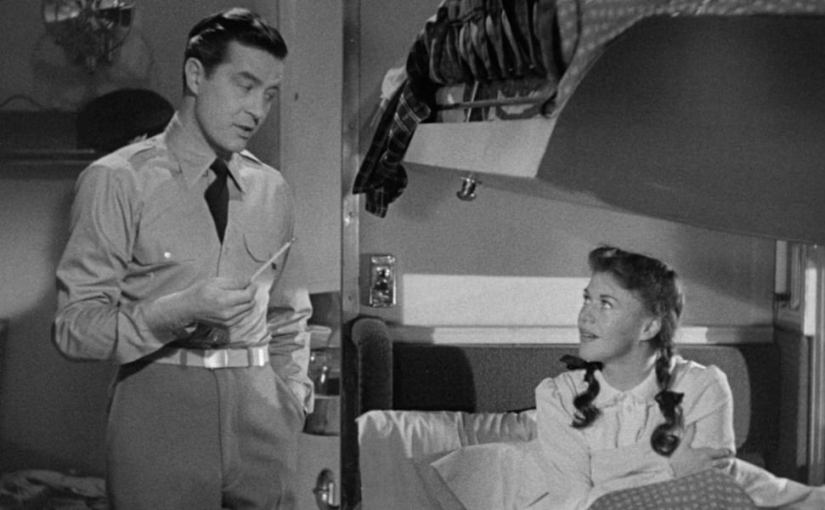
Ginger Rogers plays the lead, Susan Applegate.  Having only seen Rogers in the occasional dance film with Fred Astaire, I was bowled over by how naturally comic she is.  Based on this movie alone, she could have given Lucille Ball or Rosalind Russell a run for their money.  Anyway, Susan Applegate is fed up with living in NYC.  Tired of being besieged by lechers at every turn, she quits her job – her 25th in a year! – and tries to buy a train ticket back home to Iowa.  When she finds herself short on cash, she dresses up as a 12-year-old girl to get a ticket at half price.  Her real troubles begin when the train gets underway, as the conductors are not movie-dumb enough to fall for her act.

She winds up hiding in the compartment belonging to Major Philip Kirby (Ray Milland in a mildly uncommon comic role).  Because he has a bum right eye, he falls for Susan’s story (she calls herself Su-Su to complete the façade) and takes it upon himself to be her impromptu guardian.  Through an unfortunate series of events – a blocked train track, the unexpected arrival of Kirby’s beautiful fiancé, Pamela, and some ill-timed misunderstandings – “Su-Su” finds herself being whisked away to a military school with Major Kirby promising to get her on the next available train back to Iowa.  Trust me, it all makes sense, I’m leaving a lot of details out, otherwise we’d be here all night.

The rest of the film involves Su-Su’s misadventures on the military school campus, surrounded by three hundred school-age boys who are inexplicably attracted to this girl who somehow has the presence of an adult woman.  They like her, but they’re not quite sure why.  The same phenomenon begins to afflict the Major himself, which makes him extremely uncomfortable (understandably so), which makes things more complicated for Susan because SHE’S beginning to fall in love with HIM, and meanwhile Kirby’s future sister-in-law sees right through Susan’s disguise and wants Susan to help her break up the impending marriage, and 20 different cadets show up to escort Su-Su to the school dance, and so on and so on and so on.

This was only Wilder’s second film, but already we can see ideas and situations that he would return to in some of his future films.  The woman disguising herself as a girl is a funhouse-mirror version of the men disguising themselves as women in Some Like It Hot.  We get the reverse situation, a girl becoming a woman, in Sabrina.  The idea of how tough it is to live in the big bad city is echoed in The Apartment.  And if you really squint, you might even see an early forerunner of Norma Desmond in Major Kirby’s beautiful but devious and controlling fiancé…it’s a stretch, but I think it’s valid.

The performance by Ginger Rogers in this movie was a revelation to me.  I had absolutely no idea she could play this kind of character.  She plays everything so believably, whether she’s Susan or “Su-Su.”  In scenes where she’s near Major Kirby, her longing for him is palpable, but her outward reactions are perfectly subtle: a slight pause before a reply, a constant gaze, only occasionally a little mugging when he’s not looking at her, and always making sure to keep her brassy voice in a higher register to sound more girly.  I learn from IMDb that she was anxious to play this role because she was able to draw from her own experiences: as a younger woman, when she toured vaudeville halls with her mother, she would often make herself appear younger to get cheaper train tickets.  Who knew?

Ray Milland had a trickier time of it in this movie.  He manages to pull it off, but imagine the minefields he had to navigate.  He plays a grown man who is the self-appointed guardian of a 12-year-old girl who, by his own admission at one point, looks like a full-grown woman in the right light.  There’s a scene where he feels compelled to at least try to explain the facts of life to Su-Su so she’ll understand why all the cadets are attracted to her like a moth to a light bulb.  (In one of the less-enlightened moments of the film, he advises her: “Maybe if you made yourself a little less attractive…”  HUGE eye-roll.)  Now, we as audience members know there’s really no problem with his mild flirtations because, of course, Su-Su is really Susan.  But HE doesn’t know that.  Wilder has the good sense to pull everything back from the brink before anything unsavory occurs.  It’s one of the best high-wire acts I can think of in a comedy.

(I’m itching to relate all the hilarious Wilder-esque bits peppered throughout the movie, like finding the occasional burnt end in a delicious brisket, but I am anxious to avoid spoilers.  There’s the tap dance, the Veronica Lake look-alikes, “the Maginot Line”, the cigarette on the train…oh, too many to list.  They’re wonderful.)

As with the best farces, a crisis occurs and it seems as if all is lost, but fear not.  Wilder is not known as a genius for nothing.  If you think this romantic comedy from the early forties is not going to have a happy ending, you need to see more movies.  The Major and the Minor is a delight from start to finish.  And if the last line doesn’t quite come up to the standards of “Well, nobody’s perfect!”…well, I mean, what does?

[Note: It’s also interesting to know that The Major and the Minor was filmed and released in 1942, it’s set very specifically in May of 1941, before Pearl Harbor.  Here and there are in the movie are references to Kirby’s desire to be stationed abroad in case war breaks out.  There’s a moment when he confesses that no woman would want to marry a military man stationed overseas, only getting a letter from him once every two weeks.  The reply he gets is very direct, clearly indicating where Wilder stood on the matter: “I think you underestimate us, Mr. Kirby.  Perhaps all a woman wants is to be a photograph a soldier tacks above his bunk or a stupid lock of hair in the back of his watch.”  Sexist?  Or patriotic?  Discuss.]

SATURDAY NIGHT FEVER

By Marc S. Sanders

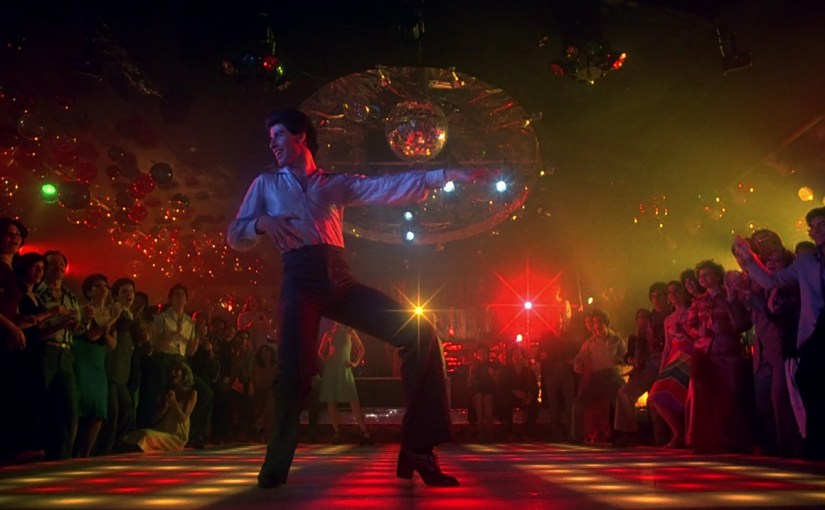
One of the biggest cinematic cultural touchstones announced itself just as the fad was withering away.  John Travolta blew up movie screens in 1977 when he strutted down the streets of Brooklyn with a paint can in one hand while wearing his wide collared red shirt under his black leather jacket.  The song that that got audiences grooving in their seats with the immediate superstar? Staying Alive by The Bee Gees.  The movie?  Saturday Night Fever which offered one of the most memorable character introductions in film history.

Disco might be dead and only designed for themed costume parties nowadays, but Saturday Night Fever remains very much alive.  No one forgets the moves Travolta did on the dance floor in his polyester shirts and suits.  John Badham’s film continues to be saluted with spoofs ranging from Airplane! to Saturday Night Live to Family Guy and one commercial after another.  The soundtrack is an unforgettable mix played for every generation that comes along at weddings, proms and bar mitzvahs.  The film was also adapted into a successful Broadway and touring musical.  I loved the live stage performance by the way.

Still, there’s a sensational dramatic story to Saturday Night Fever and Tony Monero, the nineteen-year-old kid who is only a Brooklyn celebrity on the streets and especially at the local dance club 2001: Oddyssey (the extra d is included).  Tony has unwanted ladies dying to sidle up to him, especially his contest dance partner Annette (Donna Pescow) who will eagerly surrender her virginity to Tony without protection.  His buddies idolize him as well, as they cruise the streets at night drinking in their beat-up Ford sedan on the way to and from the club, before finishing off the evening with some risky tomfoolery on the edge of the Verrazano bridge.  His boss at the paint shop even loves the kid.  Tony doesn’t ask for it, but he gets a raise and by the end of the conversation, the boss has nearly doubled his first offer. 

None of this is enough for Tony though. He doesn’t want to be tied down to working at the paint store for the rest his life.  He’s afraid he’s losing his beautifully well coifed hair and maybe his dancing skills will not survive as the years pass him by.  He also gets no love from his father.  Every dinner erupts into a family argument.  His mother has preferred adorations for Father Frank, Tony’s older brother who entered the priesthood.  Ma calls her son Father Frank, because, after all, he’s a Father of the Catholic Church.  Tony is also envious of Frank, first for their parents’ adoration.  Later, it is because Frank decides to leave the seminary to be free of the parents’ expectations.  

Tony also sees the talents and beauty of a dancer named Stephanie (Karen Lynn Gorney) who has no interest in his immaturity but is willing to be his partner for 2001’s upcoming dance contest.  Try as he might, Tony cannot keep up with Stephanie beyond the dance floor.  He’s not educated or cultured like her, and she is relocating across the bridge to Staten Island for a better life.  On the other hand, Tony remains stationary and therefore he is a frustrated man about to put his teenage years behind him with no aspirations and the weight of those who he spends time with holding him down.

I’d argue many are familiar with the colorful dance sequences accompanied by The Bee Gees’ memorable numbers (How Deep Is Your Love, Night Fever, More Than A Woman) as well as KC and the Sunshine Band (Get Down Tonight) and The Tramps (Disco Inferno).  Yet, Saturday Night Fever demonstrates a tough coming of age struggle for its protagonist.  John Travolta is at least just as memorable as James Dean was in Rebel Without A Cause.  Life goes on, but how can it when all you have to show for yourself is being the best at disco dancing?  There’s a whole other world beyond Brooklyn.

Sex is even frustrating for Tony.  He gives in to Annette’s desires to make love to him in the back seat, but then tosses her aside when she does not bring a condom.  All of this is too easy for Tony; so easy that it’s not even pleasurable and thus he’s continuously cruel and dismissive of her.  When Annette gives in to group sex with the guys, one after the other, Tony can do nothing but chastise her for allowing herself to be subjected that way.

Bobby C (Barry Miller) is the fearful, untalented, uncool and insecure buddy who is lost with what to do when he thinks he might have gotten a girl pregnant.  Tony is the greatest guy he knows, but he has no interest in helping.  Bobby even tries the next best thing by approaching Frank…formerly Father Frank.  Everyone wants to be with Tony and stay in his social circle, yet Tony is the one who wants out.

Norman Wexler’s screenplay is tremendously insightful but never so apparent.  As loud as the clothes, the disco music and the dance is, this is a script of subtly in Travolta’s performance.  It’s likely why he got the film’s sole Oscar nomination for Best Actor.  Despite Tony’s continued outbursts, there’s nothing so blatant in Saturday Night Fever like you would find in other coming of age films like James Dean’s, for example, or any of John Hughes’ films.  Director John Badham accustoms you to Tony Manero’s anxiety. 

It’s ironic, normally a protagonist will grow into self-assurance.  In this film, Badham wisely shows the confident swagger of Tony Manero in the film’s unforgettable opening only to see him diminish as the character arc proceeds over the film’s next two hours.  Badham includes small hints in this opening.  Tony might walk with a strut, but the first attractive woman he passes on the street does not give him the gumption to approach her, and the second woman tries avoiding him being in her way.  Later, Tony is outright rejected by Stephanie for anything beyond friendship and dance practice.  Tony wears the local celebrity façade, but in reality he is just a nobody.

John Travolta is so effective at showing on screen how Tony internally speaks to himself as he vocalizes his frustrations at those around him.  Whatever is angering Tony only looks like it’s Annette’s fault, or Stephanie’s or the guys, or Mom and Pop.  There must be something better for him than just being a small time, well dressed disco dancer, and a valued worker in a paint store.  He’s also outgrowing the street brawling with his buddies.  All he knows is he had better find a way out of this life with no promise of a future. Otherwise, he’s destined for a destructive ending.

Saturday Night Fever has a staying power.  Years after anyone has seen this film, all that might be remembered is John Travolta in the white suit on the lighted disco floor while Staying Alive is blaring through the speakers.  However, it’s a deeper film than just glitzy aesthetics that arrive with the final cut.  This is a coming-of-age story that does not hide the struggles nor romanticizes a path towards a better person or future. 

The film’s ending is even deliberately ambiguous. It’s more realistic than you might realize because the future remains uncertain for all of us, especially when we believe we don’t have much beyond what we are envied for to send us forward.  I know of the film Staying Alive directed by Sylvester Stallone which brought Travolta back into the legendary role.  It is the follow up film to Saturday Night Fever; notoriously considered one of the worst sequels ever made as it attempts to bring Tony Manero into the early 1980s cheesy zeitgeist world of Cats on Broadway or a poor impersonation of Prince pop music.  Norman Wexler demanded his story credit be stricken from that film. 

Choosing to ignore what came with that awful sequel, Wexler’s script for Saturday Night Fever wisely offers no promises for its protagonist, because unlike what we often see in the movies, life never guarantees a new day, and that’s what truly scares Tony Manero more than anything else.  It’s fair to say an uncertain future terrifies all of us.  That is why Saturday Night Fever remains completely genuine.  We are never meant to see what comes of Tony Manero because Tony Manero struggles with the unknown of what’s to come.  Some endings are meant to have those hanging threads from a time gone by.

CIVIL WAR

By Marc S. Sanders

On the drive home, my wife and I left saying that we could not recall this country existing on a such a divisive plane within our lifetimes as it is currently.  Maybe we were not paying enough attention as we were growing up.  With that in mind however, it’s not unreasonable to see a possible future coming to life from Alex Garland’s Civil War.  What’s clear is the vitriol displayed in Garland’s film is not surprising.

Civil War is an observational piece as it is told through eyes of photojournalists who function with no stake in the conflict.  Lee (Kirsten Dunst) has become a legendary war photographer.  Along with Joel (Wagner Moura), who’s a reporter, they intend to journey through the Northeastern battlegrounds from New York City to Washington D.C.  As they believe, the seceded states of California and Texas are close to overthrowing the government, they are determined to interview and photograph the President (Nick Offerman) before he’s taken prisoner or more likely, assassinated.  An old-time New York Times journalist named Sammy (Stephen McKinley Henderson) and Jessie (Cailee Spaney), a young photographer who idolizes Lee, tag along.  To do this trip is a crazy undertaking, but Lee and Joel know what importance their purpose serves and the fact that they have press passes should uphold their survival amidst violence and chaos. 

My wife asked which side does writer/director Alex Garland lean towards politically and I said I do not know as he’s primarily known for science fiction movies (Ex Machina, Annihilation).  Garland likely wants his political leanings to remain unknown as it upholds what Civil War deliberately steers its focus away from.  We never learn what policies each side of this war stands for or what instigated it.  In fact, it is quite intentional of Garland to make what are arguably the bluest and reddest states in the United States the united seceders who lead one side of this bloody chess board. 

This fictionalized war is well established when the picture opens.  The President attempts to deliver a speech that is clearly uncertain despite the staple resilient vocabulary he includes.  Nevertheless, buildings on fire randomly appear, looters are bloodied pulps who are strung up by random factions, downed helicopters are the carnage occupying a parking lot in front of a JC Penney.  Nothing that anyone says, much less the President of the United States are going to sway this country into a state of comfort.  That time has passed.

The production value of Civil War is astonishing.  Sometimes it looks just like photographic accounts of what we see on the evening news coverage from the Middle East.  Garland also never forgets that his main characters are photographers as he captures in freeze frame people being randomly shot or beaten or simply screaming at one another.  The film abruptly turns off the sound and a black and white photograph interrupts the chaos for you to catch a freeze frame glimpse.  The editing lends to the character designs of the story’s four main players.  I did question, however, why video footage was not also taken beyond just photographs.  Cell phones are not used or mentioned in this picture.  The inconvenience of Wi Fi on a laptop is however. 

The sound design of the film is spectacular and reminiscent of how powerful it served in the Oscar winning film The Zone Of Interest.  As the characters set up camp for the night, rapid pop pop pops are heard in the distance.  On multiple occasions, Garland gets you right in the middle of the various firefights that occur in and around office buildings or what were once shopping districts.  The machine gun fire and rubble blasts are all around you.  The cinematography is also quite eye opening.  I like to think of areas like Virginia and the Carolinas as beautiful American spots during the summertime, and that is when these events unfold. Yet, to see how ugly it is amidst endless debris and bloodshed is an awful, still convincing effect.

My Cinemaniac pal Thomas made a good point about Garland’s approach.  Out of nowhere a needle drop of songs will intrude on the picture and often I found them to be overly distracting and definitely unnecessary.  One such number is a hip hop tune with samples from an 80s tune (I can’t remember which one now) that plays over a gunfire scene.  Regrettably, it takes me a little out of the picture.  Thomas is entirely correct in this area. This technique is not effective as when Oliver Stone or Francis Ford Coppola included The Doors in their set pieces. 

Kirsten Dunst is quite good in her role.  Lee knows where to point her camera, and Dunst lives up to the legendary status that her character is supposed to have.  You can feel the exhaustion that teeters on her mental stability, especially as the story reaches its third act.  Lee has been doing this for far too long and the horrors are a part of her now.  Her trauma can never be erased or covered.  Cailey Spaeny is the standout performer though as Jessie, the young girl who is eager to reach the levels of her idol.  Lee wishes Jessie would just not tag along.  Alex Garland writes good characters, but they are not what stayed with me following the conclusion of the film.  What upholds Civil War is the depiction of this all too convincing reality. 

I write this article the morning after Iran delivered missiles and drones in the direction of Israel and with every article I’ve read, I ask myself again and again what is the purpose.  These efforts are not done for strategic overthrow.  Rather, actions are executed with hate and revenge and the only ones who are paying for it are those that are not arguing; those that are just trying to raise families and live in peace.  Alex Garland might know what finally began his fictionalized American civil war, but none of that matters any longer.  It’s what the pawns do to one another in place to place to place.

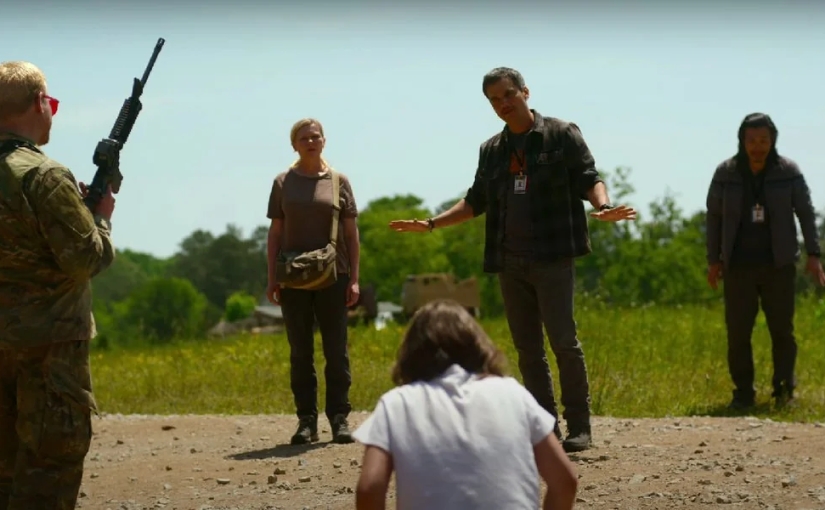
The fighters and individuals you meet in his film all move with their own ulterior motive.  A chilling scene includes Jesse Plemons (Dunst’s real-life husband) dressed in camouflage fatigues who does not even have a statement or a cause to deliver.  His minimal dialogue is nowhere near as expressive as the vast graveyard of Americans he’s sprinkling with lye and burying. When the press team comes upon him, nothing they say matters or motivates him to lower his machine gun.

Fighting, fighting, fighting.  That’s all you see in Civil War.  You don’t even know the position that the President holds, or even what his name is.  You never learn what party he represents either.  I salute Alex Garland for not leaning one way or another.  It is the divide that is tearing our country, our world, apart and not what we stand for. 

Sadly, some commentators on social media have already devised in their own minds that Civil War is a “woke film” (whatever the fuck that means) simply because of the pink (HOT PINK!!!!!) sunglasses that Plemons’ sadistic character wears.  Reader do not listen to the voices in your head.  There is no political agenda to this film.  Rather, Civil War shows us what occurs when political agendas have been entirely deafened by gunfire.

LACOMBE, LUCIEN (France, 1974)

by Miguel E. Rodriguez

DIRECTOR: Louis Malle
CAST: Pierre Blaise, Aurore Clément, Holger Löwenadler
MY RATING: 7/10
ROTTEN TOMATOMETER: 100% Fresh

PLOT: In 1944, an 18-year-old boy from a small French village collaborates with the Gestapo and subsequently falls in love with a Jewish girl.


The effectiveness of Louis Malle’s Lacombe, Lucien may depend partially on how much you know about cinema history after World War II.  It’s a historical fact that there were French countrymen who sided with the invading Nazis, going so far as to infiltrate the French Resistance and inform on their neighbors to the Gestapo.  When the war ended, that fact was politely and discreetly avoided in war films for decades.  No one wanted to spoil the notion that the whole of France united with each other to harass the Nazis at every opportunity, and that the Resistance fighters were unambiguously, morally pure.  In France, surviving collaborators went about their business, some more anonymously than others.

In 1974, Lacombe, Lucien became one of the first, if not THE first, French film to not only broach the topic of Nazi collaborators, but also to depict the French Resistance as employing guerilla tactics and carrying out assassinations that were just as morally questionable as any other similar attacks in history.  It was a bold move, to be sure.  Even when you remove that context from the film, when you watch it as a stand-alone piece of cinema, it is still makes for compelling viewing.  However, for my part, the very ending of the movie left me frustrated.  While French audiences may have seen it differently in 1974, I saw it almost as if the filmmakers simply ran out of story and used a title card to tie things up in a bow.  But the journey to get to those final frames is worthwhile, even though the lead character is one of the most loathsome people I’ve ever seen on film.  I would compare him to Amon Goeth from Schindler’s List, not because they are similar characters, but because they elicited the same reaction from me: disgust.  (Or maybe they are similar characters…you tell me.)

The film opens in 1944, just a few weeks after D-Day, in a small town in southwest France.  We first meet young Lucien Lacombe, maybe 17 or 18, mopping a hospital floor, apparently doing a good deed for his community.  Through an open window, he spies a small songbird chirping on a tree branch.  Lucien makes sure no one is watching, pulls a slingshot from his pocket, takes careful aim, and kills the little bird with one shot.  He smirks and goes back to the business of mopping.  We will witness many other instances of Lucien killing other animals.

Indeed, many of these scenes are done for real: the actor playing Lucien clearly kills several rabbits with a shotgun, one with a wooden club.  In another scene, he catches, decapitates, and calmly starts to pluck a chicken for dinner, all in one unbroken take.  Now, this would have been normal behavior for someone living in a farm community in the French countryside, where someone has to prepare tonight’s dinner.  The difference is, Lucien seems to enjoy these tasks a little too much.  Even worse, though, are the times where he is utterly impassive about it, especially with the one rabbit he catches in the snare.  These are hard scenes to watch, but in hindsight, they are vital to unpacking or interpreting Lucien’s actions later in the film.

Through a series of events that reminded me a little bit of Goodfellas (“All my life, I wanted to be a gangster”), Lucien allows himself to be recruited into a cadre of French collaborators whose base of operations is a fancy hotel where their opulent lifestyle is a rebuke to those silly Resistance fighters who must scrape a living from the dirt.  He is more than willing to do what it takes to get a taste of the good life.  He turns in a schoolteacher who is also a Resistance officer; he makes a show of being contrite about it, but he quickly gets over it.

The rest of the movie shows Lucien puffed up with pride in his new social status, bullying anyone and everyone who dares to talk down to him.  There are, to be sure, broader statements being made here about the psyche of anyone who deludes themselves into believing in their inherent superiority over their fellow man just because they’re handed a membership card, regardless of how small-minded or shallow they might be.  However, during the movie, I never thought of those broader implications.  It’s a testament to how well the movie was directed and acted that I was concerned only with how Lucien behaved and acted, and not with whatever director Malle was trying to say from a metaphorical or allegorical standpoint.

To watch Lucien bully people around was sickening and pathetic.  He is introduced to a tailor, Albert Horn, who will make him some new clothes.  Lucien’s friend in the Gestapo casually informs him that Albert is a Jew who is only allowed to live in relative peace because of his skills as a tailor, and because he makes regular payoffs to the Gestapo.  Albert has a 20-something-year-old daughter, improbably named France, with whom Lucien is almost immediately smitten, despite her ethnicity.  He tries to impress France by getting her to the front of a food line, but she demurs.  When people in line complain, he smugly explains he’s with the German police and he can do whatever he wants.  The idea of that kind of power in the hands of someone as despicable as Lucien made me as angry as I can ever recall being while watching a film.

In the background of Lucien’s plotline is the shadowy Resistance itself.  Various members of the French collaborators are being killed here and there, certainly not a bad thing.  But the aftermath of their attacks is no less disquieting than anything perpetrated by the pro-Nazi collaborators, especially after a brazen attack on the fancy hotel headquarters, where the bodies of the collaborators are just as dead as the bodies of the Resistance fighters.  Perhaps the film is making a point that dead is dead, no matter which side you’re on, so you’d better be sure you’re dead for the right reasons because history will remember you one way or the other.

At the center of all this is Lucien’s face with his cold eyes and virtually expressionless mouth.  He doesn’t smile, he smirks.  He threatens Albert and France with exposure and arrest if Albert doesn’t allow Lucien to date, then marry, France.  For her part, France is wise enough to know when to humor Lucien and when to go along with his behavior, for the good of her father.  Lucien, besotted with power, is too clueless to realize how smart she really is.

I have a general guideline that I dislike movies with rotten characters at the center of them.  But I must admit that Lacombe, Lucien sucked me into the story and kept me there, despite how much I disliked Lucien himself.  I guess I wanted to see how much the filmmakers would allow him to get away with before he was swatted down.  Whether he gets swatted down or not is for you to discover, but let it be said that the ending manages to have it both ways, which was challenging for me.  I both did and didn’t get the kind of closure I wanted, which explains my somewhat median rating despite how well-made the film is.

It may be that I’m not old enough, or knowledgeable enough, to really appreciate the impact Lacombe, Lucien had on 1974 audiences.  I can only report how it made me feel right now.  It made me feel anger and indignance towards Lucien throughout the whole movie, even when he makes a crucial decision that seems as if it will redeem his character.  I don’t think it does, because the damage he instigated has been done and cannot be undone by a single act of contrition when it’s far too late to make any difference.  Perhaps that’s not a very Christian idea, but that’s how the movie made me feel, regardless.  Lucien deserves what he gets and more.  Does that apply to the real-life French collaborators, many of whom were still alive when this movie was released?  It’s not for me to pass judgement on those people.  But I can’t deny how the movie itself made me feel towards the people within the world of the film.

THE GUNS OF NAVARONE (United Kingdom, 1961)

by Miguel E. Rodriguez

DIRECTOR: J. Lee Thompson
CAST: Gregory Peck, David Niven, Anthony Quinn, Anthony Quayle, Irene Papas, Richard Harris
MY RATING: 8/10
ROTTEN TOMATOMETER: 92% Fresh

PLOT: A team of Allied saboteurs is assigned an impossible mission: infiltrate an impregnable Nazi-held Greek island and destroy two enormous long-range field guns preventing the rescue of 2,000 trapped British soldiers.


The Guns of Navarone is a “message” picture cleverly disguised as a World War II action-adventure/thriller.  No surprise there since the screenwriter was Carl Foreman, who also co-wrote 1957’s The Bridge on the River Kwai, another stirring wartime adventure with a strong anti-war message buried inside.  I found it interesting that, in the multiple behind-the-scenes documentaries on the Blu-ray, not one of them mentioned the one movie which I feel most resembles The Guns of Navarone: 1967’s The Dirty Dozen.  In both films, teams of men mount insurmountable odds to accomplish an insanely difficult mission, incurring casualties while ultimately succeeding.  In both films, there is a buried, or not-so-buried, subtext about the futility of the mission and/or war in general, while still gluing audiences to their seats.  However, given the timeframe of the release of The Guns of Navarone in the early 1960s, I find it to be the more surprising of the two, despite the foregone conclusion of the movie.

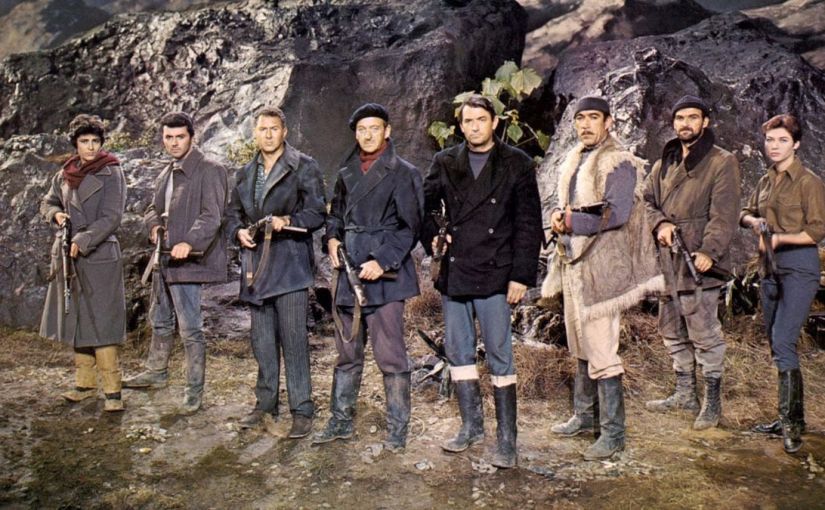
The movie’s narrated prologue tells us everything we need to know.  (Forget for a moment that there is not, and never was, a Greek island called Navarone.)  In 1943, two thousand British soldiers marooned on the island of Kheros must be evacuated before Germany convinces Turkey to join the Axis.  But the only sea lane to Kheros is defended by two massive German guns built into the sheer cliffs of the island of Navarone.  The guns must be knocked out of commission by a team of Allied saboteurs before any rescue attempts can be made.  This team will be led by Captain Mallory (Gregory Peck), Corporal Miller (David Niven), Colonel Stavros (Anthony Quinn), and Major Franklin (Anthony Quayle).  Along with the rest of the team, they must sneak on to Navarone, scale a steep cliff at night, and sneak across the island to the guns, hooking up with Greek resistance fighters along the way.  These details are laid out with admirable brevity, during which we are given just enough information about each of the three primary characters to understand their actions once the mission is underway.

The Guns of Navarone may be constructed almost entirely out of war movie cliches regarding desperate men behind enemy lines on a secret mission, staying undercover, close calls, and unexpected setbacks.  However, I enjoyed how much Navarone sort of “leans into” the material.  It’s almost as if the filmmakers said, “Okay, so this is a cliché, right?  We might as well embrace it and do it up right.”  For example, we find out that one of the squad commanders has a nickname: “Lucky.”  In the history of movies, any character in a war picture named “Lucky” has been anything but.  You know this, I know this.  Even so, as events transpired, I found myself thinking less and less about the most cliched material and just admiring how it was executed.  It’s a tribute to the director, J. Lee Thompson, that he found a way to present everything in such an uncomplicated fashion that its very directness pushes aside our suspension of disbelief.

That’s not to say there aren’t a couple of surprises.  Capt. Mallory devises an ingenious method of dealing with a man so injured he may have to be left behind.  A clandestine trip to a local doctor turns into something quite different, offering Anthony Quinn the opportunity to perform some amazing off-the-cuff histrionics that would make Nicolas Cage envious.  The Greek resistance fighters turn out to be two women who offer much more to the story than mere eye candy or comforting shoulders.  (One of them, played by the great Irene Papas, may even be the strongest member of the squad…discuss.)  David Niven’s character, Corporal Miller, is given two remarkable speeches that would have stopped a lesser film in its tracks, considering their anti-war and possibly even anarchic sentiments, including this exchange:

Mallory: And if Turkey comes into the war on the wrong side?
Miller: So what!  Let the whole bloody world come in and blow itself to pieces.  That’s what it deserves.
Mallory: And what about the 2,000 men on Kheros!
Miller: I don’t know the men on Kheros, but I do know the men on Navarone!

Was that kind of dialogue or sentiment even possible in a war movie made in the ‘50s?  (Aside from The Bridge on the River Kwai, of course.)  A war movie made in 1961, just fifteen years after The Greatest Generation rallied to defeat the worst dictator in history, and one of the main characters seems to be advocating desertion in order to survive the night?  Wow.

In my eagerness to describe how, I guess, subversive The Guns of Navarone is, I have yet to mention the action.  It’s top-notch.  Find it in your heart to forget how some of the effects are clearly matte paintings and models and miniatures and remember that this was top-of-the-line production values in 1961.  In fact, Navarone won the Oscar for Best Visual Effects that year.  There’s an impressive shipwreck sequence, attacks from dive-bombing airplanes, massive formations of tanks and troops (provided by the Greek monarchy), and the titular guns themselves, full-size props that dwarfed the actors and belched real fire when activated.  No expense was spared to provide audiences with true spectacle.

Is The Guns of Navarone perfect?  I mean, I personally could have done without the sequence where one of the soldiers sings along at a local wedding.  The story itself is ageless, but the film doesn’t quite feel timeless, despite its anachronistic tendency towards liberalism in the middle of a war zone.  There are one or two story decisions that I found questionable.  (One character’s death looked as if he was basically committing suicide, and I found no reason for it story-wise.)  But there’s no denying it’s a thumping good yarn.  And come on, who doesn’t enjoy watching Gregory Peck and Anthony Quinn tear up the screen for two-and-a-half hours?