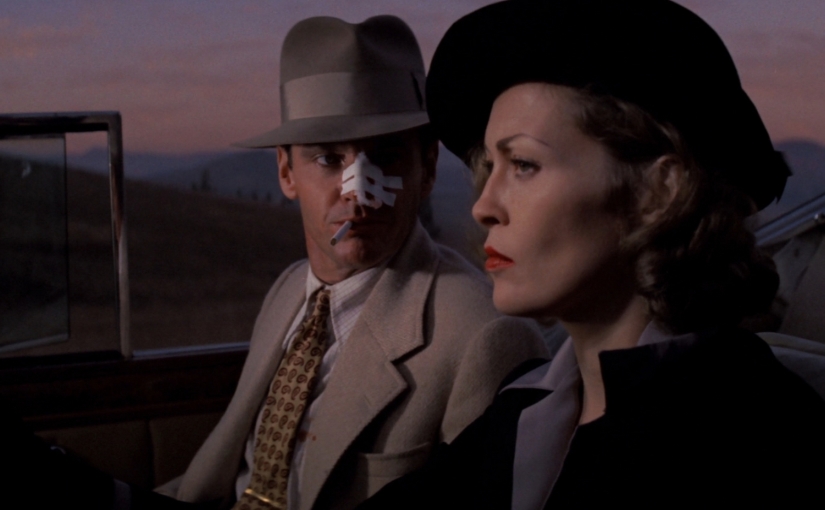
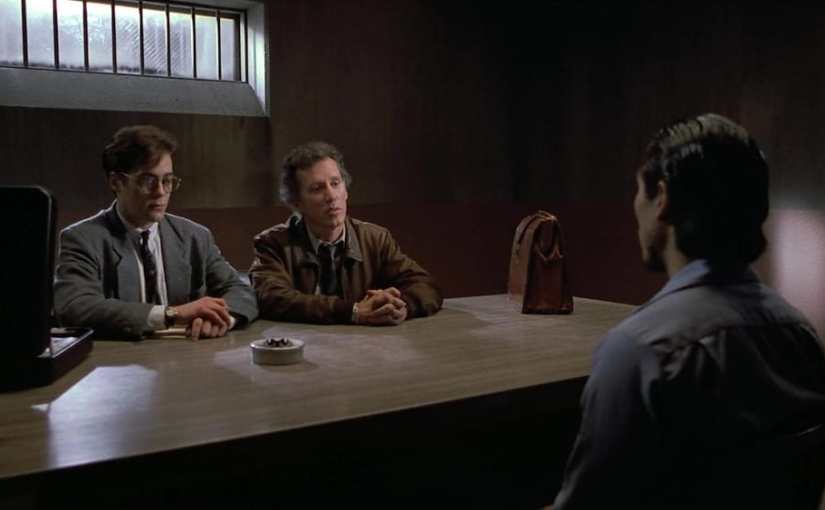
THE ASPHALT JUNGLE (1950)

by Miguel E. Rodriguez

DIRECTOR: John Huston
CAST: Sterling Hayden, Louis Calhern, Jean Hagen, James Whitmore, Sam Jaffe, Marilyn Monroe
MY RATING: 8/10
ROTTEN TOMATOMETER: 97% Fresh

PLOT: A major heist goes off as planned (almost), but then double crosses, bad luck, and solid police work cause everything to unravel.


On the Criterion Blu Ray of John Huston’s The Asphalt Jungle, noir historian Eddie Muller says you can draw a straight line from Jungle to the French heist film Rififi on through to the Tom Cruise Mission: Impossible franchise and Three Kings.  To that list I would add the crime films of David Mamet.  At the moment, I can’t think of another movie in Asphalt Jungle’s era in which the dialogue is so flat, menacing, and uncluttered.  The story is exciting without being flashy, the characters are sharply drawn, and the cinematography creates the underbelly of a city almost Blade Runner­-ish in its gloom.  Even the planned jewelry heist, while detailed, is almost like a Hitchcock MacGuffin: the heist itself hardly matters, only the results…like Reservoir Dogs.  Another descendant.

Doc Erwin Riedenschneider (Sam Jaffe) has just gotten out of prison.  After evading a police tail, he visits a local clip joint looking for help in putting together a heist he had worked on before he was imprisoned.  (I like how Doc and his colleagues rarely refer to “jail” or “prison”; it’s always “behind the walls.”)  He eventually enlists Gus, the wheel man (James Whitmore); Louis, the safecracker (Anthony Caruso); and Dix Handley, the muscle (Sterling Hayden, as shambling as ever, even in 1950).  Doc dismisses Handley as a hooligan.  “Violence is all they know, but they are, unfortunately, necessary.”  Throughout the film, Handley will do nothing to prove them wrong.

They need a bankroll for the heist, so the team goes to a crooked lawyer, Alonzo Emmerich (Louis Calhern), who agrees to their terms, but eventually reveals himself to be even more crooked than they are.  (Emmerich has a mistress, Angela, played by a young, gorgeous Marilyn Monroe in the role that made her a star.  She calls Alonzo “Uncle Lon” and steals every scene she’s in.  John Huston reportedly said Monroe was “one of the few actresses who could make an entrance by leaving the room.”)

The Asphalt Jungle is not so much about the heist as it is about the characters and their behaviors.  We watch how Dix Handley treats the one woman in his life, the appropriately named Doll (Jean Hagen).  She shows up on his doorstep the day after he’s released from a police lineup.  He grudgingly acknowledges her existence and allows her to crash at his place for a couple of nights, “but don’t you go getting any ideas, Doll.”  We see the money man, Emmerich, as he sweats about his planned double-cross, but still has to find the time to placate his bedridden wife.  There’s a great scene with Gus, the wheel man, who also owns a greasy spoon.  A rude cabbie takes cruel jabs at Gus’s hunched back, crippled gait, and scrawny pet cat; Gus reveals his true colors when he handily throws the cabby out of his restaurant while Dix looks on, amused.

Everyone gets their character-driven spotlight, even a crooked cop, Lt. Ditrich, who is assigned the task of finding Doc Riedenschneider, but when he does see him inside a clip joint, he simply turns around and walks away.  Later, Ditrich has a brutal scene with the weak-willed owner of the clip joint where he slaps him around several times to get him to spill his guts.  Watch the scene carefully, and it certainly looks as if Ditrich is really slapping this guy around.

Behavior is everything in this movie, not necessarily the plot.  Without giving too much away, behavior is what gets two characters killed, gets one arrested, drives another to suicide, and leads one to meet his fate in a horse pasture.  Nothing feels artificial or melodramatic.  There is an inevitability to what happens, a tragic undercurrent, that causes us to empathize with these hardened criminals.  These are not nice people.  But when one character unwisely stays seated in a diner when he really should have left, we are disappointed.  When one character’s lies to the police come back to haunt him, we shake our heads in resignation.  Their nature got the best of them.

Sterling Hayden is the headliner of The Asphalt Jungle, and he does get one or two scenes that are “juicier” than the rest, but this is a true ensemble piece.  It takes its time to make us familiar with each key player, with who they are, so we will understand why they do what they do at every turn.  That may seem like Storytelling 101, but you’d be surprised how many movies get that wrong.  Here’s one that gets it right in spades.

QUIZ SHOW (1994)

by Miguel E. Rodriguez

DIRECTOR: Robert Redford
CAST: John Turturro, Rob Morrow, Ralph Fiennes, Paul Scofield, David Paymer, Hank Azaria, Christopher McDonald, Mira Sorvino
MY RATING: 7/10
ROTTEN TOMATOMETER: 97% Certified Fresh

PLOT: In the late 1950s, a popular TV quiz show, along with its current champion, falls under federal investigation following allegations of rigging.


I imagine there will be no shortage of people more than willing to tell me how wrong I am, but while Robert Redford’s Quiz Show was well-directed, well-written, and well-acted, I never fell completely under its spell.  For that matter, it never felt like it had the director’s stamp on the material; a lot of it felt like a Ron Howard film.  No doubt the story captured a lot of attention when it happened in the late ‘50s, but it failed to grab mine, at least to that same degree.  It’s too well-made for me to skewer it mercilessly, but neither do I consider it a masterpiece.  It’s…okay.

It’s 1957, and Sputnik captures the world’s attention at (or at least near) the height of the Cold War.  To distract themselves from Sputnik’s implications, Americans tune their TV sets to the most popular game show on the air: Twenty-One, in which competing contestants are asked random trivia questions while isolated from each other.  These questions are something else.  One multi-part question includes: “Who rode with Paul Revere?  Who lent him his horse?  Was it a mare or a stallion?  And what was the horse’s name?”  I mean, really?  The current champion, Herbie Stempel (John Turturro), knows these answers and many others and has become something of a local hero, but he’s not terribly photogenic, with his oversized shoulders, those nerd goggles, and that one rotten bicuspid that you can’t take your eyes off.

Twenty-One’s showrunners decide Stempel’s run has come to an end and hatch a plan to throw the next episode to handsome young Charles van Doren (Ralph Fiennes), a Harvard professor who in real life did not look quite as handsome as Ralph Fiennes, but whatever, this isn’t a documentary.  Both Van Doren and Stempel comply with this plan, but the scenes in which they make their decisions felt contrived, or false, or something.  I was never convinced of their motivations.  Stempel needed the money but was supposedly swayed by the possibility of being awarded his own “panel show.”  Van Doren clearly didn’t need the money and even turns the offer down at first, but then he changes his mind because…I guess he needed a way to live up to his Pulitzer-Prize-winning father?  All the pieces are there, but it’s never fully explained until his final speech in front of a Congressional committee.

The story engine involves a young DC lawyer named Dick Goodwin (Rob Morrow) who gets a whiff of potential scandal and, eager to make a name for himself – as a possible parallel to Van Doren himself – does some independent investigating.  His digging leads inevitably to Stempel, who is more than happy to name names, but whose irascible personality makes him a less than ideal witness.  Things get interesting when he interviews Van Doren.  He is clearly suspicious, but no hard evidence appears…until he watches an old clip of a previous Twenty-One contestant who appears to give an answer the host was not expecting…

I don’t know how relevant this is, but I feel compelled to observe that director Redford seems to have phoned in a lot of favors when it came to casting Quiz Show.  In addition to the fine performances from the leads (Rob Morrow is outgunned by Turturro and Fiennes, but he holds his own), the supporting cast reads like a Woody Allen picture: David Paymer, Hank Azaria, Christopher McDonald (perfectly cast as the smarmy, superficial host of Twenty-One), Mira Sorvino, Martin freaking Scorsese, and walk-ons by Timothy Busfield, Ernie Sabella, Barry Levinson, Mario Cantone, Illeana Douglas, Calista Flockhart, and a blink-and-you’ll-miss-him Ethan Hawke.  Redford clearly wanted to make sure his canvas was deep and well-drawn, and not just with the impeccable period production design.

But to what end?  I went into Quiz Show thinking it would involve a much deeper conspiracy than just two showrunners who, following orders from corporate, simply bribed several contestants to follow a scripted playbook.  About halfway through the movie, I realized there was not going to be much more to that part of the story, and we were going to follow the lawyer on his quest to uncover the truth, and I was like, “…that’s it?”  Does that make me guilty of criticizing the movie that I wanted it to be, instead of criticizing the movie itself?  I’m not sure.  Rightly or wrongly, I felt the movie wanted me to empathize or sympathize, or one of the -izes, with Van Doren.  But I was not moved to goosebumps by Van Doren’s final speech at the end of the film.  I found myself siding more with the committee member who says, “I don’t think an adult of your intelligence ought to be commended for simply, at long last, telling the truth.”

(I suppose a case could be made that the whole film is a parable for Watergate, still several years in the future; Nixon is name-dropped a few times.  The end credits inform us that NBC and Twenty-One’s sponsor, Geritol, were never indicted because their underlings claimed full responsibility for their actions, much like Haldeman, Ehrlichman, and the rest.  Does the buried subtext of America’s lost innocence make Quiz Show a better film?  Maybe a little, but only when you stand back from it, not while you’re watching it.)

ANOTHER WOMAN (1988)

by Miguel E. Rodriguez

DIRECTOR: Woody Allen
CAST: Gena Rowlands, Mia Farrow, Ian Holm, Blythe Danner, Betty Buckley, Martha Plimpton, John Houseman, Sandy Dennis, Philip Bosco
MY RATING: 8/10
ROTTEN TOMATOMETER: 59%

PLOT: Facing a mid-life crisis, a woman becomes drawn to the plight of a pregnant woman seeking psychiatric help from the shrink next door.


Woody Allen’s Another Woman is the first movie I can remember that compelled me to do a little background research before writing about it.  It is moody, somber, theatrical, and by far the least funny of Allen’s films that I’ve seen (and I’ve seen Blue Jasmine).  It falls in that part of his career when he was delving into more dramatic fare; September had been released the year before, and Crimes and Misdemeanors would come a year later.  There is none of the charm and lightness of his earlier comedies, which may account for why I’ve never seen it mentioned alongside his other films whenever his filmography is discussed.  And yet, I was curiously drawn into this story to such a degree that when two revelations arrive almost on top of each other, I gasped.

Another Woman tells a brief chapter in the life of Marion (Gena Rowlands), a middle-aged woman married to Ken (Ian Holm).  Marion is Ken’s second wife; she was literally the “other woman” that caused Ken to divorce his first wife, Kathy, played by Betty Buckley in a single devastating scene that vividly showcases the guilt that Marion and Ken have both learned to live with in different ways: Ken gently accepts Kathy’s “condemnation”, while Marion buries the guilt deep.

Marion is a professor of philosophy at a local university.  To work quietly on a new book, she rents a small one-bedroom flat nearby and uses it as her office.  However, through a trick of acoustics, she realizes she can hear voices coming from the flat next door through an air vent on the floor.  It’s a psychiatrist’s office, and she is suddenly privy to intensely personal conversations with his patients.  (I was reminded for a minute of Rear Window.)  One such patient is Mia Farrow, playing a character whose name I won’t reveal because it’s barely mentioned in the film for a reason.  She is pregnant, and during her sessions, she reveals doubts about her identity and/or purpose in life.

For Marion, who has always been sure about everything and everyone in her life, Farrow’s confession strikes a nerve, and the rest of the film consists of Marion’s struggle to reconcile her perception of herself and her well-constructed life with how everyone else truly sees her.  Throughout the movie, people are telling her how wrong she is about her relationships with her divorced brother, with an old friend, with her own husband, with her best friend, even with the Mia Farrow character.  Has she been deceiving herself her entire life?

Okay, so this subject matter isn’t exactly a barnburner.  But consider how the movie looks and moves, and the performances from Gena Rowlands and her supporting cast (it’s Rowlands’s movie to win or lose).  Look at the warm, yet subdued lighting schemes, shot by Ingmar Bergman’s favorite cinematographer, Sven Nykvist.  (Allen is a huge Bergman fan – indeed, this film is actually a loose reinterpretation of Bergman’s film Wild Strawberries [1957].) Interiors look, not sad, exactly, but…lived in.  Bright sunlight is only ever seen from inside through a window.  Exteriors look as if Allen specifically waited for overcast days to shoot.  Everything matches Marion’s internal gloom as she re-examines her life.

At the center of the film is a dream sequence that feels more like a foreign film than anything I’ve ever seen from an American film.  Marion dreams she is in an old stage theater, where figures from her circle of family and friends are rehearsing a play based on moments in her life.  Is this self-indulgence from Allen?  Maybe.  The dialogue in this sequence is so formal and, I guess, elliptical at times that it almost feels as if it were something translated into English from another language.  Vincent Canby of The New York Times called this out, saying, “The rounded sentences sound as if they’d been written in a French influenced by Flaubert, then translated into English by a lesser student of Constance Garnett.”  I’ll probably understand this criticism more when I learn who Constance Garnett is, but I get his point.  However, while it was noticeable, I did not find it distracting.  I thought it was a fair interpretation of how our dreams rarely follow strict logic.  Marion’s dream is structured, but the content is skewed.  I was fascinated by it.

Do I think this is a movie you need to see?  Who can say.  I’m glad I saw it, at least.  It shows a side of Allen’s directorial psyche I had never seen before, even though I had read about it from many other sources.  And it inspired me to do a little introspection of my own, which is something, I guess.  The movie’s final scene includes a beautifully loaded question: “…I wondered if a memory is something you have or something you’ve lost.”  Marion has been asking herself this question the whole movie without realizing it.  I wonder if my answer would be the same as hers.  Or yours.

THE COMMUTER

By Marc S. Sanders

Sometimes it gets boring to have your suspension of disbelief tested with a movie.  Especially if it is a movie where there’s that eye in the sky that can see everything the hero does, thereby making his dilemma that much harder.  Downright impossible, actually.

You know what I mean when I say eye in the sky?  That’s where the villain or the antagonist can see everything the hero attempts to do to save the day, and every time he tries something like making a cell phone call or writing a secret message on a piece of paper (hidden next to his thigh under the table) for someone else to see, the bad guy always knows what he’s doing. It’s a wonder if the protagonist can even take a leak in private.

In The Commuter, Liam Neeson plays a former New York cop, now insurance salesman, who takes his morning and afternoon train from upstate into the city and then back after work.  Everyday, it’s the same regulars on the train while Neeson’s character, Michael MacCauley, reads the classic literature books that his son is assigned to cover for school.  I guess it’s the way they bond, and it’s pretty fortunate that this is Mike’s hobby because on the day he gets fired from his job, it might come in handy.  Go figure.  These bad guys messed with the wrong avid reader.  I mean he’s reading The Grapes Of Wrath for heaven’s sake.

Just before Mike enters the train, his wallet and cell phone are pickpocketed.  He defeatedly slumps down in his seat and shortly after an alluring woman named Joanna played by Vera Farmiga sits across from him and proposes a hypothetical.  Find twenty-five thousand in cash hidden somewhere in the bathroom.  Then seek out a passenger who identifies as Prynne and swipe the bag that person is holding.  Once that is done, he’ll collect an additional seventy-five thousand, but it must be done before the train reaches the Cold Spring station.  Joanna leaves the train making the offer sound so simple.

Considering Mike just lost his job and he’s got no cash savings as well as his son’s college tuition to pay for, he retrieves the hidden money and tries to make a clean getaway at the next stop.  However, he’s immediately halted by someone who gives him an envelope with his wife’s wedding ring in it.  Now, he knows this woman and whoever else is setting him up with his wife and son in possible danger.

As he finds a way to communicate with Joanna by phone, Mike tests just how serious she and her cohorts are, and that’s when a couple of people wind up dead.  Ultimately, the only way out of this conundrum is for Mike to find out which passenger is Prynne.

Much of the running time of The Commuter is occupied with red herrings.  Could Prynne be the punk girl with the nose ring (Florence Pugh)?  Is it the asshole Investment Banker with the phone earpiece?  Maybe it’s the guy all dressed in black?  Or the one with the guitar case?  Yeah.  It could be any one of these folks who Mike does not recognize as regular travelers.  I won’t even tell you if any of the people are the real Prynne or not, but I knew what to expect from this kind of storytelling pattern.  Mike finds a way to small talk some of them and seek out clues.  He uses the conductors by explaining that he sees something suspicious and suggests they look in their parcels.  At times, I felt like I was playing the Clue or Guess Who?  or Twenty Questions.  I dunno.  This kind of set up for a movie just seems too silly.

Sixty-year-old Mike also engages in hand-to-hand fist fights with some suspects.  I don’t know how old Liam Neeson is, but Mike says he’s sixty, and sixty-year-old Mike endures getting his head bashed through more than one speeding train window, plus a couple of knife slashes and some ass kickings, in his pursuit for the truth.  I know.  He’s a cop so he’s got fighting skills.  That’s okay.  I buy that, but to have your head bashed through doubled paned windows while this commuter train is going a hundred miles an hour? Well, that’s enough stretching for one day.

So how does Joanna stay one step ahead of Mike to ensure he’s playing by the rules?  Well, apparently there are cameras positioned in the overhead vents of every train car that can follow his every move.  C’mon now!  I’d rather the writers and director simply turn this into a sci fi cheapo and declare the villain omnipotent.  This train is at least six cars long.  Maybe seven, and the length of each one is maybe five yards if I’m being conservative, and I’m supposed to believe that these cameras cover every nook and cranny of every single train car?  Seriously, stop stretching.  You’re bound to pull something.

I stayed with The Commuter until the end because frankly I was curious who Prynne turned out to be and what the significance of this particular passenger was to the interests of Joanna. It actually works.  It’s Mike’s convenience in detective work and the powers operating against him that’s ridiculous. 

Moreover, the visuals are incredibly distracting in this picture.  The CGI could not be more apparent anytime Liam Neeson throws a punch or takes one across the chin or out a broken window.  The animation of the CGI appears terribly false.  It looks unfinished and rushed for editing as Neeson’s facial expressions of pain and struggle contort in odd ways.  The bad guys he gets into fisticuffs with appear to have the same problem.  Truly some of the worst action scenes I can remember watching in quite some time. 

The speed of the train looks false as well.  I read where Liam Neeson said that the settings within the train cars were shot on a soundstage.  Afterwards, director Juame Collet-Serra was challenged with changing the outdoor scenery of the train on a constant basis to simulate ongoing speed and movement.  I imagine this is all incredibly challenging.  I don’t know how to do it.  However, it just does not work.

The visuals for most of The Commuter fail tremendously.  Last year’s most recent installment of Mission: Impossible demonstrated how a speeding train should look in an action picture.  With this movie though, the finalized print was rushed for that all so busy January release in 2018.  Look, if you can’t do it right, then let somebody else handle the job, or better yet, make a better movie.

The Commuter would have been a much better and much shorter film had Mike never let his curiosity overtake him and go to the bathroom for that money.  Mike, why couldn’t you just stay in your seat and finish reading your Steinbeck?

CLEAR AND PRESENT DANGER

By Marc S. Sanders

Tom Clancy’s Jack Ryan finds himself in an inadvertent private war between the United States and Colombian drug kingpins in Clear And Present Danger.  Harrison Ford returns as the heroic government operative. I like this film for much of the same reasons I liked the prior Jack Ryan pictures.  These movies give an inside view of internal politics within Congress, the CIA and inside the hallowed halls and Oval Office of The White House.  The Clancy adaptations are not just about action set ups and shootouts.  Though we are treated to plenty of that material as well.

The film opens with a luxury yacht being raided by the Coast Guard. They uncover Colombian killers that have murdered a wealthy American and his family for reasons of a failing partnership with drug dealers.  The incident can be bridged to the President played by Donald Moffat, a terrific character actor who also shared the screen with Ford in Mike Nichols’ Regarding Henry. He secretly initiates a retaliation for what has occurred while also insisting on collecting over six hundred and fifty million dollars he feels the US is entitled to, following his friend’s murder.  Henry Czerny, playing a carbon copy of his role in Mission: Impossible, headlines the covert plot and recruits a mercenary named John Clark (Willem Dafoe) to place a clandestine militant team into the South American jungles to take out the drug runners one by one.

The suit and tie formal dynamics fall on Jack Ryan when he swears testimony on the legitimacy of the country’s response.  However, the President’s armament exercises are unbeknownst to Jack.  When it finally dawns on him what has been occurring, into the field Jack Ryan goes to clean up the mess.

A lot of spinning plates structure the storytelling of Clear And Present Danger which is on par with Clancy’s thousand-page novels.  There’s an abundance of characters to address, betrayals to happen and even the mechanics of various weaponry and policy decisions that need exploring, despite the innate complexities of it all.  It can feel overwhelming.  However, with this film, as well as with The Hunt For Red October and Patriot Games, I feel included.  If you’re patient through the exposition and set ups, then these fictional controversies become very absorbing, and you feel like you’re there.  

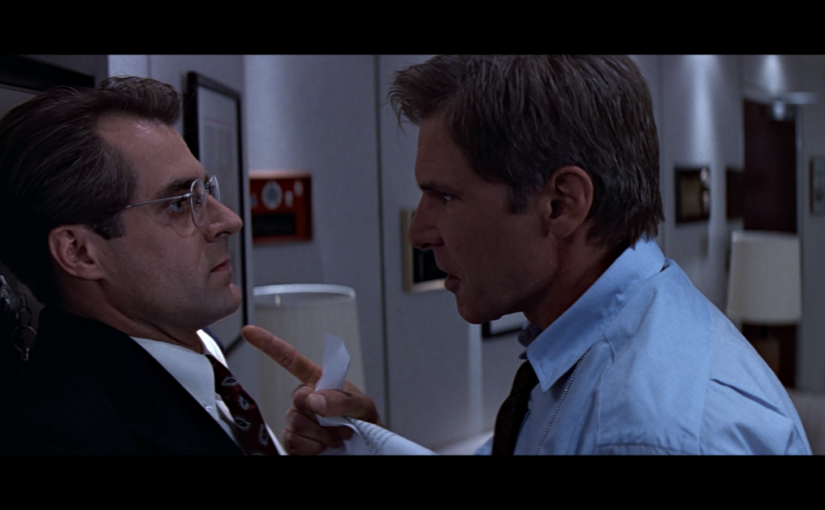
There’s a great scene between Ford and Czerny racing to download vs delete some suspicious files on a computer.  These guys are in their boring offices, dressed in their boring suits and they’re clicking on the mouse pad and typing away on the keyboard.  Director Phillip Noyce gets nail biting back and forth closeups on each guy as they are off to the races trying to get ahead of each other.  Then it becomes a yelling match in the hallway with threats of prosecution between both men, and I feel I’m in on the whole thing.

There is also a good amount of internal conversations between the main drug czar (Miguel Sandoval) and his top henchman (Joaquim de Almeida).  Almeida’s role is written very well as we witness how smart and resourceful he is while protecting the best interests of his employer.

For the most part, the action is nothing special.  However, the highlight of the whole film involves an SUV convoy getting ambushed by Colombian terrorists mounted on rooftops firing missiles at the government vehicles below.  Harrison Ford prefers to do as much stunt work as possible and it definitely helps the ten-minute sequence.  This is an outstanding part of the picture with perfect editing of sound and photography. Later on, we see Ford leap on to the landing gear of an ascending helicopter. Very impressive. Harrison Ford always does his best to invest himself in his movies.

I also admire many of the explosions that went into the Special Forces’ continuing storyline of sabotaging the drug lords’ laboratories and various locales. Nothing is miniaturized here, and the resulting blasts are really big and eye opening. This movie did not shortchange on anything it was attempting to accomplish.

The film adaptation of Clancy’s fourth book takes some major liberties.  In the novel, the story is primarily focused on John Clark and his mission, with Jack Ryan not appearing until after the midway point.  However, at this stage of Harrison Ford’s career there was no way he’d accept just a supporting role.  The notable changes hold well within the screenplay though, and a showdown between Jack Ryan and the President is one for the ages.

Overall, Clear And Present Danger was a successful picture at the box office. Critics and Clancy fans alike had favorable responses to the picture.  So, it’s disappointing that producers decided to try numerous reinventions of the Jack Ryan franchise subsequentially.  Those other movies, along with a TV show, would prove well.  Yet, it is regrettable that Harrison Ford, or at least this interpretation of the hero, did not move on through Tom Clancy’s ongoing stories transcending within other areas of government and espionage.  If you have read the books, then maybe you recall the unbelievable ending to Without Remorse.  Boy, would I have loved to see what Harrison Ford did with the cliffhanger that closed out that book. Care to know? Then this Unpaid Movie Critic suggests you pick up a book.

NOTE OF TRIVIA: James Horner conducts the music for this film and he includes samples that were used in the beginning of Aliens. Interesting to catch this as the music works for both a science fiction piece, as well as for a political thriller.

DEATH WISH (1974)

By Marc S. Sanders

I never saw the original Death Wish before.  Never felt I needed to having already watched Death Wish II and Death Wish 3.  Yes!  The inconsistency in the numbers (Roman vs numeral) is how the “saga’s” films are titled.  Sometimes self-described writers and studio marketers do not pay attention to the minute details.  If you’re gonna be stupid with your five film franchise, then be sure to strive for a complete lack of intellect.

Now before I get back to discussing the original film which I finally watched last week, I offer you this confession.  In 1985, there were two films I saw five times each in theaters.  Oh God, You Devil and Death Wish 3.  I guess Out Of Africa and Prizzi’s Honor did not appeal to my twelve-year-old mentality.  Death Wish 3, however, had a hideously violent gang making social progress because they consisted of whites, blacks and Hispanics.  A couple of punk girls too.   A welcome melting pot of deranged animals operating under an equal opportunity philosophy.  They were all pals and they pillaged, robbed, vandalized, murdered and raped the helpless neighbors of the destitute projects in New York.  Happy times.  More importantly, have you ever seen that shootout that occupies the last thirty minutes of Death Wish 3?  It is one for the ages and worth your time to watch on repeat.  Dare I say it’s as good as anything in a Stallone, Schwarzenegger or Eastwood actioner.  

Here’s where my endorsement stops with this article, though.  Skip the first two trashy Death Wish films. Unless you want to see Laurence Fishburn try to shield himself from a Charles Bronson bullet by covering his face with a boom box and then drooling blood and radio parts out of his mouth before collapsing dead on the pavement.  That glorious moment occurs midway through the second installment.

Stay with me, now.

Having experienced the happy bloodshed of the third of five films in the Charles Bronson franchise, I am surprised to learn his city architect character Paul Kersey begins the original film as a “bleeding heart liberal” who would prefer to stay away from guns.  What a departure for Bronson’s most famous role.  All that being said, director Michael Winner likely started filming this piece with a need for a message about justifiable homicide or vigilantism, but unfortunately it very quickly drowns in repulsive ugliness.

I’ll say this for Michael Winner.  He’s keen enough to show Paul and his wife (Hope Lange) vacationing in beautiful Hawaii.  Then as they return home, an overhead shot of a bloody sun-soaked New York City appears on screen with the title of the picture DEATH WISH in big block letters, accompanied by some sinister sounding music.  Hawaii is heaven.  Home is hell.  John Milton was never this poetic.

Paul Kersey’s wife and adult daughter are attacked in their home.  Interesting tidbit! One of the slimeballs is Jeff Goldblum in his first film role.  Though there’s nothing for him to be proud of here.

Kersey’s wife dies.  The daughter is brutally raped, and I mean brutally.  It’s a disgusting scene that offers no sense of sadness or fear or awareness.  It also looks as if Winner and his crew and cast never even rehearsed the scene.  The poor girl’s clothes are ripped off of her, she’s pulled against one of them from behind by her throat, and then the attackers spray paint the center of her bare anus in orange as a “target” for where to penetrate.  Another thug paints a swastika on the wall. What is that supposed to tell me? Then we are treated to seeing Goldblum and company baring themselves and mounting the actress who was awarded this unfortunate role.  Reader, I’ve seen just about everything there is to see in films.  When I consider the point of delivery that Jodie Foster offered in her Oscar winning role in The Accused, what is smeared across Death Wish is exploitative garbage. Any shred of cinematic artistry is entirely devoid in this picture.  In this case it was not just another movie.  It’s just truly sickening.

Anyway, Bronson has never been a great actor.  Nor has he been charismatic.  Yet, there’s a tough guy and dark presence to what the camera found in him.  A client gifts Paul a modern-day Colt handgun and considering the high level of violence that occurs within the streets of New York, he takes it upon himself to seek out or bait would be muggers and criminals.  He never catches up to the hooligans that tormented his family, but he takes on the mission of cleaning up the streets while a useless police force amounts to little results.

After Paul’s first shooting, he comes home to vomit.  I can only guess the liberal cannot stomach what he’s committed.  This is about the only dimension we get out of this guy.  Paul has boring conversations with his son in law.  Poorly acted scenes with actor Steven Keats; poorly acted, poorly directed, poorly written, poorly filmed.  Paul hardly ever shares a scene with his traumatized daughter who goes in and out of catatonic states when she appears in the film.

As the body count piles up, a detective played by Vincent Gardenia starts the investigation around town and wrangles up his police force posse to be on alert. Hey, look who is giving a run down on a progress report.  It’s Gardenia’s Moonstruck wife, Olympia Dukakis.  Pretty neat to see this. Still, Death Wish is not recommended for your Vincent Gardenia/Olympia Dukakis movie marathon.

Death Wish is tone deaf.  I’d be interested to see how a liberal, who shutters at violence, transitions into a vigilante.  That’s a story with an eccentric transformation. However, Michael Winner and his writers are not even aware or interested in talking to you about that.  I only know Paul Kersey starts out as a liberal because his co-worker mockingly calls him one, and again he vomits after his first shooting.  How humane of Paul.

I won’t disclose the entire ending, but I’ll share this with you.  Paul relocates to Chicago and upon arrival, Michael Winner freeze frames on a grinning Charles Bronson pointing a finger gun at a couple of harassing punks who are tormenting some citizens in a train station.  What do I gather from this hint of subtly?  I guess Paul Kersey registered with a different political party when he became an Illinois citizen.  Quite the message!

GHOSTBUSTERS: FROZEN EMPIRE

By Marc S. Sanders

When you make a new installment in a long-celebrated franchise, going on forty years, you have to reinvent the base material to keep it fresh and new.  I think the Jurassic Park/World movies are fun, but don’t they also feel like carbon copies of each other by this point?  I mean how much can you broaden the adventures that come with dinosaurs? The roar, they run, they eat.  

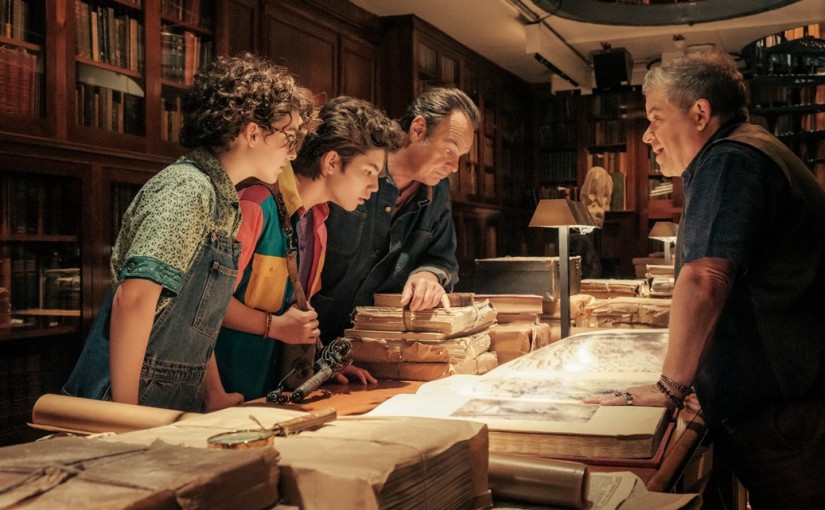
With the Ghostbusters films, there’s more flexibility in what you can do.  You can replace Saturday Night Live players with a fun, lovable leading man like Paul Rudd and he can team up with some brainy kids to fend off ghosts in the best movie jungle there is, New York City.  However, why drain all of the comedy out of the burger?  

The ongoing teenage troubles of the latest reinvention of the Reitman/Ramis/Aykroyd property hinges on so much teen angst that ghosts and ghouls only appear after we’ve endured one Breakfast Club moment after another.  Sadly, there aren’t many spooky critters roaming around the metro area anymore.  Who you gonna call? Doesn’t feel like we need to call anybody, really.

Here’s the pyramid food chain of Frozen Empire.  1) Sad, frustrated teens 2) Inevitable cameos of the celebrated heroes of the first two movies 3) Ghosts.  This movie needs to reexamine its priorities.  

The main storyline is carried by McKenna Grace as Egon’s granddaughter Phoebe who is grounded by Walter Peck aka Mr. Pecker aka Dickless (William Atherton).  I’m referencing what this guy is remembered as because the movie fails to do so. Phoebe is a minor.  Therefore, she can’t hunt after ghosts and thus builds a relationship with a sixteen-year-old friend named Melody (Emily Alyn Lind) who appears in the form of blue supernatural lighter fluid.  Melody died in a fire.  Sooooooo…much of these two young ladies’ sad sleepover conversations populate the film.

Then there is Dan Aykroyd returning as Ray to enlighten some back story on the main monster we can expect to appear in the third act.  He’s performing like an R.L. Stine adult in a second-rate Nickelodeon kid’s picture though.  Ray Stanz was always the guy who had loony science on his mind, but the comedy of the character shown through with Aykroyd’s boyish naïveté.  Remember how excited Ray was to go down the fire pole or when he thought up the giant marshmallow man?  What about when he talked back to the pink slime in the first sequel? It was downright ridiculous and now Ray is a midlife crisis depressant.  

Bill Murray is collecting a paycheck again.  The character is the same with the comedian’s special sarcasm, but if he’s in this film longer that ten minutes it’s a lot and he utters no more than five lines.  He serves one purpose to Frozen Empire – to be in the advertisements and draw a crowd.  Paul Rudd and Bill Murray have done two Ghostbusters and an Ant-Man movie together and somehow, they still have yet to share a great exchange of dialogue.  For the third time in four years, Rudd and Murray seem to be unaware that they are both members of SAG working on the same project.  If I ever need to deliver the argument that there is a lack of good writers working today, I’ll use these missed opportunities as an example of what I mean. 

Annie Potts wears the nerdy glasses, but I don’t remember a thing she says.  Ernie Hudson as Winston plays the financier of the modern Ghostbusters, but there’s nothing special going on with him.  Even the librarian from that fantastic opening of the 1984 film appears.  He talks to Ray for a moment and that’s it.

Why are these people here?  Just so we can say “Uh!  Look who it is!!!”  C’mon!  Surely, there’s something better to be spun here.

Part of the plot involves the threat that the storage container of all the ghosts ever captured over the years will be breaking down soon and set all of the paranormal prisoners free.  That’s brilliant!!!  Yet, why doesn’t the movie capitalize on that????? We are threatened by this terrible scenario over and over with music of impending doom and glances at a digital monitor.  Can the thing just break already?  

We see the slimer green ghost blob under a pile of candy wrappers in the attic.  Not bad.  Where are the other ghosts we had become familiar with?  Remember the cab driver, or the angelic apparition that seduced Ray in his sleep?  Where are they?  I’d rather see these guys than a boring Dan Aykroyd in a jean jacket.

The best parts of Frozen Empire occur in a turn of the century prologue with frozen characters in a formal dining room.  There’s also a fantastic pursuit following that scene showing all the cool tricks of the updated ECTO mobile as it races through the streets chasing after an eel like monster.  During the sequence a drone trap launches off the roof of the hearse!  That’s awesome.  The last good scene occurs midway when one of the stone lions outside the NYC public library comes alive. Everything else in this sleepy picture is very bland, however.

The original, and even Ghostbusters II and the Paul Feig lady comedienne reinvention worked as comedies like the franchise became known for.  I wasn’t crazy about those two sequels but at least the ghosts were the punchlines.  Now the main ghost needs therapy and so does the lead character.  It’s so dreary.  

Where’s the funny?  There is no longer a silliness or loony tune appeal to these monsters.  As well, there are no more jokes to tell about The Big Apple.  Don’t forget that Ghostbusters showed us that ghouls can pop out of drainpipes, drive cabs, gorge themselves on room service meals and hot dog stands and even cause the ghost hunters to wreck a posh banquet hall all in the service of the greater good.  The well of laughs that stem from New York cannot be all dried up just yet.  There are subways and buses to haunt. Broadway theatres. Cell phones. Parades. Ferrys. Morning News Shows.

I left Ghostbusters: Frozen Empire feeling morose and melancholy.  When I got home, I knew for the first time that Zuul could never be living in my refrigerator and suddenly I was as sad as Melody and Phoebe.  If this movie is depressing, then is it me or is it the Ghostbusters of today?

THE RULING CLASS (United Kingdom, 1972)

by Miguel E. Rodriguez

DIRECTOR: Peter Medak
CAST: Peter O’Toole, Alastair Sim, William Mervyn, Carolyn Seymour, Arthur Lowe
MY RATING: 8/10
ROTTEN TOMATOMETER: 77% Fresh

PLOT: A member of the British House of Lords dies, leaving his estate to his son. Unfortunately, his son thinks he is the one true God made flesh.  Murder and mayhem ensue.


Re-watching The Ruling Class for the first time in some fifteen years, I came up with a great but still imperfect way to describe it: Being There directed by Terry Jones and written by Terry Gilliam.  It has more religious blasphemy than Life of Brian – not a great example because Life of Brian is not technically blasphemous, but whatever – and more exuberant overacting than any two Nicolas Cage movies put together.  There’s nudity (but no sex), a little cross-dressing, murder, auto-erotic asphyxiation, impromptu musical numbers, and more jabs at organized religion and class structure than you can poke a burning cross at.  It feels a little too chaotic for its own good at times, but I am willing to forgive those transgressions because I am so grateful for its periodic flights of fancy and for the deliciously hammy performance from Peter O’Toole.  Is it a masterpiece?  Not quite.  But you just can’t turn away from it.

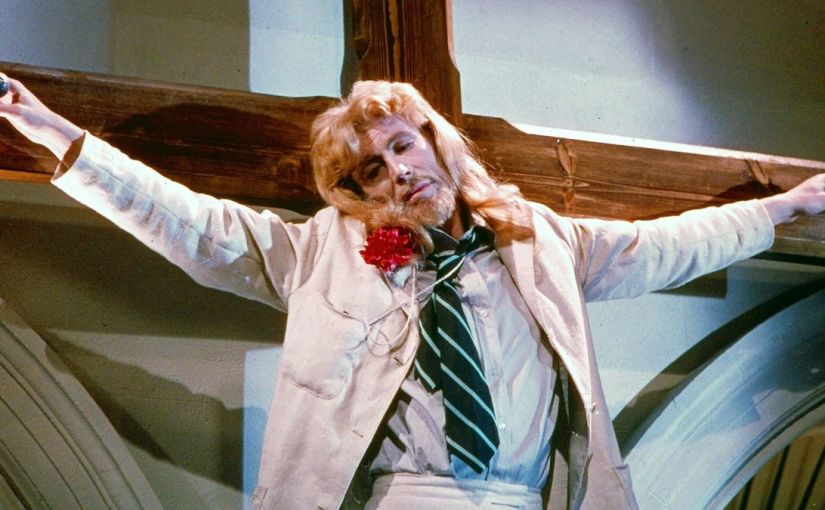
One day, the veddy-veddy proper 13th Earl of Gurney dies after a mishap involving a silken noose, a tutu, and a dislodged stepladder.  His brother, Sir Charles Gurney, is dismayed to learn that the heir to the Gurney fortune and name is none other than Jack (Peter O’Toole), the 14th Earl of Gurney.  We see the reason for Charles’s dismay when we see Jack for the first time…dressed as Jesus Christ, in a brown robe and white rope belt and long golden locks down to his shoulders.  He tells everyone he is God.  Someone asks him, “How do you know you’re God?”  He answers with unassailable logic: “Simple.  When I pray to Him, I find I am talking to myself.”  He also says things like, “For what I am about to receive, may I make myself truly thankful.”

Charles realizes he must have Jack committed to wrest away control of the family fortune, but he cannot do so until Jack has an heir.  But Jack (who insists on being referred to as “J.C.”) refuses to marry because he says he’s already married to the Lady of the Camellias, which everyone knows is the name of a less-famous novel by Alexandre Dumas fils.  To get around this inconvenience, Charles arranges for his own mistress to impersonate the Lady.  Meanwhile, Charles’s wife, Lady Claire, puts the moves on Jack’s psychiatric doctor to distract him because he opposes the marriage, citing Jack’s condition.  And always in the background is Tuck, the family butler, who received 30,000 pounds from the 13th Earl’s will, but stays in service apparently just to blow raspberries and say exactly what’s been on his mind for the last several years.  I would say he’s the comic relief, but he’s more like a demented court jester.

Peter O’Toole’s performance as Jack must be seen to be believed.  Imagine, say, Daniel Day Lewis or a young Robert De Niro, dressing up as Jesus Christ, talking animatedly to flowers, and taking a nap while standing on a life-size crucifix, arms outstretched.  At one point, Jack woos the faux Camille by impersonating a bird, and she follows suit.  You haven’t lived until you’ve seen Peter O’Toole dressed in an impeccable white ensemble, strutting across the lawn, head bobbing like an oversize pigeon, and literally cooing.

The Ruling Class is clearly a jab at its namesake, the upper-class nobs and snobs of England who firmly believe they rule their country simply because they are more suited to it than anyone else.  They never suffer from the same human foibles as the lower classes do, and if they do, it’s never acknowledged, or acknowledged and hushed up, or blamed on someone or something else.  The film is based on a stage play, which explains the occasional fourth-wall breaks and the frequent interruptions for short musical numbers, which further enhances the Python-esque feel of the movie.  I would imagine it was much more notorious upon its release than it might be today, but the message itself hasn’t dated.

That message is especially brought home when Jack is ostensibly cured, after a fantastic sequence involving a second psychotic patient, a lightning storm, and a vision of a gorilla wearing a top-hat and a tux.  However, his “cure” has an unintended side effect.  To everyone else, it looks like he’s back to being himself: Jack, the 14th Earl of Gurney.  But a creepy monologue in the attic reveals his secret.  He no longer believes he’s God, nor does he believe he’s Jack, the 14th Earl.  He believes he’s another historical “Jack,” the one who stalked prostitutes in 19th-century London.  He has visions of old London streets.  In one masterful scene, he is in the sitting room of his country house, and as he crosses the floor, the house magically transforms into an old London cobblestone street at night, in an uncut take with no visual effects.  I can imagine Terry Gilliam nodding approvingly at that absurdist touch.

What will become of the “new” Jack?  Will he remain a member of the ruling class to which he was born, whether he deserves it or not?  Will his former doctor, or his wife, ever learn of Jack’s new persona?  With his newfound purpose, he delivers a speech to the house of lords in favor of capital punishment, quoting no fewer than three verses from the Old Testament.  Their response to his words serves as the macabre capper to the film.

CHINATOWN

By Marc S. Sanders

Forget it Jake!  

Roman Polanski turned Robert Towne’s page turning script into a noir mystery for the ages.  Practically every scene in Chinatown turns whatever you learned before off its axle.  The mystery of what Jake Gittes, a private dick played so well by Jack Nicholson, is attempting to uncover seems to repeatedly take the guy back to square one.  

Towne’s Oscar winning original screenplay, one of the best ever written, begins with simplicity in motion.  A Mrs. Mulwray insists on hiring Mr. Gittes to find out if her husband is having an affair.  The husband is in charge of the water supply within the surrounding areas of Los Angeles.  Despite Jake’s encouragement for her not to go down this path and recuse herself of heartache, he accepts the case charging his regular fee plus a bonus should he turn up anything that points to something illicit.

Just before meeting with the wife in despair, Jake wrapped up a case, handing over photographs of a wife to her bruiser husband (Burt Young).  The poor guy understands that his spouse was messing around.  None of it is shocking to Jake.  He’s seen the same results many times before and he’ll likely come upon the same situation with Mr. Mulwray.  However, as he follows her husband, it does not seem to be just an affair that is transpiring.  Jake finds himself driving out to a dried-up reservoir and then he’s adjacent to a drainpipe by the ocean shore.  The more he sniffs out, the more likely his nose is going to pay for what he gets closer to.

It’s hard to write about Chinatown as I reflect on the film for a review.  There’s just so much to spoil, even beyond what is now considered to be one of the all time great twists in film history.  I would dare not give anything away.  Some of the luckiest people today are those that have never seen the picture.  To watch Chinatown with a blank slate.  If that’s you…Wow!!! You are blessed of the experience that awaits you.

The cast is a bevy of recognizable faces; character actors who went on to popular television shows and movies (Higgins from Magnum P.I. and Miss Collins from What’s Happening!!!).  Faye Dunaway though is maybe the most unforgettable.  Jake is smart enough not to trust the famed actress’ character (I don’t even want to share the name of who she portrays).  Long before Sharon Stone hammed it up with a less creative eye rolling commando cross legged sitting, Faye Dunaway was best at being sexy, alluring and especially enigmatic.  With her Hollywood glamor appearance in costume wear from Anthea Sylvester, she has that classic noir dame appearance with a smooth inflection in her voice.  Word is that Polanski wanted Dunaway to reflect his own mother’s appearance.

Then there is the celebrated filmmaker John Huston representing old money, a lot of it, in a rare acting appearance.  He plays Noah Cross, a great name to be associated with water.  His gravelly voice and hulking mass lend to what he’s earned demonstrating his power over a commodity resource that everyone cannot live without.  Per Jake Gittes’ experience, he knows it’s best to seek out a motive long before he can uncover a crime.  Gittes’ perusal of some photographs on an office wall will allow him the gumption to go up against a titan like Cross. 

It’s a welcome setting to see late 1930’s L.A.  There is a drought going on and coincidentally Jake is perhaps tailing the guy responsible, but only because of a likely affair.  Still, when his pursuit takes him to the most unexpected places, something more sinister may be happening.  When someone turns up dead by drowning, Chinatown becomes more deliciously complex. Why would Dunaway’s character pay Jake, and later why would Noah Cross double the fee to hire the detective, as well? Jake’s clients may be playing against one another, but he’s the one being tossed in several different directions.

There has to be over a dozen twists in Chinatown.  Thankfully, none of them are contrived or thought up out of the blue.  New depths await further down the rabbit hole.  

I love how Jake Gittes functions.  He might be accused of being sleazy in his profession, but he drives a nice Pontiac classic convertible and dons a stylish wardrobe to go with his fedora hats, designer sunglasses and sterling silver cigarette case.  He’s also quite sharp.  He’s got methods to easily prove how long someone has been at a certain locale and how to follow another car at night.  All of it makes perfect sense.  

Jack Nicholson is great in his role. He does not go all looney like in other pictures, but he’s quiet with his tone, reserved of any kind of shock to the discoveries he finds.  Yet, this particular case might challenge the detective’s sense of acuity into another realm.

Polanski, Towne and Nicholson also thought it best to apply a crudeness to Gittes.  He’ll happily tell an off color joke to his colleagues.  When Dunaway, sneaks up behind him, Gittes is not quick to apologize.  Instead, he gives an annoying scowl for her being there when a prim, genteel woman has no business listening in.  When he gets a phone call, he’ll tell his partners in the room to “shut the fuck up.”  Sam Spade never talked like this.  

The production value is great.  Nothing in or on top of a desk, for example, looks out of place.  From the cars to the interior furnishings of the homes and offices, it’s a Technicolor transport back in time with the dialogue uttered like characters of the ‘70s and ‘80s might deliver.  Humphrey Bogart could never occupy the role of Jake Gittes.

I recently watched The Offer on Paramount Plus which explores how The Godfather made it to the big screen.  Chinatown was next on the horizon, but executives were left confused by a boring middle section about – excuse me, water???? Plus, there was an unsavory plot twist that is hard to even fathom.  The script’s first draft doesn’t even have a scene set in Chinatown.  So what’s with the title? Casting was also unsatisfying.  Now producer Robert Evans wanted you to see more and identify with the chutzpah of the ultra-powerful and wealthy, because only the super-rich are the ones who can get away with murder.

Despite the movie’s welcome yet perplexing surpises, it’s all incredibly satisfying.  Who is doing what to whom, and why?  The best mysteries are the ones that make perfect sense yet can’t be figured out until someone finally starts telling the protagonist the whole shocking truth.  In Jake’s line of work, nothing is shocking. However, the greater the secret, the bigger the liability for everyone involved. 

I’m sorry reader.  I know I’m being vague but therein lies the delight in watching Chinatown.  As you watch, you may throw your hands in the air.  Now what?  You’ll find yourself in disbelief and that would be the best compliment you can give to Roman Polanski, Robert Evans and Robert Towne.

Chinatown is the best example of a film noir pot boiling thriller.  It’s the reason movies continue to thrive; to witness a scene chewing villain, pine after a beautiful, lustrous woman who is not telling us everything, and follow a gumshoe detective who thinks he knows everything but actually could never fully comprehend anything until he makes it all the way back to Chinatown.

TRUE BELIEVER (1989)

by Miguel E. Rodriguez

DIRECTOR: Joseph Ruben
CAST: James Woods, Robert Downey Jr., Margaret Colin, Yuji Okumoto, Kurtwood Smith
MY RATING: 7/10
ROTTEN TOMATOMETER: 96% Fresh

PLOT: A cynical former civil liberties attorney, now reduced to “specializing” in defending drug dealers, becomes transformed by an eight-year-old murder case.


I don’t know if True Believer counts as a “forgotten” film in today’s world, but it’s certainly not a movie that I hear mentioned anymore.  Directed by genre-hopping journeyman Joseph Ruben, whose films are more recognizable than he is (Dreamscape, The Stepfather, Sleeping with the Enemy), and anchored by James Woods and Robert Downey Jr., True Believer is a solid entry in the crime/courtroom drama/thriller arena, at least in broad strokes.  However, there are momentary lapses of logic that strain credulity, and despite the momentum of everything around them, they were enough to affect my opinion/impression of the movie.

After a flashback and prologue that introduces us to his future client, we meet Eddie Dodd (James Woods), a fiery former civil liberties attorney who once defended Black Panthers and other social revolutionaries in the 1960s.  Now, at the tail end of the ‘80s, in the waning days of the “Me Generation”, he specializes in defending drug dealers and/or distributors under the guise of painting the government’s use of wiretaps and undercover agents as invasions of privacy…a shabby attempt at investing his sleazy client list with some sort of social nobility.  Into his life comes an aspiring attorney, Roger Baron (future Oscar-winner Robert Downey Jr., looking fresh and innocent during what must have been one of his infamous rough patches).  Roger idolizes the old Eddie Dodd, the idealist, and is severely disillusioned by the current Eddie, the opportunist.

Things change, though, when a Korean mother and daughter track Eddie down and ask him to defend their son and brother, Shu Kai Kim (Yuji Okumoto, The Karate Kid Part II, Better Off Dead), who is eight years into a prison term for a murder they say he didn’t commit.  The daughter says she tracked him down by going to all the courthouses: “They all speak of you, and they all say the same thing…you do cases cheap.”  He dismisses them with a vague promise to “review the material,” but after some predictable prodding from Roger, his new conscience incarnate, he takes the case.

What follows is a well-directed, well-paced mystery-slash-courtroom thriller.  It’s not fancy or especially slick, but it held my interest, which is all I ask of a mystery where I’m expected to keep track of a lot of information.  And there is a lot of information to keep track of.  Eddie and Roger, with the assistance of their P.I., Kitty (the invaluable Margaret Colin), uncover inconsistencies in witness accounts, inconsistencies from their own client, the involvement of the Aryan Army, a bona fide conspiracy theorist who believes the phone company killed Kennedy, and a possible link to an 8-year-old drug bust.  (That’s about all I can say about the plot without ruining the surprises of the evidence chain.)

As I said before, the movie is solid, but they made one major misstep: casting the talented Kurtwood Smith as opposing counsel, D.A. Robert Reynard.  From his first scene, no matter how nicely he smiles or how friendly he seems, he is obviously the bad guy, because it’s Kurtwood Smith.  Because of his mere presence, you know he’s not to be trusted and must be brought low, no matter how logical his courtroom arguments are.  He is clearly the villain, even if he’s not doing anything truly wrong.  So right away, any possible objectivity about who’s right and who’s wrong is skewed.  It would have been more interesting if the ostensible bad guy had been cast by someone who is at least a little ambiguous.  Just my two cents.

There are other issues.  As the investigation progresses, there is an anguished speech from Eddie to Shu Kai Kim that spells out exactly where the title of the movie comes from and ends with some tortured dialogue that must have looked good on the page, but just doesn’t feel right coming out of James Woods’s mouth.   In another scene, Eddie walks away from two armed men who have every reason to shoot him in the back but inexplicably choose not to, presumably due to a sudden attack of conscience.  Given what these two men had done just previously, this inaction seemed wildly improbable.  Then the D.A., whom we have seen is highly intelligent, allows himself to get cornered in the courtroom when he absolutely should not have.  Not the actions of a smart man…but certainly the actions of the clear villain, because it’s Kurtwood Smith.

Because of these inconsistencies, True Believer will probably never be mentioned in the same breath with Jagged Edge or The Verdict or any other great courtroom thriller.  But the performances from the leads are more than adequate (despite James Woods’s incongruous ponytail), and the mystery is fun to unravel, and Joseph Ruben’s direction is competent if not splashy.  In other words, it’s your slightly above-average ‘80s genre movie.  (And I am sometimes a sucker for ‘80s nostalgia, so…there you go.)