THE DEER HUNTER (1978)

by Miguel E. Rodriguez

THE DEER HUNTER (1978)
Director: Michael Cimino
Cast: Robert De Niro, John Cazale, John Savage, Christopher Walken, Meryl Streep
My Rating: 10/10
Rotten Tomatometer: 86% Certified Fresh

PLOT: An in-depth examination of the ways in which the Vietnam War impacts and disrupts the lives of several friends in a small steel mill town in Pennsylvania

[Author’s note: This will be the first in an ongoing series of reviews inspired by a book given to me as a birthday present by my long-suffering girlfriend.  Entitled Everyone’s a Critic, it challenges readers to watch a movie a week within a given category, then answer questions like, “Why did you choose this particular film” or “Do you feel this film deserved the award? Why or why not?”  Clearly designed to inspire discussion.  This category was “A Film That Has Won Best Picture.” This format is a work in progress, so I hope you’ll bear with me on future installments.

I am going to assume, for the most part, that most readers will have seen the movies being reviewed in this series.  Therefore, some spoilers may or will follow.  You have been warned.]


Once about every couple of years, I like to pick up and read Stephen King’s The Stand in its original uncut version.  My paperback copy runs to 1,141 pages, not including King’s foreword and a brief prologue.  Even Tolstoy would look at that thing and go, “Dude…edit yourself.”  But having read it numerous times now, I cannot imagine what could possibly have been excised from the edited version of King’s novel.  Every detail of that apocalyptic saga feels necessary.  Reading it is like falling into a fully realized alternate universe.

That’s what watching The Deer Hunter is like.  I can still remember the first time I watched it.  I knew its reputation as one of the greatest Vietnam War movies ever made, had heard of its harrowing Russian Roulette scene, and was intensely curious.  I popped it into the VCR, hit play…and for the first 70 minutes I got a slice-of-life drama about steel workers in a tiny Pittsburgh town (Clairton, for the detail-oriented) where, mere days before three friends ship off to Vietnam, one of them is getting married.  And the centerpiece is the wedding reception.  Ever watch a video of a wedding reception?  How high do you think a young teenager would rate its entertainment value on a scale of 1 to 10? 

I could not appreciate, as I do now, how vital this scene is.  Relationships are stated, expanded upon, and brought to a kind of cliffhanger.  Take the mostly non-verbal interplay between Linda (a luminous young Meryl Streep) and Michael (Robert De Niro).  Linda is clearly in a relationship with Nick (Christopher Walken), but it is painfully obvious that Michael and Linda have eyes for each other.  Mike watches intently from the bar as Linda dances at the reception, and whenever their eyes meet you can almost hear their hearts stop beating.  The oblivious Nick even pairs them on the dance floor while he visits the bar himself.  The awkwardness as Michael forces small talk and Linda shyly reciprocates is palpable.  And…is that Nick giving the two of them the eye at one point…?

As a kid, I wondered why this soap opera nonsense was necessary in a Vietnam film.  Of course, I didn’t know what was coming.  That’s the beauty and wonder of The Deer Hunter.  It challenges you to follow along with this miniature melodrama to give meaning to what comes next.

There is a key moment during the reception when an Army soldier wearing a green beret stops by the reception.  Mike, Nick, and Steven (John Savage), who are gung-ho about serving their country, yell their support and let him know how much they’re looking forward to killing the enemy.  The steely-eyed soldier raises his glass, looks away, and says, “Fuck it.”  It’s not terribly subtle, but the ominous nature of this moment always fills me with a sense of foreboding, even having seen the film many times by now.

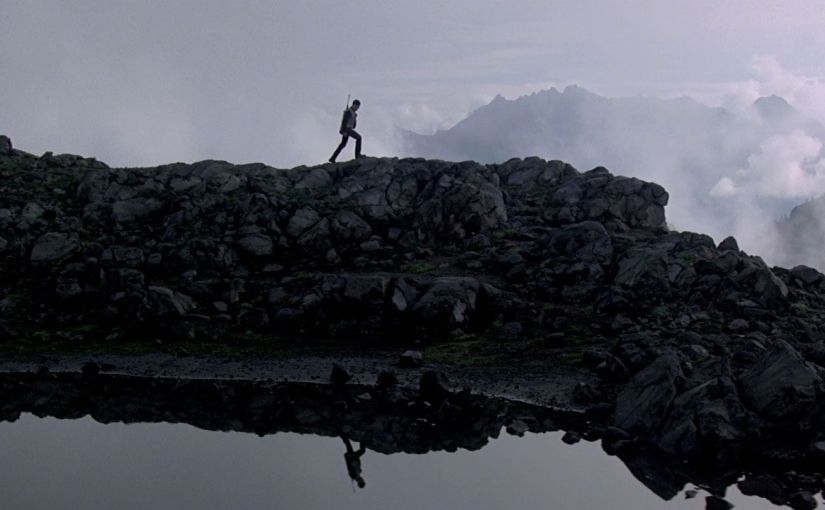
But even after the reception is over, there is one more small-town pit stop to make before the movie gets to Vietnam.  (In fact, The Deer Hunter spends surprisingly little time in Vietnam.)  Michael and a group of friends including Nicky and Stan (John Cazale) go hunting for deer in the mountains as a kind of ritual before Nick, Mike, and Steven are deployed.  It is in this sequence that Oscar-winning cinematographer Vilmos Zsigmond’s talents are put to stunning use.  We are shown vistas of the Allegheny Mountains that are simply breathtaking, with Mike and his friends seen as mere dots in the mountainsides.  Choral music with a men’s choir singing in Russian is heard on the soundtrack, giving the sequence a majestic aura that must be seen and heard to be believed.

Then the hunt is over, and the boys all have one last drunken night at the bar owned by another friend, John (George Dzundza in an under-appreciated, realistic performance).  Here they all sing along to Frankie Valli and listen somberly as John plays a sad classical tune on his piano.  And then, in one of the film’s masterstrokes of editing, we slam-cut immediately to the jungles of Vietnam – no boot camp, no footage of them being trained or flown over there, just suddenly they’re there and the contrast between the carnage we experience in the first few minutes of Vietnam versus the rhythms of their lives in Clairton could not be more extreme.

In a horrific but mercifully brief sequence, we watch as a Viet Cong soldier calmly walks into a burned-out village, discovers a hidden pit holding terrified villagers, and remorselessly tosses a grenade inside.  We then watch as Mike, now a battle-hardened soldier, emerges from a hiding place with a flamethrower and burns the VC soldier alive.

The effect of this scene cannot be understated.  To witness Michael torching a soldier, even after that soldier committed a brutal act himself, is jarring.  And why is it so jarring?  Because we have seen Mike as a civilian, as a friend, as a would-be lover, during that lengthy sequence at the wedding reception and while hunting with his friends.  Admittedly, you got the sense that he could or would get violent if necessary.  (He’s clearly the alpha male of his “clique.”)  But this…I mean, damn.

Then, in one of those Hollywood conveniences that never get old, Mike is unexpectedly reunited with Nick and Steve who just happened to arrive at that very same village with another platoon of US soldiers.  And then, immediately after being reunited, they are captured by enemy forces, imprisoned with several enemy combatants in a riverside compound, and forced by their sadistic keepers to play Russian roulette with each other as the guards bet on the outcome.  Michael comes up with a horrifyingly logical escape plan: convince the guards to put THREE bullets in the chamber instead of one.

Much has been made regarding the historical inaccuracy of this scene.  To those arguments, I say: who cares?  As someone once said, riffing from Mark Twain, “Never let facts get in the way of truth.”  The truth of the matter is, the Vietnam experience was a modern-day horror show, leaving physical and psychic scars on its participants and on our country.  In my opinion, the Russian roulette scene can be interpreted as a symbol of how those soldiers, or ANY soldiers, must have felt every single day.  Going on a routine patrol in the jungle could have potentially lethal circumstances.  They rolled the dice every time they called in an airstrike, betting they didn’t get firebombed themselves.  Booby traps were everywhere.  How is life in a war zone that much different from being given a one-in-six chance at living or dying?

I’ve already gone into far more spoilers than I am accustomed to, so let’s just say this happens and that happens, Michael winds up making it back home, Steven is grievously wounded in the escape attempt, and Nick goes AWOL when, after making it back to a military hospital in Saigon, he wanders the streets at night and discovers an underground ring of lunatics who run a high-stakes game of Russian roulette.  And we’re still just at the mid-point of the film.

When we see Michael back home, the earlier sequences establishing the rhythms of small-town life and his feelings towards Linda, for example, all come into focus.  We need that reception and the hunting scenes so we can see how much Michael has changed.  For example, when Michael is arriving back home by taxi, still in full military dress, he spots a huge banner: “WELCOME HOME MICHAEL”.  He tells the driver to keep going.  In a hotel room later that night, he sits on the edge of his bed and rocks back and forth, winding up crouching against the wall.  He is completely unable to process how to deal with people anymore.  Or, at least, he doesn’t trust what he will or won’t say.  I watch that scene, and I feel such intense sympathy and empathy.  What he’s feeling, what he’s been through, what he’s seen, is so huge that he knows he’ll never be able to explain it to anyone who hasn’t been there.  He knows he’ll get questions like, “What was it like?  Did you kill anyone?  How are you feeling?  Where’s Nicky?”  I’ll never know what it’s like to fight in a war, but if I had gone through what he’d gone through, I wouldn’t have stopped either.

There is a heartbreaking scene where Linda, who is more than a little distraught that Nicky is AWOL, hesitantly suggests to Michael that they go to bed.  “Can’t we just comfort each other?”  Mike rebuffs her, but in a way that makes it clear he’d like to, regardless.  De Niro’s performance here is staggering.  As he walks out, he makes a statement, showcasing how much he is feeling but also how unable he is to articulate it: “I feel a lot of distance, and I feel far away.”  I knew exactly what he was talking about.

The very end of The Deer Hunter is one of the most emotionally shattering finales of any movie I’ve ever seen.  It ends with a simple song, first sung as a solo, then joined by everyone else at the table.  I will not reveal what happens to get us there.  Is it shameless manipulation?  Yes.  Does it work?  Yes, so I can forgive the “shameless” part.

One of the criticisms I’ve read more than once about The Deer Hunter is how “one-sided” it is.  To which I say, “Well, duh.”  The Deer Hunter is not presented as a history lesson or a lecture on the internal politics in the country of Vietnam during the war.  The Deer Hunter is intended to make us feel something.  It wants to show us what happens to a person who is exposed to the very worst side of human behavior and lives to talk about it.  It wants to remind us that a country can wave a flag and stand for what’s right and be willing to sacrifice its best and brightest souls for a righteous cause…but it must also be prepared for the aftermath.  The Deer Hunter is a somber prayer that our country remembers the cost it demands, and that it will take care of its own when the dust settles.
THE BOURNE SUPREMACY, THE BOURNE ULTIMATUM, THE BOURNE LEGACY, JASON BOURNE

By Marc S. Sanders

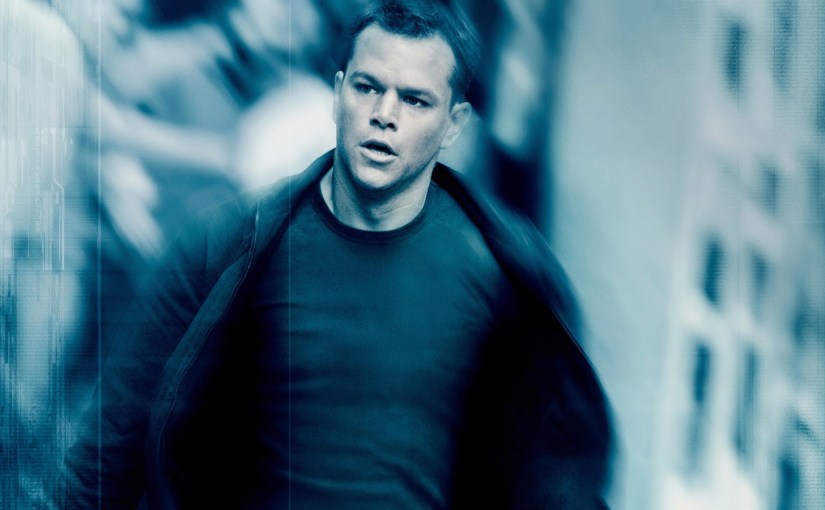
Sometimes the same old thing is all we want, right?  It’s like comfort food.  That’s what the Jason Bourne films offer.  The first time (The Bourne Identity) it is original.  The second time (The Bourne Supremacy) it is familiar.  The third time (The Bourne Ultimatum) it is what we expect.  When you get to the fourth and fifth time (The Bourne Legacy and Jason Bourne), well then perhaps you’ve overstayed your welcome.

The second and third films in the Matt Damon action series function as one long four-hour film.  They are absolutely gripping in high octane, fast cut editing, pulse pounding music from James Newton Howard, and taut direction from Paul Greengrass.  They work because at least two thirds of the material is shown through the eyes of the former assassin Jason Bourne who is trying to learn of his past and who he worked for and why.  Plus, though he may hide deep undercover on the other side of the world in places like populated India, he only resurfaces when he discovers someone is trying to kill him.

The other third of these two pictures function on the other side of the coin with clandestine departments within the CIA who only consider Bourne being alive as a threat to the integrity of their black operations.  He must be eliminated.  There are great acting scenes with Joan Allen first up against an intimidating Brian Cox, and later she’s going toe to toe with David Strathairn.  If you are not part of the chase for Bourne, then you are engrossed in the cause these three supporting players offer with government politics and debate.  With each passing film, it’s an old, grey haired white gentleman in a suit who is insistent on eliminating Bourne and anyone who he associates with.  This started with Chris Cooper in the first film followed by Brian Cox (my favorite) over to David Strathairn.  The baton is then passed to Albert Finney.  A new film moves over to Edward Norton and then Tommy Lee Jones.  Scott Glenn and Stacy Keach are in the recipe too, but they are not as prominent.  All these guys start to look alike and when you watch the films in succession, one after the other, like I recently did, you start to question when this actor and this actor entered the fold.  Best way to describe it is that it is a ladder climb.  There was one guy in charge, then another above him and so on.

The appreciation for the Bourne series comes mostly from its action and the absolute cleverness of its hero.  Jason Bourne functions with ease about staying one step ahead of those trying to kill him.  They think they have a lead on him, but in reality, he has the lead on them.  Do you know how satisfying it is when he calls these people to talk to them and they play dumb? Jason will simply say “If you were in your office right now, then we would be having this conversation face to face.”  Moments like this are what gets an audience to clap and cheer.  The old white guy has been duped.

The action works because, once again I lay claim to the lack of CGI.  So, the overabundance of car chases seems nerve wracking like they are supposed to.  That door on that car is actually getting bashed in.  That taxi cab is really getting t-boned and turning into a 360 tailspin.  Jason can grab a seatbelt, lie down on his side and when the car careens over the barrier onto the landing fifty below, upside down, I’ll believe he gets out with only just a slight limp and a dribble of blood on his brow.  Only Jason Bourne can drag a wrecked rear bumper on a stolen police car through a busy Times Square and bash an SUV into a concrete barrier.

Fight scenes are not just fight scenes in the Bourne films.  It’s not just fists and punches and karate kicks.  Creatively speaking, the films construct their fight scenes to have the hero arm himself with a ball point pen or a magazine that’s wrapped up ready to wallop an opponent in the nose.  I’ll never forget when my colleague Miguel and I saw Ultimatum in the theatres and witnessed Jason punching a book into the face of a dangerous bad guy.  How many times have you seen a guy get punched in the face?  How many times have a seen a guy punch a book into the face of another guy?  There’s a difference. 

Matt Damon has been quoted as saying he believes the Bourne films carried the least amount of dialogue for him to memorize.  Yeah.  That’s likely true.  These films are visual feasts.  They rely on watching Damon move.  They are paced by how he walks, drives a car or tinkers with props.  Even how he listens and observes move with a kinetic progress. 

The locales are spectacular, spanning the globe from India, to Russia, to London, to Morocco, to the Philippines, and on to New York City and Las Vegas.  Following the first film, Paul Greengrass directed three of the next four.  (Writer Tony Gilroy directed the fourth film, The Bourne Legacy with Jeremy Renner taking the lead while Damon’s character was only talked about.) Each film takes every advantage of the atmosphere, using the overpopulated extras as obstacles and means to hide and weave away from the antogonists while on foot, behind a steering wheel or saddled upon a motorcycle.  Greengrass practically invents the concept of putting the viewer so much within the environment, you can almost smell the diesel or the food trucks within the area.  Zoom in overhead shots offer quick glances of the playground and traffic we are engrossed in.  Approximately twenty-five minutes within the center of The Bourne Ultimatum go by with no dialogue as Jason Bourne pursues a bad guy through a labyrinth of apartment tenements and rooftops, while the bad guy pursues actor Julia Stiles.  Finally, when all three catch up to one another, with a leap through a window, do you let out the deep breath you never realized you were holding on to. 

The first three films in the series (Identity, Supremacy and Ultimatum) work as a tight trilogy.  Each film ends with hanging threads to consider and lend to the next film.  By the time Ultimatum concludes, you feel as if all that needed to be told has been covered.  The next two (Legacy and Jason Bourne) function as cash grabs for the studio.  Legacy is entertaining and it boasts a good cast with Jeremy Renner and Rachel Weisz trying to outrun the government adversaries.  It hinges on operating as parallel material that occurs in the prior Damon installment.  While Jason Bourne is being pursued, this is happening over here.  It’s not unwatchable, but it is also truly unnecessary as it doesn’t advance the universe of the series at all.  A thrilling motorcycle chase closes out the film, but it’s a retread of what we’ve seen before.  It gets old quickly.  The film demonstrates that guys like Jason are trained to become dependent on drug enhancements for their highly trained arts of warfare and instinct.  Renner’s character is just another kind of Jason Bourne.  I was more impressed when I thought Jason was just a highly skilled fast learner to all that he’s capable of.  If you tell me blue and green pills lend to what he’s capable of, well then, he’s not much of a superhero in my eyes anymore.

With the final film, Jason Bourne, Greengrass returned to the director’s chair and Damon agreed to come back (paycheck had to be right, I’m sure), though he was significantly greyer and older than his prior films.  It was a weak return.  Just when we think Bourne has learned everything he needed to know and he could now live comfortably underground as a street brawler for bucks, he is informed that his deceased father knew and did some things for these secret agencies that put Jason on this path of special operations.  It doesn’t hold much weight and the payoff is nothing special.  Another car chase occurs in Vegas that appears nearly shot for shot similar to what we already saw in Damon’s prior installments. 

I wrote in an earlier review of The Bourne Identity, that Matt Damon works so well in the role because he’s such an unexpected surprise.  He’s not the muscle guy like Stallone or Schwarzenegger.  He comes off common.  In the first three films, he’s simply a kid.  When you place him in action or see how he gets the drop on a bad guy who is surveilling him, it is so satisfying.  The Bourne films work best with the locales they choose to shoot from.  Bourne will spy on his pursuers from a rooftop building across the street from where they are.  This is inventive filmmaking not just found in the pages of the script.  Paul Greengrass strategically shoots his players.  Director Doug Liman planted the seeds for this series’ potential (The Bourne Identity), very loosely based on the Robert Ludlum novels with creative adaptations from Tony Gilroy, primarily.   Greengrass enhanced the characters and their motivations by use of scenic locales, skillful shaky cameras to make it look like the audience is running at the same pace of Bourne and his adversaries, and quick cut, real time editing.  He applied this approach to his 9/11 film United 93.  The last two films are good even if they seemingly peter out the series, but overall, the four sequels hold up very well. 

If you’re asking, the best of the series is The Bourne Ultimatum, followed very closely by The Bourne Supremacy.  Either way, no matter which film you’re watching, you’re in for a good time when Jason Bourne shows up on the grid.

PIG (2021)

by Miguel E. Rodriguez

Director: Michael Sarnoski
Cast: Nicolas Cage, Alex Wolff, Adam Arkin
My Rating: 9/10
Rotten Tomatometer: 97% Certified Fresh

PLOT: A truffle hunter who lives alone in the Oregon wilderness must venture to urban Portland in search of his beloved foraging pig after she is, I guess, pig-napped.


Gotta tell you, that plot summary is one of the most bizarre summaries I’ve ever typed out.  To me, it’s on par with, “A file clerk working on the 7th-and-a-half floor of an office building discovers a portal that transports you into the brain of John Malkovich for 15 minutes before spitting you onto the side of the Jersey Turnpike.”

Who read the elevator pitch for Pig and thought it was worth filming?  Nicolas Cage himself is credited as one of the producers, so that’s a partial explanation, I guess.  The film has twenty other credited producers and executive producers, so it’s clear the financial burden was spread around.  But still…a movie about a guy looking for his stolen pig?  Is this a movie you should run out and rent/stream/buy?

Yes.  Yes, you should.  Oh, but let me tell you why.

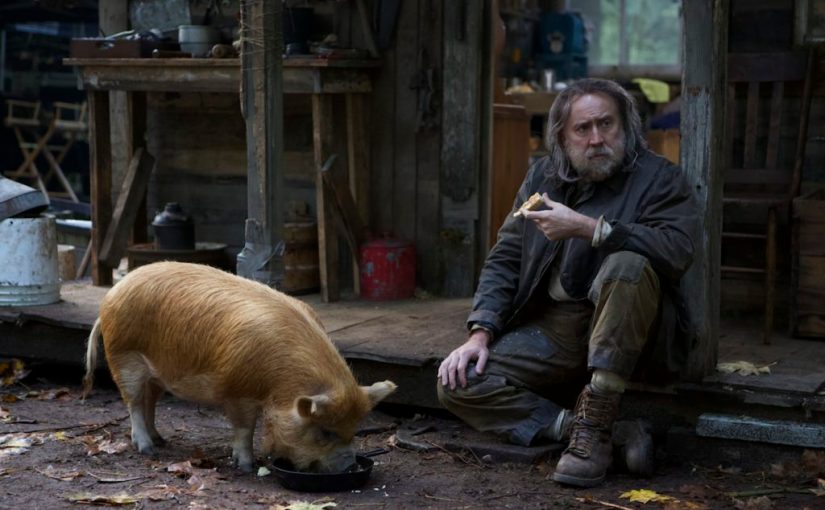
Cage plays a scraggly fellow named Rob who lives in the aforementioned cabin with his pig, whose name is never spoken throughout the movie.  (Although when it was over, I had one or two guesses of my own, each as unlikely as the other.)  This pig excels at finding valuable truffles hidden in the shallow forest soil.  How valuable?  Well, the ones we see in the movie are black, and the current market price for winter black truffles runs from $300 – $1,300 per kilo, depending on the variant.  So…yeah, pretty valuable.  Rob apparently funds his meager existence by selling his truffles to a high-end buyer named Amir (Alex Wolff, Hereditary [2018]), a slick customer who drives a banana-yellow late-model Camaro.  I’m not sure how many Portland restaurateurs can afford Camaros, but it didn’t bother me until this precise moment, so I’ll let it slide.

One night, unknown parties break into Rob’s cabin, beat him up, and steal his pig.  At this point, I was reminded unavoidably of the opening scenes of John Wick (2014), and I thought we were in for another kill-crazy-rampage film like Mandy (2018).  But I was very pleasantly surprised.

It turns out Pig isn’t a revenge movie, or a weird Spike-Jonze-esque journey into absurdity, or a mind-numbing Bergman-esque examination of the human condition.  Ultimately, it’s about food.  Yeah.  Or the transformative properties of food.  Or maybe it’s just about cooking food.  It feels like the kind of movie Anthony Bourdain would have loved, if that’s not being too presumptuous.

Once he gets a line on who the thieves might be, Rob convinces Amir to help him track them down by driving him into the city.  First stop is a sketchy-looking guy who rebuffs Rob’s request for information and asks Amir, “Do you even know his real name?”  That leads to a hidden restaurant under another restaurant where we learn Rob’s full name…a name that brings shock and awe to the eyes and faces of everyone who hears it.  Who is this guy?

One thing I noticed during this film was the great economy of the storytelling.  Scenes that might involve pages of dialogue in other movies are handled in seconds with either terse dialogue or sometimes none at all.  For example, there’s a scene in Amir’s apartment.  Rob wakes up on the couch to the sound of a fire alarm.  The camera tilts up and we see Amir standing on the counter trying to fan smoke away from the alarm.  Cut immediately to a kitchen table, Amir slides a plate in front of Rob, and he says sheepishly, “I don’t cook a lot.”  I can easily imagine that scene in some other movie involving a setup showing Amir trying to cook, burning something, trying to put the fire out, all very comic and probably well-done…but ultimately unnecessary.  Asking the viewer to do the occasional heavy lifting is not the worst thing in the world.  Pig is full of moments like this.  It’s a welcome change when it’s done right.

The screenplay is brilliant in other ways.  It convincingly leads you down one path where you think you can guess what’s about to happen, and then it throws a curveball or neatly sidesteps your expectations.  At least, it did mine.  Rob visits the house where he used to live, where he has a conversation with a small boy.  Where are the parents?  Who knows?  Doesn’t matter.  Amir talks about his family life, about his very successful father who doesn’t believe Amir can cut it in this business.  Later, there’s a scene where Rob and Amir cook a fancy meal for Amir’s father, and the dinner service for that food has a huge emotional payoff I did not expect, and which is worth the price of admission all by itself.

Is Pig a good movie just because it’s unique?  No.  But unique it is, and it is VERY good.  Cage gives one of his most understated performances in forever, so if you have been avoiding this one because you didn’t think you could take more Cage-ian histrionics, you don’t have to worry.  He’s very low-key.  There are a couple of moments where you can see the anger boiling deep within Rob, or when you might expect him to overturn a table or throw a glass of wine in someone’s face.  But it doesn’t happen, and that works for this unexpectedly touching film.

JUDAS AND THE BLACK MESSIAH (2021)

by Miguel E. Rodriguez

Director: Shaka King
Cast: Daniel Kaluuya, LaKeith Stanfield, Jesse Plemons, Martin Sheen
My Rating: 9/10
Rotten Tomatometer: 97% Certified Fresh

PLOT: In the late ‘60s, William O’Neal, offered a plea deal by the FBI, infiltrates the Illinois chapter of the Black Panthers to gather intelligence on party Chairman Fred Hampton.


By the time it was over, Judas and the Black Messiah made me think of that scene in Psycho (1960) where Norman is cleaning up after his mother and the car starts to sink in the swamp and then stops…and Norman gets nervous.  At that moment, I started rooting for Norman, getting in his headspace: “C’mon, car, sink.”  I was empathizing with the bad guy.  Neat trick.

That’s how I felt during Judas and the Black Messiah.  Instinctively, I know I’m supposed to be rooting for one character, but the movie empathizes with the “villain” character so well that I found myself rooting for him, too.

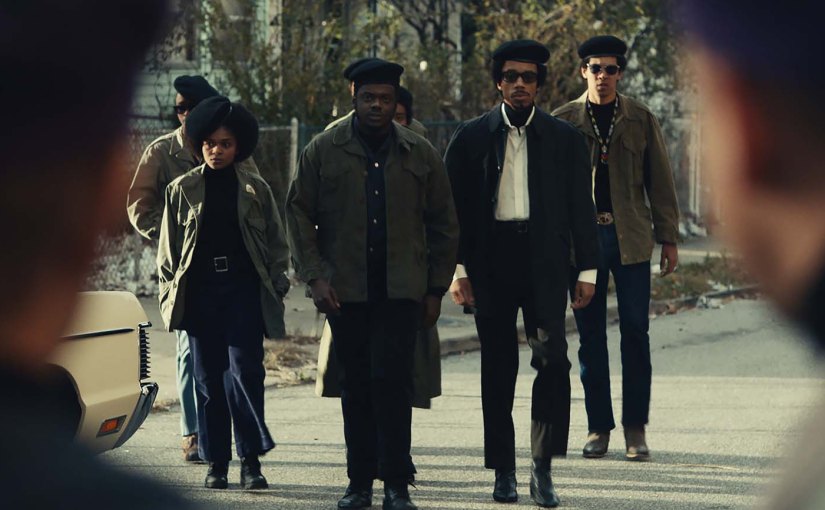
In the late 1960s, Fred Hampton’s star was on the rise in the black community.  As portrayed in a sensational performance by Daniel Kaluuya, Hampton is a fiery, charismatic, passionate public speaker who publicly advocates armed patrols of Black Panthers in black neighborhoods to keep an eye out for harassment from white cops.  When he is made Chairman of the Illinois chapter of the Black Panthers, the FBI takes an interest.  Well…Hoover takes an interest, which pretty much means the FBI followed suit regardless.

Meanwhile, a petty thief named Bill O’Neal (LaKeith Stanfield) is arrested by the FBI, who gives him a choice: serve a 5-year stretch for impersonating an FBI officer, or…go undercover into Fred Hampton’s Black Panther chapter and bring out good intel that will help them arrest Hampton.  O’Neal agrees, and what follows is an exercise in classic cinematic storytelling and misdirection, done up with glossy modern cinematography that looks like the best movie Oliver Stone never made.

(…actually, “misdirection” is not the right word.  I’m not sure what the right word is.  I’ll explain.)

Fred Hampton is clearly meant to be the hero of the film.  Hoover even refers to Hampton as a “messiah” of the black movement.  This all takes place a few years after both Dr. King and Malcolm X had been assassinated.  (If things had turned out differently, Fred Hampton’s name would be synonymous with King and Malcolm X, but it’s not, and based on this movie, that seems distinctly unfortunate and unfair.)  He boldly walks into a local meeting of white supremacists and, incredibly, turns them around to his way of thinking, using a brilliant metaphor of America as a house on fire.  If that moment is not based on fact, it should be.

So, if Hampton is the hero, then O’Neal is clearly meant to be the villain.  Hampton is the messiah of the title, so O’Neal is Judas, the traitor, the informer.  As a direct result of his intel [SPOILER ALERT], the FBI makes several arrests, including Hampton himself, and eventually initiates a raid during which Hampton is killed in his bed with his pregnant wife in the next room.  (This is all a matter of public record, though it’s interesting that it took this movie to really make me aware of it.)

But it’s easy to make a movie with a two-dimensional villain.  Judas and the Black Messiah does something much more difficult.  It asks us to empathize with both Hampton AND O’Neal.  We see the conflict in O’Neal’s face when Hampton promotes him to chief of security for their chapter.  We see O’Neal’s fear when he is recognized by a member of a local gang.  We see how few choices he really has in his various meetings with his FBI handler (Jesse Plemons), who constantly reminds him that, if he runs, they will find him and put him in jail.  Hampton says numerous times in the film that if he were to die for the cause, it would be a life well spent.  O’Neal has no such ideals.  I’d go as far to say that, if that were me in O’Neal’s shoes, I might do the same thing to stay out of jail.  I know my limits.

So, the entire film, I was pulled back and forth between admiration for Hampton and his cause and feeling anger towards O’Neal; and feeling terribly sad for O’Neal and what he’s essentially being forced to do by the FBI.  In other films depicting the Jesus story, I felt no such sympathy for the Judas character.  Director Shaka King accomplishes what so many other films do not: total alignment with one viewpoint while also demonstrating that not everything is so – forgive me – black and white.

Frankly, for me, the movie is worth watching just for the closing epilogue alone.  We get a glimpse of the real Bill O’Neal being interviewed for a real PBS documentary in 1989, and he is asked what he might tell his son about his role in the events surrounding Fred Hampton’s death.  His answer feels like something he’s rehearsed and said all his life.  And then there’s a closing subtitle…and it’s devastating.

I feel like there is more I could say, but it would involve getting into much more detail about several plot points, and I would prefer to leave them for the viewer to discover on their own.  Judas and the Black Messiah is worthy enough to stand with Spike Lee’s Malcolm X (1992), Ava DuVernay’s Selma (2014), and Steve McQueen’s 12 Years a Slave (2013) as one of the best films ever made about the black experience in America.

A MOST VIOLENT YEAR

By Marc S. Sanders

If Michael Corleone had kept his promise to Kay to go strictly legitimate, he’d probably have become Abel Morales, the protagonist of A Most Violent Year, played exceedingly well by underrated Oscar Isaac.

Writer/Director J.C. Chandor sets his story in winter 1981, on record statistically recognized as what the film’s title literary suggests.  Therefore, it is a challenge for Morales to successfully bring his heating oil enterprise to a capital success when his competitors don’t play by the rules and hijack his product while threatening his able staff of truckers and salespeople. Then there is the stigma Morales must endure by being married to a reputed mob boss’ daughter, searingly played by Jessica Chastain, ready at a moment’s notice to call on her own family for help or to just pull a trigger herself.  Morales tried his hardest to keep her in check.  Furthermore, the industry he’s chosen is riddled with suspicion of fraud, embezzlement, racketeering, and underhanded tricks. All this warrants the DA to bring an endless array of indictments against Morales and his business, despite all the cooperation and legal activities that have been accomplished so far.

So why go through with this at all?  A lifetime has been invested.  Time of money and work to fight for an opportunity.  Abel knows this more than anything, and he will not surrender to deals from the DA or the mob.  He will not compromise despite the challenges.

Chandor’s film is well done.  It had been on my radar to watch since its release and yet it was not what I expected.  I was waiting for Abel’s widely seen beautiful camel overcoat to end up soaked in blood.  It never came to be.  That observation only suggests that A Most Violent Year does not promise on its descriptiveness.  On the contrary, it offers the setting so that we understand Abel’s conflict.  

A good story piles on one problem after another to keep a viewer compelled. Maybe one primary problem is wrapped up a little too neatly here, but no matter.  I also would have preferred better camera positioning from Chandor on occasion. Some characters who are being introduced for the first time are heard speaking off camera only to then be shown a close up of them with no more to say.  Happened more than twice and I can’t understand why.  I’m sure Chandor artistically intended it to be that way.  Yet, I didn’t like it.

Oscar Isaac and Jessica Chastain are great.  These are two actors rarely seen in the gossip rags.  So, they are more well known for selecting smart roles and stretching their flexibility for the parts they agree to take.  It’s refreshing. It’s why A Most Violent Year can be capably made with a great script (better than the film) amid all of the tentpole blockbuster sequels.  

It’s worth it to check out.

SKYSCRAPER

By Marc S. Sanders

Dwayne “The Rock” Johnson helms a film stuffed with beefcake, gusto, an artificial leg, and LOTS OF DUCT TAPE. Even his world-famous chest tattoo makes a cameo.

Skyscraper is his latest action piece, and it makes no bones about how absurd its set pieces and stunts are.  This is a self-aware picture; self-aware of all its UN-likelihood.  It has to be.  

The writer of this piece, that is not a Die Hard ripoff, is Rawson Marshall Thurber (rolls off the tongue like Spielberg, Coppola and Scorsese) is also the director.  I can almost promise this guy wrote this script in airport terminals and secluded library corners with his iPad knowing how out of control this hostage/burning building film would be and just laughed hysterically, like a mad scientist, as he typed.  Heck, he probably took his old GI Joes out of the shoe box and used them to storyboard on the tall oak tree in his backyard.  This guy should be given all jobs first considered for Michael Bay.  He knows the audience will roll their eyes at everything they are seeing, and he goes even crazier with the next set piece.  

MILD SPOILER ALERT IF YOU HAVE NOT SEEN THE TRAILERS:

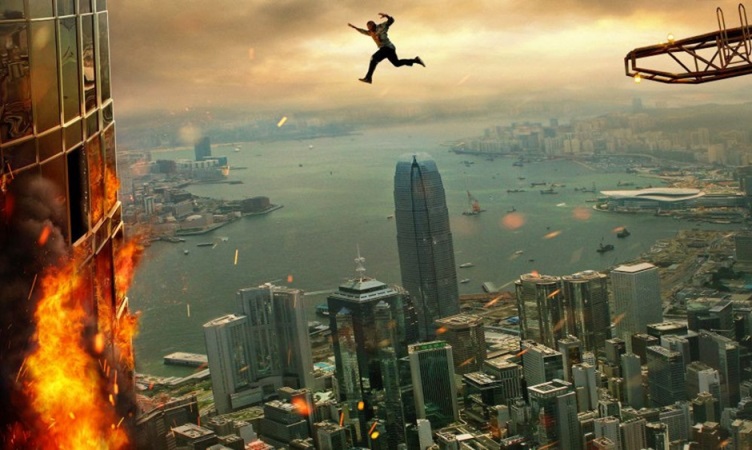
It’s not enough that Johnson, with an artificial leg, can climb a sky high crane while a skyscraper (hence the title) blazes to pieces next to him.  He then makes a ridiculous leap from said crane to said skyscraper through a broken window.  What?!?!? It could happen!!!!! Same as you can put sticky duct tape on your hands and shoes, and climb the outside of the building with the same artificial leg, like Spider-Man.

So, what do you think reader? Did I like Skyscraper?  You bet I did.  The edits are sharp.  I know The Rock isn’t going to perish, but when his hand slips from a ledge, you bet I jumped.  I laughed with such glee at each moment of ridiculous suspense. I loved the badassery of Neve Campbell playing the reverse of a distressed damsel wife to Johnson.  

On top of all that, this skyscraper, located in Hong Kong, and reportedly 5 times the size of the Empire State Building, is a gargantuan setting of the best technology.  Known as The Pearl, this is one super cool building of over 220 floors plus a fun house hall of mirrors dome at the top.  How that dome helps the world or even just the building beats the hell outta me.  It’s just amazingly cool and that’s why it’s there. 

So yes!!!!  Go see Skyscraper. Throw your logic and snobby intolerance for the absurd off the roof and have a great time at the movies.

MOLLY’S GAME

By Marc S. Sanders

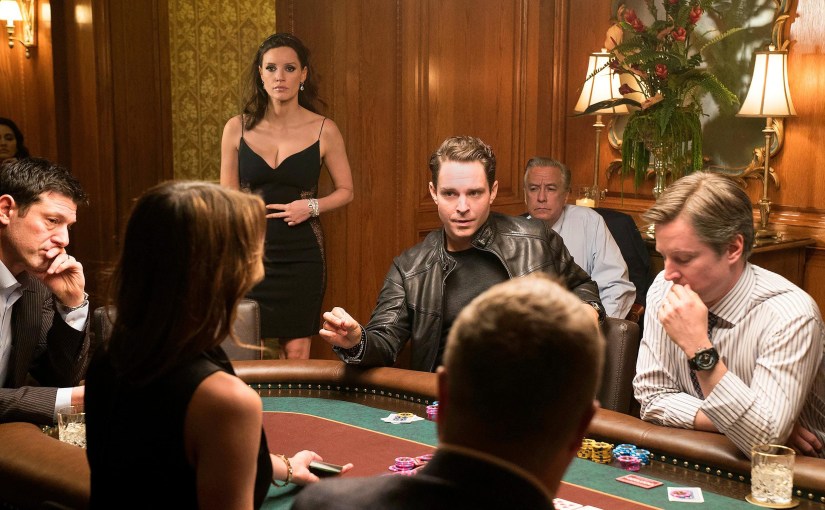
Despite being a little distracted by a drunk patron sitting next to me, I thought Molly’s Game was very good. It doesn’t measure up to The Social Network, and I feel justified in comparing the two because the sharp, fast dialogue follows what appears to be an intentionally similar narrative from writer, and here director, Aaron Sorkin.

Sorkin in his directorial debut uses great techniques for film editing to match the beats of his dialogue.  His opening voiceover of Jessica Chastain as Molly describing the ultimate worst sports experience will get your heartbeat racing.  It draws you into the film right away.

Chastain is good, but maybe a little over the top.  I needed a little more convincing that she was actually this brilliant, inventive and resourceful woman who was also considered one of the world’s greatest skiers.  Can’t put my finger on it but something was missing with her playing the Molly Bloom role.  Was she really holding her own against these high stakes guys who take big risks in her personally constructed poker ring?  I’m just not sure.

Felt the same about Kevin Costner in the role of her father.  He’s supposed to be an incredibly brilliant psychologist and an intimidating patriarch.  Yet Costner doesn’t fit that mold for me here.  Couldn’t feel the pressure from Dad on his daughter.  Someone else might have been stronger.

Michael Cera too.  I think he is playing a combination variation of Tobey Maguire & Leonardo DiCaprio, two of the most famous celebs that participated in the real Molly Bloom’s underground poker games, but Michael Cera?  Really?  He doesn’t carry the weight or looks of guys like that.  There just was not enough power or presence from him.

None of these actors were the worst options for this cast, I just think the film could have used more appropriate performers. There was more appropriate talent out there, I’m sure.

Idris Elba is great, however.  He’s blessed with an awesome Sorkin monologue in the 3rd act of the film, and he hits every note.

A great script.  A great story worthy of being a big screen film and it’s got me interested to learn more about the real Molly Bloom, including reading her novel.

SOLO: A STAR WARS STORY

By Marc S. Sanders

To those who naysayed this standalone installment in the galaxy far, far away, all I say is you are trying too hard to be pleased.  Shut up and have some fun, will ya?

Solo: A Star Wars Story presents a film that stands on its own, relying on mysterious legendary side stories only talked briefly about for the last fortysomething years like the Kessel Run, Sabaac card games, dice and the origin of how Chewbacca met everyone’s favorite space smuggler, Han Solo, plus the Millennium Falcon and the scoundrel Lando Calrissian.  

My brother and even a few friends of mine (Joe Pauly) grew up loving John Wayne’s films. No one else epitomized a Hollywood western better than The Duke.  He was their childhood hero.  For me, it is the generation after that which introduced the space cowboy Han Solo played by Harrison Ford.  He is not anywhere near a multi-dimensional character; pretty one note if you ask me (which ironically is opposite of what I demand in any kind of storytelling these days).  

Captain Solo was the guy who would make it up as he goes; never planning ahead or considering others beyond his trusted furry partner and his beloved spaceship.  He’d poorly talk his way out of trapped situations and when that didn’t work, he was a fast draw with his blaster.  

The screenwriters for Solo, legendary Lawrence Kasdan with his son Jonathan, were all aware of Han’s placement in this space opera, while constructing this film.  Only this time they intended on showing how that devil may care came about. It reminded me of a similar approach writer Paul Haggis took with the reinvention of James Bond in Casino Royale.    A lone hero trusts very little beyond his own arrogance and self-assurance.  The Kasdsans used that technique as the spine for this story and it works.

Director Ron Howard is the right guy to fill in following a notorious director incident beforehand.  Howard keeps the film moving fast with casualties you might not expect to perish, revealing masks (an under looked theme of the original films), traitors, fast ships, fast cars, and their pursuits and chases.  A favorite scene, saluting the Western, is a thrilling train robbery across a snowy mountain that seamlessly changes its angle and vector at times.  It’s as awesome a scene as it promised in the trailers.  

Howard is best at keeping the film grounded in actors rather than tired CGI cartoons.  He definitely makes Han, Lando and the rest look convincing trying to steer a ship or carry a blaster and play cards.

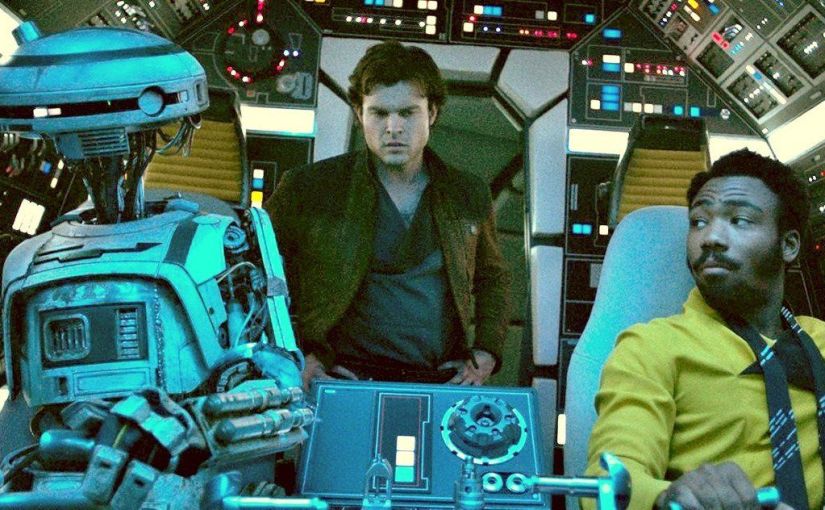
The cast is great.  Alden Ehrenreich is fine in the role; young, cocky, brash, handsome.  I wasn’t looking for him to do a Harrison Ford impersonation.  That would only look like a 12:45 am Saturday Night Live skit. The guy had to do his own thing, not someone else’s much like the Batman and Bond films have done before.  Donald Glover is perfect as Lando, even adopting Billy Dee Williams own way of pronunciation (“Han” vs Ha-an”).  Still, he makes the part his own.  He’s fun to watch.  Beyond some mild makeup scarring, Paul Bettany makes for a really uncomfortable crime lord, like a suave Miami Vice drug kingpin, and Woody Harrelson is just right in the inspirational pirate role; gruff and tough and educating.  Emilia Clarke is finally directed properly in a film.  (I still haven’t forgotten her awful Terminator: Genisys Sarah Conner portrayal.). She is dangerously sexy, but smarmy and cocky like Carrie Fisher was.  She’s a great femme fatale of the 1940s beautifully incorporated into some very thick sci fi.  

This was such a fun time at the movies.  Go ahead.  Accuse me of my bias, but as well shouldn’t I be expected to be a tough demanding critic of all new Star Wars material?  I’d probably be wanting it to match the magic of the original trilogy.  Well no.  I don’t want it that way.  I want new and fresh ideas, while still recognizing George Lucas’ used universe settings.  Disney and Lucasfilm continue to move along, stretching their imagination in monies well spent while also following the rules of smart aleck characters, film western motifs, Eastern cultures and death-defying cliffhangers.  Had the Star Wars franchise remained with Fox, audiences would not be getting the treats we’ve been blessed with for these last 10 years.

Solo really only has two minor misfires.  The droid L3, Lando’s Co-pilot, does not live up to Anthony Daniels nor Alan Tudyk and their high brow robot attitudes.  Why? Because it’s hard to understand what L3 is truly saying.  The lines are garbled at times; drowned out by the robot dialect I guess, and maybe also by a mostly origninal score.

As well, there is one ending moment that’s eye opening, but puzzling with little demand for it.  It was one surprise that did not seem to be well thought out and considering this is a stand alone film, it left me unsure of what Lucasfilm hoped to gain from it.  The moment was too distracting for me.  Yet it’s in there and it’s not the worst offense.  Just very very unnecessary and perplexing.

Solo: A Star Wars Story is none other than great fun with something to think about.   I was laughing out loud.  The audience we were with was clapping and cheering.  That’s why Star Wars films continue to thrive.  Their audiences get caught up in the ride, especially when the films are relatable while not taking themselves too seriously.