ASHES AND DIAMONDS (Poland, 1958)

by Miguel E. Rodriguez

DIRECTOR: Andrzej Wajda
CAST: Zbigniew Cybulski, Ewa Krzyzewska, Waclaw Zastrzezynski
MY RATING: 7/10
ROTTEN TOMATOMETER: 96% Fresh

PLOT: Against a backdrop of internal political turmoil at the end of World War II, a Polish resistance fighter faces a crisis of conscience when ordered to assassinate a Soviet official.


The Polish film Ashes and Diamonds is reportedly Francis Ford Coppola’s favorite movie, and Martin Scorsese has stated in interviews that he used it as an answer for one of his finals at film school.  From a technical standpoint, I can see why.  Echoes of this film (and perhaps others from director Andrzej Wajda’s filmography) are overwhelmingly evident in the bodies of work of both directors, from the mobile camera to the shocking moments of violence to the psychological makeup of the characters themselves.  As an emotional experience, I confess I didn’t get “worked up” over it, but it was interesting to see where two of the greatest American film directors got a healthy dose of inspiration.

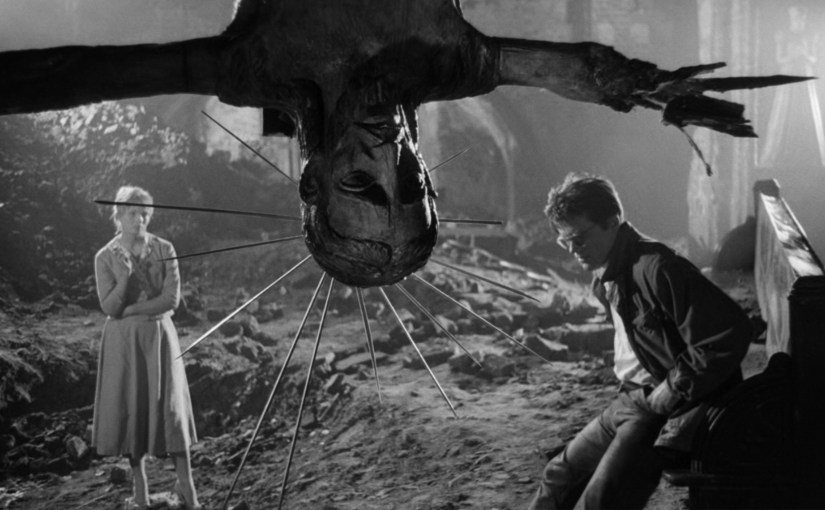
Ashes and Diamonds opens on May 8, 1945, with an idyllic scene outside a country church that quickly degenerates into a brutal double murder.  The killers are the calm, detached Andrzej and the flighty, charismatic Maciek, who spends most of the movie behind dark sunglasses.  We quickly learn their victims are not who they thought they would be.  Instead of killing two Soviet/Communist officials, they have killed two innocent factory workers.  War is hell.

Later, through circumstances that feel very Hitchcockian, Andrzej and Maciek hole up in a hotel bar, only to discover that one of their real targets, Szczuka, has booked a room in the very same hotel.  Maciek books a room directly below Szczuka’s, and the rest of the film plays out with that element of suspense hanging in the background, leaving us to wonder when and how Maciek will complete his assignment.

Complications arise when Maciek becomes infatuated with the hotel bartender, Krystyna, a blond beauty who rebuffs Maciek’s advances at first.  Later, they connect, but she doesn’t want to get involved with someone when it will eventually have to end: “I don’t want bad memories when memories are all I have left.”  Maciek falls for her so hard that he starts to doubt his resolve to kill his target.  “Will he or won’t he?” becomes the movie’s prime conflict.

Where to begin with the comparisons to Coppola and Scorsese?  The most obvious one is the unblinking attitude towards violence.  The two killings at the beginning of the film are done with very few cutaways as we see the multiple bullet hits on each victim, with one of them getting hit in the eye and another shot in the back at point blank range with such force his shirt catches fire.  (Malfunctioning squib?  Possibly, but it’s still effective.)  It’s interesting that this movie predates Bonnie and Clyde (1967) by almost a decade, but its depiction of onscreen violence feels very modern, even by today’s standards.

Then you’ve got the moral struggle of the main character, a man of action capable of casual murder who is suddenly given a reason to make something different with his life.  This reminded me of Scorsese’s The Departed (2006), with DiCaprio’s character undergoing the same internal conflict.  Maciek has multiple opportunities to kill Szczuka throughout the film, but something always pulls him back from the brink.  His partner, Andrzej, becomes impatient and reminds him what happens when soldiers let personal feelings interfere with their duties.  I had a vivid flashback of Michael Corleone’s credo: “It’s not personal, Sonny.  It’s just business.”

(I also felt that the dynamic between Maciek and his more level-headed partner Andrzej were evoked in Scorsese’s Mean Streets [1973], with De Niro’s Johnny Boy and his more level-headed partner Charlie, played by Harvey Keitel.)

But, cinematic comparisons aside, I didn’t find Ashes and Diamonds to be as gripping as other war or crime dramas of that era, such as Elevator to the Gallows, Touch of Evil (both 1958), or Rififi (1955), to name a few.  It’s a little weird to me, because all the pieces are there for a first-rate thriller.  I’m not asking that every drama pack the exact same kind of emotional gut punch every single time because I know that’s unrealistic.  But the fact remains: Ashes and Diamonds, while clearly very influential on future filmmakers, did not get me as involved as I would like to have been.  I was never bored, but neither was I over the moon.  It was…average.  Perhaps one day I’ll watch it again with a fresh eye to maybe see what I missed the first time around.

WINGS (1927)

by Miguel E. Rodriguez

DIRECTOR: William A. Wellman
CAST: Clara Bow, Charles ‘Buddy’ Rogers, Richard Arlen, Gary Cooper
MY RATING: 10/10
ROTTEN TOMATOMETER: 94% Certified Fresh

PLOT: Two young men, one rich, one middle class, who are in love with the same woman, become fighter pilots in World War I.


Not long ago, I purchased a copy of the 1927 classic Wings, based mostly on the favorable review by my friend and colleague, Marc Sanders.  I was more or less aware of its place in cinema history: the very first winner of the Best Picture Oscar, essentially the birthplace of Gary Cooper’s career (despite appearing in the film for just over 2 minutes), legendary aerial footage, and so on.  But I never felt compelled to seek it out.

Having finally watched it, I am very glad I did, and you should, too.  Wings is pure entertainment from start to finish.  Unexpectedly engrossing, captivating, thrilling, the whole enchilada.  High melodrama, comedy (borderline slapstick, what are you gonna do, it was 1927), romance, comic misunderstandings – and some not-so-comic – and eye-popping aerial footage, true to its reputation.  A neat camera move gliding over several cabaret tables even showcases director William A. Wellman’s desire to push the boundaries of what was possible with the massive cameras of his day.  I once wrote that Sunrise (1927) was my favorite silent film of all time.  If I ever make another 100-Favorite-Films list, Wings and Sunrise are going to have to duke it out…

Wings sets a surprisingly modern tone from the start.  In the very first sequences of the film, Jack Powell (Charles ‘Buddy’ Rogers) does not “ham it up” like some of the more typical Hollywood actors of that era.  Obviously, his mannerisms are exaggerated, but there is a restraint to his face and body that seems at odds (in a good way) with nearly everyone else in the film…except Gary Cooper, who, if he underplayed his role any further, would have become a still painting.  That restraint is also evident in Jack’s foil/nemesis, David Armstrong (Richard Arlen), the rich aristocrat to contrast Jack’s more humble background.  This moderation lends a very contemporary feel to a movie that’s nearly a century old – quite a feat.

In sharp contrast to the two male leads, the fabled Clara Bow plays her role, Mary Preston, with complete abandon.  She never truly overacts, exactly, but she throws herself into her supporting role with abandon.  Mary is hopelessly infatuated with Jack, who is actually in love with the debonair Sylvia Lewis (Jobyna Ralston), who is already involved with David, though they haven’t made anything official.  (If Facebook had been a thing back then, their relationship status would have been “It’s Complicated”.)  So, when Jack makes eyes at Sylvia, poor Mary is in the background as her hopeful smile deteriorates into sobs.  She may not be subtle, but Clara Bow makes sure you know EXACTLY what is on Mary’s mind at any given moment.

In the middle of this would-be soap opera, World War I intervenes.  Jack and David both enlist to become aviators.  A crucial scene shows Jack asking for Sylvia’s picture to keep as a good luck charm, a picture that has already been signed over to David.  Then, as he says his farewells to the lovelorn Mary, she offers him her picture.  How this scene plays out, and how it comes to bear much later, is one of the high points of the film’s ground-based drama.

But the real marquee attraction Wings comes during the aerial training and combat scenes.  Watching this movie, you understand why modern filmmakers today strive for realism as much as possible.  Ron Howard wanted to show weightless environments for Apollo 13, so sets were constructed inside a military jet tanker that flew parabolic arcs to simulate weightlessness…for real.  The makers of Top Gun: Maverick wanted to draw audiences into the film, so they had their actors train for weeks and months so they could be filmed inside the actual cockpits of F-18 fighters as they performed simulated combat maneuvers…for real.  Those filmmakers knew what had already been demonstrated decades earlier by Wings: nothing beats reality.

(Almost nothing…Ready Player One was pretty damn cool…BUT I DIGRESS…)

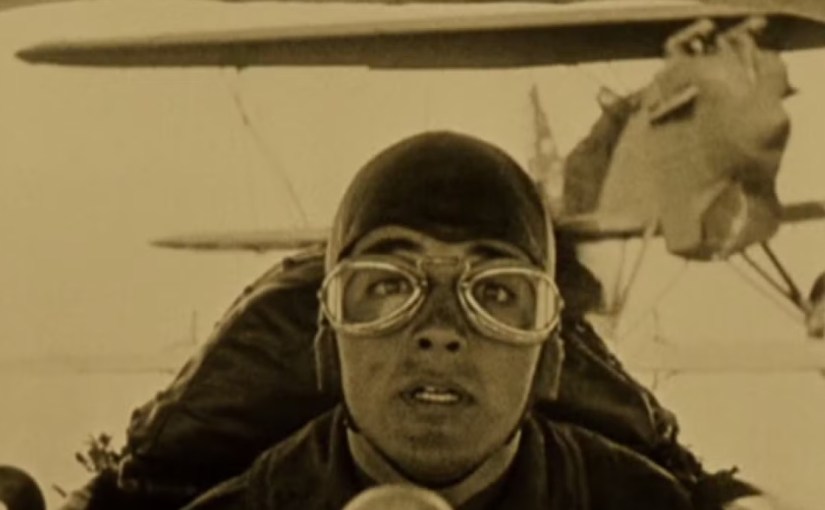
For Wings, director Wellman, a combat pilot himself during the war, knew that the best way to grab the audience by the lapels would be to get his actors up in the air for real.  To put it very briefly, he got his two lead actors to become certified pilots, got them into the air with small cameras strapped to the front of their planes, and had them act, fly their own planes, and be their own camera operators, all at the same time, while other stunt pilots flew around them, sometimes in VERY close quarters, simulating aerial combat.

The results are staggering.  There is a visceral mojo to these scenes that cannot be overstated.  Sure, it looks “old” because it’s black and white and grainy, but it is also undeniably real, and when you see long shots of a biplane going into a death spiral after being shot out of the sky, your intellect tells you there’s a real pilot flying a real plane hurtling at high speed towards the real ground, and you either sit back in awe or you lean forward with excitement.  There are a few scenes where real planes crash to the ground in various ways; one of them crashes into the side of a freaking HOUSE…for REAL.  IMDb mentions one staged crash where the plane didn’t do exactly what it was SUPPOSED to do, and the stunt pilot literally broke his neck…but survived and returned to his job six weeks later.  And it was all done in camera with no trickery or fake dummies in the cockpit.  It is literally mindboggling.

However, it should be noted that these accomplishments by themselves would mean very little if they weren’t hitched to a compelling story.  The love story among Jack, David, and Mary is a constant thread through the whole film.  Mary, having volunteered as an ambulance driver in the Army, miraculously finds herself stationed overseas…right next to Jack and David’s unit, wouldn’t you know it!  Contrivances aside, Wings expertly balances the exciting elements with the melodramatic flourishes.  The melodrama comes to a head when Mary finds herself alone in a hotel room with Jack, who is so drunk on champagne he doesn’t recognize her.  (She is dressed as a cabaret dancer, but that’s a long story…)  This movie truly contains the best of both worlds, genre-wise.

This might be crass of me to mention, but I’m going to anyway…Wings is also notable for some of the earliest on-screen nudity (in an AMERICAN film, anyway) that I can recall seeing.  There is a scene in a recruitment office where a line of bare male bums are lined up in the background, awaiting health inspection.  Then later, we see a woman’s bare breasts…just a brief glimpse, but it’s there.  Not only THAT, but during a fancy camera move in a French cabaret, we see a woman caressing another woman’s face…are they a couple?  Scandalous!  Who needs the Hays Code?  Not this guy!

(I could also mention the homo-erotic overtones during a pivotal scene towards the end of the film, but they pretty much speak for themselves [like the volleyball scene in Top Gun], so I’m just gonna move on…)

To sum up: Wings ranks as one of the greatest pure entertainments that Hollywood has ever served up.  Marc mentioned that it perhaps doesn’t get the love it deserves.  He’s probably right.  I’m sure it’s revered among cinephiles, but it is certainly not in the general public consciousness when it comes to silent films.  Regardless, it is exceptionally well-made and uncommonly effective.  If ever an old film deserved to be rediscovered by the general public, Wings is it.

THE BOYS IN COMPANY C (1978)

by Miguel E. Rodriguez

DIRECTOR: Sidney J. Furie
CAST: Stan Shaw, Andrew Stevens, James Canning, Michael Lembeck, Craig Wasson, Noble Willingham, R. Lee Ermey
MY RATING: 9/10
ROTTEN TOMATOMETER: [no score]

PLOT: In 1967, five young men undergo Marine boot camp training before being shipped out to Vietnam. Once they get there, the experience proves worse than they could have imagined.

[This review contains MILD SPOILERS concerning the film’s finale.]


I remember a short while ago, when I watched the original The Taking of Pelham One Two Three (1974) for the very first time.  I remember asking myself, “Why did it take me so long to finally watch this movie?  It’s fantastic!”

I’ve just had the same exact experience after watching Sidney J. Furie’s The Boys in Company C, which I think (someone correct me if I’m wrong) is the first attempt by Hollywood to provide a genuinely realistic portrayal of being a combat soldier during the Vietnam War.  There are some obvious parallels to Kubrick’s Full Metal Jacket (1987) and Fuller’s The Big Red One (1980), but this one was first out of the gate.  Company C is just as visceral, just as riveting, and just as entertaining to watch as those other films.  I have only seen a handful of Furie’s other films (including Iron Eagle [1986] and Superman IV: The Quest for Peace [1987]), so I can’t make a 100% informed opinion, but in my limited experience, this is far and away his masterpiece.  It goes on the list of my favorite war movies ever made, and I think it’s a real shame that it appears to have been nearly forgotten.

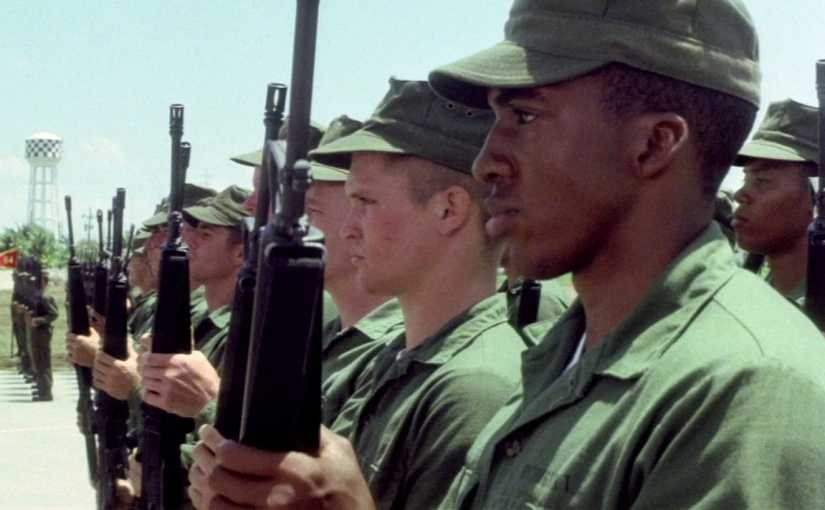
Like so many other war films that came after it, The Boys in Company C begins at boot camp.  More properly, it begins right outside the recruitment center (I think?) in late 1967, as several young men – boys, really – kiss their loved ones goodbye before getting on a bus.  In a weird way, this sequence reminded me of the opening scene in The Breakfast Club (1985) as each student is dropped off for detention by their parents (except for Bender, of course).  We are introduced to the boys who will become the key players: Washington, the angry black man (Stan Shaw); Pike, the country boy (Andrew Stevens); Foster, the aspiring writer (James Canning); Fazio, the Italian American from Brooklyn (Michael Lembeck); and Bisbee, the pacifist who is put on the bus in handcuffs (Craig Wasson).  Stereotypes?  Sure, I guess.  But the screenplay doesn’t limit them to JUST their stereotypes.  Washington, for example, starts out in camp as a guy who is looking out for himself, but after a surprisingly passionate speech from his drill instructor (R. Lee Ermey in his film debut!), he assumes the mantle of leadership and wears it exceedingly well.

We get the by-now standard scenes of the recruits getting their heads shaved, struggling through exhausting training runs, being called names that would’ve made George Carlin blush, and, eventually, graduation, where their reward for making it through boot camp is being assigned to combat duty in the ‘Nam.  Their problems begin even before they disembark from their troop carrier when the Vietnamese port comes under artillery fire.  It all sort of goes downhill from there.

The movie so far is nothing incredibly new, at least not to someone watching in the present day, but I had to keep reminding myself that this was probably the first time American audiences had seen a relatively honest representation of combat that wasn’t filtered through layers of self-censorship and jingoism.  M*A*S*H (1970) did show us the bloody reality of surgery in the field, but it didn’t concern itself too much with actual combat – plus it was set in Korea, not Vietnam.  A minor quibble.

There are a LOT of plot details I won’t relate here – the clueless captain, the “vital” convoy, Washington’s drug trafficking plans – because of the soccer subplot that reveals itself to be the film’s beating heart and real cry of protest.  Much like Kilgore and the California surfer in Apocalypse Now (1979), the squad captain learns that Pike, the country boy, is pretty good with a soccer ball.  There is a squad of elite Vietnamese military men who are also good at soccer.  The captain dreams up a plan: put together a soccer team of American soldiers who will play the Vietnamese men in an exhibition match.  If the American team wins, they will get a reprieve from combat and go on a “goodwill” tour of southeast Asia, including Tokyo and Bangkok.

Sounds good, right?  But complications arise when, at the match, the American general watching the match is approached by his opposite number in the Vietnamese army.  With the Americans leading at the half, the order is passed to the team: lose the match so the Vietnamese can save face in front of their own people.  If they throw the match, they will still get reprieved from combat to go play mare matches against Vietnamese teams…and lose every time.

The Americans can’t believe it.  Pike (and everyone else) wants to get back home, but he is afraid he can’t live with the shame of intentionally throwing a match, no matter what the big picture looks like.  But the orders contain no ambiguity.  Throw the match and go on tour, or win and go back to frontline combat the next day.

This is what the movie has been driving towards the whole time.  The squad has to collectively decide what is more important: winning or surviving.  I hope I don’t come off like an amateur historian here, but to me, that is the same question that could have been asked about the entire Vietnam conflict.  As a country, we had a chance to ask ourselves: is winning this war worth the price we’re paying?  How much more are we willing to spend, in money and lives?  In the film, the squad is asked to balance that equation themselves on a smaller, but no less important, scale.

Is this about honor?  Should they win the match to preserve their own personal integrity, even if it means going back to fighting in the jungle and maybe never making it back home?  Or should they throw the match, increasing their odds of making it home alive and boosting morale for their Vietnamese allies, but leaving them with a stain on their integrity?  Is this kind of thinking the reason the American government participated in possibly the most unpopular war in American history?  Because losing face was worse than losing lives?

These are questions I would not presume to think I could answer.  I know, of course, what I would have done in that situation, but I can only speculate because I have never been a soldier in a time of war.  The Boys in Company C put me right there and allowed me to understand the whys and wherefores of each major character in a way that we’ve seen in every notable war film ever since.  This is an incredibly important artifact in the history of war films, and it deserves to be seen by every movie fan.

[Trivia note: this movie was executive produced by none other than Raymond Chow, the man behind Enter the Dragon (1973) and nearly 200 other Hong Kong films, and virtually the entire movie, including the boot camp sequences, was filmed in the Philippines.]