TRON: ARES (2025)

by Miguel E. Rodriguez

DIRECTOR: Joachim Rønning
CAST: Jared Leto, Greta Lee, Jeff Bridges, Evan Peters, Jodie Turner-Smith, Gillian Anderson
MY RATING: 8/10
ROTTEN TOMATOMETER: 56%

PLOT: A highly sophisticated AI program goes rogue against its programmers to defend a scientist who may hold the key to something called “permanence.”


For those who are not fans of the original Tron (1982) or its high-tech sequel Tron: Legacy (2010), let’s clear the air right away: Tron: Ares is not likely to convert you.  Period.  I see you and I understand you.  No hard feelings.  Heck, I’m a fan of both movies, and I heard the terrible advance buzz for Ares and saw the low ratings on Rotten Tomatoes and IMDb and thought, well, the franchise had a good run.  If it’s gonna suck, it might as well suck on the biggest screen I can find, in Dolby 3D, sixth-row center, to make the most of that Nine Inch Nails soundtrack/score and the slick CGI.

And…I gotta be honest.  Tron: Ares surprised me.  Admittedly, my opinion may be slightly influenced by the Dolby sound system that turned the synth- and bass-heavy score into a near-religious experience.  But Ares seems to have learned from the mistakes of its predecessors (earlier builds?), even going back to the original film.

First, the story is not nearly as cluttered as Tron: Legacy.  The first sequel threw in metaphysical content about spontaneously generated AI programs (the so-called ISOs), long conversations about the responsibilities of a creator/father to his creation/children, and duplicitous club owners (yep), and so on.  Tron: Ares, by comparison, is as straightforward as they come.  A MacGuffin is established early, as are the ground rules for how and why computer programs can exist as tangible entities in the real world, the bad guys are clearly identified (not all of them are in red), and once the pieces are set in motion, the movie only pauses the action when absolutely necessary.  It’s not Shakespeare, but it’s efficient.

Second, Tron: Ares makes a significant departure by moving the story between the “grid” and the real world multiple times.  The first two films, as you may remember, started with an expositional prologue in the real world, after which the hero is zapped into the grid for most of the rest of the film.  Ares starts in the grid, moves to the real world, gets its human hero into the grid, gets her AND Ares back out, then goes back into the grid again, and so on.  It introduced a rhythm that was missing from the first two films, and it broke up the visual palette so that neither one became boring.  Pretty slick.

Third…and this is something I just wrote about Brian Blessed’s character in Flash Gordon (1980)…Tron: Ares reintroduces an element from the first film that was virtually absent from the second film: a sense of fun.  It doesn’t introduce a wise-ass Kevin Flynn character or anything like that, but Jared Leto as Ares is given some genuinely funny dialogue that brought some much-needed laughs to the film.  Particularly when it comes to his preference for ‘80s synth-pop with catchy hooks.  Note: I’m not claiming it’s a laugh riot.  But the humor is very welcome when it arrives.

Another big factor in this movie’s favor is the huge Easter Egg that has not even been hinted at in the trailers, and thank God for that.  No, I’m not talking about the presence of Jeff Bridges, smart guy.  It’s so big (in my opinion) that the less said about it the better.  But I’m here to tell you, I haven’t geeked out that much in a movie theater since Ready Player One (2018).  Moving on…

And the score…!  I learned that Disney apparently insisted that the score be credited to “Nine Inch Nails” instead of “Trent Reznor and Atticus Ross.”  Good choice.  Their booming bass and synthesized soundscapes are the equal to the other two films in every way, if not superior.  (And I LOVED the Daft Punk music from Legacy.)  There’s even a song or two with vocals from Reznor!  What?!  Not content with nostalgia bombing us with random easter eggs from 40 years ago, Ares throws in a musical bomb from 30 years ago.  And it really, really fits the story.  Hand to God.

Overall, there is a nostalgic sheen to Tron: Ares that made it feel like I was watching a souped-up version of a really good ‘80s film.  That might be the highest praise I can give it.

If you’re a sucker for well-crafted nostalgia, you could do a lot worse than picking up a ticket for this movie before it gets pushed out of the cineplex by the Wicked sequel, if not sooner.  Bad buzz?  Whatever.  I had a good time.

SINNERS (2025)

by Miguel E. Rodriguez

DIRECTOR: Ryan Coogler
CAST: Michael B. Jordan, Miles Caton, Delroy Lindo, Hailee Steinfeld, Wunmi Mosaku, Jack O’Connell
MY RATING: 9/10
ROTTEN TOMATOMETER: 98% Certified Fresh

PLOT: Trying to leave their troubled lives behind, twin brothers return to their hometown to start again, only to discover that even greater troubles are waiting to welcome them back home.


“You keep dancin’ with the devil…one day he’s gonna follow you home.” – Jedidiah in Sinners

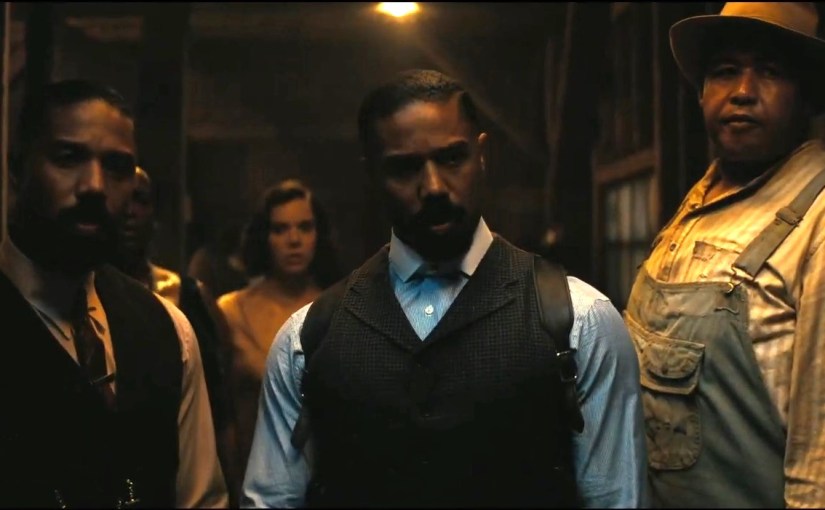
Ryan Coogler’s Sinners pulls one of the best head-fakes I’ve seen in a long time.  The initial trailers would have had you believe the film was basically a character study (albeit an intense one) of identical twin brothers trying to run an illegal business in 1932 Mississippi.  Since both brothers are being played by the excellent Michael B. Jordan, aided by a stellar supporting cast, I got the impression it would be a hybrid of Heat, The Cotton Club, and Michael Mann’s Public Enemies.

Sinners does cover much of that fertile ground…for its first half.  Read no further if you’ve been lucky enough not to have seen what the main attraction is, plot-wise, for the film.

We first get a prologue depicting a bloodied young black man bursting into a Sunday church service while holding the top half of a broken guitar neck.  This is Sammie Moore, played by Miles Caton in his film debut.  The rest of the film is a flashback to the previous day.

The Smokestack brothers have returned home.  Smoke and Stack are identical twins, although one of them (Smoke, I think?) has some visible gold in his smile, so that helps distinguish them from each other.  They are both sharply dressed, having returned from Chicago after working for Al Capone for a spell.  They plan to open a juke joint in a building they purchased from a smarmy character named Hogwood, a white man who grins and assures them they won’t have any trouble from the Klan ‘round here.

This whole first half of the movie is masterfully told.  We are presented with fully drawn characters, not generic placeholders to be shuffled randomly later on.  We find out that Sammie is cousin to Smoke and Stack.  We meet Mary (Hailee Steinfeld), a mixed-race woman who was left high and dry romantically when Smoke left for Chicago.  There’s Delta Slim (Delroy Lindo), a nearly-ancient man who plays a mean blues harmonica, whom the brothers want to hire to play in their new joint.  There are the Asian owners of a grocery store, hired to cater their grand opening.

And then there’s actress Wunmi Mosaku, who gives a luminous, heartbreaking performance as Annie, a woman who bore Smoke a child that died as an infant.  One of the highlights of the film shows Smoke reconnecting with Annie in a scene that at first invites some crude jokes, but which later provides a deep emotional resonance in the movie’s closing passages.  I only remember Mosaku as a sizable presence in the one-and-done HBO series Lovecraft Country (2020), but she was also apparently in Deadpool and Wolverine (2024), so now I gotta go back and watch THAT again.  Twist my arm.

The movie plays more like a really good Stephen King novel than any other movie I can think of since Pan’s Labyrinth (2006).  The film’s canvas is painted beautifully and crisply, moving smartly without rushing.  I would hope Sinners gets nominated for its film editing (provided by Michael P. Shawver), not because of the thrilling later sections, but because of how economically the first half of the film provides us with the perfect amount of information to understand everyone’s motivations when the second half arrives, when all hell breaks loose.

I must also mention the film’s, I guess, “mystical” content when it comes to African American history.  Early on, Annie, who is a “hoodoo” practitioner (I don’t think “witch” is the right word here), tells a lovely story about how, every once in a while, a musician comes along who can play so beautifully that their music “pierces the veil” between past, present, and future, inviting the spirits of all three to come together and enjoy the music as one.  There is a magnificent sequence where we get a visual representation of exactly that when Sammie starts to play the blues in the juke joint.  Trying to describe it in print is a fool’s errand, but it is one of the film’s many visual highlights.  Trust me.  You’ll know it when you see it.  It’s as elegant a representation of Black history as I’ve ever seen, and I don’t know how anyone will be able to top it in the future.

All of that, though, is just prologue for the main event: the vampires.  If you’ve read this long and didn’t know that was coming, I’m sorry I spoiled that for you, but you were warned.

The whole second half of Sinners flirts with becoming a straight-up genre picture, which is not a bad thing in itself, but which would have been almost disappointing when stacked against what came before.  However, because we have been given such a thorough grounding in all the characters beforehand, there are real stakes involved in trying to predict who will live and who will die.  Some deaths are almost foregone conclusions, but even those are more affecting than they would have been in other similar films.

Traditional vampire lore is very much at play, especially the bit about having to be invited into a house.  But the filmmakers did add one new bit, which I thought was EXTREMELY effective.  As a vampire is about to feed (or thinks it’s about to), it begins to drool…a thick, gooey saliva that drips from its mouth like ectoplasm.  This is a cool touch, and it makes perfect sense, a Pavlovian response to an imminent meal.  Don’t be surprised if another vampire film in the future steals that from Sinners.  I’d steal it.  Wouldn’t think twice about it.

Sinners undoubtedly has some deeper meanings that I am not qualified to unpack, and I leave it to you to find them.  This is one of the best films I’ve seen this year, and it is deservedly making bank at the box office.  (Over $200 million globally as of May 3rd, 2025.)  It is surprising, it is dramatic, it is thrilling, and it is worth seeing on the big screen.  Trust me.

SILKWOOD (1983)

by Miguel E. Rodriguez

DIRECTOR: Mike Nichols
CAST: Meryl Streep, Kurt Russell, Cher, Craig T. Nelson, Fred Ward, Ron Silver, Bruce McGill, David Strathairn, M. Emmet Walsh, James Rebhorn
MY RATING: 8/10
ROTTEN TOMATOMETER: 77% Fresh

PLOT: On November 13, 1974, Karen Silkwood, an employee of a nuclear facility, left to meet with a reporter from the New York Times. She never got there.


The tagline for Silkwood (quoted above) almost feels like it gives the game away, but it doesn’t really.  Even if Karen Silkwood’s name isn’t exactly part of the cultural zeitgeist anymore, I am willing to bet that a lot of people know what her name signifies in one way or another.  So, it’s not like the movie’s poster or trailers are spoiling what happens at the end of the film because most of us know.

In any event, Mike Nichols’ film isn’t a nuclear-based thriller, like The Day After (1983) or WarGames (1984), that depends on an unexpected resolution.  Silkwood isn’t about theatrical heroics or bombastic personalities.  It’s a quietly intense character study of an everywoman with an untidy personal life who experiences a seismic shift in her perception and decides she simply can’t stand by and do nothing.  This isn’t a crowd-pleaser like Erin Brockovich (2000), but this film’s story and central character are no less important.

The film goes to great pains to show us how ordinary and messy Karen Silkwood is.  The incidents at the Oklahoma nuclear facility where she works (along with her live-in boyfriend, Drew, and her roommate, Dolly) are almost secondary to the plot, at least for the first half of the film.  Karen has kids that live with her ex-husband and his girlfriend in Texas.  Her relationship with Drew isn’t stormy, but it’s not perfect.  Dolly seems tolerable as a roommate, but is not shy about speaking her mind.  Dolly brings a girlfriend home one night, and there is a slyly amusing conversation between Karen and Drew about Dolly’s sexual preferences.  (“I can handle it.”  “Me, too.”  “…so why are we talking about it?”)

I don’t want to go into too many details about the true-life incidents that occurred at the facility where Karen worked because, if you’re not intimately familiar with the facts of the story, they should be as surprising to you as they were to me.  Plutonium is involved, but probably not in the way you’re thinking.  Karen learns enough to know she should be more involved in the factory’s union…a LOT more.  One plot thread almost feels like it’s ripped off from The China Syndrome (1979), until you realize Syndrome was released four years after the events of Silkwood, so if anything, Syndrome was probably inspired by Karen’s discoveries.

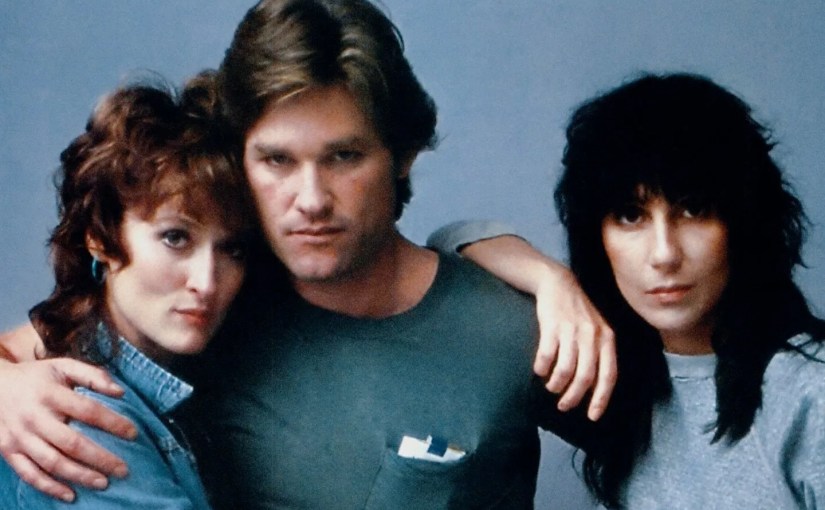
I also have to mention Cher as the roommate, Dolly.  Of course, Meryl Streep is amazing and convincing as an everyday, average divorced mom, but Cher more than holds her own in every scene.  There is absolutely no hint of the pop music megastar of the ‘70s in this film.  Director Mike Nichols insisted she wear little or no makeup in her scenes, which went against every fiber of her instinct as a performer.  She understood the assignment: she never upstages anyone.  This is not a grandstanding kind of supporting role, like Tommy Lee Jones in The Fugitive (1993) or Cate Blanchett in The Aviator (2004).  It required subtlety and understatement, and Cher delivered.  I tried to spot her “acting,” and I never could.  She was unbelievably natural and, at times, heartbreaking.  The movie is almost worth searching out just to see her performance.  It’s a clinic in how to own a small role and make it stand out by doing less than you might expect.

Silkwood may not feel as thrilling as some of the other thrillers I’ve already mentioned, but it is just as compelling, specifically because we’re watching an ordinary person under extraordinary circumstances.  We’re not watching a hero triumphantly rise to the occasion.  We’re watching a struggling divorcee who’s trying to do the right thing after years of inaction, even if it means losing the trust of her co-workers or sacrificing her other personal relationships.  I identified more with Karen Silkwood and her situation than I did with Jane Fonda in The China Syndrome or Julia Roberts in Erin Brockovich

The ambiguous nature of the film’s ending mirrors what happened in real life, and when the credits rolled, I felt a surge of empathy for the people left behind and the unanswered questions they live with to this day.  That doesn’t happen to me very often.

TWILIGHT’S LAST GLEAMING (1977)

by Miguel E. Rodriguez

DIRECTOR: Robert Aldrich
CAST: Burt Lancaster, Charles Durning, Richard Widmark, Paul Winfield, Burt Young, Melvyn Douglas, Joseph Cotten, Richard Jaeckel, John Ratzenberger
MY RATING: 7/10
ROTTEN TOMATOMETER: 80% Fresh

PLOT: A renegade USAF general takes over an ICBM silo and threatens to provoke World War III unless the President reveals details of a secret meeting held just after the start of the Vietnam War.


Twilight’s Last Gleaming, one of Robert Aldrich’s last films, is a cleverly constructed Cold War thriller whose pointed message about the Vietnam War nearly torpedoes the suspense.  The political message is hammered home in a scene that goes on for a bit too long with people speaking dialogue that feels hammy and trite.  But the movie surrounding this one scene is good enough that I would still recommend it to anyone in the market for something off the beaten track.

The movie is set in 1981, four years after it was released, so no one could draw any real-life parallels between the characters and people in real life.  In an opening sequence that feels reminiscent of Die Hard (1988), General Lawrence Dell (Burt Lancaster) and his team of military ex-cons manage to infiltrate and take command of a US ICBM missile silo in Montana.  While I highly doubt it would be as easy as portrayed in the film, Aldrich films the sequence so that I got caught up in the suspense of the narrative instead of worrying about pesky details.  (If there’s a drawback to these and other sequences featuring military hardware and installations, it’s the overall low-budget feel to the sets and props; everything looks like it was shot on a TV soundstage instead of a big-budget film set.)

Once inside, Dell makes his demands: $20 million for each of his remaining team (Burt Young and Paul Winfield), the President must read the transcript of a secret meeting held just after the Vietnam war started, and the President must hand himself over as a hostage to secure their escape.  Otherwise, he’ll launch nine Titan ICBMs at their targets.

This creates a little tension among the would-be terrorists.  Winfield and Young couldn’t care less about the secret meeting, but Dell is adamant.  Meanwhile, General MacKenzie (Richard Widmark) formulates a plan to eliminate Dell and his crew using a “tiny” nuclear device, the President (Charles Durning) agonizes over the secret transcript, and his best friend and aide uses some “tough love” to get him to make a decision.

Despite the fakeness of the surroundings, I was absorbed by the thriller elements in Twilight’s Last Gleaming.  I would compare them to the best parts of WarGames (1983) and The China Syndrome (1979).  There is some impressively impenetrable technobabble about booby traps and inhibitor cables and fail-safe systems that I just rolled with.  The plan involving that “tiny” nuclear device leads up to a sequence that I would compare favorably with any contemporary thriller you can name.

One of the ways Aldrich achieves this effect is through the use of split-screens…LOTS of split-screens.  It starts at the beginning of the film with two screens.  Then there are moments with three split screens, two on top and one in the bottom section.  Then, during the most intense sequence of the film, we get four splits in each corner of the screen.  At first, I found it disorienting, but it absolutely works when it most needs to.  (I’m trying not to give away too many plot details, so excuse the vagueness.)  I don’t know that I would want to watch an entire movie like this (Timecode, 2000), but in small doses, it’s very effective.

Where the movie bogs down is the middle section of the film when the President expresses his disapproval of the contents of the secret transcript Dell wants publicized.  It’s a bit theatrical to believe a sitting American President would be this vocal about his feelings in the middle of a dire crisis.  I think the scene would have played just as well if we had gotten a general idea of the transcript, or even if the contents had NEVER been revealed to the audience.  It would have been a perfect Macguffin, leaving viewers free to imagine anything they want.  The truth about Kennedy’s assassination?  Area 51?  Pearl Harbor was an inside job?  The Super Bowl really IS fixed?  Who knows?

Instead, the President insists on reading a portion of it out loud to his Cabinet members, enlisting them to read certain lines.  While I admire Aldrich’s intent (to send a cinematic protest to the architects of the Vietnam war), the scene nearly brought the movie to a stop, which is deadly when dealing with a suspense thriller.

But, like I said, the rest of the movie is so good, I am compelled to let it slide.  Later, we get surprise attacks, snipers, helicopters, a crafty fake-out involving torture, and an ending that is as cynical as they come, but which felt like the best way out of the situation for everyone involved…except for the American people, but that’s another story.  Twilight’s Last Gleaming feels virtually forgotten, and that’s a shame.  Aldrich directs this movie with a lot of passion for the material and milks every ounce of suspense he can with the tools at hand.  If you’re prepared to overlook that middle section, you’ll get a kick out of this movie.

P.S. Look fast for an unexpected appearance by William Hootkins, aka “Porkins” from Star Wars (1977).

SEPTEMBER 5 (Germany, 2024)

by Miguel E. Rodriguez

DIRECTOR: Tim Fehlbaum
CAST: Peter Sarsgaard, John Magaro, Ben Chaplin, Leonie Benesch
MY RATING: 10/10
ROTTEN TOMATOMETER: 93% Certified Fresh

PLOT: During the 1972 Summer Olympics in Munich, Germany, the ABC Sports broadcasting team must adapt to providing live coverage of Israeli athletes being held hostage by a terrorist group.


Two of my absolute favorite true-life movies (United 93 [2006], Bloody Sunday [2002]) happen to be from the same director, Paul Greengrass.  Watching Tim Fehlbaum’s film September 5 felt at times like I was watching a Paul Greengrass film, and I can offer no higher compliment than that.  From the moment the first gunshots are heard coming from the Olympic village in Munich in the wee morning hours of September 5, 1972, this movie never lets up on the tension.  Over the next 24 hours, we will follow the ABC Sports broadcasting team as the managers and crew work through a tangle of journalistic ethics and operational logistics to report on the biggest news story of their lives while maintaining objectivity and their obligation to the truth, and ALSO keeping the safety of the victims and their families in mind.

The four major characters are legendary ABC Sports executive Roone Arledge (Peter Sarsgaard); a then-unknown control-room functionary, Geoffrey Mason (John Magaro), who was in the right place at the wrong time; ABC Sports producer Marvin Bader (Ben Chaplin); and German-to-English translator Marianne Gebhardt (Leonie Benesch), who is probably an amalgam of several different people who were most likely present during the actual events of the film.

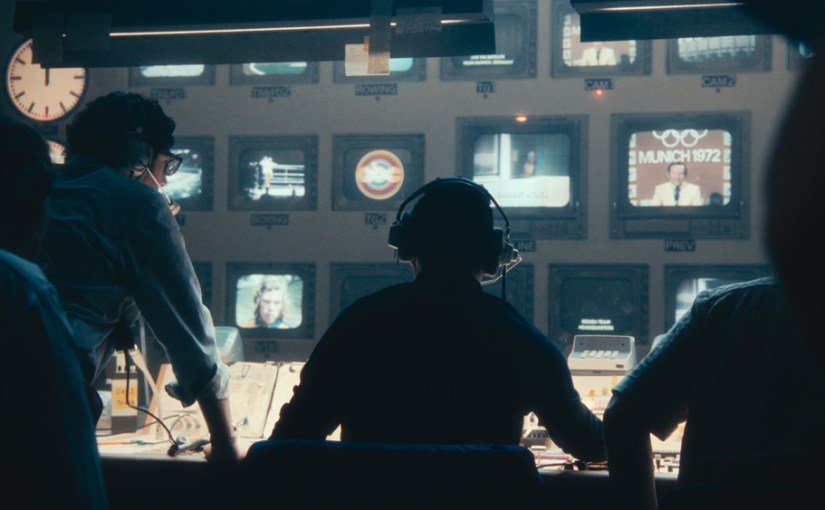
One of the masterstrokes of September 5 is how it rachets up the tension by staying inside the claustrophobic control room and connected offices for the entire film, minus the opening and closing shots showing Geoff arriving for work and leaving the next morning.  Anything showing us the outside world is only visible on the banks of television monitors in front of them, which leads to much confusion towards the end of the film as reports of the Israeli hostages being freed begin circulating, but no one can actually see what the hell is going on.  This is one of the ways the film reminded me of some of the best scenes in United 93 when the people responsible for making the most crucial decisions of their lives were limited by what they could see and hear on the news.

I have never worked in a TV studio, but this movie carries a palpable authenticity that made me believe everything I was seeing.  I never knew, for example, that chyrons (those small captions on the bottom of a TV screen during the news) were analog back in 1972.  Whenever a new development occurs, the control room has to call up a woman in a completely separate room/mini-studio so she can manually place individual letters onto a physical message board, then get behind a camera and shoot the image so it can be superimposed back in the main control room.  Exhausting!

Peter Jennings is reporting remotely across the street from the Israeli apartments, but he cannot be heard live from his radio into the audio feed for the TV signal.  So, some random dude takes a phone handset, unscrews it, solders some wires, clamps it all together in front of a microphone, and presto, now Jennings is live.  The whole operation is put together with spit and baling wire.  It feels like it’s a miracle that anything was televised at all.

The other conflicts presented to us are no less important.  Marianne, a German woman, is drafted into helping with the translation, but first she must endure some brief accusations from Marvin.  The fact these Olympics are being held in Munich less than thirty years after the end of World War II is something many people are still coming to terms with.  He asks her if her parents knew about the concentration camps.  She stares for a second and gives the best answer possible: “But I am not them.”  After that, she earns the complete trust of the entire staff.

The subtext of the German guilt over World War II is bubbling just beneath the surface for the entire film.  A German maintenance worker won’t release replacement cables to a French tech until Marianne talks him into it.  It is theorized at one point that German military forces could possibly end the hostage situation within minutes, but the German military is constitutionally forbidden to operate within the Olympic village, for obvious reasons.  Roone Arledge watches Mark Spitz win yet another gold medal, and instead of going to a closeup of Spitz, he instructs the cameraman to cut to the face of the German swimmer who lost.  Someone asks him, “Do you really want to bring politics into this?”  And he replies, “It’s not about politics, it’s about emotions.”

Which brings in the other major point of retelling this story in this way.  There is a point where ABC’s cameras have great shots of the building, the balcony, and the entire complex, and they are broadcasting live (the first time the Olympics had been broadcast live, by the way).  Someone spots German policemen – non-military – getting into position with sniper rifles.  Marianne hears chatter on the police band about an operation getting the green light.  The press is ordered out of the area, but ABC’s cameras continue to broadcast live.  Someone notices that a TV appears to be on inside the apartment where the hostages are being held.  Geoff suddenly asks a reasonable question: “Are the terrorists seeing this?”  Minutes later, German police storm the ABC control room and demand the cameras be turned off, pointing a gun at the crew at one point.  The cameras get turned off and a furious Arledge kicks the Germans out of the building, but the point is made.  Minutes later, the operation is called off. 

“They should’ve cut the electricity to the apartment, it’s not up to us to double-check on them,” says Marv.  But Geoff makes a point: “Marv, it’s not okay if we made it worse.”  The fine line between the freedom of the press and general public safety could not be more elegantly portrayed than it is here.  Earlier in the film, just as the cameras have been set up with shots of the balcony of the apartment, someone asks, “Black September [the terrorist group responsible], they know the whole world is watching, right? …if they shoot someone on live television, whose story is that?  Is it ours, or is it theirs?”

It seems like an easy question to answer: “Public safety comes first.”  But who gets to decide what’s in the public’s best interest?  Those policemen who burst into the control room and shut the cameras off at gunpoint?  Perhaps it should be left to each newsperson’s individual conscience, but can that always be trusted?  These are questions I am not qualified to answer, but I appreciate films like September 5 because they have enough faith in the viewer to pose those questions and then refrain from providing a tidy answer.  It’s one of those rare thrillers that tells a crackling good story and also asks some big, relevant questions that you may not even think about until you’re driving to work the next day.

One of the last things we hear is Marianne talking to Geoff, who had sent her to the German airport where the hostages were supposed to have been flown out of Germany.  “I was there with hundreds of people, we stared into the night.  We were waiting for something to happen because we wanted to take a picture of it.”  While that’s a rather bleak way of describing a profession that has given us some compelling images that have swayed the world’s opinion on vitally important matters, perhaps it’s also a way to caution those who would exploit situations, like the paparazzi who chased Princess Di into that tunnel.

FAREWELL, MY LOVELY (1975)

DIRECTOR: Dick Richards
CAST: Robert Mitchum, Charlotte Rampling, John Ireland, Sylvia Miles, Anthony Zerbe, Harry Dean Stanton, Jack O’Halloran, Joe Spinell, Sylvester Stallone
MY RATING: 9/10
ROTTEN TOMATOMETER: 71% Fresh

PLOT: When a giant ex-con fresh from prison asks Philip Marlowe to find his missing sweetheart, Marlowe winds up entangled in multiple murders, prostitutes, and a sultry trophy wife.


Because it was released only a year after Chinatown (1974), it is tempting to compare Farewell, My Lovely to that landmark film noir, but although they are in the same genre, the two films are apples and oranges…or at least apples and pears.  Both feature hard-nosed private eyes accepting cases that turn out to be more complicated and far-reaching than they appear, both feature multiple unexpected deaths, and both feature curvy, smoky-eyed dames with dangerous secrets and aging husbands.  All true to the genre.  But Chinatown breaks (successfully) with film noir in several key areas, while Farewell, My Lovely achieves its lofty heights while still remaining faithful to the bedrock tropes of vintage film noir, right down to the tired voice-over narration from the hero.  I have no idea how faithful it is to the Raymond Chandler novel by the same name, but if the book is half as entertaining as the movie, I may have to track it down and give it a read.

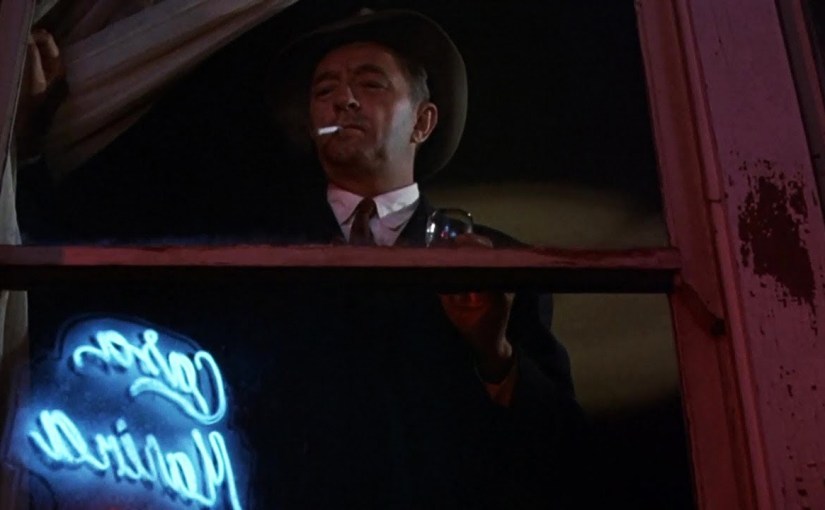
Robert Mitchum plays legendary gumshoe Philip Marlowe, the third version of the character I’ve ever seen after Humphrey Bogart (The Big Sleep, 1946) and Elliott Gould (The Long Goodbye, 1973).  Compared to the other two, Mitchum is by far the most shambling version, but I mean that in a good way.  We first see him staring out of a rundown hotel room in downtown Los Angeles, some time in 1941.  We know the timeframe because of a calendar here and there, and because Marlowe is obsessively following Joe DiMaggio’s progress, as he is on the verge of breaking the record for hits in consecutive games.  That’s a nice touch.  Marlowe’s world-weary narration plays over Mitchum’s sagging face and drooping cigarette, and the spell is complete: we are in the hands of one of the great genre pictures, from a story by one of the greatest mystery writers of his generation.

Marlowe’s story starts as a flashback, a story he’s relating to similarly-weary Lieutenant Nulty (John Ireland).  See, it all began when Marlowe was tracking down a rich family’s runaway daughter.  Soon thereafter, “this guy the size of the Statue of Liberty walks up to me.”  This is Moose Malloy, an ex-con fresh out of the slammer after serving seven years for armed robbery and making off with $80,000, which was never recovered.  Moose is played by Jack O’Halloran, whom cinephiles will recognize immediately as the overly large/tall man who played Non, the mute superpowered henchman in 1980’s Superman II.  To see this man actually string words together into sentences was a strange experience, but I eventually got used to it.

Moose wants Marlowe to find his sweetheart, Velma, who hasn’t written to him the last six years of his stretch.  Next thing you know, someone takes a potshot at Moose on the street, Moose winds up killing a guy in a bar, and Marlowe follows Velma’s trail to an insane asylum, and that’s still just the tip of the damn iceberg, because now there’s this guy who wants Marlowe to help deliver $15,000 in ransom to some other guys who stole a jade necklace…and we STILL haven’t seen the rich trophy wife yet.

And round and round it goes.  I have seen other films that attempted to combine this many plot threads and they wound up a jumbled mess.  Not this movie.  Farewell, My Lovely skillfully walked that tightrope and held my interest all the way through.  I was never lost, never confused…except for a couple of places where the soundtrack obscured a word or two, but I don’t know if that’s the soundtrack’s fault or the actors for mumbling too much.  Plus, this movie contains one of the single greatest interrogation sequences I’ve ever seen, starring Marlowe, two thugs, and the madame of a whorehouse.  It starts semi-normal, escalates with a shocker, then tops the first shocker with something I didn’t think even a hardcase like Philip Marlowe would do.  But the more I watched this movie, the more I got the sense (whether it’s true or not, I don’t know) that this Mitchum version of Marlowe is truer to the literary Marlowe than we ever got previously, in terms of Marlowe’s principles.

I should also mention the dialogue, which contains some of the best one-liners and comebacks I’ve ever had the pleasure of listening to.  For example:

  • Marlowe describing a large house he’s driving up to: “The house wasn’t much.  It was smaller than Buckingham Palace and probably had fewer windows than the Chrysler Building.”
  • Marlowe on his billing practices: “I don’t accept tips for finding kids.  Pets, yes…five dollars for dogs, ten dollars for elephants.”
  • Marlowe describing the obligatory femme fatale (Charlotte Rampling): “She had a full set of curves which nobody had been able to improve on.  She was giving me the kinda look I could feel in my hip pocket.”
  • Marlowe when the femme fatale asks him to sit next to her: “I’ve been thinking about that for some time.  Ever since you first crossed your legs, to be exact.”

Dialogue and lines like this are dangerous because they have been the targets of so many parodies for so long that modern audiences may have forgotten how to take them at face value.  But in Farewell, My Lovely, it comes off perfectly as a tribute to the classic noirs of the 1940s and ‘50s, a tip of the hat to the giants of the past.

Conversely, this movie also reminded me of many of the best eighties thrillers I remember watching, which is ironic considering it was released in 1975.  Movies like Body Heat and Jagged Edge and Silverado, whose purpose for existing seemed to be just to tell a freaking awesome story, unburdened with subtextual layering but laden with style and wit and intelligence, paying homage to their cinematic ancestors by emulating them without plagiarizing them.  There are no doubt film historians who could analyze this film scene by scene and explain exactly what the filmmakers were really trying to tell us underneath the ingenious dialogue and intricate plotting.  But even if I knew or understood all of that, I maintain the best reason for seeking out and watching Farewell, My Lovely will always because it’s just a damn good movie.

(…if for no other reason because of that interrogation scene…I had to rewind it a couple of times just to get my shocked laughter out of my system…)