
THE BIG PARADE (1925)

by Miguel E. Rodriguez

DIRECTOR: King Vidor
CAST: John Gilbert, Renée Adorée, Tom O’Brien, Karl Dane
MY RATING: 8/10
ROTTEN TOMATOMETER: 100% Fresh

PLOT: Wealthy James Apperson deploys as a soldier in World War I France and grows from a naive kid into a battle-hardened veteran as he and his two buddies are paraded to the front.


Films that incorporate tonal shift had better know what they’re doing, lest they become a thematic mess.  King Vidor’s The Big Parade toes that line by shifting from a nearly Keaton-esque “you’re-in-the-Army-now” military comedy to a terrifying war thriller almost on a dime, anticipating and surely influencing future war films like M*A*S*H, The Boys of Company C, and Three Kings.  I’m compelled to forgive the Hallmark Channel ending because, doggone it, I found myself rooting for it like a 1970’s housewife watching her soaps.

It’s 1917, and James Apperson (John Gilbert) is the layabout son of a wealthy family.  He’s engaged to a lovely girl, Justyn, but we don’t see too much of their relationship before the news breaks: America has officially entered World War I.  Justyn has a revealing line when she tells James how much more she’ll love him when he’s in uniform.

An effective scene shows an impromptu parade going down a city street, with flags flying, bands playing, and people holding banners and signs with things like, “GIVE ‘EM ‘L’ IN BERLIN”.  James starts to get carried away with the patriotic fervor on display and joins a carload of his buddies on their way to enlist.  James’s stern father is delighted that his laid-back son is doing something important, but his mother is naturally dismayed, Jim’s fiancé swears she’ll wait for him, and so on.

In Army basic training, Jim connects with two men whom we saw in an earlier prologue: Bull, a no-nonsense bartender, and Slim, a country-boy construction worker with a long, expressive face and a fondness for chewin’ tobacky.  This trio forms the framework for most of the rest of the film.  In fact, for about the first 90 minutes, even after they get shipped to France, the movie is more or less a military-themed comedy.  Jim’s squad is forced to de-manure a farmhouse before they can sack out, and they do so while singing “You’re in the Army Now.”  Bull, with his two stripes, bosses everyone around and cheerfully leads the singing without doing any of the work himself.  And so on.

There’s even the obligatory encounter with the local women, including a farmgirl named Melisande, with whom James is instantly smitten.  His first clumsy overtures are rebuffed, but she takes a shine to him when he somehow finds himself walking through her farmyard with a barrel over his head and body, looking for all the world like an ultra-primitive droid from Star Wars.  A charming scene where Jim teaches her the fine art of chewing gum was supposedly improvised on the spot by the two actors, and has an incredibly effective payoff much later in the film.

This is all handled nicely and even gently at times.  I could have done with a LITTLE less of the scenes involving Bull and Slim also trying to put the moves on Melisande.  The comic point is made early and then beaten into us a couple of times later, and I just wanted the movie to get on with the rest of the story.

Where The Big Parade really shines is in the next half/phase of the film, when the doughboys finally get their orders to the front.  They’re driven out to a forest somewhere as part of a massive truck convoy…another parade with a vastly different connotation.  The battle scenes that follow are as horrifying as anything from Platoon.  Jim’s squad is ordered into a forest reported to be full of snipers and machine gun nests.  The brilliant tactical strategy is for the men to simply walk slowly into the forest and let the German snipers pick them off until they give their positions away, at which point they can be killed by the Americans.

These scenes had me leaning forward in my seat.  The Americans are marching forward, and every so often one of them simply drops to the ground.  Then another, and another.  And still they march.  The soldiers in front don’t look behind them, and if anyone drops in front of them, they simply step over or around the bodies.

(Wasn’t this the kind of thing the British redcoats did in the Revolutionary War, marching in straight lines while the colonials made mincemeat of them?  I seem to remember reading that somewhere.)

Jim and his two buddies survive this death march (let’s call it what it was) only to arrive in a vast no-man’s land defended by German machine guns and artillery mortars.  I won’t go into great detail about this extended sequence, but it involves two things I didn’t expect from a movie made in 1925.  There’s a censored title card which conveys even more of an impact than if it had been spelled out: “Let’s get those b – – – – – – s!”  And also, in one scene, it’s absolutely clear that one soldier evades gunfire and mouths, “Son of a BITCH!”  We don’t get a title card for that one, but it’s unmistakable.  Such is the intensity of this sequence.  The Big Parade is worth watching for many reasons, but I would recommend that one sequence to any fans of modern war films.  There are some physical effects that are clearly more primitive than what we’re used to, but it captures all the horrors of war just as efficiently.

The last arc of the film involves Jim’s attempts to reconnect with Melisande and his eventual return home.  As I said before, these last scenes are overflowing with melodramatic flourishes – especially concerning Jim’s fiancé – but the movie has earned them, and I was on board with it all the way to the final fadeout.

The Big Parade made stars of its director and its lead actors, and it was the first big hit for Metro-Goldwyn-Mayer.  Indeed, it was MGM’s highest-grossing film until the colossal success of Gone with the Wind.  I can see why.
WINGS (1927)

by Miguel E. Rodriguez

DIRECTOR: William A. Wellman
CAST: Clara Bow, Charles ‘Buddy’ Rogers, Richard Arlen, Gary Cooper
MY RATING: 10/10
ROTTEN TOMATOMETER: 94% Certified Fresh

PLOT: Two young men, one rich, one middle class, who are in love with the same woman, become fighter pilots in World War I.


Not long ago, I purchased a copy of the 1927 classic Wings, based mostly on the favorable review by my friend and colleague, Marc Sanders.  I was more or less aware of its place in cinema history: the very first winner of the Best Picture Oscar, essentially the birthplace of Gary Cooper’s career (despite appearing in the film for just over 2 minutes), legendary aerial footage, and so on.  But I never felt compelled to seek it out.

Having finally watched it, I am very glad I did, and you should, too.  Wings is pure entertainment from start to finish.  Unexpectedly engrossing, captivating, thrilling, the whole enchilada.  High melodrama, comedy (borderline slapstick, what are you gonna do, it was 1927), romance, comic misunderstandings – and some not-so-comic – and eye-popping aerial footage, true to its reputation.  A neat camera move gliding over several cabaret tables even showcases director William A. Wellman’s desire to push the boundaries of what was possible with the massive cameras of his day.  I once wrote that Sunrise (1927) was my favorite silent film of all time.  If I ever make another 100-Favorite-Films list, Wings and Sunrise are going to have to duke it out…

Wings sets a surprisingly modern tone from the start.  In the very first sequences of the film, Jack Powell (Charles ‘Buddy’ Rogers) does not “ham it up” like some of the more typical Hollywood actors of that era.  Obviously, his mannerisms are exaggerated, but there is a restraint to his face and body that seems at odds (in a good way) with nearly everyone else in the film…except Gary Cooper, who, if he underplayed his role any further, would have become a still painting.  That restraint is also evident in Jack’s foil/nemesis, David Armstrong (Richard Arlen), the rich aristocrat to contrast Jack’s more humble background.  This moderation lends a very contemporary feel to a movie that’s nearly a century old – quite a feat.

In sharp contrast to the two male leads, the fabled Clara Bow plays her role, Mary Preston, with complete abandon.  She never truly overacts, exactly, but she throws herself into her supporting role with abandon.  Mary is hopelessly infatuated with Jack, who is actually in love with the debonair Sylvia Lewis (Jobyna Ralston), who is already involved with David, though they haven’t made anything official.  (If Facebook had been a thing back then, their relationship status would have been “It’s Complicated”.)  So, when Jack makes eyes at Sylvia, poor Mary is in the background as her hopeful smile deteriorates into sobs.  She may not be subtle, but Clara Bow makes sure you know EXACTLY what is on Mary’s mind at any given moment.

In the middle of this would-be soap opera, World War I intervenes.  Jack and David both enlist to become aviators.  A crucial scene shows Jack asking for Sylvia’s picture to keep as a good luck charm, a picture that has already been signed over to David.  Then, as he says his farewells to the lovelorn Mary, she offers him her picture.  How this scene plays out, and how it comes to bear much later, is one of the high points of the film’s ground-based drama.

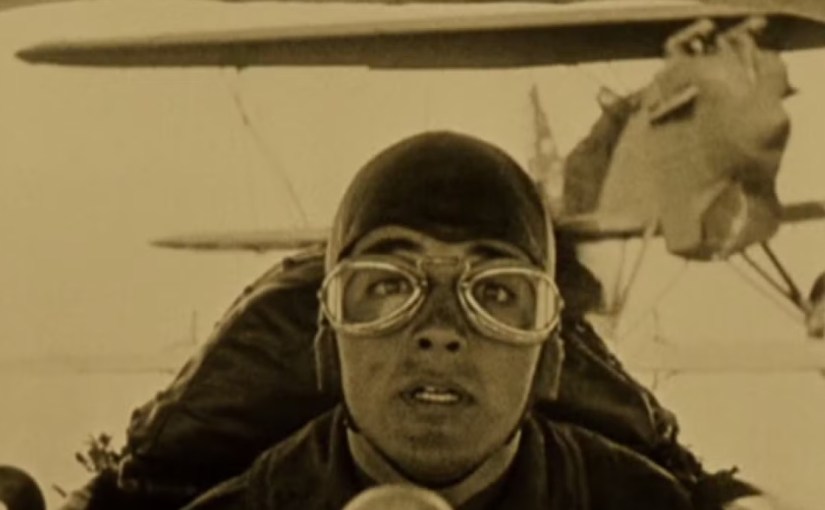
But the real marquee attraction Wings comes during the aerial training and combat scenes.  Watching this movie, you understand why modern filmmakers today strive for realism as much as possible.  Ron Howard wanted to show weightless environments for Apollo 13, so sets were constructed inside a military jet tanker that flew parabolic arcs to simulate weightlessness…for real.  The makers of Top Gun: Maverick wanted to draw audiences into the film, so they had their actors train for weeks and months so they could be filmed inside the actual cockpits of F-18 fighters as they performed simulated combat maneuvers…for real.  Those filmmakers knew what had already been demonstrated decades earlier by Wings: nothing beats reality.

(Almost nothing…Ready Player One was pretty damn cool…BUT I DIGRESS…)

For Wings, director Wellman, a combat pilot himself during the war, knew that the best way to grab the audience by the lapels would be to get his actors up in the air for real.  To put it very briefly, he got his two lead actors to become certified pilots, got them into the air with small cameras strapped to the front of their planes, and had them act, fly their own planes, and be their own camera operators, all at the same time, while other stunt pilots flew around them, sometimes in VERY close quarters, simulating aerial combat.

The results are staggering.  There is a visceral mojo to these scenes that cannot be overstated.  Sure, it looks “old” because it’s black and white and grainy, but it is also undeniably real, and when you see long shots of a biplane going into a death spiral after being shot out of the sky, your intellect tells you there’s a real pilot flying a real plane hurtling at high speed towards the real ground, and you either sit back in awe or you lean forward with excitement.  There are a few scenes where real planes crash to the ground in various ways; one of them crashes into the side of a freaking HOUSE…for REAL.  IMDb mentions one staged crash where the plane didn’t do exactly what it was SUPPOSED to do, and the stunt pilot literally broke his neck…but survived and returned to his job six weeks later.  And it was all done in camera with no trickery or fake dummies in the cockpit.  It is literally mindboggling.

However, it should be noted that these accomplishments by themselves would mean very little if they weren’t hitched to a compelling story.  The love story among Jack, David, and Mary is a constant thread through the whole film.  Mary, having volunteered as an ambulance driver in the Army, miraculously finds herself stationed overseas…right next to Jack and David’s unit, wouldn’t you know it!  Contrivances aside, Wings expertly balances the exciting elements with the melodramatic flourishes.  The melodrama comes to a head when Mary finds herself alone in a hotel room with Jack, who is so drunk on champagne he doesn’t recognize her.  (She is dressed as a cabaret dancer, but that’s a long story…)  This movie truly contains the best of both worlds, genre-wise.

This might be crass of me to mention, but I’m going to anyway…Wings is also notable for some of the earliest on-screen nudity (in an AMERICAN film, anyway) that I can recall seeing.  There is a scene in a recruitment office where a line of bare male bums are lined up in the background, awaiting health inspection.  Then later, we see a woman’s bare breasts…just a brief glimpse, but it’s there.  Not only THAT, but during a fancy camera move in a French cabaret, we see a woman caressing another woman’s face…are they a couple?  Scandalous!  Who needs the Hays Code?  Not this guy!

(I could also mention the homo-erotic overtones during a pivotal scene towards the end of the film, but they pretty much speak for themselves [like the volleyball scene in Top Gun], so I’m just gonna move on…)

To sum up: Wings ranks as one of the greatest pure entertainments that Hollywood has ever served up.  Marc mentioned that it perhaps doesn’t get the love it deserves.  He’s probably right.  I’m sure it’s revered among cinephiles, but it is certainly not in the general public consciousness when it comes to silent films.  Regardless, it is exceptionally well-made and uncommonly effective.  If ever an old film deserved to be rediscovered by the general public, Wings is it.