
by Miguel E. Rodriguez
DIRECTOR: Satyajit Ray
CAST: Anil Chatterjee, Madhavi Mukherjee, Jaya Bachchan, Haren Chatterjee
MY RATING: 9/10
ROTTEN TOMATOMETER: 93% Fresh
PLOT: The housewife of a lower-middle-class home in Kolkata decides to find a job to supplement her family with much-needed income, battling age-old customs and her own anxieties the whole way.
Stop me if you’ve seen this movie before: a housewife battles deeply held beliefs and outright chauvinism and gets a job to help her family financially, despite resentment from in-laws and her out-of-work husband. Frankly, if I didn’t know any better, I’d think you were loosely describing the plot of Mr. Mom (1983) or parts of Nine to Five (1980). But The Big City, directed by the legendary Satyajit Ray (The Apu Trilogy), transcends the sit-com tendencies of the story and presents us with real characters and circumstances that feel as relevant today as they did over sixty years ago. This is a miracle of a movie.
Meet the Mazumder family: husband Subrata, wife Arati, and young son Pintu. They live in three or four small rooms in what is described as the lower-middle-class, but to me it looks pretty close to the poverty line. Living with them are Subrata’s father and mother, Priyogopal and Sarojini, and his younger sister, Bani. Kinda crowded. Priyogopal used to be a well-respected professor at a local school, but he was aged out and now must rely on Subrata’s single salary as a banker.
When it becomes clear that Subrata’s salary is no longer enough to support six people by himself, Arati suggests that she look for work herself. Subrata is by no means a cruel or mean man, but it’s 1953, and his first instinct is to gently remind his wife of the natural order of things: the husband goes to work, and the wife takes care of the family. “Remember what the English say: a woman’s place is in the home.” It’s interesting how gentle and straightforward Subrata is. He doesn’t browbeat his wife, but because this is how things have always been done, he believes they should just accept it.
But when Subrata’s father, the former professor, finds himself begging his former pupils for things like free eyeglasses or some spare cash – “You’re successful because of me, so you owe me,” he essentially says to them – Subrata changes his tune. So, Arati finds a job as a door-to-door salesgirl for a local company selling household gadgets like the “Autonit”, a device to help with knitting. (It’s never explained how this machine works, for the record.) But when she develops an aptitude for it, and she starts bringing home the bacon…what will her husband think? What about her father-in-law, who is so entrenched in his conservative values that he finds it impossible to speak with Arati directly when she comes home late from work?
We have all the makings of a been-there, done-that domestic melodrama, but The Big City lured me in somehow and made me really care about how these problems would resolve themselves. There is a moment when Subrata convinces Arati to quit her job because he has a line on a second part-time job himself. She is all ready to give her boss the letter, but the movie starts cross-cutting to Subrata discovering there has been a run on his bank and he’s suddenly out of a job. As the movie cut between Subrata desperately trying to reach Arati, and Arati just on the verge of submitting her resignation, I found myself SUPER-involved in the story, muttering to myself and clutching the armrest of my sofa. Very few movies work on me like that anymore.
How did this movie from India get under my skin so well? For one thing, the movie never rushes. Even in the sequence described above, the cutting is moderately paced, not like an action sequence at all. We get a good long look at the family’s dynamics before Arati finds a job so we have an excellent idea of how everyone will react, and why. The pacing allowed me fall into the story without boring me in any way. This surprised me. I did not expect this foreign film to be as engrossing as anything by Villeneuve or Hitchcock.
For another, even though I disagreed fundamentally with the chauvinistic attitudes from Subrata and his father (and even his mother, too set in her ways to congratulate her daughter-in-law), I didn’t dislike them the same way I disliked the villains in other similar films, because they’re not exactly villains. They’re not evil, they’re just misguided and, to be honest, a little brainwashed by years of being told the wife stays home and that’s that. Because there was no one for me to dislike (except maybe Arati’s boss, but that’s another story), I was rooting for the entire family as a whole.
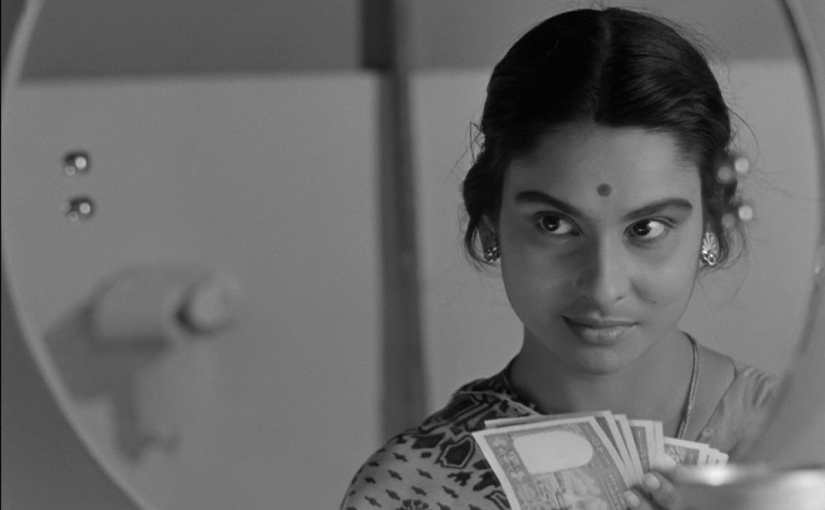
But especially for Arati. In her society, for a woman of her class to even wear lipstick was considered a disgrace…but it helps with her sales numbers, so she wears it. On her first payday, she retreats to the ladies’ room with her cash and just holds it in her hands while looking in the mirror. You can see the pride of accomplishment in her face without a word spoken. This is mine…I did this. That’s something everyone can identify with, no matter your race, color, creed, or gender. During the course of the movie, Arati experiences some ups and downs, as well as telling a crucial lie for the sake of a sale, and I was rooting for her every step of the way.
A quick internet search tells me The Big City is streaming on the Criterion Channel and on HBO Max. If you’re feeling a little adventurous, give this movie a look. It’s a wonderful movie…not just a “film.”
 2 UNPAID MOVIE CRITICS!!!!