THE SUGARLAND EXPRESS (1974)

by Miguel E. Rodriguez

DIRECTOR: Steven Spielberg
CAST: Goldie Hawn, Ben Johnson, Michael Sacks, William Atherton
MY RATING: 6/10
ROTTEN TOMATOMETER: 87% Certified Fresh

PLOT: A young wife breaks her husband out of prison in 1969 Texas so he can help reclaim their infant from a foster family.  The ensuing media circus takes everyone by surprise.


Watching Steven Spielberg’s The Sugarland Express is like looking at one of those historical medieval tapestries of fierce battles, created by artists who didn’t yet know how to depict perspective.  There is plenty of action on display, but everything looks and feels flat.  The film took an award at Cannes that year for Best Screenplay, probably (at least partly) in recognition of how it shies away from a traditional Hollywood resolution, but even its downbeat ending is reminiscent of earlier, more resonant films like Bonnie and Clyde [1967] or Butch Cassidy and the Sundance Kid [1969].  As a stepping stone in the career of an eventual legend, it’s worth a view.  As a stand-alone film, it never quite achieves liftoff.

Based on real events, The Sugarland Express tells the story of Lou Jean Poplin (Goldie Hawn at her irrepressible, bubbly best), the young wife of prison inmate Clovis Poplin (William Atherton).  During a conjugal visit, just four months before Clovis is to be released, Lou Jean boldly busts him out because she needs his help to reclaim their infant, Langston, from a foster home.  Lou Jean herself has just finished serving time at a women’s prison, and the state, probably very wisely, determined Langston was better off with a foster family.  But they need to hurry because “I bet those Methodists are gettin’ ready to move out of state.”  Lou Jean’s delivery of “Methodists” tells you all you need to know about her feelings on the matter.

After Lou Jean breaks him out, a comedy of errors ends up in a situation where she and Clovis have hijacked a police cruiser and are holding a police officer at gunpoint.  They demand to be left alone while they drive to Sugarland, Texas, and retrieve their son, at which point they’ll release their hostage.

Now, this has all the makings of a smart, character-driven “road” movie, instigated by desperate people with no real plans for their end-game.  But for reasons I can’t put a finger on, nothing ever happens in the film that got me on the edge of my seat, figuratively speaking.  I fully comprehended the situation intellectually, but the film never got to me at an emotional level.

Could it be because we never really learn a lot about Lou Jean and Clovis in order to make them more empathetic?  No, I don’t think so, because over the course of the film, we’ll hear all about their past histories and previous brushes with the law.  The very fact they’re executing this plan to essentially kidnap Langston is proof of how unfit they are as parents.

I think part of the problem with the movie is…

…I’ve been sitting here for the last fifteen minutes trying to finish that sentence.  I can report that the film didn’t get to me emotionally, but I am struggling to explain why.  Could it be as simple as I think they’re not such great people, but the film seems to be siding with them as the movie progresses?  I mean, the movie HAS to side with them at least partially in order to make their journey mean anything.  Look at Butch Cassidy and the Sundance Kid.  Bank robbers, lawbreakers, but clearly the good guys because, duh, Paul Newman and Robert Redford are playing them.

So, maybe it has to do with the casting?  The Sugarland Express had one of America’s sweethearts as a woman willing to resort to kidnapping just to commit another kidnapping in the name of maternal love.  So, we’ve gotta root for her, right?  But then we see her behaving in the most inane, brainless way for so much of the movie.  I found it difficult to side with her when I just wanted to, forgive the expression, slap some sense into her.

What about Clovis?  I could side with him.  He appears to have misgivings throughout the entire film, right up to the point of no return.  But the way he willingly goes along with the scheme because, dammit, it’s his wife…something about that also turned me off on him.  There are moments I felt sorry for him, for them both, because I could see where this movie was headed early on.  But that empathy wasn’t enough to make me feel a catharsis of tragic energy at the film’s finale.  There’s just something about Clovis and Lou Jean that wouldn’t allow me to get too worked up over their fate.

I guess I identified most with the kidnapped police officer, Slide (Michael Sacks).  Maybe too much.  From the beginning, Slide is begging them to drop their weapons and turn themselves over to the police.  At first, he looks like he’s just following his training.  But then the movie progresses, and doggone it, he starts to like these two loonies, even though Clovis handcuffs him and even shoots at him a couple of times in the heat of the moment.  He can see where this road ends, and he pleads with them not to do exactly what the Texas state troopers expect them to do, because he doesn’t want to see them dead.  Because Slide never stops imploring the Poplins to see sense and do the smart thing, I guess he’s who I sided with for the entire movie.  (Well, him and his superior, Captain Tanner [Ben Johnson], who also doesn’t want to see them die.)

But…isn’t that the wrong way to approach this movie?  I shouldn’t be siding with the cops, for cryin’ out loud, should I?  At least, not in this movie.  Discuss.

From a technical standpoint, it is pretty cool to see how Spielberg, in only his second film, was able to marshal vast resources to create some arresting imagery.  The sight of what looks like literally hundreds of cop cars following the Poplins is a deceptively difficult feat, logistically speaking.  There’s a tense shootout in a used car lot that would have been right at home in The French Connection.  And everywhere, there’s bits of humor that made me smile.  From the elderly couple abandoned on the road (long story) to the solution of how to get Lou Jean to a toilet while in the middle of an extended police chase, Spielberg constantly pokes us in the ribs.  If this had gotten to the hands of someone like John Landis, it’s easy to see how this could have been turned into an out-and-out comedy with thriller elements, instead of the other way around.

One other aspect I did like was the media circus that blew up around the Poplins’ plight.  I’m sure it is yet another link to previous anti-heroic films, but while I was watching it, I was reminded of only one film: Oliver Stone’s Natural Born Killers [1994].  The outpouring of affection from the general public for these two, let’s face it, outlaws was both funny and sobering at the same time.  It would have been interesting to see a scene or two at the end of the film as an epilogue, so we could get a reading on what the public thought about how the police should have handled the situation.

If comparing The Sugarland Express to most of Spielberg’s later films, it certainly comes up lacking, no question.  As a lifelong Spielberg fan, I am compelled to say it SHOULDN’T be compared to his later films because it was made before he’d had a chance to hone his skills and become the populist/mainstream film icon he is today.  Look carefully at the two-dimensional storytelling and you can see the outlines of what was coming around the bend for this modern-day master.

SHANE (1953)

by Miguel E. Rodriguez

DIRECTOR: George Stevens
CAST: Alan Ladd, Jean Arthur, Van Heflin, Brandon De Wilde, Jack Palance
MY RATING: 8/10
ROTTEN TOMATOMETER: 97% Fresh

PLOT: A drifter (who may or may not be a retired gunfighter) comes to the assistance of a homestead family terrorized by a wealthy cattleman and his hired gun.


Shane affords me the opportunity to use a word I never get to use in daily conversation: archetypal.  John Ford’s Stagecoach [1939] may be the granddaddy of the modern Western, but Shane taps into something even more primal.

Alan Ladd as Shane is the archetype of the mysterious stranger riding out of the mountains, either coming to the aid of a community who has lost hope (Pale Rider, 1985) or wreaking havoc as an avenging angel (High Plains Drifter, 1973), and then disappearing into the sunset or riding back into the distant mountains.  This formula was probably already old when Shane was made, and the film does little to dress it up or add any kind of pretentious spin to the story.  But by sticking to the formula and really nailing it home, director George Stevens achieved a weird kind of clarity that elevates Shane into a mythical realm.  If it’s not terribly realistic, well…who wants realism mixed in with their magic?  Not me.

Shane is set in the high plains of Wyoming in 1889.  (I don’t remember the exact year being mentioned in the film – I pulled it off IMDb – but we can tell it’s after the war because a running gag involves a harmonica player who always starts playing a Union song whenever a homesteader called Stonewall, who fought for the South, walks into a meeting.  It’s a mark of faith in the intelligence of the average viewer that the screenplay never comes out and explains that’s what’s happening; we just see it and have to put two and two together.  Nice.)

ANYWAY…it’s 1889, and a land baron named Rufus Ryker is trying to run homesteaders off some land that they rightfully own, but which is preventing Ryker from expanding his cattle ranch.  Among these homesteaders is Joe Starrett (Van Heflin); his wife, Marian (Jean Arthur); and his little boy, Joey (Brandon De Wilde, who earned an Oscar nomination for Best Supporting Actor, but don’t ask my opinion of his performance…just don’t).

One day, true to mythical form, a lone figure rides out of the mountains and up to Starrett’s patch of land.  He is improbably good looking, wears a fringed buckskin jacket, two ivory-handled revolvers, and identifies himself only as Shane.  After earning Starrett’s trust, he agrees to stay on as a hired hand and possibly help with the struggle against Ryker…

…and if you’ve been watching movies as long as I have, you could practically write your own screenplay for the rest of the film, because you’ve seen it before, many times.  The stranger proves his worth, defends his new friends, makes friends with the wife (but not TOO friendly), gets hero-worshipped by the little boy, and eventually runs them cattle barons plumb out of business.  But I’ve never seen it done quite like Shane.

For example, there’s a bar fight that ought to be in the Bar Fight Hall of Fame.  Shane, in what HAS to be a deliberate move to goad the bad guys into action, walks into a saloon filled with Ryker’s men to return a soda-pop bottle for the deposit.  A fight predictably breaks out, first one-on-one, then 1-on-2, then 3, then 4.  (Who does this guy think he is?  John Wick?)  The fight gets to a point when it’s winding down…then it picks right up again.  Then they get Shane on the ropes and start waling on him…until Starrett sees what’s happening, grabs an axe handle, and cracks it over someone’s head.  That may not sound like much in writing, but it’s pretty impressive visually, especially from a 1953 Western that feels at times like a Disney product.

(It almost feels like what Tarantino did with the fight between the Bride and the Crazy 88 in Kill Bill, Vol. 1 (2003).  George Stevens said, “Okay, these people want a bar fight?  I’ll give you a damn bar fight.”)

But while I was watching it, I started to analyze it a little bit.  Bar fights…seen one, seen a thousand.  But Shane felt to me like it was embracing the cliché, making friends with a trope, and in so doing the fight became a myth of a bar fight, a fever dream of itself.  It’s not just a bar fight.  It’s THE bar fight.

A lot of Shane works that way.  Shane isn’t just a mysterious stranger, he’s THE mysterious stranger.  An argument could be made for Eastwood’s “Man with No Name” as the archetype of this character, at least in the Western genre, but it’s clear that Eastwood took a lot of cues from Shane when writing and directing his own films.  I’m not suggesting that Eastwood plagiarized Shane.  I’m suggesting that Eastwood’s creations are infused with Shane’s DNA in all the best ways.  (I wouldn’t presume to speculate how much of Shane is in Sergio Leone’s spaghetti westerns starring Eastwood, though I would say those have more of Kurosawa in them than George Stevens.)

There are just two items that bugged me while watching Shane.  One, the editing was occasionally erratic, using a lot of fades or cuts to virtually empty frames in the middle of the action.  I don’t normally pick that kind of thing apart in a review, but it was glaringly apparent in a lot of places.

Two…the tragic waste of talent by casting Jean Arthur as Mrs. Starrett.  Jean Arthur is the fast-talking, quick-thinking actress who appeared in such classics as Mr. Deeds Goes to Town [1936], Mr. Smith Goes to Washington, and Only Angels Have Wings [both 1939].  She goes (or OUGHT to go) on the list of intelligent female actors like Katharine Hepburn and Rosalind Russell.  By 1953, she was semi-retired and only appeared in Shane as a favor to her friend, director George Stevens.  When I saw her name in the credits, I had visions of her delivering fiery speeches, shaming and out-thinking the menfolk, declaring her admiration for Shane without exactly laying out her TRUE feelings for him, and so on.  Instead, she is reduced to spending the majority of her screen time fretting over her husband’s safety, casting loaded glances at Shane while her husband isn’t around, baking pies, and reading bedtime stories to Joey.  I know I just got done writing about how the movie embraces clichés and becomes mythological, and there’s nothing more clichéd than the “little woman” supporting her husband, etc., but something about her role just rubbed me the wrong way.  After this film, Arthur retired from film completely, and although Shane was a massive popular and critical hit, I can’t help but wish she had been given more to do in her last film.

By the time Shane reaches its famous finale (“Shaaane!  Come baaack!”), justice has been meted out and the little guys have won…all is right with the world.  Echoes of Shane still linger today, because who doesn’t like a good old-fashioned bad-guy beatdown, administered by the archetypal mysterious stranger?  This may not be my favorite Western of all time, but from now on, whenever I do watch my favorite Westerns, I’ll keep an eye out for Shane’s shadow, looming large over all who came after it.

TO CATCH A THIEF (1955)

by Miguel E. Rodriguez

DIRECTOR: Alfred Hitchcock
CAST: Cary Grant, Grace Kelly, Jessie Royce Landis, John Williams [no, not THAT John Williams]
MY RATING: 7/10
ROTTEN TOMATOMETER: 93% Certified Fresh

PLOT: A retired jewel thief in the French Riviera sets out to prove his innocence after being suspected of returning to his former occupation.


Alfred Hitchcock’s To Catch a Thief is somewhat of a paradox.  It contains all the hallmarks of the master’s touch during what was arguably his most fruitful decade of work: exotic location shoots, a breathless romance, sly comedy, daring innuendo, and, of course, a vivacious blonde.  But there is little to no suspense.  There’s an intriguing mystery that admittedly left me guessing until almost the very end, but I never felt invested in the hero’s predicament.  I cared way more about L.B. Jefferies [Rear Window] or Roger O. Thornhill [North by Northwest] or even “Scottie” Ferguson [Vertigo] than I did for John Robie.

The story opens right away with a typical Hitchcock wink-and-nod.  The camera pushes in to an inviting travel brochure for the south of France, then there’s an immediate smash cut to a woman screaming.  Is she being murdered?!  This is a Hitchcock movie, after all!  No, she’s distraught because someone has stolen her precious jewelry.  There has been a rash of burglaries, in fact, perpetrated by a shadowy, unseen figure whom French authorities believe is none other than the infamous John Robie (Cary Grant), aka “The Cat.”  But Robie has retired comfortably to a stunning villa and claims he’s innocent of this new string of daring crimes.  To clear his name, he must do what the police can’t: identify and capture the burglar himself.

There’s a subplot about how Robie was involved in the French Resistance during the war, but his former comrades, who now all work at the same restaurant (!), are distrustful of him.  I was never quite clear on why.  Something about how the law could catch up to them if Robie was ever arrested?  But if they were Resistance, why would they be considered criminals?  Did they help him with his previous string of burglaries?  The screenplay is not 100% clear on this, unless my attention wandered at some point.

Anyway, in the course of Robie’s investigation, he meets (by chance?) the stunning Frances Stevens, played by the inimitable Grace Kelly in one of her three films for Hitchcock.  At first, she is aloof towards Robie, but when he escorts her to her hotel room after rebuffing him all night, she boldly plants a firm kiss on his lips before closing the door on him.  Not only that, she reveals the next day she knows exactly who Robie is and practically dares him to steal the fabulous diamond necklace she’s wearing.

While Frances is certainly no shrinking violet, her attitude and character felt…forced.  The screenplay explains (in a roundabout way) that she is a bit of a thrill-seeker, so she’s getting her kicks by tweaking a known criminal.  Okay, fair enough, I guess, but later in the film, she abruptly declares she’s in love with Robie, almost out of the blue.  This and other incidents, too numerous to mention, had me thinking that the new burglar was actually…Frances herself?  Watch the movie and tell me I’m wrong for thinking that way.  She throws herself at him in a male-fantasy kind of way because, duh, it’s a Hitchcock movie, but this aspect kept me locked in to my theory of her as the burglar, because what other motive could she possibly have?

Without giving TOO much away, let it be said that the mystery of the new burglar’s identity is cleverly hidden until the final scenes which demonstrate Roger Ebert’s Law of Economy of Characters.  This law posits that a character introduced with no clear role will turn out to be important to the plot.  In hindsight, it’s an obvious choice, but I must admit, it did keep me guessing.

But, again, while there was mystery, there was no genuine suspense.  The whole film is so light-hearted and airy that to introduce real danger might have ruined the atmosphere.  It’s not just comic, it’s downright slapstick, exemplified in a scene where Robie runs from the police only to fall into a bunch of flowers at a market and the elderly flower-seller starts beating him with a bunch of lilies.  In an earlier scene set in a hotel casino, Robie drops a 10,000-franc chip down the cleavage of a female guest as part of a ruse.  These and other instances almost make me want to classify this film as a romantic comedy rather than a suspense thriller.

Which brings up another point.  To Catch a Thief might be the most unwittingly prophetic film in Hitchcock’s filmography.  Consider:

  1. There is an early scene when Robie gets on a bus and sits next to a woman who is holding small birdcage.  Shades of The Birds, released eight years after To Catch a Thief.
  2. One scene features Robie in a motorboat, running from the police who are chasing him in…an airplane.  Four years later, Cary Grant would be running from another airplane in North by Northwest.
  3. A late scene features a key character dangling from a rooftop, which immediately reminded me of Vertigo, released five years later.
  4. The scene at the flower market takes place at an outdoor market that looks uncannily like the same one Cary Grant visits while looking for some rare stamps in Stanley Donen’s Charade, released TEN years later.  (Not a Hitchcock movie, but one featuring a very similar romantic relationship, this time with Audrey Hepburn.)

Having said all of that, I still must confess that this movie did not exactly stir up my emotions the way many other Hitchcock films do, even after repeated viewings.  To Catch a Thief is beautiful to look at, not least because of its sensational location photography and, of course, Grace Kelly.  The mystery at the center of the plot is sound, and I appreciate Hitchcock’s sense of humor, which occupies front and center as opposed to his other films where it lurks at the edges of the danger.  But I was never on the edge of my seat.  I know, I know, this isn’t Psycho or The Birds, but…there you have it.

LEAVE HER TO HEAVEN (1945)

DIRECTOR: John M. Stahl
CAST: Gene Tierney, Cornel Wilde, Jeanne Crain, Vincent Price
MY RATING: 9/10
ROTTEN TOMATOMETER: 85% Certified Fresh

PLOT: A writer falls in love with a young socialite, and they quickly marry, but her obsessive love for him threatens to be the undoing of them both as well as everyone around them.


Leave Her to Heaven is one of the earliest examples in my movie collection of what I call a “head-fake” movie.  There is a tiny bit of foreshadowing in its opening moments, but after that, it appears to fall into the traditional pattern of an old-fashioned, melodramatic potboiler, with a spurned fiancé, lovers in a whirlwind romance, and glorious three-strip Technicolor production design and cinematography that makes everything feel like a Douglas Sirk soap opera.  When it makes its left turn into unanticipated territory, I was on tenterhooks.

Author Richard Harland (Cornel Wilde) has a classic, almost clichéd meet-cute with the ravishing Ellen Berent (Gene Tierney, who has never looked more beautiful) during a train trip to New Mexico.  He’s visiting friends, she’s there for a funeral, and their circles of friends unexpectedly mesh.  He winds up staying with her family at their ranch house.  She and her family remark how much Richard resembles Ellen’s late father.  He notices her engagement ring, but a few days later he also notices its absence along with her declaration that she’s removed it “forever.”  (I’m REALLY condensing here to get to the point…)

Her fiancé, Russell Quinton (a very young Vincent Price), arrives upon hearing she’s broken off their engagement.  He leaves after a brief conversation, and a few minutes later she literally proposes to Richard.  They marry and enjoy a few scenes of wedded bliss (in separate beds, of course, this is the ‘40s), during which Ellen makes some red-flag-raising statements to the effect of, “I’ll never let you go” and “I want you all to myself.”

During all of this, the filmmakers exhibit terrific restraint.  In some high-tension scenes, there is a notable lack of background score, which is a bit unusual for these kinds of pictures.  You usually get ominous for tension, or pastoral for outdoor scenes, etc.  But Stahl seems determined not to cue the audience for what they’re supposed to feel at any given moment, with one or two exceptions.  This method contributes greatly to not giving away what’s coming.  Ellen’s own words do that all by themselves.

There are other plot developments I could mention: Richard’s brother, Danny, who is disabled and comes to live with them for a while…Ellen’s fixation on how much time Richard spends with her sister, Ruth…Ellen’s attempt to get Danny’s doctor to prescribe more bedrest…these and other signal markers start to twist this apparent soap opera into something else entirely.  It reminded me of the great head-fakery in Woody Allen’s ingenious Match Point [2005], which also started out in soap opera territory and wound up somewhere altogether more sinister.

Much is made of the film’s Oscar-winning cinematography, and rightly so.  In an era when color films were an extravagance for a movie studio, they made the right choice here.  Cinematographer Leon Shamroy and production designer/art director Lyle R. Wheeler create picture-postcard images of a bygone era, lending an air of “vintageness” to the rooms, wardrobe, and makeup of the actors.  Look at Gene Tierney’s marvelous red lips, or the gaudy red of her swimsuit, worn at a time in the film when she probably shouldn’t have been so extravagant.

But I particularly love the music choices, or rather the choices to NOT use music during key sequences.  One in particular stands out.  If you’ve never seen Leave Her to Heaven, I won’t spoil it for you.  It’s the scene with a rowboat and one character’s attempt to swim across a lake.  In many other films of the time, there would almost certainly have been tense strings, low cellos and brass in the background.  For some reason, my mind goes to Miklós Rózsa’s magnificent score for Double Indemnity [1944].  That’s the kind of music normally heard in scenes like this.  But the filmmakers made the canny decision to let us merely listen to the actors and watch as Ellen makes a crucial decision.  That dread silence fairly SCREAMS as the scene progresses.

It’s tempting to look at this movie as a kind of Fatal Attraction [1987] prototype, but that’s not giving either movie its due.  Fatal Attraction is a straight up thriller, and it’s about an unfaithful husband getting what he deserves.  Leave Her to Heaven is also a cautionary tale, but not because the husband did anything wrong, aside from choosing to ignore a lot of red flags in Ellen’s behavior until it was far too late.  It might also be possible to interpret the film as a warning to men against women who think for themselves too much, who are too “take charge”, or would be considered such in the 1940s.  But I would disagree with that interpretation, too.

Look at Leave Her to Heaven as a whole, and I think it most closely resembles Lawrence Kasdan’s Body Heat [1981], or vice versa.  Both feature femme fatales who are not shy about doing what’s necessary to get their way.  The film’s ending even seems about to resemble Body Heat’s ending, but it veers away at the last second from the later film’s bleakness, providing an ending that seems just a little too pat.  I have a sneaking suspicion the filmmakers had a different ending in mind, but were forced to make changes to please the censors.  If there’s anyone out there who knows how the book on which the film is based ends, sing out.

Leave Her to Heaven is a singular experience.  I even knew about the famous boat scene, and I was still on the edge of my seat.  I simply couldn’t believe she was going to go through with it.  That’s the sign of a great film: you know what’s coming, it’s inevitable, but instead of feeling predestined, there is real suspense, a desire to know why this is happening, and what’s going to happen next.

SINNERS (2025)

by Miguel E. Rodriguez

DIRECTOR: Ryan Coogler
CAST: Michael B. Jordan, Miles Caton, Delroy Lindo, Hailee Steinfeld, Wunmi Mosaku, Jack O’Connell
MY RATING: 9/10
ROTTEN TOMATOMETER: 98% Certified Fresh

PLOT: Trying to leave their troubled lives behind, twin brothers return to their hometown to start again, only to discover that even greater troubles are waiting to welcome them back home.


“You keep dancin’ with the devil…one day he’s gonna follow you home.” – Jedidiah in Sinners

Ryan Coogler’s Sinners pulls one of the best head-fakes I’ve seen in a long time.  The initial trailers would have had you believe the film was basically a character study (albeit an intense one) of identical twin brothers trying to run an illegal business in 1932 Mississippi.  Since both brothers are being played by the excellent Michael B. Jordan, aided by a stellar supporting cast, I got the impression it would be a hybrid of Heat, The Cotton Club, and Michael Mann’s Public Enemies.

Sinners does cover much of that fertile ground…for its first half.  Read no further if you’ve been lucky enough not to have seen what the main attraction is, plot-wise, for the film.

We first get a prologue depicting a bloodied young black man bursting into a Sunday church service while holding the top half of a broken guitar neck.  This is Sammie Moore, played by Miles Caton in his film debut.  The rest of the film is a flashback to the previous day.

The Smokestack brothers have returned home.  Smoke and Stack are identical twins, although one of them (Smoke, I think?) has some visible gold in his smile, so that helps distinguish them from each other.  They are both sharply dressed, having returned from Chicago after working for Al Capone for a spell.  They plan to open a juke joint in a building they purchased from a smarmy character named Hogwood, a white man who grins and assures them they won’t have any trouble from the Klan ‘round here.

This whole first half of the movie is masterfully told.  We are presented with fully drawn characters, not generic placeholders to be shuffled randomly later on.  We find out that Sammie is cousin to Smoke and Stack.  We meet Mary (Hailee Steinfeld), a mixed-race woman who was left high and dry romantically when Smoke left for Chicago.  There’s Delta Slim (Delroy Lindo), a nearly-ancient man who plays a mean blues harmonica, whom the brothers want to hire to play in their new joint.  There are the Asian owners of a grocery store, hired to cater their grand opening.

And then there’s actress Wunmi Mosaku, who gives a luminous, heartbreaking performance as Annie, a woman who bore Smoke a child that died as an infant.  One of the highlights of the film shows Smoke reconnecting with Annie in a scene that at first invites some crude jokes, but which later provides a deep emotional resonance in the movie’s closing passages.  I only remember Mosaku as a sizable presence in the one-and-done HBO series Lovecraft Country (2020), but she was also apparently in Deadpool and Wolverine (2024), so now I gotta go back and watch THAT again.  Twist my arm.

The movie plays more like a really good Stephen King novel than any other movie I can think of since Pan’s Labyrinth (2006).  The film’s canvas is painted beautifully and crisply, moving smartly without rushing.  I would hope Sinners gets nominated for its film editing (provided by Michael P. Shawver), not because of the thrilling later sections, but because of how economically the first half of the film provides us with the perfect amount of information to understand everyone’s motivations when the second half arrives, when all hell breaks loose.

I must also mention the film’s, I guess, “mystical” content when it comes to African American history.  Early on, Annie, who is a “hoodoo” practitioner (I don’t think “witch” is the right word here), tells a lovely story about how, every once in a while, a musician comes along who can play so beautifully that their music “pierces the veil” between past, present, and future, inviting the spirits of all three to come together and enjoy the music as one.  There is a magnificent sequence where we get a visual representation of exactly that when Sammie starts to play the blues in the juke joint.  Trying to describe it in print is a fool’s errand, but it is one of the film’s many visual highlights.  Trust me.  You’ll know it when you see it.  It’s as elegant a representation of Black history as I’ve ever seen, and I don’t know how anyone will be able to top it in the future.

All of that, though, is just prologue for the main event: the vampires.  If you’ve read this long and didn’t know that was coming, I’m sorry I spoiled that for you, but you were warned.

The whole second half of Sinners flirts with becoming a straight-up genre picture, which is not a bad thing in itself, but which would have been almost disappointing when stacked against what came before.  However, because we have been given such a thorough grounding in all the characters beforehand, there are real stakes involved in trying to predict who will live and who will die.  Some deaths are almost foregone conclusions, but even those are more affecting than they would have been in other similar films.

Traditional vampire lore is very much at play, especially the bit about having to be invited into a house.  But the filmmakers did add one new bit, which I thought was EXTREMELY effective.  As a vampire is about to feed (or thinks it’s about to), it begins to drool…a thick, gooey saliva that drips from its mouth like ectoplasm.  This is a cool touch, and it makes perfect sense, a Pavlovian response to an imminent meal.  Don’t be surprised if another vampire film in the future steals that from Sinners.  I’d steal it.  Wouldn’t think twice about it.

Sinners undoubtedly has some deeper meanings that I am not qualified to unpack, and I leave it to you to find them.  This is one of the best films I’ve seen this year, and it is deservedly making bank at the box office.  (Over $200 million globally as of May 3rd, 2025.)  It is surprising, it is dramatic, it is thrilling, and it is worth seeing on the big screen.  Trust me.

SILKWOOD (1983)

by Miguel E. Rodriguez

DIRECTOR: Mike Nichols
CAST: Meryl Streep, Kurt Russell, Cher, Craig T. Nelson, Fred Ward, Ron Silver, Bruce McGill, David Strathairn, M. Emmet Walsh, James Rebhorn
MY RATING: 8/10
ROTTEN TOMATOMETER: 77% Fresh

PLOT: On November 13, 1974, Karen Silkwood, an employee of a nuclear facility, left to meet with a reporter from the New York Times. She never got there.


The tagline for Silkwood (quoted above) almost feels like it gives the game away, but it doesn’t really.  Even if Karen Silkwood’s name isn’t exactly part of the cultural zeitgeist anymore, I am willing to bet that a lot of people know what her name signifies in one way or another.  So, it’s not like the movie’s poster or trailers are spoiling what happens at the end of the film because most of us know.

In any event, Mike Nichols’ film isn’t a nuclear-based thriller, like The Day After (1983) or WarGames (1984), that depends on an unexpected resolution.  Silkwood isn’t about theatrical heroics or bombastic personalities.  It’s a quietly intense character study of an everywoman with an untidy personal life who experiences a seismic shift in her perception and decides she simply can’t stand by and do nothing.  This isn’t a crowd-pleaser like Erin Brockovich (2000), but this film’s story and central character are no less important.

The film goes to great pains to show us how ordinary and messy Karen Silkwood is.  The incidents at the Oklahoma nuclear facility where she works (along with her live-in boyfriend, Drew, and her roommate, Dolly) are almost secondary to the plot, at least for the first half of the film.  Karen has kids that live with her ex-husband and his girlfriend in Texas.  Her relationship with Drew isn’t stormy, but it’s not perfect.  Dolly seems tolerable as a roommate, but is not shy about speaking her mind.  Dolly brings a girlfriend home one night, and there is a slyly amusing conversation between Karen and Drew about Dolly’s sexual preferences.  (“I can handle it.”  “Me, too.”  “…so why are we talking about it?”)

I don’t want to go into too many details about the true-life incidents that occurred at the facility where Karen worked because, if you’re not intimately familiar with the facts of the story, they should be as surprising to you as they were to me.  Plutonium is involved, but probably not in the way you’re thinking.  Karen learns enough to know she should be more involved in the factory’s union…a LOT more.  One plot thread almost feels like it’s ripped off from The China Syndrome (1979), until you realize Syndrome was released four years after the events of Silkwood, so if anything, Syndrome was probably inspired by Karen’s discoveries.

I also have to mention Cher as the roommate, Dolly.  Of course, Meryl Streep is amazing and convincing as an everyday, average divorced mom, but Cher more than holds her own in every scene.  There is absolutely no hint of the pop music megastar of the ‘70s in this film.  Director Mike Nichols insisted she wear little or no makeup in her scenes, which went against every fiber of her instinct as a performer.  She understood the assignment: she never upstages anyone.  This is not a grandstanding kind of supporting role, like Tommy Lee Jones in The Fugitive (1993) or Cate Blanchett in The Aviator (2004).  It required subtlety and understatement, and Cher delivered.  I tried to spot her “acting,” and I never could.  She was unbelievably natural and, at times, heartbreaking.  The movie is almost worth searching out just to see her performance.  It’s a clinic in how to own a small role and make it stand out by doing less than you might expect.

Silkwood may not feel as thrilling as some of the other thrillers I’ve already mentioned, but it is just as compelling, specifically because we’re watching an ordinary person under extraordinary circumstances.  We’re not watching a hero triumphantly rise to the occasion.  We’re watching a struggling divorcee who’s trying to do the right thing after years of inaction, even if it means losing the trust of her co-workers or sacrificing her other personal relationships.  I identified more with Karen Silkwood and her situation than I did with Jane Fonda in The China Syndrome or Julia Roberts in Erin Brockovich

The ambiguous nature of the film’s ending mirrors what happened in real life, and when the credits rolled, I felt a surge of empathy for the people left behind and the unanswered questions they live with to this day.  That doesn’t happen to me very often.

THE HEIRESS (1949)

by Miguel E. Rodriguez

DIRECTOR: William Wyler
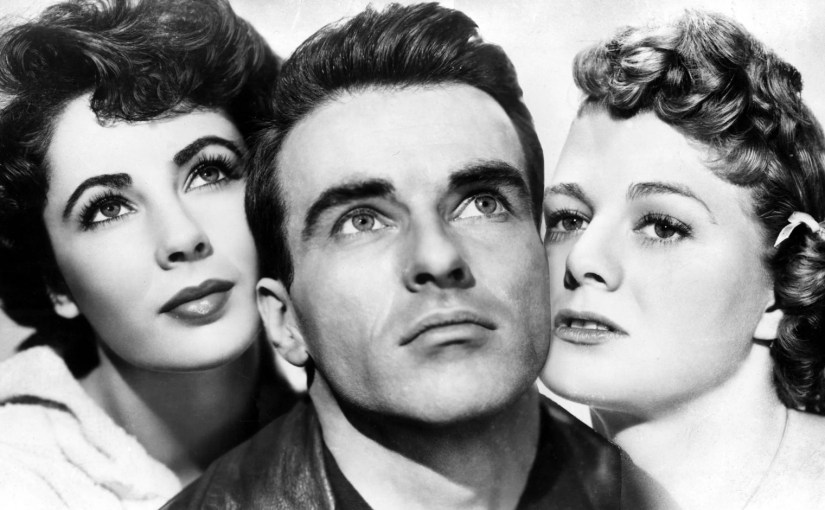
CAST: Olivia de Havilland, Montgomery Clift, Ralph Richardson, Miriam Hopkins
MY RATING: 10/10
ROTTEN TOMATOMETER: 100% Fresh

PLOT: In the mid-1800s, a naïve young woman falls for a handsome young rogue whom her emotionally abusive father suspects is the male version of a gold-digger.


[Author’s note: If you have not seen this film, but intend to do so, I urge you not to seek out spoilers.  The final resolution of this movie deserves to be seen in a vacuum, if you know what I mean.]

The AFI’s list of the 50 Greatest Villains in American film does not include Dr. Austin Sloper, played with indifferent cruelty by the great Ralph Richardson in William Wyler’s The Heiress.  This is a miscarriage of justice, as Dr. Sloper is one of the most ruthlessly harsh characters I’ve seen in a movie in many years.  The fact that he is successfully upstaged by Olivia de Havilland as his daughter, Catherine, is a triumph of screenwriting, directing, and pitch-perfect acting from both performers.  The fact that both performances nearly overshadow a charismatic young Montgomery Clift is something that must be seen to be believed.

The film starts in the mid-1800s in the Washington Square area of New York City.  It’s a time of horse-drawn carriages, corsets, and garden parties.  Catherine Sloper is a very plain, very shy, single woman who lives in a three-story brownstone with her widowed aunt, Lavinia (Miriam Hopkins), and her father, a financially successful doctor who will bequeath a $30,000-a-year inheritance to Catherine upon his death.  In addition to the $10,000-a-year she already receives from her mother’s inheritance, Catherine will be financially comfortable for the rest of her life.  Alas, her social graces are virtually nonexistent, and she is quite plain when compared to her late mother…as Dr. Sloper casually mentions from time to time, utterly oblivious to the effect this has on Catherine.

At a garden party, during which Catherine is socially humiliated by a thoughtless gentleman, she meets the well-dressed, well-behaved, and nearly penniless Morris Townsend (Clift), who makes it clear that he is utterly taken with her and would like nothing more than to spend the rest of the evening talking or dancing with her and no one else.  Her aunt Lavinia is ecstatic the next day, but Dr. Sloper is skeptical.  In his mind, no gentleman in his right mind would express romantic intentions towards his socially unsuitable daughter unless he simply wanted the money that comes with her, and he says as much to Mr. Townsend AND to Catherine.  The callousness of Dr. Sloper’s behavior is abhorrent, and I found myself thinking, “If this guy were drawn and quartered by the end of the movie, that would still be too good for him.”

The brilliance of the screenplay becomes apparent when Morris boldly announces his love for Catherine, to her complete stupefaction.  And when he actually proposes, that pushes her over the edge, and she falls head over heels in love with him, because he’s the first man who has ever shown anything more than polite tolerance towards her…including her father.  Dr. Sloper lays out his case for what he believes Townsend’s true intentions are: to take control of or squander her inheritance after they marry.

Dr. Sloper’s brutality knows no bounds…but you find yourself thinking: what if he’s right?  Certainly, Townsend is completely genuine in his love for Catherine, or at least seems to be.  He knows exactly what to say, and when and how to say it.  Is it an act?  He’s handsome enough to be an eligible catch for any number of society women in the city, so why waste his time on such a plain-Jane girl as Catherine?

This conflict occupies the main thrust of at least the first half of the film.  What transpires and how and when, I will not say.  I will say that the story led me in one well-traveled direction, took a left turn, then took another unexpected turn that left me kind of breathless at its audacity.  The movie as a whole has been compared in some circles to Scorsese’s The Age of Innocence (1993), and deservedly so.

Olivia de Havilland’s performance as Catherine is one of the greatest performances I’ve seen in any film of that era.  It trumps even her powerful turn in The Snake Pit a year earlier.  Clearly, de Havilland was anything but plain and awkward in real life, but careful makeup and performance nuances helped her bring off one of the most commanding roles of her career.  There is an emotional transformation that occurs at one point where she is able to affect a complete one-eighty in her character, and it never once feels histrionic or gimmicky.  She shares a scene with her father in which she has “found [her] tongue at last,” as he puts it, that I would rank as one of the greatest two-handed scenes I’ve ever watched.  The surgical application of language to inflict harm on another person is breathtaking.  Neil LaBute or David Mamet couldn’t have written it any better.

The Heiress left me feeling a little wrung out at the final credits.  I remember watching this movie many years ago, but nothing stuck with me except that ending.  Despite this foreknowledge, the movie still worked its spell on me, leaving me with a dropped jaw and a blown mind.  The ending is somehow definite and ambiguous at the same time, a screenwriting miracle.  (And I don’t mean in a Sopranos kind of way, either.)  The Heiress is officially one of my new favorite films.

WINCHESTER ‘73 (1950)

by Miguel E. Rodriguez

DIRECTOR: Anthony Mann
CAST: James Stewart, Shelley Winters, Dan Duryea, Stephen McNally, Millard Mitchell, Rock Hudson, Tony Curtis
MY RATING: 9/10
ROTTEN TOMATOMETER: 100% Fresh

PLOT: A cowboy’s obsession with retrieving his stolen rifle leads to a violent odyssey through the American West.


Even without knowing the full history of how the film impacted contemporary audiences, Anthony Mann’s Winchester ’73 still packs a punch.  Using an ingenious story structure, courtesy of a very Western MacGuffin, the film follows the path of a rare, expensive Winchester rifle from hand to hand for ninety taut minutes.  James Stewart is top billed, but he is on screen for less time than you’d think.  That’s actually a good thing in this case, as Mann’s focus is not on star power, but on metaphor and mythology.  (Although Stewart’s star power certainly doesn’t hurt, as he demonstrates in several key moments.)

The movie plops us right into the action with nary a flashback nor an expositional monologue in sight.  The legendary town of Dodge City is holding a shooting contest to celebrate Independence Day, 1876.  Sheriff Wyatt Earp (!) is officiating, and the prize will be a rare model of the Winchester ’73 repeating rifle.  Arriving in town that day is Lin McAdam (Stewart) with his partner, High-Spade Frankie Wilson (Millard Mitchell).

(Around this part of his career, Stewart’s trajectory was on the decline, as he was getting too old to play the aw-shucks-y kind of roles that were his bread and butter in the ‘30s and ‘40s.  Winchester ’73 was an opportunity to showcase his range, and he delivered.  Lin McAdam is not the villain, but neither is he the kind of character Stewart had ever played before.  It’s been written that, when audiences of the day saw Stewart get violent and pin a man to a saloon bar, there were gasps.)

Lin is none too friendly towards another man in town, Dutch Henry Brown (Stephen McNally), who reciprocates in spades.  There is clearly some kind of history, but what that history entails would take too long to explain, so the movie wisely doesn’t try.  They’re enemies, and that’s enough.  Somewhat predictably, they both enter the contest for the prize Winchester, but in the first of many twists, the contest doesn’t play out exactly as you would expect.  Then the rifle is stolen, Dutch and his pals skip town, and Lin and his partner give chase.

From there, the movie gets episodic.  There’s the Indian trader, the Indian himself, Young Bull (Rock Hudson in a fake nose and braids!!!), the obligatory feisty lady, Lola (a luminous young Shelley Winters) and her beau who behaves in a most unmanly manner, a run-in with some cavalrymen (featuring an unknown young actor billed as “Anthony Curtis”), and winding up with a real sleazeball, Waco Johnny Dean (Dan Duryea).  How the rifle makes its way from place to place I will not reveal, but it’s all perfectly feasible.

(I will leave it to wiser minds than I to discuss the racist portrayal of Indigenous Americans, including using Rock Hudson in “red-face” to play a tribal chief.  Yes, it’s shameful and unfortunate, but it happened, and I use the term “Indian” earlier because that’s how they’re referred to in the film, for better or worse.)

If I had to explain what this movie is actually about, beyond its brilliant plotting, I’m not sure I could do it.  I can report that it was engaging and crisp and surprising and almost demands a rewatch after the end credits, but aside from just being a darn good entry in the Western genre, it’s hard for me to pin down its message.  Is it a screed against the violence in the real West?  How some men searched for violence because it was in their nature, or because they felt it was their duty?  I mean…yeah, I guess, but that feels like just scratching the surface.  What were Mann and Stewart trying to say?

Maybe it’s one of those movies where the message depends on the viewer.  If you look at it as an anti-violence film with a bittersweet ending filled with moral ambiguity, it’s there.  If you look at it as just a travelogue or tapestry of the old West, made by a director who loves the genre and an actor sinking his teeth into a great role, that’s there, too.  (Mann and Stewart would go on to make seven more films together, five of them Westerns.)  There’s even melodrama and a hint of romance along the way, but never too much to drown everything else out.  For me, Winchester ‘73 is much harder to unpack than Unforgiven (1992), whose message is crystal clear from beginning to end.  Both movies are equally entertaining, though, don’t misunderstand me.

If any active readers have made it this far, feel free to let me know what the “true meaning” of Winchester ’73 is.  Whether I find out or not will truly not matter, because the movie is still hugely entertaining with or without an explanation.  I might have a tiny bone to pick with the final battle, with its foregone conclusion, but it comes with the territory, so I have to forgive it.  This is a great entry in the genre, featuring a star pushing his boundaries and a director who knew how to harness that energy.

VAMPYR (Germany, 1932)

by Miguel E. Rodriguez

DIRECTOR: Carl Th. Dreyer
CAST: Julian West, Maurice Schutz, Rena Mandel, Sybille Schmitz
MY RATING: 8/10
ROTTEN TOMATOMETER: 98% Certified Fresh

PLOT: A drifter obsessed with the supernatural stumbles upon an inn where a severely ill adolescent girl is slowly becoming a vampire.


Carl Th. Dreyer’s Vampyr [pronounced “vom-PEER” in this German version] is not the scariest vampire film I’ve ever seen, but it is definitely one of the creepiest.  There’s a difference.  Dreyer’s film doesn’t move with the pacing seen in more standard horror fare.  Instead, it forsakes typical plot development for scenes that linger on the horrific or the unexplained.  In its own way, it is more directly related to the films of David Lynch than to any other contemporary monster movies of the time (Dracula or Frankenstein, for example, both 1931).

The story is fairly simple, but it belies the complex imagery that awaits the viewer.  A young drifter, Allan Grey, happens upon an inn from which he thinks he can hear animal sounds, or perhaps a young woman screaming.  The village doctor, who looks like a bespectacled long-lost relative of Doc Brown from Back to the Future, vehemently denies the presence any animals or young women on the property.  The innkeeper invites Allan to stay the night.  In the middle of the night, Allan’s sleep is interrupted by a mysterious visitor to his room who intones, “The girl must not die!”  The gentleman then leaves a package on Allan’s desk and writes a most portentous message: “TO BE OPENED ONLY UPON MY DEATH.”

What is this book?  What did Allan hear?  And how do you explain the shadows he saw on his way to the inn?  Shadows of people running along the lane – with no corresponding people attached to them?  Wouldn’t YOU like to know.

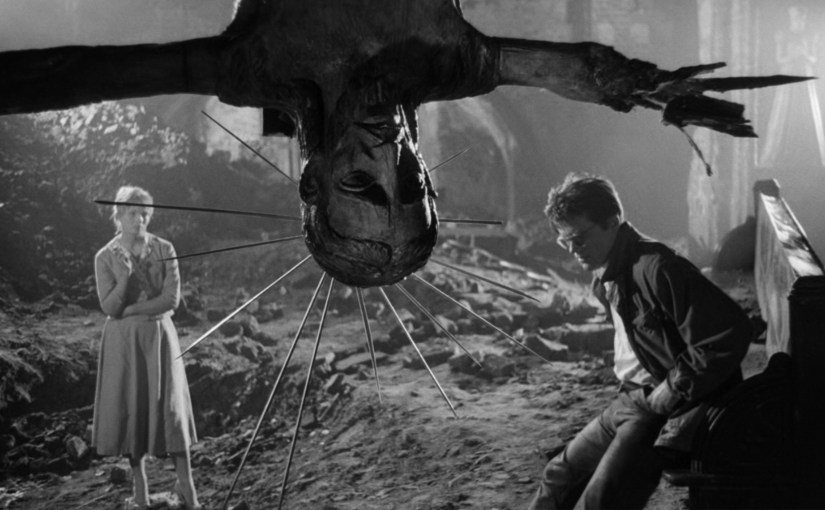
Vampyr is positively drowning in atmosphere.  Dreyer apparently shot many scenes with a piece of thin gauze over the lens, creating a misty layer that makes everything feel like a dream, even when Allan is awake.  Allan goes on frequent excursions around the inn and the surrounding property, and it’s here where most of the fantastical imagery is seen, especially when it comes to disembodied shadows.  In one mildly unsettling sequence, a shadow of a man with a peg leg descends a ladder and appears to sit on a bench…re-joining itself to a peg-legged man already sitting on the same bench.

There’s a lot more, but I don’t want to just write a list.  However, I am compelled to mention one sequence in particular that exudes as much creepiness as anything I’ve ever seen from this cinematic era.

It turns out there is, not one young woman at the inn, but two: Gisèle and Léone.  Léone is seen early on, confined to her bed with a mysterious illness, which we later learn has been brought on by her contact with a seldom-seen old woman who lurks somewhere on the property.  And there are some odd injuries on her neck…UH oh.

At one point, Léone awakes while Gisèle is alone with her.  I don’t remember what they discuss, but Léone goes into this weird sort of trance.  Without the use of any strange Chaney-esque makeup or camera tricks, Léone’s face becomes an object lesson in creepiness.  Her eyes open wide, her face breaks into a creepy grin, and she slowly moves her head from side to side, while Gisèle backs away in terror.  It might be the scariest sequence in the film, one which could easily compare to any subsequent monster or vampire movie.

Later, Dreyer throws more camera tricks at us in increasingly imaginative ways.  Allan dreams of a skeleton handing him a bottle of poison.  A dead man’s face appears in the sky during a sudden thunderstorm.  Dreyer includes camera moves that would fit right into any modern film.  And in a sequence that reminded me of Wes Craven’s The Serpent and the Rainbow (1988), Allan watches as his own body is sealed inside a coffin with a tiny square window for his apparently dead eyes to look out of.

If nothing else, Vampyr is an interesting artifact of cinema’s transitional era from silent to sound.  Even though there is a conventional soundtrack and we hear people’s voices as they speak, a lot of expository information is provided via title cards and long looks at passages from a book of vampire lore.  Given that the vampire mythology was then not as popular as it is today, I can forgive these beats that tend to bring the momentum to a halt.

While Nosferatu (1922) and the Bela Lugosi Dracula are much more famous, Vampyr is worth a look if you’re a horror fan.  While it doesn’t involve the kind of fear factor I tend to expect as a child of the 1970s and ‘80s, it is nevertheless creepy as hell. 

IPHIGENIA (Greece, 1977)

by Miguel E. Rodriguez

DIRECTOR: Michael Cacoyannis
CAST: Irene Papas, Kostas Kozakos, Tatiana Papamoschou
MY RATING: 9/10
ROTTEN TOMATOMETER: [Not scored]

PLOT: In ancient Greece, King Agamemnon, in order to appease the gods, is told he must sacrifice his favorite daughter, Iphigenia, before his troops can march to war.


To my mental library of favorite closing shots in cinema, I must now add the final image of the engrossing Greek film Iphigenia.  I won’t spoil it, but the hatred in the eyes, the set expression of the face, spell out exactly what will follow in the years to come without saying a word.  It’s cinematic, yes, but it’s also theatrical, expressing oceans of passion (good or bad) with a stare instead of a monologue.

Director Michael Cacoyannis’ filmed adaptation of an ancient Greek tragedy by Euripides (Iphigenia in Aulis) does not immediately seem like the kind of film I would cotton to.  I’ve never read any of the ancient Greek plays, nor have I ever read the Iliad or the Odyssey, though I am familiar with their plots…barely.  This is not the kind of literature I have traditionally sought out, and I am content in my decisions.  But a weird thing happened while watching Iphigenia.  After a somewhat rocky start, I became enthralled with the language these characters were using.  I don’t mean the Greek language itself, but the subtitles used in the English translation.  I cannot say with any certainty how closely the subtitles mirror what is actually being said, but if they’re even just fairly accurate, then I now understand, at least to a small degree, why these plays have endured for millennia.

The story itself is one that has undergone countless interpretations and revisions over the course of history.  King Agamemnon (Kostas Kozakos) and his vast army are ready to set sail for war against the kingdom of Troy, but their ships are stranded by a lack of wind.  The seer Calchas informs Agamemnon that the winds will not blow until he sacrifices his eldest and favorite daughter, Iphigenia, to the goddess Artemis, who is withholding the winds because his men have offended her by killing a sacred deer.  (And now I know where the title of The Killing of a Sacred Deer [2017] comes from…knowledge really IS power!)

Agamemnon agonizes over this decision, but his hand is forced by the eagerness of his troops to sack Troy; he’s afraid they’ll mutiny if he doesn’t go through with the sacrifice.  He invents a pending marriage of Iphigenia to the great warrior Achilles to get Iphigenia to the encampment, but Clytemnestra (Irene Papas), her mother and Agamemnon’s queen, tags along unexpectedly.  The rest of the movie churns with gloriously over-the-top melodrama, as Clytemnestra rages at Agamemnon, Iphigenia pleads for her life, and Achilles swears to defend Iphigenia at all costs.  Agamemnon also argues with his brother, Menelaus, in a terrific scene during which they both change each other’s minds just a little too late.  In the meantime, the winds never blow, the Greek troops grow restless, and the seer waits a little too eagerly for the chance to carry out the impending sacrifice.

It was during Agamemnon’s argument with Menelaus that I really started to perk up.  This is not an easy scene to write or act out.  Even with English subtitles, the sentence construction and syntax were occasionally overworked.  I remember thinking at one point, “Huh…this is almost Shakespearean.”  Except these scenes were written roughly two thousand years before Shakespeare was born.  When that concept smacked me in the face, I started paying attention a little more to the style and the passion of the words.  And I can’t explain it, but everything acquired a new dimension.  It started to feel more like a play than a film.  It became – at the risk of sounding a tad abstract – poetic.

That feeling permeated everything after that scene.  Throwaway scenes felt more immediate, and really important scenes felt monumental.  Sure, there is some overacting, particularly from the actor playing Achilles, but really, it’s called for in this scenario.  When Clytemnestra promises her husband that, if he goes through with the sacrifice, she will accept his will but hate him for the rest of her life…I really felt it.  And it’s not just the language, but the zealotry of the acting on display, especially from Irene Papas, who must have salivated at the chance to play this fiery woman, a proto-feminist who accepts her duty as a queen but never lets the king forget who truly rules the roost.

And then there’s Iphigenia herself, played by a waifish, almost elvish actress I’d never heard of before seeing this movie, Tatiana Papamoschou.  In her first scenes, she’s almost too innocent to be taken seriously.  It’s only when Iphigenia learns of her father’s plans to murder her for the sake of war that Papamoschou’s acting style allows her to really embody the character, and she delivers a speech late in the film that is, for lack of a better word, biblical.  She accepts her fate and shames the men around her with the same surgical precision that can be found in the Gospels when Jesus accepts His own fate while dismantling the Pharisees with His words.  There are monumental themes at play behind the scenes, and “normal” dialogue just would not feel adequate.

And then there’s that final shot.  I did a tiny bit of research on the original play, and when you learn what historically happened to the main characters after the play’s events, that last look carries even more weight, foretelling decades of death and tragedy without saying a word.  That a foreign film of a 2,200-year-old play was able to affect me this greatly was very pleasantly surprising to me.  I doubt any newer version with today’s technology or modernized dialogue would affect me the same way.  Iphigenia was a very pleasant, surprisingly effective discovery.