
by Miguel E. Rodriguez
DIRECTOR: Frank Lloyd
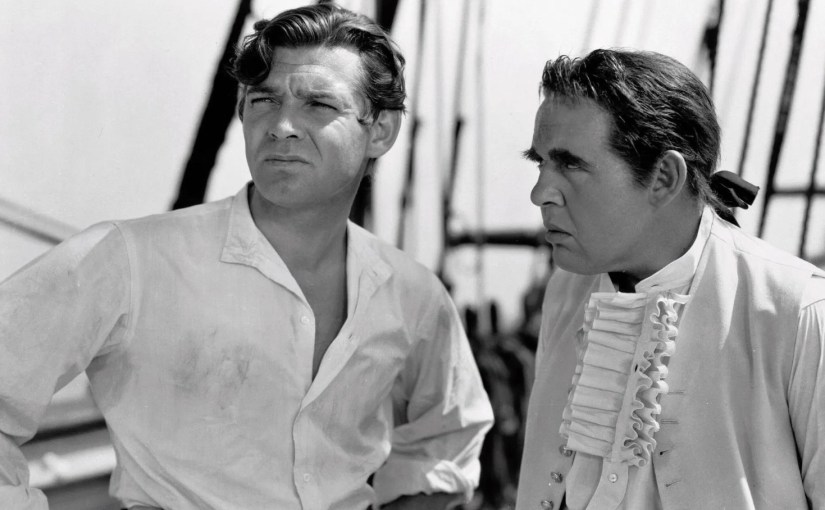
CAST: Charles Laughton, Clark Gable, Franchot Tone
MY RATING: 9/10
ROTTEN TOMATOMETER: 96% Certified Fresh
PLOT: First mate Fletcher Christian leads a revolt against his sadistic commander, Captain Bligh, in this classic seafaring adventure, based on the real-life 1789 mutiny.
For me, what makes the 1935 version of Mutiny on the Bounty special is not just the cast, although it’s exceptional, or the performances – the only film in Oscar history with three Best Actor nominations – or the rousing story. It’s the fact that the film provides a clear villain in Captain Bligh and appears to provide a clear hero/anti-hero in Fletcher Christian, while also making a great case that Fletcher was, in fact, wrong to incite the mutiny that made him famous. Bligh gets what he richly deserves, but does Fletcher Christian have the right to give it to him? I was reminded of Jason Robards’s classic line from the closing sequence of Crimson Tide, also about a (fictional) mutiny: “…insofar as the letter of the law is concerned, you were both right. And you were both also wrong. This is the dilemma…”
Gable as First Mate Fletcher Christian may not feel entirely appropriate in the role when we first see him, “press-ganging” unlucky sods into the crew of the Bounty in 18th-century England, prepping for a 2-year round-trip voyage to Tahiti. He’s taller than just about everyone else, handsomer, and speaks with no trace of an English accent. But his mere presence exudes “I’m the hero”, a quality not everyone can pull off just by standing there.
As the authoritarian Captain Bligh, Charles Laughton is incomparable. He generates instant antipathy when he’s first seen boarding the Bounty, not because of how he looks, but because of what he does: he commands a punishment of 24 lashes to be applied to a sailor convicted of striking his Captain…even though the sailor has already died from his injuries. When a crewmember faints at the spectacle, Bligh refuses to allow other crewmen to help him up. As an omen of things to come, that’s hard to beat.
But before we get to the classic struggle between Bligh and Christian, we first have to put to sea, and there’s an exhilarating sequence/montage of the Bounty getting underway. Nautical terminology flies fast and furious, commands are repeated, men scurry up the rigging faster than I can walk in a straight line, and I was reminded of my favorite “sailing-ship” movie of all time, Master and Commander: The Far Side of the World. The effect, while simply accomplished, is palpable and thrilling. Director Frank Lloyd and ace editor Margaret Booth work hard to keep that adventurous element present throughout the picture, a fact not lost to audiences who made Mutiny on the Bounty the box-office king of 1935.
After the Bounty gets underway to Tahiti, Bligh’s nasty streak gets even worse and worse. I’ll spare you the details, but his mean-spiritedness and petty cruelty knows no bounds. Meanwhile, Christian befriends a novice midshipman, Roger Byam. Like virtually the entire crew, neither man can stand Bligh’s behavior, but they remember they are sworn to the King’s service and follow their orders.
Their friendship is put to the test on the voyage home after their brief, almost idyllic stay on Tahiti. When Christian incites mutiny, the movie leaves no doubt that it’s the right thing to do. He’s had all he can take of Bligh, and so has most of the crew. But there are some who still swear loyalty to Bligh, not because they agree with his methods, but because, one, it’s their duty, and two, mutiny is punishable by death. After Bligh is cast adrift in the ship’s longboat with men loyal to him, Byam wants to go, too, but there is no more room.
The dynamic here really took me by surprise. Byam is as clean-cut as they come, but he’s no naif. His ethical stance is not to be taken lightly. When Christian calls Byam to his cabin for a talk, Byam refuses to look Christian in the eye, while Christian himself is apologetic and realizes that something has broken between them that may never be repaired. To me, this exchange was eye-opening. In many – not all, but many – other films from the Golden Age, the hero’s decisions and motivations are deemed pure and “right.” But here, to contrast Gable’s “righteous” image, we have another “righteous” character who implies that mutiny was absolutely NOT the way to go, no matter how vicious Bligh had become. Is it possible that Christian is the “bad guy” in this scenario?
(Towards the end of the film, there’s a court-martial scene. In another example of the film’s even-handed storytelling, after the verdict is handed down in favor of Bligh and against the mutineers, Bligh seeks to shake the hand of the judge presiding over the court-martial…but the judge refuses, telling him in so many words, “Your superb seamanship is not in doubt, but as a captain of men…” In other words, the law is the law, but I wouldn’t trust you as far as I could throw you.)
I love that Mutiny on the Bounty refuses to take sides, all appearances to the contrary. It turns what could have been a straightforward story about black and white into a surprising exploration of the gray areas in between. The sterling performances from Laughton, Gable, and Franchot Tone (as Roger Byam) are worth the price of admission. And there are some facts about the historical mutiny itself and its fallout that I did not know or remember, so I feel like I learned something in addition to being superbly entertained. What more could you ask for?
 2 UNPAID MOVIE CRITICS!!!!