THE EXTERMINATING ANGEL (Mexico, 1962)

by Miguel E. Rodriguez

DIRECTOR: Luis Buñuel
CAST: Silvia Pinal, Jacqueline Andere, José Baviera
MY RATING: 9/10
ROTTEN TOMATOMETER: 94% Fresh

PLOT: The guests at an upper-class dinner party find themselves unable to leave the drawing room in Buñuel’s famous, none-too-subtle satire.


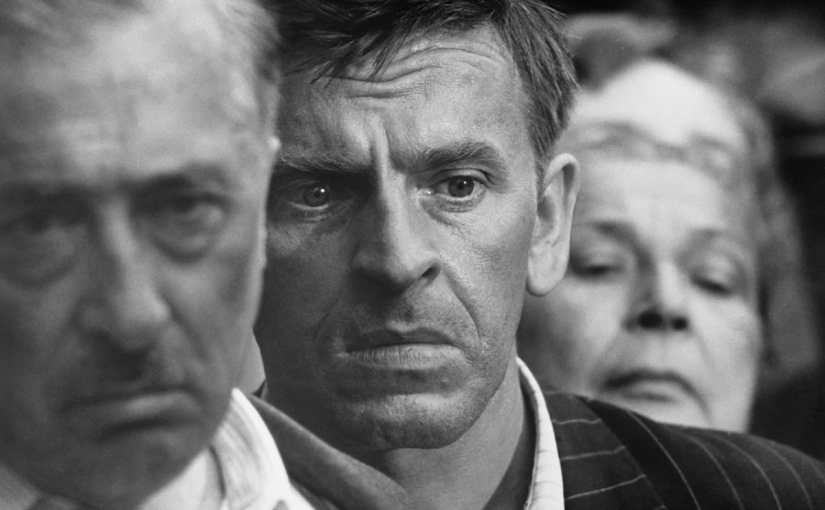
Buñuel’s The Exterminating Angel has many moods.  On the one hand, it’s a dark comedy of manners railing against the entitlements of the upper classes, much like the more recent Triangle of Sadness (2022), which owes much to this film.  On the other, it’s a Serling-esque horror story mining a common occasion for unexpected suspense, like The Ruins (2008) or Open Water (2003).  On a deeper level, perhaps it’s a Lynchian exploration of the human psyche, regardless of class, like Mulholland Drive (2001) or…well, with Lynch, you can probably just take your pick.

I experienced all of those moods while watching The Exterminating Angel.  I haven’t seen such an effective juxtaposition of tone since Everything Everywhere All at Once (2022).

The weirdness starts right away, in scenes that seem to be setting the stage for a Marx Brothers comedy.  Edmundo Nobile (“Nobile”, “noble”, get it, wink, wink?) has invited a large number of his posh friends to his mansion for dinner following an opera.  The moment they arrive, Nobile notes that his servants are not stationed at the door to take the visitors’ coats.  This is because most of the servants felt the sudden need to take the night off and left, being careful to avoid their employer.  He makes a statement about his servants, then everyone troops up the grand staircase to the dining room.

Moments later, this scene literally repeats itself, not by re-using the same footage, but in a separate take.  This kind of repetition occurs multiple times during the actual dinner scene, as well.  If there’s a deeper meaning to this device, I’ll have to leave it to film scholars to analyze.  For myself, it simply added a layer of oddness to the proceedings, but not in a bad way.

The dinner scene contains pratfalls, repeated conversations, and a visit to a side room containing three or four lambs and a bear on a leash.  What the WHAT…?  I remember thinking, okay, so this is going to a broad comedy turning upper-class manners into slapstick.  Seen it before, so I hope this movie executes it well.

The weirdness escalates when everyone retreats to a drawing room just off the dining room, where one of Nobile’s guests entertains everyone with a piano solo.  But when one of them tries to leave, he finds he can’t.  Not physically, like there’s suddenly an invisible wall, but one by one the guests discover they’re simply unable to leave the room.

They slowly realize the logistics of this bizarre situation.  The drawing room has no food.  Water runs low.  The one servant who remained outside manages to bring in a tray of water and coffee, but when he tries to leave to bring food…he can’t.  There’s no phone for them to call anyone about their predicament.

Outside the house, people find themselves unable to enter the grounds, so no one can tell what has happened to the people inside.  Curious crowds gather.  Inside, social structure starts to degenerate.  There are no restrooms, but one quick shot reveals a closet full of nothing but vases, and we see people entering and exiting these rooms repeatedly.  Ick.  Arguments are started with the drop of a hat.  One couple finds a unique, but undesirable, method of escaping their prison.

I responded to this material very unexpectedly, due mostly to its unpredictability.  I wasn’t cheering at the sight of upper-class twits being brought low when faced with bizarre circumstances, but I was more in tune with the horrific aspects of this story.  Buñuel has stated in interviews that he regretted not being able to take the story even further by including cannibalism, which is honestly where I thought things were headed.  It would have made a marvelous satirical statement, hearkening all the way back to Jonathan Swift.

(So, what DO they eat, you may be asking yourself?  Wouldn’t EWE like to know?)

I realize this review of the film hasn’t been much more than just a summary of its events, minus the surprising, “circular” ending.  A more detailed analysis might require listening to the commentary or reading Roger Ebert’s review or something.  But I hope I’ve conveyed how much I enjoyed The Exterminating Angel.  It was weird and surreal and absurd, and comic and horrific, and slapstick and satiric, and totally unpredictable all the way to the final frame.

P.S.  Now that I’ve seen this movie, the Woody Allen film Midnight in Paris (2011) has even deeper resonance when Gil meets Buñuel at a party and gives him the idea for The Exterminating Angel, and even Buñuel can’t understand it: “But I don’t get it. Why don’t they just walk out of the room?”  Funny stuff.

ASHES AND DIAMONDS (Poland, 1958)

by Miguel E. Rodriguez

DIRECTOR: Andrzej Wajda
CAST: Zbigniew Cybulski, Ewa Krzyzewska, Waclaw Zastrzezynski
MY RATING: 7/10
ROTTEN TOMATOMETER: 96% Fresh

PLOT: Against a backdrop of internal political turmoil at the end of World War II, a Polish resistance fighter faces a crisis of conscience when ordered to assassinate a Soviet official.


The Polish film Ashes and Diamonds is reportedly Francis Ford Coppola’s favorite movie, and Martin Scorsese has stated in interviews that he used it as an answer for one of his finals at film school.  From a technical standpoint, I can see why.  Echoes of this film (and perhaps others from director Andrzej Wajda’s filmography) are overwhelmingly evident in the bodies of work of both directors, from the mobile camera to the shocking moments of violence to the psychological makeup of the characters themselves.  As an emotional experience, I confess I didn’t get “worked up” over it, but it was interesting to see where two of the greatest American film directors got a healthy dose of inspiration.

Ashes and Diamonds opens on May 8, 1945, with an idyllic scene outside a country church that quickly degenerates into a brutal double murder.  The killers are the calm, detached Andrzej and the flighty, charismatic Maciek, who spends most of the movie behind dark sunglasses.  We quickly learn their victims are not who they thought they would be.  Instead of killing two Soviet/Communist officials, they have killed two innocent factory workers.  War is hell.

Later, through circumstances that feel very Hitchcockian, Andrzej and Maciek hole up in a hotel bar, only to discover that one of their real targets, Szczuka, has booked a room in the very same hotel.  Maciek books a room directly below Szczuka’s, and the rest of the film plays out with that element of suspense hanging in the background, leaving us to wonder when and how Maciek will complete his assignment.

Complications arise when Maciek becomes infatuated with the hotel bartender, Krystyna, a blond beauty who rebuffs Maciek’s advances at first.  Later, they connect, but she doesn’t want to get involved with someone when it will eventually have to end: “I don’t want bad memories when memories are all I have left.”  Maciek falls for her so hard that he starts to doubt his resolve to kill his target.  “Will he or won’t he?” becomes the movie’s prime conflict.

Where to begin with the comparisons to Coppola and Scorsese?  The most obvious one is the unblinking attitude towards violence.  The two killings at the beginning of the film are done with very few cutaways as we see the multiple bullet hits on each victim, with one of them getting hit in the eye and another shot in the back at point blank range with such force his shirt catches fire.  (Malfunctioning squib?  Possibly, but it’s still effective.)  It’s interesting that this movie predates Bonnie and Clyde (1967) by almost a decade, but its depiction of onscreen violence feels very modern, even by today’s standards.

Then you’ve got the moral struggle of the main character, a man of action capable of casual murder who is suddenly given a reason to make something different with his life.  This reminded me of Scorsese’s The Departed (2006), with DiCaprio’s character undergoing the same internal conflict.  Maciek has multiple opportunities to kill Szczuka throughout the film, but something always pulls him back from the brink.  His partner, Andrzej, becomes impatient and reminds him what happens when soldiers let personal feelings interfere with their duties.  I had a vivid flashback of Michael Corleone’s credo: “It’s not personal, Sonny.  It’s just business.”

(I also felt that the dynamic between Maciek and his more level-headed partner Andrzej were evoked in Scorsese’s Mean Streets [1973], with De Niro’s Johnny Boy and his more level-headed partner Charlie, played by Harvey Keitel.)

But, cinematic comparisons aside, I didn’t find Ashes and Diamonds to be as gripping as other war or crime dramas of that era, such as Elevator to the Gallows, Touch of Evil (both 1958), or Rififi (1955), to name a few.  It’s a little weird to me, because all the pieces are there for a first-rate thriller.  I’m not asking that every drama pack the exact same kind of emotional gut punch every single time because I know that’s unrealistic.  But the fact remains: Ashes and Diamonds, while clearly very influential on future filmmakers, did not get me as involved as I would like to have been.  I was never bored, but neither was I over the moon.  It was…average.  Perhaps one day I’ll watch it again with a fresh eye to maybe see what I missed the first time around.

FRANKENSTEIN (2025)

by Miguel E. Rodriguez

DIRECTOR: Guillermo del Toro
CAST: Oscar Isaac, Jacob Elordi, Christoph Waltz, Mia Goth, Charles Dance, David Bradley
MY RATING: 8/10
ROTTEN TOMATOMETER: 86% Certified Fresh

PLOT: A brilliant but egotistical scientist brings a creature to life in a monstrous experiment that threatens to undo both the creator and his tragic creation.


Having never read the original novel by Mary Shelley, I have no idea if Guillermo del Toro’s rendition of Frankenstein is any more or less faithful to the source material.  What’s interesting about this version is that it feels like it is.  There are long passages of dialogue and even some monologuing on the nature of life, death, and the creator’s responsibility to their creation.  del Toro is smart enough to balance these cerebral discussions with enough gothic (and gory) horror to satisfy any fan of the genre.  Call it a good example of a thinking man’s horror film.

Oscar Isaac’s performance as Victor Frankenstein puts a new spin on the stereotypical mad scientist.  He’s no less obsessed than previous versions, but del Toro and Isaac went for a slightly different vibe in his personal appearance.  Rather than a cackling lunatic with a god complex, Isaac’s doctor looks and sometimes behaves more like a self-absorbed rock star…with a god complex.  (I learn on IMDb that this was by design; del Toro wanted Victor to evoke David Bowie, Mick Jagger, and Prince…mission accomplished.)

Jacob Elordi as The Creature does an admirable job of generating sympathy and empathy for perhaps the greatest misunderstood monster of all time.  The unique makeup (which took up to 10 hours to apply!) allows Elordi to emote and lend humanity to the Creature in the second half of the film, especially during his encounter with the blind man.  There is a subtle but ingenious effect where one of his eyes will sometimes glow orange with reflected light as a reminder that, when push comes to shove, this Creature is not to be trifled with.

Mia Goth is a welcome presence as Elizabeth, who is not Victor’s love interest this time around, but fiancé to Victor’s younger brother, William.  I supposed I could quibble that the screenplay does not give Elizabeth much to do.  She comes across as the intellectual equal of Victor in a few well-written scenes, but her encounter with the chained Creature felt a little trope-y, and her character’s payoff left me wanting more.

The visual style of the film is crammed with del Toro’s signature fingerprints: huge gothic structures, elaborate costume designs (loved Victor’s mother’s red outfits near the start of the film), startling dream sequences, and lots of practical effects…well, more than there were in Pacific Rim (2013) and Crimson Peak (2015), anyway.  One image that really struck me was the unique design of two coffins seen in the film.  They looked more like futuristic cryogenic chambers than Victorian-era caskets.  Watch the movie and you’ll see what I mean.

Other things I loved:

  1. Victor’s early presentation of his theories to a disciplinary board, in which we get an echo of that creepy dead guy resurrected by Ron Perlman in del Toro’s Hellboy (2004).
  2. The towering set for Frankenstein’s laboratory.  What it lacks in the whirring, crackling machinery we normally associate with his lab, it makes up for in scale, including a yawning pit several feet across that really should have had a guardrail.
  3. Being able to get inside the Creature’s head this time around.  There have no doubt been other variations where the Creature speaks, but I haven’t seen one where he is this eloquent, expressing his pain and anguish over his unwanted existence and apparent immortality (his wounds are self-healing).  This is another factor that makes this movie feel more faithful to Shelley’s novel, even if it isn’t.
  4. The no-holds-barred aspect to the violence and gore, which can be quease-inducing, but which never feels overdone or exploitative.  In fact, the moment that scared me the most in the film had nothing to do with the gore or violence at all, but with one of the doctor’s early experiments that comes to life in a most surprising manner.

Above all, there’s the tragic nature of the poor Creature’s existence, the misunderstood monster that has been so often satirized or spoofed, and the deeper questions the story raises about our own lives.  It might be tempting to listen to the closing passages of the film and dismiss them as trite and sentimental, but Frankenstein earns those moments, in my opinion.  More than any other Frankenstein movie I’ve seen, this one made me think, and jump a little, in equal measures.  Tricky stuff.

THE LIFE OF EMILE ZOLA (1937)

by Miguel E. Rodriguez

DIRECTOR: William Dieterle
CAST: Paul Muni, Gale Sondergaard, Joseph Schildkraut, Gloria Holden
MY RATING: 9/10
ROTTEN TOMATOMETER: 92% Certified Fresh

PLOT: Prolific novelist and muckraker Emile Zola becomes involved in fighting the injustice of the infamous Dreyfus affair.


If you want to get me angry at the movies, you can do one of two things (besides leaving your phone on): Make a really terrible movie that makes me sorry I’ll never get those two hours back…or make a really good movie about some kind of social injustice, where those in power are so empirically wrong that any fool can see it, except those in power.  Matewan (1987) comes to mind, as do I, Daniel Blake (2016) and Do the Right Thing (1989).  William Dieterle’s The Life of Emile Zola falls neatly into that category, as well.

I’m tempted to give a play-by-play summary, but that would take too long.  In short, novelist and muckraking author Emile Zola is approached by the wife of Alfred Dreyfus, a French officer wrongly convicted of espionage and sentenced to Devil’s Island.  Mme. Dreyfus convinces Zola of her husband’s innocence, and Zola pens the famous J’Accuse…! article, an open letter published in the paper accusing the French military of antisemitism (Dreyfus was Jewish) and conspiracy.  The last act of the film covers Zola’s trial for libel.

The scenes that really made me angry were the ones where French officers planted, suppressed, or burned incriminating evidence of their own treachery.  Outright lies were paraded as fact, and the actual spy was acquitted in a court-martial of his own, just so the French government could continue the façade of Dreyfus’s guilt.  When the comeuppance arrives for the parties involved, it is immensely satisfying.  No one is drawn and quartered, which is what I would have preferred, but it’s good enough.

While the actor playing Dreyfus himself (Joseph Schildkraut) won the Oscar for Best Supporting Actor, it seems incredible to me that Paul Muni did not win for Best Actor that same year.  It went to Spencer Tracy for Captains Courageous, and I’m sure Tracy’s performance was exceptional, but Muni as Zola is pretty amazing.  He ages convincingly with Zola, from starving artist to a well-fed member of respected Parisian society, never less than convincing while playing a man much older than himself for much of the film.  The highlight is a late courtroom monologue that runs about six minutes.  It’s not exactly subtle screenwriting, but Muni makes the most of it.

The same could be said about the film’s screenplay as a whole.  It’s not the kind of story where the two sides have equal validity, so the script doesn’t have to be coy about where its sympathies lie.  There may be a few moments that feel like the film is preaching to the choir, but it nevertheless has great power.  That might just be me, though, given my proclivity for rooting against social injustice at the movies.

On the whole, The Life of Emile Zola is the tale of a life well-lived, punctuated by an incident that made Zola’s name immortal, and contains one of the best courtroom sequences I’ve ever seen.  It’s biography at old Hollywood’s best, not 100% historically accurate (as stated in an opening title card), but capturing the emotional essence of the story in a way no history textbook ever could.

SOMETHING WICKED THIS WAY COMES (1983)

by Miguel E. Rodriguez

DIRECTOR: Jack Clayton
CAST: Jason Robards, Jonathan Pryce, Vidal Peterson, Shawn Carson, Royal Dano, Diane Ladd, Pam Grier(!)
MY RATING: 5/10
ROTTEN TOMATOMETER: 62%

PLOT: In a small American town, a diabolical circus and its demonic proprietor grant wishes to the townsfolk…for a price.


Something Wicked This Way Comes answers the question: What would the Disney version of Needful Things (1993) look like?  Instead of the Devil opening a curio shop in the middle of town, we get a malevolent carnival impresario, Mr. Dark, and his devilish carnival that promises delights beyond your wildest dreams.  But beware, for the price of having your wish granted comes straight out of The Twilight Zone.

And no wonder, the screenplay was written by Ray Bradbury, based on his novel.  Too bad the movie fell victim to studio interference, resulting in jarring tonal shifts, some awkward edits, and two re-shot scenes where the two child stars are clearly a year older and a year taller than they appear elsewhere in the film.

The movie starts out as feel-good Americana, right out of Normal Rockwell: a small midwestern town in what looks like the late 19-teens or early ‘20s, complete with a town square, a general store with the obligatory cigar-store Indian out front, and a friendly bartender with one arm and one leg.  We are introduced to Will and Jim, our two child protagonists, and Will’s father, Charles (Jason Robards), who looked to old to have an 11-year-old son in 1968, let alone 1983, but whatever.

So, there’s that part of the movie, where it looks like it’s going to be a gentle fantasy like Field of Dreams (1989) or something, with the background score to match…but then really weird things start happening.  A local eccentric vanishes after seeing a ghostly woman inside a funeral parlor.  Mister Dark’s Pandemonium Carnival opens just outside of town.  We watch as the local miser takes a ride on the Ferris Wheel with a beautiful woman…but she’s the only one who gets off the ride at the end.  The disabled bartender sees a marvelous reflection in the House of Mirrors and walks in…but never comes out.  Our two heroes, Will and Jim, witness something incredible when they peek under the big top at a broken-down carousel that only runs in reverse…

And so on.  I’ve seen umpteen versions of this story, and so have you.  It can be done well, but it takes a singular vision.  Watching this movie felt like someone spliced two films together and hoped no one would notice.  First of all, who in their right minds casts Pam Grier as a non-speaking character called The Dust Witch?  Granted, she’s a looker, but you don’t cast Pam Grier in a movie just because she’s beautiful.  You gotta give her something to do besides seduce men and stare menacingly, which, granted, she does better than most, but what a waste!  I wanted to hear her vow to bring the powers of darkness down upon your village in a fiery rage, or something, I dunno, anything.

But that’s a side point compared to the horrors awaiting our heroes.  In a scene right out of your nightmares, our two heroes are faced with an army of tarantulas in their bedrooms in the middle of the night.  So many tarantulas, in fact, that in one horrifying moment, you can see the bedsheets moving from the sheer numbers of arachnids under the covers.  (This was one of those re-shot scenes where the kids are a year older.)  Much later in the film, Mr. Dark grips someone’s hand so hard that we see the victim’s hand literally splitting open – in a VERY brief shot, mind you, but there is no question of what has happened, as the victim wears a bandage on that hand for the rest of the movie.

What is this horrific material doing in a Disney movie, for crying out loud?  Something Wicked This Way Comes arrived during a transitional period for Disney, when they were testing the waters with more adult-themed fare – The Watcher in the Woods had been released a few years earlier, and Touchstone Pictures was on the brink of breaking out with Splash (1984).  But when it came to this weird hybrid family/horror movie, they got a little gun shy.

According to the invaluable IMDb, after a poorly-received test screening, Disney execs delayed the film’s release for a year so the film could be re-edited, an opening narration could be added, additional scenes could be shot and old ones replaced, and an entirely new score could be composed by maestro James Horner.  In their attempts to make the movie more family-friendly, they were the embodiment of the axiom “too many cooks in the kitchen.”  On an early laserdisc commentary, Ray Bradbury stated that much of his original intention for the film was destroyed as a result of these after-market edits.

There is a really, REALLY good movie trapped inside the existing version of Something Wicked This Way Comes.  Watch the movie, and you can see that really good version peeking through here and there (it feels like there was a LOT more that could’ve been done with Jonathan Pryce’s rendition of Mr. Dark).  As it is now, the movie is little more than an object lesson on why so many directors dream of getting “final cut” in their contract…so something like THIS doesn’t happen.

TRON: ARES (2025)

by Miguel E. Rodriguez

DIRECTOR: Joachim Rønning
CAST: Jared Leto, Greta Lee, Jeff Bridges, Evan Peters, Jodie Turner-Smith, Gillian Anderson
MY RATING: 8/10
ROTTEN TOMATOMETER: 56%

PLOT: A highly sophisticated AI program goes rogue against its programmers to defend a scientist who may hold the key to something called “permanence.”


For those who are not fans of the original Tron (1982) or its high-tech sequel Tron: Legacy (2010), let’s clear the air right away: Tron: Ares is not likely to convert you.  Period.  I see you and I understand you.  No hard feelings.  Heck, I’m a fan of both movies, and I heard the terrible advance buzz for Ares and saw the low ratings on Rotten Tomatoes and IMDb and thought, well, the franchise had a good run.  If it’s gonna suck, it might as well suck on the biggest screen I can find, in Dolby 3D, sixth-row center, to make the most of that Nine Inch Nails soundtrack/score and the slick CGI.

And…I gotta be honest.  Tron: Ares surprised me.  Admittedly, my opinion may be slightly influenced by the Dolby sound system that turned the synth- and bass-heavy score into a near-religious experience.  But Ares seems to have learned from the mistakes of its predecessors (earlier builds?), even going back to the original film.

First, the story is not nearly as cluttered as Tron: Legacy.  The first sequel threw in metaphysical content about spontaneously generated AI programs (the so-called ISOs), long conversations about the responsibilities of a creator/father to his creation/children, and duplicitous club owners (yep), and so on.  Tron: Ares, by comparison, is as straightforward as they come.  A MacGuffin is established early, as are the ground rules for how and why computer programs can exist as tangible entities in the real world, the bad guys are clearly identified (not all of them are in red), and once the pieces are set in motion, the movie only pauses the action when absolutely necessary.  It’s not Shakespeare, but it’s efficient.

Second, Tron: Ares makes a significant departure by moving the story between the “grid” and the real world multiple times.  The first two films, as you may remember, started with an expositional prologue in the real world, after which the hero is zapped into the grid for most of the rest of the film.  Ares starts in the grid, moves to the real world, gets its human hero into the grid, gets her AND Ares back out, then goes back into the grid again, and so on.  It introduced a rhythm that was missing from the first two films, and it broke up the visual palette so that neither one became boring.  Pretty slick.

Third…and this is something I just wrote about Brian Blessed’s character in Flash Gordon (1980)…Tron: Ares reintroduces an element from the first film that was virtually absent from the second film: a sense of fun.  It doesn’t introduce a wise-ass Kevin Flynn character or anything like that, but Jared Leto as Ares is given some genuinely funny dialogue that brought some much-needed laughs to the film.  Particularly when it comes to his preference for ‘80s synth-pop with catchy hooks.  Note: I’m not claiming it’s a laugh riot.  But the humor is very welcome when it arrives.

Another big factor in this movie’s favor is the huge Easter Egg that has not even been hinted at in the trailers, and thank God for that.  No, I’m not talking about the presence of Jeff Bridges, smart guy.  It’s so big (in my opinion) that the less said about it the better.  But I’m here to tell you, I haven’t geeked out that much in a movie theater since Ready Player One (2018).  Moving on…

And the score…!  I learned that Disney apparently insisted that the score be credited to “Nine Inch Nails” instead of “Trent Reznor and Atticus Ross.”  Good choice.  Their booming bass and synthesized soundscapes are the equal to the other two films in every way, if not superior.  (And I LOVED the Daft Punk music from Legacy.)  There’s even a song or two with vocals from Reznor!  What?!  Not content with nostalgia bombing us with random easter eggs from 40 years ago, Ares throws in a musical bomb from 30 years ago.  And it really, really fits the story.  Hand to God.

Overall, there is a nostalgic sheen to Tron: Ares that made it feel like I was watching a souped-up version of a really good ‘80s film.  That might be the highest praise I can give it.

If you’re a sucker for well-crafted nostalgia, you could do a lot worse than picking up a ticket for this movie before it gets pushed out of the cineplex by the Wicked sequel, if not sooner.  Bad buzz?  Whatever.  I had a good time.

À NOUS LA LIBERTÉ (1931)

by Miguel E. Rodriguez

DIRECTOR: René Clair
CAST: Henri Marchand, Raymond Cordy, Paul Ollivier, Germaine Aussey
MY RATING: 7/10
ROTTEN TOMATOMETER: 100% Fresh

PLOT: A convict escapes prison and becomes a wealthy industrialist, but his life of leisure is threatened when his former cellmate turns up unexpectedly.


À nous la liberté (rough translation: “freedom for all”) is a charming, if slight, romantic farce from celebrated French director René Clair, who would later make his mark in Hollywood films with I Married a Witch (1942) and And Then There Were None (1945) before returning to French cinema for the rest of his career.  It won’t go down as my favorite French film, or classic film, or anything like that, but as a snippet of cinema’s early years, along with some mildly scandalous history of its own, it’s worth a look for cineastes.

Louis and Émile are cellmates in a French prison.  Their daily routines are marked by hours and hours of assembling children’s toys on an assembly line that looks and feels a lot like the one from Chaplin’s Modern Times (1936) or even that one at a chocolate factory in a famous episode of I Love Lucy – but we’ll come back to that.  They sing, too, while toiling.  There’s a LOT of singing in À nous la liberté, not all of it clearly motivated, but serving as a kind of punctuation mark or accent piece to various scenes.

Émile and Louis attempt to escape their prison, but through no one’s fault, only Louis gets away, while Émile remains behind.  After some amusing episodes involving Louis trying to blend unobtrusively back into society, he lands a job hawking phonographs to pedestrians for a department store.  He gets so good at it that eventually he’s running the store…and eventually, improbably, he becomes the owner of the factory that BUILDS the phonographs, making him rich beyond his wildest dreams.

Trouble arrives in paradise when Louis’ cellmate, Émile, unexpectedly shows up, recently released from prison.  But he’s not looking for a job or to “touch” an old wealthy friend.  He’s in love with a girl who works at Louis’ factory, and getting a job there is the easiest way to stay close to her.  (I don’t THINK her name is ever said aloud, but she’s listed on IMDb as “Maud”, so that’s what I’ll call her.)  If Émile’s behavior sounds mildly stalker-y, well, it is, but what are you gonna do, love is love, and I’m sure I could dig up a modern rom-com or two that feature stalking as a romantic element.  Somehow.

Plus, there’s this whole ironic subtext that shows how the assembly lines at Louis’ phonograph factories are no different from the assembly lines at the prison.  The movie is not subtle about their similarities, but how could it be?  This fluffy material is corny as all hell, but the movie never gets too schmaltzy.  And if you think you know how the romantic subplot plays out in a romantic comedy from the 1930s, check your assumptions.

The centerpiece of the film is an assembly line sequence at the phonograph factory, a scene that has been imitated many times.  More modern movies and TV shows may have improved it, but having seen this movie, it’s clear where their inspiration came from.  In fact, the most interesting backstory of À nous la liberté is the fact that, after Charlie Chaplin released Modern Times in 1936, the producers of the French film sued Chaplin for plagiarism.  Both films feature bumbling but charming protagonists who wind up working on, and screwing up, assembly lines, and both films were making a point about the increased mechanization and dehumanization of the labor force.  After dragging on for ten years, Chaplin ultimately settled (without admitting guilt), but remained friends with René Clair for years afterward.

Having seen both films now, my opinion is that the similarities between the two films are purely incidental.  You might as well say that Star Wars plagiarized Star Trek because they both have “Star” in the title.  Modern Times is funnier and faster-paced, while the most farcical scenes in À nous la liberté are played, not for laughs, but smiles, if that makes sense.  It does to me, so I’m sticking with it.

It’s also interesting to observe how Clair used sound in this film from sound’s early years.  As I said before, there’s a lot of singing, but scenes with dialogue are few and far between.  Ambient sound is almost non-existent.  Where you might expect to hear lots of noises – scenes on the assembly line, for example – we only hear background score.  It’s almost startling when one scene plays street noises during an outdoor shot.  It’s almost as if Clair – like Chaplin – was reluctant to completely abandon silent storytelling in favor of this new sonic “trend.”  As a result, while it’s not a laugh riot, the film does have a quaint likability that is hard for me to describe.

À nous la liberté is an interesting peek backwards in time to when many of the film tropes we take for granted today were shiny and new.  It didn’t get me all “riled up” at an emotional level, but it wasn’t a waste of time.  And, like I said, there are one or two surprises story-wise.  That’s never a bad thing.

WINGS (1927)

by Miguel E. Rodriguez

DIRECTOR: William A. Wellman
CAST: Clara Bow, Charles ‘Buddy’ Rogers, Richard Arlen, Gary Cooper
MY RATING: 10/10
ROTTEN TOMATOMETER: 94% Certified Fresh

PLOT: Two young men, one rich, one middle class, who are in love with the same woman, become fighter pilots in World War I.


Not long ago, I purchased a copy of the 1927 classic Wings, based mostly on the favorable review by my friend and colleague, Marc Sanders.  I was more or less aware of its place in cinema history: the very first winner of the Best Picture Oscar, essentially the birthplace of Gary Cooper’s career (despite appearing in the film for just over 2 minutes), legendary aerial footage, and so on.  But I never felt compelled to seek it out.

Having finally watched it, I am very glad I did, and you should, too.  Wings is pure entertainment from start to finish.  Unexpectedly engrossing, captivating, thrilling, the whole enchilada.  High melodrama, comedy (borderline slapstick, what are you gonna do, it was 1927), romance, comic misunderstandings – and some not-so-comic – and eye-popping aerial footage, true to its reputation.  A neat camera move gliding over several cabaret tables even showcases director William A. Wellman’s desire to push the boundaries of what was possible with the massive cameras of his day.  I once wrote that Sunrise (1927) was my favorite silent film of all time.  If I ever make another 100-Favorite-Films list, Wings and Sunrise are going to have to duke it out…

Wings sets a surprisingly modern tone from the start.  In the very first sequences of the film, Jack Powell (Charles ‘Buddy’ Rogers) does not “ham it up” like some of the more typical Hollywood actors of that era.  Obviously, his mannerisms are exaggerated, but there is a restraint to his face and body that seems at odds (in a good way) with nearly everyone else in the film…except Gary Cooper, who, if he underplayed his role any further, would have become a still painting.  That restraint is also evident in Jack’s foil/nemesis, David Armstrong (Richard Arlen), the rich aristocrat to contrast Jack’s more humble background.  This moderation lends a very contemporary feel to a movie that’s nearly a century old – quite a feat.

In sharp contrast to the two male leads, the fabled Clara Bow plays her role, Mary Preston, with complete abandon.  She never truly overacts, exactly, but she throws herself into her supporting role with abandon.  Mary is hopelessly infatuated with Jack, who is actually in love with the debonair Sylvia Lewis (Jobyna Ralston), who is already involved with David, though they haven’t made anything official.  (If Facebook had been a thing back then, their relationship status would have been “It’s Complicated”.)  So, when Jack makes eyes at Sylvia, poor Mary is in the background as her hopeful smile deteriorates into sobs.  She may not be subtle, but Clara Bow makes sure you know EXACTLY what is on Mary’s mind at any given moment.

In the middle of this would-be soap opera, World War I intervenes.  Jack and David both enlist to become aviators.  A crucial scene shows Jack asking for Sylvia’s picture to keep as a good luck charm, a picture that has already been signed over to David.  Then, as he says his farewells to the lovelorn Mary, she offers him her picture.  How this scene plays out, and how it comes to bear much later, is one of the high points of the film’s ground-based drama.

But the real marquee attraction Wings comes during the aerial training and combat scenes.  Watching this movie, you understand why modern filmmakers today strive for realism as much as possible.  Ron Howard wanted to show weightless environments for Apollo 13, so sets were constructed inside a military jet tanker that flew parabolic arcs to simulate weightlessness…for real.  The makers of Top Gun: Maverick wanted to draw audiences into the film, so they had their actors train for weeks and months so they could be filmed inside the actual cockpits of F-18 fighters as they performed simulated combat maneuvers…for real.  Those filmmakers knew what had already been demonstrated decades earlier by Wings: nothing beats reality.

(Almost nothing…Ready Player One was pretty damn cool…BUT I DIGRESS…)

For Wings, director Wellman, a combat pilot himself during the war, knew that the best way to grab the audience by the lapels would be to get his actors up in the air for real.  To put it very briefly, he got his two lead actors to become certified pilots, got them into the air with small cameras strapped to the front of their planes, and had them act, fly their own planes, and be their own camera operators, all at the same time, while other stunt pilots flew around them, sometimes in VERY close quarters, simulating aerial combat.

The results are staggering.  There is a visceral mojo to these scenes that cannot be overstated.  Sure, it looks “old” because it’s black and white and grainy, but it is also undeniably real, and when you see long shots of a biplane going into a death spiral after being shot out of the sky, your intellect tells you there’s a real pilot flying a real plane hurtling at high speed towards the real ground, and you either sit back in awe or you lean forward with excitement.  There are a few scenes where real planes crash to the ground in various ways; one of them crashes into the side of a freaking HOUSE…for REAL.  IMDb mentions one staged crash where the plane didn’t do exactly what it was SUPPOSED to do, and the stunt pilot literally broke his neck…but survived and returned to his job six weeks later.  And it was all done in camera with no trickery or fake dummies in the cockpit.  It is literally mindboggling.

However, it should be noted that these accomplishments by themselves would mean very little if they weren’t hitched to a compelling story.  The love story among Jack, David, and Mary is a constant thread through the whole film.  Mary, having volunteered as an ambulance driver in the Army, miraculously finds herself stationed overseas…right next to Jack and David’s unit, wouldn’t you know it!  Contrivances aside, Wings expertly balances the exciting elements with the melodramatic flourishes.  The melodrama comes to a head when Mary finds herself alone in a hotel room with Jack, who is so drunk on champagne he doesn’t recognize her.  (She is dressed as a cabaret dancer, but that’s a long story…)  This movie truly contains the best of both worlds, genre-wise.

This might be crass of me to mention, but I’m going to anyway…Wings is also notable for some of the earliest on-screen nudity (in an AMERICAN film, anyway) that I can recall seeing.  There is a scene in a recruitment office where a line of bare male bums are lined up in the background, awaiting health inspection.  Then later, we see a woman’s bare breasts…just a brief glimpse, but it’s there.  Not only THAT, but during a fancy camera move in a French cabaret, we see a woman caressing another woman’s face…are they a couple?  Scandalous!  Who needs the Hays Code?  Not this guy!

(I could also mention the homo-erotic overtones during a pivotal scene towards the end of the film, but they pretty much speak for themselves [like the volleyball scene in Top Gun], so I’m just gonna move on…)

To sum up: Wings ranks as one of the greatest pure entertainments that Hollywood has ever served up.  Marc mentioned that it perhaps doesn’t get the love it deserves.  He’s probably right.  I’m sure it’s revered among cinephiles, but it is certainly not in the general public consciousness when it comes to silent films.  Regardless, it is exceptionally well-made and uncommonly effective.  If ever an old film deserved to be rediscovered by the general public, Wings is it.

A PLACE IN THE SUN (1951)

by Miguel E. Rodriguez

DIRECTOR: George Stevens
CAST: Montgomery Clift, Elizabeth Taylor, Shelley Winters, Raymond Burr
MY RATING: 9/10
ROTTEN TOMATOMETER: 82% Fresh

PLOT: A struggling young man gets a job working for his rich uncle and ends up falling in love with two women, one rich and one poor.


I first saw A Place in the Sun many moons ago at a friend’s house.  I remember enjoying it but thinking it was too soapy for my taste.  Years went by.  I finally got around to watching Woody Allen’s Match Point and was stunned at how much Allen’s film borrowed from George Stevens’ celebrated melodrama.  Having just re-watched A Place in the Sun, my opinion of it has warmed considerably, without diminishing my admiration for Match Point, which remains one of my favorite films of all time.

A Place in the Sun tells the story of young George Eastman, played by Montgomery Clift at or near the height of his powers.  He’s a bit of a layabout who wrangles a job at his rich uncle’s swimsuit factory.  When George meets his rich relatives, I was reminded of a George Gobel quip: “Did you ever get the feeling that the world was a tuxedo and you were a pair of brown shoes?”  That’s George Eastman to a T, a ne’er-do-well in a sea of the well-to-do.

Against company policy, George falls in love (or at least in lust) with a rather plain girl, Alice, played by Shelley Winters in a de-glamorized role that went completely against type at that point in her career, winning her a Best Actress nomination.  Alice and George flirt and hold hands and occasionally neck (mildly scandalous for a 1951 film), but George can’t help but stare at another girl who pops up occasionally: Angela Vickers.  Angela is played by a ravishing Elizabeth Taylor, who was only 17 at the time of filming and empirically one of the most beautiful women in Hollywood, if not the world.  It’s not too hard to imagine any man, let alone poor George Eastman, falling in love with her instantly.

But George is still connected to Alice, especially because he’s already slept with her.  When George learns Alice is pregnant, he despairs because he had been planning to end things with Alice to pursue Angela.  Alice even visits a doctor who might possibly provide an abortion.  Of course, this being 1951, “abortion” is never mentioned out loud, nor is the word “pregnant.”  But Alice’s visit to the doctor is handled with incredible intelligence and brilliant screenwriting that manages to say everything it needs to say without ever uttering those forbidden words.

The rest of the film examines what George may or may not be willing to do for the sake of his love for Angela, who loves him back, it turns out…but she doesn’t know about Alice.  Since this is based on a then-famous novel called An American Tragedy (by Theodore Dreiser), it may not be too hard to divine what is in store for George before the final credits roll, but getting there is the fun part.  By casting heartthrobs as the hero/anti-hero and the rich girl he loves, the film cleverly gets us to root for them a little bit, even when George is considering murder.

While Elizabeth Taylor dominates every scene she’s in just by standing there, the Academy made sure Shelley Winters was recognized for her incredibly difficult performance as Alice.  There are some movies where, if a character is an emotional yo-yo, it can be frustrating.  With Alice, Winters never crossed a line into unlikability, even when she calls George at a fancy dinner party demanding he marry her tomorrow, “or else.”  It’s clear she has no options left to her if she wants to have any semblance of a life in polite society (by 1950s standards, anyway).  I felt bad for her.  But I also felt bad for George – to a degree – when he demonstrates how sincerely he has fallen head over heels for Angela.  Not just because she’s stunningly beautiful, but also because she really seems to have fallen for him, too.

Lately, my movie-watching itinerary of classic films has involved a fair share of outstanding melodramas (Leave Her to Heaven, 1945; The Heiress, 1949; Dodsworth, 1936).  A Place in the Sun fits right into that mold.  It doesn’t quite achieve the perfection of The Heiress, but it is a fantastic example of its genre, good enough for Woody Allen to “reimagine” its basic story for Match Point, so it’s definitely worth a look if you’re into that kind of thing.

BRING HER BACK (2025)

by Miguel E. Rodriguez

DIRECTORS: Danny Philippou & Michael Philippou
CAST: Billy Barratt, Sally Hawkins, Jonah Wren Phillips, Sora Wong
MY RATING: 9/10
ROTTEN TOMATOMETER: 89% Certified Fresh

PLOT: A brother and sister uncover a terrifying ritual at the secluded home of their new foster mother.


Bring Her Back is a supremely disturbing modern horror film from the two directors of 2022’s celebrated debut film Talk to Me; it’s right up there with Hereditary [2018] and The Babadook [2014].  It brazenly opens with creepy black and white footage of…something…then appears to drop into “Lifetime-movie” mode, lulling us along until WHAM, something truly unbelievable occurs, and it’s just a roller-coaster ride the rest of the way.  It’s bloody ingenious.  (Emphasis on the “bloody.”)

Andy (Billy Barratt) and the visually-impaired Piper (Sora Wong) are step-siblings who experience an early tragedy, resulting in the two of them being assigned as foster children to Laura (Sally Hawkins), a single mother who has experienced a tragedy of her own.  Her child is Oliver (Jonah Wren Phillips), a 10-year-old boy who has been voluntarily mute since his sister, Laura’s daughter, drowned in their pool, now kept empty.

Ominous signs abound.  Laura’s house is completely encircled by a strip of white paint.  She locks Oliver in his room whenever she leaves the house.  At a funeral, Laura surreptitiously clips some hairs from the body in the casket.  Andy discovers he has started wetting the bed, but he’s 17 years old; Laura ascribes it to stress, but the real reason is far more…invasive.  And over everything is the mute Oliver, lurking in the background, occasionally banging on doors and windows, and more.

Another superb element to the story is the character of Piper, Andy’s visually-impaired sister.  I mention this because the filmmakers deliberately held a casting call for actual visually-impaired actresses, settling on the completely non-professional Sora Wong.  This aspect of her character is utilized to the hilt throughout the movie, in ways I can’t even hint at without spoiling any surprises.  (Okay, I’ll mention one moment…where she knows someone is front of her, feels their head, then turns and asks someone else, “Who is this?”  BRRRRR…)

When the Philippou brothers do drop the hammer and get started with the real horror elements, they do not hold back.  There are scenes here as terrifying and as off-putting (in a good way, I guess?) as anything in [insert your favorite horror film here].  There are images here that I will not soon forget.  In a perfect world, this movie would become so popular among horror fans that those scenes would become part of a pop-culture shorthand.  “The knife scene.”  “The table scene.”  “The Russian videos.”  “The ‘self-snacking’ shot.”

I initially had an issue with the very ending, which felt more, shall we say, heartfelt than the rest of the movie implied was coming.  However, I learn from IMDb that the Philippous had a much grander ending planned.  But everything changed when a close friend of theirs passed away unexpectedly during production; the film is dedicated to him in the closing credits.  Danny Philippou is quoted: “[The film’s ending] goes against the conventions a little bit, but it feels more true to life.”  Watch the film and judge for yourself if he’s right.  As for me, now that I know that piece of trivia, the film’s ending is easier for me to accept.

Here’s hoping that Bring Her Back becomes at least a cult classic.  For someone like me, who’s a bit picky with this genre, it’s an easy pick for a new movie to throw into my annual Halloween rotation.  I enjoyed the hell out of this movie.