
by Miguel E. Rodriguez
DIRECTOR: William A. Fraker
CAST: Lee Marvin, Jeanne Moreau, Jack Palance, Mitchell Ryan
MY RATING: 7/10
ROTTEN TOMATOMETER: 89% Fresh
PLOT: An aging cowboy realizes that the West he knew and loved will soon be no more – and that there will be no room for him, either.
Based on this film, Monte Walsh, and the other two films he directed, A Reflection of Fear [1972] and The Legend of the Lone Ranger [1981], I think it would be charitable to say that William A. Fraker’s best films are the ones where he served instead as director of photography, such as Bullitt [1968], WarGames [1983], and Tombstone [1993], among many other notable movies. Am I saying Monte Walsh is a bad film? No, but it’s certainly not as bad as Gene Siskel’s 1-star rating, nor is it as stellar as Roger Ebert’s 4-star rating. I give it a 7-out-of-10 on my scale because of the way the second half of the film builds and builds so that the outbursts of violence feel earned and motivated instead of cliched.
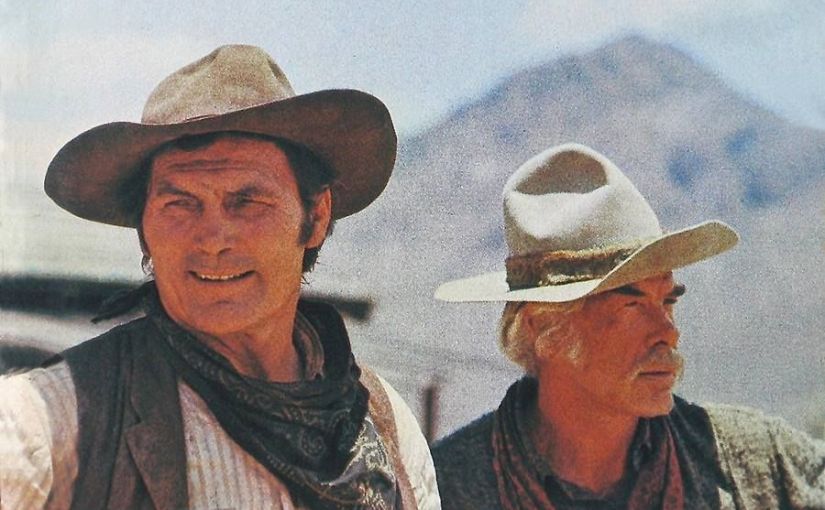
Monte Walsh (Lee Marvin, grizzled as ever, even with a handlebar moustache) and his friend and partner, Chet (Jack Palance in a rare non-villainous role), come down off a mountainside after a rough winter keeping watch on Mr. Brennan’s herd of cattle, only to get news that Brennan’s ranch has been purchased by a corporate entity, Consolidated Cattle. Brennan offers them a steady job, which they reluctantly take, but deep inside they know this means their prairie-roaming way of life is coming to an end. Chet is prepared to accept this, but Monte chafes at the idea. “I ain’t doing nothing I can’t do from a horse,” he warns Brennan.
We get entertaining glimpses of the ranch hand life, complete with the saloon fights and the stinky cook. Monte dallies with a French madame, Martine (played by the exotic Jeanne Moreau). At one point, Monte and Chet ride out and meet a weathered old ranch hand who is “riding fence,” or inspecting every foot of fence around the ranch for repairs…the only work he’s cut out for anymore. “Looks like his life is over with,” they say, and you can tell they’re looking into their own future.
The thrust of the film is one I’ve seen in many other westerns before this one: “The old West is changing, and there’s no place in it for people like us anymore, so we’d better evolve or die.” This theme is present in Once Upon a Time in the West [1968], Butch Cassidy and the Sundance Kid [1969], and especially The Wild Bunch [also 1969]…seemed to be a trend for westerns at the turn of the decade, for some reason. Monte Walsh handles it in an episodic format, kind of like another Lee Marvin film, The Big Red One [1980]. It doesn’t quite tell a straightforward plot with a pre-determined story arc. It skips around a little bit, painting a picture without telling a conventional story.
There can be a sense of freedom in this kind of storytelling. Unshackled by traditional story beats – at least for the first half – the movie is laid back, asking the viewer for a little patience as it slowly lays down building blocks for the finale. However, I must report that I found this section of the movie a little slow. I grew impatient. I felt I was being set up for something, but pretty soon I just wanted the movie to get on with it. Butch Cassidy sort of works that way, but you had two of the most photogenic stars who ever lived as the two leads. I struggled to care the same way for Jack Palance as I did for Paul Newman.
But then an unexpected scene of violence occurs, setting into motion a series of events that culminate in a tragic series of deaths that, I must admit, had me glued to the screen as they unfolded. Because of the gangbusters nature of this section, I am inclined to forgive the film’s shortcomings in its first half. Here, we see, yes, Monte must evolve or die, and even if it’s never in any real doubt what he will choose, it’s entertaining to watch him make that choice.
If not for the second half of the picture, I might not even be writing about Monte Walsh. I didn’t care for the opening song (even if it WAS sung by Mama Cass), some of the movie felt ripped off from several other westerns, and I was borderline bored for the first half. But if you stick with Monte Walsh until the end, I think you’ll agree it’s worth a look.
 2 UNPAID MOVIE CRITICS!!!!