FAREWELL, MY LOVELY (1975)

DIRECTOR: Dick Richards
CAST: Robert Mitchum, Charlotte Rampling, John Ireland, Sylvia Miles, Anthony Zerbe, Harry Dean Stanton, Jack O’Halloran, Joe Spinell, Sylvester Stallone
MY RATING: 9/10
ROTTEN TOMATOMETER: 71% Fresh

PLOT: When a giant ex-con fresh from prison asks Philip Marlowe to find his missing sweetheart, Marlowe winds up entangled in multiple murders, prostitutes, and a sultry trophy wife.


Because it was released only a year after Chinatown (1974), it is tempting to compare Farewell, My Lovely to that landmark film noir, but although they are in the same genre, the two films are apples and oranges…or at least apples and pears.  Both feature hard-nosed private eyes accepting cases that turn out to be more complicated and far-reaching than they appear, both feature multiple unexpected deaths, and both feature curvy, smoky-eyed dames with dangerous secrets and aging husbands.  All true to the genre.  But Chinatown breaks (successfully) with film noir in several key areas, while Farewell, My Lovely achieves its lofty heights while still remaining faithful to the bedrock tropes of vintage film noir, right down to the tired voice-over narration from the hero.  I have no idea how faithful it is to the Raymond Chandler novel by the same name, but if the book is half as entertaining as the movie, I may have to track it down and give it a read.

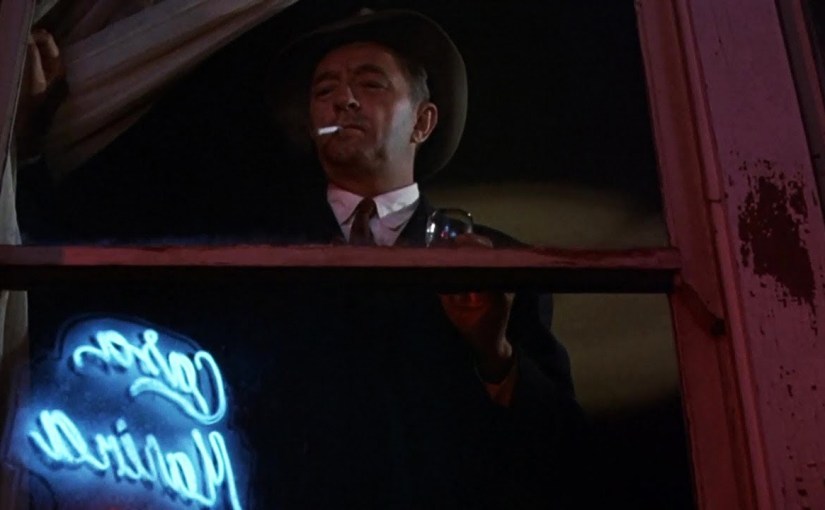
Robert Mitchum plays legendary gumshoe Philip Marlowe, the third version of the character I’ve ever seen after Humphrey Bogart (The Big Sleep, 1946) and Elliott Gould (The Long Goodbye, 1973).  Compared to the other two, Mitchum is by far the most shambling version, but I mean that in a good way.  We first see him staring out of a rundown hotel room in downtown Los Angeles, some time in 1941.  We know the timeframe because of a calendar here and there, and because Marlowe is obsessively following Joe DiMaggio’s progress, as he is on the verge of breaking the record for hits in consecutive games.  That’s a nice touch.  Marlowe’s world-weary narration plays over Mitchum’s sagging face and drooping cigarette, and the spell is complete: we are in the hands of one of the great genre pictures, from a story by one of the greatest mystery writers of his generation.

Marlowe’s story starts as a flashback, a story he’s relating to similarly-weary Lieutenant Nulty (John Ireland).  See, it all began when Marlowe was tracking down a rich family’s runaway daughter.  Soon thereafter, “this guy the size of the Statue of Liberty walks up to me.”  This is Moose Malloy, an ex-con fresh out of the slammer after serving seven years for armed robbery and making off with $80,000, which was never recovered.  Moose is played by Jack O’Halloran, whom cinephiles will recognize immediately as the overly large/tall man who played Non, the mute superpowered henchman in 1980’s Superman II.  To see this man actually string words together into sentences was a strange experience, but I eventually got used to it.

Moose wants Marlowe to find his sweetheart, Velma, who hasn’t written to him the last six years of his stretch.  Next thing you know, someone takes a potshot at Moose on the street, Moose winds up killing a guy in a bar, and Marlowe follows Velma’s trail to an insane asylum, and that’s still just the tip of the damn iceberg, because now there’s this guy who wants Marlowe to help deliver $15,000 in ransom to some other guys who stole a jade necklace…and we STILL haven’t seen the rich trophy wife yet.

And round and round it goes.  I have seen other films that attempted to combine this many plot threads and they wound up a jumbled mess.  Not this movie.  Farewell, My Lovely skillfully walked that tightrope and held my interest all the way through.  I was never lost, never confused…except for a couple of places where the soundtrack obscured a word or two, but I don’t know if that’s the soundtrack’s fault or the actors for mumbling too much.  Plus, this movie contains one of the single greatest interrogation sequences I’ve ever seen, starring Marlowe, two thugs, and the madame of a whorehouse.  It starts semi-normal, escalates with a shocker, then tops the first shocker with something I didn’t think even a hardcase like Philip Marlowe would do.  But the more I watched this movie, the more I got the sense (whether it’s true or not, I don’t know) that this Mitchum version of Marlowe is truer to the literary Marlowe than we ever got previously, in terms of Marlowe’s principles.

I should also mention the dialogue, which contains some of the best one-liners and comebacks I’ve ever had the pleasure of listening to.  For example:

  • Marlowe describing a large house he’s driving up to: “The house wasn’t much.  It was smaller than Buckingham Palace and probably had fewer windows than the Chrysler Building.”
  • Marlowe on his billing practices: “I don’t accept tips for finding kids.  Pets, yes…five dollars for dogs, ten dollars for elephants.”
  • Marlowe describing the obligatory femme fatale (Charlotte Rampling): “She had a full set of curves which nobody had been able to improve on.  She was giving me the kinda look I could feel in my hip pocket.”
  • Marlowe when the femme fatale asks him to sit next to her: “I’ve been thinking about that for some time.  Ever since you first crossed your legs, to be exact.”

Dialogue and lines like this are dangerous because they have been the targets of so many parodies for so long that modern audiences may have forgotten how to take them at face value.  But in Farewell, My Lovely, it comes off perfectly as a tribute to the classic noirs of the 1940s and ‘50s, a tip of the hat to the giants of the past.

Conversely, this movie also reminded me of many of the best eighties thrillers I remember watching, which is ironic considering it was released in 1975.  Movies like Body Heat and Jagged Edge and Silverado, whose purpose for existing seemed to be just to tell a freaking awesome story, unburdened with subtextual layering but laden with style and wit and intelligence, paying homage to their cinematic ancestors by emulating them without plagiarizing them.  There are no doubt film historians who could analyze this film scene by scene and explain exactly what the filmmakers were really trying to tell us underneath the ingenious dialogue and intricate plotting.  But even if I knew or understood all of that, I maintain the best reason for seeking out and watching Farewell, My Lovely will always because it’s just a damn good movie.

(…if for no other reason because of that interrogation scene…I had to rewind it a couple of times just to get my shocked laughter out of my system…)

THE PUBLIC ENEMY (1931)

by Miguel E. Rodriguez

DIRECTOR: Willam A. Wellman
CAST: James Cagney, Jean Harlow, Edward Woods, Joan Blondell
MY RATING: 10/10
ROTTEN TOMATOMETER: 100% Fresh

PLOT: An Irish-American street punk tries to make it big in organized crime during Prohibition.


Having just finished watching Little Caesar (1931) a few days ago, I popped in The Public Enemy, expecting more of the same, if I’m being honest: a fledgling gangster picture, rough around the edges, not spectacular, but historically important.  I could not have been more wrong.  Where Little Caesar at times seemed to be going through the motions, The Public Enemy crackles and sizzles and pops off the screen, still capable of shocking and surprising me nearly a century after it was released.  If that’s not the definition of a masterpiece, well, it damn sure oughta be.

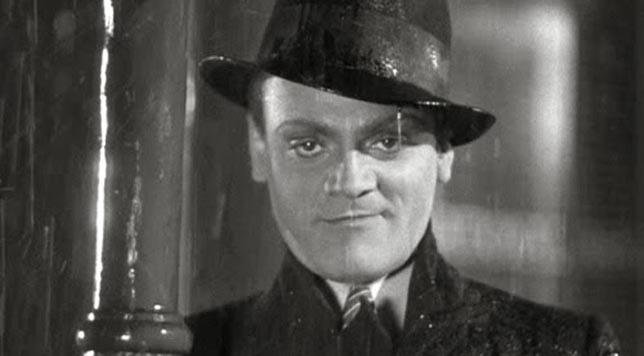
James Cagney gives one of his most indelible performances as Tom Powers, a kid who grew up tough with his best friend, Matt Doyle.  We meet them first as kids in 1909, raising a little hell, teasing Matt’s sister, disdaining Tom’s goody-two-shoes older brother Mike, and learning to treat the law and police officers as a necessary evil.  They supplement their income by stealing watches and giving them to a small-time hood, Putty Nose, who gives them a pittance and treats them like Fagin treated Oliver Twist.  Six years later, they’ve grown into young men (Matt is played as an adult by Edward Woods) who are still in league with Putty Nose, but when a planned theft goes awry, Putty leaves Tom and Matt dangling and wishing only for revenge.

(I enjoyed this back-story approach, as opposed to Little Caesar, which by comparison feels like it plunks us into the middle of a story already in progress and wastes no time waiting for us to catch up.  I know I probably shouldn’t critique a movie by comparing it to another, but I can’t stop myself, sue me.)

It’s during this botched robbery that we get the first glimpses that this movie will pull no punches when it comes to violence, or at least as much as it could in 1931.  A fleeing accomplice is shot at least twice in the back by a patrolman.  He chases Tom and Matt into a dark alley.  We see gunshots flare in the darkness with no clear idea of what’s happening.  Tom and Matt reappear, toss their guns away, and run off…and in a poignant button to the scene, we see a close up of the patrolman’s gun hand lying lifeless under a streetlamp.  We see nothing graphic, but we know exactly what’s happened.  The Public Enemy will use this device many times throughout the picture, to great effect.

Time passes.  Tom’s older brother, Mike, enlists in the Marines for World War I.  No love is lost between the two of them when Mike learns of Tom’s criminal activities.  When Prohibition is enacted, Tom and Matt get even more involved in those activities, working for a sharply dressed mobster, “Nails” Nathan.  They start making more money, buying fancy new cars and clothes.  (One of the funnier scenes occurs when Tom is getting fitted for a custom suit by a tailor who is so far in the closet he’s finding Christmas presents from 1889.)  They meet a couple of molls, which leads to the famous “grapefruit” scene that had women’s groups up in arms…maybe it still does, I couldn’t say.  And they get better at their jobs, in deeper with the mob, and suddenly…

But I’m summarizing again.  That’s how this movie has gotten to me.  I am so enthused about it that I want to shake people by the collar and say, “If you love gangster movies, don’t make the same mistake I did by not seeing The Public Enemy until I was [age deleted]!  It’s sensational!  Here, let me tell you about it…”

Director William A. Wellman (The Ox-Bow Incident, 1942) displays a directorial style that, to my untrained eye, transcends the era in which he was working.  Made in 1931, it feels like it was made ten or fifteen years later, in the vein of the best films of Wilder or Hawks.  Martin Scorsese even calls it “the birth of modern movie acting,” and it’s hard to argue with him when you’re watching Cagney command every single second he’s onscreen, whether he’s whispering sweet nothings into a girl’s ear or playfully chucking his mom on the chin or contemplating gruesome violence as his face twists into an evil grin.

I feel it necessary to mention once more the shocking violent acts perpetrated during the film.  Again, we rarely actually see the violent acts themselves (like the infamous ear scene in Reservoir Dogs [1992]), but that just makes them land even harder.  The camera either tracks off the impending scene or stays behind while gunmen march into another room, leaving us to hear the violence instead of seeing it.  It’s practically Hitchcockian, and it’s perfectly executed.  This method makes the film feel even MORE modern.  Re-shoot this movie, shot for shot, line for line, with all of the tools available to the modern filmmaker, and it would still work, even in a world where Goodfellas and The Untouchables exist.

So, run, don’t walk, to either your friendly local streaming service or to your favorite online retailer and buy or stream The Public Enemy today.  And don’t thank me.  Just promise to tell YOUR friends how awesome it is.  Because it really, really is.

LITTLE CAESAR (1931)

by Miguel E. Rodriguez

DIRECTOR: Mervyn LeRoy
CAST: Edward G. Robinson, Douglas Fairbanks Jr., Glenda Farrell
MY RATING: 7/10
ROTTEN TOMATOMETER: 96% Fresh

PLOT: A small-time hood shoots his way to the top of the mob ring during Prohibition, but how long will he stay there?


Lurking in the DNA of Mervyn LeRoy’s seminal gangster flick Little Caesar are the genetic markers for virtually every mob movie that’s been made ever since.  It helped kick off a trend of gangster films that proliferated in the 1930s: Angels with Dirty Faces, Scarface, The Public Enemy, The Roaring Twenties, et al.  Its themes have been repeated in masterpieces like The Godfather, Bonnie and Clyde, and Brian DePalma’s epic remake of Scarface, and we never seem to tire of it.  If Little Caesar lacks the visual and editorial pizzazz of those later films…well, what are you gonna do, they were pretty much breaking ground on the genre.  Let’s cut them at least a LITTLE slack.

The film tells the story of the rise and fall of Caesar Enrico Bandello, a small-time thug played by Edward G. Robinson in the performance that would follow him for the rest of his career, no matter how many times he tried to shake it off.  His delivery and intonations would become the hallmarks of gangster-speak for decades.  (Even Chief Wiggum’s voice on The Simpsons is an echo of Robinson.)  The movie opens with a scene of sudden and startling violence, even if it’s done in the shadow of darkness.  Afterwards, Rico and his partner in crime, Joe, talk things over in an all-night diner.  The casting of Douglas Fairbanks Jr. as Rico’s partner was a masterstroke, emphasizing their differences in size and demeanor right at the start.  As their career paths diverge, Rico gets a little meaner and “squintier”, while Joe stays as improbably handsome as ever.  Clever visual shorthand.

Little Caesar moves quickly…really quickly.  Think of one of your favorite gangster movies.  Picture it as a big hamburger patty sitting on a bun.  Now trim everything off the edges so nothing spills off the boundaries of the bun, and you’re left with nothing but a lean little circle of meat.  That’s Little Caesar.  Clocking in at a scant 78 minutes, it’s barely longer than Bambi.  This movie exemplifies the get-in-get-out-nobody-gets-hurt school of moviemaking.  We get all the character exposition we need in the opening five minutes.  Villains look like villains, cops look like cops, and you can tell the nice girls from the not-so-nice ones by the way they dress, not by what they say.  Considering Little Caesar was made just a few years after the advent of sound, it’s not too surprising to see these vestiges of silent film lingering on the screen.  (There are even a couple of title cards to indicate the passage of time, so we don’t get bogged down with all that talking…)

There is one scene where director LeRoy and the studio editors tried for an effect and failed.  Rico leads his gangsters to rob a hotel lobby during a big party.  The robbery is edited together in a series of fade-ins and fade-outs, instead of quick cuts from one shot to the other.  In the course of the robbery, an important character is murdered.  But because of the shots fading into each other, the effect is not startling, but dreamlike.  It’s hard to explain.  Was this intended to try to get into Rico’s head, to experience the robbery through his own perception, as if he sort of “goes away” whenever he commits acts of violence?  If so, it never happens during any of the other killings he commits.  I can’t figure out exactly what this effect is supposed to symbolize, and as the great man once said, “If you have to ask what something symbolizes, it doesn’t.”

Aside from that scene, and apart from the occasional overacting by a supporting player who is still getting used to using their voice on camera, Little Caesar is lean and mean, like its title character.  Supposedly, it also features what may be the first drive-by shooting ever put on film.  Kinda neat.  It gave Edward G. Robinson the role of a lifetime, as well as one of the greatest exit lines in the history of cinema.  (If you don’t know what it is, you deserve to hear it from him, not me.)  It doesn’t get my blood racing like, say, Heat or The Untouchables, but as a piece of Hollywood history, I’d call it required viewing for anyone who’s a fan of the genre.  Watching Little Caesar is like participating in cinematic archaeology, discovering the roots of everything that came after it.  I’d try to put it more eloquently than that, but it’s late.  Nyaa…nyaa.

P.S. Even Goodfellas paid homage to Little Caesar…there’s a scene where Rico is being introduced to his new gang, and the camera goes around the room: “There’s Tony Passa. Can drive a car better than any mug in town. Otero…he’s little, but he’s the goods all right.” …and so on. I was waiting for one of the mugs to repeat himself like Jimmy Two-Times…

A WOMAN UNDER THE INFLUENCE (1973)

by Miguel E. Rodriguez

DIRECTOR: John Cassavetes
CAST: Peter Falk, Gena Rowlands, Fred Draper, Matthew Laborteaux (for all you Little House fans out there)
MY RATING: 9/10
ROTTEN TOMATOMETER: 89% Fresh

PLOT: Domestic turmoil gets a whole new definition in director John Cassavetes’ landmark portrait of a family in psychological free-fall.


I am a newcomer to the films of John Cassavetes.  The only one of his films I’d seen prior to A Woman Under the Influence is Love Streams (1984), a character study of a woman, played by Gena Rowlands, whose determination to only be herself puts her in conflict with the people and expectations around her.  As a director, Cassavetes seemed only to be interested in putting real people on the screen.  I don’t mean that other great films don’t do that kind of thing, but few directors have made films with scenes so genuine that I had to fight the urge to cough and look away because I felt like I was intruding on a private conversation.

A Woman Under the Influence is about a woman, Mabel Longhetti, a mother of three, who is similar to the woman in Love Streams in that she is constantly waging a battle between how she wants to behave and what is expected of her.  The difference this time is that Mabel is clearly suffering from…well, I’m not going to embarrass myself by putting a name to it because I’m not a psychiatrist.  She seems to be overly anxious all the time.  ALL.  THE.  TIME.  Her husband, Nick (Peter Falk), appears to be sympathetic with her anxiety, almost to a fault sometimes, but he tends to explode at her when she tries to be the life of the party.

How has this relationship lasted through three children?  Nick promises Mabel a romantic night at home, but is unexpectedly called away when a city water line bursts.  (He works in construction.)  She assures him everything’s fine on the phone…and promptly walks out of the house, goes to the nearest bar, and picks up a random dude and brings him home to spend the night.  But hey, Nick’s no angel, either.  After a long shift at work, he impulsively invites his entire crew of roughneck buddies to his modest home for a spaghetti dinner…cooked by Mabel, of course.  Mabel anxiously tries to “act normal” by being friendly and chummy with Nick’s co-workers, but she overdoes it, and Nick blows up at her.

Later, there is a remarkable scene where Nick brings a doctor to the house to see if he can talk Mabel down from one of her episodes.  Gena Rowlands adds these brilliant physical tics and peculiarities to Mabel that, in someone else’s hands, would be showboating, but with Rowlands, they come off as so real that it felt like I was watching a documentary.  I read on IMDb that Cassavetes did very little rehearsing, if any at all, so a lot of what we see in this scene and elsewhere was improvised on the spot.  It’s one of the best performances I’ve ever seen.  Had it not been for One Flew Over the Cuckoo’s Nest (1975), Rowlands would have walked away with the Oscar.

A Woman Under the Influence was one of the first movies to really make waves as a truly independent production, predating the modern indie movement by some fifteen years or so.  Is it a movie I enjoyed watching?  Yes, but not in the same way that I enjoy watching The Goonies or Avatar.  This was like watching There Will Be Blood or Sophie’s Choice.  It’s an amazing example of acting as a craft, as an art form.  Not a single scene felt scripted or contrived.  I never knew Peter Falk had this kind of range as an actor.  I’d heard that Gena Rowland’s performance was the stuff of legend, and now I understand the hype.  If I have to be honest, I didn’t care for the very end of the film, a scene that seems to indicate that nothing will keep Mabel and Nick apart, even though they are not good for each other, in my opinion, especially considering what happens in the scene immediately preceding it.

This is a shorter review than I might normally write, but words are failing me with this one.  I’ll start describing one scene, then another, then another, and soon I’ve just recapped the entire film, which I don’t want to do.  This movie is searing, uncompromising, authentic.  To do it justice, I’d have to go away for a month or two and write an old-fashioned research paper (remember those?) complete with outlines, bullet points, and a bibliography.  Whatever you may have heard about Gena Rowland’s performance is 100% true, and then some.  In an earlier review of Peter Hall’s The Homecoming (also 1973), I mentioned that I did not have a lot of space in my head for blistering dramas about dysfunctional families, but I’m glad I made room for A Woman Under the Influence.  It’s a master-class of direction and performance.

THE HOMECOMING (Great Britain, 1973)

by Miguel E. Rodriguez

DIRECTOR: Peter Hall
CAST: Paul Rogers, Ian Holm, Cyril Cusack, Viven Merchant
MY RATING: 7/10
ROTTEN TOMATOMETER: 86% Fresh

PLOT: After a nine-year absence, a philosophy professor visits his psychologically dysfunctional family in London to introduce them to his wife.  Let the mind games begin.

[WARNING: This review contains mild spoilers. …not that a ton of people will run out to find this movie right away, but still…just in case…mild spoilers.]


There have been countless movies about dysfunctional families through the ages, so many that I won’t bother listing any.  I haven’t watched them all because there is only so much psychic room in my mind for movies about mean people being mean to each other for the sake of being mean.  There are exceptions to the rule, as always, but that is my general feeling on the matter.  Peter Hall’s The Homecoming, based on a blistering play by Harold Pinter, has an ending that I’m still trying to sort out, and which I felt left me hanging, but I think I may see what Pinter was reaching for, and in order to suss all that out, it will be necessary for me to discuss specifics of that ending.  So, be warned.

In the tradition of Arthur Miller, Edward Albee, and Tennessee Willaims, Pinter’s The Homecoming is a portrait of several unlikable people who are thrown together due to an accident of birth.  Based on the movie, it is unlikely any of them would cross the street to piss on any of the others if they were on fire.  Max (Paul Rogers) is the patriarch, a mean, abusive little man who spews never-ending insults at whomever is in range.  He is a widower with three sons: Lenny (Ian Holm), Joey, and Teddy.  Lenny and Joey are grown but still live at home.  Joey is an aspiring boxer, and Lenny…well, we never quite get to know what Lenny does for money, although it is hinted towards the end that he is involved in some less-than-savory enterprises.  Teddy, miraculously, has made good as a professor of philosophy in the United States, but he hasn’t been home in nine years.

There is also Max’s brother, Sam (Cyril Cusack), a tall, effete man with a high, reedy voice that would probably be comic in different circumstances.  Sam absorbs Max’s tirades with the kind of unruffled calm that only comes after years of experience.  Together, they form one of the most unpleasant family units since Jaime and Cersei in Game of Thrones.  Here’s one of Max’s more pleasant descriptions of his sons: “Look what I’m lumbered with.  One cast-iron bunch of crap after another.  One flow of stinking pus after another.”  How is this guy still single.

One night, they’re surprised by the return of Teddy, the philosophy professor, with his wife, Ruth (Vivien Merchant) in tow.  It’s indicative of Teddy’s relationship with his family that none of them knew he had been married for nine years…with three sons of his own.  After some quote-unquote pleasantries, everyone goes to bed except Ruth and Lenny.  Lenny has the balls to slyly put some moves on her in a weird-ass game of cat and mouse, as if he’s probing her for weaknesses, looking for the best place to stick the knife in.  Ruth is passive at first, but shows a spark of strength before everyone calls it a night.  But the next day…that’s when the feces really hits the fan.

The Homecoming is a great example of a “slow burn” film, the kind of movie that takes its sweet time getting around to its prime directive because it only makes sense because of everything that came before, like Atonement [2007] or Incendies [2010].  We are shown so much of Max’s vitriolic harangues because we have to see how momentous it is when his brother or Ruth finally respond in a meaningful way.  We are shown so little of what Ruth is capable of at the beginning because it is that much more shocking when she proves herself even more adept at psychological warfare than anyone else in the house, including her husband.

But what is the point of all this?  In a movie like In the Company of Men [1997], for example, we spend so much time in the presence of sociopathic monsters so that, at the end, one of them can be shown the error of his ways in an immensely satisfying conclusion.  But, in The Homecoming, we don’t really get that kind of wallop in the face at the end.  Granted, Ruth displays her tenacity in a satisfying manner, putting each and every man in the house in their place in one way or another (some ways more surprising than others), but when that final shot faded to black, I was like, “That’s IT?”

What is Pinter getting at?  Is he demonstrating that, no matter how bad you may think your family is, it could always be worse?  Did he perhaps exorcise some demons in his own past by committing these flawed individuals to paper?  The film is based on a play, but the acting style throughout is very stilted, for lack of a better word.  The only character who displays something vibrant on the screen is Max, but his vibrancy is only defined by his cruelty.  Everyone else (with the possible exception of Ian Holm as Lenny) sounds almost as if they’re reciting their lines at the first read-through of the rehearsal period.  Cyril Cusack gets some jabs in as Sam, but they’re very few and far between.  Why does the meanest character have the strongest voice, at least until the final sequence?

It might be easy to explain it as a Whiplash [2014] thing, where great things can only be accomplished after even greater trials and tribulations.  You can’t appreciate the light unless you’ve spent some time in the dark, et cetera.  As a movie-watching experience, I must honestly report that my patience was starting to wear thin until we finally got to the second act of the film.  I would have enjoyed more color and flair from the other actors.  However, that might have ruined the effect the filmmakers were going for, so I’m of two minds.  It explains my only slightly-above-average rating.  If the entire movie moved and sparkled like its second half, I may have gone a little higher.

It’s also worth mentioning that this film only exists because of a filmmaking project spearheaded by producer Ely Landau whereby fans of stage drama would purchase a subscription to a “season” of films that would be shown simultaneously at 500 movie theaters across America, sort of like what Fathom Events does today.  These were filmed adaptations of stage plays, not a record of a staged production, and 100% faithful to the original scripts.  Notable films in this experiment included The Homecoming, Eugene O’Neill’s The Iceman Cometh [1973, dir. John Frankenheimer], Ionesco’s Rhinoceros [1973, dir. Tom O’Horgan], and Albee’s A Delicate Balance [1973, dir. Tony Richardson and starring Katharine Hepburn and Paul Scofield <!!!>].  American Film Theatre only lasted two seasons, but if you’re a fan of faithful cinematic adaptations of stage plays, these are going to be worth the search on streaming or home video.

The Homecoming is ultimately a rewarding watch, for the performances from Paul Rogers and Ian Holm, if for nothing else.  (Vivien Merchant is appropriately cool, but again, you have to wait for near the end of the film to see her really shine.)  It’s an interesting record of a moment in film history when a group of people had a radical idea and the money to fund it.  And, it must be said, it’s an excellent way to remind yourself that, however bad your family is, it can always be worse.  MUCH worse.

THE BRUTALIST (2024)

by Miguel E. Rodriguez

DIRECTOR: Brady Corbet
CAST: Adrien Brody, Felicity Jones, Guy Pearce, Joe Alwyn, Raffey Cassidy
MY RATING: 7/10
ROTTEN TOMATOMETER: 93% Certified Fresh

PLOT: When a visionary architect and his wife flee post-war Europe, their lives are changed forever by a wealthy client.


Maybe I’m a victim of too much hype.  Maybe that’s partly my fault, too, as I waited to see Brady Corbet’s The Brutalist until after it had been nominated for a whopping ten Oscars, including the so-called “Big Five:” Best Picture, Director, Actor, Actress, and Screenplay.  As a result, my expectations were possibly a little too high.  I admit it.  However, even if my expectations hadn’t been inflated, I don’t believe The Brutalist would have affected me any differently.  It never lost my interest during its 3.5-hour running time, but it never achieved the kind of liftoff I felt I was being prepped for.  At the end, I was left with more questions than answers, which can be acceptable for some films, but for this one, I felt like I was left out of the loop.

In 1947, László Tóth (Adrien Brody), an Austro-Hungarian Jew, successfully emigrates to America, fleeing intolerable conditions at home, but is forced to leave behind his wife, Erzsébet (Felicity Jones), and his mute niece, Zsófia (Raffey Cassidy).  He was a respected architect in his home country, but now he is part of the huddled masses, represented in a sensational shot as his ship sails past Lady Liberty, the camera tilting so she is upside-down and cattywampus in the frame.  That really got my attention, for some reason.  If you want to really drill down, it could be visual foreshadowing for how László’s American experience will not be quite as stable as he had hoped.  Or maybe director Corbet just liked how it looked.  Either way.

Although László’s overriding priority is to somehow get his wife and niece to America, he must first get a job (after first engaging in a surprisingly frank and raunchy sex scene with a prostitute).  His first safe harbor is with his Americanized cousin, Attila (Alessandro Nivola), who runs a custom furniture company with his shiksa wife, Audrey.  It’s through this job that László meets American millionaire Harrison Lee Van Buren Sr. (Guy Pearce), a man who will unwittingly shape László’s life for the next several years.  Harrison has a son, Harry (Joe Alwyn), who looks like a distant relative of the Hemsworth clan and is a condescending racist, let us not mince words, but who, in his own words, tolerates László’s presence because of his architectural skills.  (Harrison wants László to design a community center in honor of his late mother.)

This is all just in the first act of the movie, before the intermission.  The Brutalist moves with a deliberate calmness, in spite of its thriller-esque title.  I was reminded of Doctor Zhivago [1965], as it covers large swatches of László’s life with nice attention to detail, never hurrying, but never losing my interest.  The second act finally introduces Erzsébet, László’s wife, for the first time in two hours (hope that’s not too much of a spoiler).  The plot spins out for the rest of the film as a series of conflicts between László, his wife, Harrison and his son, and the crew building the community center that László has designed.  László becomes more irascible as changes are proposed and approved without his knowledge, plus he must deal with a change in his wife’s condition.  There is a detour to Italy where László and Harrison must decide on which marble to use for the center’s, er, centerpiece, and it’s here where an act is committed that, although it feels like it came out of left field, does not seem too surprising considering the behavior of the perpetrator during the first couple of hours.

As I was watching The Brutalist play out, I was repeatedly reminded of another film, featuring another madman with a single-minded focus, also played out in an earlier era of American history, though it takes place decades earlier than The Brutalist: Paul Thomas Anderson’s There Will Be Blood [2007].  Both films have the same deliberate pacing, the same focus on men of industry, their familial and professional challenges, even the same kind of jarring, atonal score playing in the background during key scenes.  But while The Brutalist is at least equally as well made as There Will Be Blood, the latter movie reached out and grabbed me by the lapels and didn’t let go until the final scene, ending with a bang and not a whimper.  I cannot say the same about The Brutalist.  I give props to the craft of the film, to the filmmakers who clearly had a lot to say and needed the time to say it.  The editors knitted everything together and gave the film a very specific voice.  But as the film’s epilogue played out, and I realized how it was about to end, I sank a little lower in my seat and thought to myself, “Well, this is mildly disappointing.”

Sidney Lumet once wrote words to the effect of, “If your movie is over two hours long, you’d better have a lot to say.”  The Brutalist does have a lot to say about the Jewish experience in post-war America, about the single mindedness of gifted artists, about the casual racism embedded in white America that persists even today.  But I couldn’t get away from the feeling that it could have said it in a movie that wasn’t long enough to require an intermission, that didn’t answer questions that were left unanswered (how and when did Zsófia suddenly start speaking?  where did Harrison go??  what exactly happened on that stream bank between Harry and Zsófia???), and that didn’t leave me feeling as if I’d watched a correspondence course video on American architecture instead of a movie.  Again, it’s well-made and occasionally beautiful to look at.  It’s not a BAD movie.  It’s just not a GREAT one.

WEEKEND (France, 1967)

by Miguel E. Rodriguez

DIRECTOR: Jean Luc Godard
CAST: Mireille Darc, Jean Yanne
MY RATING: 8/10
ROTTEN TOMATOMETER: 93% Fresh

PLOT: A married couple go on the road trip from hell to visit the wife’s parents, intending to kill them for her inheritance.


You don’t risk the time it takes to do this…unless the act itself has meaning. – Detective Somerset, Se7en (1995)

In my personal opinion, there are few things more dangerous than a skilled director who genuinely has something to say.  Oliver Stone.  Stanley Kubrick.  Martin Scorsese.  Spike Lee.  Even Kevin Smith (Dogma, 1999), among many others you or I could name.  Give these guys a finished script and a camera and watch the fireworks from a safe distance.

In 1967, iconoclastic filmmaker Jean Luc Godard became disgusted or disillusioned or just plain pissed off about the class division in France and around the world, especially with how the middle class/bourgeoisie had forsaken human connection for the accumulation of material wealth.  So, he dashed off a screenplay, gathered up a crew and some actors (including a lead actress that he specifically did not like, because he needed her to play a CHARACTER he did not like), and made a film that defies classification or genre.  Is it a comedy?  A drama?  Satire?  I’m still not sure.  All of the above?  None of the above?  Weekend stands stubbornly apart from anything I’ve ever seen, thumbing its nose at the world with one hand while flipping the bird with the other.  It is many things, but timid it is not.

The movie begins with a simple enough scene, interrupted by title cards that say things like, “A FILM FOUND IN A DUMP”.  A husband and wife calmly discuss their plans to murder her parents so she can get her inheritance.  They might as well be talking about what movie to see tonight.  When the husband leaves the room, the wife takes a call from her lover.  In the driveway of their house, a fight breaks out among three people about…what?  Doesn’t matter, they’re never seen again, and the husband and wife observe the fight without commenting on it or making any attempt to stop it.

This is followed by an extraordinary scene, in a film full of extraordinary scenes, in which the wife, apparently speaking to her analyst, describes, in graphic detail, a sexual encounter she had with a strange man and his other mistress.  Meanwhile, Godard’s camera does a slooow zoom in to the woman’s face, then a slooow zoom out to reveal she’s in her bra and panties, then another slooow zoom in, and out, and in, and out, and you get the idea, right, wink, wink, nudge, nudge?

Is Godard being too obvious in this scene?  Clearly.  So, what is he trying to say here?  By being so blatantly obvious, is he parodying earlier French New Wave and Italian neo-realist films, some of which invested a lot of screen time in long conversations about nothing?  Sure, let’s go with that.  What’s with that in-and-out camera move that I read someone describe as “masturbatory” that occurs during the explicit discussion?  Is he also poking fun at other filmmakers who lack subtlety?  Yep, that works, too.  In a weird way, I was reminded of Tarantino’s Kill Bill cycle, movies that took every kung fu trope imaginable, turned the volume up to eleven, and then turned it up some more.  That’s what Godard is doing here.  Why?  As Robin Williams once said, “Because we’re French.”

That’s just the first two scenes.  Later, there is a justly famous tracking shot (really two or three that are spliced together) that lasts for nine minutes and covers 300 meters of ground.  It tracks past an endless traffic jam as our “heroes” try to get around them on their way to kill her parents.  The camera passes cars, convertibles, trailer trucks, a flatbed with two caged lions and a monkey on a leash, horns honking, people yelling at each other.  THIS part reminded me of some of the best “Family Guy” gags where something is spun out for a ridiculously long time, where the duration of the event becomes the gag, instead of the gag itself.  In the film, it actually did become kind of funny…until finally, nine minutes later, we see the cause of the traffic jam, and my jaw dropped.

Car accidents are a recurring motif throughout the film.  Perhaps they represent Godard’s assertion that his country was, at the time, more or less a trainwreck.  With other filmmakers, showing just one or two car wrecks would get the point across.  Not Godard.  They’re everywhere.  And you don’t get just twisted and burning metal; there’s also broken and bloody bodies adorning the wrecks and the roadside.  And through all of this (and more), our main characters walk or drive, apathetic to the chaos, asking everyone – even the dead bodies – how to get back to the main road, blind to the madness around them.

Godard adds intertitles at random intervals, some of which are laden with French cultural references that escaped me.  Some of them didn’t even get translations on my Blu Ray.  One of them says “THE EXTERMINATING ANGEL”, which is the title of a famous film by Luis Buñuel…sly wink to the cinemaniacs in the audience.  Go Godard, celebrating geek culture before it was cool.  Some of them are repeated while the film backtracks as if the projectionist is having a spasm.  At one point, the film jumps and skips forward as if there was a bad splice in the reel. At another, a scene occurs in a field full of abandoned cars. Then, JUMP CUT, and the cars are now a flock of sheep. Take THAT, audience expectations!

At every stage, Godard is constantly reminding the viewer that they’re watching a movie.  One of the characters even says, “What a rotten film, all we meet are crazy people.”  Later there are scenes that approximate some kind of revolution.  Battles are fought.  The gunplay looks curiously amateurish.  There’s a scene with a pig.  I don’t want to give too much away, but let’s just say that it was definitely harmed in the making of this movie.  Same with the chicken.

The chaotic nature of the movie was mesmerizing, like…a car accident that you can’t turn away from.  To fully analyze every historical, literary, and cinematic reference would be like trying to catalog every single pop culture reference in Ready Player One [2018], and that’s something for which I have neither the time, the inclination, the education, nor the space to do.  Weekend is not for everyone, he said, blatantly stating the obvious.  But I ultimately enjoyed it because it’s not that often I get to listen to the voice of a really angry filmmaker.  I may only understand the basics of what Godard is angry about, but that doesn’t diminish the power of his statement.

THE LEOPARD (Italy, 1963)

by Miguel E. Rodriguez

DIRECTOR: Luchino Visconti
CAST: Burt Lancaster, Claudia Cardinale, Alain Delon, Paolo Stoppa
MY RATING: 9/10
ROTTEN TOMATOMETER: 98% Certified Fresh

PLOT: The Prince of Salina, a noble aristocrat of impeccable integrity, tries to preserve his family and class amid the tumultuous social upheavals of 1860s Sicily.


Visconti’s intimate epic The Leopard evokes the spirit of so many other films, in all the best ways, that it’s hard to know where to begin.

It’s epic in scope and intimacy, like Doctor Zhivago.  The opulent costumes reminded me of Amadeus, and the lush scenery reminded of Barry Lyndon.  The final ballroom sequences must have influenced the wedding party in The Deer Hunter.  The literate screenplay refining tons of background exposition resurfaces in movies like JFK and Nixon.  The theme of a grizzled older man facing his own obsolescence is echoed in scores of Westerns from The Wild Bunch to Unforgiven to Butch Cassidy and the Sundance Kid.

In short, The Leopard takes bits and pieces of many of my favorite films and consolidates them into an absorbing movie that held my interest from beginning to end, despite its esoteric setting: Italy during the tumultuous years of the “Risorgimento,” when the aristocratic ruling classes were faced with extinction as the middle classes rose up, rebelled, and created a democratic Italy.

We first meet Prince Don Fabrizio Salina (Burt Lancaster) as he and his extended family are attending vespers in an upstairs room of their palatial mansion.  Their ritual is interrupted by sounds of commotion and argument coming from outside the room; turns out the dead body of a soldier has been found in the garden.  (In retrospect, this seemed to me an elegant metaphor for the entire rest of the film: a family’s stability and comfort in ceremony and formality being interrupted by outside forces intent on tearing down the old order in favor of the new.)

The dead body is forgotten very shortly amid the return home of a beloved nephew, Tancredi Falconeri (the dashing Alain Delon).  His return is short-lived as he intends to leave and join the middle-class army under General Garibaldi.  Meanwhile, Prince Salina comprehends the way the wind is blowing in his country and befriends a man, Don Calogero Sedara (Paolo Stoppa), who USED to be in a lower class, but who is now on the same social footing as the Prince himself.  As the newly instated supervisor of elections, Sedara wields considerable power in the imminent new society on the horizon, and the Prince knows what must be done, despite his misgivings.

From there, The Leopard evolves into a vivid tapestry of life in the rustic Italian countryside, set among some of the most beautiful Tuscan/Sicilian backdrops I’ve ever seen.  Some of the exteriors, showing seas of wheat or olive groves with peasant workers in the foreground, looked like museum-quality oil paintings.  Some soapy material is introduced, but it never panders, never descends into schmaltz.  For example, Tancredi falls in love with Don Sedara’s daughter, the luscious Angelica (Italian knockout Claudia Cardinale), at the expense of breaking the heart of Concetta, one of Prince Salina’s daughters.  We watch as the Prince boldly strides into a seedy quarter of town to visit the rundown apartment of his mistress.  When his priest rebukes him for this transgression against his wife, the Prince explodes: “What do you want from me?  I’m a vigorous man.  I can’t be content with a woman who crosses herself before hugging me!  …I had seven kids with her.  You know what?  I never saw her navel!”

While this dialogue is both funny and not, it highlights the way the Prince has always viewed himself: as a man of noble birth whose behavior is no one’s business but his own, regardless of morality or social niceties.  But this same man is intelligent enough to know which way the wind is blowing and how to modify his behavior accordingly.

Everything concludes with a magnificent ball held by a neighboring nobleman, attended by “anybody who’s anybody” including the Prince, his family, Tancredi and Angelica, and literally hundreds of others, decked out in some of the greatest costumes I’ve ever seen on film.  During this lavish party, some final decisions are made, and the Prince contemplates what will happen to him and his family, and his entire class, after his death.  The live orchestra plays several waltzes and dances by the one and only Nino Rota, the scorer for Coppola’s The Godfather and numerous Fellini films.  As a result, yet another great film is evoked: as the celebrants dance in a line and weave their way throughout the great house, I was reminded of the famous ending of Fellini’s [1963] and its conga line of circus performers.

Some time ago I read Donna Tartt’s Pulitzer-prize winning novel The Goldfinch.  While it didn’t deliver breathless thrills like a Crichton technothriller, it was nevertheless engrossing.  The language of Tartt’s prose transported me into the world of her hero and his morally complex journey like few other books had before or since.  That’s exactly what happened with The Leopard.  I expected it to be a “spinach” movie [good for you, but yucky taste], so my expectations were a bit low, despite its massive reputation in film circles.  But, like the other Visconti film that I’ve seen [Rocco and His Brothers, 1960], it breaks free of the mold I had created for it and becomes something grand and operatic.  I have a slight issue with the very final scene (I was hoping for something a little less open-ended), but if you have the patience for it – and if you don’t mind watching Burt Lancaster overdubbed into Italian – The Leopard is a treasure worth digging for.

THE WILD ROBOT (2024)

by Miguel E. Rodriguez

DIRECTOR: Chris Sanders
CAST: Lupita Nyong’o, Pedro Pascal, Bill Nighy, Stephanie Hsu, Ving Rhames, Mark Hamill, Catherine O’Hara
MY RATING: 10/10
ROTTEN TOMATOMETER: 97% Certified Fresh

PLOT: An intelligent helper robot winds up stranded on an island populated only by wild animals.  To survive its new environment, it adjusts its programming, with unexpected results.


Just days after watching Flow [2024], a dialogue- and human-free animated film about animals struggling to survive after a cataclysmic flood, I watched The Wild Robot, also human-free, also starring mostly animals, and also about the struggle for survival, but it adds conventional dialogue and an intelligent robot in search of its purpose.  In broad, REALLY broad strokes, they are similar, but don’t bother asking me which one is better.  I give them both a ten-out-of-ten, each for different reasons from the other.  Flow may be literally unique, at least in my experience, but The Wild Robot tames its genre and bends it to its will, creating one of the most heart-tugging movie experiences since Wall*E [2008].  If you’re prone to crying during a movie, this is a three-hanky film, at least.  (Penni went through five, herself.)

On a dark and stormy night, a mysterious container washes up on the shores of an uninhabited island.  Inside is Rozzum 7134, an intelligent helper robot with exceptional physical capabilities and the speaking voice of Lupita Nyong’o.  Hope she gets her royalty checks.  Upon escaping her would-be watery coffin, Rozzum searches the island for the one thing that will give her existence meaning: a task to complete.  The opening scenes get us off to a hilarious start as she tries to complete tasks for various animals, to no avail.  In an intelligent bit of screenwriting, she powers down for a couple of days and, through passive listening, effectively learns the language of the animals around her.  In a lesser movie, this feat might have been handled with the push of a button.  I liked the fact the writers went for something a little easier to swallow, science-fiction-wise.

Through circumstances which I will not reveal, Rozzum winds up as the guardian for a newly-hatched gosling, and as the unlikely friend of a fox named Fink (Pedro Pascal, whose voice was utterly unrecognizable; I thought it was Matthew Broderick).  The gosling imprints on Rozzum, which she finds bothersome.  A helpful mom opossum, Pinktail (Catherine O’Hara), warns Rozzum that the gosling must learn to feed itself, swim, and fly by the next fall so he can migrate with the other goose; otherwise, it will starve during the harsh winter.  Presto…a task!

Eventually, Rozzum is shortened to Roz and she names the gosling Brightbill (Kit Connor).  As she undertakes her task of raising the gosling, Roz’s programming…evolves.  She starts to actually care for the little guy.  She starts asking questions that robots aren’t supposed to ask.  She exhibits all the early warning signs of helicopter-momism.  And all the while, she debates whether to activate the internal beacon that will let her makers know where she is…

Because the plot is so dependent on tugging those heartstrings, that’s all I’ll say about it.  Let me talk instead about Wild Robot’s visual style.  The backgrounds and characters are gorgeous, sumptuous, evocative of oil or acrylic paintings.  I could mention two or three specific shots right now that contain some of the most beautiful animated imagery I’ve seen since Pinocchio [1940], but I don’t want to give anything away.  (Hint: butterflies and geese.)  In this way, among others, it shares a lot of DNA with Flow, whose backgrounds and characters also resembled hand-painted objects.  I don’t even want to think about how long it took to create such a painterly style and make it look so effortless and organic.

I also liked the way Wild Robot used its story to make a pointed commentary, but not in the direction I thought it would go.  From the trailers, I assumed it would be yet another paint-by-numbers story about preserving nature or life, which was already covered as well as it possibly could be covered by Brad Bird’s The Iron Giant [1999].  Instead, Wild Robot makes some eloquent statements about the terrifying task of parenthood.  At one point, Roz, who is programmed to solve problems, discovers the task she’s undertaken – raising a gosling, i.e., being a parent – is a task that could potentially never end.  She experiences the fear of almost losing a child.  The joy of watching Brightbill learn to fly, while at the same time realizing that means he will one day migrate.  As I list the plot points here, it sounds like the movie is composed of cliches, but I can assure you, it’s not.  All of these nuances, and many more, are allowed to occur organically without the slightest hint of being nudged along by the screenplay.

DreamWorks has created possibly their best animated film since…gosh, I’ll go all the way back to The Prince of Egypt [1998].  It’s a crowd-pleasing adventure with a point, which is a hallmark of only the best science-fiction movies/stories.  There are real stakes on the line.  There are some actual deaths in the story, which surprised me for some reason, but there you are.  It looks sensational.  It’s smart.  I can’t say enough about it.  The Wild Robot was one of my most favorite films of 2024.

FLOW (Latvia, 2024)

by Miguel E. Rodriguez

DIRECTOR: Gints Zilbalodis
MY RATING: 10/10
ROTTEN TOMATOMETER: 97% Certified Fresh

PLOT: Somewhere deep in a forest wilderness, a solitary Cat barely survives a cataclysmic flood by clambering into a boat with an assortment of other animals; their survival will depend on their ability to help each other.


Nearly twenty-five years ago, Disney released an animated film called Dinosaur [2000] that was touted as being an industry game-changer.  The premise was revealed in a stunning, epic-length teaser trailer that fired my imagination.  Some of you may remember it.  Using state-of-the-art CG animation, and with no spoken dialogue, we watched as a dinosaur egg on prehistoric Earth was flipped out of its nest, carried away by scavengers, dropped into a river, swallowed and regurgitated by a fish, then plucked out of the water by a pterodactyl that soared over magnificent real-world vistas and plains before being dropped accidentally into a jungle canopy where the egg was discovered by a family of, I think, prehistoric lemurs.  A reminder: all with no spoken dialogue.

I remember thinking, wow, Disney is going to attempt the impossible: create a feature-length animated movie with no spoken words.  I was stoked.  What an experiment!  Hasn’t been done since Fantasia [1940]! And if anyone can pull it off, it’ll be Disney, right?  Imagine my disappointment when I went to see the movie, the opening scene plays out exactly as shown in the teaser, the lemurs peek through the foliage at the fallen egg, and one of the lemurs opens its mouth…and talks.  Not just human speech, but with a New York-Brooklyn-esque accent that almost sounded like Bugs Bunny.  Dreams shattered.

I mention that story because Flow, the recent winner of the Golden Globe for Best Animated Motion Picture, promised the same thing in its trailer: an animated film without words, starring only animals on a perilous journey.  I was skeptical.

Until I watched the movie today.  Not only does it deliver on its promise (making Dinosaur look shallow and childish by comparison), it sets some kind of crazy bar for mystical, awe-inspiring visuals that I would put on the same level as Avatar [2009] or Dune [2021].  Yes.  They’re that good.  And, according to IMDb, it was all created using only Blender, a free, open-source animation software tool.  Flow is a remarkable accomplishment.

The story opens with Cat wandering a forest.  None of the animals are named, of course, nor were they named by the animators.  They were all referred to simply by their species or breed: Cat, Whale, Bird, etc.  After being chased by some dogs, including a friendly Retriever, Cat curls up in the top floor of an abandoned, expensive-looking forest cabin with nary a human in sight.  Where are all the people?  No answer is given.

With ominous abruptness, a cataclysmic flood sweeps through the forest, leaving Cat and Retriever stranded at the cabin as the waters steadily rise.  Retriever hops into a passing rowboat occupied by the other dogs from an earlier scene, but Cat understandably passes on this opportunity and eventually finds itself sharing a second boat occupied by a grunting, monosyllabic Capybara.

…but this simple plot summary doesn’t begin to do justice to the experience of simply watching this film.  I am super glad I saw it on the big screen first, 3rd row back, so the screen filled my field of view.  The whole movie reminded me of the best oceanic scenes in Finding Nemo [2003], crammed with detail, lavishly rendered, so that you sort of fall into the world.  There are hints to indicate that the forest and the lands beyond, now flooded, were once populated by humans, but they have all disappeared.  Statues of animals.  Top floors of houses still untouched by water, but not for long.  And, on a distant hilltop, a massive statue of a cat, on which Cat must find refuge at one point.

The look of the film is something I’m not going to be able to describe very well.  Partnered with the smooth CG animation itself, the main animal characters nevertheless have a hand-painted quality to their coats and fur.  The virtual camera moves as if being held by a real cameraman, reminiscent of the best scenes in the first Avatar.  There is a magical, spiritual sequence towards the end of the film (you’ll know the one I mean) that took my breath away and rivals anything from Pixar or Studio Ghibli.  I may not know precisely what it means, but to be honest, I didn’t care then, and I don’t care now.  I just know that it is a spectacular scene.  There are subtle hints that this world may not even be Earth as we know it, or when we know it.  Mystery abounds!  I love it.

I must give special mention to the animation of the lead character.  Cat has moments of cat behavior so specific and real that, even if you’re not a cat person or watched umpteen cat videos on YouTube, you will recognize it as being 100% authentic.  For that matter, the same could be said of all the animals in the film.  I must be honest and report that there are times when, viewed through a lens of “is-this-realistic”, the animals behave in a way that does not compute with reality.  I highly doubt a capybara would be able to figure out how to work the rudder of a sailboat…and yet, in this movie, it does, and it’s fine.

Which brings me to the one problem I can imagine some folks might have with the film: the ending.  I can’t tell if the right descriptor is “elliptical” or “open-ended” or “inconclusive.”  Perhaps it’s a plea from the filmmakers for cooperation and teamwork in an age where uncontrollable outside forces are doing their best to prevent it; like these animals, we’re all in the same boat.  Or maybe that’s not the message.  The beauty of Flow is that the ending is subject to interpretation, thanks to the lack of dialogue simply telling us what it means.

Frankly, I’m not too fussed about extracting the message from Flow.  I am too grateful that a film like this even exists to lose sleep over its Deeper Meaning.  It is a film constructed out of wondrous sights that harken back to the days of Pinocchio and Fantasia [both 1940], when animators and filmmakers gave equal weight to story and visuals, and it’s one of the best animated films I’ve ever seen.