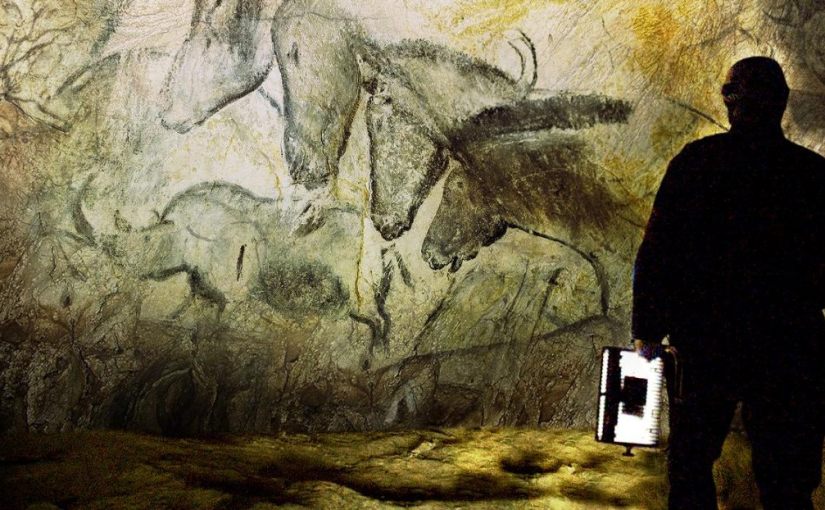
CAVE OF FORGOTTEN DREAMS (2010)

by Miguel E. Rodriguez

Director: Werner Herzog
My Rating: 9/10
Rotten Tomatometer: 96% Certified Fresh

PLOT: Filmmaker Werner Herzog is granted a rare opportunity to film a documentary inside France’s Chauvet Cave, where the walls are covered with the world’s oldest surviving paintings, dating back some 30,000 years.


Over the last several years, I’ve had the opportunity to travel to some amazing places, including London, England, where we toured the famous Tower of London.  When I lived in Virginia, we used to visit colonial Williamsburg, where some structures and artifacts exist from the 1600s.  But at the Tower of London, we saw walls and structures that have existed since the 1400s.  Six-hundred-plus years old, man!  Wild!  We saw Anne Boleyn’s final resting place.  THE Anne Boleyn!  Was buried right there.  Freaky.

Then we traveled to Greece, and that really put the zap on me.  We walk to the Acropolis and a tour guide tells us, “And that rock over there is Mars Hill, where the apostle Paul preached to the Greeks over two thousand years ago.”  TWO THOUSAND YEARS.  And in a museum, we saw artifacts dating back to 5,000 BCE, objects that were so old the archaeologists weren’t even sure what they were for.  Religious totems?  Toys for children?  Purely decorative?  Who knows?  I love this kind of thing!  Looking at things that have survived for millennia, created by people who were probably just satisfying a hobby, for all we know.

Now comes Werner Herzog’s documentary Cave of Forgotten Dreams, in which he was allowed to film inside the famous Chauvet Cave in France.  Inside are the oldest known artistic renderings of any kind on the planet.  How old?  Approximately thirty thousand years old.  To put that number in perspective, when Paleolithic humans made these paintings, the surrounding area was covered with a glacier that was so huge, when it finally melted, the ocean levels rose three hundred feet.  A hunter could have crossed what is now the English Channel by walking on dry land from coast to coast.  It’s an abyss of time that is utterly incomprehensible to me.

These paintings are indescribably cool to observe.  I’d seen photos before, but to see them on film is an indescribably stirring experience.  There are drawings of horses and wild rhinoceros that look as if they were drawn yesterday.  One animal was drawn with a total of eight legs.  A mistake?  No.  It was an attempt by the artist to convey movement or motion.  PROTO CINEMA.  Mind.  Blown.

There are handprints by some of these drawings.  Were they intended as a signature by the artist?  Perhaps so, because further into the cave are more handprints by other drawings, and we can tell they’re handprints from the same person because of a crooked pinky finger.  A maker’s mark from three hundred centuries ago.

I can’t stop.  On the floor of the cave, nearly obscured by eons of calcification and crystals, are visible footprints of a wolf and a 7-year-old child.  Was the wolf stalking the child as prey?  Were they maybe companions?  Or are the footprints separated by years, or decades, or centuries?  Near what used to be the entrance to the cave – the actual entrance was blocked by a rockslide an unknown number of years ago – is a rock with a flat top like a table, and on the table, facing the entrance, is the skull of a cave bear.  Traces of charcoal at the base hint that incense may have been burned there.  Was this a temple?  A holy place?  Or did they just think it looked badass to have a skull on a table?

This stuff fascinated me.  I found myself thinking about, of all things, a scene from Star Trek: First Contact, when Picard, having traveled back in time, is able to reach out and touch the very first vehicle to achieve warp speed.  He explains to a confused Data that touching something old is a way of somehow reaching back across the centuries and identifying yourself with the people who created it.

That’s what these cave paintings are like.  They’re a conduit back through time.  Along with the paintings, archeologists also discovered remnants of what look like flutes.  One enterprising guy recreates one of these instruments and plays it for the camera.  Using a 30,000-year-old design, this guy knocks out the first stanza of The Star-Spangled Banner.  On a flute made from BONE.

Why did Herzog even want to make this movie?  To be a social activist?  The cave is in no environmental or man-made danger.  There are only two weeks out of every year when anyone is even allowed inside the place.  He filmed it in 3-D.  Was he looking for a fast buck by capitalizing on the 3-D craze around that part of the decade?  It only grossed $5.2 million, a pittance, even by documentary standards.  (Although that was the highest box-office return of any independently released documentary of 2011…so there’s that, I guess.)

So why do this?  Because I believe Werner Herzog is one of the last remaining filmmakers who will make a film simply because he feels he must do so.  He latches onto an idea, and it will not release him until he commits it to film.  He doesn’t particularly care if it’s commercially viable or mainstream or anything.  If he gets an idea (and the funding), he finds a way to get it filmed.  It may not reach everyone, but you know what they say: “If you only reach one person, you succeeded.”

Man, did this reach me.  I was fascinated from beginning to end.  There’s one sequence that is nothing but, I think, 5 or 10 minutes of the camera simply regarding the paintings, slowly panning and tilting, just looking at them, while strange, but appropriate, music plays in the background.  Under any other circumstances, this would be boring.  Here, it was almost holy.

NOSTALGIA FOR THE LIGHT (2010, Chile)

by Miguel E. Rodriguez

Director: Patricio Guzmán
My Rating: 10/10
Rotten Tomatometer: 100% Certified Fresh

PLOT: This award-winning documentary juxtaposes the search for answers about the history of the cosmos with Chilean women searching the Atacama Desert for the remains of loved ones killed by a despotic regime decades earlier.


I am going to look at the stars.  They are so far away, and their light takes so long to reach us…all we ever see of stars are their old photographs. – Dr. Manhattan, Watchmen


If Nostalgia for the Light has one flaw, I might point to its rather abrupt ending.  It comes so quickly it almost cuts off the sentence being spoken by the film’s narrator.  Perhaps it’s metaphorical.  The film is over, but there is no resolution.  The riddles of the cosmos remain unanswered, and the bodies of cherished loved ones remain undiscovered.  If they don’t get a resolution, why should we?

The Atacama Desert in Chile is one of the driest places on earth, with an average annual rainfall of 0.5 inches.  With its virtually zero percent humidity, the skies remain remarkably clear at night, making it one of the prime spots on the planet for astronomical observatories.  From these perches, astronomers use massive visible light and radio telescopes to probe the outer reaches of the cosmos, searching for clues to the origins of life, the universe, and everything.  (Sorry, couldn’t resist.)

One astronomer points out that many times, when science finally answers a question, two more pop up to replace it.  He says some people even consider it an exercise in futility.  If every answer only reveals more questions, why bother?  You might as well ask NASA why we sent men to the moon.  Because it’s in man’s nature to know, to try to find out what’s over the next hill or what is beyond the farthest galaxy.

Another scientist explains that the calcium in our very bones literally comes from the stars.  Everything on earth today is descended in one form or another from the Big Bang.  Radio telescopes can measure the calcium levels in distant stars.  (Calcium in stars?  You learn something new every day.)  That calcium came from the Big Bang, and so did Earth’s.  As Carl Sagan said, “We are star stuff.”  We may die, and we will.  The stuff in our bodies remains, and will eventually help a tree to grow, or a vegetable, and so on and so on.  The circle of life, as it were.

All this information in the film is presented in a very straightforward without flash or fanfare, at least in terms of the narration.  Visually, the filmmakers use great editing with the interiors of huge observatory domes and the immense telescopes within, cut together with stunning vistas of starfields, including shots of our own Milky Way.  Indeed, the film’s narration informs us that, night after night, “slowly, impassively, the center of the galaxy passes over Santiago.”

But this is not simply an overblown episode of “Nova.”  Nostalgia for the Light is divided almost schizophrenically into two parts bumping into each other for the duration of the film.  It’s this second part that gives Nostalgia its heart and soul.  I’ve been thinking about it ever since I finished watching it this afternoon.

In 1974, Augusto Pinochet rose to power in Chile.  His dictatorship lasted for 17 years.  During that time, he imprisoned as many as 80,000 people in concentration camps in the Atacama Desert, killing anywhere from 3,000 to 4,000 dissidents.  To cover his tracks, he ordered his military to truck the bodies into the desert and dump them in unmarked mass graves.  It was rumored that he also had many of them thrown into the ocean.  Families were torn apart.  One young woman in the film tells how, when she was 12 months old, her grandparents were forced to reveal the whereabouts of her mother and father, using her as leverage.

For decades since then, women have come to the desert with spades and pickaxes, searching the dry ground for clues to the whereabouts of their loved ones.  The desert is enormous, and there are very few of these women.  In the film, they talk about the people who try to convince them of the futility of their actions.  Not just their friends or family, but public figures, politicians.  They are embarrassing.  They are dredging up a painful past others would prefer to forget.

One of these women wishes the giant telescopes on the distant hilltops could be designed to see through the ground instead of into space, so they wouldn’t have to dig.  They could find the secrets of their past much more quickly.  But of course, that’s exactly what the telescopes are designed to do.  They’re just pointing in a different direction, reaching to a far more distant past.

When I was younger, I was of the belief that a good documentary had to be completely impartial.  It simply documented what was happening without commentary from the filmmakers.  You could use editing to make a point, but it was against the “rules” to editorialize your subject.  And never use a narrator.  Let the audience make up its own mind, right?  The fancy word for this kind of strictly observational filmmaking is “cinéma verité.”

Nowadays, with most modern documentaries I’ve seen, the strictures of “cinéma verité” have gone by the wayside.  Instead of being a passive observer, the director is free to edit together disparate footage and interviews to make their point of view heard loud and clear.  This director, Patricio Guzmán, is using this documentary as a tool for social activism, or at least awareness.  I wouldn’t normally care for this kind of in-your-face, this-is-my-point documentaries.  I have never been a fan of Michael Moore’s films (at least not anything after Roger and Me), and I think Morgan Spurlock’s films are nothing but glorified Jackass stunts.

But Nostalgia for the Light affected me in a way I did not expect.  There is a sequence where an astronomer explains how “the present” isn’t technically real.  Light from the sun takes eight minutes to reach earth.  The light we see from the distant stars are years, decades, centuries old.  What we see in the sky is not the stars’ true position.  It’s where they were years and years ago.  It’s almost as if we’re looking at the memory of light.  This concept, which I’ve heard before, simply boggled my mind this time around.  I don’t know how to explain it.  And then when the film draws parallels between the astronomers searching for answers in the cosmos to the sad, determined women searching for closure in the desert, and the perceived futility of both ventures in the minds of so many…it’s very difficulty to put into words.  I felt that I was watching, or perceiving, something that transcended my poor abilities to describe it.

The astronomers search for answers to better our world and themselves.  The women in the desert search to bring closure to their lives and to the lives of the ones they lost.  They cannot forget, as so many in their country have willingly forgotten.

Director Guzmán also narrates the film, and I believe the crux of the entire film can be explained in one of his lines: “…those who have a memory are able to live in the fragile present moments.  Those who have none don’t live anywhere.”

THE KILLERS (1964)

by Miguel E. Rodriguez

Director: Don Siegel
Cast: Lee Marvin, Angie Dickinson, John Cassavetes, Clu Gulager, and in his final acting role, Ronald Reagan
My Rating: 5/10
Rotten Tomatometer: 80%

PLOT: A hit man and his sadistic partner try to find out why their latest victim, a former race-car driver, did not try to escape.


…well, THAT was disappointing.

Fresh off watching the original The Killers from 1946, I dove into the 1964 remake.  Originally intended for television – indeed, this was supposed to have been the very first made-for-TV movie – it contained so much casual violence and sexual content that no network would touch it, not even the network that commissioned it, NBC.  It was imported to movie screens, pillarbox framing and all, where it cemented Lee Marvin’s status as one of the all-time great Hollywood tough guys.  (How tough?  He reportedly shot a scene while he was literally falling-down drunk.  That’s the take that’s in the film; you’ll know which scene it is when you see it.)

But while Lee Marvin is indeed tough, and even though his partner (Clu Gulager) plays a sociopathic killer who brings tension to every scene he’s in, I couldn’t get as worked up over this remake as I did over the original version.  Those two performances aside, this movie felt cliched and a little boring to me.

The story is the same as the original, with a couple of minor changes.  Two hitmen stroll into a school for the blind (!) and gun down Johnny North (John Cassavetes) in broad daylight.  Afterwards, Charlie, the veteran hitman (Lee Marvin) latches on to something he can’t figure out: why didn’t the target try to escape?  He does his own digging which leads him to a motley assortment of thugs and one duplicitous dame, Sheila (Angie Dickinson), who isn’t just a gold-digger, she’s a gold-strip-miner.  Turns out North was part of a million-dollar heist along with Sheila and some other thugs, including Jack Browning (Ronald Reagan).  The heist was successful, but after a series of double-crosses, no one seems to know where the money is.  With his seriously psycho partner, Lee (Gulager), Charlie tracks down the witnesses, and we get the same flashback structure as the original.  And the more he digs, the less he likes what he finds…

One major factor that didn’t score many points with me was the production’s obvious roots in television.  As you can well imagine, lighting on a movie set is very different from lighting for television.  And this movie looks like a TV movie through and through.  At the time, because of the relatively smaller screens of most televisions, it was believed that a movie shot FOR television needed bright lights and especially colors, so the pictures would be clearly visible on the tiny screens.  Well, in this remake, everything is so brightly lit and colorful it looks an episode of Star Trek or any other TV series of that era.  The very brightness of the surroundings drains a lot of the tension out of scenes that are meant to be disturbing or violent.  Blood doesn’t look like blood; it looks like Sherwin Williams.  I’m aware of the technical limitations of the time, but the shortcomings are just so obvious that it left me cold.

(By comparison, the original 1946 version is steeped in darkness and shadows and pools of light; it’s not only more beautiful, but it also just works better for the story.)

I also had problems with the casting of some of the big character roles, but my momma always said, if you can’t say nothin’ nice, don’t say nothin’ at all.  So that’s all I’ll say about that.

The editing was also a little distracting.  Again, this might be a factor of the period when it was made, as well as the fact that it was intended for TV, not the movies.  But one scene annoyed the heck out of me.  I don’t normally nit-pick bad editing, but here goes.

There’s a scene where someone has to drive a car down the length of a winding dirt road within two minutes, if not faster.  Zoom, off he goes.  And as we cut back and forth to various shots showing the car’s progress, instead of cutting directly to a different vantage point or camera angle, it’s cut with fades, which are normally used to indicate a passage of time.  But when the fades are used in what is basically a race against time, it has the effect of making the scene feel longer than two minutes, even though only 30-40 seconds of real time have elapsed.  It made the whole scene feel “off”, even amateurish.  Director Siegel had already directed 15 or 16 films by this time.  I think he should have known better.  Or his editor should have.

By the time we get to the end of the film, we’ve seen someone get dangled out of a hotel window from seven stories up, six or seven people get shot dead (one by a sniper rifle), more double-crosses than a Luftwaffe squadron, and a future hardline conservative President of the United States play…a villain.  But it all felt like an exercise in futility.  Sure, you get Lee Marvin playing a tough guy, but in three short years he’d get to play a really tough guy in Point Blank.  THAT’S the movie you wanna see. Or go find Dirty Harry, or even Escape from Alcatraz, both directed by Don Siegel, both superior films.

This one?  This one I only got because it came packaged with the 1946 version on the Criterion Blu-ray.  Do with that information what you will.

THE KILLERS (1946)

by Miguel E. Rodriguez

Director: Robert Siodmak
Cast: Burt Lancaster, Ava Gardner, Edmond O’Brien (and William Conrad in a small role…and yes, he was a big fella even then)
My Rating: 8/10
Rotten Tomatometer: 100%

PLOT: An insurance investigator tries to get to the bottom of a strange case involving a man who waited calmly for two men to find him and kill him.


Over the last several months, I’ve been digging a little more into the film noir genre, specifically going back to the ‘40s and ‘50s, and I’ve discovered some gems.  Pickup on South Street (1953), for example, featuring one of the most violent fight scenes to be found outside of a Tarantino film.  Or The Killing (1956), an early Stanley Kubrick film depicting the kind of ruthless behavior that I didn’t think was permitted at the time.  I’m discovering that, for the adventurous moviegoers back then, there were films available to see that might have made their parents or grandparents gasp in horror.

Take the movie I watched today, The Killers (1946), the film noir that introduced Burt Lancaster to the world.  It’s based on a short story by Ernest Hemingway that was also adapted into a film in 1964, starring Lee Marvin, Angie Dickinson, and, in his last film role, Ronald Reagan.  [Watch this space for a review of that film, coming soon.]  At the beginning of this movie, we’re introduced to two thugs who walk into a small town, cloaked in the kinds of shadows and light that only film noir can get away with.  After terrorizing the patrons of a small diner, they walk to a nearby boarding house and up the stairs to a room occupied by Ole Anderson, aka “The Swede” (Lancaster), who has been alerted to their arrival but makes no effort to escape or call the cops.  He simply awaits his fate.

And what a fate.  The two thugs burst into the room and obliterate the Swede in a hail of gunfire that goes on for quite a long time, even by today’s standards.  (Later, the coroner describes the Swede’s body as being nearly “cut in half” by the barrage…yikes.)  This being 1946, we don’t see any of the actual carnage, but the implication is there.

The movie proceeds in a series of flashbacks.  An insurance investigator named Jim (Edmond O’Brien) tries to find out two things: why the Swede named a kindly hotel maid as beneficiary of his life insurance policy, and what happened to the $250,000 payroll that the Swede helped steal from a hat factory.  Now that I think about it, The Killers is almost like a thick-necked, brass-knuckles, gun-toting variation on Citizen Kane.  We never see anything about the Swede that wasn’t directly observed by someone Jim tracks down, and as Jim continues to dig, things just get mysteriouser and mysteriouser.

Figuring prominently in the Swede’s backstory is Kitty Collins, played by the ravishing Ava Gardner.  This was not her first film, but The Killers is the movie that put her on the map for good.  We first see Kitty when the Swede goes to a fancy party with his girlfriend, Lilly.  Alas, Lilly is no match for the sultry Kitty, who is wearing the kind of stunning black gown that inspires poetry when it isn’t simply driving men crazy.  How crazy?  At one point, when Kitty is caught by a cop wearing shoplifted jewelry, the Swede claims responsibility, slugs the cop, and winds up doing three years in jail for her.  Talk about being Kitty-whipped.

Naturally, as Jim, the insurance guy, meets more people, the Swede’s story comes more sharply into focus, but there’s still the mystery of what happened to all that money.  The robbery was indeed pulled off by the Swede with three other guys, but none of them have the money, and the Swede doesn’t have the money, so where is it?  As it turns out, the hat factory they stole from is insured by the same company that provided the Swede’s life insurance policy, so it’s in Jim’s best interest to get to the bottom of everything and recover the money, even if it means getting involved with the same kinds of thugs who killed the Swede in the first place.  That’s okay, though.  Jim is prepared.  He carries his own piece, and he comes up with a cool plan to get the guilty parties to confess as much as possible before they wind up dead…or he does.

The Killers is an example of a film that helped define, or at least refine, the relatively new film noir genre.  Similar films centering on crime, criminals, and punishment had been around since the ‘30s, but the real granddaddy of them all, The Maltese Falcon, had only been released five years earlier in 1941.  Since then, World War II came and went, and as dark as noir had been, it got even darker and more violent than Bogey was when he slapped Peter Lorre around.  With this film, director Robert Siodmak turned everything up to eleven.  The shadows aren’t just dark, they’re black, which of course makes the periodic pools of light that much more striking.

And the characters mean business, too.  Among the bad guys, there’s one named Colfax who doesn’t look like much – sort of like a moderately well-built school principal.  But when a genuine thug threatens to fight him, he doesn’t posture like a bully.  He just sits back in his chair and calmly tells the thug: “You’ve got quite a reputation yourself.  You’re supposed to be a troublemaker.  Okay.  Make some.”  And you just know that if the thug so much as lifts a finger, he’ll get it broken for his trouble.  It’s an interesting scene that reminded me of Goodfellas: “Paulie may have moved slow, but it was only because Paulie didn’t have to move for anybody.”

(I should also mention the flashback involving the payroll robbery.  In today’s films, when we marvel at long takes involving complicated camera moves, it’s good to be reminded that, three-quarters of a century ago, The Killers gave us a heist sequence that starts at ground level, follows the robbers up a staircase, shows the actual robbery, follows them back down into their getaway cars, and even provides a small-scale shootout as they drive away – all in one uncut take, using a camera about the size and weight of a SmartCar.)

While I thoroughly enjoyed The Killers, I wouldn’t quite put it in the same weight class as, say, Out of the Past or The Big Sleep, but it’s got all the right ingredients, it tells a good story well, it gives us Ava Gardner in that gown, and it provided a great springboard for the films that came after.  Good film noir is fine; GREAT film noir is better.  This is one of the great ones.

[P.S.  The scene near the beginning of the film where the two thugs terrorize the people at the diner reminded me strongly of the scene in No Country for Old Men when Anton Chigurh quietly tells the store clerk to “call it.”  They were just as calm and serene and tightly coiled as Chigurh.  Pretty creepy.]

AN EDUCATION (2009, Great Britain)

by Miguel E. Rodriguez

Director: Lone Scherfig
Cast: Peter Sarsgaard, Alfred Molina, Rosamund Pike, Dominic Cooper, Olivia Williams, Emma Thompson, Carey Mulligan
My Rating: 9/10
Rotten Tomatometer: 93% Certified Fresh

PLOT: A coming-of-age story about a teenage girl in 1960s suburban London, and how her life changes with the arrival of a playboy nearly twice her age.


Lone Scherfig’s An Education, written by famed British author/screenwriter Nick Hornby, is yet another example of how my preconceived notions of a film are often very wrong.  Based on the plot description above, I assumed I was in for what I call a “spinach movie”: something that’s good for you, but not a lot of fun to eat.  I thought the film would be dark and deep, delving into unsavory territory involving a predatory older man putting the make on an underage girl.  Lessons would be learned, but it would be an uncomfortable watch.

For about the first half of the film, I felt I was mostly right.  It’s 1962 in England, and Jenny (Carey Mulligan in her first major role) is a sixteen-year-old student who is studying hard to pass her A-levels – I think I got that right – with flying colors, which she hopes will give a favorable impression to the admissions board at Oxford.  Her father (Alfred Molina) supports her plans…or rather, he supports HIS plans for her.  He gives several impassioned speeches about the importance of getting a higher education, making sacrifices, dropping her cello hobby, etcetera, all in the service of getting those Oxford-level grades.

One day, Jenny gets caught in the rain and is rescued by David (Peter Sarsgaard), a charming older man driving an irresistible maroon sportscar.  He isn’t just charming, he’s effortlessly charming, turning the exact right phrases to put Jenny at ease.  The morning after he drives her home, he leaves a bouquet of flowers at her doorstep.  He bumps into her again quite by accident, or “accident”, and asks her on a date for dinner and a concert.  For this, he must convince Jenny’s very suspicious father…which he does with silver-tongued ease.

Jenny is caught up in this whirlwind of attention from a much older man who is clearly well off with sophisticated friends, Danny and Helen (Dominic Cooper and Rosamund Pike).  Jenny’s father, Jack (Alfred Molina), is torn between his protective instincts and the idea that Jenny might have met a man who could make her dreams of Oxford…moot.  Why worry about the expense of university when a rich husband can keep his daughter well cared for?

Despite the father’s (and my own) forebodings, Jenny is genuinely enjoying herself.  She loves music, so David takes her to a concert.  She loves art, so David takes her to an art auction.  She loves learning and speaking French, so David takes her to Paris.  His method of getting Jenny’s father to agree to this overnight trip is simultaneously simple and diabolical.  Jenny is having fun for what seems to be the first time in her life.

She’s having so much fun that, for a while, I wasn’t quite sure what the movie was advocating.  Is it supporting this relationship?  She has a very frank conversation with David regarding her wish to remain a virgin until her seventeenth birthday.  David agrees…then, in one of the ballsiest (and creepiest) moves I’ve ever seen from a guy in a movie, he asks her to give him a “peek.”  What is going on?!?  This guy is clearly a cad.  But he’s so nice to her…and she’s having fun…!

Put it this way: I was prepared to throw something at the television by this point.

Around the midway point, though, the movie finally makes its true purpose known.  It’s not about judging Jenny, which is too easy to do, or even judging David, which is ridiculously easy to do.  The film is based on a memoir by a British journalist named Lynn Barber, which made some of the revelations about David’s past and how he makes a living easier to swallow, knowing that it’s based at least partially on fact.  It also made all the “icky” parts in the first half of the film a little more palatable.  When you realize that someone really went through this, it puts everything in a different light.  I had the same epiphany during Schindler’s List; the concept that this all actually happened brought a deeper level to the viewing experience that I hadn’t expected.  (It’s also what made Fargo so much more entertaining than your average crime film, but that’s another story…)

Anyway, this happens and that happens, and before you know it, Jenny has made the kinds of decisions that would make grown men and women tremble with anxiety. The movie’s title takes on a whole new meaning.  It’s not just about Oxford anymore.  It’s about studying at the University of Life, where the only way to know if you passed your test is if you’re still willing to take the next one, and the next, and the next.  Even David learns a thing or two.  Maybe.  It’s a little inconclusive when it comes to that guy.  What a jackass.

So…is it any good?  Yes, it is.  It’s got brilliant performances working from a Nick Hornby script that switches easily among pathos and embarrassment humor (witness the predicament of Jenny’s other suitor at her 17th birthday party) and even a little suspense.  I tend to think of Hornby as Britain’s answer to Cameron Crowe.  Hornby’s books and screenplays walk that same tightrope time after time (About a Boy, High Fidelity, the original Fever Pitch – soccer, not baseball), just like Crowe’s best work (Jerry Maguire, Say Anything, Almost Famous, which I don’t particularly love, but I do acknowledge its craftsmanship).  By the time I got to the end of An Education, the double- or triple-meaning of the title is fully realized.  Everyone has learned something.  Not all of it has been good.  It doesn’t all tickle.  But, except possibly for David, everyone has taken what they’ve learned, good or bad, and put it to good use.  That’s a satisfying ending.

[Side note: after this movie was over, I found myself thinking of Licorice Pizza and its plot regarding an underage boy and an adult woman. I can imagine my friend and partner-in-crime reading my favorable review above and asking me, “If you like this movie, how can you not like Licorice Pizza?” (He really loved Licorice Pizza.) The difference is that, by the time An Education is over, the characters have EVOLVED. Discuss.]

BEN-HUR (1959)

by Miguel E. Rodriguez

Director: William Wyler
Cast: Charlton Heston, Jack Hawkins, Haya Harareet, Stephen Boyd, Hugh Griffith
My Rating: 9/10
Rotten Tomatometer: 86% Certified Fresh

PLOT: After a Jewish prince is betrayed and sent into slavery by a Roman friend in 1st-century Jerusalem, he regains his freedom and returns for revenge.


For my money, 1959’s record-setting production of Ben-Hur would be a better pick for an annual Easter flick over C.B. de Mille’s overblown The Ten Commandments.  Certainly, Commandments shows the actual story of Passover and might lay claim to more special effects sequences, but Ben-Hur feels grander AND more intimate at the same time.  Plus it actually shows Christ and the crucifixion at the end, and what better symbols could you ask for in an Easter film?

Then, of course, there’s that chariot race.  Game, set, and match.

Ben-Hur was created in an era when Hollywood was watching its profits dwindle because of the advent of television, which was keeping more and more people glued to their sets at home instead of paying for a ticket at the box office.  One way to get people back into theaters was to take the “bigger-is-better” approach: do things that were impossible on a TV budget.

Consider these statistics: Three hundred separate sets were built for Ben-Hur.  The chariot race alone required 15,000 extras on 18 acres of backlot at Cinecitta Studios in Rome and took 10 weeks to shoot.  Over a million props were needed, and it took two years to amass them all before shooting.  Approximately 1.25 million feet of expensive 65mm film was exposed and developed at a cost of roughly a dollar per foot.  The budget for the film ballooned to nearly $15 million, equivalent to over $146 million in today’s dollars, an unthinkable amount in the late 1950s.

But when it was released, Ben-Hur made history by being the first film to win eleven Academy Awards, including Best Picture, Best Director, Best Actor, and Best Supporting Actor.  It remains the only film to date to win Best Picture and Best Visual Effects.  At the box office, it raked in $75 million ($731 million when adjusted for inflation), making it one of the most profitable films in Hollywood history at the time.  It remains popular today, ranked in the IMDb’s top 250 most popular movies and listed as the #2 epic film of all time by the American Film Institute.  (#1 is Lawrence of Arabia, naturally.)

How does a 63-year-old film, with a running time of 3 hours and 42 minutes, with a blatantly religious plotline culminating in the crucifixion of Christ and a shamelessly manipulative miracle, and featuring some of the hammiest acting this side of Bollywood, remain as popular as it is?  Because despite its shortcomings, it does what every film should do, long or short, sacred or secular: it tells a rollicking good story, and it does it extremely well.

After a solemn prologue depicting the first Nativity, we jump forward 26 years and meet Judah Ben-Hur (Charlton Heston), a wealthy Judean prince who enjoys a reunion with his old friend, Messala (Stephen Boyd).  They grew up together but went their separate ways, and now Messala is a Roman tribune assigned to keep the peace in Judea.  Poor Judah realizes just how far they’ve grown apart when an accident leads Messala to arrest Judah and his mother and sister, to demonstrate his power and loyalty to Rome.  Judah vows vengeance and is sentenced to die as a galley slave.  But fate intervenes in the form of Quintus Arrius (Jack Hawkins), a Roman general whose life Judah saves in battle.  Arrius befriends Judah and officially adopts him as his own son, giving Judah the means to return to his homeland, wreak his vengeance upon Messala, and rescue his mother and sister from prison.

…and that’s just Act One.  Act Two focuses heavily on Judah’s revenge in the form of one of the greatest set pieces in Hollywood history: the chariot race.  Or, more properly, The Chariot Race.  If you’ve never seen it, Google/YouTube it.  Even viewed as a stand-alone scene, it is as breathtaking and thrilling as any car chase ever filmed.  It’s so good that George Lucas cribbed many of its beats for the pod-race sequence in Star Wars: Episode I – The Phantom Menace.  The crashes you see during the race were planned, but they were performed with real stuntmen in real danger.  Note especially one sensational stunt where a 2-wheeled chariot drawn by four horses, at full gallop, approach a crashed chariot in their path.  The horses leap the chariot, then the chariot dangerously rolls over the crash itself, hurling the stuntman so high into the air he nearly topples head over heels over the front of his own chariot.  I am at a loss to imagine how they could possibly accomplish this same scene today without the use of visual effects.

Peppered throughout the story are brief scenes featuring Jesus of Nazareth, although we never hear Him speak, and we never see His face.  In Act One, He offers water to Judah as he is being marched to the galleys, a compassionate act that will resonate through the years.  Later He is glimpsed from a distance delivering the Sermon on the Mount.  And later still, we see His trial, His journey to Golgotha, and His crucifixion.  Everyone involved in those scenes show the appropriate and expected levels of awe and sadness, while the score plays a mournful dirge.  It’s a little ham-handed by today’s standards, especially when compared to modern films like The Passion of the Christ, but it is still effective.

The movie’s highest level of filmmaking, apart from The Chariot Race, is on its best display in the first half of the movie.  Nearly two-and-a-half hours fly by, thanks to superb editing.  It’s never boring or soapy.  (Well…ALMOST never soapy.  The requisite love scenes between Judah and the slave girl Esther, played by the lovely Haya Harareet, are not as easy to watch as the rest of the film, but thankfully there aren’t that many of them.)  Every event and every scene feels crucial to the story.  There’s never a moment that drags.  Like the best epic films, watching Ben-Hur makes me feel like I’m reading a richly detailed novel.

If the film has a major downfall, it’s the story that follows The Chariot Race.  The movie doesn’t exactly grind to a halt, but it doesn’t offer the viewer any kind of climactic punches that can match the visceral effect of Judah’s capture, escape, and victory in the race.  (Sorry if I spoiled that for you, but if you seriously thought he lost that race, seek help.)  Sure, there’s the capture and crucifixion of Jesus and the miraculous aftermath, but while that satisfies the true arc of the story, I still, to this day, feel like the film deflates a little at the end.  There’s simply nothing it can offer that could possibly follow up that damn Chariot Race.  The race is the payoff.  Everything that follows feels anti-climactic.

That quibble aside, Ben-Hur is still as captivating as it ever was, with “old” Hollywood’s full power brought to bear to bring audiences a cinematic experience unlike any other at that time.  No matter where you might stand when it comes to its religious overtones, you can’t deny that the movie is exactly as respectful as it needs to be for this story.  And ultimately, the message of the film isn’t “An eye for an eye.”  It’s “Love thy enemy as thyself.”  It takes Judah Ben-Hur a little while to get there.  But he gets there.

THE DARJEELING LIMITED (2007)

by Miguel E. Rodriguez

Director: Wes Anderson
Cast: Owen Wilson, Adrien Brody, Jason Schwartzman, Amara Karan
My Rating: 8/10
Rotten Tomatometer: 69%

PLOT: A year after their father’s funeral, three brothers travel across India by train in an attempt to bond with each other.


In one of the bonus features on the Criterion Blu-ray for Wes Anderson’s charming The Darjeeling Limited, film critic Matt Zoller Seitz compares it to Stanley Kubrick’s 2001: A Space Odyssey because (I’m paraphrasing here) it is the perfect distillation of the director’s method, mood, and style.  I would reserve that distinction for either The Royal Tenenbaums or The Grand Budapest Hotel, myself, but The Darjeeling Limited certainly does capture everything that is typical of a Wes Anderson film: charm, whimsy, troubled souls, a quest of some kind, attention-grabbing camera moves, frequent slo-mo (but not too much), cameos, light and dark material jockeying for position, and a denouement that may signal the end of the film but certainly not the final arc of the main characters.

Meet the Whitman brothers: Francis (Owen Wilson), Peter (Adrien Brody), and Jack (Jason Schwartzman).  A year ago, their father died, and for the first time since that day, they’re about to meet each other and speak to other on board The Darjeeling Limited, a train that will take them across India on a spiritual journey.  Francis, the eldest, is the eager organizer of this little pilgrimage, providing everyone with laminated daily itineraries that are produced by Brendan, his personal assistant who is also travelling in a separate train car.  Francis will spend much of the film wearing bandages on his head and face that make him look as if he lost a fight with a honey badger.  What caused these injuries is not for me to say.

The ostensible reason for this journey is spiritual awakening and reconnecting with each other.  “I want us to become brothers again like we used to be and for us to find ourselves and bond with each other,” says Francis.  Peter and Jack are skeptical and not exactly psyched for this little trip, each for their own reasons.  Peter has a wife back home, 7-and-a-half months pregnant, who has no idea he’s in India.  Jack, a writer, has broken up with his girlfriend, but he obsessively checks her voicemails remotely because he still has the code to her answering machine.  (Hey, this was made in 2007 when you could still do that.)  He has his own return ticket in case he wants to leave the trip early.  Of course, he’ll find that difficult without his passport, which Francis has confiscated.  “For safety,” he argues.  Yeah, right.

There is an ulterior motive for the trip, having to do with who did and didn’t attend their father’s funeral, but ultimately the ins and outs of the characters, while engaging, kind of take a back seat to the trademark Wes Anderson visual style.  This is not a bad thing.  I am not a fan of Anderson’s first film, Bottle Rocket, because I felt it was all posturing with no meat to the story.  However, with each successive film of his, I become more and more endeared and captivated with his trademarks, especially when he uses it to tell stories that I would never have thought would “mesh” with his style.

For example, near the halfway point of the film, an extremely unexpected crisis occurs.  Because the movie has been happy and bouncy and witty up to now, it comes completely out of left field.  But remarkably, in the middle of this action, Anderson’s camera remains as “Anderson-esque” as ever, still performing quick pans and push-ins and keeping me involved in the story.  This crisis might have felt contrived in another film, a plot device to inject some needed drama into the story.  Not here.  Anderson’s storytelling methods made the event feel as random as anything life might throw at us on any given day: the death of a parent, the birth of a child, a snake getting loose in your train compartment, etcetera.

With one or two obvious exceptions (I think), the entire film was shot in India.  The trusty IMDb trivia page informs me the train scenes themselves were filmed inside a moving train travelling from Jodhpur to Jaisalmer.  The beautiful Indian locations are a major feature of the film.  They visit temples, marketplaces, a monastery, and hilltops overlooking vast Indian vistas.

And all the while, Francis, Jack, and Peter struggle to come to grips with their differences and their brotherhood.  “I wonder if the three of us would’ve been friends in real life,” Jack asks at one point.  Great question.  Given what we see in the film, it’s sometimes hard to believe they ever loved each other.  At one point, Francis and Peter get into a wrestling match and Jack has to step in: “I love you, but I’m gonna mace you in the face!”  That’s real love right there.  Right?  I guess…

I’ve heard that if you’re ever not sure what a book or a movie is about, just look at how a character has changed at the end of the story as opposed to what they were like at the beginning.  In The Darjeeling Limited, that’s not so easy to pin down.  I can see that Francis has grown a bit (he eventually relinquishes his brothers’ passports).  But when it comes to Jack and Peter…I’m not sure much has changed with them at all.  Does that make this Francis’s movie through and through?

I’m not sure it matters.  I mean, yes, the story is fun to watch, and I wanted to see where this journey would lead each one of the three brothers.  But for me, the element, or factor, or whatever, that makes The Darjeeling Limited so fun to watch is the directorial style of Wes Anderson.  In this film, as in so many of his films, it’s not about the destination.  It’s about the journey.

[Trivia note: the Criterion Blu-ray also contains a short film called Hotel Chevalier which is intended as a kind of prologue to The Darjeeling Limited.  Don’t make the mistake I did…if you get the Blu-ray, be sure to watch the movie with the prologue.  Don’t wait until after watching the main feature.]

[Super-nerdy trivia note: every musical cue in the film was cribbed from the early films of James Ivory and Satyajit Ray; Wes Anderson wanted to pay tribute to the filmmakers who influenced so much of his style.]

ELEVATOR TO THE GALLOWS (1958, France)

by Miguel E. Rodriguez

Director: Louis Malle
Cast: Jeanne Moreau, Maurice Ronet, Georges Poujouly
My Rating: 10/10
Rotten Tomatometer: 93% Certified Fresh

PLOT: A married woman and her lover hatch an apparently foolproof plan to kill her husband (his boss), but a split-second decision at a crucial moment sends everything into a tailspin.


We plan, God laughs. – old Yiddish proverb

Let me get this out of the way right at the top: Elevator to the Gallows is one of the best crime drama/thrillers I’ve ever seen.  It holds its own against anything by Hitchcock or Clouzot.  With admirable focus and restraint, first-time director Louis Malle (My Dinner with Andre, Vanya on 42nd Street) crafts a gripping illustration of how the best laid plans can fall apart because of one minor miscue.

The film cuts right to the chase at the opening scene, showing a phone conversation between Florence Carala (Jeanne Moreau) and her lover, Julien Tavernier.  They discuss their plans for Julien to kill her husband in his office on a Saturday evening, after which he’ll pick her up at a café where she’ll be waiting, and that will be that.  Everyone will assume her husband is in Geneva on business, and no one will discover the murder, which Julien will arrange to look like a suicide, until Monday morning, giving Florence and Julien plenty of time to make their escape.

(I liked how we never got any flashbacks of the relationship between Florence and Julien.  All we need to know is, they’re lovers, they’re desperate enough to commit murder, and that’s it.  Very concise.  I love it.)

Julien’s plan involves using a grappling hook to avoid using the office elevator to get to his boss’s office one floor above his.  He proceeds with the plan, nearly getting caught in the process, but he’s able to commit the crime and leave the building with several witnesses as an alibi, witnesses who will say they never saw him enter his boss’s office before he left.  So far so good.

Julien gets to the street, takes the top down from his convertible, takes one last look back at the building…and realizes he left a vital clue in full view of any pedestrian or street cop.  Leaving his car running, he decides to run back into the office building and retrieve the evidence before the night guard shuts off the power for the night.

Unnoticed by Julien, a florist and her bad-boy boyfriend have been having an argument at the shop next to his car.  The boyfriend sees this rich man leave his convertible on the street…with the engine running…

Thus begins a Hitchcockian odyssey that leaves Julien stranded in an elevator, his car and his identity stolen, and his mistress stranded on the streets wondering where the hell her lover is.  At one point, Florence sees Julien’s car drive by the café where she’s waiting…she can’t quite make out the driver, but who is that girl in the car with him?!  Has she been betrayed at the last minute?

The film follows the younger couple, Louis and Véronique, as they tool around in Julien’s car, eventually winding up at a roadside motel, and unwittingly making friends with two German tourists.  They even share drinks with the Germans and take some candid photos using a little spy camera in Julien’s raincoat.  (We learn that Julien was in the Foreign Legion and was well-trained as a soldier – maybe even in spycraft.)  I found myself wondering why we were wasting time with this larcenous couple…until they decide to check into the motel as Mr. and Mrs. Tavernier to cover their own tracks.

The screenplay ingeniously heaps one hasty decision on top of another so that, just when it seems Julien might be in the clear, something else happens that makes it seem impossible he won’t be discovered or at the very least blamed for something he didn’t do.  Meanwhile, Julien is desperately trying to escape the elevator, using a penknife as a screwdriver, getting excruciatingly close to tripping a vital switch that’s just out of his reach.  He eventually tries to get out using the old climbing-the-cable trick…which is of course exactly when a night watchman is making his rounds.

This story is so good, I can’t believe there hasn’t been an American remake.  And it’s not like there aren’t other great films out there that cut right to the chase and never look back for flashbacks or additional material.  I’m not sure what makes Elevator to the Gallows so good, to be honest.  Maybe I was rooting for Florence and Julien when they are clearly not the good guys.  Maybe it’s the economy of the storytelling, or the screw-turning twists that lead the police to believe Julien has committed more than one murder.  At one point, Louis and Véronique make a startling decision that had me yelling at the screen.

Words fail me on this one.  I can’t describe it any better than by saying this is one of the best films I’ve ever seen, certainly one of the best film-noirs I’ve ever seen, and a movie that I’ll bet Hitchcock watched while thinking to himself, “Damnation…I wish I’d thought of that.”

BRUTE FORCE (1947)

by Miguel E. Rodriguez

Director: Jules Dassin
Cast: Burt Lancaster, Hume Cronyn, Charles Bickford, Ann Blyth
My Rating: 9/10
Rotten Tomatometer: 94%

PLOT: A convicted felon tries to organize a prison break under the nose of a sadistic chief guard who is on the verge of becoming the new warden.


In Brute Force, released seventy-five years ago, we are witness to: a man getting crushed by a metal press, a suicide, a brutal interrogation with the help of a length of metal pipe, a prisoner machine-gunning dead cops out of sheer frustration (okay, you got me, that part is off camera), and the kind of nihilistic ending that you typically only see in old French films.  Wages of Fear, for example.  I mean, this movie is violent by TODAY’S standards, let alone just a couple of years after World War II ended.

Joe Collins (Burt Lancaster in only his second film) is just getting out of solitary confinement at Westgate Penitentiary when he sees one of his cellmates being driven out of prison…in a hearse.  This only solidifies his resolve to escape with the help of his remaining cellmates.  Meanwhile, we get glimpses of life elsewhere in the prison.  The current warden is a trembling coward who addresses the prisoners only through a P.A. system in his office.  The prison physician, Dr. Walters, sees injustice and top-down barbarism on a daily basis and has his own method of escape: whiskey.  Inmate informants and stool pigeons are dealt with promptly and carefully.

Looming above everyone, despite his relatively small stature, is Captain Munsey (Hume Cronyn).  He has the real power at Westgate.  He rarely raises his voice and even stops his lieutenant from beating a prisoner unnecessarily.  But he unflinchingly doles out punishments and even strong-arms other convicts into ratting out their buddies.  Of course, the stoolies are usually found out and wind up dead.  Shame about that.

The crux of the story is the escape plan, an ambitious endeavor involving capturing the yard tower which controls the gate and lowers the drawbridge – an actual drawbridge! – to the mainland.  Between making these plans and various other intrigues involving the warden and an imperious visiting government official, we are also treated to flashbacks showing how some of Joe’s cellmates wound up in prison to begin with.  Here the film gets a little overly melodramatic, a typical trait of many dramas of the ‘40s, but director Jules Dassin wisely doesn’t dwell on them for too long.  The scenes do just enough to create more audience empathy for these “bad men” without bathing in soap.

I put “bad men” in quotes because these guys are, in fact, criminals, but they’re also our protagonists.  When it comes to Joe himself, it seems clear by his demeanor and his flashback that he wasn’t just a criminal, he was a leader of criminals, head of his own little gang.  This is not a very nice man.  The only convict sharing a cell with Joe who might conceivably be considered a “good guy” is Tom, a man who embezzled money from the company he worked for to buy his frustrated wife a fur coat.  Everyone else looks capable of perpetrating real violence.

Why do we root for these men?  Partly because it’s in our nature to support anyone who is out to give authority figures the finger.  From Cool Hand Luke all the way to Hannibal Lecter and beyond, we are instinctively drawn to men and women who are bucking the system.  But it’s especially prominent in this movie where we see these men at the mercy of a broken system that eventually revokes all their privileges, even visiting hours, in the name of restoring discipline.  Armed guards watch the prisoners everywhere, even in the chapel.  There is no longer any attempt at actual rehabilitation.  In the prison’s auto garage, a prisoner is asked what he’s learned while working there.  His answer: “I’ve learned that, when I get out, I don’t wanna be a mechanic.”  He hasn’t learned anything.  He’s just learned that it’s better to not get caught.  For this we pay our taxes?

So, yes, there is a strong message in Brute Force.  It’s not especially subtle, especially during the liberal Dr. Walters’ various monologues about the corrupting nature of power and the futility of expecting lasting behavioral changes through punitive measures.

But what stood out to me was the unexpected level of violence in the story.  Sure, some of it is discreetly left off screen, but what is left to the imagination can be infinitely worse than what the screen shows us.  Case in point: Se7en, where we are always shown murder scenes, never the murders themselves.  Or the infamous ear scene in Reservoir Dogs, where we never actually see the deed being done, yet it’s remembered as one of the most violent scenes in film history.

In Brute Force, during an interrogation, we see Captain Munsey winding up to deliver several blows with a lead pipe to the head of a handcuffed prisoner.  We push past the prisoner, so we only see Munsey, and down comes the first blow.  We hear the impact, then cut to just outside Munsey’s office where other officers are killing time playing cards or writing reports.  And through the doorway we hear more impacts, one after the other after the other.  Some officers look uncomfortably toward the office but make no move to stop what’s happening in there.  One officer is so disturbed he throws down his cards and stalks away.  Right away, we’re thinking, jeez, if HE’S that upset, something terrible is going on in that office.

This is not the kind of “realness” I was expecting from a 1947 film.  And it doesn’t end there.  There are other little vignettes of violence during the climactic escape attempt that made me gasp, including a hand-to-hand fight where one guy appears to be getting hit in the head and neck with a belt of machine gun bullets…for real.  At least twice.  Looked convincing to me, anyway.

Jules Dassin (1911-2008) is known for directing some of the best loved film noirs of all time, including The Naked City [1948], Night and the City [1950], and Rififi [1955], which won him the Best Director award at Cannes that year.  His best films are steeped in atmosphere and a fatalistic sense of…well, fate, an idea that no matter how hard we kick and scream at the walls of our existence, any attempts to escape will be met with massive resistance and will most likely end in failure, or at best only a partial victory.  Not a particularly uplifting outlook, but who says all movies must have a happy ending?  Sometimes you get the bear, sometimes the bear gets you.  By the end of Brute Force, Dassin ingeniously combines those two outcomes.  Tricky.

TURNING RED (2022)

by Miguel E. Rodriguez

Director: Domee Shi
Cast: Rosalie Chiang, Sandra Oh, Wai Ching Ho, James Hong
My Rating: 10/10
Rotten Tomatometer: 95% Certified Fresh

PLOT: A 13-year-old girl named Meilin wakes up one morning with the rather inconvenient power to turn into a giant red panda whenever she gets too excited.


Disney/Pixar’s Turning Red is one of the best, funniest animated movies I’ve seen since Inside Out.  Or The Lego Movie.  Take your pick.

If you’ve seen the trailer, you know the plot.  A 13-year-old Chinese-Canadian girl named Meilin [may-LINN] discovers one day she has the (inconvenient) ability to turn into a giant red panda.

Details: Meilin’s relationship with her mom, Ming (Sandra Oh), is complicated enough without this new tangle.  Ming encourages Meilin to excel at everything and has enlisted her help with running and maintaining a small Chinese temple devoted to an ancient ancestor of theirs who supposedly channeled the power of the red panda to defend her children thousands of years ago.

When Meilin learns to control her newfound power to a certain degree, she decides to use it, not to fight crime, but to earn some money to buy a ticket to see this awesome boy band, called 4Town (even though they have five members), with her three besties.  Like, Oh.  Em.  GEE!

Complications ensue, Meilin tells a crucial, heartbreaking lie at one point, and previously unsuspected powers are unleashed.  That’s all you’re getting out of me, story-wise.

While the story was great, and worthy to stand with Pixar’s finest films, what made Turning Red stand out for me was the humor.  It is just plain laugh-out-loud funny.  I was laughing through almost the entire movie.

Through a completely believable misunderstanding, Meilin’s mom, Ming, thinks she knows what’s behind Meilin’s strange new behavior and asks her, ever so delicately, “Did the scarlet peony bloom?”  There’s a brilliant moment when Ming chases Meilin to school and, in front of an entire classroom, holds up an item she forgot to pack in her bag: a box of pads.  That’s right out of a John Hughes movie, man!  I laughed like a maniac.

Meilin’s three friends are a treat, especially the little spitfire named Abby, whose face seems to be permanently stretched into a fierce scowl.  There’s a moment when she catches one of those red playground balls with her teeth.  Maybe SHE’S the monster.

As with all the best Pixar films, though, the humor, as effective as it is, is just window-dressing for the real thrust of the story.  The exploration of the mother-daughter relationship hasn’t been done this well since Brave.  And I’ve gotta say, it was refreshing to see how real the character of Meilin was.  Because she’s rooted in the real world (of 2002 Toronto), her attitude felt more authentic somehow.  Sure, in Brave, Merida had the same rebelliousness and determination to forge her own path despite an imposing mother figure.  But with Turning Red, everything was more grounded.

There’s a moment when Meilin has turned into a panda and is running down a city street trying to hide.  She passes a convenience store where a cute guy works the counter.  She is desperate to get out of sight…but she stops just long enough to glance through the window at the cute guy, stomp her foot like Thumper, and yell, “Ah-OOO-gah, ah-OOO-gah!”  Another big laugh.  And I thought to myself, “See, that’s normally what you would see GUYS do in a movie.  Who makes a Disney film about a girl obsessed with boys?  What a treat!”  (I know, I know, the early Disney princesses weren’t exactly models of modern feminism, I’m talking about more recent films, stay with me here…)

Naturally, there’s a lot of symbolism with Meilin being thirteen, coming of age, and suddenly going through all sorts of changes.  What’s great about the storytelling is that the symbology is secondary, at least initially.  There’s the usual very well-executed denouement where all the emotional threads come together.  But before we get there, it’s just a story about a young girl with a weird problem.  And I have to say again, it is doggone FUNNY.

I took a glance at the “rotten” reviews at rottentomatoes.com, and I kept seeing one repeated phrase among several of them: the lead character was “irritating.”  I am at a loss to explain this point of view.  Meilin is a 13-year-old girl.  Of COURSE, she’s irritating.  AND obnoxious.  What were you expecting?  Meilin is endearing precisely because she’s portrayed as someone who isn’t perfect, even though she’s trying hard to be.  She lies to her parents.  When she has to think of something to calm herself down, she doesn’t think of her mom…she thinks of her best friends.  She feels bad about it, but what are you gonna do, she’s thirteen.

Further pontificating from me seems pointless.  Take it from a lifelong Pixar fan.  Turning Red is one of their finest moments.  It’ll make you laugh, and if you’re not careful it’ll make you cry.  It might make you remember what it was like to scream like crazy at a rock concert.  It’ll make you remember your first real best friends.  And it’ll make you wonder why more people don’t make movies like this.  Because they should.